Quick Points
-
• On February 6, 2023 a devastating earthquake struck our country, impacting the general population and university students.
-
• Midwives have important roles in meeting the care needs of women and children affected by the earthquake during pregnancy, birth, and postpartum.
-
• Therefore, it is important for students studying in midwifery departments at universities to prepare for natural disasters such as earthquakes and to cope with the physical-psychological problems caused by natural disasters in terms of both their own health and public health.
-
• Consequently, it is crucial to assess the post-earthquake trauma levels among midwifery students and address any potential issues that may arise. These individuals, as both survivors of the disaster and future health care providers, will play a vital role in maintaining health care services during earthquakes, participating in rescue operations when necessary, and promoting the psychological well-being of the affected society.
-
• Furthermore, conducting research on university students who have experienced trauma is significant in understanding the long-term effects of such traumatic events and developing appropriate psychological intervention programs within universities to address their consequences.
Natural disasters are a global concern affecting many people and are of international importance. Natural disasters represent a challenge that can affect both the physical and psychological health of individuals and communities and their ability to cope with activities of daily living, including displacement, death and injury, disruption of health systems, shortages of food, water, and energy resources, as well as threats to human health.Reference Trip, Tabakakis and Maskill1, Reference Khosravi, Xosravi and Ziapour2
One of the natural disasters is an earthquake. Considering that the Earth is composed of tectonic plates, there is a constant risk of earthquakes.Reference Trip, Tabakakis and Maskill1 The World Health Organization (WHO) reported that 1150 fatal earthquakes occurred in 75 countries worldwide in the last century.Reference Yoosefi Lebni, Khorami and Ebadi Fard Azar3 A major earthquake with a magnitude of 7.7 occurred in our country on February 6, 2023 at 04:17 AM local time. The earthquake affected a geographically wide area and was felt in 11 provinces. Apart from material losses, it is reported that over 50 000 people died, and over 100 000 people were injured.4
Traumatic events often seriously impact people’s physical and mental health.Reference Zhou, Liang and Tong5 Unlike ordinary negativity, traumatic events involve threats to the lives or integrity of individuals, violence, or risk of death. Natural and man-made disasters such as war, violence, terrorist attacks, floods, and earthquakes are among the important traumatic events. Earthquakes are one of the most studied natural disasters and traumatic events because they occur frequently, affect human life deeply, and cause significant psychological damage. Research on the psychological effects of earthquakes has concluded that survivors show varying levels of post-traumatic stress symptoms. If these symptoms are not treated appropriately in time, they can turn into depression and post-traumatic stress disorder (PTSD). PTSD is an important illness that is common after an earthquake, causes serious disability, and persists for a long time. Therefore, it is important to recognize early post-earthquake psychological stress and identify related factors to protect personal and public health.Reference Cansel and Ucuz6
One of the most affected groups in disasters is women and children. The reproductive health of women tends to be affected by disasters, and its neglect may lead to serious consequences. In addition, the lack of gynecology and obstetrics clinics in disasters and the lack of qualified personnel during birth can lead to acute and chronic problems regarding women’s health. Disaster preparedness is necessary for health service providers. Health professionals should be ready to meet the needs of women affected by a disaster. The WHO has recommended that in-service training courses or training packages are necessary to close gaps in the disaster management skills of midwives and nurses. Therefore, developing the professional skills and competencies needed by midwives and future midwifery students in crisis management and appropriate care in disasters is important.Reference Ie, Nasrabadi and Sohrabizadeh7
On February 6, 2023 a devastating earthquake struck our country, impacting the general population and university students. During this challenging period, midwives actively assisted the affected areas through social media platforms, while midwifery associations also highlighted the urgent demand for midwives in earthquake-affected regions.8, 9 Midwives have important roles in meeting the care needs of women and children affected by the earthquake during pregnancy, birth, and postpartum. However, while managing this process, midwives may face health problems such as anxiety and depression.Reference Hays and Prepas10 It is crucial for midwifery students, who represent the future of the profession, to learn how to navigate difficult periods, develop effective strategies, improve health outcomes, assist individuals, and manage their own emotions.Reference Çuvadar and Aksoy11 One study reported that midwifery students who were in the earthquake zone at the time of the event had a reduced sense of meaning in their lives and that those who had previously experienced an earthquake had higher death anxiety.Reference Çuvadar and Aksoy11 In another study, it was determined that the level of preparedness for disasters of midwifery and nursing students was at a moderate level and that factors such as gender, income level, the grade they attend, and the type of building they live in affected the “level of preparedness for disasters.”Reference Çiftçi Baykal, Kardaş Özdemir and Beydağ12 Another study conducted with health students reported a positive relationship between earthquake disaster mitigation knowledge and attitudes toward disaster preparedness.Reference Maizar, Gayatri and Nuraini13 Therefore, it is important for students studying in midwifery departments at universities to prepare for natural disasters such as earthquakes and to cope with the physical-psychological problems caused by natural disasters in terms of both their own health and public health.Reference Cansel and Ucuz6 Consequently, it is crucial to assess the post-earthquake trauma levels among midwifery students and address any potential issues that may arise. These individuals, as both survivors of the disaster and future health care providers, will play a vital role in maintaining health care services during earthquakes, participating in rescue operations when necessary, and promoting the psychological well-being of the affected society. Furthermore, conducting research on university students who have experienced trauma is significant in understanding the long-term effects of such traumatic events and developing appropriate psychological intervention programs within universities to address their consequences. This study aims to evaluate the trauma levels of midwifery students following the earthquake in Turkey, often referred to as the “disaster of the century.”
Research Questions
-
1. What is the trauma level of midwifery students after the Turkey earthquake?
-
2. According to which some descriptive characteristics does the trauma level of midwifery students differ after the Turkey earthquake?
Methods
Study Design and Participants
The study was descriptive and cross-sectional. The study was conducted with first, second, third, and fourth-grade level midwifery students enrolled in a state university in the spring of 2022-2023. The study sample consisted of students over 18 who did not have communication problems, did not have a diagnosis of neuropsychiatric disorder, and agreed to participate in the study. The total number of students enrolled in the midwifery department was 277. All students were female. The study was conducted between May 16, 2023-June 10, 2023, and an Informed Voluntary Consent Form was obtained from the students. Sampling was not taken into account; it tried to reach the entire population. The study was completed with 252 students. The study was carried out on a voluntary basis. Twenty students did not want to participate in this study. In this respect, the power of the study is 90.9%.
Measurements
The data were collected through the “Participant Information Form” developed by the researchers by reviewing the relevant literatureReference Khosravi, Xosravi and Ziapour2, Reference Ie, Nasrabadi and Sohrabizadeh7, Reference Ni, Niu and Chiang14, Reference Tanhan and Kayri15 and the “Scale for Determining the Level of Post-Earthquake Trauma.”
Participant Information Form
This form consists of 14 questions related to age, grade level, loss of a relative in the earthquake, level of damage to the place of residence during the earthquake, receiving psychological support after the earthquake, and previous traumatic events.Reference Khosravi, Xosravi and Ziapour2, Reference Ie, Nasrabadi and Sohrabizadeh7, Reference Ni, Niu and Chiang14, Reference Tanhan and Kayri15
Post-earthquake trauma level identification scale (PETLIS)
PETLIS was developed by Tanhan and Kayri (2013).Reference Tanhan and Kayri15 The scale is a 5-point Likert scale measuring the stress levels experienced by individuals after the earthquake. The Likert style statements are “strongly disagree,” “slightly agree,” “moderately agree,” “strongly agree,” and “completely agree.” The scale consists of 5 sub-dimensions. Accordingly, the first sub-dimension was named “Behavioral Problems (1-4);” the second sub-dimension as “Excitement Limitation (5-9);” the third sub-dimension as “Affective (10-13);” the fourth sub-dimension as “Cognitive Configuration (14-17);” and the fifth sub-dimension as “Sleep Problems (18-20).” Cronbach’s alpha coefficient of the scale was 0.64 for the first sub-dimension, 0.75 for the second sub-dimension, 0.61 for the third sub-dimension, 0.68 for the fourth sub-dimension, and 0.70 for the fifth sub-dimension. Cronbach’s alpha coefficient was found to be 0.87 for all items of the DBSTBS. The lowest score that can be obtained from the scale is 20, and the highest score is 100. The increase in the scores obtained from the scale indicates that individuals’ level of being affected by earthquakes increases.Reference Tanhan and Kayri15 In this study, Cronbach’s alpha coefficient of the scale was calculated as 0.91. The Cronbach’s alpha coefficient of the scale was 0.83 for the first sub-dimension, 0.89 for the second sub-dimension, 0.88 for the third sub-dimension, 0.88 for the fourth sub-dimension and 0.91 for the fifth sub-dimension.
Data Collection
Data for this study were collected online using Google Forms from students enrolled in the Midwifery Department of the Faculty of Health Sciences at a state university during the Spring semester of 2022-2023. Only students who met the predefined inclusion criteria were included in the data collection process.
Ethical Considerations
Written approval was obtained from the Çankırı Karatekin University Ethics Board (March 28th, 2022, no. 31) and the institution involved (May 15th, 2023, no. E-52950036-100-127957). Before inclusion in the study, students were informed about the purpose and method of the study. Informed consent was obtained from students who agreed to participate in the study. This research was conducted in compliance with the Declaration of Helsinki.
Data Analysis
SPSS statistical package (version 22.0; SPSS, Inc., USA) was used to analyze the data. Number, percentage, mean (minimum, maximum), median, interquartile range (IQR), and standard deviation values were used for descriptive statistics. The Kolmogorov-Smirnov test, Skewness, and Kurtosis evaluated the normality distribution of the data. For non-normally distributed data, the Kruskal-Wallis test and Mann-Whitney U test were used. The Kruskal Wallis-H test was used to test the significance of the difference between the means of 3 or more groups in groups that did not show normal distribution. The Mann-Whitney U test was used to examine the mean difference between 2 independent groups that did not show normal distribution and to determine the difference or equality between the groups. Since the variances were not equal, Tamhane’s T2 post hoc test was used to determine the significant difference between more than 2 groups. In the evaluation of effect size; it was accepted as d:0.1–0.3: small effect; d:0.3–0.5: medium effect; and d:0.5 and above: strong effect. The questionnaires of the students who did not fill out the data collection form were not included in the data analysis. The data were evaluated at a significance level of P < 0.05 at a 95% confidence level.
Results
The mean age of the students was 21.21 ± 1.77 years. It was determined that all of the students included in the study were female; 29.4% were first grade level, 21.8% were second grade level, 20.2% were third grade level, and 28.6% were fourth grade level students.
It was determined that 72.6% of the students were not in one of the cities where the earthquake occurred, 98.4% were not trapped under the rubble in the most recent earthquake, 1.6% of those trapped under the rubble were rescued on the first day, 81.3% did not have their house damaged in the earthquake, 53.6% lost their relatives in the earthquake, 63.7% lost their friends, and 99.2% did not receive professional support after the earthquake. It was found that 92.1% of the students did not move from their residence address due to the earthquake, 79% stayed in their own homes after the earthquake disaster, 94% did not participate in search and rescue activities during the earthquake, and 75% did not participate in social responsibility activities during the earthquake disaster (Table 1).
Distribution of students based on their experience regarding earthquakes (n = 252)

* Being rescued from the rubble on the first day (1.6%)
It was determined that 85.7% of the students had felt an earthquake before, 77% had not experienced a traumatic event that shocked them deeply before, 34.5% had experienced a traffic accident, and 25.9% had experienced an earthquake. The study determined that 64.7% of the students did not receive any training on disaster management (Table 2).
Information on students’ previous traumatic experiences (n = 252)

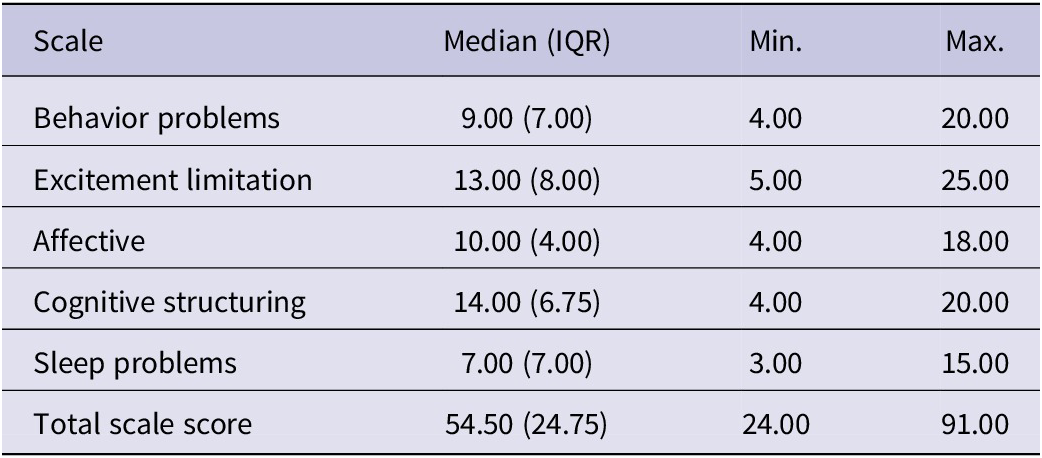
The median total score of the PETLIS was 54.50 (IQR:24.75). The median score of the behavioral problems subscale was 9.00 (7.00); the median score of the excitability subscale was 13.00 (8.00); the median score of the affective subscale was 10.00 (4.00); the median score of cognitive structuring subscale was 14.00 (6.75); and the median score of sleep problems subscale was 7.00 (7.00) (Table 3).
Post-earthquake trauma level identification scale (PETLIS) and median scores of its sub-dimensions (n = 252)

IQR, interquartile range; Min., minimum; Max., maximum.
There was no statistically significant difference between the total score medians of students in determining post-earthquake trauma level according to their grade levels (P > 0.05). In terms of the students’ grade level, it was determined that the emotional limitation and cognitive structuring subscale mean scores of the first graders were statistically significantly higher than those of the fourth graders (P < 0.05). The median value of the total score for determining the level of post-earthquake trauma in those who were in one of the earthquake zones during the earthquake was found to be statistically significantly higher than those who were not in one of the earthquake zones (P = 0.001) and the difference was determined to be strongly effective (d = 0.60). The difference was found to be small effective (d < 0.3) and statistically significant (P = 0.001) in the sub-dimensions of the scale: behavioral problems, excitement limitation, cognitive structuring, and sleep problems (Table 4).
Comparison of the median scores of the post-earthquake trauma level identification scale (PETLIS) and its sub-dimensions with some descriptive characteristics (n = 252)

Notes: IQR, interquartile range; KW, Kruskal-Wallis test; Z, Mann-Whitney U test.
* Tamhane’s T2 post hoc test
P < 0.05
Statistically significant findings were observed in the study regarding the post-earthquake trauma levels of the participants. Specifically, among the students whose houses were damaged during the earthquake, the median total score, as well as the sub-dimensions of behavioral problems, cognitive structuring, and sleep problems, were significantly higher compared to students whose houses were not affected by the earthquake (P < 0.05). Furthermore, the median score for the excitement limitation sub-dimension of the post-earthquake trauma level identification scale significantly differed between students whose houses were damaged or destroyed in the earthquake and those whose houses remained undamaged (P < 0.05). Additionally, the median score of the affective sub-dimension of the scale varied significantly among students whose houses were destroyed compared to those with damaged or undamaged houses during the earthquake (P < 0.05). The median value of the total score in determining the post-earthquake trauma level of those who lost a relative in the earthquake was found to be statistically significantly higher (P = 0.001) than those who did not lose a relative in the earthquake, and the difference had a strong effect (d = 0.51). The difference was found to be small-level effective (d < 0.3) and statistically significant (P = 0.001) among the sub-dimensions of the scale—behavioral problems, excitement limited, cognitive structuring, and sleep problems (Table 4).
It was determined that the median total score for determining the trauma level of those who left their address due to the earthquake was statistically significantly higher than those who did not leave their city of residence (P = 0.001) and the difference between them had a strong effect (d = 0.66). In the sub-dimensions of the scale—behavioral problems, cognitive structuring, and sleep problems—the difference between them was found to have a small effect (d < 0.3) and statistical significance (P = 0.001). It was determined that the total median score of the post-earthquake trauma scale of the students who had previously experienced a traumatic event was statistically significant (P = 0.001) compared to the students who had not previously experienced a traumatic event, and the difference between them had a strong effect (d = 0.68). It was found that there was a small effect (d < 0.3) statistical difference (P = 0.001) in the behavioral problems, cognitive structuring, and sleep problems sub-dimensions of the scale. It was determined that there was a moderate effect (d = 0.38) statistical significance (P = 0.002) in the excitement limitation sub-dimension of the scale. It was found that the total median score of students who received training on disaster management in determining the level of post-earthquake trauma was statistically significantly different (P = 0.001) compared to those who did not receive training, and the difference was moderately effective (d = 0.38). The scale was found to have a small level of effectiveness (d < 0.3) and a statistically significant difference (P = 0.001) in the behavioral problems, cognitive structuring, and sleep problems sub-dimensions (Table 4).
Discussion
Earthquakes deeply affect people’s lives and cause significant psychological damage.Reference Tanhan and Kayri15 Although earthquake events affect all areas, they significantly affect health and educational environments.Reference Trip, Tabakakis and Maskill1 It is important for students in midwifery departments at universities to prepare for natural disasters such as earthquakes and to cope with the physical and psychological problems caused by natural disasters in terms of both their own health and public health.Reference Cansel and Ucuz6 For this reason, it is necessary to determine the post-earthquake trauma levels of midwifery students and eliminate the related problems. The results of this study were discussed in comparison with similar studies since there were no studies on midwifery students after the earthquake.
In this study, midwifery students received a total score of 54.50 (24.75) on the scale for determining the level of post-earthquake trauma (Table 3). This finding indicates that the students were more than moderately traumatized after the earthquake. In a study conducted by Nobakht, Ojagh, and Dale (2019) in Iran, it was found that students’ severity of exposure to post-earthquake trauma and stress levels were high.Reference Nobakht, Ojagh and Dale16 One study reported that midwifery students who were in the earthquake zone at the time of the event had a reduced sense of meaning in their lives and that those who had previously experienced an earthquake had higher death anxiety.Reference Çuvadar and Aksoy11 A study conducted with nursing students reported that students experienced depression, anxiety, and fear after the earthquake.Reference Achbani, Rida and Kharbach17 Another study conducted with Emergency Aid and Disaster Management students found that as levels of depression and hopelessness increased, death anxiety also increased.Reference Gümüş Şekerci, Ayvazoğlu and Çekiç18 Contrary to our findings, in the study conducted by Kardaş and Tanhan (2018), it was determined that university students were traumatized at a low level, with a score of 23.12 ± 15.03 from the scale for determining the level of post-earthquake trauma.Reference Kardaş and Tanhan19 Considering these results, it is assumed that the trauma level of the students in the study was above the medium level because all of the students in the study were female—women experienced traumatic events more intensely emotionally, 53.6% of them lost a relative due to a recent earthquake, 99.2% did not receive professional support after the earthquake, and 85.7% had a history of experiencing earthquakes before.
Having different traumatic experiences, being female, younger age, lower education level, fear experienced during the earthquake, level of damage to the place of residence during the earthquake, participating in search and rescue activities, being injured in the disaster, and witnessing the death or injury of someone during the disaster are variables predicting the level of trauma and post-traumatic stress.Reference Kardaş and Tanhan19, Reference Valladares-Garrido, Zapata-Castro and Peralta20 In our study, the trauma level of the students who were in one of the cities where the earthquake occurred during the earthquake was found to be significantly higher. In contrast to our study’s findings, a study conducted by Cansel and Ucuz (2022) reported low trauma levels among healthcare workers in earthquake-prone provinces during earthquakes.Reference Cansel and Ucuz6 Similarly, a study conducted in Piura, Peru, revealed high levels of trauma among individuals who experienced an earthquake.Reference Valladares-Garrido, Zapata-Castro and Peralta20 One study found that age, gender, being diagnosed with depression, having experience with earthquakes, and professional specialization (for example, psychiatric nursing students experience less stress, while intensive care nursing students experience more stress) affect students’ post-earthquake depression, anxiety, and fear levels.Reference Achbani, Rida and Kharbach17 Contrary to our findings, in another study conducted with students in the health program, it was found that there was no significant difference between the characteristics of major, semester, gender, disaster-related course material, disaster-related seminars/trainings, and earthquake disaster experience and mitigation knowledge.Reference Maizar, Gayatri and Nuraini13, Reference Muafiroh, Suroto and Ekawati21 Another study conducted by Odai, Azodo, and Chhabra on the knowledge, attitude, behavior, and disaster preparedness of dentists in Nigeria found that the knowledge of male respondents was significantly higher than that of female respondents.Reference Odai, Azodo and Chhabra22 Several factors may have influenced our findings in this study. Firstly, the earthquake in Turkey was the most severe of the century. Additionally, the earthquake occurred during nighttime when people were asleep. Furthermore, the average age of the students in our study was 21.21 ± 1.77 years, and a significant proportion (64.7%) had not received disaster management training.
In this study, the trauma level of students whose houses were destroyed in the earthquake was found to be significantly higher. In one study, depression, anxiety, and fear were evident among nursing students who were evicted from uninhabitable or potentially unsafe homes, suffered property loss, and lost family members.Reference Achbani, Rida and Kharbach17 Contrary to our study, it was found that the destruction or damage of houses after the earthquake did not affect the trauma levels of individuals.Reference Valladares-Garrido, Zapata-Castro and Peralta20, Reference Gerstner, Lara-Lara and Vasconez23-Reference Adhikari Baral and KC25 This difference in our study results was attributed to the fact that the earthquake occurred in the winter season with harsh weather conditions, and the basic needs of the students, such as eating and drinking, sleeping, and hygiene, could not be met adequately in the first stage, the routine of life was disrupted, and 21% of the students had to reside in a place other than their own home.
Death or loss of a family member, friend, or relative is an important risk factor for post-traumatic stress symptoms.Reference Lu, Zeng and Li26 In our study, the trauma level of students who lost their relatives in the earthquake was found to be significantly higher. Previous studies found that post-traumatic stress levels were higher in individuals who lost first-degree relatives such as their mother, father, or siblings.Reference Lu, Zeng and Li26, Reference Divsalar and Dehesh27 Death anxiety was found to be higher in males and in students whose relatives or close friends died.Reference Gümüş Şekerci, Ayvazoğlu and Çekiç18 During the period of adaptation to normal life after a disaster, the death of a family member is a constant reminder of trauma for individuals, which may facilitate their recall of disaster scenes and cause permanent mental health disorders.Reference Valladares-Garrido, Zapata-Castro and Peralta20, Reference Lu, Zeng and Li26 Our study results may have been affected by the fact that 63.7% of the participants lost a friend and had experiences with the friends they lost.
It has been reported that environmental changes such as moving to temporary houses, living in an evacuation area outside the local area, an increase in the rate of illness, or deterioration in eating habits cause increased stress.Reference Hayashi, Ohira and Nakano28 This study determined that the trauma level of the students who moved from their residence address due to the earthquake was significantly higher. Contrary to our findings, studies have shown that post-earthquake place/location change does not affect the stress level.Reference Gerstner, Lara-Lara and Vasconez23, Reference Adhikari Baral and KC25, Reference Hayashi, Ohira and Nakano28 In this study, it is thought that cultural characteristics, the inability to maintain the socially normal traditional life, unexpected lifestyle changes, and the anxiety of living in an unknown place may be effective in the high trauma level of students who moved from their residence address due to the earthquake.
Post-traumatic stress disorders are a variety of problems arising from an individual’s direct exposure to actual death or threat of death, injury or threat of serious injury, sexual violence or threat of sexual violence, and witnessing or being indirectly exposed to its effects through their professional roles. The number or severity of traumatic events does not affect the reactions of these individuals.Reference Kardaş and Tanhan19 Our study revealed a significant association between higher trauma levels and students who had previously experienced a deeply traumatic event, such as an earthquake, illness, flood, or harassment. This finding aligns with the research conducted by Hayashi et al. (2021), which indicated that factors like cancer, diabetes, and previous earthquake experiences contributed to increased post-earthquake trauma levels.Reference Hayashi, Ohira and Nakano28 In the literature, it has been reported that individuals with prior earthquake experience exhibit higher levels of traumaReference Cansel and Ucuz6, Reference Silwal, Chudal and Dybdahl24, while the occurrence of another traumatic event (such as illness, flood, or harassment) does not significantly impact trauma levels.Reference Cansel and Ucuz6 Consistent with the existing literature, our study findings suggest that the elevated trauma levels among students who had experienced a traumatic event before may be influenced by the fact that 85.7% of the students had experienced an earthquake and 34.5% had encountered a traffic accident.
It is reported in the literature that getting training affects disaster competencies such as specific knowledge and skills. Health professionals, such as midwives and nurses who are in one-to-one communication with people, should especially periodically provide appropriate disaster education and training programs such as realistic disaster drills and disaster simulations to improve their disaster competencies.Reference Hong, Jung and Woo29, Reference Tzeng, Feng and Cheng30 In this study, it was found that the trauma level of students who received training in disaster management was significantly higher. Another study conducted with health students reported a positive relationship between earthquake disaster mitigation knowledge and attitudes toward disaster preparedness.Reference Maizar, Gayatri and Nuraini13 Studies conducted with students studying in the health program reported that knowledge, attitude, and education factors strongly affect positive coping with disasters.Reference Odai, Azodo and Chhabra22, Reference Hesti, Yetti and Erwani31 Receiving training on disaster management may have caused the students to improve their awareness and knowledge levels and thus to predict what might happen as a result of a major earthquake, which may have affected the students to be traumatized at a higher level.
Study Limitations
The study has limitations as it is a “single-center cross-sectional descriptive study” and includes only midwifery students from the specific university who agreed to participate. Therefore, the results of the study cannot be generalized to the whole population.
Conclusion
This study determined that the trauma level and sub-dimension scores of midwifery students were above average after the earthquake in Turkey, the disaster of the century.
There was a statistically significant difference in the trauma levels of students in one of the earthquake-prone provinces during the earthquake, whose houses were destroyed in the earthquake, who lost their relatives, who had experienced a traumatic event before, and who received training in disaster management.
As a result of this study, it is recommended that academicians should integrate these topics into their curricula in order to prepare students in midwifery departments in universities for natural disasters such as earthquakes and to cope with all the problems brought by natural disasters, both for their own health and public health.
Data availability statement
The data that support the findings of this study are available on request from the corresponding author. The data are not publicly available due to privacy or ethical restrictions.
Acknowledgments
All authors are grateful to all the participants for their useful contributions to this study.
Author contribution
SY: Conceptualization; visualization; formal analysis; data curation; methodology; writing—original draft and review and editing. YO: Conceptualization; formal analysis; methodology; original draft and review and editing. DA: Conceptualization; data curation; methodology; original draft and review and editing. All authors have approved this version for publication.
Funding statement
This research did not receive any specific grant from funding agencies in the public, commercial, or not-for-profit sectors.
Competing interests
All authors declare that they have not received any financial support or have relationships that may pose conflict of interest.