1 Introduction
Goizueta is a town of about 900 inhabitants located in western Navarre, on the Gipuzkoan border. It is one of the towns where the Basque language enjoys the greatest vitality in the entire Basque Country. Although virtually all inhabitants are bilingual in Spanish and Basque, interaction within the town is almost exclusively in Basque. The local dialect is actively used by all generations in Goizueta, even though young speakers also learn standardized Basque or euskara batua (and Spanish) through the school system.
One of the most interesting features of Goizueta Basque is its accentual system, which, until now has remained little studied and ill-understood. In this paper we show that both stress and tone are lexically contrastive in Goizueta Basque. This prosodic system is thus substantially different from any that has been previously described for other Basque varieties. Some of the Basque varieties of the northern Bizkaian area possess a pitch-accent system, reminiscent of Tokyo Japanese, with a lexical contrast between pitch-accented and unaccented words (Hualde Reference Hualde1991, Reference Hualde and van der Hulst1999; Elordieta Reference Elordieta, Fernando and Morales-Front1997; Hualde, Elordieta, Gaminde & Smiljanić Reference Smiljanić2002; Elordieta & Hualde Reference Elordieta and Hualde2003). The prosody of Goizueta Basque is strikingly different, as it involves both lexical stress and lexical tone. The Goizueta accentual system is thus rather more like that of Swedish (Bruce Reference Bruce1977, Riad Reference Riad, Kehrein and Wiese1998). Since the Goizueta and northern Bizkaian prosodic systems are clearly historically related, these facts are of great importance for our understanding of how one type of pitch-accent system may evolve into the other (or both may evolve from a third type of prosodic system). In this paper, however, we will attempt to provide an adequate phonetic and phonological characterization of Goizueta word-prosody, leaving historical considerations aside.
The existence of a Basque variety where both stress and tone are lexically contrastive is an unexpected discovery. Although some brief remarks on the musical nature of Western Navarrese accentuation are found in Ormaechea (Reference Ormaechea1918, Reference Ormaechea1958), existing work on the accentual system of Goizueta Basque (or any other Western Navarrese varieties, for that matter) is fairly limited. A partial description of Goizueta word-prosody is found in Zubiri (Reference Zubiri and Zuazo2000) (see also Zubiri & Perurena Reference Zubiri and Perurena1998). Hualde (Reference Hualde1997, Reference Hualde and van der Hulst1999) does not include Goizueta in his overview of Basque accentual systems. Gaminde (Reference Gaminde1998a, Reference Gaminde and Caminob) provides some examples for Goizueta, but he is not consistent in his transcription of phonological contrast or in the location of the stress. As for neighboring Western Navarrese varieties, Olano (Reference Olano and Zuazo2000) includes some brief remarks on the accentual system of Leitza, and Ibarra (Reference Ibarra1994) includes observations on the prosodic system of Basaburua and Imotz. None of these sources refer to the possibility that both stress and tone may be lexically contrastive in these Navarrese varieties. On the other hand, Jacobsen (Reference Jacobsen1972: 84f.) does raise this possibility for the variety of Oiartzun (not far from Goizueta but across the provincial border with Gipuzkoa) based on very perceptive auditory observation of a few singular/plural minimal pairs. (Since then, the variety of Oiartzun seems to have undergone prosodic simplification.)
The most extensive previous investigation of Goizueta word-prosody is that in Zubiri (Reference Zubiri and Zuazo2000). Zubiri points out that words in Goizueta may receive stress on either the initial or the postinitial syllable, in a lexically contrastive manner, providing a number of minimal pairs. In addition, he notes that singular and plural forms of the same word are prosodically distinguished. Regarding the nature of this distinction, he relies on his perception and intuition as a native speaker of Goizueta Basque. In Zubiri's view, inflected words have two stresses, one on the stem and another one on their last syllable. In the singular, the stress on the last syllable is secondary, whereas in the plural both stresses would be primary. This relative prominence contrast would be enhanced by a somewhat complex contrast in duration.
Building in part on previous research, our analysis differs from previous work in important respects.Footnote 1 First of all, we propose that in Goizueta Basque there is a lexical contrast in tone in addition to a contrast in stress (as Jacobsen1972 suggests for Oiartzun). The stressed syllable may be lexically associated to one of two melodies, which we refer to as Accent 1 and Accent 2. Whereas Accent 1 is properly characterized as a wide circumflex contour HL over the stressed syllable, Accent 2 is best characterized as a falling contour lacking the lexical H tone, since the stressed syllable is systematically lower in pitch than in words with Accent 1. In our analysis, then, Accent 1 involves a lexical H tone that is not present in Accent 2.
Secondly, the prominence on the last syllable noted by Zubiri in words in isolation is a phrasal phenomenon, most likely related to the expression of focus, both in Accent 1 words and in Accent 2 words.
Thirdly, the correlation between morphological number and accent type turns out to be less strict than previously assumed. Whereas most words do have Accent 1 in the singular and Accent 2 in the plural, this is not the only possibility. There are smaller classes of words with either Accent 1 or Accent 2 in both morphological numbers. We also note the existence of some accent changes in derivational morphology. Accent type is thus logically independent of inflectional morphology. Instead of speaking of a prosodic contrast between singular and plural forms, we will thus refer to an Accent 1 vs. Accent 2 contrast, which is only partially related to the singular vs. plural distinction.
Finally, we establish that both duration and intensity are important cues of stress, whereas pitch distinctions are used to convey the superimposed lexical accent contrast.
In the remainder of this paper, we first describe the lexical distribution of the prosodic contrasts and then report on an investigation of the acoustic cues of stress and lexical pitch-accent. The description of Goizueta prosody in this paper is based primarily on the analysis of recorded speech data from three native speakers in their twenties, one female (G1f) and two male (G1m, G2m) with some additional data from a fourth, older, speaker (G3m). All four speakers have university education.
2 Word-prosodic contrasts in Goizueta Basque
In Goizueta Basque, the position of the stress is lexically contrastive. Words may be stressed either on the first or on the second syllable ([+1] vs. [+2]). In addition, the stressed syllable may be lexically associated with one of two tonal specifications, which we will call Accent 1 and Accent 2 and will represent with an acute and a grave accent, respectively. There is, thus, a four-way prosodic contrast, as illustrated in (1):Footnote 2
(1) Prosodic contrasts


As can be seen in the examples in (1), word-prosody is involved in both lexical and grammatical distinctions. In particular, whereas the position of the stress (on the first or on the second syllable of the stem) is fixed throughout the inflectional paradigm of a given word, singular and plural inflected forms of most words differ in accent type. For instance, as illustrated above, in the pair basóri ‘to the forest’ vs. basòri ‘to the forests’, the singular/plural contrast is signaled by a difference in accent type. The same is true for úmeri ‘to the child’ vs. ùmeri ‘to the children’, with stress on the initial syllable. On the other hand, in the case of bàsori ‘to the glass or to the glasses’, there is no singular/plural contrast, as this word has Accent 2 (on its initial syllable) in both singular and plural. To understand this prosodic system, it is necessary to consider the lexical and grammatical functions of word-prosody separately.
In uninflected forms, all four prosodic types are found, although not with equal frequency or lexical distribution. In (2), examples are given of uninflected words belonging to all four prosodic classes:Footnote 3
(2) Stress and accent contrasts in uninflected words
By far the most common type is stress on the second syllable and Accent 1 (Class A). Class B, with stress on the first syllable and Accent 1, contains a relatively small number of bisyllabic stems. Classes C and D, both with Accent 2 in their uninflected form, contain mostly borrowings and some etymologically-polymorphemic native words.Footnote 4
All inflected singular forms have the same prosodic properties as the uninflected form of the word. In the plural, however, Accent 1 is replaced by Accent 2 if the uninflected form has three or fewer syllables. That is, words in Classes A and B acquire Accent 2 in the plural except for stems with four or more syllables like basérritar ‘farmer’ and emákume ‘woman’. This is illustrated in (3) with examples in four morphological cases, absolutive, ergative, dative and comitative (absolutive and ergative plural are always identical).
(3) Singular/plural contrasts
Words with Accent 2 in the uninflected form (Classes C and D), as well as Accent 1 words with four or more syllables, do not participate in this alternation. In these words ABS singular and plural are different, since they take segmentally different endings, but the singular/plural contrast is neutralized in other morphological cases, including the ERG, DAT and COM.Footnote 5
(4) Words without singular/plural contrast
We may thus capture the accent alternation facts by means of the rule in (5):
(5) Plural Accent Rule
Accent 1 → Accent 2 in plural
(Condition: if stem has three or fewer syllables)Footnote 6
Stated differently, all plural words have Accent 2, except for Class A words with four or more syllables in the stem. If the word has Accent 2 in its uninflected and singular forms (Classes C and D), a rule assigning Accent 2 in the plural would apply vacuously.
Rule (5) has, in fact, a somewhat wider domain of application, since Accent 1 is also replaced by Accent 2 in superlative forms (suffix -(a)na ‘the most’), ‘excessive’ forms (suffix -(a)gi ‘too’) and derived forms bearing certain other suffixes, including the adjectival -ti and -tarr ‘(who is) from’:Footnote 7
(6) Accent 1 → Accent 2 in derivational morphology
In the next section we turn to the acoustic characterization of the lexical contrasts in stress position and accent type in Goizueta Basque.
3 Acoustic correlates of stress and accent
3.1 Methods
The speech data discussed in this section were elicited from three native speakers of Goizueta Basque, G1f, G1m and G2m. Participants were asked to read three times a list containing 44 nouns and adjectives in the comitative case (‘with’, suffix -kin) in the frame ____ esan dut ‘I said ____’. Basque is a verb-final language, so that ‘X esan dut’ is the unmarked order, pragmatically equivalent to English ‘I said X’. Both a Spanish translation and the target word in uninflected form were given in the written stimulus, as in the following example:
(7) Reading materials: example
Written stimulus: con el monte (mendi) ____ esan dut
Expected response: mendíkin (e)san dut ‘I said with the mountain’
The 44 items included 22 different words in the singular and in the plural and were presented in pseudo-random order, so that the singular and the plural of the same word were never adjacent. All items in the list were bisyllabic or trisyllabic stems. Words were chosen so that all five vowels and the most common final consonants would be included in stem-final position and both initial and postinitial stress would be represented.
From Zubiri's (Reference Zubiri and Zuazo2000) description, words were expected to be stressed on the same syllable in their singular and plural form, but to show some other prosodic difference between singular and plural. From our previous fieldwork (see also Hualde Reference Hualde, Gussenhoven and Riad2007) we hypothesized that the singular/plural contrast would be manifested on the stressed vowel of the stem. The existence of Classes C and D, without a prosodic contrast between singular and plural was not known before this recording, since earlier work did not identify these word classes. As it turns out, the small classes C and D are each represented by one item. This was determined a posteriori through further elicitation. The complete list of target items, grouped by accentual class, is given in (8). Again, for each item the comitative singular and plural were elicited:
(8) Target words
The acoustic analysis of the data was performed with PRAAT (Boersma & Weenink Reference Boersma2006). The first two vowels of every target word (V1, V2) were manually segmented using standard criteria. The rest of the analysis, which included taking measurements of duration, intensity and pitch, was performed automatically, running a script written for this purpose. All tokens of la(g)un ‘friend’ were removed, as the etymological /g/ was consistently deleted in this word by all speakers, which made the segmentation and analysis of this word problematic (should [w] in [lawn] be considered V2?). Obvious mistakes were also removed from the analysis after confirming with one speaker that they were indeed production errors.Footnote 9
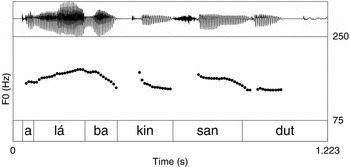
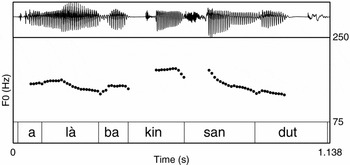
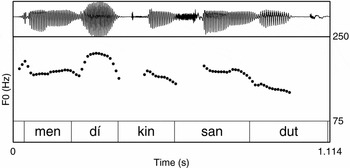
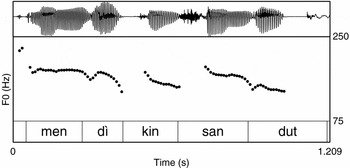
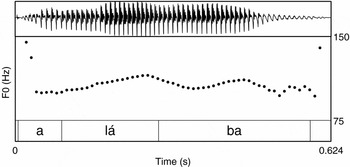
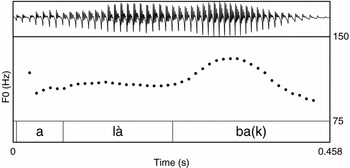
Examples of sg/pl pairs are given in figures 1–4.
alábakin san dut ‘I said “with the daughter”’ (G1f).

alàbakin san dut ‘I said “with the daughters”’ (G1f).

mendíkin san dut ‘I said “with the mountain”’ (G1f).

mendìkin san dut ‘I said “with the mountains”’ (G1f).

3.2 Results
Duration, intensity and pitch over the first two syllables of the word were measured as likely correlates of stress and/or lexical accent. In all tables presented in this section, items are grouped in eight lexical classes (s = singular, p = plural): As, Ap, Bs, Bp, Cs, Cp, Ds, Dp. Since at issue are the effects of Stress Pattern (initial = [+1] vs. postinitial = [+2]) and Accent Type (1 vs. 2), the statistics are based on a classification of items according to these two factors (each of them with two levels). Graphs are shown only for class A and B items, since classes C and D contained very small numbers of tokens. We have employed the statistical program R (R Development Core Team 2006) for all statistics and plots.
3.2.1 Duration
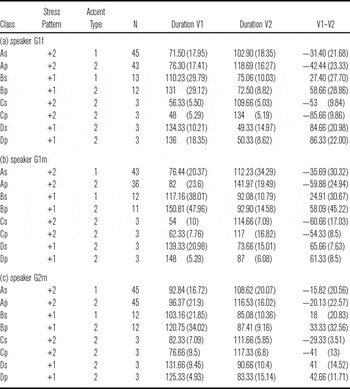
The duration of the vowel of the first two syllables, V1 and V2, was measured for all items. Means (and standard deviations) in ms for each class of words are given in table 1 for each speaker separately.
Duration of V1 and V2 (means and standard deviation in ms).

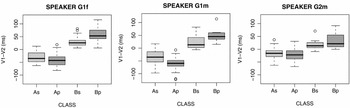
Notice that for words with stress on the second syllable (classes As, Ap, Cs, Cp) this difference is always negative, showing that the second syllable is longer, whereas for words with stress on the first syllable (Bs, Bp, Ds, Dp), the difference is positive. That is, the stressed syllable is always longer than the adjacent unstressed syllable in the stem, regardless of accent type. The boxplots in figure 5 show the difference in duration between V1 and V2 (duration of V1 minus duration ofV2) for As, Ap, Bs and Bp words.
(3 panels) Difference in duration in ms between V1 and V2. Negative numbers on y-axis indicate that V2 is longer than V1.

ANOVAs on the difference of duration between V1 and V2, for each speaker separately, with factors Stress Pattern (+1, +2) and Accent Type (1, 2), show that Stress Pattern is a significant factor for all speakers [G1f: F(1,121) = 339, p < 0.001; G1m: F(1,110) = 225, p < 0.001; G2m: F(1,122) = 106, p < 0.001]. However, no significant effect was found for Accent Type for any of the three speakers. An interaction between stress and accent was significant (G1f: p < 0.001, G1m: p < 0.001, G2m: p < 0.05). We conclude that duration is an important correlate of stress, but not of accent type, in Goizueta Basque. Stressed vowels are significantly longer than unstressed vowels.
3.2.2 Intensity
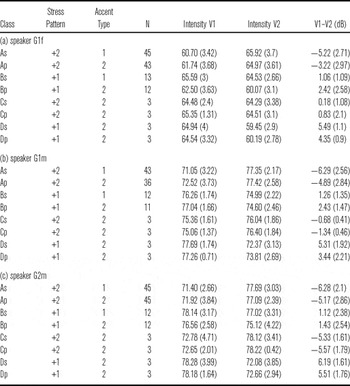
To examine the possible role of intensity in cueing Stress Pattern and/or Accent Type, the difference between peak intensity in V1 and V2 was calculated. Table 2 shows mean values (and standard deviations) in dB for each prosodic class. A difference of 6 dB would indicate that one of the two sounds compared is twice as loud as the other.
Peak intensity of V1 and V2 (means and standard deviation in dB).

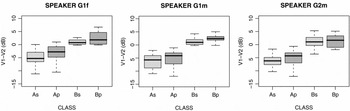
Peak intensity differences for classes A and B are also shown graphically in the boxplots in figure 6.
Difference in peak intensity in dB between V1 and V2.

ANOVAs on the difference in peak intensity between V1 and V2 with Stress Pattern and Accent Type as factors show that for all three speakers both factors significantly condition differences in intensity. For Stress Pattern, G1f: F(1,121) = 118, p < 0.0001; G1m: F(1,110) = 196, p < 0.0001; G2m: F(1,122) = 220, p < 0.0001. From the boxplots in figure 6, showing the results for lexical classes A (with postinitial stress) and B (with initial stress), it is evident that Stress Pattern clearly separates the data. V2 has greater intensity than V1 when it is stressed, and vice versa.
It is clear from both the tables and the boxplot figures that Accent Type has a much smaller effect on intensity than stress position. Nevertheless, this effect too turns out to be significant. For Accent Type, G1f: F(1, 121) = 30, p < 0.0001; G1m: F(1,110) = 16, p < 0.0001; G2m: F(1,122) = 7, p < 0.001. There is no interaction between both factors. Differences in intensity between stressed and unstressed syllables are greater under Accent 1 in words with postinitial stress, and under Accent 2 in words with initial stress.
We conclude that, like vowel duration, intensity is primarily a cue of Stress Type (initial vs. postinitial).
3.2.3 Pitch
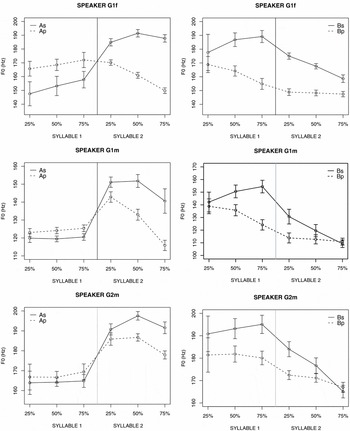
To analyze pitch patterns, F0 values were extracted at three equidistant points within each of V1 and V2: at 25%, 50% and 75% of the duration of the vowel. Mean values (with error bars) are plotted in figure 7 for words of lexical classes A (left panels) and B (right panels).
F0 values at three equidistant points in each of V1 and V2 for classes As (postinitial stress, Accent 1), Ap (postinitial stress, Accent 2), Bs (initial stress, Accent 1) and Bp (initial stress, Accent 2).

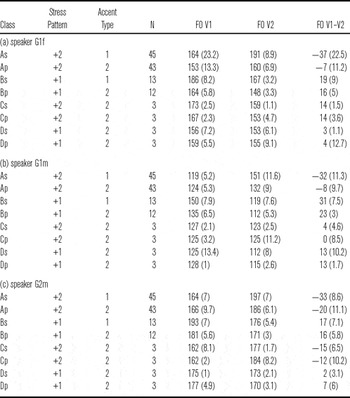
It appears from figure 7 that F0 is higher on the stressed syllable; the second syllable for class A words, and the initial for class B words. In addition, Accent 1 words (As and Bs) have higher pitch on their stressed syllable than Accent 2 words. Mean F0 values at mid point of V1 and V2 are given in table 3.
F0 at mid point of V1 and V2 (means and standard deviation in Hz).

An ANOVA with dependent factor F0 at mid point of V1 minus F0 at mid point of V2 and independent factors Stress Pattern and Accent Type shows that both factors are significant and interact. For Stress Pattern, G1f: F(1,121) = 76, p < 0.0001; G1m: F(1,110) = 430, p < 0.0001; G2m: F(1,122) = 385, p < 0.0001. For Accent Type, G1f: F(1,121) = 137, p < 0.0001; G1m: F(1,110) = 73, p < 0.0001; G2m: F(1,122) = 27, p < 0.0001. The interaction, p < 0.0001 for all speakers.
The stressed syllable has a higher pitch at mid point under Accent 1 than under Accent 2. Accent 1 is thus associated with a higher tone.
4 The nature of the Accent 1/Accent 2 contrast
As just mentioned, stressed syllables are significantly higher in pitch when associated with Accent 1 than when bearing Accent 2. The connected means in figure 7 offer a rough approximation to the overall tonal contours associated with the two accents.
In a different recording session, speakers G1f, G1m and G2m were asked to produce a list of short sentences containing a small number of representative words each bearing several inflectional suffixes and in both singular and plural. The stimuli were written in both Spanish and standard Basque and the speakers were asked to provide oral translations in Goizueta Basque. For instance, for the word amóna ‘grandmother’, the following written stimuli were provided (we add English glosses):
(9) Examples of stimuli
Es la abuela (amona da) ‘It is the grandmother’
Son las abuelas (amonak dira) ‘They are the grandmothers’
Se lo ha quitado a la abuela (amonari kendu dio) ‘S/he took it away from grandma’
Se lo ha quitado a las abuelas (amonei kendu die) ‘S/he took it away from the grandmothers’
La abuela lo ha hecho (amonak egin du) ‘The grandmother did it’
Las abuelas lo han hecho (amonek egin dute) ‘The grandmothers did it’
Es el nombre de la abuela (amonaren izena da) ‘It is the grandmother's name’
Es el nombre de las abuelas (amonen izena da) ‘It is the grandmothers' name’
Es de la abuela (amonarena da) ‘It is the one of the grandmother’
Es de las abuelas (amonena da) ‘It is the one of the grandmothers’
Even though in standard Basque singular and plural forms are always segmentally different, in Goizueta they are segmentally identical except in the absolutive case. Two repetitions of the list were recorded by every speaker.
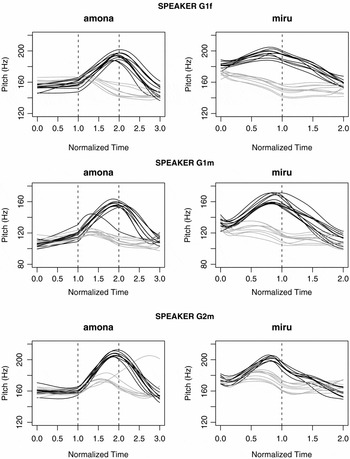
figure 8 shows time-normalized F0 contours over the syllables of the stem (that is, excluding inflectional suffixes, which vary among the examples) for all tokens of the words amóna ‘grandmother’ and míru ‘hawk’. The word amóna is a Class A word, with stress on the second syllable, Accent 1 in the singular and Accent 2 in the plural. The word míru, on the other hand, belongs to Class B, with stress on the initial syllable and the same accent alternation between singular and plural (a few tokens containing obvious pitch tracking errors, mostly due to glottalization of word-initial vowels, have been excluded from the figures). Other words show similar patterns.
Time-normalized Fo contours over the syllables of the stem for representative examples of lexical classes A (amona ‘grandmother’) and B (miru ‘hawk’). Singular tokens are represented in black and plural tokens in grey.

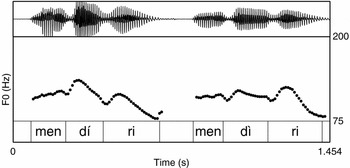
Examination of these figures allows us to obtain a more accurate overall impression of the tonal contours associated with Accent 1 and Accent 2 words in declarative contexts. As can be seen, Accent 1 includes a prominent peak on the stressed syllable that is not present in words under Accent 2. Instead, Accent 2 can be characterized as a fall over most of the stressed syllable from a syllable-initial mid level. It appears to us that an adequate characterization of the phonological contrast is the presence of a H* tone in Accent 1 vs. its absence in Accent 2. Accent 2 words have significantly lower pitch than Accent 1 words. This difference in pitch height is in fact also observable in figure 9, containing a sg/pl minimal pair pronounced in isolation.
mendíri ‘to the mountain, DAT’ (Accent 1), mendìri ‘to the mountains, DAT’ (Accent 2) (G3m, adapted from Hualde Reference Hualde, Gussenhoven and Riad2007).

What characterizes Accent 2 is not just a slower fall than in Accent 2, but also a lower peak. Whereas Accent 1 includes a wide circumflex contour over the stressed syllable, Accent 2 is realized as a fall from a mid value towards the beginning of the stressed syllable.Footnote 10
5 Secondary stress on final syllables?
For Zubiri (Reference Zubiri and Zuazo2000), who does not consider the existence of a tonal contrast, a difference between singular (Accent 1) and plural (Accent 2) words is that in the plural the last syllable of the word is as prominent as the stressed syllable of the stem. As can be seen in figure 9, in citation forms there is indeed a tonal peak over the last syllable of the word, which is downstepped with respect to the peak on the stressed syllable under Accent 1, but not under Accent 2, lending the final syllable greater prominence in the latter case. This is further illustrated in the sg/pl pair in figures 10 and 11.
alába ‘daughter’, citation form (G1m).

alàbak ‘daughters’, citation form (G1m).

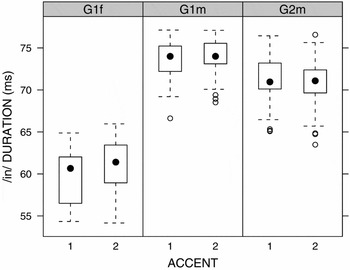
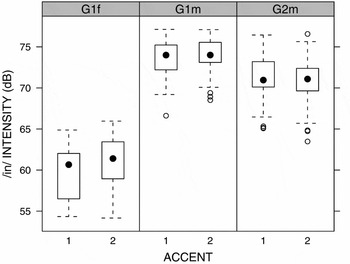
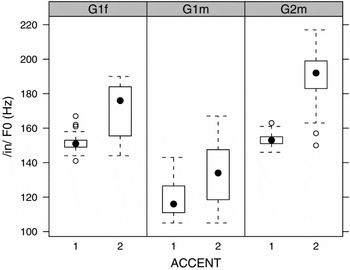
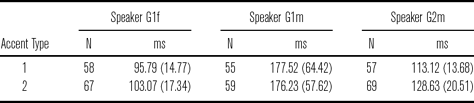
To test the hypothesis of greater prominence on the final syllable of the word in words bearing Accent 2, in the recorded data described in section 3 (all in the comitative case, with suffix -kin), we measured the duration and peak intensity of the word-final rhyme /-in/ as well as the pitch at mid point of the duration of this sequence. Results are shown in boxplots in figures 12–14. Duration values are also given in table 4.
Duration of /-in/ in ms by Accent Type.

Peak intensity of /-in/ in dB by Accent Type.

F0 at mid point of /-in/ by Accent Type.

Duration of /-in/ in ms by accent type (means and standard deviation).

For all speakers, F0 in /-in/ turned out to be significantly higher in pitch under Accent 2 than under Accent 1 (see figure 14) – Gf1: F(1,123) = 114, p < 0.001; G1m: F(1,112) = 36, p < 0.001; G2m: F(1,124) = 516, p < 0.001. Intensity differences (figure 13) were only significant for one speaker, G1f: F(1,123) = 7, p < 0.01, with greater intensity in Accent 2 words. Regarding duration (figure 12), /-in/ was significantly longer under Accent 2 for two speakers, G1f: F(1,123) = 6, p < 0.05, and more clearly, G2m: F(1,124) = 24, p < 0.001.
Thus, from these data, it does appear that the last syllable of the word has greater prominence under Accent 2 than under Accent 1, as suggested by Zubiri (Reference Zubiri and Zuazo2000). This greater prominence is mostly manifested by higher pitch.
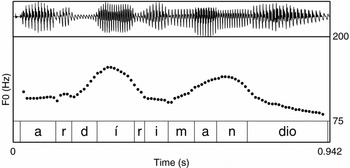
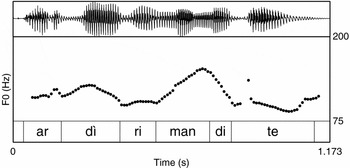
There are, however, reasons to believe that the peak on the final syllable of words is an intonational effect related to focalization. Whereas Accent 2 words often have a prominent rise on their last syllable, as in figures 9 (right-hand contour) and 11 above, systematic comparison of Accent 1 and Accent 2 in a number of different prosodic contexts shows that the tonal contour on the last syllable may be absent for both types of words. Figures 15 and 16, for instance, show the words ardíri ‘to the sheep, DATsg’ and ardìri ‘to the sheep, DATpl’, respectively, before a verbal participle and without an intervening prosodic break. Notice that the contours on the lexically accented syllables are very similar to those in figure 9, but there is no tonal prominence on the last syllable of the word in either case.
ardíri man dio ‘he gave it to the sheep (sg)’ (G1m).

ardìri man dite ‘he gave it to the sheep (pl)’ (G1m).

We would suggest that the H tone on the last syllable of words given in citation form is a phrasal accent that has to do with the expression of focus, as in Swedish (Bruce Reference Bruce1977). In our recorded materials elicited in the frame ___-kin (e)san dut ‘I said with the ___’, the target word would tend to be focalized.
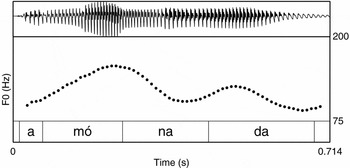
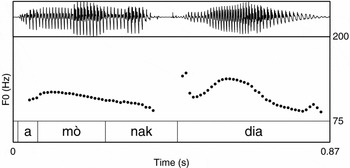
The Accent 1/Accent 2 contrast is further illustrated in the absence of a following H in the same word in figure 17 amóna da ‘(she) is the grandmother’ and figure 18 amònak dia ‘(they) are the grandmothers’. The copula da ‘is’/dia ‘are’ is integrated in a single prosodic phrase with the preceding noun and receives a phrasal H. Observe that, whereas the Accent 1 word amóna ‘grandmother’ has a wide rise and fall contour, its plural, amònak, which has Accent 2, lacks a high tone and instead shows a fall over the stressed syllable from a mid point, so that the accent on the copula has higher pitch.
amóna da ‘it is the grandmother’ (G1m).

amònak dia ‘they are the grandmothers’ (G1m).

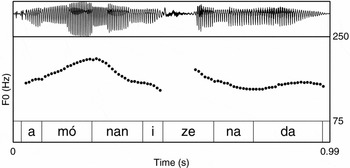
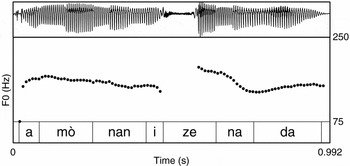
In sentence-medial position, Accent 2 words, which lack a lexical H on the stem, appear to have a greater tendency to induce a phrasal-break to the right, anchoring a phrasal H on their last syllable, but this is not a necessary feature of Accent 2 words. In certain contexts, such as in pronominal genitive modifiers, a prosodic break between genitive and the noun is unlikely, and consequently no word-final H will normally occur. This is shown with prenominal genitive examples in figures 19 and 20.
amónan izena da ‘it is the grandmother's (sg) name’ (G1f).

amònan izena da ‘it is the grandmothers' (pl) name’ (G1f).

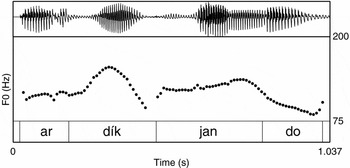
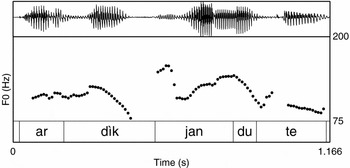
Furthermore, the fact that the distinction between these two classes of words relies on the shape of the accent on the stressed syllable of the stem is obvious when we consider that the contrast is maintained in inflected words where the stressed stem syllable is also the last syllable of the word, as in ardík ‘the sheep, ERGsg’ vs. ardìk ‘the sheep, ERGpl’ in figures 21 and 22.
ardík jan do ‘the sheep has eaten it’ (G1m).

ardìk jan dute ‘the sheep have eaten it’ (G1m).

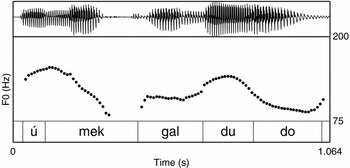
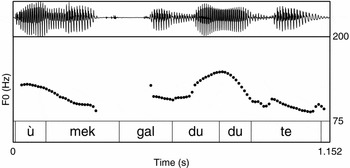
For comparison, another bisyllabic minimal pair but with stress on the first syllable, úmek ‘the child, ERG’ vs. ùmek ‘the children, ERG’ is shown in figures 23 and 24.
úmek galdu do ‘the child has lost it’ (G1m).

ùmek galdu dute ‘the children have lost it’ (G1m).

To conclude, whereas Accent 2 words display a prominent rise on their final syllable in phrase-final position (including in citation form), this H tone is not part of the lexical specification of Accent 2 words, since it may be absent in other phrasal contexts. The contrast, instead, relies on the tonal shape associated with the stressed syllable of the stem.
6 Conclusion
Previous research on Goizueta Basque accentuation revealed that, in this Basque dialect, words can be contrastively stressed on the initial or the postinitial syllable. A given stem is always stressed on the same syllable, throughout the word's inflectional paradigm, both in the singular in the plural (unlike in many Bizkaian and Gipuzkoan varieties). However, with most words, there is also a prosodic contrast between singular and plural forms. The nature of this contrast has not been properly understood in the limited work that had been done on this topic.
In this paper we have shown that this contrast, which we have labeled Accent 1 vs. Accent 2, involves different tonal melodies. Furthermore, contrary to previous assumptions, the contrast in lexical tone is not totally dependent on inflectional morphology. Although most words have Accent 1 in the singular and Accent 2 in the plural, there are words with Accent 2 in both singular and plural (Classes C and D) as well as words with Accent 1 in both morphological numbers (Class A words with long stems).
We have argued that Accent 1 and Accent 2 words differ in the tonal configuration that is lexically associated with the stressed syllable. Whereas Accent 1 has a prominent rise, Accent 2 is a falling contour from a mid pitch level at the beginning of the stressed syllable. We have analyzed this contrast as the presence of an H* in Accent 1 words vs. its absence in Accent 2 words.
Lexical stress, which falls on the same syllable in all inflected forms of a given lexical stem, is cued by significant differences in duration and intensity.
In focalized words, including citation forms, there is a rise-fall contour on the last syllable, which is downstepped by Accent 1 but not by Accent 2. We have argued that final-prominence is independent from lexical stress and accent. In focalized words the final syllable bears a phrasal-accent H, in a way that is reminiscent of Swedish.
We have thus demonstrated that in Goizueta Basque both tone and stress are independent, lexically contrastive features. As, for instance, in Swedish (Bruce Reference Bruce1977, Riad Reference Riad, Kehrein and Wiese1998) and Serbian/Croatian (Godjevac Reference Godjevac2000, Smiljanić & Hualde Reference Smiljanić and Hualde2000, Smiljanić Reference Smiljanić2002), stressed syllables are lexically associated with one of two melodies.
From the lexical distribution of prosodic patterns it is clear that both prosodic contrasts in stress position and accent type in Goizueta Basque are diachronically related to the single contrast between lexically accented and unaccented words in the Basque varieties of the northern Bizkaian area. The typological interest of Goizueta Basque is thus increased by the fact that it is historically related to a very different type of pitch-accent system. In Hualde et al. (Reference Hualde, Elordieta, Gaminde, Smiljanić, Gussenhoven and Warner2002), the Tokyo-type pitch-accent system of Northern Bizkaian Basque, with a contrast involving presence vs. absence of accent, is distinguished from pitch-accent systems with a tonal contrast superimposed on stress, as in Swedish and several other European languages. It turns out now that both types of pitch-accent system are found in Basque, which raises interesting questions regarding the possible evolutionary paths of word-prosodic systems.
Acknowledgements
We are grateful to our Goizueta speakers for their collaboration. We also want to thank Juan Joxe Zubiri and Gorka Elordieta for stimulating discussion.