Introduction
Orthodox seeds are capable of surviving the removal of most of their cellular water and can be stored in the dry state for long periods, ranging from decades to centuries, depending on the species (Priestley et al., Reference Priestley, Cullinan and Wolfe1985; Walters et al., Reference Walters, Wheeler and Grotenhuis2005) and storage conditions (Roberts, Reference Roberts1960; Walters, Reference Walters1998). Remarkable survival for several hundreds of years has been observed for seeds of Canna compacta (Lerman and Cigliano, Reference Lerman and Cigliano1971), sacred lotus Nelumbo nucifera (Shen-Miller, Reference Shen-Miller2002) and the date palm Phoenix dactylifera L. (Sallon et al., Reference Sallon, Solowey, Cohen, Korchinsky, Egli, Woodhatch, Simchoni and Kislev2008). Seed longevity is strongly influenced by environmental factors such as temperature and seed moisture content (Boswell et al., Reference Boswell, Toole, Toole and Fisher1940; El-Shishiny, Reference El-Shishiny1953), which has been attributed to the thermodynamic properties of the residual water present in seeds (reviewed in Walters et al., Reference Walters, Ried and Walker-Simmons1997) and the intracellular glass properties under the same storage conditions (reviewed in Buitink and Leprince, Reference Buitink and Leprince2004). Typically, seed deterioration is severely slowed down when the tissues are in the glassy state (Buitink and Leprince, Reference Buitink and Leprince2004). Conditions such as high temperature and high relative humidity, which bring seeds out of their glassy state, result in a dramatic increase in the ageing rate. This is often referred to as accelerated ageing. Moreover, comparison of the ageing rates with the molecular mobility in intracellular glasses reveals a linear relationship between these two parameters over a wide range of temperatures and water contents (Buitink et al., Reference Buitink, Leprince, Hemminga and Hoekstra2000), which indicates that deteriorative chemical reactions leading to loss of seed viability are controlled by the kinetics of molecular mobility.
Seed ageing is accompanied by the deterioration of cellular components, such as membranes (Perez and Argüello, Reference Perez and Argüello1995; Roqueiro et al., Reference Roqueiro, Facorro, Huarte, Rubin de Celis, Garcia, Maldonado and Maroder2010), proteins (Oge et al., Reference Oge, Bourdais, Bove, Collet, Godin, Granier, Boutin, Job, Jullien and Grappin2008; Rajjou et al., Reference Rajjou, Lovigny, Groot, Belghazi, Job and Job2008) and DNA (Rao et al., Reference Rao, Roberts and Ellis1987). It has been proposed that this deterioration originates from oxidative reactions during storage (Hendry, Reference Hendry1993; Roqueiro et al., Reference Roqueiro, Facorro, Huarte, Rubin de Celis, Garcia, Maldonado and Maroder2010) and that the oxidative stress defence plays an important role in seed longevity. The seeds of the Arabidopsis vte (vitamin E) mutants, which are deficient in several forms of tocopherols, lipophilic antioxidants, exhibit decreased germination compared to wild-type seeds after accelerated ageing for 3 d at 40°C and 100% relative humidity (RH) (Sattler et al., Reference Sattler, Gilliland, Magallanes-Lundback, Pollard and DellaPenna2004). In addition, the loss and/or oxidation of gluthathione (GSH) during storage is correlated with a decrease in the viability of seeds of different species (Kranner et al., Reference Kranner, Birtic, Anderson and Pritchard2006).
In contrast to the existing knowledge about the oxidative stress defence, it is unclear how the abundance of stress proteins which is correlated with desiccation tolerance influences seed longevity. Heat shock proteins (HSPs) are chaperones that protect proteins from unfolding-induced aggregation and may assist refolding into the native conformation. Their abundance is strongly reduced in abi3 (abscisic acid sensitive 3), fus3 (fusca 3) or lec1 (leafy cotyledon 1) Arabidopsis mutants which are desiccation sensitive (Wehmeyer and Vierling, Reference Wehmeyer and Vierling2000). Overexpression of the sunflower HaHSFA9 heat stress transcription factor in tobacco seeds led to the accumulation of HSPs and conferred an increased resistance against accelerated ageing at 50°C with 28% seed moisture content on a fresh weight basis (Prieto-Dapena et al., Reference Prieto-Dapena, Castano, Almoguera and Jordano2006).
Another group of stress-related proteins, the late embryogenesis abundant (LEA) proteins, is suggested to play an important role in seed desiccation tolerance (reviewed by Tunnacliffe and Wise, Reference Tunnacliffe and Wise2007). Some in vitro experiments provide evidence that at least some LEA proteins stabilize membranes and/or proteins against the deleterious effects of drying. LEAs are able to prevent protein aggregation during freezing and drying (Chakrabortee et al., Reference Chakrabortee, Boschetti, Walton, Sarkar, Rubinsztein and Tunnacliffe2007; Boucher et al., Reference Boucher, Buitink, Lin, Boudet, Hoekstra, Hundertmark, Renard and Leprince2009), and interact with and stabilize liposomes in the dry state (Pouchkina-Stantcheva et al., Reference Pouchkina-Stantcheva, McGee, Boschetti, Tolleter, Chakrabortee, Popova, Meersman, Macherel, Hincha and Tunnacliffe2007; Tolleter et al., Reference Tolleter, Jaquinod, Mangavel, Passirani, Saulnier, Manon, Teyssier, Payet, Avelange-Macherel and Macherel2007; Thalhammer et al., Reference Thalhammer, Hundertmark, Popova, Seckler and Hincha2010). In addition, some LEAs can stabilize sugar glasses (Wolkers et al., Reference Wolkers, Tetteroo, Alberda and Hoekstra1999, Reference Wolkers, McCready, Brandt, Lindsey and Hoekstra2001; Shimizu et al., Reference Shimizu, Kanamori, Furuki, Kikawada, Okuda, Takahashi, Mihara and Sakurai2010), suggesting that they play a role in longevity. However, evidence for a role of LEA proteins in seed desiccation tolerance and longevity in vivo remains scarce. Manfre et al. (Reference Manfre, Lanni and Marcotte2006, Reference Manfre, LaHatte, Climer and Marcotte2009) showed that the absence of the group 1 LEA protein AtEM6 (PF00477) in Arabidopsis altered the timing for the establishment of desiccation tolerance. However, this protein was not essential for desiccation tolerance itself since the mutants produced viable dry seeds (Manfre et al., Reference Manfre, LaHatte, Climer and Marcotte2009). The presence of group 2 LEA proteins, also called dehydrins (PF00257), is not sufficient to confer desiccation tolerance as these proteins were also found in desiccation-sensitive, recalcitrant seeds (Finch-Savage et al., Reference Finch-Savage, Pramanik and Bewley1994; Gee et al., Reference Gee, Probert and Coomber1994; Greggains et al., Reference Greggains, Finch-Savage, Quick and Atherton2000). In a recent study on Medicago truncatula, the putative link between desiccation tolerance and the heat-stable proteome, to which most LEAs belong, was analysed comprehensively (Boudet et al., Reference Boudet, Buitink, Hoekstra, Rogniaux, Larre, Satour and Leprince2006). The survey revealed that the abundance of some, but not all, LEAs is associated with desiccation tolerance of germinating radicles. For example, some dehydrin isoforms increased in abundance upon re-induction of desiccation tolerance. However, while a function of dehydrins in low temperature and/or osmotic stress tolerance in vegetative tissues has been demonstrated experimentally (Figueras et al., Reference Figueras, Pujal, Saleh, Save, Pages and Goday2004; Brini et al., Reference Brini, Hanin, Lumbreras, Amara, Khoudi, Hassairi, Pagès and Masmoudi2007; Tunnacliffe and Wise, Reference Tunnacliffe and Wise2007 and references therein), little is known about the impact of dehydrins on seed longevity in orthodox seeds.
In this study, we address the question whether dehydrins contribute to the longevity of Arabidopsis seeds in the dry state using an RNAi knockdown approach. We analysed the impact of a seed-specific dehydrin gene, At2g21490, on the desiccation tolerance and longevity during storage and on salt stress tolerance upon germination. The expression of the target gene as well as two dehydrin homologues was reduced in mature seeds from RNAi plants which exhibited a reduced longevity and reduced tolerance to NaCl during germination.
Materials and methods
Cloning of LEA genes, transformation of A. thaliana and seed production
LEA14 (At2g21490; PF00257) was cloned from the RIKEN full-length cDNA clone RAFL09-38-N20 (Seki et al., Reference Seki, Carninci, Nishiyama, Hayashizaki and Shinozaki1998, Reference Seki, Narusaka, Kamiya, Ishida, Satou, Sakurai, Nakajima, Enju, Akiyama, Oono, Muramatsu, Hayashizaki, Kawai, Carninci, Itoh, Ishii, Arakawa, Shibata, Shinagawa and Shinozaki2002). The coding region was amplified by polymerase chain reaction (PCR) and inserted into the vector pENTR.SD.D-TOPO (Invitrogen, Carlsbad, California, USA). The identity of the insert was checked by sequencing. The gene was transferred to the pJawohl8 vector obtained from Max Planck Institute für Zuechtungsforschung, Cologne, Germany, for RNAi-mediated suppression of transcript abundance in planta. Arabidopsis thaliana accession Col-0 plants were transformed with the vector via Agrobacterium-mediated gene transfer by floral dipping (Bechtold et al., Reference Bechtold, Ellis and Pelletier1993; Clough and Bent, Reference Clough and Bent1998). Soil-grown transgenic lines were selected based on their phosphinotricin (BASTA, Bayer, Leverkusen, Germany) resistance. Two independent single-insertion lines with a large reduction in LEA14 expression were chosen for physiological characterization. Homozygous T3 seeds and wild-type seeds were sown in soil and plants were grown at 16 h day length with a light intensity of 200 μE m− 2 s− 1 and a temperature regime of 20°C during the day and 18°C during the night, as described before (Rohde et al., Reference Rohde, Hincha and Heyer2004). For each line, seeds of three individual plants were pooled and stored for 2 months at ambient conditions to release dormancy.
Accelerated ageing of Arabidopsis seeds
Approximately 200 fully afterripened seeds of each genotype were spread evenly in a 4-cm-diameter glass Petri dish that was put in an air-tight container with 75% RH adjusted by a saturated NaCl solution. One container was prepared per time point of storage. The containers were stored at 35°C in the dark for up to 4 weeks. At different intervals, seeds were removed from the containers and left to cool for 1 h at ambient conditions before germination tests. To calculate the P50 (the time necessary to obtain loss of 50% viability during storage), a sigmoidal equation was fitted to the data using the Sigmaplot Software (SPSS Inc., Chicago, Illinois, USA).
Germination assay
Square Petri dishes (12 cm) containing 25 ml half-concentrated modified Hoagland medium (for composition, see Hundertmark and Hincha, Reference Hundertmark and Hincha2008) with 1% (w/v) agar (bacteriological agar, ultrapure, Carl Roth GmbH, Karlsruhe, Germany) were prepared. For germination under salt stress, 100 mM NaCl was added to the Hoagland solution. Approximately 150 seeds were taken up in 0.5 ml of 0.1% (w/v) agar containing 0.002% (v/v) Tween 20 and spread in three rows on the plates. Plates were placed upright in shallow translucent boxes at 23°C under continuous light (~50 μE m− 2 s− 1). Seeds were considered germinated when the radicle protruded from the seed coat. Germination percentage was assessed after 3 d and 7 d of imbibition.
Expression analysis by quantitative RT-PCR
RNA was isolated from T4 seeds and quantitative two-step real-time (RT)-PCR was performed as described previously (Hundertmark and Hincha, Reference Hundertmark and Hincha2008). The UBC9 gene (ubiquitin-conjugating enzyme 9, At4g27960) was used as a reference. Primers for the reference and LEA genes are listed in Hundertmark and Hincha (Reference Hundertmark and Hincha2008). Data were expressed as the cycle number necessary to reach a threshold fluorescence value (Ct). ΔCt values (Ctreference − Ctgene) were calculated. The fold change in gene expression was calculated using the following equation:

where WT = wild type.
Results
Seed-expressed and stress-expressed dehydrins in Arabidopsis
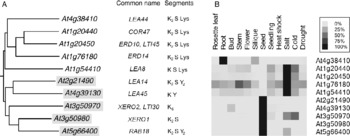
Ten different genes encoding dehydrins were identified in the Arabidopsis genome (Hundertmark and Hincha, Reference Hundertmark and Hincha2008). Five distinct groups of dehydrins can be distinguished based on the presence and number (n) of the signature amino acid motifs: YnSKn, SKn, Kn, YnKn and KnS (Rorat, Reference Rorat2006). They differ in the number of K-segments (KIKEKLPG), the signature motif of dehydrins (Fig. 1A). The other conserved motifs, Y-segment, the S-stretch and the Lys-rich segment, which differs from the K-segment and mainly consists of a stretch of lysine residues, are not systematically present in all Arabidopsis dehydrin sequences. Expression profiles of the ten genes show that their expression depends on the plant developmental stage or abiotic stress factors (Fig. 1B). For four dehydrin genes, no transcript was detected in seeds. Instead the genes were highly up-regulated in leaves under salt and cold stress conditions, suggesting an important role of these dehydrins in abiotic stress responses. One dehydrin gene (At4g38410) was expressed in roots and developing siliques at very low levels (Hundertmark and Hincha, Reference Hundertmark and Hincha2008), and was not stress-responsive. The other five genes showed the highest transcript abundance in dry mature seeds. Interestingly, the dendrogram shows that the seed-expressed dehydrins form a separate cluster from those expressed in vegetative tissues (Fig. 1A). The Y-segment was found in three out of the five seed-expressed dehydrins whereas the Lys-segment is absent in the seed-expressed dehydrins. Among the seed-expressed dehydrins, At3g50970 (XERO2) and At5g66400 (RAB18) also respond to cold and salt stress in leaves. These expression data were consistent with the previous in silico analysis of available microarray data on seeds, resurrection plants and vegetative tissues subject to abiotic stress (Illing et al., Reference Illing, Denby, Collett, Shen and Farrant2005). Those authors suggested that only a specific group of LEA genes was activated as part of the desiccation tolerance programme. To elucidate the possible role of seed-expressed dehydrins in desiccation tolerance and seed longevity, we focused on LEA14 (At2g21490), which is a so far uncharacterized, seed-specific gene that was not induced in vegetative tissue by stress, and performed experiments using a reverse genetics approach.
Phylogenetic tree of Arabidopsis dehydrins and their expression profiles. (A) The ten dehydrin genes of Arabidopsis thaliana were aligned with clustalW and a dendrogram was drawn. Seed-expressed genes are highlighted in grey. The content of K, S, Y and Lys-rich segments, which are typical for dehydrins, in the gene products is given, as well as the attributed gene names. (B) Expression of the Arabidopsis dehydrin genes in various organs without stress and in leaves in response to abiotic stresses. Data are shown as a heatmap that is normalized per gene to indicate where maximal expression occurs. The heatmap was calculated using our quantitative RT-PCR data from Hundertmark and Hincha (Reference Hundertmark and Hincha2008). COR, cold-regulated; ERD, early response to dehydration; LTI, low-temperature induced; RAB, responsive to abscisic acid.

Expression analysis using quantitative RT-PCR
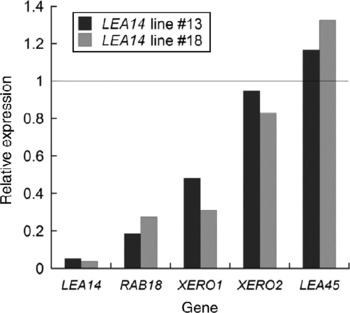
We verified the reduction of LEA14 transcripts in seeds of the two RNAi lines by quantitative RT-PCR. The transcript level of LEA14 was reduced to 5% and 3% in seeds of the independent RNAi-lines #13 and #18, respectively, compared to that in wild-type seeds (Fig. 2), indicating that the introduction of the RNAi construct was efficient. We monitored the transcript levels of the four other seed-expressed dehydrins in the RNAi lines (Fig. 2). While XERO2 and LEA45 showed hardly any change in expression, the transcript levels of XERO1 and RAB18 were reduced to approximately 40% and 20%, respectively. This likely reflects the high homology of the nucleotide sequences of LEA14, XERO1 and RAB18, which share regions that are highly similar (data not shown). Thus, the expression of three seed-specific dehydrin genes was affected by our RNAi approach.
Expression of seed-specific LEAs in the two LEA14 RNAi lines. Expression of dehydrin genes in seeds was monitored by quantitative RT-PCR. Data are expressed as relative expression levels in relation to those in wild-type seeds (horizontal bar at 1). RAB, responsive to abscisic acid.

Desiccation tolerance of LEA14 RNAi lines
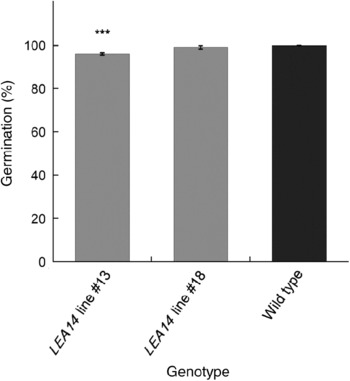
Dry afterripened seeds of both RNAi lines exhibited high germination percentages under optimal conditions (Fig. 3), indicating that the reduction in dehydrin transcript abundance had no major influence on the desiccation tolerance of Arabidopsis seeds. While the slight reduction of germination of seeds from the RNAi line #13 compared to wild-type seed germination was statistically significant (96.0% versus 99.8%, respectively, P ≤ 0.0001 in an ANOVA test), the germination percentage of seeds from the RNAi line #18 (98.9%) was not significantly different from that of the wild type. The reason for the slight reduction in line #13 is not clear.
Germination of mature dry seeds of the two LEA14 RNAi lines and wild type. Approximately 150 seeds per line were imbibed and the germination percentages were determined after 7 d at 23°C. Bars indicate standard errors (n = 5). Asterisks indicate the significant difference between the line LEA14 #13 and wild type according to an ANOVA test (P ≤ 0.0001).

Seed germination after ageing
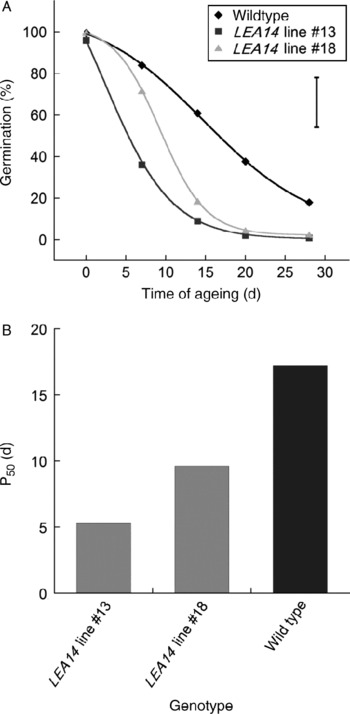
To assess whether the partial silencing of the three dehydrin genes had an influence on seed longevity, accelerated ageing tests were performed at 35°C and 75% RH over 4 weeks. Samples were taken at weekly intervals and imbibed to assess germination, which provided the ageing curves shown in Fig. 4A. The wild-type seeds showed 76% and 51% germination after 14 d and 21 d of ageing, respectively. In contrast, seeds of both RNAi lines showed much lower germination percentages at the same time points ( < 30% and < 3% for 14 d and 21 d, respectively). The enhanced susceptibility to ageing conditions was reflected in the P50, the time of ageing necessary to obtain loss of 50% viability (Fig. 4B). While it took 17 d of ageing to diminish the germination percentage of wild-type seeds to 50%, it took only 5 d and 10 d for seeds of line #13 and #18, respectively.
Loss of viability in wild-type seeds and seeds from LEA14 RNAi lines during storage at 35°C and 75% RH. (A) Germination percentages during ageing. Germination tests (7 d, 23°C) on approximately 150 seeds per line were carried out after indicated time points during storage. Data were fitted with sigmoidal curves. The bar indicates the least significant difference (P < 0.05) calculated from the Poisson distribution (n = 150). (B) Time necessary to obtain 50% viability during storage (P50). Data were calculated from the curves shown in (A) and are expressed in days.

Germination under salt stress conditions
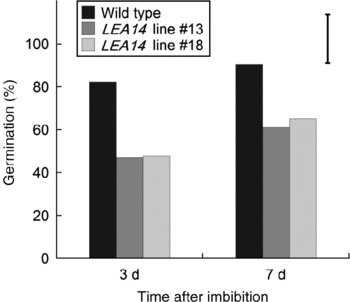
Overexpressing dehydrin genes may lead to increased tolerance to abiotic stress during seedling establishment (Figueras et al., Reference Figueras, Pujal, Saleh, Save, Pages and Goday2004). We tested whether the tolerance to salt stress was affected by the suppression of the three dehydrin genes. We chose 100 mM NaCl, a concentration where the wild-type seeds showed a germination percentage (90.4%) comparable to that observed in the absence of salt (99.8%). Germination of seeds from the RNAi-lines was affected by the salt treatment: seeds of RNAi-lines #13 and #18 germinated only 61% and 65%, respectively, after incubation on agar containing 100 mM NaCl for 7 d (Fig. 5).
Germination of seeds from the LEA14 RNAi lines and wild-type plants under salt stress conditions. Approximately 150 seeds per line were imbibed in the presence of 100 mM NaCl and germination percentages were determined after 3 d and 7 d at 23°C. The error bar indicates the least significant difference (P < 0.05) calculated from the Poisson distribution (n = 150).

Discussion
This study addresses the question whether dehydrins are involved in the desiccation tolerance and storability of orthodox seeds. Because of the small sizes of LEA genes, not many suitable T-DNA insertion lines exist in the Arabidopsis mutant collections. Therefore, we used an RNAi approach which led to a strong reduction in the expression of LEA14 and other homologous dehydrins, LEA34 (XERO1) and LEA51 (RAB18). The seeds of RNAi plants exhibited reduced longevity while their tolerance to desiccation was not affected. There are several reports showing that enhanced dehydrin expression leads to improved germination or seedling growth under stress (Ismail et al., Reference Ismail, Hall and Close1999; Figueras et al., Reference Figueras, Pujal, Saleh, Save, Pages and Goday2004; Brini et al., Reference Brini, Hanin, Lumbreras, Amara, Khoudi, Hassairi, Pagès and Masmoudi2007). Our results indicate that the reduction in dehydrins affects the storability of Arabidopsis seeds. Wechsberg et al. (Reference Wechsberg, Probert and Bray1994) did not find a correlation between the abundance of dehydrin-like proteins and storability of developing Ranunculus sceleratus seeds. The discrepancy between our data and the previous finding is probably due to the technical differences between the two studies: the previous study used polyclonal antibodies raised against a consensus sequence of the K-segment which is present in all dehydrins (Fig. 1), resulting in the recognition of all dehydrins, which may have masked possible correlations between certain key dehydrins and seed longevity. We have demonstrated here that in Arabidopsis the down-regulation of three out of five seed-expressed dehydrins was sufficient to affect seed longevity and performance under salt stress. A decreased ability to tolerate accelerated ageing and abiotic stress conditions during germination is a symptom of low seed vigour (McDonald, Reference McDonald1999). Therefore, our data indicate that seed-specific dehydrins play a role in seed performance as previously suggested by Ismail et al. (Reference Ismail, Hall and Close1999).
The storage conditions chosen to assess longevity (~20°C and ~65% RH) were an intermediate between ambient conditions under which seed deterioration becomes measurable only after several years of storage and extremely deleterious conditions that lead to loss of viability within a few days (Walters, Reference Walters1998; McDonald, Reference McDonald1999; Hay et al., Reference Hay, Mead, Manger and Wilson2003). There is increasing evidence from different plant species, including Arabidopsis, that the accelerated ageing by high temperatures and/or high RH cannot be used to extrapolate the kinetics of deterioration during natural ageing (Clerkx et al., Reference Clerkx, El-Lithy, Vierling, Ruys, Blankestijn-De Vries, Groot, Vreugdenhil and Koornneef2004; Niedzielski et al., Reference Niedzielski, Walters, Luczak, Hill, Wheeler and Puchalski2009). In our study, seeds were stored at 35°C and 75% RH. The water content under these conditions is likely to be around 8.5% (Hay et al., Reference Hay, Mead, Manger and Wilson2003). Thus, the decreased storability of the seeds of RNAi plants suggests a protective role of at least one of the three dehydrins in seeds with low moisture content. Under these conditions, the water potential of the seed matrix is likely very low and the seed matrix is close to the point of glass transition, when it is no longer in the glassy state (Buitink and Leprince, Reference Buitink and Leprince2004). We conclude that dehydrins play a protective role in seeds when the seed matrix is out of its glassy state. Whether dehydrins are also able to play a protective role against natural ageing, similar to the group 3 LEA proteins that stabilize sugar glasses in vitro (Wolkers et al., Reference Wolkers, McCready, Brandt, Lindsey and Hoekstra2001; Shimizu et al., Reference Shimizu, Kanamori, Furuki, Kikawada, Okuda, Takahashi, Mihara and Sakurai2010), remains to be investigated.
For the decreased tolerance of imbibed seeds of RNAi plants to salt stress (Fig. 5), the applied stress corresponds to an osmotic stress of about − 0.2 MPa. This suggests that the dehydrins LEA14, XERO1 and RAB18 play a role also at high moisture contents. LEA proteins have a broad range of stabilizing functions (Tunnacliffe and Wise, Reference Tunnacliffe and Wise2007). It remains to be investigated whether these functions vary depending on seed moisture contents. The reduced germination of the seeds of RNAi plants under salt stress conditions observed in this study is in agreement with the finding that the overexpression of dehydrins, including RAB18, resulted in an increased germination rate under salt stress (Brini et al., Reference Brini, Hanin, Lumbreras, Amara, Khoudi, Hassairi, Pagès and Masmoudi2007).
The precise mechanisms about how the three dehydrins function and whether they act synergistically in the seed matrix remain to be elucidated. The structure of the recombinant RAB18 protein, which has been investigated by circular dichroism spectroscopy (Mouillon et al., Reference Mouillon, Gustafsson and Harryson2006), indicates that it is largely devoid of stable secondary structures such as α-helix or β-sheet, but contains a significant content of highly flexible poly-Pro II (PII) helices. Based on the current understanding of the function of the characteristic conformation of PII, Mouillon et al. (Reference Mouillon, Gustafsson and Harryson2006) speculated that PII helices could alter the hydration shell of macromolecules and act as a water reservoir. This idea is also in accordance with our current understanding about how the physical environment of the seed matrix responds to water content and temperature changes during storage and influences the kinetics of ageing (Walters, Reference Walters1998; Buitink and Leprince, Reference Buitink and Leprince2004). Other possible functions of dehydrins, such as the stabilization of enzymes or membranes in the dry state or binding to Fe ions (for a review see Tunnacliffe and Wise, Reference Tunnacliffe and Wise2007), could also contribute to seed longevity.
The RNAi-induced reduction in the transcript levels of LEA14, XERO1 and RAB18 had little influence on the desiccation tolerance (Fig. 2). Likewise, Manfre et al. (Reference Manfre, LaHatte, Climer and Marcotte2009) showed that the onset of desiccation tolerance in an Arabidopsis mutant with a T-DNA insertion in AtEM6, a LEA gene, was altered during seed development, but the desiccation tolerance itself remained unaffected. In the atem6 mutant, the homologous protein, AtEM1, was found to be more abundant than in wild-type seeds. The authors hypothesized that the accumulation of the EM1 protein probably compensated for the loss of EM6. Here we showed that none of the other seed-expressed dehydrins were significantly up-regulated. On the contrary, the down-regulation of two other dehydrins was observed due to the RNAi construct used to target LEA14. The reduction in dehydrin transcripts did not lead to an impaired desiccation tolerance of Arabidopsis seeds. These results could either indicate that these dehydrins play no important role in desiccation tolerance, or that their suppression was compensated by other mechanisms that were not investigated in this study, as the acquisition of desiccation tolerance seems to be a multigenic trait.
In conclusion, our findings show that Arabidopsis seeds contain an array of dehydrins, some of which have adaptive roles in both seed longevity in the dry state and the tolerance to salt stress during germination. This study also shows that an RNAi strategy is a valuable approach to dissect the roles of LEA proteins in vivo in relation to seed performance.
Acknowledgements
M.H. acknowledges financial support through a PhD fellowship from the University of Potsdam and through a postdoctoral fellowship from the Region des Pays de la Loire. We gratefully acknowledge the assistance of Yvonne Ludwig and Phanh Than Mai.