An important debate associated with the peopling of the New World is the chronological relationship between Clovis and Western Stemmed Tradition (WST) projectile points in the Intermountain West.Footnote 1 Recent discoveries of WST points in Clovis-era deposits at the Paisley Caves (Jenkins et al. Reference Jenkins, Davis, Stafford, Campos, Hockett, Jones, Cummings, Yost, Connolly, Yohe, Gibbons, Raghavan, Rasmussen, Paijmans, Hofreiter, Kemp, Barta, Monroe, Gilbert and Willerslev2012, Reference Jenkins, Davis, Stafford, Campos, Connolly, Cummings, Hofreiter, Hockett, McDonough, Luthe, O'Grady, Swisher, White, Yates, Yohe, Yost, Willerslev, Graf, Ketron and Waters2013) and older than Clovis deposits at Cooper's Ferry (Davis et al. Reference Davis, Madsen, Becerra-Valdivia, Higham, Sisson, Skinner, Stueber, Nyers, Keen-Zebert, Neudorf, Cheyney, Izuho, Iizuka, Burns, Epps, Willis and Buvit2019), in addition to a handful of post-Clovis dates associated with fluted points in the Intermountain West and California, have prompted numerous archaeologists (e.g., Beck and Jones Reference Beck and Jones2010, Reference Beck, Jones, Graf, Ketron and Waters2013; Davis et al. Reference Davis, Madsen, Becerra-Valdivia, Higham, Sisson, Skinner, Stueber, Nyers, Keen-Zebert, Neudorf, Cheyney, Izuho, Iizuka, Burns, Epps, Willis and Buvit2019; Jenkins et al. Reference Jenkins, Davis, Stafford, Campos, Hockett, Jones, Cummings, Yost, Connolly, Yohe, Gibbons, Raghavan, Rasmussen, Paijmans, Hofreiter, Kemp, Barta, Monroe, Gilbert and Willerslev2012) to argue that the WST marks the earliest widespread projectile point technology in the region. Not everyone accepts this premise. Objections mostly center on the associations between WST artifacts and dated materials, uncritical acceptance of the WST radiocarbon record, and an inadequate sample of dated fluted point/Clovis sites for chronological comparison (Fiedel Reference Fiedel2014; Fiedel and Morrow Reference Fiedel and Morrow2012; Goebel and Keene Reference Goebel, Keene, Parezo and Janetski2014). Revisiting known sites and materials with improved methods and reassessing previous analyses can add clarity to this discussion.
Since its discovery, the Buhl burial from south-central Idaho has figured prominently in the WST-Clovis debate for two reasons. First, an AMS date of 10,675 ± 95 14C BP was obtained on collagen from the interred woman's bones (Green et al. Reference Green, Cochran, Fenton, Woods, Titmus, Tieszen, Davis and Miller1998:440). Well-dated Younger Dryas (11,100–10,100 14C BP or 12,900–11,600 cal BP) occupations in the Intermountain West are rare (Goebel et al. Reference Goebel, Hockett, Adams, Rhode and Graf2011; Smith et al. Reference Smith, Duke, Jenkins, Goebel, Davis, O'Grady, Stueber, Pratt and Smith2020). Even with the recent discoveries of WST points in terminal Pleistocene contexts at the Paisley Caves (Jenkins et al. Reference Jenkins, Davis, Stafford, Campos, Hockett, Jones, Cummings, Yost, Connolly, Yohe, Gibbons, Raghavan, Rasmussen, Paijmans, Hofreiter, Kemp, Barta, Monroe, Gilbert and Willerslev2012, Reference Jenkins, Davis, Stafford, Campos, Connolly, Cummings, Hofreiter, Hockett, McDonough, Luthe, O'Grady, Swisher, White, Yates, Yohe, Yost, Willerslev, Graf, Ketron and Waters2013) and Cooper's Ferry (Davis et al. Reference Davis, Nyers and Willis2014; Davis et al. Reference Davis, Bean and Nyers2017; Davis et al. Reference Davis, Madsen, Becerra-Valdivia, Higham, Sisson, Skinner, Stueber, Nyers, Keen-Zebert, Neudorf, Cheyney, Izuho, Iizuka, Burns, Epps, Willis and Buvit2019), the burial remains one of the oldest WST discoveries in the region. When calibrated using a terrestrial calibration curve, the Buhl date (12,740–12,420, 95.4% confidence; Table 1) overlaps with the very end of the Clovis era in the Plains and Southwest (Miller et al. Reference Miller, Holliday, Bright, Graf, Ketron and Waters2013; Waters and Stafford Reference Waters and Stafford2007). The terminal date for Clovis is often taken from the Jake Bluff site in Oklahoma, which produced five AMS dates averaging 10,805 ± 16 14C BP (12,745–12,685, 95.4% confidence; Bement and Carter Reference Bement and Carter2010). Second, a stemmed biface was found immediately below the cranium of the woman. This proximity and the fact that the relatively small number of nearby cultural items (5) were all recovered from the deposits adjacent to the human remains indicate that there is likely a direct association between the artifact and radiocarbon-dated human remains (Green et al. Reference Green, Cochran, Fenton, Woods, Titmus, Tieszen, Davis and Miller1998). For the past two decades, this clear association between dated terminal Pleistocene human remains and a complete stemmed point has been some of the best evidence that WST and Clovis technology might overlap in the Intermountain West. In their critical assessment of early WST point dates in which they expressed reservations about many other associations, Goebel and Keene suggested that the Buhl biface “likely represents one of the earliest stemmed points in the Intermountain West” (Reference Goebel, Keene, Parezo and Janetski2014:46).
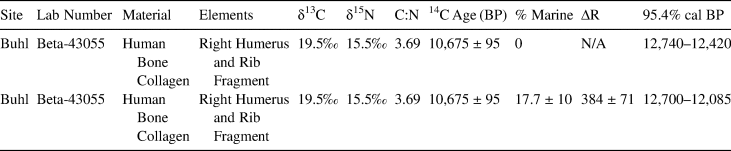
Radiocarbon Date and Isotopic Values Associated with the Buhl Burial Reported by Green and Colleagues (Reference Green, Cochran, Fenton, Woods, Titmus, Tieszen, Davis and Miller1998). (The δ13C value was measured by Beta Analytic Inc. and the δ15N value was measured at Augustana University, both in 1992. The two rows represent calibrated radiocarbon ranges determined for the Buhl burial using a 100% terrestrial curve and a mixed curve of 17.7% marine and 82.3% terrestrial. The mixed curve was applied with a ΔR value of 384 ± 71 and has an error of 10% [Arneborg et al. Reference Arneborg, Heinemeier, Lynnerup, Nielsen, Rud and Sveinbjornsdottir1999].)

The relevance of the Buhl burial to the WST-Clovis debate hinges on the reliability with which this calibrated radiocarbon date reflects the date of death, which relies on the careful consideration of the bone chemistry of the dated individual and any concerns with the quality of the radiocarbon measurement. If the calibrated age range of the burial unequivocally overlaps with the Clovis era, then Buhl may continue to offer important evidence of WST and Clovis contemporaneity in the Intermountain West. Conversely, if the calibrated age range postdates the Clovis era, then it is less relevant because we already know from numerous other sites that most WST sites date to the centuries immediately following Clovis (Rosencrance Reference Rosencrance2019; Smith et al. Reference Smith, Duke, Jenkins, Goebel, Davis, O'Grady, Stueber, Pratt and Smith2020). To be clear, we are not addressing the overlap between WST and Clovis as a whole, which has recently been discussed in more detail elsewhere (Brown et al. Reference Brown, Gilmour, Solimano and Ames2019) and demonstrated at the Paisley Caves and Cooper's Ferry (Davis et al. Reference Davis, Madsen, Becerra-Valdivia, Higham, Sisson, Skinner, Stueber, Nyers, Keen-Zebert, Neudorf, Cheyney, Izuho, Iizuka, Burns, Epps, Willis and Buvit2019; Jenkins et al. Reference Jenkins, Davis, Stafford, Campos, Hockett, Jones, Cummings, Yost, Connolly, Yohe, Gibbons, Raghavan, Rasmussen, Paijmans, Hofreiter, Kemp, Barta, Monroe, Gilbert and Willerslev2012). Instead, we focus only on the Buhl burial, which is frequently included in the debate but which warrants further scrutiny. Furthermore, the primary objective of this article is to outline potential problems with the date from the Buhl burial—not to argue that it can be convincingly assigned to a specific date. We emphasize why it is unreliable and, therefore, that it should not be used in debates about the timing of Clovis and WST. Because the remains have been reburied, it is not possible to obtain additional dates. Here, we outline our concerns with the radiocarbon measurement presented by Green and colleagues (Reference Green, Cochran, Fenton, Woods, Titmus, Tieszen, Davis and Miller1998) and the resulting calibrated range.
The Buhl Burial: Context and History of Work
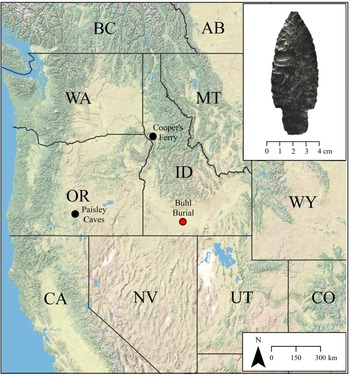
The Buhl burial was inadvertently discovered by highway workers at a gravel quarry near the town of Buhl, Idaho, in 1989 (Figure 1). Workers observed a right femur in a rock crusher and immediately notified the Herrett Center for Arts and Science at the College of Southern Idaho. Herrett Center staff visited the quarry shortly thereafter and observed additional bones near the base of an approximately 5 m high profile of exposed sediment. One day after the remains were encountered, archaeologists from the Idaho Historical Society and Herrett Center visited the site and observed additional bones. They recovered a cranium, mandible, and a few axial elements from the profile. The rest of the recovered elements had been displaced and collected by the workers (Green et al. Reference Green, Cochran, Fenton, Woods, Titmus, Tieszen, Davis and Miller1998). Most of the lower skeleton was never found and was presumably destroyed by the gravel-mining operation. Green and colleagues (Reference Green, Cochran, Fenton, Woods, Titmus, Tieszen, Davis and Miller1998) indicate that the skeleton was not articulated prior to disturbance from construction. Instead, the locations of those elements recovered in situ suggested that the remains had dispersed at some point after the individual was interred. An obsidian stemmed biface was recovered in situ from immediately beneath the cranium and an unmodified badger baculum, a bone needle fragment, and two fragments of an incised bone awl/pin were recovered from screened sediment that had accumulated at the base of the profile (Green et al. Reference Green, Cochran, Fenton, Woods, Titmus, Tieszen, Davis and Miller1998). Upon completing their analysis, Green and colleagues (Reference Green, Cochran, Fenton, Woods, Titmus, Tieszen, Davis and Miller1998) returned the skeleton and associated artifacts to the Shoshone-Bannock Tribes of Fort Hall for reinternment, so they were not available to us for reanalysis.
Location of the Buhl burial and other sites mentioned in the text. The stemmed biface associated with the burial is shown in the inset. (Color online)

Green and colleagues’ (Reference Green, Cochran, Fenton, Woods, Titmus, Tieszen, Davis and Miller1998) report is the primary source of information about the burial, including its context and subsequent bioarchaeological analysis (also see Herrmann et al. Reference Herrmann, Jantz, Owsley and Pedraza2006). They focused on four topics: (1) sex and age estimation, (2) an assessment of overall health, (3) dietary reconstruction via isotopic analysis, and (4) the artifacts associated with the burial. They concluded that the individual was a 17- to 21-year-old woman who stood roughly 161–169 cm tall. She possessed craniofacial features that fall within the range of American Indian or East Asian groups. Her teeth were worn, suggesting that she ingested considerable sand or grit during her lifetime. She had no caries, but linear enamel hypoplasia revealed that she may have suffered nutritional stress or localized trauma at approximately five years of age. Harris lines were observed in a radiographic analysis of Buhl's right femur, also indicating periodic dietary stress. Those issues aside, Green and colleagues (Reference Green, Cochran, Fenton, Woods, Titmus, Tieszen, Davis and Miller1998) concluded that the individual, who became known as the Buhl Woman, was generally in good health at the time of her death, the cause of which is unknown.
The Buhl burial is an important discovery given the direct evidence of Paleoindian lifeways that her skeleton provided. There are fewer than 20 human skeletons from dated Pleistocene contexts in North America (Lepper Reference Lepper, Owsley and Jantz2014), and few individuals have been analyzed in as much detail as the Buhl Woman. Green and others’ (Reference Green, Cochran, Fenton, Woods, Titmus, Tieszen, Davis and Miller1998) study produced rare clues about the general health, diet, and cultural systems of a woman who lived during a time about which we still know very little. The Buhl burial is even more important when considered within the context of the current debate over how and when groups first reached temperate North America.
The proximal half of the Buhl Woman's right humerus and a fragment of a rib were sent by Green to Beta Analytic Inc. (Beta) for AMS dating in 1991 (Table 1). Combining the two samples was necessary to obtain enough collagen for AMS dating. After the samples were combusted and graphitized, three graphite samples were submitted to the Eidgenössische Technische Hochschule (Swiss Federal Technical University) in Zurich (ETH Zurich), which obtained an average AMS date of 10,675 ± 95 14C BP from these samples. Green and colleagues (Reference Green, Cochran, Fenton, Woods, Titmus, Tieszen, Davis and Miller1998) did not calibrate the AMS date or present a calendar age range. The geological context of the burial, which was excavated into aeolian and colluvial sediments immediately overlying Bonneville flood gravels deposited after ~18,000 cal BP (Oviatt Reference Oviatt2015), provides a terminus post quem for the age of the burial.
Limitations to the Radiocarbon Measurement and Calibration
Here, we outline our concerns with the radiocarbon measurement and discuss their implications for the potential contemporaneity of the Buhl burial with Clovis. Our concerns are as follows: (1) assuming the given radiocarbon range is correct, overlap with the established range of Clovis is relatively small and only in the initial tail of the calibrated probability distribution; (2) the ratio of carbon to nitrogen abundance in the bone collagen indicates that diagenesis occurred since the Buhl Woman died, potentially altering the 14C content; and (3) carbon (δ13C) and nitrogen (δ15N) stable isotopic measurements indicate that there may have been a sufficient marine contribution to the Buhl Woman's diet through consuming anadromous fishes from the nearby Snake River to skew the radiocarbon age older when applying a terrestrial calibration curve.
Overlap of Buhl with Clovis
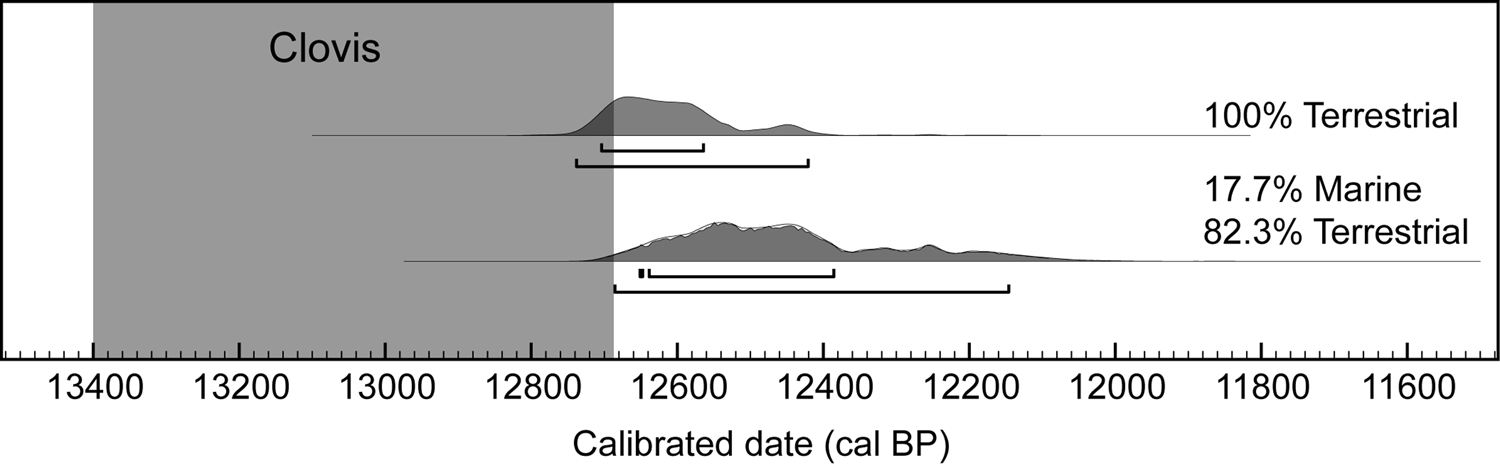
As mentioned above, the uncalibrated date obtained from bone collagen from the Buhl burial at ETH Zurich was 10,675 ± 95 14C BP. When calibrated in OxCal 4.3 using the most recent terrestrial calibration curve, IntCal13 (Reimer et al. Reference Reimer, Bard, Bayliss, Warren Beck, Paul Blackwell, Ramsey, Buck, Cheng, Lawrence Edwards, Friedrich, Grootes, Guilderson, Haflidason, Hajdas, Hatté, Heaton, Hoffmann, Hogg, Hughen, Felix Kaiser, Kromer, Manning, Niu, Reimer, Richards, Marian Scott, Southon, Staff, Turney and van der Plicht2013), it returns a 68.2% confidence interval of 12,705–12,565 cal BP and a 95.4% confidence interval of 12,740–12,420 cal BP (Table 1; Figure 2). The accepted range of Clovis is 13,400–12,700 cal BP (Miller et al. Reference Miller, Holliday, Bright, Graf, Ketron and Waters2013), but we conservatively use the age of 12,685 cal BP (the most recent end of the 95.4% confidence interval from the Jake Bluff site; Bement and Carter Reference Bement and Carter2010) as a terminal date for Clovis. Still, this yields only a 15% likelihood that the Buhl bone date overlaps with the end of Clovis. This value was calculated by summing the area under the curve of the calibrated date that predates 12,685 cal BP. Therefore, while contemporaneity between the Buhl Woman and terminal Clovis remains a possibility, the greater likelihood is that she postdated Clovis. Considering only this fact, we cannot confidently determine that the stemmed biface from the Buhl burial is one of the oldest in the Intermountain West. Instead, based on our model, it is more likely consistent in age with other WST Younger Dryas–aged components (Rosencrance Reference Rosencrance2019; Smith et al. Reference Smith, Duke, Jenkins, Goebel, Davis, O'Grady, Stueber, Pratt and Smith2020). The artifact's morphology suggests that it could even date to the Early Holocene based on similarity to styles and relative chronological associations from recent cases in the nearby eastern Great Basin (Beck and Jones Reference Beck and Jones2009, Reference Beck, Jones, Madsen, Schmitt and Page2015; Duke Reference Duke2011; Duke and King Reference Duke and King2014).
Calibrated radiocarbon ranges for the Buhl burial using a 100% terrestrial curve and a mixed curve of 17.7% marine and 82.3% terrestrial. The mixed curve was applied using the a ΔR value of 384 ± 71. Bars represent 68.2% and 95.4% confidence intervals. The dates are calibrated using the most recent calibration curves, IntCal13 and Marine13 and OxCal 4.3. The dark gray shading on the left represents the accepted age range of Clovis.

Potential Postdepositional Alteration of Carbon in Collagen
There are several reasons to question the reliability of the AMS measurement. Foremost is that it appears that the collagen tested from the Buhl burial was not subjected to filtration. Today, ultrafiltration (or in some cases, XAD or other methods) is typically used to filter out small contaminants, but this was not done for the Buhl burial. In fact, it appears likely that the dated material was simply crude organic that remained after the apatite was dissolved (Irka Hajdas, personal communication 2019). It is unclear whether there was any contamination of the sample from humic acids, but Green and colleagues (Reference Green, Cochran, Fenton, Woods, Titmus, Tieszen, Davis and Miller1998:456) clearly indicate that Stafford's (Reference Stafford, Bonnichsen and Steele1994) best practices for radiocarbon dating bone were not followed, in part because they had yet to be published when the sample was dated. In redating bones from Paleoindian sites, Deviése and colleagues (Reference Deviése, Stafford, Waters, Wathen, Comeskey, Becerra-Valdivia and Higham2018) have shown that dates obtained from XAD-processed collagen and hydroxyproline in some cases return differences of several hundred years or more from more traditional methods. This indicates that when samples are extremely contaminated, it can be difficult to remove all of the contamination from collagen without the newer methods (see also Becerra-Valdivia et al. Reference Becerra-Valdivia, Waters, Stafford, Anzick, Comeskey, Diviése and Higham2018).
Other attributes of the bone chemistry of the Buhl burial also call the reliability of the date into question. The year after the AMS measurement was made and after the bones were reburied, Beta measured some of the remaining collagen to obtain a δ13C value of −19.5‰. This was measured on an isotope ratio mass spectrometer (IRMS) with an error of 0.3‰ (Ron Hatfield, personal communication 2018). Beta returned the remaining collagen to the authors, who submitted it to Augustana College for further isotopic analysis. These tests yielded a δ15N value of 15.5‰ and a C:N ratio of 3.69, with 11% carbon (Green et al. Reference Green, Cochran, Fenton, Woods, Titmus, Tieszen, Davis and Miller1998:448, 456). Although δ13C was likely also measured concurrently at Augustana, this value was not reported by Green and colleagues (Reference Green, Cochran, Fenton, Woods, Titmus, Tieszen, Davis and Miller1998), and it has since been lost (Larry Tieszen, personal communication 2019).
Van Klinken (Reference Van Klinken1999) has argued that the C:N ratio for well-preserved bone should fall within a range of 3.1–3.5 for accepting radiocarbon results. He argues that the range of 2.9–3.6 provided by DeNiro (Reference DeNiro1985) is too wide to make C:N ratios a sensitive tool to detect contamination. Our value of 3.69 is outside of both ranges, indicating that alteration of some sort has occurred. Furthermore, the value of 11% carbon is well below the typical values of 35% in bone collagen (34.8 ± 8.8, 1σ range); values in poorly preserved bone often drop under 30% (Van Klinken Reference Van Klinken1999). A simple calculation indicates that the collagen is then less than 4% nitrogen. This is well below the nitrogen range for intact collagen of between 11 and 16% (Van Klinken Reference Van Klinken1999). This indicates that there was substantial loss of both elements, with relatively more loss of nitrogen than carbon. The date should therefore be interpreted with caution. Postdepositional diagenetic processes could introduce contamination from either older or younger carbon from humic acids or other material in groundwater. Therefore, the poor preservation of the collagen tested by Green and colleagues (Reference Green, Cochran, Fenton, Woods, Titmus, Tieszen, Davis and Miller1998) could affect the accuracy of the radiocarbon measurement, skewing the date. It is important to note that this alteration of the carbon isotope does not necessarily fit the narrative that Buhl is younger than has been frequently interpreted. It may result in a measurement either older or younger than the actual date of death.
Potential Marine Dietary Contributions
Because carbon derived from marine sources is older relative to contemporaneous terrestrial sources, disregarding a marine contribution to the diet will skew the calibrated age older. The Buhl Woman was found adjacent to the Snake River, where salmon and other anadromous fish are abundant today (Green et al. Reference Green, Cochran, Fenton, Woods, Titmus, Tieszen, Davis and Miller1998). Here, we consider the δ13C value of −19.5‰ and δ15N value of 15.5‰ discussed above as potential indicators of a relative marine contribution to the diet. In the original study, Green and colleagues (Reference Green, Cochran, Fenton, Woods, Titmus, Tieszen, Davis and Miller1998) suggested, based on these isotopic values, that there was a marine contribution to the diet, but they did not estimate what it was. For the same reason that we are concerned with the effects of diagenesis on radiocarbon measurements, we also question whether the measured δ13C and δ15N values accurately reflect the isotopic values at the time that Buhl Woman died. Nonetheless, we discuss how, if accurate, these values may indicate a small marine contribution to the diet, which would push the calibrated range younger and decrease or eliminate the overlap with Clovis.
First, we use the method described by Cook and colleagues (Reference Cook, Ascough, Bonsall, Derek, Hamilton, Russell, Sayle, Scott and Bownes2015; see also Arneborg et al. Reference Arneborg, Heinemeier, Lynnerup, Nielsen, Rud and Sveinbjornsdottir1999; Chisholm et al. Reference Chisholm, Nelson and Schwarcz1982) to estimate the relative marine contribution to the diet using the δ13C value. To calibrate a radiocarbon date from the remains of an individual with a mixed terrestrial/marine diet, it is necessary to estimate the percent marine diet of the individual. This method assumes a linear relationship between the δ13C ratios from theoretical 100% marine and 100% terrestrial diets. Because these values are not available for the Intermountain West during the terminal Pleistocene, we adopt end member values used by Arneborg and colleagues (Reference Arneborg, Heinemeier, Lynnerup, Nielsen, Rud and Sveinbjornsdottir1999): we assume that a δ13C value of −12.5‰ represents a 100% marine diet and that a δ13C value of −21.0‰ represents a 100% terrestrial diet. The former is derived from Inuit populations who lived in western Greenland during the fifteenth century (−12.49 ± 0.18‰), and the latter is derived from several samples of Scandinavian populations who lived during the Viking period (−20.49 ± 0.26‰ for 6% marine), Medieval period (−20.92 ± 0.36‰ Sweden for 1% marine; −20.6 ± 0.3‰ Norway for 5% marine), and seventeenth century (−20.69 ± 0.33‰ for 4% marine). A simple linear calculation yields an estimate of a 17.7 ± 10% marine contribution to the Buhl Woman's diet, with the uncertainty given by Arneborg and colleagues (Reference Arneborg, Heinemeier, Lynnerup, Nielsen, Rud and Sveinbjornsdottir1999) as reasonable precision for the method. This is substantially less than the marine contribution of the nearby Kennewick Man skeleton, which returned averaged collagen isotopic values of −13.95‰ for δ13C, indicating a much higher contribution of salmon and salmon-based foods in the diet (Chatters Reference Chatters2017; Schwarcz et al. Reference Schwarcz, Stafford, Knyf, Chisholm, Longstaffe, Chatters, Owlsley, Owsley and Jantz2014). The diet of the Buhl Woman is clearly more terrestrial. Still, although it has only a small marine contribution, we show here that even this could have an appreciable effect on the calibrated age of the bone.
Following Chatters (Reference Chatters2017), we used a ΔR value of 384 ± 71 obtained as an average of the 30 values closest to the mouth of the Columbia River (46.25°N, 124°W) in the CALIB database (Stuiver et al. Reference Stuiver, Reimer and Reimer2020). These dates are primarily from around Vancouver Island, with two from the Oregon Coast. It is consistent with the offset of 400 years for faunal materials obtained by Chatters (Reference Chatters2017) from early Holocene deposits at the Kennewick site. When calibrated using a mixed model with a marine contribution of 17.7 ± 10% and the IntCal13 and Marine13 curves (Reimer et al. Reference Reimer, Bard, Bayliss, Warren Beck, Paul Blackwell, Ramsey, Buck, Cheng, Lawrence Edwards, Friedrich, Grootes, Guilderson, Haflidason, Hajdas, Hatté, Heaton, Hoffmann, Hogg, Hughen, Felix Kaiser, Kromer, Manning, Niu, Reimer, Richards, Marian Scott, Southon, Staff, Turney and van der Plicht2013), the 95.4% calibrated age range for the Buhl burial is 12,690–12,145 cal BP (Table 1). That age range is younger than if the radiocarbon date is calibrated as 100% terrestrial, and it would reduce the likelihood that the date overlaps with the end of Clovis to 1.8% (now 12,700–12,685 cal BP at the 95.4% level). We urge caution in applying the δ13C value to calculate the marine contribution because postdepositional processes that influenced the radiocarbon measurement could also influence this value. Therefore, the value of 17.7% is just an estimate used as a heuristic tool to demonstrate the implications of a partially marine diet in the potential overlap between Buhl and Clovis. Of course, the use of different dietary end members or calculation methods (i.e., nonlinear) would likely affect the results.
Furthermore, the δ15N value of 15.5‰ is high for bone collagen from mammals living inland that presumably have terrestrial-derived diets (DeNiro and Epstein Reference DeNiro and Epstein1981). This value can be a product of several factors. First, it is consistent with coastal populations eating a combination of marine vertebrates and invertebrates (Walker and DeNiro Reference Walker and DeNiro1986). High δ15N values can indicate a marine diet or one that is meat heavy (i.e., reliant on higher-trophic-level organisms). In the case of the Buhl Woman, it may reflect a diet high in salmon and/or other anadromous fishes. In the case of the Kennewick Man skeleton, the value of 21.26‰ for δ15N follows the same pattern as δ13C, indicating that elevated values in the region may be related to marine protein (Chatters Reference Chatters2017; Schwarcz et al. Reference Schwarcz, Stafford, Knyf, Chisholm, Longstaffe, Chatters, Owlsley, Owsley and Jantz2014). There is also evidence that vegetation in arid and high-elevation environments can have elevated δ15N values (Ambrose Reference Ambrose1990; Murphy and Bowman Reference Murphy and Bowman2009). Consequently, herbivores and carnivores living there can also have higher δ15N. The Intermountain West, including the Snake River Plain, is at relatively high elevation compared to the coast, and this region is also drier, although the climate would have been wetter during the terminal Pleistocene than it is today (Goebel et al. Reference Goebel, Hockett, Adams, Rhode and Graf2011). Of course, we apply this δ15N value with caution for the same reasons as we discussed above with carbon. Nonetheless, if reliable, the δ13C and δ15N values obtained by Green and colleagues (Reference Green, Cochran, Fenton, Woods, Titmus, Tieszen, Davis and Miller1998) could be indicative of a marine contribution that would suggest that the calibrated range is younger than previously thought, and therefore, Buhl is less likely to overlap with Clovis.
Conclusion
A paucity of well-dated sites has long hindered efforts to understand how the WST fits into broader models of the peopling of the Americas. Recently, excavations at WST sites and studies of museum collections have improved the situation somewhat (Rosencrance Reference Rosencrance2019; Smith et al. Reference Smith, Duke, Jenkins, Goebel, Davis, O'Grady, Stueber, Pratt and Smith2020). This study represents part of that ongoing effort. The lone radiocarbon date obtained on the Buhl Woman should be interpreted with caution for several reasons. Taken at face value, it indicates only a limited overlap with Clovis at the 95.4% confidence interval. Furthermore, the C:N ratio and %C measurements on collagen indicate that substantial degradation or diagenesis may have occurred or that contaminants may have been introduced that could have led to an erroneously old or young measurement. Finally, based on the location of the Buhl site and possible corroboration from stable isotopic measurements, it is likely that the Buhl Woman's diet included anadromous fish. Calibration that takes this into account would make her younger than previously believed. By considering these factors, it cannot be said for certain that Buhl dates to the Clovis era. Instead, it is unlikely that she does, with a less than 2% probability of overlap if the radiocarbon date is to be accepted.
Other WST components at the Connley Caves, Paisley Caves, Wishbone, Danger Cave, Bonneville Estates Rockshelter, Lind Coulee, Tule Lake Rock Shelter, Wewukiyepuh, and Sentinel Gap all postdate the Clovis era by a few hundred years (Rosencrance Reference Rosencrance2019; Smith et al. Reference Smith, Duke, Jenkins, Goebel, Davis, O'Grady, Stueber, Pratt and Smith2020). Buhl is best interpreted to be considered similarly. If we can accept the radiocarbon date, our reinterpretation of the existing data indicates that the Buhl burial probably postdates older WST components at the Paisley Caves, Bonneville Estates Rockshelter, Cougar Mountain Cave, Connley Caves, Smith Creek Cave, and the older-than-Clovis and Clovis-age WST occupations at Cooper's Ferry and the Paisley Caves. A combination of potential problems with the date from the Buhl burial, along with the fact that at face value, the calibrated date very likely falls after Clovis, indicates that it is not possible to say that the Buhl burial is one of the earliest stemmed point sites in the Intermountain West. Based on the concerns with the lone radiocarbon date presented here, Buhl should no longer figure prominently in discussions of Clovis and WST in the Intermountain West.
Acknowledgments
The Shoshone-Bannock Tribes of Fort Hall granted Thomas Green permission to study the Buhl Woman. Ron Hatfield (Beta Analytic Inc.), Thomas Green (Arkansas Archaeological Survey, retired), Irka Hajdas (ETH Zurich), and Larry Tieszen (Augustana University, emeritus) shared their knowledge and recollections of the original radiocarbon dating and isotope studies. Brendan Culleton (Pennsylvania State University) reviewed an earlier version of this article and provided helpful feedback. Comments from James Chatters, Charlotte Beck, Lynn Gamble, and five anonymous reviewers improved the manuscript. Thank you to Kirk Schmitz for translating the abstract into Spanish.
Data Availability Statement
All data used in this study have been presented in the manuscript.