Introduction
Since 2012 China’s most powerful individual, Xi Jinping, has increasingly attracted research attention. This is understandable given that Xi surprised the world by shedding his inherited status as a primus inter pares within the Chinese Communist Party (CCP) to become China’s strongest leader since Mao Zedong. His rise to power culminated with the inscription of ‘Xi Jinping Thought’ into the CCP constitution in 2017 followed by the removal of term limits for his presidency in 2018. However, this article argues that scholars should focus on the message, not the man. In order to understand the implications of Xi Jinping’s rise for China and the world, what is required is a structural rather than person-centric account of ‘Xiism’. This entails asking what the CCP leadership hopes to achieve by allowing Xi Jinping to become the face of its historical mission at the current, critical stage of its development. Thus, this article analyses the stated substance and logic of the political-economic and ideological agenda for China’s continued rise that Xi Jinping has spearheaded on behalf of the CCP during his first leadership term.
We already have several useful ‘checklist’ overviews of Xi’s major policy initiatives.Footnote 1 However, there have been few attempts to systematically conceptualise the guiding approach of the CCP under Xi in an historical-comparative perspective focused on the implications of the rise of China for international order. Hence, this article offers an anatomy of Xiism, interpreted as a package of discourses and policies articulated by the CCP leadership to serve as a national-cum-global leadership philosophy for the twenty-first century. Indeed, classifying Xiism as a case of a ‘contender state’ power bloc seeking to extend its hegemonic appeal from the national to the international arena, I conceptualise this agenda as a hegemonic project. Inspired by the Gramscian British state theorist Bob Jessop, I define hegemonic projects as the (always contested, fallible, and incomplete) strategic attempts of political-economic elites to produce ideological consent to its rule and bolster it materially with economic accumulation strategies, and an organisational agenda for institution-building, a state project.Footnote 2
By applying this framework to the CCP’s policy agenda under Xi, the article contributes to international political economy scholarship in four ways. First, it adds to the corpus of neo-Gramscian studies of the rise of China in the post-Maoist epoch. By highlighting the articulation between the national and international dimension of Xi’s agenda, it expands on emergent work on Xi’s domestic hegemonic appeal.Footnote 3 Furthermore, it updates neo-Gramscian IR analysis of China’s rise up until the 2008–09 recession.Footnote 4
Second, the Gramscian vocabulary offers a way to integrate rather than abstract from the constitutive effects of ideas and ideology in studies of international political economy. Priya Chacko and Kanishka Jayasuriya have argued that to combat the bifurcation between IR and IPE, we need frameworks that treat (geo)politics and economics as mutually constitutive, rather than giving primacy to one or the other.Footnote 5 However, their attempt at theoretical synthesis underestimates ideology as a mediating force. Emphasising the ideological dimension of China’s rise is crucial both for theoretical and historical-empirical reasons. Theoretically, because – echoing Max Weber – social science cannot succeed without paying attention to the impact of ideas and worldviews in motivating individuals and groups to action. Indeed, as Michael Mann has shown, ideology has been a distinct and non-reducible ‘source of social power’ throughout history.Footnote 6 Empirically, because China’s historical development – from the dominance of Confucian values in imperial governance, to succeeding waves of revolutionary upheaval in the twentieth century, to Xi Jinping’s calls for an ideological reawakening – becomes unintelligible if abstracting from the transformative power of ideas.
Third, the Jessopian framework brings clarity to ongoing debates about what historical figure Xi Jinping most resembles. While Western media routinely dabble in the shock narrative of a ‘return to Maoism’, echoed by some China scholars, one also find observers viewing Xi as an agent of Dengist business-as-usual.Footnote 7 By disaggregating three levels of analysis, this article shows how the legacies of the Maoist and Dengist epochs impact differentially at different levels of the CCP’s current agenda. Xiism, briefly put, seeks to update Deng’s ideology of modernising China through economic ‘reform and opening up’, but combines it with a distinctly neo-Maoist return to charismatic legitimation and Mass-line party-building. Crucially, Xiism also resembles Maoism more than Dengism in aiming for international rather than simply domestic hegemony.
Fourth, by virtue of its integrative ‘politics-economics-ideology’ approach, the Jessopian framework allows us simultaneously to address two specialised debates on the consequences of the rise of China that are not always analytically integrated. On one hand, debates among IR scholars on the implications for the international order of the identity clash between a liberal West and an increasingly assertive, non-liberal China.Footnote 8 On the other, debates among IPE scholars about whether a distinct ‘China Model’ of statist capitalism challenges the ‘Washington Consensus’.Footnote 9 This article analyses the two issues as sides to the same coin: Xiism involves an emergent attempt to launch an alternative to Western-liberal hegemony both at the level of identity-based competition in the system of states, and ‘model competition’ in the global capitalist economy.
Some caveats about the limits to the knowledge contribution are required, however. First, this article does not purport to provide a definitive statement about the nature of Xiism, since it is still in the making. Instead, the ambition is to take stock of the key trends from Xi’s first five years in order to conceptually frame a discussion about China’s current direction and ‘the meaning of Xi’ that will hopefully engage IR/IPE scholars representing various schools of thought. Second, my goal is to clarify how the CCP under Xi is presenting its own historical mission – not to assess whether its discourse is convincing, truthful, or efficacious. The ambition is to show how the CCP’s idealised representation of its own practice differs in crucial respects from earlier periods. This entails studying how the CCP under Xi strategically frames its ideology and policy programme as a systematic and holistic project without flaws. However, the article in no way assumes that the CCP leadership does indeed have a coherent plan, nor that it will be successful in convincing the Chinese population or international constituencies about its benevolence.
Finally, the analytical emphasis is on China’s ideological, not repressive state apparatuses. Because of this focus on the production of consent, the article aims to shed light on how Xiism is heavily fortified by coercion. From the founding of the People’s Republic, the CCP leadership has consistently relied on the power of surveillance and repression to eradicate and/or preempt resistance to its projects, from the Mao-era ideological crackdowns to the crushing of the 1989 student movement with tanks. This repressive state apparatus continues to be in place under Xi Jinping and casts more than a shadow of doubt over any claim by the CCP to actually enjoy widespread popular support. If anything, the functional importance of repression has intensified since 2013, as the CCP’s disciplinary apparatus, aided by new technological advances (AI, face recognition software, big data) has enhanced its infrastructural capacity for monitoring and sanctioning the behaviour of citizens.
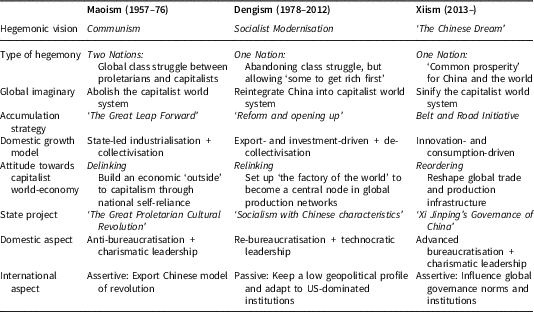
The next section presents the Jessopian framework and specifies the research strategy. After a contextualisation of the emergence of Xiism as a response to growing societal tensions produced by ‘reform and opening up’ since 1978, the three main empirical sections compare ‘Xiism’ to Maoism and Dengism, as hegemonic visions, economic accumulation strategies, and state projects respectively, followed by a concluding discussion of four key challenges to Xiism. Table 1 provides an overview of the argument.
Three hegemonic projects in the history of the People’s Republic of China: an overview.

Source: Author’s compilation.
From hegemony of production to production of hegemony: a Jessopian analytical framework
As an influential state theorist within the Gramscian tradition since the 1980s, Bob Jessop has long emphasised the importance of cultural-ideological struggles to define the ‘common sense’ as key to all politics. However, he also argues for a holistic approach that does not give analytical primacy to the level of ideology. His ‘cultural political economy’ approach aims to make a ‘cultural turn’ while retaining a materialist basis that identifies the capitalist logic of competition and the geopolitical logic of territorial domination as interdependent mechanisms, operating above and beyond how actors ‘narrate’ them.Footnote 10 This holistic starting point makes Jessop’s conceptual universe a relevant, if overlooked, tool for bridging the gap between ‘materialist’ international political economy and ‘constructivist’ international relations approaches.
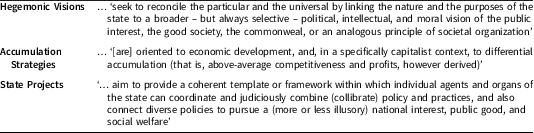
Jessop’s interventions in 1980s debates over British political economy provide an excellent entry point to the specificity of his theoretical position.Footnote 11 Jessop argued that the most influential theorist of ‘Thatcherism’, Stuart Hall, had given a lucid account of the ideational aspect of Thatcher’s agenda (analysed under the headline of ‘authoritarian populism’), but that Hall’s discourse-theoretical method had led him to neglect its material-institutional underpinnings. For Jessop, Thatcherism depended not just upon ideological imaginaries, but also on economic power and control of the state apparatus. To fully understand any hegemonic project, one must analyse it as an attempt to: (1) disseminate a specific set of social philosophical values of what constitutes a just society; (2) devise an economic strategy for national survival in a specific historical conjuncture of the capitalist world system; and (3) reorganise the mode of functioning of the state apparatus accordingly through the formulation of a specific governmental rationality.Footnote 12 Table 2 further specifies the three dimensions.
Hegemonic projects: a three-dimensional analytical framework

Source: Author’s compilation, based on Bob Jessop, The State – Past, Present, and Future (London: Polity, 2016), pp. 86–7; 57; 85.
A key conceptual question is who constitutes the hegemonic agent behind Xiism? In what follows, I build on the assumption that the leading tiers of the CCP can be viewed as a strategically self-aware power bloc defined as ‘… a stable, structurally determined, and organized bloc of dominant classes (or class fractions) and dominant social and political categories (for example, top bureaucrats, military elites, intellectuals)’.Footnote 13 The crucial characteristic of China’s party-state system is the melding together of political and economic power. On one hand, the leadership of the CCP controls both the bureaucratic apparatus and the Chinese army. On the other, it constitutes the dominant, state-oriented fraction of China’s capitalist class, qua its direct control of China’s corporatised, large state-owned enterprises.
Importantly, Jessop does not simply propose to map ideological, economic, and political templates. His method entails Ideologiekritik, in the Marxian sense that hegemonic projects are viewed as attempts of the powerful to make differentially beneficial ideals, policies, and priorities appear as self-evidently optimal for everybody (masking a particular interest behind the a universalist veil). This is not just the case for ideological visions, but also for economic strategies (how do certain sectors of producers and fractions of capital gain more than others?), and for state projects (what interests within the state apparatus are marginalised by the imposition of a specific governmental rationality?). Thus, this article heeds Shaun Breslin’s (2013) warning against ‘overtly-statist and realist’ IR understandings of ‘China’ as a unitary actor.Footnote 14 Jessop’s framework is used to subvert any notion that the CCP leadership actually operates in the objective national interest of China. The point of analysis is rather to study how its claims to do so change over time.
One key virtue of Jessop’s approach in relation to classical neo-Gramscian IR literatures on hegemony is his cautious treatment of the category of ‘hegemony’.Footnote 15 Jessop defines hegemony as ‘… the successful mobilization and reproduction of the “active consent” of dominated groups by the ruling class through its exercise of a political, intellectual, and moral leadership oriented to a “collective will” or “national-popular consensus”’.Footnote 16 Crucially, Jessop argues that this aspiration can only ever be partially and temporarily realised. ‘Hegemony’ is an ideal typical state never fully reached in empirical reality. It is a vector, not a structural trait of the state system or of individual states. What we find in empirical reality are constant struggles both between elites and non-elite forces (to consolidate vs to undermine hegemonic projects or present counter-hegemonic alternatives) and within elite groups (to redefine and remold the political, ideological, and economic underpinnings of existing frameworks).
Rather than presume the existence of (capitalist) hegemony a priori, Jessop prompts us to focus on the improbability of hegemony (analogously to the improbability of a smoothly functioning ‘mode of regulation’). Thus, the aim of analysis is to study the contested ‘production of hegemony’, and not simply to assert the ‘hegemony of production’.Footnote 17 The relevance of applying the category of hegemony in a given historical context cannot be asserted prior to empirical analysis. Accordingly, by reading Maoism, Dengism, and Xiism as hegemonic projects, I am not claiming that the CCP ever achieved its objective of becoming hegemonic. The purpose of analysis is simply to distinguish the shifting historical contour and internal logic of the CCP’s hegemonic appeal.
Conversely, I push an insight from neo-Gramscian IR that remains somewhat underdeveloped by Jessop’s definition. Namely that domestic hegemonic projects need not be limited to a given ‘national-popular’ setting, but can expand to become relevant at a world scale.Footnote 18 Both the size and history of China suggests the pertinence of this insight. For smaller countries, national hegemonic struggles need not relate to hegemony at the level of the inter-state system. Small-state power blocs can eschew the intricacies of international norm setting. In contrast, the CCP has always conceptualised its mission of modernising China as ultimately bound up with the question of world order itself. Consequently, it is insufficient to compare Xiism with Maoism and Dengism as projects to retain legitimacy from the Chinese population. They must be studied also as projects that seek to articulate what could perhaps be termed an ‘international-popular’, that is, to speak to the issue of what would constitute a just world order (and, as it will transpire, Dengism ‘spoke’ by tacitly tolerating the Western-liberal international order).
The analytical strategy is to identify the specificity of Xiism through comparison with CCP strategy in earlier phases. Thus, I use juxtaposition with Maoism and Dengism as the entry point to identifying the defining ideological, economic, and political coordinates of Xiism. However, the objective is not to provide a comprehensive historical sociological analysis of every attempt of articulating hegemonic projects in the history of the PRC. Such a project is too large for the remits of this article. It would involve not only extending the frame of reference back to the original, USSR-inspired state building project from 1949–57 period, before Mao established his idiosyncratic ideological dominance, but also to separately analyse Hua Guofeng’s overlooked stint in power (1976–8).Footnote 19
However, in order to understand the impetus for Xiism – and to deflate CCP hyperbole about Xi Jinping as a great individual – it is pertinent to examine its immediate historical context. This entails outlining how the leadership of Xi’s immediate predecessor, Hu Jintao (2002–12), began to register and respond to new societal pressures produced by reforms, thus anticipating what is now framed as Xiist strategy on several counts.Footnote 20
Contextualising Xiism: Growing tensions under Hu Jintao (2002–12)
When Hu Jintao came to power in 2002, the unintended social consequences of the famously economic reforms initiated by Deng Xiaoping in 1978 had begun to take their toll. During the term of Deng’s designated successor, Jiang Zemin (1989–2002), China had privatised most of its state-owned enterprises and joined the WTO (2001). At the ideological level, Jiang’s ‘Three Represents’ theory justified the decision in 2000 to allow capitalists into the party by stipulating that the CCP primarily represented not workers, but ‘the most advanced productive forces in China’.Footnote 21 Under Jiang’s leadership, then, China had become much wealthier, but also more unbalanced both socially and economically. Consequently, the Hu leadership staked out a shift in both policy and rhetoric designed to counteract the booming difference between winners and losers of reform and lay the grounds for an equitable and socially stable ‘harmonious socialist society’, organised on the technocratic basis of ‘scientific development’.Footnote 22
This political-ideological readjustment was echoed by a realisation that Deng’s economic growth model, which had served China’s take-off so well, could not be relied upon indefinitely. As the 2000s progressed, it became increasingly clear to the CCP leadership that the existing growth model based on low-wage export and investments would need an upgrade. As Hu’s premier Wen Jiabao declared in 2007, the Chinese economy was becoming increasingly ‘unstable, unbalanced, uncoordinated, and [ultimately] unsustainable’.Footnote 23 Thus, a consensus within the leadership about the need for supply-side reforms to escape the ‘middle income trap’ and create a growth model based on domestic consumption was in place several years before Xi’s ascent.Footnote 24 Moreover, in the realm of foreign policy, the Hu administration did begin to move beyond Deng’s cautious approach of ‘laying low’ on the international stage. For example, it initiated the practice of setting up Confucius Institutes as bridgeheads of Chinese soft power.Footnote 25 Similarly, Hu’s discourse of ‘harmonious world’ can be read as a preliminary stage to the assertive foreign policy approach of Xi Jinping.Footnote 26
It is plausible that barring the exogenous shock of the 2008 financial crisis, a distinctly ‘Huist’ hegemonic project would have materialised. However, when faced with the threat of collapsing growth, the Hu leadership resorted to the well-tried practice of stimulus through infrastructure investment.Footnote 27 This business-as-usual approach worked to bring China relatively unscathed through the recession, but also fed into the narrative that Hu had presided over a ‘lost decade’ in having been unable to act with sufficient resolve on their realisation that a new growth model was needed.Footnote 28 Ultimately, the task of recombining and adding building blocks to formulate a holistic and decisively post-Dengist hegemonic project of strategic reorientation at every level – ideological, economic, and political – was left to the Xi administration.
Hegemonic vision: the ‘Chinese Dream’ of national rejuvenation and common prosperity
Below I analyse Xi Jinping’s ubiquitous ‘Chinese Dream’ discourse as the key to the CCP’s hegemonic vision since 2012. Before doing so, I map Maoism and Dengism as comparative points of reference.
Mao’s ideological vision was a radically egalitarian global order without class-based exploitation and imperialist domination.Footnote 29 The political strategy underpinning this vision was adapted by Mao into a ‘Chinese Marxism’ to fit China’s historical conditions. Yet, the normative principles on which this strategy built were those paradigmatically formulated by Marx and Engels in The Communist Manifesto.Footnote 30 Although Mao was optimistic about the prospects of leaping into socialism, he never came to believe that utopia had been reached. Indeed, from the late 1950s onwards, he became increasingly paranoid that after his death China would be thrown off the course towards Communism and revert – as had, in his view, happened in the Soviet Union – to ‘the capitalist road’. Consequently, the hegemonic vision he instilled through the party-state was one of keeping alive fierce ideological class struggle. The purpose was to liquidate the enemies of the revolution, the ‘capitalist roaders’ allegedly still hiding within the Party.
Thus, on Mao’s command, the CCP built its appeal around a ‘Two Nations’, rather than ‘One Nation’ hegemony. In Jessop’s view ‘Two Nations’ hegemonic projects are based on ‘the support of strategically significant sectors of the population’, and ‘seek to pass the costs of the project to other, excluded sectors (as in fascist and apartheid regimes)’.Footnote 31 Meanwhile, ‘One Nation’ projects are based on the claim, ‘often more rhetorical than real’, that hegemony is ‘expansive and exclusive’, that is, ‘based on widespread popular support mobilized through material concessions and symbolic rewards’.Footnote 32 Whereas the Maoist vision explicitly excluded ‘bad class elements’ deemed not to possess the correct ‘proletarian’ attitude, both Dengism – and, as we shall see, Xiism – is predicated on replacing Mao’s combative class struggle vision with an emphasis on social harmony, and a notion of the CCP as the representative of the entire Chinese people – not just parts of it.
From 1978 Deng formulated a hegemonic vision that negated Maoism. Deng did not repudiate the ideological legacy of Mao tout court. Rather, he argued that constructing socialism would take much longer than Mao had assumed. In Deng’s view China would long remain in the ‘primary stage of socialism’. Hence, the CCP’s priority should be economic modernisation as prerequisite of reaching the next ‘stage’. This revised vision was formally adopted through the 1981 Resolution on Party History, which declared that Mao’s relentless pursuit of class struggle after 1958 had been erroneous and that ‘developing the forces of economic production and raising the livelihood of the Chinese people’ was to be the primary objective.Footnote 33
The implication of Deng’s vision of economic modernisation under conditions set by the existing capitalist world system was clear. Nationalism, which had been one leg in Mao’s ‘dialectical’ intertwinement of national liberation and global revolution now became the dominant aspect of CCP ideology. The ‘Two Nations’ hegemony favouring those with a correct ‘proletarian’ mindset was abandoned in favour of a ‘One Nation’ vision emphasising the collective struggle of the entire Chinese People as an assumed functional unit without inherent antagonisms. Meanwhile, the radical egalitarian thrust of the Maoist vision was replaced by the aim of ‘letting some get rich first’, as Deng quipped in 1992. In the general interest of the country’s modernisation, all entrepreneurial spirits had to be released, even if it led to inequality.
How does the CCP’s hegemonic vision under Xi compare to Maoism and Dengism? Briefly put, it is an elaboration on the latter. The slogan of the ‘Chinese Dream of National Rejuvenation’ was first used by Xi in a November 2012 speech and has featured unceasingly since. Xi defined the substance of the ‘dream’ as follows
I firmly believe that the goal of bringing about a moderately prosperous society in all respects can be achieved by 2021, when the CCP celebrates its centenary; the goal of building China into a modern socialist country that is prosperous, strong, democratic, culturally advanced and harmonious can be achieved by 2049, when the People’s Republic of China marks its centenary; and the dream of the rejuvenation of the Chinese nation will then be realized.Footnote 34
Thus, Xi outlined a two-step agenda of ‘national rejuvenation’. The invocation of the so-called ‘Centennial Goals’ – of moderate prosperity by 2021 and a fully modern socialist country by 2049 – loyally echoes Deng’s nationally-oriented vision of gradual modernisation. Indeed, both goals were first mentioned by Jiang Zemin in his 1997 speech to the 15th Party Congress, and so the ‘substance’ of the Chinese Dream was not invented by Xi.
But although the basic coordinates of Dengist ideology remain in place under Xi, its articulation has evolved, as the CCP is attempting to come to terms with a rapidly changing Chinese society and update its hegemonic appeal accordingly. Whereas Deng and Jiang accepted growing socioeconomic differences, Xi Jinping builds on Hu Jintao’s discourse of harmonious society by pointing out that the CCP stands for ‘common prosperity’, thus claiming a heightened attention to the plight of the disadvantaged strata of the Chinese population. This shift was codified in Xi’s crucial remark in his 19th Party Congress Speech (October 2017) that:
As socialism with Chinese characteristics has entered a new era, the principal contradiction facing Chinese society has evolved. What we now face is the contradiction between unbalanced and inadequate development and the people’s ever-growing needs for a better life.Footnote 35
This statement is crucial because of the emphasis laid in CCP terminology since Mao on the dialectical materialist concept of the ‘principal contradiction’ as the pivotal, era-defining problem that decides the overarching strategic orientation of the CCP and justifies major policy shifts, particularly when it is considered ‘antagonistic’ rather than non-antagonistic.Footnote 36 The last time the CCP formally redefined its understanding of the principal contradiction in Chinese society was in 1981 when Deng, overturning Mao’s emphasis on class antagonism, declared it to exist ‘between the ever-growing material and cultural needs of the people and backward social productivity’, thus signalling that economic growth to escape backwardness was the primary objective, to be achieved by any means necessary.
In Xi’s reformulation, the new keyword unbalanced indicates that the CCP’s priority is no longer growth at any cost, but rather to deliver balanced development, that is, to narrow the gap in living standards between the rich coastal provinces and the poor inland provinces, as well as between China’s new rich and the disadvantaged strata. Even though the Hu leadership began to shift CCP discourse in this direction from 2003, it was only with the 2017 Congress Decision that this movement beyond the Dengist agenda was endorsed at the highest theoretical level – thus officially ushering in a ‘new era’. The task of rebalancing development is no longer secondary to furthering growth but has become the primary, existential challenge for the CCP and the defining problem of Xiism as a whole.
Whether the CCP leadership can actually deliver on this promise of more material concessions to the population remains, however, an open question.
Apart from the Chinese Dream, the most important element in Xi’s hegemonic vision is the 12 so-called ‘Core Socialist Values’, a novel conceptual frame through which the galvanisation of two political philosophical repertoires – socialism in the Marxist-Leninist tradition, and traditional Chinese thought – is taken to new heights.Footnote 37 Since late 2012, the CCP has conducted an intense campaign across all propaganda channels (from television and newspapers to billboards and social media) to use this set of ideals to manufacture consent in the Chinese population.
The ‘Core Socialist Values’ are organised in three groups with national values (prosperity, democracy, civility, harmony) taking logical precedence over the societal (freedom, equality, justice, rule of law) and citizens’ values (patriotism, dedication, integrity, and friendship). At first glance, this may appear as a rather random collection of ideals that few could disagree with. But in fact, both the ordering of concepts and the specific meaning given to them in CCP discourse indicates an attempt to crystallise the CCP’s value system as a coherent, positively formulated alternative to Western liberalism.
This attempt is manifested in two ways. First, the quintessentially ‘Western’ political ideals of democracy, freedom, and rule of law are all carefully reinterpreted to fit the Chinese context of a party-controlled ‘people’s democracy’ rather than parliamentarism, of the people’s (collective) freedom as distinct from personal freedom, and ‘rule of law’ referring to the emerging party-controlled system of ‘socialist rule of law’, not to a liberal regime of external oversight. Second, the citizens’ values are not founded in a notion of rights for individuals vis-à-vis the state, but instead on the Confucian idea of the moral obligation for individuals to cultivate a proper mode of behaviour given their place in the societal order. As Gow suggests, the Xi leadership is making a Confucian turn to exploit an assumed pre-existing cultural ‘common sense’ to make the task of generating consent easier.Footnote 38
The inherent ‘Chineseness’ of this national-popular ideological edifice provokes the question of whether it translates into an international-popular, that is, an appeal to the common good that reaches beyond Chinese constituents? Certainly, there has been no lack of effort by the Xi leadership to convince the world that it does. Briefly put, Xiism extends the CCP’s domestic aspiration for balanced and harmonious socioeconomic development to the level of world order. Here, Xi’s speech at the Davos Economic Forum in January 2017 is key. In this speech, held immediately after the inauguration of Donald Trump, Xi explains what kind of global leadership China wishes to exert.
Xi argues that historically, the phenomenon of ‘globalization’ has been beneficial in terms of economic growth, technological advances, and cultural interaction among people. Indeed, in a decisively anti-Maoist passage, Xi asserts that ‘we’ (implying both China and his multinational elite audience) should retain a pro-globalisation stance:
We should commit ourselves to growing an open global economy to share opportunities and interests through opening-up and achieve win-win outcomes … We must remain committed to developing global free trade and investment, promote trade and investment liberalization and facilitation through opening-up and say no to protectionism. Pursuing protectionism is like locking oneself in a dark room. While wind and rain may be kept outside, that dark room will also block light and air. No one will emerge as a winner in a trade war.Footnote 39
However, despite the alleged pro-free trade stance and barely veiled attack on Trump’s protectionism, Xi does not endorse globalisation unconditionally. Globalisation is a ‘double-edged sword’,Footnote 40 which may in times of slumping growth strain relations ‘between growth and distribution, between capital and labor, and between efficiency and equity’. If globalisation processes are not managed adequately, this will lead to an explosion in global inequality. Indeed, this unbalanced development is precisely the ‘biggest challenge facing the world today’.Footnote 41 Development, then, is not just ‘unbalanced’ in China, but across the globe. Xi elaborates that the ‘gap between the poor and the rich and between the South and the North is widening’, that the richest 1 per cent of the world’s population own more wealth than the remaining 99 per cent, and that 700 million people still live in extreme poverty. Thus, Xi calls on his audience to follow China in giving priority to ‘addressing poverty, unemployment, the widening income gap and the concerns of the disadvantaged to promote social equity and justice’.Footnote 42
In Jessopian terms, Xi’s Davos speech can be viewed as an attempt to extend the ‘One Nation’ domestic appeal to the global scale, thus transforming it – in effect – into a ‘One World’ appeal. None of Mao’s geopoliticised class struggle rhetoric survives. The world system is depicted as fundamentally a harmonious place. Indeed, Xi calls for a model of ‘open and win-win cooperation’ on the premise that ‘mankind has become a close-knit community of shared future’. Even if ‘the South’ has withstood the worst costs of globalisation, the solution is not, as in Mao’s time, to antagonise North-South relations. Rather, common solutions are desirable. In fact, as Xi asserts, summits like Davos give elites from various countries the opportunity to identify mutually beneficial solutions. Thus, Xi attempts to position himself as the paragon of a socially responsible, elite-driven globalisation.
Precisely because Xi cloaks his vision in allegedly universal terms, calling mankind a ‘community with a shared future’, it is pertinent to highlight the political ‘selectivities’ of his discourse. Tellingly, Xi concludes by arguing that globalisation cannot be managed adequately without an overhaul of the ‘global governance system’ to offer ‘emerging markets and developing countries’ – including China – better representation. Beneath the universalist appeal, then, lies a self-interested call to give China more bargaining power within international institutions.
This demand points to the key tension of the attempt to move from domestic to international hegemonic vision: between a universalist plea for cooperation and a particularist focus on national development. If the domestic vision is a distinctly Chinese dream of rejuvenation – a both absolute and relative improvement of living conditions for the Chinese people – then how sincere could the talk about international ‘win-win’ cooperation be? This is particularly problematic in a world where natural resources necessary for growth are increasingly scarce. The invocation of a ‘community of shared future’ for all mankind suggests that Xi’s China does not seek to preclude any other country from cooperation on a priori grounds. However, the lingering question is whether anybody really expects Xi to be willing to put the common good of the international community over China’s national interests?
Ultimately, the most efficient way for the CCP to convince the world of its good intentions is probably to ‘put its money where its mouth is’ and invest in ways that generate win-win socioeconomic development. The issue of how the CCP claims to do so takes us to the next level of the hegemonic project, the economic accumulation strategy.
Accumulation strategy: the Belt and Road Initiative and the transition to a new growth model
This section clarifies that Xi’s accumulation strategy is anathema to Maoism, since it retains Deng’s technique of using state-controlled capitalism as a tool for national economic development. Yet, Xiism nevertheless breaks with Deng’s geopolitically cautious approach since it involves an outwards-oriented attempt to reconfigure the infrastructure of global capitalism.
As John Gray lamented, the economic dimension of Maoism is often overlooked.Footnote 43 But Maoism did involve a distinct economic strategy designed to handle competition in/from the capitalist world system. This strategy combined rapid industrialisation with complete socialisation of the means of production and reproduction, guided by macro-scale state planning.Footnote 44 In the 1950s, the PRC had largely copied Stalin’s strategy of forced collectivisation as a means for increasing agricultural productivity and used the revenue to finance state-led urban industrialisation.Footnote 45 However, from 1958, the CCP leadership with Mao at the helm abandoned the Soviet road.
The infamous Great Leap Forward campaign (1958–61), which ended in a catastrophic famine, epitomises the Maoist accumulation strategy’s utopian spirit.Footnote 46 In step with his growing rift with Khrushchev, Mao became impatient with the pace of socialist development in China. Hence, the ‘Great Leap Forward’ entailed a drive to increase agricultural productivity through reorganising the rural population into very large-scale production units, the People’s Communes, which remained in place until the Dengist epoch. Relying on ideological fervor as a subjective factor endowment, Mao aimed to out-compete both the capitalist and ‘revisionist’ Communist powers, thus producing demonstration effects for revolutionary peasant-based socialism worldwide. Mao favoured the principle of economic ‘self-reliance’ to avoid becoming coopted by the West. Instead, China built economic ties with other socialist and developing countries to form an ‘international anti-imperialist united front’.Footnote 47 Thus, domestic collectivised industrialisation was accompanied by ‘delinking’, that is, of building a socialist outside to the capitalist world system, instead of integrating into it.
Dengism negated this Maoist strategy. Deng considered that economic survival could be achieved only by relinking with the capitalist world. Thus, China adopted the well-known economic strategy of ‘reform and opening up’ focused on decollectivisation, market incentives, and foreign capital investments. This happened in accordance with the ideological shift from class struggle to modernisation. Deng’s key accumulation strategy through the 1980s was to use China’s rich supply of cheap labour power to become the ‘workshop of the world’ and achieve export-driven growth based on manufacturing. After an impasse following the 1989 crackdown, which led to intra-party debates on whether reforms had gone too far, Deng finally convinced the CCP to speed up the construction of a ‘socialist market economy’ in 1992.
It may seem as if Deng set China on the course towards complete liberalisation, an ultimate dismantling of the Party’s grip of the economy. However, Deng and his followers remained staunchly Leninist in their approach to creating a market economy. Deng never envisioned the CCP abandoning its core state-owned enterprises and thus losing its control of the ‘commanding heights of the economy’. As Richard Baum points out, the contradiction of Deng is that he combined the two essences of being a ‘bold, pragmatic economic innovator’ and an ‘unyielding, hard-line political Leninist’.Footnote 48 The vision Deng called ‘Socialism with Chinese characteristics’ was always based on a strong state guiding the development of the market economy.Footnote 49 From a liberal-capitalist standpoint it may well be disappointing that Xi – as a loyal follower of Dengist economics – has not vowed to take ‘reforms’ to their supposedly logical consequence of letting the CCP give up its control of a core of state-owned enterprises. But expecting this kind of reform would be to fundamentally misunderstand the way in which the CCP has approached managing the Chinese economy since 1978.
Thus, the Xiist accumulation strategy follows in the footsteps of Deng’s vision of the gradual evolution of a party-controlled market economy. Accordingly, the current objective for the Xi leadership is to upgrade China’s growth model by climbing the value ladder. Export- and investment-driven growth has served China well since the onset of reforms, but a consensus among Chinese and foreign economists suggests that China’s impressive growth rates will soon begin to decline and that structural supply side reforms are needed in order to avoid the ‘Middle Income Trap’. To preempt this scenario, Xi has since 2014 argued that China is moving towards a so-called ‘New Normal’ of lower, but sustainable growth.Footnote 50 The ‘New Normal’ imaginary is used in the Chinese context as a covering term to motivate a set of policies to raise China’s capacity for innovation (industrial policies of R&D investments and preferential treatment of hi-tech start-ups), speed up urbanisation to enhance domestic consumption, and transition to an ecologically sustainable mode of growth.Footnote 51 Its intended function in terms of producing popular consent or, failing this, acquiescence, is to lower public expectations about China’s immediate economic future. The ‘New Normal’ slogan is preemptively deployed to allow the CCP to insist that things are going to plan even in the event of an economic downturn leading to increasing unemployment. Whether the discourse is efficient in shaping public opinion remains an open question.
The international extension of this economic imaginary is the so-called Belt and Road Initiative (BRI), a gigantic infrastructure investment plan first outlined in 2013. The guiding idea is to construct two new ‘Silk Roads’, one across the landmass that connects China with Europe (the Road), and one across the Indian Ocean (the Belt) to Africa, via Central and Southeast Asia. This idea is consonant with the metaphor of national rejuvenation; ancient trade routes must be reconstructed to restore China’s glory. On this premise, Xi’s leadership is courting countries located near the Silk Roads to take part in bilateral partnerships. It has invested a significant part of China’s capital reserves in funds and organisational infrastructure, such as the Asian Infrastructural Investment Bank, to realise the dream.
The geopolitical and geo-economic motivations behind the BRI have been highlighted by IR scholars.Footnote 52 The plan involves a conscious attempt to reorder geo-economic power balances at the continental level and push back against the American ‘Pivot to Asia’ strategy. Indeed, as Sebastian Heilmann et al. note, the BRI serves as part of a wider ‘shadow foreign policy’.Footnote 53 Among the most economically significant ‘shadow’ structures that have either been introduced since 2012 Heilmann et al. list mechanisms to make the Renminbi a world currency (as an alternative to the US dollar); two projected free trade zones, the Regional Comprehensive Economic Partnership (RCEP) and Free Trade Area of Asia Pacific (FTAAP) (as budding, Chinese-centred alternatives to the US-led Trans-Pacific Partnership and the Trans-Atlantic Trade and Investment Partnership); and the approval in 2013 of Shanghai as a new free trade zone and global financial hub.Footnote 54 Furthermore, two new development banks, the BRICS-supported New Development Bank and the Asian Infrastructure Investment Bank, have been established as alternatives to the Asian Development Bank, the World Bank, and the International Monetary Fund.Footnote 55
Reading the exuberant official CCP statements on the BRI, one gets the impression that the initiative is bound to succeed. In contrast, some observers argue that the initiative may become a failure that will leave a trail of incomplete, ‘white elephant’ projects.Footnote 56 For the purposes of this article, however, the goal is not to evaluate the likelihood of success or the degree to which rhetoric is backed up with actual investments. Rather, the concern here is the fact that the CCP leadership has invested significant amounts of political and economic capital in the BRI, and clearly considers it instrumental both to leveraging the desired change of its growth model and as a symbol of China’s changing role in the world.
Indeed, China has begun to work systematically, if cautiously, towards a realignment of the international order. Rather than confront the Western-dominated order directly, China is ‘strategically targeting gaps within established intergovernmental structure’ and focuses on opening up new lines of cooperation by including ‘marginalised countries that are now seeking out new partners for international development assistance’.Footnote 57 The metaphor of ‘shadow’ foreign policy is apt, because China remains fully engaged in existing institutional institutions. However, at the same time, ‘… [China] is constructing supplementary – in part complementary, in part competitive – channels for shaping the international order beyond Western claims to leadership’.Footnote 58
This attempt to reshape the institutional governance infrastructure of the global economy illustrates the difference between Xiism and Dengism. Xiism is oriented towards changing how global capitalism is institutionalised and regulated, rather than simply adapting to it. However, there is also a domestic economic logic, related to the attempt of upgrading China’s growth model, behind this increasingly assertive international approach.
The BRI allows China’s state-owned enterprises to export their excess capacity.Footnote 59 The BRI involves building, for example, railroads, ports, roads, power plants, airports – precisely the kind of infrastructure investments now becoming less tenable in China itself for the state-owned mega-companies in the construction and energy sectors. The BRI thus involves an attempt to geographically displace the contradictions of the current Chinese growth model, and lower the opposition of ‘vested interests’ at home. Following Jessop, we can think about the ‘selectivities’ of the accumulation strategy by asking for which fractions of capital it is particularly beneficial. Here, the compatibility of the BRI with the needs of the SOE sector stands out. The power bloc, headed by Xi, is not about to abandon itself as part of the transition to consumer-based growth, but is rather gradually moving its activities abroad. This potentially opens the path for other fractions of capital on the Chinese market to prosper, but in a way that does not threaten profitability for the SOEs. Indeed, the Belt and Road Initiative is an economic imaginary of what is good for China that is especially attuned to what is immediately lucrative to the SOE sector the CCP leadership’s own economic base.
The following section examines how a distinctly Xiist state project has been articulated as the institutional mediation between the ideological vision of ‘the Chinese Dream’ and the economic strategy of upgrading China’s growth model.
State project: Exporting ‘the governance of China’?
This section argues that while the Xiist state project loyally pursues Deng’s socioeconomic development goals, it also revitalises Mao-era governance practices in two important respects. First, charismatic legitimation and intra-party self-rectification campaigns are back. Second, Xiism reignites the domestic/international dialectic of hegemonic aspiration.
The Dengist state project was coupled with the accumulation strategy of ‘reform and opening up’. The unifying purpose of party-state development under Deng was that of exploring the optimal ways to advance and manage the gradual transition to a market-based economy, while retaining social stability under the CCP’s political command. The historical backdrop to this emphasis on pragmatics, as opposed to ideological zeal, was the societal instability generated by Mao’s ‘Great Proletarian Cultural Revolution’ (GPCR). The GPCR was launched in 1966 and officially lasted until 1976. Mao launched the GPCR to avoid that the revolutionary fervour of the party-state would become stultified through bureaucratisation. The goal was to keep the domestic class struggle alive, beyond the taking of state power, through grassroots mobilisation.Footnote 60 Thus, the GPCR represented a combined anti-capitalist and anti-state project – an attempt to make it impossible for the party-state bureaucracy ever to pursue modernisation on a capitalist economic basis. In this context, the personality cult around Mao Zedong as the charismatic embodiment of the revolution was an important part of the alternative to bureaucratic legitimation.Footnote 61
In contrast, Deng emphasised the need for predictable, institutionalised, and depersonalised – in a word rebureaucratised – CCP leadership and governance. Despite his elevated personal status and vast discretionary powers, Deng sought to institutionalise party-state mechanisms of governance that would prevent a return to what he perceived as a regressive state of personality cult that had blighted the GPCR epoch.Footnote 62 Specifically, Deng – and the leaderships of his successors, Jiang Zemin and Hu Jintao – all stressed the importance of collective decision-making based on reaching a deliberative consensus within the CCP leadership. Here, the Dengist state project differed starkly from that of Mao Zedong who often launched political campaigns ‘unilaterally’, banking for support on his assumed direct connection to the hearts and minds of the Chinese masses.
The other crucial difference between the two state projects concerns their geographical scope. Even though China’s actual foreign policy line fluctuated between 1957 and 1976, Maoism was comparatively assertive in international affairs, powered by the doctrinal long-term goal of replacing the ‘imperialist’ world order with a socialist one.Footnote 63 Dengism, in contrast, entailed a ‘non-revisionist’ foreign policy approach. The mission of inspiring socialist revolutions across the globe was replaced by national development as the stated goal. Deng’s state project saw China literally minding its own business to achieve domestic economic growth. Thus, Dengism left the CCP with one sole hegemonic aspiration – towards the Chinese people – and abandoned wider international audiences. This geopolitical acquiescence indicated the shift in the CCP’s mindset from challenging the Western-led international order to accepting (at least for the time being) the logic and institutional set up of the existing capitalist world system.
What, then, about Xiism? An indispensable entry point to the current state project, as the CCP leadership wants the world to perceive it, is Xi Jinping’s 2014 book The Governance of China.Footnote 64 This volume, published simultaneously in nine main languages, compiles 79 speeches by Xi between 2012 and 2014. With coverage of every policy field from economic reform over anti-corruption to foreign relations, the book represents an attempt by the CCP leadership to summarise its alleged wisdom on both domestic and international governance in one single volume, reaching out to domestic and global audiences with an identical message.
That message is that the alleged genius of Xi Jinping lies in his ability to synthesise a plethora of sources of inspiration from across Chinese history and build them into one coherent state philosophy. Xi’s speeches are laced with aphorisms from Chinese state philosophers across dynasties, from the Shang (c. 1600–1046 bc) to the Qing (1644–1911), ostensibly representing a millennial tradition of Chinese governance wisdom to which the CCP is positioning itself as the natural heir. But beyond reclaiming this imperial philosophical legacy, Xi’s agenda is furthermore presented as an amalgamate of the best aspects of both the Dengist and the Maoist legacies. This is indicated by the structure of the book, with several chapters honouring the intellectual contributions of both men.
Beyond homage to the ancestors, however, the book also emphasises the personal charisma of Xi Jinping as the alleged bearer of the aspirations of ordinary Chinese people. The Governance of China projects an image of Xi that mirrors Max Weber’s definition of charismatic authority as ‘… resting on devotion to the exceptional sanctity, heroism or exemplary character of an individual person, and of the normative patterns of order revealed or ordained by him’.Footnote 65 The Governance of China not only reveals a set of ‘normative patterns of order’ (the corpus of speeches) but also highlights the ‘exemplary character’ of its ‘author’. The concluding biographical chapter, ‘Man of the People’, is the longest and most significant of the book. It tells the story of a man who, despite coming from a privileged background as the son, former vice-premier Xi Zhongxun has ‘experienced tough times’.Footnote 66 The trauma of the Cultural Revolution, during which the young Xi ‘volunteered’ to relocate for seven years to a remote village in the Shaanxi countryside, is invoked to create an emotional bond of common hardship between Xi and his people. This experience is highlighted as the reason why he chose to pursue a career in the service of the Party rather than go into business like many of his generation, and why he has ostensibly developed a deep affection for common people.
Thus, The Governance of China construes Xi as the moral guarantor of the CCP’s benevolence towards ordinary people. Xi’s personality is given as a key reason to trust the viability not only of the state project of improving governance, but indeed the hegemonic project of geopolitical ascent, growth model transition, and clean government as a whole. The Governance of China seems designed to leave the reader with the impression that the hegemonic project of the current CCP leadership as a whole is impossible to detach from the personal integrity of the most powerful individual within it.
The question, though, is how this discourse of a charismatic leader embodying a new synthesis of Maoist, Dengist, and traditional Chinese statecraft has been implemented in practice. While there is consensus among scholars that party-state governance has changed drastically since 2012, debates on the nature and direction of change are still ongoing. One economical way to summarise ‘Xiism-in-practice’ is to point to two overarching and intertwined policy trends, centralisation and party self-rectification.
Centralisation has been implemented through a wide range of reforms and campaigns to grant more power to the party leadership with Xi at the centre vis-à-vis both the state apparatus and wider Chinese society.Footnote 67 For example, the formal administrative structure of the party-state has been reformed to narrow the decision-making space for local government. In many areas of policy including the economy and national security, the CCP’s ‘leading small groups’ have taken over power from formal state bodies.Footnote 68 The People’s Liberation Army has been streamlined to ensure direct loyalty to Xi. State media face an increasingly strict obligation to toe the Party line.Footnote 69 In higher education, teachers have been instructed to highlight the CCP’s teachings and refrain from spreading subversive foreign ideas. The role of party committees in all firms, including private and foreign-owned ones has been enhanced. In civil society, a new NGO law entails stricter control through a requirement to formally register with the government.
This shift in party-state and party-society relations has occurred in tandem with a sustained campaign of intra-party self-rectification, designed to improve the moral behaviour of cadres through what Shaoying Zhang and Derek McGhee aptly term ‘ethical revolution’ designed first to legitimise the CCP in the eyes of the people and second to improve the bureaucratic efficiency of the party-state.Footnote 70 The negative expression of self-rectification is Xi’s much-debated anti-corruption campaign. Although anti-corruption initiatives did exist before 2012, Xi has undeniably upped the ante both in terms of the number of people convicted, and through the conviction of many high-ranking cadres – so-called ‘tigers’ – earlier assumed to be above the law.Footnote 71
However, the ‘pre-emptive’ side of ‘self-rectification’, the concomitant attempt to reshape cadre behaviour to fit with top-level requirements, is equally significant. Since 2012, an array of new policies have sought to curtail ‘bad work styles’ by instituting bans on excessive and immoral consumption (lavish banquets, travel, expensive cars, etc.) deemed catastrophic to the CCP’s image in the general population. To enhance a virtuous and frugal culture the Xi leadership has unrolled a campaign of ‘Mass Line Education’ that takes its inspiration from Mao’s teachings on how to be a good communist and involves Cultural Revolution-style self-criticism sessions.Footnote 72 In addition, the Xi administration has deviated from its predecessors by making ‘ideological correctness’ and political loyalty to the central leadership formal criteria for promotion.Footnote 73 As Xi’s speeches in The Governance of China reveal, the normative compass informing this campaign is a mix of Mao-era communist ideals, and cumulative philosophical insights from more than two millennia of ostensible enlightened elite rule, starting with the Confucian Analects.
In sum, the Xiist state project seeks to refine an indigenous Chinese model of governance that abandons Western inspirations and instead embraces the Chinese ‘Confucian’ tradition of morally invested officials as the necessary supplement to the Marxist-Leninist legacy. This project involves a paternalistic point of departure, which stresses the moral superiority of the elite or vanguard. The liberal solution to inefficient governance and corruption would be to increase civic oversight. Xiism in contrast insists that intra-party self-monitoring is superior to external mechanisms as long as CCP cadres retain their moral vanguard character. The same logic extends to centralisation. If the leadership is corrupted, centralisation is catastrophic. Conversely, if CCP cadres are indeed more virtuous than ordinary citizens are, centralisation will improve governance efficiency.
The notion that China must develop a political system that fits with Chinese culture is of course not unique to the Xi leadership. But its self-confidence about having ostensibly developed a coherent system of governance, on par with or even superior to the Western model, is. No pretension is made, however vague, of a political convergence or Western-style political reforms still to come. This brings us, finally, to the thorny issue of the possibility of an internationalisation of Xi’s state project.
What distinguishes the Xiist foreign policy approach from the Dengist and makes it structurally – but not substantially – similar to Maoism is the notion that the set up of the inter-state system needs to be reshaped. As indicated, Xiism involves a self-conscious attempt of the Chinese power bloc to influence global governance norms and institutions, both through discursive soft power and institution building. This constitutes an evolution beyond the Dengist state project, which focused on readapting China to the existing institutional framework of global capitalism, while ‘keeping a low profile’ in foreign policy affairs, as Deng famously put it. Now, under Xi’s slogan of ‘striving for achievement’, China is once again becoming a voice for change in the international system.Footnote 74 The CCP has reemerged as a self-assured participant in a global dialogue on how to set up polities, both at the national and international levels. The advocacy of a distinct ‘China Model’, until recently left to party-aligned intellectuals, is becoming part of the CCP’s own discursive repertoire.
But exporting a state project is difficult. Whereas ideological visions can be conceptually ‘stretched’ and globally communicated at a low cost, and capital investments are relatively mobile, state apparatuses are more territorially bound. Consequently, it is unsurprising that the Xiist governance strategy remains less explicitly articulated at the international level than the either hegemonic vision or the accumulation strategy. Arguably, the practice of ‘shadow foreign policy’ constitutes a first step towards the institutionalisation of Chinese notions of good global governance in the realm of international institutions. Yet, the ‘transnationalisation’ of the Chinese state project discussed by Chacko and JayasuriyaFootnote 75 is – from a Jessopian viewpoint – a future possibility, not an institutional reality.
Xi’s second term as party chairman (2017–22) will be the crucial test to the viability of Xiism beyond China’s own borders. This period will be critical not only to the success of BRI and the new international institutions designed in support of it, but also to the possibility for the CCP to bilaterally ‘sell’ Xi-style governance as a recipe that other countries can take inspiration from for their own national state projects. The prediction emanating from the analysis above is that Xiism as inter-state project is only in its infancy and will develop rapidly in the 2020s in step with China’s increasing political-economic stakes in retaining social stability beyond its own borders.
To gauge potential outcomes, we must be clear on what a Xiist hegemonic push in relation to global governance would seek to achieve. Here, Xiism’s difference from self-declared universalist state projects (such as the liberal imaginary of the West) is important. By its own admission, the CCP harbours no intention to push its own, culturally specific model as a universal one-size-fits-all recipe. If nothing else because this would bluntly contradict the rhetoric raised against the US that no country should seek to impose its own values upon others, but that all countries have a right to develop their own culturally appropriate institutions without interference. Besides, while Xi may be projected to the world as the epigone of societal stability and long-term planning (particularly as the negation to Trump’s unpredictability) it is doubtful that his alleged charisma works beyond China’s borders.
Nevertheless, it is – ceteris paribus – in the CCP’s interest to contribute to changing the global power balance in favour of national state projects that, while of course culturally divergent, are structurally similar to Xiism in terms of its political and economic foundations. As China’s involvement with Hun Sen’s dictatorial regime in CambodiaFootnote 76 suggests, dealing with fellow ‘authoritarian statist’ elites that are unburdened by democratic opposition and less inclined to follow ‘Western’ liberal norms is conducive to the kind of high-speed economic development and bilateral deals desired as part of the growth model upgrading.
Arguably, the global political moment appears to be one of convergence with Xiism’s communitarian-nationalist brand of ‘strongman’ governance. From Putin’s Russia across Duterte’s Philippines, Orban’s Hungary, Erdogan’s Turkey to Bolsonaro’s Brazil, a wave of explicitly illiberal state projects are emerging within formal democracies on the promise of restoring lost national glory by silencing the cacophony of an ostensibly inefficient parliamentary system. In this regard, the global significance of Xiism may lie in showcasing that resurgent nationalism can be combined with a strategic embrace of globalised capitalism, rather than a protectionist withdrawal from it. Xiism does not solve Dani Rodrik’s ‘trilemma’, which suggests that only two of the three desirables of deep economic globalisation, national sovereignty, and democracy can be realised at the same time.Footnote 77 Yet, it may contribute to inspiring a return to the nineteenth-century formula of fierce nationalism plus pro-capitalist globalisation minus democracy, as the globally dominant government rationality.
The big question, however, is whether Xiism’s inherent tensions will turn out to derail the CCP’s global ambitions sooner rather than later. Below, I close on a critical note by outlining the nature of four such challenges to Xiism.
Conclusion
The theoretical ambition of this article is to call on international political economists to ‘bring ideology back in’ when studying China’s rise. At a time when both the geopolitical assertiveness and sheer economic prowess of China registers ever more strongly in debates over the future of international order, it is pertinent to grasp what ideological vision of the ‘Good (world) Society’ China’s Communist Party – from its foundation in 1921 an eminently ideas-driven organisation – seeks to project both within and beyond its borders. By applying a Jessopian framework for mapping and comparing ‘hegemonic projects’, this article has proposed one way to confront that challenge.
The Jessopian framework also allows us to develop a neo-Gramscian IR approach that avoids asserting the ubiquity of (capitalist) ‘hegemony’ with its roots in economic production. Instead, the article exemplifies a research agenda of mapping the (always contradictive and contested, and often futile) attempts of power blocs to manufacture consent by producing a socially persuasive account of the naturalness of their rule through the combination of ideological imaginaries, economic policies, and institutional blueprints for state building. This approach takes the improbability of hegemony as its theoretical starting point, and focuses on how power elites seek to ‘beat the odds’ by building and readjusting a political mode of regulation that helps to stabilise their hold of power within a given historical conjuncture.
Following Jessop, hegemony is improbable even in liberal-democratic states with parliaments as channels of formal legitimisation. Hence, the challenge of building consent is no less stark for power blocs in countries like China. One does not need to argue that the CCP has ever actually achieved hegemony in any meaningful sense to acknowledge the fact that it has somehow managed to prevent existential challenges to its rule for seven decades. Of course, the constant use of repression is an important part of the explanation, but so are historically variable claims to ‘performance-based’ legitimacy (the CCP as the guarantor of inter alia socialist justice, national strength, social stability, economic prosperity, etc.). As the CCP leadership seems eminently aware, the strategy for manufacturing consent requires constant recalibration as society develops. It is in this light we must see the rise of Xi Jinping.
Thus, the empirical objective of this article is to apply this Jessopian framework on the case of ‘Xiism’, a sui generis hegemonic project in the making, emerging during Xi Jinping’s first leadership term (2012–17). In relation to ongoing debates about the meaning of Xi, the Jessopian framework allows us to deconstruct the binary terms of discussion. By disaggregating Xiism into three domains, we get a firmer grasp both of where China is moving as it enters a new era, and how we are neither observing a Maoist revival nor simply Dengist ‘business-as-usual’. The empirical analysis reveals that Xiism is comparable to Maoism, but distinct from Dengism, in terms of its projected range. Under Xi, the CCP-based power bloc is no longer content with seeking hegemony domestically, but is indeed constructing a set of globally oriented policies and discourses in support of its rule. The emergence of Xiism signals that China aims to become an active ‘contender state’ in the battle for global hegemony.
It is crucial for understanding the nature of the challenge, however, that Xiism is a world apart from Maoism’s call to universalise revolutionary socialist upheaval. First, the hegemonic vision of the ‘Chinese Dream’ negates Mao’s utopian-egalitarian dream while merely readjusting Deng’s goal of national prosperity through markets. Where Deng famously ‘let some get rich first’, Xiism emphasises ‘common prosperity’ as the priority both at home and internationally. Second, Xi’s accumulation strategy, rhetorically built around the Belt and Road Initiative consists in exporting the excess capacity of China’s state-permeated model of capitalism through heavy investments in infrastructure across Asia and beyond to make room for an upgraded growth model based on domestic consumption. Third, the Xiist state project attempts to fuse the millennial political tradition of ‘Confucian’ governance with both a neo-Dengist commitment to political stability and Mao-era practices of charismatic legitimation and intra-party moral self-rectification.
Due to space constraints, this article has focused primarily on mapping Xiism’s hegemonic appeal as the CCP leadership itself construes it. Hence, the analysis has only scratched the surface of which factors speak against Xiism as a plausible recipe for popular consent. Ultimately, a central aim of Jessopian and Gramscian analysis is to prepare the ground for critical work of this kind. Hence, to conclude I outline four points of departure for future studies of the challenges to Xiism.
First, the Xi leadership’s ability to manage the case of Hong Kong constitutes a major litmus test in coming years. While popular political opposition to Xiism in the mainland is currently made virtually invisible, the situation in Hong Kong – a microcosm of the global clash between top-down and bottom-up governance ideals – is quite different. Hong Kong’s new grassroots movement for democracy, which emerged in 2014, challenges the CCP’s claim that parliamentary democracy and liberal rule of law is not compatible with Chinese culture. The more internationally visible this movement, the weaker the CCP’s claim to possess the historical and moral authority to define what political system constitutes the best match with Chinese culture and mentality. Consequently, the Xi leadership must at all costs prevent another wave of popular protest from propelling into media headlines across the world and producing a major publicity setback for Xiism. But the dilemma is that the democracy movement may only become further empowered by heavy-handed CCP attempts to repress it. On the other hand, if left alone the movement can quietly expand its reach into Hong Kong civil society, thus improving its resilience and functionality as a sanctuary for exiled dissidents and training ground for mainland working-class organisers.Footnote 78 This points towards the second challenge.
It is an open question whether the Xiist formula involves sufficient concessions to China’s increasingly self-aware working class to prevent discontent from taking root. The Xi leadership appears to assume that a critical mass of workers can be acquiesced through a ‘Bismarckian’ combination of improving material living standards, welfare benefits, and enhanced national-cultural pride but without political empowerment. Meanwhile, reforms of the industrial relations system to institutionalise independent worker representation remain off the table as antithetical to Xiism’s mantra of top-down control. But if the CCP systematically misreads the mindset of a new generation of Chinese workers, this gamble could backfire. Moreover, the spectre of orthodox Marxist sentiment (particularly of a Maoist hue) in wide sections of the population could still come back to haunt the CCP leadership, undercutting its claims to represent the Chinese people. The Xi leadership walks a tightrope. It has no choice but to appropriate Marxist categories for its own purposes. Discarding Marxism in favour of a full ‘Confucian’ turn would leave a flank open for counter-hegemonic projects based on the mobilisation of widespread socialist sentiment. On the other hand, embracing orthodox Maoism is incompatible with the CCP’s political and economic ambitions both at home and internationally.
Third, the Xi leadership’s increasingly harsh repression of both political dissidents and ethnic minorities, exemplified by the forced mass-scale assimilation of the Uighur population,Footnote 79 as well as the ramping up of online censorship and the curbing of intellectual debate arguably undermine the CCP’s aspiration to active consent. The ‘Chinese Dream’ is framed as an expansive and socioculturally open-ended ‘One Nation’ hegemony. Yet, from the perspective of dissidents and minority groups – and arguably from the international community as well – the reality is more like an emergent ‘Two Nation’ hegemony. The contradiction is that the more aggressively the CCP cracks down on what it deems to be ‘unpatriotic’ elements in order to retain social stability, the clearer it becomes that ultimately, despite rhetorical claims to the opposite, the CCP bases its power mainly on its monopoly of violence rather than ideological consent.
Finally, a fourth threat to Xiism concerns intra-elite unity or, in Jessopian terms, the cohesion of the power bloc. Xi Jinping came to power as a candidate with wide support across factional boundaries. However, his elevation since 2015 to the status of charismatic helmsman and de facto number one decision-maker could easily upset delicate intra-party power balances. To the extent that Xi goes beyond his original mandate to make Xiism a personalistic project rather than a project of the power bloc as a whole, it becomes vulnerable to intra-elite splits, which may in turn embolden insurgent popular movements. However, firm evidence proving that Xi and his closest allies have started a war within the party has still not surfaced. Hence, we should not rule out the possibility that the power bloc as a whole (or at least its overwhelming majority) continue to see Xi as one of the CCP’s strongest assets in its struggle to keep China together while also advancing internationally. Besides, on a more cynical note, from the point of view of CCP as an organisation, a person-centric agenda can have its advantages. If Xiism should prove a strategic failure, then – similarly to Mao’s fate after 1978 – the CCP will once more have one individual on whose ‘subjective errors’ to deflect the blame.
Acknowledgements
I would like to thank the editors and the three anonymous reviewers for their many constructive suggestions, which helped me to clarify the argument. Furthermore, I am indebted to Ben Rosamond, Nis Grünberg, Bo Ærenlund Sørensen, Pia Bang Jensen, Hubert Buch-Hansen, Tobias Ten Brink, Laura Horn, Shaun Breslin, Li Xing, Leonard Seabrooke, Eleni Tsingou, Lasse Folke Henriksen, Rune Møller Stahl, Peter Marcus Kristensen, and Andreas Bøje Forsby for their valuable advice. All remaining errors are, of course, my own.