Introduction
In 1876–78, William Temple Hornaday, a taxidermist who would later become famous as one of North America's most important wildlife conservationists, was funded to travel to India and Ceylon on a year-and-a-half-long hunting expedition to collect specimens for various natural history museums throughout the United States.Footnote 1 Although the trip was a resounding success, in that it supplied his country's budding museums with many of their first Asian animal exhibits, Hornaday ran into considerable resistance to his hunting all along the way. Once Hornaday landed in Bombay, he started making enquiries as to where he could find certain specimens, particularly the gharial (Gavialis gangeticus), a long-snouted species of crocodile unique to South Asia.Footnote 2 In his hotel, he met an educated Indian gentleman, who started to excitedly describe the haunts and habits of his country's wildlife. In Hornaday's words:
He was talking at a great rate, and I was busily jotting down notes, when he suddenly stopped and asked, ‘Sir, why do you require to know about these animals?’ ‘Why, I wish to find them.’ ‘Why do you require to find them? Do you wish to shoot them, to kill them?’ ‘Exactly, for their skins and skeletons.’ ‘Ah,’ he said, dropping my map, ‘then I cannot inform you where any animals are; I do not wish any thing to be killed, and if I tell you where you can find any animals I shall do a great wrong.’Footnote 3
Undeterred, but perhaps perturbed, Hornaday journeyed from Bombay to the Jumna River where he commissioned a boat and shot a number of gharials as well as blackbuck, deer, gazelle, and nilgai in the ravine country near the river. Here he encountered resistance of a more direct kind. Hornaday records:
One day as we were floating down the river with an eleven foot gavial skin suspended by the head from the top of the mast . . . we saw some distance ahead of us three gavials lying upon the bank. Just beyond them were some natives washing at the riverside. We began to lay our plans for making a kill, but suddenly two of the natives caught sight of us, and guessing our purpose from the emblem at the masthead, they ran toward the gavials and drove them into the water. We shouted angrily at them, and by way of reply they threw stones at the gavials until their heads entirely disappeared under water, and were thus beyond our reach.Footnote 4
On another occasion, Hornaday and his associates started shooting at some peacocks roosting in a tree, when they were approached by a group of locals who ‘humbly begged, as a personal favour to themselves, that we would not kill “any more of those poor fellows that never did anything bad, but only ate a little wheat”’ and so Hornaday promised to desist. Writing generally about such incidents, he recorded:
The peacock is a bone of contention between English soldiers . . . and the Hindoos. The soldiers go out hunting and shoot peacocks, for which the natives attempt to mob them, and it is said that they seldom go out shooting without getting into a row and perhaps shooting a native.Footnote 5
Indeed, as will be shown in what follows, such clashes were a relatively common phenomenon in late nineteenth- and early twentieth-century British India. This article examines a large body of incidents, such as the ones Hornaday describes above, found in South Asian newspapers, colonial and princely state archives, and hunting literature published between the 1870s and 1940s, in which rural Indian villagers resisted the hunting activities of British and other sportsmen. They constitute a hitherto unexamined category of instances that the colonial record refers to variously as ‘affrays’, ‘disturbances’, and ‘shootings’, where out-armed Hindu villagers would frequently risk (and lose) their lives by physically opposing sportsmen they caught hunting in protected places or killing protected species. Many of these reports describe sportsmen finding themselves surrounded by crowds of angry onlookers, and in the ensuing conflicts villagers were often shot and killed. That is, out-armed Indian peasants often wound up locked in physical combat with hunters, the Indians seemingly trying to protect local wildlife.
While the colonial sports-hunting obsession was in its heyday in the late nineteenth and early twentieth centuries, opposition to hunting across India was also relatively common. As in the cases cited by Hornaday, resistance to hunting came from numerous directions and took various forms; for example, an urban Hindu might refuse information to a sportsman, a Brahmin in a position of local power might block access to hunters, rural villagers might attempt to petition the durbar or court of their princely state to prevent hunting on their lands, or villagers might scare off game before a sportsman had a chance to make his mark. Physical resistance to hunting was never merely spontaneous or frivolous—it was almost always a last resort. Yet clashes between sportsmen and villagers were an increasingly frequent occurrence across the length and breadth of rural pre-independence India. Dozens of these violent incidents resulting in serious injury or death were reported annually in Indian newspapers and the colonial archive, with many more documented by sportsmen themselves, and with unknown numbers of such affrays going unreported each year.
Sportsmen often assumed that it was religious ‘fanaticism’ that made rural Hindus defend the lives of what they saw as game animals, trophies, and specimens. Instead, this article assesses the full possible range of motivations for their resistance to hunting. The focus here is on mapping and analysing the issues that lay beneath the violence between colonial sportsmen and villagers, and in determining the impact of these conflicts. In so doing, in each case this article asks whether it was the power of religious beliefs or anti-colonial consciousness that created these conflicts, whether these beliefs were manifested for environmental reasons or as assertions of local territoriality and authority, and whether these events demonstrate either an ecological consciousness or conservationist impact on the part of Indians who resisted sportsmen.
In terms of its structure, the article moves through an evaluation of likely explanations for what might have motivated Indian subalterns to resist sportsmen in pre-independence India. Beginning with religious meanings and moving on to political, while always considering environmental interpretations, it will show that each category holds some explanatory power but that there are serious problems with obtaining a generalizable or exclusive explanation of motives that is based on any one of them. Problematically, each set of sources describing these events contains interpretive biases that cannot be overlooked. While colonial administrators typically wished to regard these incidents as purely religious acts because of their fear of political resistance, in contrast, Indian language newspapers often sought to strike a nationalist tone in their reading of these events. This discussion thus serves as a warning against ‘wrongly attributing particular forms of consciousness and politics to acts of resistance’,Footnote 6 but also shows that the relationship between religion, politics, and conservation needs to be considered when explaining the health of certain species’ populations in India.
Ranajit Guha, founding member of the subaltern studies collective, famously argued that it is in the mode of resistance that the agency and consciousness of the subaltern can be seen. But for what sort of consciousness was this resistance evidence? Was it a conservationist consciousness, the power of religious cathexis or latent ecological nationalism? Relevantly, Guha also maintains that ‘in every instance that resistance is nothing but political’, and that ‘prior to the emergence of any clear distinction between the sacred and the secular in affairs of the state, politics . . . was so thoroughly mingled with religion as to permit of no categorical separation of the two’.Footnote 7 Rather than simply referring to discrete religious, political or environmental causes for subaltern resistance, scholars have begun creating new hybrid categories with more focused explanatory power (for example, religious environmentalism and ecological nationalism) in increasingly theory-driven work. While it will be argued that neither the religious environmentalism nor the ecological nationalism concept is a perfect fit for understanding the apparent motivation behind every single one of the specific and detailed acts of resistance to hunting evaluated in this article, there does seem to be more explanatory potential in theoretically sophisticated constructs designed especially to understand the complex Indian situation, rather than relying on old nomenclature and categories laden with Eurocentric or anachronistic assumptions. Accordingly, this article moves through a discussion of what is at stake using the concepts of religious environmentalism and ecological nationalism to explain the resistance to hunting described in primary source materials, and concludes by proposing a new concept—‘cultural conservation’—to make sense of the success of Indian approaches to wildlife in conserving the populations of certain species.
There are at least two meanings of the term ‘cultural conservation’ as I employ it here: first, the conservation of nature resulting from cultural behaviour, and second, the conservation of culture. Interestingly, these two forms of conservation seem to have been mutually reinforcing. Objects of conservation such as wild fauna became the sites of resistance to outside pressures and interference, and so cultural conservation served to protect local interests as much as it protected animal life. As I argue, one of the major hurdles that the cultural conservation concept sidesteps is the problem of consciousness. Whereas the explanation of these events through both the lenses of ecological nationalisms and religious environmentalism rely on claiming to access subaltern consciousness or intentions, determining whether these events represent a form of cultural conservation relies mainly on gauging impacts.
As Raymond Hames, who developed one of the best anthropological models with which to test for wildlife conservation in tribal societies, argues: ‘If people have a conservationist ideology but do not act as conservationists, they are not conservationists.’Footnote 8 To save a species, what matters is not your reason for wanting to do so, but the fact of doing so. To be a conservationist means to have a conservationist impact. Thus, in Hames's work, he assesses indigenous communities’ impacts on wildlife to see if their behaviour resulted in conservation or not. Although the subaltern may never speak, and we may never know for certain what type of consciousness this resistance to hunting was indicative of, we can see that these acts of resistance had positive conservationist results. As the final part of this article will assert, while assessing the precise ecological impacts of resistance to hunting in the colonial era may be all but impossible, it does seem that the available evidence moves us towards an ability to verify successful cultural conservation to a certain degree.
One of the thorniest questions raised by this new evidence is whether reports of active resistance to hunting in pre-independence India can be read not only as evidence of cultural conservation but also as substantiation of what might be called the (other) ecological Indian hypothesis. In his 1999 book The Ecological Indian: Myth and History, Shepherd Krech asks the fundamental question: ‘Were American Indians ecologists and conservationists in their behavior, as well as in this image?’Footnote 9 The term ‘the ecological Indian’ was coined by Krech to illuminate the Native American situation, but it may as well have been created with South Asia in mind, as innumerable parallels to the ecological Indian myth, as Krech outlines it, exist in the popular image of historical forest-dwelling and peasant communities in South Asia. Criticizing problematic ‘claims that women, forest dwellers and peasants were . . . keepers of a special conservationist ethic’, Subir Sinha et al. critique what they call the ‘“new traditionalist” discourse of Indian environmentalism’, which they say ‘dominates the historiography of the Indian environment’.Footnote 10 Many scholars arguing ‘against ecological romanticism’ (to borrow one author's title) have rightly critiqued the popular tendency to essentialize and idealize the lifestyles and values of non-industrial communities, particularly that benighted and saintly figure of environmentalist discourse around the world—‘the ecologically noble savage’.Footnote 11
Yet few studies in the South Asian context have successfully assessed the environmental consciousness and conservationist impacts of various subaltern communities. While the inclination in indigenous and peasant studies around the world has been to test whether claims to environmentalism can be verified, in the South Asian situation there have been many theoretical critiques but few empirical evaluations regarding the environmentalism of peasants and adivasis.Footnote 12 None has set out ‘to determine’, as Krech puts it, ‘the extent to which Indians were ecologists and conservationists (as is commonly understood today)’.Footnote 13 Yet before we can properly answer this question, another key question up for (potentially endless philosophical) debate is whether it is environmentalist intentions or conservationist impacts that are necessary to substantiate the reality of the ‘ecological Indian’. That is to say, does verifying the image of the ecological Indian peasant or adivasi rely on a deontological model defined by intentionality where the only environmentalism is intentionally for the environment (à la Kantian ethics where ‘the only good is a good will’) or does it rely on a consequentialist model where what matters are conservationist results? As I argue here, although we may never be able to establish the certainty of a historical subaltern environmental consciousness from the sources at hand, what we can see is that the mediation between various conflicting attitudes towards wildlife resulted in augmentation of the game laws, and thus increased conservation.
As far as I am aware, no contemporary author—whether environmental historian, anthropologist, political ecologist or religious scholar—has published a discussion of any of the primary sources presented here, nor any discussion of the history of opposition to hunting in India based on religious, political or environmental grounds. This is somewhat surprising because, famously, and perhaps stereotypically, the Indian subcontinent is known as the land of vegetarianism and ahimsa (nonviolence). It is the birthplace of Jainism, Buddhism, and forms of Hinduism that stress non-violence and tolerance towards all life through the concept of ahimsa. And, indeed, contemporary statistics suggest that some 20 to 40 per cent of the population of India are vegetarian.Footnote 14 Perhaps this omission can be explained by considering the trajectory of the historiography of shikar or hunting in colonial India, which was, for a long time, focused on the issue of local collaboration in the imperial hunt, while entirely ignoring the interwoven history of resistance to hunting and colonialism in India. This emphasis came about because histories of hunting in India began by studying the culture of imperialism vis-à-vis the hunt. John MacKenzie's 1988 book Empire of Nature set the pace for scholarship on hunting and colonialism, concentrating on how the hunt was turned into a ‘symbolic activity of global dominance’, how the hunt ‘became a ritualized and occasionally spectacular display of white dominance’, and ‘how the hunt, in short, constituted propaganda’ for empire.Footnote 15 Yet if sports hunting was an act designed to establish an empire of nature, surely there must have been acts of resistance challenging this dominion as well?
Even colonial-era sportsmen who themselves experienced resistance to hunting in India seemed liable to forget or ignore their experiences. For example, some 30 years after his Indian big game hunting adventures, William Hornaday had a sort of volte-face, rising to become one of North America's most celebrated early wildlife conservationists. However, in his later books, when discussing the situation facing India's wildlife, he repeatedly railed against the depredations of ‘native shikaris’ (hunters), blaming them for the decline of wildlife, and never once mentioning the continual resistance to hunting he faced while shooting his way across the subcontinent.Footnote 16 It was elite sportsmen who developed global wildlife conservation in the early twentieth century; non-Western conservation methods were rarely acknowledged.Footnote 17 Yet, as this article will show, subaltern resistance to sports hunting played a tangible role in shaping colonial India's hunting and conservation laws.
Although there is next to no scholarship on the non-European antecedents of contemporary global wildlife conservation, another history of animal defence in India has been widely studied: the protection of cows. In attempting to establish a framework for assessing the significance of resistance to hunting in pre-1947 India, drawing parallels from the struggle for cow protection seems inevitable. A wide variety of religious and political as well as economic and environmental arguments have been made to explain the vigorous cow protection movement that emerged in late nineteenth-century India. Just as in the case of resistance to hunting, while some groups employed petitions and persuasion to stop the slaughter of cows, others resorted to coercion and communal violence.
In the 1970s and 1980s a debate raged between historians, religious scholars, anthropologists, and economists over the reasons for cow protection in India, a debate which hinged particularly on the role of ahimsa and, more broadly, on the role of religion and politics in cow protection. When anthropologist Marvin Harris controversially claimed that Indians’ ‘cattle use is efficient, represents a rational, predictable response by farmers to their environment, and can be explained without reference to ahimsa’, the economist Alan Heston rejoined that Indian cattle are economically inefficient and that, for efficiency's sake, large numbers should be eliminated.Footnote 18 Interestingly, Harris's explanation for cow protection is much the same as the argument made by Swami Dayanand Saraswati, founder of the Arya Samaj, when he launched the cow protection movement in 1881. As C. S. Adcock has shown, Arya Samajists rarely, if ever, made religious arguments for cow protection. Instead, they preferred to rely wholly on economic justifications in their campaigns to stop cow slaughter, whether by persuasion, legislation or violent coercion.Footnote 19 This late twentieth-century debate seemed to repeat many points made by the Arya Samaj and other nineteenth-century cow protectionists, without acknowledging this historical precedent.
Unlike the case of cow protection, however, it seems nearly impossible to argue that wildlife conservation might have been primarily economically motivated. In the case of resistance to hunting and the protection of wildlife species, there was no direct economic benefit to peasants to keeping wild animals alive. On the contrary, farmers around the world typically label as pests birds, monkeys, and other species commonly protected in India as pests. It thus seems unlikely that one could avoid reference to the role of religion, ahimsa, and possibly even environmentalist explanations, similar to the way in which economics was used to justify cow protection.
In contrast to many other types of scholars studying cow protection, historians analysing the gau mata (mother cow) movement in the late nineteenth century tend to see historically situated political causes behind the spike in cow protection-related conflicts at this time. According to Peter Robb, the movement was seen as ‘a challenge to an alien sirkar [government]’ and as a form of opposition to Muslims as well. It expressed ‘inchoate hostilities’ and ‘religious fervour in particular involved a shutting-out of the foreigner’.Footnote 20 Cow protection will not be further analysed in this article. Yet, as in the case of the ecological Indian debate, it is worthwhile drawing attention to how corresponding issues—geographical, thematic, and chronological—have been used to shape the theoretical framework for this article. It seems unlikely that one could argue successfully against the reading that nationalist politics and religious communalism were involved in the cow protection movement at this time; in the case of resistance to hunting, there seems to be more space for debate. What is particularly important about the case of cow protection for my argument, however, is that it is a good example of how hard it is to ascertain motives in such movements, and how important it is that they be seen as the result of a multiplicity of ideas and motives. Although it may not always be possible to prove intentionality or historical forms of subaltern consciousness, it is often quite possible to measure outcomes, and through such outcomes to tell a certain kind of story—in this case, one of conservation.
Religious environmentalism?
It is exceedingly easy for religious scholars with environmentalist leanings (or environmentalists with a religious penchant) to assert the ur-presence of environmentalism in South Asia by quoting ancient sources such as Brahmanic, Buddhist, and Jain scriptures. Discussions of the environmentalism of South Asian religious traditions have typically been limited to this type of exegesis, coupled with contemporary environmentalist invectives, but without providing much evidence of how belief translates into action.Footnote 21 Scripture portrays and prescribes what was ideally valued at the time of writing, yet it does not necessarily provide evidence of human conduct or human ecology in a given historical milieu. To test the efficacy of ideology in situ, a further step is needed. If we are to accept the premise that resistance to hunting in pre-independence India was indicative of religions that protect the environment, then by examining the heightened level of conflict between hunters and non-hunters in the late colonial period, we can see the efficacy of religious ideology in praxis. The challenge is to demonstrate the correspondence between belief systems and behaviour, and then to show how ideology has proved effective, not only as a code for human conduct, but also in averting at least some detrimental impact on the environment—or, in this case—on wildlife populations.
The position that Eastern religions are inherently more environmentally friendly than their Western counterparts has been popular at least since 1967 when the historian Lynn White suggested that ‘Christianity bears a huge burden of guilt’ for the world's modern ecological crisis; her claim sparked a decades’ long international debate over the differing environmental impacts of the world's religions.Footnote 22 In recent years several influential edited volumes and monographs on ecology in relation to Hinduism, Jainism, and Buddhism have contained fervent arguments for the environmentalism of Indian religions.Footnote 23 In fact, one of the most common ways that the image of the ecological (South Asian) Indian has been propagated is through the concept of religious environmentalism.
While there does seem to be evidence supporting the argument that the underlying motivation for some resistance to hunting was ‘religious’, such evidence only goes so far. It is at least clear that opposition to hunting was not always grounded in anti-colonial or communal sentiment. Historical records show that Englishmen were not the only ones who sparked ire for violating religious protection for wildlife; incidents where members of religious communities protected wildlife in their vicinity from martial hunters were by no means new in the colonial era. Already in Kalidasa's Shakuntala, arguably the most famous of all the Sanskrit dramas, an incident similar to the one so often faced by modern sportsmen is portrayed. The play opens with King Dusyanta and his charioteer chasing a dark antelope through the forest, but, just as the charioteer utters the words, ‘The antelope is an easy target now’, and mimes fixing an arrow, voices offstage intercede, pleading: ‘Stop! Stop, King! This antelope belongs to the hermitage!’ and a monk tells the king: ‘Withdraw your well aimed arrow! Your weapon should rescue victims, not destroy the innocent!’ Only when the Dusyanta complies does the monk bless the king: ‘May you beget a son to turn the wheel of your empire!’Footnote 24 Thus, rather than assuming that opposition to British sportsmen was based on anti-colonial sentiment, we must situate our understanding of resistance to sports hunting in the pre-independence period in terms of a much larger history of conflicting values and attitudes towards wildlife in South Asia.
Across the centuries we see that religious pressures have been brought to bear on curbing the impact of the royal hunt. From the edicts of Ashoka (circa 262 BCE) to the orders of the Mughal emperor Akbar in 1582 CE, the rulers of India had been known to protect wild animals based on Indic values. Akbar, for example, was apparently persuaded by the Jain Svetambara monk Hiravijaya-Suri to ‘release prisoners and caged birds and to prohibit the killing of animals on certain days . . . Akbar renounced his much-loved hunting and restricted the practice of fishing.’Footnote 25 There is also evidence to suggest that the emperor Jahangir took a vow of ahimsa on the advice of a Jain monk.Footnote 26 Interestingly, the year after Akbar's decree, disobeying the law against animal slaughter was actually made a capital offence. One might assume that this protection for wildlife would have been based on the Jain principle of ahimsa, yet Jain monks could not always control the manner in which their counsel was followed. Thus, as Ellison Findley puts it, Mughal policies towards this community often took ‘rather odd’ turns.Footnote 27
Part of the reason that the Mughal state would make concessions to Indic religious values towards wildlife was a result of inter-religious tension over fauna, rather than a principled religious stance in itself. One example of communal conflict over wildlife in that era is recorded in the journal of Fray Sebastian Manrique, a European missionary writing in the 1640s. ‘Fearing trouble’ when his Muslim servant killed a domesticated peacock, ‘the remains were buried but the villagers ran up to the campsite, armed with arrows, angry at “the sacrilege and crime”. The Shiqdar or administrator of the nearest town entered the scene, and admonished the peacock-killer: “Are you not, as it seems, a Bengali and a Mussulman? How then did you dare in a Hindu district . . . to kill a living thing?”’Footnote 28 We see then that already in the Mughal era, rather than a general embrace of the principle of ahimsa, intergroup dynamics resulted in certain conservation measures based on Indic principles.
A particularly rich archive full of examples of historical conflict over hunting between various Indian populations comes from an area now in the state of Rajasthan, where we find examples of intra- as well as inter-religious conflict. In Jodhpur (or Marwar), wildlife was particularly well protected by a range of communities, from Bishnois to Brahmins. A letter from the Society for the Preservation of the Fauna of the Empire in 1928 noted of the region:
Although there are no separately and distinctly organized National Parks and game sanctuaries, in the true sense of the term, the preservation of wild and domesticated life is adequately, automatically and intrinsically provided, to a large extent, by the various [Jodhpur] State social, religious and economic institutions, in particular, by the religious scruples of the local population, who are in general, nearly 50 per cent mainly or habitually and religiously vegetarian.Footnote 29
Caste Hindus, Jains, and Bishnois in Marwar often attempted to protect wild animals from any, and all, hunters. Already in the early modern era, the maharaja of Jodhpur famously came into conflict with Bishnois over tree felling and hunting.Footnote 30 Far less famous is an incident from the early twentieth century when local Brahmins petitioned the maharaja to have his royal guests stop hunting over their water tank:
In 1925 some inhabitants of Phalodi calling themselves the ‘public of Phalodi’ sent a wire to the Mahakma Khas complaining that Maharaja [sic] Fateh Singh had shot on one of the tanks . . . they represented that the water of these tanks was used for drinking purposes, and that if shooting is allowed on them their religious feelings would be hurt . . . the prayer of the public [was] granted. . .Footnote 31
Another incident documented in the Jodhpur shikar khana (hunting department) archive reveals that a pair of Muslim lords came into conflict with Hindu temple goers over hunting in 1936:
The Pujaries of Shri Sha Kambaree Mata ji's Mandir in Sambhar alleged that the Nizam and the Tehsildar [a Mr Ikram Ali Khan] of Jaipur State, . . . ‘indulge in shooting deer in the vicinity of the Matajee's Temple and that some people have also begun fishing in the Deoyani’.Footnote 32
The state intervened to put an end to the nizam's hunting and fishing there. Brahmins could be extremely resistant to violence against animals, but rather than taking up arms against hunters they often used legalistic or other non-violent means to exert pressure and challenge hunting. One British sportsman, writing under the pseudonym ‘Felix’, complaining of resistance to hunting in general, grumbled particularly of Brahmins:
With all due respect to their caste, I consider the Brahmin to be the most mischievous class in the whole of Western and Central India . . . The Brahmin is the sworn enemy of the British sportsman, for the slaying of all animals is against his creed. You may set out on a hunting expedition provided with an order from a Hindoo Court through a Political Agent for supplies in the remote villages, situated near the jungles; but if the Tehsildar [district chief official] happens to be a Brahmin, the durbar order is not worth the paper it is written on.Footnote 33
From various sources it does seem that Brahmin government officials did interfere with sportsmen's hunting plans when they had the opportunity, that they would protect their sacred tanks and temple groves from hunters, and that certain regions with high concentrations of vegetarian castes such as Marwar did protect their local fauna particularly well. But is all of this evidence for religious environmentalism in India?
Complicating this picture is the work of Emma Tomalin, who draws a useful, if somewhat overstated, distinction between ‘nature religions’ and ‘religious environmentalism’ in the Indian context. To Tomalin, Indian religions are nature religions and do not necessarily display religious environmentalism. By her definition, whereas in a nature religion, nature ‘is already sacred therefore it should be protected’, to the ‘contemporary religious environmentalist it [nature] should be protected therefore it is made sacred’.Footnote 34 That is to say, to Tomalin, whether or not practitioners of a religion display environmentalist or conservationist behaviour is irrelevant to their status as religious environmentalists; what matters is whether the motive is environmentalism or religion. Thus environmentalism is defined along a diametrically opposite axis from how we have defined conservation above. Whereas conservation is dependent on consequences, environmentalism here is seen to be dependent on intentionality. Besides the obvious point about the anachronism of applying the term ‘environmentalism’ to periods when there was no sense of environmental crisis, or to peoples who had no concept of the environment, Tomalin's work is a useful corrective to the faulty equation that simply any nature worship or reverence for nature can be interpreted as religious environmentalism. However, even if we subscribe to her position, it still leaves us with the question of whether resistance to hunting was primarily ‘religious’.
One objection to this label is that religion can never be fully separated from its historical, political, cultural, environmental, and other contexts. The point has recently been made by C. S. Adcock, who argues that the classification of an issue as either religious or non-religious in late nineteenth-century India should not be taken as ‘self-evident’. According to this argument, the category of religion derives from modern European history and should not be treated as a ‘universal category’. Though Adcock admits that the term ‘religion’ was certainly used as a ‘category of colonial politics’, he objects that the way in which many historians currently analyse it ‘obscures the politics of translation’ and ‘elides the problem of cultural translation’. Consequently, religion was used as a ‘pragmatic category’ by cow protectionists who were engaged in a largely secular, political, and economic struggle with the colonial state.Footnote 35 Similarly, in the case of Bishnoi tree protection, Ann Gold and Bhoju Gujar write that it ‘highlights a nexus of religion and politics’ in Rajasthan, where Fisher points out that, while outwardly religiously motivated, tree protection was long ‘a symbol of political resistance to the [ruling] Rajputs’.Footnote 36 All of this goes to say that religion is not a category that can be analysed in a vacuum.
Another reason that this defence of non-human animal life might not be viewed as specifically religious is that it was often expressed as violence against other humans. The confrontational defence of wildlife may have been based on some Indic religious values, but clearly not on others, that is, the principle of ahimsa was quite often violated. Hornaday was caustic about Hindu sentiments towards animal life, quipping, ‘Benares is the headquarters of fanaticism . . . Any Hindoo would rather kill ten Christians than one Brahmin bull, and it would no doubt be safer for a Christian to kill ten natives than one of these brutes.’Footnote 37 And, as a contemporary Bishnoi named Kolaram, from a village located about 20 kilometres from Jodhpur city, put it: ‘If a Bhil or a Rajput came to hunt here we’d kill them. In fact a hunter did come recently. The villagers captured his jeep, burnt it, and gave him a good beating. They nearly killed him.’Footnote 38 The violent approach to saving animal life is a paradox that George Bernard Shaw captured with his usual wit in the volume Killing for Sport, where he wrote:
Sportsmen are not crueller than other people. Humanitarians are not more humane than other people . . . I know many sportsmen; and none of them are ferocious. I know several humanitarians; and they are all ferocious. No book of sport breathes such a wrathful spirit as this book of humanity. No sportsman wants to kill the fox or the pheasant as I want to kill him when I see him doing it.Footnote 39
In the case of late nineteenth- and early twentieth-century India, as with any historical situation where we can no longer conduct field studies or interview participants, there are any number of ways of understanding the motivations and intentions of the actors involved. Therefore, it can be persuasively argued that there was something more than religion involved in the environmental protection activities of Brahmins, Bishnois, and others discussed here. Even in the case of the monks’ request of King Dusyanta not to hunt around the hermitage in Kalidasa's Shakuntala, each instance above could be interpreted as an assertion of local rights, for example. In this reading, the opposition to hunting in Jodhpur just documented was a form of territoriality, where resistance to intrusion on the local terrain was also a resistance to difference—whether caste, religious or racial. Resistance to hunting might thus be seen as a form of petty communalism.Footnote 40 Or it could be explained on ecological grounds—after all, ‘Marwar’ literally means ‘the region of death’ and it is one of the most arid regions of India, a region where many life forms simply could not thrive. Perhaps this fact, as much as an upper-caste influence, explained the propensity towards vegetarianism in the region. In sum, it may be asserted that a variety of motives and ‘levels of consciousness’ can be seen at work in the conservation of wildlife—religious, political, cultural, and, perhaps, ecological.Footnote 41
Ecological nationalism?
One potential interpretation of these various manifestations of resistance to hunting is what K. Sivaramakrishnan and Gunnel Cederlof have dubbed ‘ecological nationalisms’, in a book by the same title. Defined as ‘a condition where both cosmopolitan and nativist versions of nature devotion converge and express themselves as a form of nation-pride in order to become part of processes of legitimizing and consolidating a nation’, it is also described as the ‘ways in which varieties of nationalism are mediated and constructed through reference to the natural’.Footnote 42 The concept of ecological nationalisms may well offer a useful rubric for understanding many of reports discussed in this section. In this reading, physical resistance by Hindu villagers, protests by the Indian press, and the occasional involvement of Indian nationalist politicians all interact in a complex web of nationalist claims grounded in place-based identities, religious-based identities, and claims on nature. More than just a neat label, the ecological nationalism concept helps to summarize how religious, political, and environmental issues blend into hybrid histories. But as we will see, while resistance to hunting might have been a kind of ecological nationalism for those locally involved in it, no unified nationalist politics of wildlife conservation was clearly emergent in India at this time.
In the colonial era, conflict between Indian and Western approaches to wildlife came to a head as resentment grew over the fact that India had been turned into the ‘happy hunting grounds’ of the British. From the 1870s onwards, the Hindi and Urdu press were full of outrage at the atrocities committed by British soldiers while hunting. Numerous cases were reported annually in every province of the empire. Arguably, these press outcries were most often meant to inspire anti-British or nationalist feelings. In 1891, the Bharat Jiwan newspaper of Benares protested that the ‘humane Government of India regularly publishes an annual statement showing the number of men killed by snakes and wild beasts during the year. The Government would do well to publish another statement giving particulars of the deaths of natives who fall victim to the kicks and blows of Europeans.’Footnote 43 At one point, legislation to keep track of the number of such deaths was proposed by a member of the government, but apparently no effort was made to follow through and actually collect the statistics.Footnote 44 As A. U. Fanshawe worried, ‘Every shooting affray in which natives lose their lives, and Europeans, with whatever justification, escape scot-free, sets up an amount of ill-feeling and resentment, the effect of which cannot readily be measured.’Footnote 45
Like everything else about the social structure of colonial India, records of hunting injuries were asymmetrically maintained. If a subaltern shikari or villager lost his life, there was often no official record whatsoever; if an elite sportsman sustained even a slight injury, the case might be massively documented. For example, when the raja of Raghogarh took a bullet to the left side of his chin while hunting in Gwalior, a 300-page file was devoted to the incident and to his recovery.Footnote 46 Angry at the acquittal of certain British soldiers accused of causing the death of a man near Lahore while out hunting, the Union Gazette of Bareilly complained, ‘some Europeans do not value the life of a native at anything more than that of a game animal’.Footnote 47 In 1907, the Hind of Lucknow summarized, with reference to these hunting-related incidents, ‘No week passes but some European is reported to have assaulted a native.’Footnote 48 Thus, disputes over hunting plainly constituted politics, at least to the Indian press. And, considering the fact that the government took the time and money to translate and abstract these reports in its annual Selections from the Vernacular Press, colonial officials certainly took notice.
In contrast to the Indian press, English-run newspapers usually only published accounts of such affrays when a European was killed or injured. One such Times of India piece from 1899 reported: ‘An affray is reported to have occurred between three soldiers of the 16th Lancers while out shooting and some villagers near Umballa [near Lahore]. Two of the soldiers ran away; but the third was captured and beaten by the villagers with lathis. He had both his legs broken.’Footnote 49 In another similar account from near Patiala in 1895, reported in The Times of India, it appears that while the lambardar (a powerful landowner) of a village gave the sportsmen permission to shoot peacocks, the villagers themselves ‘rushed out en masse surrounding the party’. In the ensuing encounter the lambardar was killed by a gunshot, another villager was injured, and the son of the European sportsman, a Mr Bryne, was also injured by a gunshot to the shoulder when villagers tried to wrestle the offending weapon from his hands. According to the report, the sportsman and his other son were then seized and beaten by the villagers.Footnote 50
Such affrays had several results in terms of colonial politics. Besides continuing to fuel local and national hostility towards the British, they also shaped colonial India's newly emerging conservation legislation—the game laws and the arms act. Laws that attempted to curb hunting-related violence often did so by protecting Indian religious sentiments and village rights. For example, during the hot weather of 1890, three British Army privates went out hunting in Punjab. It was after dark, and they shot at some birds roosting in a tree near a village. What followed was not an uncommon occurrence in that day and age. Disturbed by a shot in the night, a crowd of villagers armed with sticks, hoes, and sickles went out to investigate. Two of the villagers ended up being fired at, and one of them was killed. The British soldiers successfully argued that they ‘unintentionally’ and ‘unknowingly’ fired shots. They were found not guilty and released without any punishment. After the case, though, steps were taken to prevent the repetition of such incidents. Army officers were warned to ‘communicate with the civil authorities in order to ascertain in what tracts of country shooting should be forbidden either on account of sacredness of the localities or for other reasons’. Also, a prohibition on shooting at night in the territory was put in place. Yet some Army officers vigorously fought against even these modest concessions; they worried that the proposed restrictions would ‘practically deprive many deserving men of desirable means of recreation’. Still, new rules were finally enacted, because as J. P. Hewett, secretary to the Government of India, noted of hunting related clashes: ‘These cases have become rather common and constitute a political danger. I think it necessary to place further restrictions on soldiers.’Footnote 51
Colonial India's game laws were shaped by these disturbances. After one case involving the death of a villager, soldiers were warned ‘to stick together as much as possible and not separate into parties of less than three’.Footnote 52 In another, a specific type of heavy firearm considered to be too powerful for hunting was banned.Footnote 53 In still another case in 1895, an all-India ‘prohibition of sportsmen from shooting sacred birds or animals in the vicinity of villages, habitations, temples and mosques’ was passed. The resolution warned all sportsmen: (1) against trespassing on standing crops; (2) against shooting peafowl, or other birds which are looked upon as sacred, in the vicinity of villages and habitations; (3) against shooting domestic animals, such as dogs or pigs; and (4) generally against shooting in the immediate vicinity of villages, temples and mosques.Footnote 54 Again, the resolution was passed only after vigorous protest by the British sportsmen within the government. ‘We certainly cannot undertake to warn our officers against every kind of folly they might commit, and there is no reason for singling out the particular folly of shooting peacocks among people who consider them sacred,’ argued a home department official. Yet the colonial archive is full of reports of violent encounters between Indians and Europeans that ignited when sportsmen violated fairly simple rules. Indeed, the need for animal protection legislation came about specifically because of the disregard for religious feelings and local customs so frequently displayed by British sportsmen. As one official worried at the time of the resolution's passage in 1895, ‘I fear the unofficial European has a legal right to shoot at the sacredest peacock.’Footnote 55
Conflicts with political ramifications also occurred in the princely states. Sometimes conflict over hunting arose not between subaltern villagers and sportsmen but between British soldiers and the forest guards (chowkidars) of local Indian rulers. For example, one Central India Agency file describes a party of soldiers numbering 15 or 16 who entered the game reserve of the Holkar maharaja without permission, even though ‘signs were put up in English “shooting prohibited”’.
The Chowkidars at once appeared on the spot and distinctly told the soldiers about the prohibition to shooting the jungle to which they replied in the Hindi language ‘Chale Jao; Ham Shikar Karenge’ Go away; We shall shoot. The Chokidars still continued to protest against the action of the soldiers. In order to threaten the Chowkidars, the soldiers even fired blank cartridges at them. Throughout the whole affair, Private Brooker took the lead and kicked and struck Amra and the two other Chowkidars with the butt of his rifle. The soldiers then took to their heels pursued by the Chowkidars, who succeeded in apprehending Private Brooker only, the rest having escaped with his rifle.Footnote 56
Of course the Holkar court vigorously protested against this behaviour, and so hunting became a political matter about the assertion of local sovereignty and territoriality. Once again, the offending soldiers were not personally punished. The major general did withdraw all permission to shoot from the dragoons, however, and no passes were henceforth issued for sporting purposes.Footnote 57 While, in general, this article is not focused on the princely precedent for wildlife conservation, the argument that India's royal game reserves laid the foundations for some of the subcontinent's most successful national parks is discussed elsewhere by Divyabhanusinh Chavda.Footnote 58
If resistance to hunting had been overtly political and nationalist (in the same way that cow protection was, for example), one would have expected to find mainstream Indian independence leaders joining in the protest. This was not the case. Even Swami Dayananda, who wrote the foundational text on late nineteenth-century cow protection, Gokarunanidhi, did not make an argument for protecting wildlife. In fact, his commentary on the Vedas speaks against the protection of wild animals, writing: ‘Let no one kill animals that are useful to all but protect them . . . But the wild animals who cause injury to the animals and to the cultivation of the villages and their inhabitants may be killed or driven away by the rulers.’Footnote 59
Similarly, based on Gandhi's strong stance on cow protection, one might assume that he would have had a similar position when it came to hunting wild animals. In fact, Gandhi's attitude towards hunting was rather complicated. Tigers, for example, did not fit neatly into Gandhi's Weltanschauung. While in most cases Gandhi condemned hunting, especially hunting for sport or pleasure, when it came to what he perceived to be dangerous animals, he believed that it was the government's duty to protect people from the ravages of these beasts. He once criticized the ‘inhumane’ and ‘barbarous shikar laws of Jaipur State’ where tigers were ‘protected under pain of heavy fines’. Jaipur's tigers, said Gandhi, were free to ‘eat men and animals with impunity’.Footnote 60 To Gandhi, tigers were the example par excellence that nature could be cruel and violent. Rather than interpreting the tiger as a native symbol for a powerful India as many nationalists did, Gandhi repeatedly equated the British with predatory tigers.Footnote 61 On one occasion, he remarked:
Living amidst tigers and wolves, we can do only two things. True courage lies in absence of fear of wild animals. Tigers and wolves too have been created by God, and we should view them without any ill-will. This can be practiced only by saints . . . There is a second type of courage which consists in facing tigers and wolves with weapons. This also involves risk to one's person. Such is the plight of those living in the midst of whites.Footnote 62
Exasperated by the question of ‘whether it is permissible to kill dogs, tigers and wolves, snakes, lice, etc.’, Gandhi replied:
We do not destroy the vipers of ill-will and anger in our own bosom, but we dare to raise futile discussions about the propriety of killing obnoxious creatures and we thus move in a vicious circle. We fail in the primary duty and lay the unction to our souls that we are refraining from killing obnoxious life. One who desires to practise ahimsa must for the time being forget all about snakes, etc. Let him not worry if he cannot avoid killing them, but try for all he is worth to overcome the anger and ill-will of men by his patient endeavour as a first step toward cultivating universal love.Footnote 63
Gandhi was more concerned about intra- rather than inter-species violence. His true battle was against the human violence expressed through colonialism in the exercise of power over the weak.Footnote 64 Resistance to hunting was not part of the nationalist agenda at the all-India politics level.
Part of the explanation for why resistance to hunting was not to become a major plank of the nationalist platform is that much of India was actually vigorously pro-hunting in the pre-independence period. Not only was hunting a colonial obsession, it was also the sport of choice pursued by maharajas and much of the Indian elite. Huge swathes of the rural population, including so-called ‘tribals’ and ‘lower castes’, were also omnivorous communities with their own hunting traditions. This is not to diminish the point that there was widespread opposition to hunting. But less frequently discussed than the fact that India is often perceived as the land of vegetarianism and non-violence is the fact that India is also full of non-Brahmin, non-vegetarian, martial, and hunting traditions. Across the spectrum of historical periods, regions, and social groups, there have always been disparate values, beliefs, and traditions with regard to animal life. In many ways the history of non-violence can only be appreciated as it stands in response to violence. Opposition to hunting has a long history in India. It became more pronounced in the late colonial period as hunting also dramatically increased and marked the beginning of the global wildlife endangerment crisis. Opposition to hunting was widespread among certain Hindu, Jain, Buddhist, and Bishnoi populations, yet anti-hunting sentiment, if not always a minority feeling, was at least bound to remain marginalized and fragmented, and its logic inchoate. Resistance to hunting certainly often involved an element of politics at the local level—perhaps we can call it ecological nationalism—and it was sometimes coopted into overtly nationalist agendas (for example, by the vernacular press), but as a political movement it never rose to the level of cow protection in terms of prominence and coherence.
Ecological adivasis?
Although the focus of this article is primarily on resistance to hunting, which might be seen as ideological and absolute, and coming from non-hunting vegetarian communities, it may be useful to briefly consider the resistance to sports hunting that so-called tribal, forest dwelling, indigenous (that is, adivasi) communities occasionally mounted. There are two starkly opposing traditions of thought when it comes to adivasi approaches to wildlife. One blames them for being ecological sinners; the other upholds them as ecological saints. Both of these are a priori positions that can be traced at least as far back as Hobbes and Rousseau, who originally based their arguments on no evidence at all. Whereas in Rousseau's conjectural history the state of nature was one of romantic harmony and subsequent society was seen as a debasement, Hobbes saw the state of nature as brute existence, a bellum omnium contra omnes—‘a war of all against all’. Yet somehow it seems that pundits today continue to square off along these polarized lines in the ‘ecologically noble savage’ and ‘ecological Indian’ debate. The fact is that the question of adivasi and other forest-dwellers’ historical human ecology remains massively under-analysed. That ‘tribes’ lived in harmony with their environment has been shown to be a vague concept most frequently ‘used to imply aboriginal use of the environment approached a steady state such that demands for renewable resources did not exceed environmental replenishment’.Footnote 65 As with most vague concepts, validating or invalidating it involves stripping it of its universal overtones and examining some specific element of the claim.
One particular way in which the thesis of tribal harmony with nature can be tested is with reference to these groups’ impact on wildlife. If adivasi hunting patterns can be shown to have resulted in the maintenance of healthy wildlife populations, or at least leaned more towards conservation than sports hunting, then this might be considered sufficient evidence to underpin the claim that they were ‘ecological Indians’. In the colonial period, ‘native shikaris’ who did not subscribe to sportsmen's notions of fair play were often blamed for ‘the diminution of game’ in empire.Footnote 66 Elsewhere, my own quantitative work has shown that there is ample evidence that colonial sports hunting and vermin eradication programmes had had a measurably detrimental impact on wildlife populations.Footnote 67
Forest dwellers’ modes of resistance to alien approaches to wildlife were quite different from religious and nationalist modes. Subaltern shikaris, as I have called them elsewhere, generally reaped immediate short-term benefits from collaboration with elite hunters.Footnote 68 Resistance did sometimes arise, but when it did, it was not because of ahimsa or a vegetarian ethic. There is little evidence to indicate that so-called tribals or other forest dwellers would actively oppose anyone else's hunting through physical confrontation. Still, if pressed to hunt when they deemed it improvident or impious, they repeatedly showed their capacity to refuse. Furthermore, many everyday forms of resistance arose in situations where hunting communities were compelled into persistent servitude.
In contrast to the religious ethic of ahimsa among upper castes, there were overtly practical reasons why tribal groups, who were often employed as shikaris, would sometimes refuse to kill wildlife. Subaltern shikaris might not have wanted to show dangerous game to European sportsmen because, first, there was the concern about putting their lives in the hands of an unknown sportsman. When British sportsmen entered many villages for the first time, the populace often fled to the surrounding hills and forests rather than greet them. However, for a newcomer, they would almost always beat harmless game and birds. Secondly, the shikari might have been trying to save the game for a higher-paying or higher-ranking customer, an old customer-friend, or for himself. Unknown hunters might be viewed as outsiders to be shut out from local hunting grounds rather than helped. Third, often, especially in the case of begari, conscription labour might create deep resentment in the local population. When compelled to participate in a hunt against their will, villagers could show remarkably creative powers of subversion and resistance.Footnote 69
Nearly every forest community in colonial India refused to kill certain animal species. This was not because they believed in ahimsa or in protecting all animal life, but because in each case the specific animal was considered sacred, totem or taboo.Footnote 70 In many cases, not even cash bounties offered by the government would tempt adivasis to kill particular species. For example, frustrated by resistance to his desire to hunt, a colonial official from the 1870s Central Provinces grumbled, ‘if you were to offer ten pounds a life it would not tempt the natives more. I believe no reward will tempt these superstitious creatures to stir in the matter.’Footnote 71 Vincent Ball's Jungle Life in India records numerous species-specific restrictions: ‘The Kadanballis of Kanara will not eat the Sambhar stag, the Bargabillis the Barga deer, and the Kuntiballis the woodcock . . . The Bengal Bawariyas take the heron as their emblem, and must not eat it . . . The peacock is the totem of the Jats and of the Khandhs.’ Ball also tells of an instance where ‘some Khands refused to carry the skin of a leopard because it was their totem’.Footnote 72
As opposed to mainstream Hindu values which favoured the sanctification of docile animals like the cow, the peacock, and the monkey, many forest-dwelling communities worshipped and protected fierce, man-eating wild animals. It was said that the Gonds of central India often believed that if they attacked a tiger there would be divine retribution, especially if they failed to kill the animal. Christoph von Fürer-Haimendorf described how when the Raj Gonds of Adilabad District in Hyderabad killed a tiger, all of the hunters would go up to the animal in turn, put its paws on their heads, and say: ‘you we killed guru/don't get angry, feet I touch’.Footnote 73 Verrier Elwin and others noted that when a tiger killed a Gond, his relations would not attempt to slay the tiger, but rather would seek to appease it. These forest dwellers would turn to a Baiga priest to propitiate the man-eater and make peace with the spirit of the deceased.Footnote 74
As Shafquat Hussain has suggested in his work on the ‘moral ecology of colonial and indigenous hunters’ in the northwestern frontier region of what is today Pakistan, different categories of hunters had different ‘meanings that they attached to hunting and animals’. Arguing that hunting represented ‘a struggle between different social classes’ as much as a struggle between hunters and prey, Hussain discusses how the colonial sportsmen's code of conduct and game laws often clashed with hunting traditions and practices of local peoples.Footnote 75 So while tigers and other animals, which were treated as big game or vermin by the British (such as wolves, hyenas, wild dogs, etc.), seemed to thrive in many adivasi regions long after they became endangered in other areas, the same was not true for all species. ‘In Hindu India the monkey is always present, being sacred and so free to devour anyone's crops. The Maria eats monkey as readily as any other animal, and the monkey long ago decided to avoid his lands,’ wrote W.V. Grigson.Footnote 76
Many sportsmen found that forest dwellers maintained a sort of truce with the tigers and other carnivores in their vicinity. One sportsman recorded that he killed an old pair of tigers in the jungle within a mile of a village where the people spoke with respect of the tigers and referred to them as familiar objects; they neither feared them nor objected to their presence. ‘Sahib!’ said the headman of the hamlet, ‘we have known these Tigers for more than a dozen years, and they never harmed us. Certainly they have killed some of our cattle, and we have seen them close to the village, but they have not attacked or molested any of us.’Footnote 77 Sainthill Eardley-Wilmot, the inspector general of forests to the government of India, recorded, ‘As a rule the jungle tribes will not readily give information as to the whereabouts of a tiger, and it is not till he passes the bounds of neighbourly acquaintance that they ask for help or set to work to remove him.’Footnote 78
A mosaic of conservationist impacts
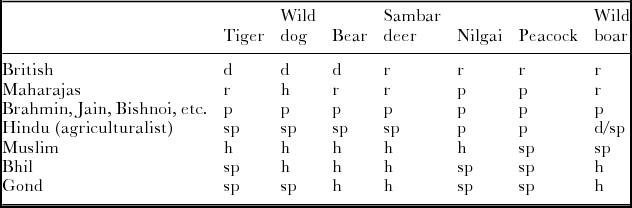
Numerous forces served to protect wildlife and biodiversity in colonial India, even before the society-wide paradigm-reversal of the mid-twentieth century that saw the colonial obsession with sports hunting replaced by a conservationist imperative. During those years, various hunting methodologies and wildlife conservation and preservation ‘systems’ vied for primacy in the subcontinent. Stepping back and viewing this constellation of hunting and conservation regimes from afar, we can see that a veritable mosaic of measures, spread over time and space and across social groups, worked to conserve many hunted species. Consider the following table:
While the British designated for destruction certain species they deemed to be ‘dangerous beasts’ in their vermin eradication campaigns, they maintained strict rules of sportsmanship when it came to hunting, rules which, to a certain extent, may have worked in favour of conservation, for example, by restricting lower orders of hunters from ‘poaching’. Similarly, the maharajas and other royal sportsmen of India maintained their ancestral hunting estates as game reserves for themselves, and so many species received at least limited protection from them. As discussed, Brahmins and other religious figures often protected species as best they could. And the struggles of the vegetarian classes of Hindu cultivators have been the subject of greatest elaboration in this article. While there are likely to have been some exceptions to the hunting and conservation regimes outlined in Table 1, it does serve as a general rubric to help us consider all of the various approaches to conservation simultaneously extant in late colonial India, many of which seem to be largely culturally defined.
Conservation and hunting regimes in colonial India.

d = designated for destruction, h = hunted, r = reserved, regulated or restricted, p = protected, sp = sometimes protected
Overall, conservation laws that were applied across the empire by the mid-twentieth century were informed primarily by the sportsman's ethic. Yet by as early as the end of the nineteenth century, some wildlife protection based on Hindu religious sensibilities, as opposed to sportsmen's or scientists’ notions of conservation, was being written into British Indian law. When clashes between sportsmen and villagers occurred, the sportsmen were almost never punished, but the British would sometimes seek to regulate the types of weapons, methods, times, places, and species permissible for hunting. As Kant argues, ‘the antagonism of men in society . . . becomes, in the end, the cause of a lawful order of this society’.Footnote 79 In colonial India, for a law to be successful meant not only finding a happy medium between individual and society, but also mediating between disparate communities within a diverse nation. In the absence of codified, agreed-upon laws and rules for both maintenance of local rights and the conservation of wildlife in much of colonial India, it is unsurprising that resistance to hunting became a site for insisting upon local rights and customs. Thus, I refer to such resistance as ‘cultural conservation’. In this light, the emergence of colonial conservation legislation was a dialectic process: sports hunting thesis, cultural conservation antithesis, with colonial conservation laws moving towards biased synthesis.
We have looked at religious and political explanations for resistance to hunting and have considered how they mixed with the environmental, but found neither the religious environmentalism nor the ecological nationalism concepts to be wholly sufficient as an overarching, generalizable explanation for all wildlife protection we encounter in the pre-1947 era in India. Arguably, the category of cultural conservation is preferable to religious environmentalism in that it allows for a broad understanding of what is at stake—people's deeply held religious beliefs, as well as local interests, among other things—without the conundrum of whether the intention was either fully religious or environmentalist. By shifting the discussion from environmentalism to conservation, we can assess impacts that are measurable, rather than intentions, which may never be fully knowable. The concept also fits the evidence somewhat better than ecological nationalism, because it is clear that not all resistance to hunting was nationalistically or even overtly politically motivated. And when resistance to hunting did have a nationalistic element to it, it was arguably as much an expression of cultural nationalism as of ecological nationalism.
In contrast to the cultural conservation of wildlife, colonial era efforts to guard sporting interests might be regarded as a form of ‘selfish conservation’ where elite sportsmen attempted to preserve wildlife from subaltern encroachments, for themselves only.Footnote 80 One explicit function of the ideology of sportsmanship was to manage wildlife for hunting. For example, the maharajas who owned private hunting reserves usually sought to maintain viable wildlife populations for their own pleasure. With historical hindsight we can see how European conservationists ignored the gamut of indigenous and religious protection mechanisms in place for wildlife, while paradoxically blaming local hunters for the diminution of game in the empire.
It is anachronistic and overly instrumentalist to equate most cultural conservation of wildlife in India with a conscious environmentalist ethic in the contemporary sense, but whether because of religion or politics, Indians did offer de facto protection for numerous species, thus providing at least some limited validation of the ecological Indian hypothesis. Across the subcontinent before 1947, various communities protected various species for cultural, religious, communal, political, and possibly environmental reasons, thereby, to some extent, counterbalancing the mosaic of hunters’ impacts. Consider the fact that in comparison to species that were targeted by sportsmen, such as large carnivores, those protected or restricted in the name of religion seem to have fared relatively well in the modern period. Peacock (Pavo cristatus), nilgai (Boselaphus tragocamelus), wild boar or suar (Sus scrofa), and various monkey populations have remained remarkably resilient, whereas nearly all species targeted in vermin eradication projects under the colonial state have dwindled massively. While all of these species were wide-ranging generalists rather than specialists occupying particular ecological niches, the relationship between religion, politics, and cultural conservation needs to be considered when attempting to explain the health of these species’ populations and the creation of conservation laws in India. Though historical data on hunting can rarely be scientifically conclusive, whether resistance to hunting in colonial India was primarily directed at upholding religious values or at combating what was perceived to be a predatory state, the outcomes of these actions functioned, at least in specific cases, to mitigate anthropogenic impacts on wildlife.