Introduction
Multi-band antennas are receiving more and more attention in modern wireless communication systems due to their ability to reduce the number of required antennas, save the space of wireless systems, and lower the cost. In recent years, various multi-band antennas for wireless system applications were presented. The methods of achieving the multi-band designs are diverse, such as loading various slots (L-shaped, U-shaped, etc.) [Reference Boukarkar, Lin, Jiang and Yu1–Reference Baytore, Gocen, Palandoken, Kaya and Zoral5], adding multiple resonant arms [Reference Karthikeyan, Sitharthan, Ali and Roy6–Reference Alam, Faruque, Hasan and Islam9], using metamaterial structures [Reference Hasan, Faruque and Islam10–Reference Gao, Jackson and Gardner13], and adopting novel feeding techniques [Reference Abdalla, Hu and Muvianto14–Reference Zhu, Antoniades and Eleftheriades16]. A triple-band dielectric resonator antenna for WLAN and WiMAX applications was designed by Sahu et al. [Reference Sahu, Sharma and Gangwar17]. The antenna can obtain different radiating modes by using a modified feeding structure composed of an annular ring patch and a V-shaped printed line. By employing a three-layer substrate and a complex coupled resonators network, Mao et al. [Reference Mao, Gao, Wang and Sanz-Izquierdo18] presented a directional antenna with four working bands applied to wireless applications. In order to achieve the multi-band performances, Weng et al. [Reference Weng and Hung19] proposed an H-shaped fractal antenna based on the fractal theory for operating over the WLAN and WiMAX bands. This triple-band antenna has well omnidirectional in the lower band and strong directional in the middle and upper bands. Anguera et al. [Reference Anguera, Andújar and García20] proposed a multi-band and small coplanar antenna system applied to handheld wireless communications. The multi-band characteristic of the antenna system was obtained by loading four non-resonant pad elements with different size. And the size of the antenna was greatly reduced by employing ground plane radiation modes. By stacking two dielectric resonators with different permittivities, Khan et al. [Reference Khan, Jamaluddin, Kazim, Nasir and Owais21] proposed a high-profile antenna with two operating bands for LTE applications. A compact printed monopole antenna with a defected ground plane for Internet of things was presented by Mao et al. [Reference Mao, Guo and Chen22]. The dual-band characteristic of the antenna was produced by the combination of a U-shaped stub and an L-shaped stub as well as a reduced rectangular ground plane. Saurav et al. [Reference Saurav, Sarkar and Srivastava23] introduced a triple-band dipole antenna loaded with composite right/left-handed unit cell. The three operating bands were obtained by adding two complementary split-ring resonators with different sizes. In [Reference Wang and Chan24], Wang et al. designed a dual-band and low-profile printed antenna for WiFi and WiGig communications. A compact microstrip resonance battery (CMRC) structure is proposed for feeding monopole in WiFi band and isolating monopole in WiGig band, respectively. Abdalla et al. [Reference Abdalla and Hu25] presented a compact quad-band monopole antenna. The multi-band characteristic of the antenna was achieved by etching several composite left- and right-hand (CRLH) structures with different sizes on the rectangular monopole. In [Reference Anguera, Andújar, Huynh, Orlenius, Picher and Puente26], Anguera et al. summarized the evolution of wireless handheld technologies. And the methods to achieve multi-band design were also introduced, such as adding multiple monopole parasitic elements and combing planar inverted-F antenna (PIFA) with slots. Although many multi-band antennas with different structures have been proposed, some of the presented antennas do not have sufficient bandwidth to over more WLAN and WiMAX applications and some designs fail to perform stable omnidirectional radiation patterns or reliable gains. Moreover, in order to facilitate processing and cost savings, the multi-band antennas should have a simpler structure. Therefore, a multi-band antenna for WLAN and WiMAX applications with enough bandwidths, stable omnidirectional radiation patterns, reasonable gains and simple structure is desirable.
In this article, a printed triple-band planar antenna for WLAN and WiMAX applications combing different monopoles and defected ground plane is designed. The monopoles compose of a rectangular ring and a rectangular patch attached a straight metal strip, which can generate the lower- and middle-frequency bands and omnidirectional radiation patterns. In order to excite higher resonance frequency and improve the impedance matching of the antenna at lower and middle resonance frequencies, a novel compact arch-shaped ground structure is proposed and used. The presented triple-band antenna has a symmetrical and very simple structure. A prototype of the antenna has been fabricated and tested, and the results show that the proposed antenna has three operating bands with enough bandwidths which can cover all the desired 2.4/5.2/5.8-GHz WLAN (2.4–2.48/5.15–5.35/5.725–5.825 GHz) and 3.5/5.5-GHz WiMAX (3.4–3.69/5.25–5.85 GHz) bands. Moreover, the measured results confirm the antenna has consistent omnidirectional radiation patterns and reliable gains in three operating bands.
In the next section, the design details of the antenna are introduced. Later, the effects of important structural parameters and the simulated and measured results are deeply discussed in the section “Parametric analysis” and the section “Results and discussions”, respectively. Finally, the section “Conclusions” gives a concise conclusion.
Antenna design
Different schematic views of the designed triple-band antenna are illustrated in Fig. 1. The simple antenna composes of a rectangular ring, a rectangular patch attached a straight metal strip, and an arch-shaped ground plane etched a circular defect. The design selects the 1.6-mm thick FR-4 (relative permittivity ɛ r = 4.4, loss tangent δ = 0.02) as the substrate. The compact size of the radiation element is 0.145 λ 0 × 0.158 λ 0 (λ 0 is the wavelength in free-space at 2.45 GHz). The presented antenna is fed by a microstrip line with width (W 1) of 3.1 mm. The dimensions of all parameters have been optimized and are listed in Table 1. A prototype of the triple-band antenna is fabricated and its different views are shown in Fig. 2.
Geometry of the proposed triple-band antenna, (a) front view, (b) back view.

Prototype of the fabricated antenna, (a) front view, (b) back view.

The detailed dimensions for various parameters.

The antenna design process is depicted in Figs 3 and 4 gives the corresponding simulated reflection coefficients. From Fig. 3(a), it can be seen that the antenna-1 is a simple monopole antenna composed of a modified rectangular ring, which is fed by a 50 Ω microstrip line. The length of half of the rectangular ring (L 4 + L 5–2 × W 2) is calculated and optimized to half of the wavelength to excite the first resonance frequency of the antenna-1. And the width of the strips of the rectangular ring (W 2) is set to 2 mm to achieve a good impedance matching of the antenna. Moreover, due to the rectangular ring fed symmetrically by the microstrip line, the far-field radiation generated by the rectangular ring is mainly determined by the two long strips of the rectangular ring (which length is L 4). Thus, the length of L 4 is adjusted and optimized to obtain a relatively better far-field radiation performance. As demonstrated in Fig. 4, antenna-1 with operating bands of 2.48–3.26 GHz resonates at 2.84 GHz. The first resonant frequency of antenna-1 generated by the rectangular ring and is given by Equation 2. For the first resonance of antenna-1, the length of the current path is half of the guided wavelength.


where ɛeff ≈ ɛr + 1/2 and c is the speed of light.
Design process of the proposed antenna, (a) Antenna-1, (b) Antenna-2, and (c) Antenna-3.

Simulated reflection coefficients for the three antennas.

By introducing a rectangular patch into the rectangular ring, Antenna-2 is obtained. Adding the rectangular patch to the inside of the rectangular ring allows the antenna to obtain a new resonant frequency and a compact structure. And the dimension of the rectangular patch attached a straight strip is carefully calculated and optimized. From Fig. 4, it can be found that antenna-2 has two operating bands of 2.33–2.49 and 2.97–5.5 GHz which resonate at 2.45 and 3.5 GHz, respectively. The impedance matching of antenna-2 can be realized by adjusting the sizes of the rectangular patch attached a straight strip and the rectangular ground plane. Moreover, it can also be seen that the first resonant frequency excited by antenna-1 is shifted to the left. Thus, it can be summarized that the rectangular patch plays the dual role of generating the second band and adjusting the first band. The left shift of the first resonance is due to the addition of a rectangular patch attached a straight strip, which extends the length of the current path. For the second resonant frequency of the antenna-2, the length of the current path should be a quarter of the guided wavelength, and it can be calculated by Equation (4) approximately.


Further, in order to generate the third operating band of the antenna to cover the desired operations, a circular defect is introduced in the arc-shaped ground plane (Antenna-3). The novel arc-shaped defected structure can be used to effectively adjust the input impedance and impedance matching of the antenna. According to the results of reflection coefficient shown in Fig. 4, the defected structure successfully excites the third resonant frequency and also improves the impedance matching of the first and second resonant frequencies. For antenna-3, the upper band shifts with the change of the dimension (L 6) of the reduced ground plane loaded with defected structure. When the value of L 6 is optimized as 9.3 mm, the upper band of the antenna can cover all the desired 5.2/5.8-GHz WLAN and 5.5-GHz WiMAX operations. Thus, the antenna-3 obtains three working bands of 2.33–2.49, 3.01–3.96, and 5.14–6.01 GHz, which can satisfy the bandwidth requirements of 2.4/5.2/5.8-GHz WLAN and 3.5/5.5-GHz WiMAX operations.
Parametric analysis
To better analyze the operating principle of the antenna, the effects of the rectangular patch, rectangular ring, and defected ground plane on antenna performance are investigated. The studies are done by changing the values of L 2, L 3, L 5, and R 2, while keeping other parameters constant.
Figure 5(a) displays the simulated reflection coefficients for different values of L 2. It can be observed that, with an increase of L 2, the lower and middle bands shift left while the upper band is unchanged. Similarly, both the lower and the middle bands can also be adjusted by tuning the value of L 3. From Fig. 5(b), it is clear that on increasing the value of L 3, a left shift in the lower and middle bands are achieved while the upper band is unaffected. Thus, the desired lower and middle bands for 2.4-GHz WLAN and 3.5-GHz WiMAX operations can be obtained by selecting L 2 as 5.6 mm and L 3 as 6.0 mm.
Simulated reflection coefficients for the antenna with different values of (a) L 2, (b) L 3, (c) L 5, and (d) R 2.

Figure 5(c) illustrates the variation of the reflection coefficients by changing the value of L 5. From the figure, it can be seen that, by increasing the value of L 5, the upper bands shift left while the lower and middle bands do not have an obvious movement. Moreover, the effects of the ground plane etched a circular defect on the upper band are also studied by varying parameter R 2 = 2.5, 3.0, and 3.5 mm. From Fig. 5(d), with the increasing of R 2, the third resonate frequency shifts to the right and the bandwidth of the upper band is narrowed. Therefore, both L 5 and R 2 can adjust the upper band to cover the 5.2/5.8-GHz WLAN and 5.5-GHz WiMAX bands.
Results and discussions
Reflection coefficients
Figure 6 displays the simulated and measured results of reflection coefficient (S 11) for the triple-band antenna. The simulated working frequency bands of the antenna (|S 11|<−10 dB) are 2.36–2.51(6.2%), 3.05–4.01 (27.2%), and 5.13–6.01 GHz (15.8%), and the measured three operating bands are 2.35–2.52 (7%), 3.2–4.16 (26.1%), and 5.13–5.87 GHz (13.5%), respectively. Thus, the antenna has enough bandwidths to cover all the desired 2.4/5.2/5.8-GHz WLAN and 3.5/5.5-GHz WiMAX operations. It is able to be seen that the simulated and measured curves have a good agreement. The slight difference between the simulated and measured reflection coefficients (S 11) mainly due to the tolerances of the relative permittivity (ε r), poor welding, and the difference between the characteristic impedance of the microstrip feed line of the antenna and the SMA connector.
Simulated and measured reflection coefficients of the antenna.

Surface current distributions
The simulated amplitude and vector distributions of the surface current at three frequencies of 2.45, 3.5, and 5.55 GHz are depicted in Figs 7 and 8. From Fig. 7(a), it can be observed that the surface current is mainly distributed on the rectangular ring and the rectangular patch attached a straight strip. It is able to be concluded that the combination of the rectangular ring and the rectangular patch attached a straight strip generates the lower operating band. As the rectangular ring is fed symmetrically by the microstrip line, the currents on the short strip of the rectangular ring (along the y-axis) have opposite directions on both sides of the feed point as shown in Fig. 8(a). Thus, the far-field radiation patterns and gains at lower band are mainly determined by the current superposition of the currents distributed on the two long strips of the rectangular ring (along the x-axis) and the patch attached a straight strip. However, the currents distributed on the long strips of the rectangular ring and the rectangular patch attached a strip have opposite directions, which causes the surface currents to be partially cancelled and the gains to be relatively weakened at the lower band. At 3.5 GHz, it is found that the current is focused on the rectangular patch attached a straight strip. There is no doubt that the middle frequency band is excited by the rectangular patch attached a straight strip. And the current distributed on the patch attached a straight strip also determines the far-field radiation characteristics of the antenna including radiation patterns and gains at middle band. From Fig. 7(c), it can be observed that, at upper-frequency band, both the rectangular ring and the circular defected structure have higher current density. The rectangular ring and the defected structure play a significant role in the production of the upper operating band. As shown in Fig. 8(c), the currents on the short strip of rectangular ring also have opposite directions on both sides of the feed point. The far-field radiation patterns and gains at upper band mainly generated by the current distributed on the two long strips of the rectangular ring, although the arc-shaped defected structure also has a slight impact on the far-field radiation. Therefore, it can be concluded that the distribution of the surface current and the main radiation element change with frequency. And at lower band, the amplitude of the surface current in the main radiation element is obviously lower than that of the upper band. As a result, the gains are relatively low at lower frequency band compared to the upper frequency.
Simulated current distributions on the antenna at (a) 2.45 GHz, (b) 3.5 GHz, and (c) 5.55 GHz.

Simulated vector distributions of the surface current at three different frequencies of (a) 2.45 GHz, (b) 3.5 GHz, and (c) 5.55 GHz.

Radiation characteristics
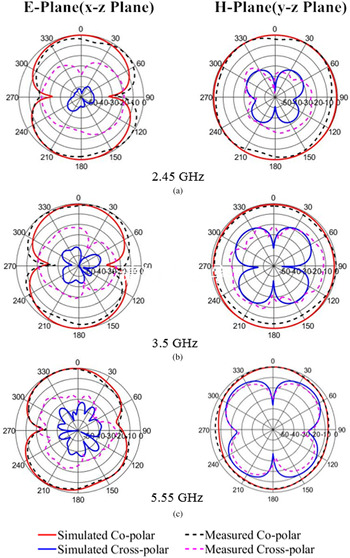
Figure 9 displays the simulated and measured radiation characteristics of the antenna at 2.45, 3.5, and 5.55 GHz. It is clearly observed that the proposed antenna has bidirectional patterns in the E-plane (x–z plane) and omnidirectional radiation patterns over all three operating frequency bands in the H-plane (y–z plane). And the levels of cross-polarization are lower than that of co-polarization in the E- and H-plane. The differences between the simulated and measured radiation patterns may be due to the scattering caused by the testing cable, SMA connector and antenna holder, and the chamber scattering. The simulated and tested peak gains of the antenna in three operating bands are drawn in Fig. 10. The simulated peak gains of the antenna are 1.14–1.69, 2.41–2.79, and 2.68–4.02 dBi in 2.37–2.51, 3.3–3.8, and 5.3–5.9 GHz, respectively. And the measured peak gains are 1.22, 2.15, and 4.06 dBi in 2.45, 3.5, and 5.55 GHz, respectively. Moreover, it can be found that the simulated average gain of the upper band is higher than that of middle and lower bands, while the simulated gains at the middle and lower bands are relatively stable. The simulated radiation efficiencies of the antenna are 83–93%, 98–99%, and 92–95% at 2.35–2.48, 3.4–3.65, and 5.15–5.8 GHz, respectively. And the simulated average radiation efficiencies are 88, 98.6, 93.7% in three desired operating bands. The measured radiation efficiencies are roughly 85, 95, and 91 at 2.45, 3.55, and 5.5 GHz, respectively.
Simulated and measured radiation characteristics for the antenna at (a) 2.45 GHz, (b) 3.5 GHz, and (c) 5.55 GHz.

Simulated and measured peak gains of the triple-band antenna.

The radiation characteristics of the antenna are measured in the anechoic chamber, and Fig. 11 shows its actual environment for far-field measurements. The overall size of the rectangular anechoic chamber is 8 m (length) × 6 m (width) × 3.5 m (height). In the measurement of the proposed antenna, the distance between the auxiliary transmitting antenna and the antenna under test (AUT) is selected as 5 m which can satisfy the requirements of far-field measurements. The equipment used to characterize the antenna in the anechoic chamber is mainly composed of the auxiliary transmitting antenna, vector network analyzer, and test turntable.
The photograph of the measurement environment for the presented antenna.

Table 2 shows the comparison of the proposed antenna with some multi-band antennas introduced in the literature. From Table 2, it can be concluded that the proposed triple-band antenna provides better radiation efficiency and appropriate gains in a simple structure for all the 2.4/5.2/5.8-GHz WLAN and 3.5/5.5-GHz WiMAX applications.
Comparison of the designed antenna with other referred multi-band antennas.

Conclusions
A new printed triple-band planar antenna combing two different modified monopoles and an arc-shaped defected ground plane for WLAN and WiMAX applications are proposed. By employing two simple modified monopoles of a rectangular ring and a rectangular patch attached a straight strip, the lower and middle operating bands and the omnidirectional radiation patterns are obtained. Furthermore, in order to excite a new resonance at a higher frequency and improve the impedance matching at lower and middle resonance frequencies, a new compact arch-shaped defected ground structure is proposed and used. With the help of the arch-shaped defected ground structure, the main radiation element of the antenna composed of only two simple monopoles provides three omnidirectional radiation modes at three desired bands. And the presented triple-band antenna has a very simple structure. In order to verify the performance of the antenna, a prototype of the triple-band antenna is fabricated and tested. The measured results indicate that the proposed antenna has better radiation efficiencies, stable omnidirectional patterns, and reasonable gains. And the experimental results also show that the antenna provi enough bandwidths to cover all the desired 2.4/3.5/5.2-GHz WLAN and 3.5/5.5-GHz WiMAX applications. Therefore, the several advantages of better radiation efficiency, stable omnidirectional pattern, appropriate gain, enough bandwidth, and simple structure make the proposed triple-band antenna high practicality and good prospect for WLAN and WiMAX applications.
Acknowledgements
This research work was supported by the National Key R&D Program of China under Grant No. 2016YFC0302802, and by the National Natural Science Foundation of China under Grant No. 61475084 and 61801267.
 Shiquan Wang was born in Linyi, China. He received the B.S. degree in electronic information science and technology from Qilu University of Technology (Shandong academy of sciences) in 2017. He is currently pursuing the Ph.D. degree in electronic science and technology with the School of Information Science and Engineering, Shandong University, Qingdao. His current research interests include design and analysis of antennas, microwave devices, and metamaterials.
 Fanming Kong received the B.S. and M.S. degrees in electrical engineering from Shandong University, Jinan, China, in 1991 and 1994, respectively, and the Ph.D. degree from the School of Physics, Shandong University, in 1999. He joined the Department of Electrical Engineering, Shandong University, in 1999, where he is currently a Professor with the School of Information Science and Engineering. His current research interests include design and analysis of antennas, microwave integrated circuits, and computational electromagnetics.
 Kang Li was born in Jinan, China, in 1962. He received the B.S. and M.S. degrees in electrical engineering and the Ph.D. degree in optical engineering from Shandong University, Jinan, in 1984, 1987, and 2006, respectively. He is currently a Professor with the School of Information Science and Engineering, Shandong University. He is a member of IEEE (USA) and a reviewer of many International and National journals. His current research interests include antennas, computational electromagnetics, and fiber-optic communications.
 Liuge Du received the B.S. degree in electronic science and technology and the M.S. and the Ph.D. degrees in radio physic from Shandong University, Jinan, China, in 2005, 2008 and 2011, respectively. From 2011 to 2017, he was an engineer with the 41st research institute of China Electronics Technology Group Corporation (CETC). He is currently an Associate Professor with the electronic science and technology, Shandong University. His interests include design and measurement of antennas, algorithm for microwave imaging, and computational electromagnetics.