INTRODUCTION
Children with specific language impairment (SLI) have been attested to have problems in a broad range of language areas including phonology (e.g. Fraser, Goswami & Conti-Ramsden, Reference Fraser, Goswami and Conti-Ramsden2010), semantics (e.g. Gray, Reference Gray2004), and morphosyntax (e.g. Paradis & Crago, Reference Paradis and Crago2001), while necessary prerequisites for language learning such as hearing, non-verbal intelligence, and neurological and socio-emotional development are relatively preserved (Leonard, Reference Leonard1998; Leonard & Deevy, Reference Leonard, Deevy, Traxler and Gernsbacher2006). Grammatical morphology appears to pose particular challenges for many individuals with SLI. For instance, English-speaking children with SLI lag behind their typically developing peers in acquiring certain closed-class free and bound morphemes, e.g. copula be forms, present third person singular -s and regular past -ed verb inflections (Leonard, Eyer, Bedore & Grela, Reference Leonard, Eyer, Bedore and Grela1997; Marchman, Wulfeck & Ellis Weismer, Reference Marchman, Wulfeck and Ellis Weismer1999; Rice, Wexler & Cleave, Reference Rice, Wexler and Cleave1995).
Cross-linguistic studies that have explored grammatical morphology in SLI have yielded mixed results, confirming that language typology plays a crucial role in determining specific linguistic features that are vulnerable in this population (Leonard, Reference Leonard2009). Essentially, morphological development and delay differ from one language to another based on the complexity of the language, both in terms of the course it takes and the morphological processes used. For example, unlike English, the profile of SLI in Italian revealed special difficulties with function words like articles and direct object clitics (Bortolini, Caselli & Leonard, Reference Bortolini, Caselli and Leonard1997).
Research on language impairment in Arabic has received very little attention, with the exception of a few studies that have examined morphosyntax. Abdalla and Crago (Reference Abdalla and Crago2008) reported that preschool Arabic-speaking children with SLI (Urban Hijazi dialect) were significantly less accurate in using verb inflections than typically developing comparison groups – mean length of utterance and chronological age matches. A similar trend was also found for Egyptian Arabic-speaking children with developmental language impairment (Fahim, Reference Fahim2005; Morsi, Reference Morsi2006). The children with SLI often used a default form resembling the imperfective bare stem (Fahim, Reference Fahim2005) or the imperative (Abdalla & Crago, Reference Abdalla and Crago2008; Morsi Reference Morsi2006) as a substitute for correct finite verbs.
In his study on Qatari Arabic, Shaalan (Reference Shaalan2010) found that although school-aged children with SLI had difficulty with verb inflection, their performance was not significantly different from that of typically developing children. However, he stated that further examination is warranted since this observation was based on only a few verb inflections. In a study on another Semitic language, Leonard, Dromi, Adam and Zadunaisky-Ehrlich (Reference Leonard, Dromi, Adam and Zadunaisky-Ehrlich2000) observed that Hebrew-speaking children with SLI performed well on verb inflections; however, their performance was affected when they were presented with verbs involving more complex morphophonological structures.
The focus in SLI research has been verb morphology, and yet noun morphology has been shown to be affected in SLI in some languages (e.g. Dalalakis, Reference Dalalakis1996; Lukács, Leonard & Kas, Reference Lukács, Leonard and Kas2010). In the current study, we focused on noun morphology in Arabic, a language with a rich morphology, to determine whether noun plurals posed a particular problem for children with SLI, and whether the errors they made suggested a delay or deviance in development.
Before we review previous research on typical and atypical acquisition of noun plurals in Arabic and cross-linguistically, we will present an overview of the plural system in Kuwaiti Arabic.
Nominal plural morphology in Kuwaiti Arabic
In every part of the Arab-speaking world, Arabic means at least two varieties: the standard variety and the colloquial/spoken variety. The standard variety, known as Modern Standard Arabic (MSA), is the written variety that is officially used all over the Arab world in formal contexts such as school and the media. MSA has preserved the syntactic, morphological, and phonological aspects of Classical Arabic, the language of the Koran from which it descended (Fischer, Reference Fischer and Hertzron1997). Colloquial Arabic, such as Kuwaiti Arabic, the focus of our study, is the native language of the child. Kuwaiti Arabic (KA) still shares common characteristics of the conservative standard variety but has also diverged from it.
Plural formation in Arabic, as in other Semitic languages such as Hebrew, relies on two processes: linear suffixation and non-linear stem modification. In linear suffixation, a suffix is added at the end of a stem to form the plural, very much like English (book, book-s). Suffixation is considered regular because it applies to many nouns and does not involve any change in the base word (the singular) from which it is derived. There are two forms: feminine sound plural (FSP) and masculine sound plural (MSP). The FSP suffix (-a:t) is more general and can apply even to singular nouns that do not have the grammatical feminine marker (-at). The MSP suffix (i:n) is, however, limited to deverbal singular nominals (i.e. derived from verbs). Because the two plural affixes (-a:t and -i:n/-u:n) apply to many words and do not involve modification of the stem of the singular noun, they are considered regular or sound.
In non-linear processes, known as the broken plural (BP), the root is combined with a number of plural patterns that are different from those of the singular. Lyovin (Reference Lyovin1997) indicates that the BP is formed by internal change in the word, e.g. CaCaC /saħan/ ‘a plate’ CuCuuC /suħu:n/ ‘plates’. These patterns are many in the standard variety, but fewer in Kuwaiti Arabic; Holes (Reference Holes1995) cites five frequent patterns used in Gulf Arabic (CuCCaaC /ʕumma:l/ ‘workmen’, CaCaaCiC /mala:ʕig/ ‘spoons’, CaCaaCiiC /fasa:ti:n/ ‘dresses’, aCCaaC /agla:m/ ‘pens’, and CuCuuC /suħu:n/ ‘plates’). The BP is not based on a clear rule and is lexicalized (Fischer, Reference Fischer and Hertzron1997) and therefore needs to be learned item by item. This type of plural morphology is also phonologically less salient than the regular processes (i.e. suffixation), which could be particularly problematic for children with SLI.
Although some researchers (e.g. Ravid & Farah, Reference Ravid and Farah1999) have cited Arabic as a language where the minority form (Broken Plural) is the default in some varieties of Arabic, Boudelaa and Gaskell (Reference Boudelaa and Gaskell2002) have demonstrated that the sound regular (FSP and MSP) is not only quantitatively more productive as a process but also applies to more nominal forms. Because MSP is limited to deverbal nominals, FSP (-a:t) is more common and seems to be the default.
To sum up, plural formation in KA is achieved through two main processes: linear suffixation and non-linear stem transformation. Suffixation is considered regular because it applies to many nouns and does not involve any change in the base word (the singular) from which it is derived. The MSP marker is, however, limited to deverbal singular nominals, but the FSP marker is more general and can apply even to singular nouns that do not have the grammatical feminine marker (-at). The stem-transformation process, the BP, is lexicalized and has to be learned item by item. This type of plural morphology is also phonologically less salient than the regular modification (i.e. suffixation), which could be particularly problematic for children with SLI. This general picture suggests that the acquisition of the noun plural would be in the following order: FSP is acquired before MSP and BP. Previous studies on KA and other varieties seem to support this prediction.
Plural noun morphology in typically developing children and children with SLI
Typically developing children
Previous studies of plural acquisition in typically developing children showed varying developmental patterns across languages. Studies on English-speaking children revealed that the plural suffix -s and its two allomorphs emerge between 1;9 and 2;3, and that children master the regular plural form as well as most irregular forms by the age of five (Berko, Reference Berko1958; Brown Reference Brown1973; Cazden, Reference Cazden1968). Young children were found to generalize the plural to novel forms in a longitudinal setting (Zapf & Smith, Reference Zapf and Smith2007), and an experimental setting (Berko, Reference Berko1958). The errors seem to display a pattern where children first use some correct forms of both regular and irregular inflections, then move to a stage where they use both correct and incorrect forms of regular and irregular forms, and finally master the plural inflectional system (Marcus, Ullman, Pinker, Hollander, Rosen & Xu, Reference Marcus, Ullman, Pinker, Hollander, Rosen and Xu1992).
Early acquisition of nominal number marking has been found in German child language, with an onset as early as 1;4, and in some children with a Mean Length of Utterance (MLU) of 1·25 and relatively good competence at the age of 3;8 (Szagun, Reference Szagun2001). In her longitudinal study of children aged 1;4 to 3;8, Szagun (Reference Szagun2001) compared adults' speech to that of the children and found that the growth rates of the plural classes were in accordance with the frequencies of plurals in adult language and child language around 3;8. The error patterns in child speech reflected the regularities in the German plural system and children made errors early on at the onset of acquiring plural inflection with no preference of one error type over others.
In Hebrew, a Semitic language like Arabic, regular plural formation is acquired as early as two years, with an advantage for the masculine plural over the feminine plural and both reaching adult mastery by the age of six years. However, plurals that involve stems with irregular suffixes (masculine plural marker for feminine singular or vice versa), nouns with changing stems in the plural (for instance a deletion of a vowel or a vowel change after suffixation), and nouns with changing stems and irregular suffixes were still being acquired at the age of six (cf. Ravid & Schiff, Reference Ravid and Schiff2009, and studies therein).
Previous studies on Arabic-speaking children demonstrate a rather homogeneous picture, namely the precedence in acquisition of the FSP compared to the MSP and the BP, both of which were not acquired until very late. In one of the earliest studies on the acquisition of Egyptian Arabic, Omar (Reference Omar1973) found that children developed the regular plural inflection at the age of three years and most BPs at the age of five. In particular, Omar's study revealed a tendency by the children to use the FSP inflection -a:t to regularize BPs or to create plurals for nonsense words. The overgeneralization process categorically employed the FSP suffix -a:t rather than the MSP suffix -i:n. At the same time, they used BPs but they did not overgeneralize them once acquired.
Ravid and Farah (Reference Ravid and Farah1999) tested the use of FSP, MSP, and BPs in forty-eight Palestinian children aged two to five years, divided into four age groups (2 years, 3 years, 4 years, and 5 years). The participants were asked to provide the plural of a picture depicting a singular noun. Statistical analysis of average correct scores showed that the FSP was easier to acquire than the MSP and BP across ages. By the age of three, the children's performance was at ceiling for FSP (approximately 13 out of 14 maximum responses). The BP and MSP by contrast were around 5 to 6 correct (out of 14) at age three and only reached an accuracy of 11 in the oldest age group (5 years). Similar results were reported in another study on Palestinian Arabic, (Ravid & Hayek, Reference Ravid and Hayek2003) in children between 3;6 and 8;0, whereby mean percentage scores showed a distinct development of the regular feminine plural -a:t.
Siddiki (Reference Siddiki2002) examined plural formation in typically developing speakers of Saudi Arabic (Hijazi dialect) aged four to eleven years, divided into four age groups (4;1–5;0, 5;1–7;0, 7;1–9;0 and 9;1–11;0). The elicitation stimuli comprised thirty-two real nouns (8 FSP and 24 BP) and eight nonce words. The consistent result across age groups was more superior performance on the regular nouns (FSP) than irregular (BPs). Mastery of the regular FSP was reached only around the ages of seven and nine years and the broken plurals were still being learned even at age eleven. Siddiki indicated that the frequency of plurals (the regular FSP being the most common) affected the performance of the children.
Similar results were reported by Nawwab (Reference Nawwab2009), who studied the implementation of nominal number inflections (duals, sound plurals, broken plurals, and collectives) of 240 typically developing Saudi children (Hijazi Arabic dialect) aged 2;0 to 6;0, divided into eight age groups covering six-month age intervals. She used two elicitation tasks to test the children's comprehension (52 real words) and production (61 real and nonce words). The study also included an analysis of a spontaneous speech task to supplement the experimental findings. The results were presented descriptively in percentages by noun pattern and age group with no inferential statistical tests to compare the groups. Nawwab found that comprehension of the different plural types were above chance level even in the youngest group (70% or above). However, accuracy in producing the real words showed that most patterns (BP and MSP) were below chance level for all groups with the exception of the FSP, which reached 60 percent accuracy in the older two groups only. She also observed that errors occurred early on rather than after an initial period of correct use, reflecting the regularities of the plural marking system. The most productive error type was -a:t, which replaced almost all patterns in all tasks.
Daana (Reference Daana2009) studied the acquisition of plural inflection in children speaking Jordanian Arabic aged between two and seven, and also found that the regular feminine plural was acquired before the regular masculine plural and the irregular plural (BP), with no clear advantage for one over the other (i.e. MSP and BP). Within the irregular plural, the more common patterns are acquired earlier than the less common ones. At age seven, the acquisition of the plural is still at around 90 percent accuracy compared to adults.
Aljenaie, Abdalla, and Farghal (Reference Aljenaie, Abdalla and Farghal2011), who examined the development of noun number marking, dual and plural, by Kuwaiti Arabic-speaking children between the ages of four and nine years in an elicited production task, also found that correct FSP appeared more frequently than MSPs and BPs in Group 1 (four- to five-year-olds) and demonstrated near-ceiling effects in Group 2 (six- to seven-year-olds) and Group 3 (eight- to nine-year-olds). In contrast, the acquisition of the other two plural types (MSP and BP) increased in accuracy across age groups.
In summary, compared to other languages such as English (Brown, Reference Brown1973) or German (Szagun, Reference Szagun2001), the plural is acquired rather late in Arabic. The regular FSP (feminine sound plural), which is often used as the default, is acquired quite early and with high accuracy around age three (e.g. Omar, Reference Omar1973, for Egyptian Arabic; Ravid & Farah, Reference Ravid and Farah1999, for Palestinian Arabic; Aljenaie et al., Reference Aljenaie, Abdalla and Farghal2011, for Kuwaiti Arabic), and adult-like accuracy around age seven (e.g. Nawwab, Reference Nawwab2009, for Hijazi Arabic; Daana, Reference Daana2009, for Jordanian Arabic; Aljenaie et al., Reference Aljenaie, Abdalla and Farghal2011, for Kuwaiti Arabic). The more restricted MSP (masculine sound plural) and the irregular (broken) plural are acquired very late (Aljenaie et al., Reference Aljenaie, Abdalla and Farghal2011, reported that up to age nine, Kuwaiti children were still acquiring these two forms). At age five (the limit of the age range studied), the BP was still being learned in Egyptian Arabic (i.e. far from the adult-like 100 percent accuracy; Omar, Reference Omar1973) and in Palestinian Arabic (Ravid & Farah, Reference Ravid and Farah1999). Siddiki (Reference Siddiki2002) reported that the broken plural was still developing at age eleven in Hijazi Arabic-speaking children. This is comparable to the developmental pattern found in Hebrew, a language with a similar plural morphology (Ravid & Schiff, Reference Ravid and Schiff2009, and the studies therein).
Children with SLI
Results on plural inflection in English-speaking children with language impairment are mixed. While Oetting and Rice (Reference Oetting and Rice1993) did not find it to be a major problem in English SLI, case studies (Crystal, Fletcher & Garman, Reference Crystal, Fletcher and Garman1976; Eyer & Leonard, Reference Eyer and Leonard1995) and group studies (e.g. Leonard et al., Reference Leonard, Eyer, Bedore and Grela1997) have reported difficulties with noun plural inflections. Gopnik and her colleagues (Gopnik & Crago, Reference Gopnik and Crago1991; Ullman & Gopnik, Reference Ullman and Gopnik1994) studied the use of noun plural -s in an English-speaking family (13 members from three generations) with language impairment, and found that their performance significantly diverged from those of controls from the same family. According to the researchers, application of a productive rule was limited, and the participants appeared to have learned inflected words as distinct lexical items, much as one learns irregular patterns like children and men.
Similar results to those found by Oetting and Rice (Reference Oetting and Rice1993) in English were found in Italian (Bortolini et al., Reference Bortolini, Caselli and Leonard1997) and Hebrew (Dromi, Leonard & Shteiman, Reference Dromi, Leonard and Shteiman1993), where the performance of the participants with SLI was comparable with their typically developing MLU-matched peers. This seems to be rather surprising, given the fact that Italian and Hebrew have a more complex noun plural inflection system than English. Leonard and his colleagues (e.g. Dromi et al., Reference Dromi, Leonard and Shteiman1993; Leonard, Sabbadini, Leonard & Volterra, Reference Leonard, Sabbadini, Leonard and Volterra1987) argue that, in morphologically rich languages like Italian and Hebrew, the focus is made on the best rendition of morphology to better serve communication, in contrast to a language like English where attention is devoted to word order.
Dalalakis (Reference Dalalakis1996) found that Greek-speaking children with SLI performed more poorly than age-matched controls in producing plural forms of nonsense nouns. Greek has a rich noun morphology whereby noun plurals differ not only according to three genders (feminine, masculine, and neuter), but also in the singular form of the noun in the nominative case. Interestingly, both groups displayed more success with feminine nouns than with neuter nouns. Repeating singular nouns as plurals (i.e. omissions) occurred more frequently than producing ungrammatical plural inflections (e.g. incorrect gender).
Clahsen, Rothweiler, Woest, and Marcus (Reference Clahsen, Rothweiler, Woest and Marcus1992) examined plural allomorphs by German-speaking children with SLI (aged 3;1 to 6;11). The children's spontaneous correct use of plural allomorphs approximated typically developing children aged three. Substitution of an inappropriate inflection was more common in the spontaneous data, while the use of singular for plural nouns dominated in the formal task. Ljubešić and Kovačević (Reference Ljubešić and Kovačević1992) explored the use of dual and plural noun formation in sixty-one school-age children with SLI (aged 7 to 10 years) learning Serbo-Croatian, a Slavic language. The children with SLI scored significantly lower in marking plurals (real and nonce stimuli) than their age-matched typically developing peers. A higher tendency to repeat the singular (omission) was observed in the group with SLI.
More recently, Lukács et al. (Reference Lukács, Leonard and Kas2010) examined the use of regular and irregular noun morphology in two groups of Hungarian-speaking children with SLI – an older group (eight to ten years) and a younger group (four to seven years) – and two control groups matched on size of vocabulary. The younger group displayed lower accuracy in marking plurals and accusative case in regular noun stems than the vocabulary-matched controls. Overgeneralization of stem forms was frequently observed in all groups. However, stronger lexical frequency effects and a higher reliance on memorized forms were found in the children with SLI.
The studies reviewed thus far demonstrate that the typology of a language can influence the types of grammatical difficulties displayed by children with SLI in a given language. In some languages (e.g. English), plurals do not seem to be problematic for SLI. However, noun plural marking, unlike the case of Indo-European languages described above, constitutes a complex system both semantically and structurally for children learning Arabic. KA, like other dialects, uses three main processes to mark the plural: two rule-based concatenative processes – linear suffixing – the FSP (affix -a:t for feminine nouns) and the MSP (that adds the affix -i:n to masculine nouns); and a non-concatenative process, BP, an irregular, non-linear root-and-pattern plural form that relies on internal modification of the singular stem rather than affixation. In addition to the large number of irregular forms (BP), which do not follow a clear rule and have to be learned item by item, the regular MSP does not apply to all masculine nouns but is restricted to animate deverbal singular nominals. In other words, Arabic does not seem to conform to the regular/irregular division seen in the plural systems of English and other languages (Ravid & Farah, Reference Ravid, Farah, Stephany and Voeikova2009), making it an interesting case study. In essence, one cannot conclude that the irregular forms will pose more difficulty, given that one of the regular markers (MSP) is less productive. As a result of this unique typology, several researchers have demonstrated late acquisition of this structure (Omar, Reference Omar1973; Ravid & Farah, Reference Ravid and Farah1999; Aljenaie et al., Reference Aljenaie, Abdalla and Farghal2011).
Very few studies have investigated noun plural formation in SLI speakers of Arabic (Fahim, Reference Fahim2005; Shaalan, Reference Shaalan2010), and the data they provide do not permit a systematic examination of the structure. Fahim (Reference Fahim2005) analyzed longitudinal language data from three Egyptian Arabic-speaking children with developmental language impairment (EA-DLI) (aged 3;01 to 4;06 when first recorded) and twelve typically developing controls (aged between 1;00 and 4;04). Data was recorded for twenty-one to thirty-six months and the children with DLI were aged 5;11 to 7;01 by the end of study. Spontaneous speech was used to analyze the children's production of noun plurals. However, the number of plurals produced by the children with DLI was very limited. For example, one of the three children with DLI only used plurals on three occasions, while another did not produce any broken plurals. Moreover, no productions of masculine sound plurals were witnessed in the DLI data. Based on this preliminary data, Fahim concluded that plural morphology was acquired late, with the FSP emerging before BP and MSP. The children with DLI displayed error patterns that were similar to those of controls (e.g. using quantifiers kitir kita:b ‘many book’ or substituting the FSP -a:t for BP), and others that deviated from the norms (e.g. repeating the noun instead of using a morphological inflection to mark pluralization).
Shaalan (Reference Shaalan2010) tested two groups of Qatari Arabic-speaking children between the ages of 4;6 to 9;4. Twenty-six of these were diagnosed with SLI while eighty-eight were developing language typically. Accuracy in using three types of plurals (FSP, MSP, and BP) was elicited using an expressive language test designed for Qatari Arabic. However, the number of tokens for each plural type was restricted, e.g. there was only one item for MSP. Shaalan's initial examination of plurals showed that the children with SLI and controls up to the age of six years were more competent in using the FSP than MSP. Irregular plurals (BP) were also a challenge for the group with SLI, and overregularization (adding the FSP suffix -a:t) was the preferred error pattern. In sum, although neither Fahim (Reference Fahim2005) nor Shaalan (Reference Shaalan2010) conducted a systematic investigation of the acquisition of Arabic plurals, their preliminary observations seem to corroborate what has been documented for typical Arabic language learners (Aljenaie et al., Reference Aljenaie, Abdalla and Farghal2011; Omar, Reference Omar1973; Ravid & Farah, Reference Ravid and Farah1999).
The primary purpose of this study was to extend the investigation of noun plurals in SLI to yet another dialect of Arabic, Kuwaiti. At present we know very little about how Arabic-speaking children with SLI use noun plurals. The Arabic language is a morphologically rich language, and thus can shed light on explanations of SLI which have largely been based on English and a few Indo-European languages. Only two unpublished studies (Fahim, Reference Fahim2005; Shaalan, Reference Shaalan2010) have reported preliminary observations of nominal plurals in Arabic speakers with language impairment. As explained earlier, neither of these studies thoroughly examined this type of morphology, leaving us with an incomplete picture of exactly how children with SLI in Arabic use regular and irregular noun plural markers. The present study is the first to examine noun morphology in Kuwaiti-speaking children with SLI. Moreover, it adopts a more carefully designed experimental paradigm to elicit productions of a representative set of noun plural stimuli (regular and irregular inflection) using two varying contexts – real and nonsense stimuli. Additionally, two groups of native Kuwaiti Arabic speakers – typically developing age-matched children and a group of adults – served as controls to ensure the real and nonsense stimuli were effective in eliciting the target plural forms and to contrast their pattern of results with the group with SLI. More specifically, the investigation sought to answer the following questions:
1. How do the Kuwaiti children with SLI compare with the typically developing age peers in accuracy of using regular and irregular noun plurals in real words? We hypothesized that the group with SLI would be less accurate than the age-matched peers, given that studies reviewed earlier have demonstrated that noun plural development in Arabic is rather prolonged.
2. Will the three types of plurals (FSP, MSP, and BP) display varying levels of accuracy and frequency for the real and nonsense words in the TD and SLI groups? Based on previous findings in the Arabic literature, we predicted that the feminine sound plural (FSP) would have a special status (i.e. more accurately used in real words and resorted to most frequently for nonsense forms).
3. Are the children with SLI qualitatively different in the types of errors they exhibit? We expected the errors of the children with SLI to resemble those of the TD, and that FSP would be overgeneralized in both groups.
METHOD
Participants
A total of thirty-six Kuwaiti Arabic-speaking individuals participated in this study. The participants formed three groups of twelve each: a group of adults and two groups of children – one with specific language impairment (SLI group) and the other typically developing age-matched controls (TD group).
The children with SLI (n = 12) comprised nine boys and three girls aged 3;7 to 6;2 (Mean age = 55·7 months, SD = 10·3) recruited from Sheikh Salem Al Ali Center for Hearing and Speech, Kuwait, a public specialty clinic that serves Arabic-speaking individuals with communication disorders. They had been clinically assessed by senior Arabic-speaking speech-language pathologists and were in their initial month of treatment sessions. Children who met the following exclusionary and inclusionary criteria were included in the study: (1) they passed a hearing screening (20 dB in each ear, at the frequencies 1000, 2000, and 4000 Hz) conducted by the hospital audiologist, and had no history of recent bouts of Otitis Media; (2) they presented developmentally appropriate articulation abilities as measured by a one-word Arabic articulation test, and displayed good speech intelligibility as judged by an independent research assistant; (3) they passed an oral-motor speech mechanism examination; (4) they presented records that indicated normal non-verbal IQ and no frank neurological deficits or socio-emotional disturbances from their psychologist and developmental specialists at the Psychiatric Hospital, Kuwait.
Identifying preschoolers with SLI posed a challenge because there are currently no standardized language assessment batteries for Kuwaiti Arabic. To document that the group with SLI demonstrated significant language difficulties we used four sources of information: (a) adapted Arabic receptive and expressive language tests; (b) adapted Arabic version of the Speech and Language Assessment Scale (SLAS) (Hadley & Rice, Reference Hadley and Rice1993) which helps parents to describe their child's competencies in terms of assertiveness, responsiveness, semantics, syntax, and articulation; (c) spontaneous language sample analyses; and (d) clinical judgements of bilingual Arabic–English-speaking speech-language pathologists. We administered three subtests (the Sentence Comprehension Test, the Expressive Language Test, and the Sentence Repetition Test) based on an earlier version of Shaalan's (Reference Shaalan2010) Arabic test battery. The tests examine the comprehension and production of morphosyntactic structures in Gulf Arabic (e.g. negation, verb markers, possessive pronouns, clitic pronouns, adjectives, relative and subordinate clauses, etc.). We compared the test scores of the children with SLI in this study to data in our lab from fifty typically developing Kuwaiti children of similar ages. We used a more conservative cut-off than previously used (e.g. Tomblin, Records, Buckwalter, Zhang, Smith & O'Brien, Reference Tomblin, Records, Buckwalter, Zhang, Smith and O'Brien1997) to identify the children with SLI. All twelve children scored below −1·5 SDs on two or more language tests.
An analysis of the spontaneous communication samples of the participants with SLI revealed that their MLU, number of errors per utterance, and lexical diversity were below those of a comparison group of twenty-five age-matched typically developing Kuwaiti Arabic-speaking children in our clinical database. It is worth noting that Dunn, Flax, Sliwinsky, and Aram (Reference Dunn, Flax, Sliwinski and Aram1996) found a higher congruency between clinical diagnoses of SLI and measures based on children's spontaneous speech samples in terms of MLU than results obtained from formal tests.
Twelve monolingual, typically developing Kuwaiti Arabic-speaking children (6 boys, 6 girls), ranging in age from 3;9 to 5;7 (with a mean age of 55·6 months, SD = 5·5) served as chronological age-equivalent controls. An independent samples t-test was conducted to compare age equivalency between the SLI and TD groups. No significant differences in age were found (t(22) = –0·02, p = 0·98 [two-tailed]). Parental case history forms, an Arabic version of SLAS, school reports, and preliminary hearing, speech-language screenings by a speech-language pathologist indicated that the TD groups had achieved developmental milestones as expected. No neurological or intellectual impairments were reported.
The twelve adults were native speakers of KA and had completed twelve years of high school in Arabic. They consisted of six females and six males, age range was twenty to thirty-eight years, with a mean age of twenty-three years, nine months (SD = 4·6).
Materials and procedure
This study used an experimental design consisting of thirty-four pictured stimuli – fourteen real singular nouns, seven plural real nouns, and thirteen nonsense stimuli (see ‘Appendix’ for a list of all stimuli). The word ‘real’ means conventional or attested in Arabic. The fourteen real singular nouns consisted of common, concrete objects. Given that there are no frequency tables for Kuwaiti Arabic, we selected the real stimuli based on the following criteria: (a) imageable noun that could be represented via pictures and required the target plural marker (FSP, MSP, or BP); (b) reportedly used by two-year-old typical learners of Arabic in Aljenaie (Reference Aljenaie2001) and Daana (Reference Daana2009) ; and (c) received a scoring of 4 or more (highly familiar) on a Likert scale of 1–5 from a list of words rated by sixty adult Arabic speakers for familiarity (Shaalan & van der Lely, Reference Shaalan and van der Lely2007). The real singular nouns were further categorized into five items that require the FSP suffix -a:t, three that take the MSP suffix -i:n, and six that change the singular to BP. The number of items per plural suffix is based on a rough estimate of their frequency in the language (Boudelaa & Gaskell, Reference Boudelaa and Gaskell2002).
The nonsense stimuli consisted of a mixture of both mono- and multisyllabic words. The monosyllabic nonsense words and their pictures were borrowed from Berko (Reference Berko1958). Three native KA informants generated nonsense words that rhymed, and had a root pattern comparable to a corresponding real singular noun used in the study, e.g. fla:b for gla:s ‘glass’ and tankab for ʔarnab ‘rabbit’. Overall, the nonsense forms conform to expected patterns of Kuwaiti Arabic.
Seven highly familiar plural nouns were also presented as distracters, and to control for priming effect (Schacter & Buckner, Reference Schacter and Buckner1998). Two plural nouns had FSP -a:t marker (tufa:ħ-a:t/tufa:ħ ‘apples/apple’; kabat-a:t/kabat ‘cupboards/cupboard’), one had MSP -i:n (ħala:g-i:n/ħala:g ‘barbers/barber’), and four were BP that changed the root pattern (mafa:ti:ħ/muftaħ ‘keys/key’; zehewi/zehewiya ‘cockroaches/cockroach’; suwar/su:ra ‘pictures/picture’; bana:t/bint ‘girls/girl’). The thirty-four target stimuli (14 real singular nouns, 7 plural nouns, and 13 nonsense singular forms) were written on a piece of paper separately and drawn from a hat to generate a randomized list consisting of real singular, real plural, and nonsense singular forms. The order of presentation was fixed.
A native Kuwaiti Arabic-speaking research assistant administered the test to each participant individually in a quiet room. The assistant followed a research protocol to elicit the Arabic plural noun inflection. Testing was preceded by three practice trials to familiarize the participant with the procedure. The instructions were worded carefully to avoid providing the participants with clues to the target noun's gender. Following Aljenaie et al. (Reference Aljenaie, Abdalla and Farghal2011), the neutral form ihni ‘here’ was used rather than the demonstrative ha:ða ‘this’, which is conjugated for gender in Arabic. For example, to elicit the plural forms, a laminated page consisting of multiple images of a target object was used. A specially designed cover page was used to conceal the objects except for one. The participant was then told, ihni ta:wla ‘Here is a table’. Next, the cover page was lifted to reveal the remaining images of the object (total of five). The examiner would then ask Ilħi:n sa:r xams šunu? ‘Now we have five what?’ while pointing to the multiple images. The same procedure was adopted for eliciting the singular from the plural distracters, except that the examiner would first show a page with multiple images of one object and say ihni bana:t ‘Here (are) girls’ before revealing a page with only one object. During the experimental phase, the participants were verbally encouraged without providing them with corrective feedback.
Responses for each stimulus were audio-recorded using a digital recorder (Olympus DS-50). The examiner also transcribed the participants' responses on-line in Arabic orthography during testing. A second research assistant double-checked the transcript using the audio-recorded version. Average inter-transcriber reliability for the real words was 98·2 percent, and 93·7 percent for the nonsense stimuli. Disagreements were resolved through discussion.
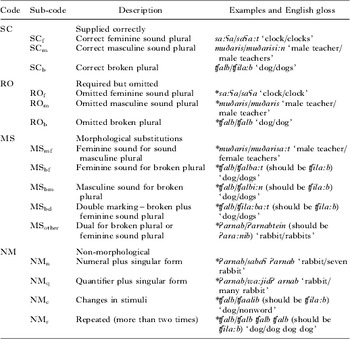
Each participant's elicited production of the plural morpheme for the real stimuli was coded as correct and incorrect using an adaptation of Cazden's (Reference Cazden1968) and Jia's (Reference Jia2003) coding system: SC (supplied correctly), RO (required but omitted), MS (morphological substitutions), and NM (non-morphological forms). Table 1 provides a breakdown of the coding classification and examples from the corpus for each type of code. SC and RO were further classified into the three inflectional types of interest in this study – FSP, MSP, and BP. For example, the participant added the correct plural inflection for FSP -a:t to change sa:ʕa ‘watch’ to sa:ʕa-a:t ‘watches’. However, the same target would be categorized as an omission of a required FSP plural marker (RO) when sa:ʕa is produced as sa:ʕa without -a:t to mark pluralization. Morphological substitutions (MS) errors consisted of the following types: (a) one plural marker replacing another (e.g. ʧalb ‘dog’, which requires a broken plural ʧila:b ‘dogs’, is erroneously produced as FSP by adding -a:t *ʧalb-a:t); (b) double-marking (e.g. ʧalb receives not only the correct broken plural form ʧila:b but also the FSP -a:t to generate *ʧila:b-a:t); or (c) using other forms such as the feminine dual marker -tein as substitutes. A final error pattern included the use of non-morphological forms (NM) such as changing the stimuli (e.g. phonological or semantic alterations such as ʧa:lib instead of ʧila:b ‘dogs’), using a quantifier or a numeral with the singular form (e.g. saying wajid ‘many’ instead of inflecting for plural), or repeating the stimuli more than two times (e.g. ha:ða beit beit beit ‘this house house house’).
Description of the codes used to classify the real words along with examples from the corpus

A similar coding procedure was used for the elicited nonsense word productions. A main difference was that frequencies of occurrence rather than correct–incorrect classification were used in the case of nonsense stimuli. Hence the categories ‘supplied correctly’ (SC) and ‘morphological substitutions’ (MS) were precluded for the nonsense stimuli for two reasons: (a) frequency of use rather than accuracy (SC) was the target; and (b) the participants' responses for the nonsense forms were described without labelling them as morphological substitutions. Three main categories appeared – a morphological inflection (regular linear suffixation: FSP or MSP; or irregular affixation: BP), RO (omitted plural inflection), and non-morphological forms (NM).
RESULTS
The current study examined the acquisition of a particular inflectional class, noun plurals in three groups of Kuwaiti Arabic-speaking participants: a group of children with SLI, a chronological age equivalent group (TD), and a group of adults. This section presents the participants' responses along three measures: (a) proficiency in marking noun plurals for the fourteen real stimuli; (b) use of the three types of plural morphological categories: regular, linear suffixation (FSP and MSP) and irregular non-linear affixation (BP) in fourteen real nouns and thirteen nonsense stimuli; and (c) other response patterns the groups used for indicating nominal number in both types of stimuli (real and nonsense). Criterion for statistical significance was set at p-values of ⩽·05.
Proficiency in producing plural inflection in real words
A composite percentage score was calculated for the three groups of participants (adult, TD, and SLI) using the formula below as an indicator of proficiency of marking plural inflections in real nouns (Jia, Reference Jia2003).
 $${\rm Composite\ score \equals }{{{\rm Total\ correct\ plural\ tokens\ \lpar SC}_{\rm f} \plus {\rm SC}_{\rm m} \plus {\rm SC}_{\rm b} \rpar } \over {{\rm Total\ plural\ contexts\ \lpar SC \plus RO \plus MS \plus NM\rpar }}}$$
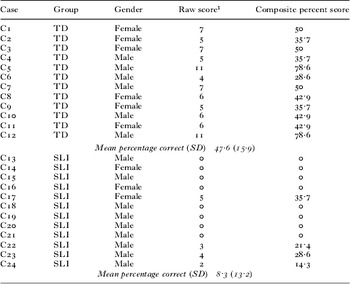
The composite scores were divided by 100 to obtain a percentage. The adults were 100 percent accurate in producing the elicited plural inflection for real nouns. Table 2 presents the raw and composite percentage scores obtained for each participant in the TD and SLI groups. A clear gap in general proficiency of using the correct plural forms was evident for both groups of children when compared with the adults.
Correct elicitations of real noun plural inflections (composite percent scores, means and standard deviations and raw scores) for the two groups of children (TD and SLI)

note 1: Out of 14 real stimuli.
As is evident from Table 2, the children with SLI appeared less proficient than their age-matched typically developing peers in correctly inflecting noun plurals. An independent samples t-test confirmed the significance of this difference (TD >SLI), (t(22) = 6·58, p < ·001 [two-tailed]).
Interestingly, the groups had no problems with the distracter stimuli, which required the participants to supply the singular forms of five real words when presented with their plurals. Both the TD and the adults scored at ceiling (Mean = 100%, SD = 0·00) for this task. The group with SLI were slightly lower in generating the singular forms (Mean = 80·9%, SD = 30·6) than either the TD or the Adult groups, (F(2, 33) = 4·63, p = ·02, ηp2 = ·220).
Noun plural category
Three plural morphological categories occur in Kuwaiti Arabic: FSP, MSP, and BP. This section examines the accuracy and frequency of these inflections as used by the three groups of participants in both testing contexts (real and nonsense).
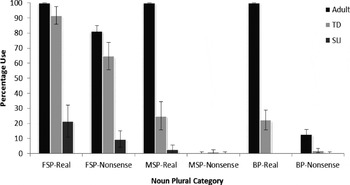
Figure 1 displays mean percentages of the three real and nonsense plural categories (FSP, MSP, and BP). The nonsense percentages represent how often the inflection occurred, while the scores for the real words signify accuracy. An examination of Figure 1 depicts an obvious variability in how the three types of plural inflections were used in the real and nonsense words. In terms of accuracy for inflecting the real stimuli, a one-way ANOVA revealed that the three groups were significantly different in their accuracy of using the FSP (Adult: Mean = 100%; TD: Mean = 91·6, SD = 19·9; SLI: Mean = 21·6, SD = 36·6) (F(2, 33) = 38·3, p < ·001, ηp2 = ·69); MSP (Adult: Mean = 100%; TD: Mean = 24·9, SD = 32; SLI: Mean = 2·7, SD = 9·6) (F(2, 33) = 82·8, p < ·001, ηp2 = ·83); and BP (Adult: Mean = 100%; TD: Mean = 22·2, SD = 22·8; SLI: Mean = 0%) (F(2, 33) = 190·2, p < ·001, ηp2 = ·92). Post-hoc Fisher LSD pairwise comparisons revealed no reliable differences between the adult and TD groups for the FSP. However, the TD children performed significantly lower than the adults for the MSP (p < ·001) and BP (p < ·001). In turn, scores for the MSP (p < ·001) and BP (p < ·001) were significantly greater in the TD group than those of the children with SLI.
Mean percentage scores for the three inflectional types (FSP, MSP, and BP) across the three groups (SLI, TD, and Adults) – percent correct for real words and percent frequency of occurrence for the nonsense stimuli. Error bars represent one standard error above and below the mean.

As is evident in Figure 1, the overall advantage of the FSP in real nouns was also true for the elicited nonsense stimuli. In other words, the FSP (e.g. ya:fig-a:t for ya:fig) was the most preferred plural category when participants were asked to inflect nonsense stimuli. Adults used FSP at 81·4% (SD = 12), followed by the TD group at 64·7% (SD = 31) and the SLI group at 9·6% (SD = 18·9). MSP (e.g. muttas-i:n for muttas) was rarely utilized (adults and SLI Mean = 0·64%, SD = 2·2; TD = 1·3, SD = 4·4). Frequency of producing the BP (e.g. afla:b for fla:b) was higher in the Adults (Mean = 12·8%, SD = 11) than either the TD (Mean = 1·9%, SD = 4·8) or the SLI groups (Mean = 0·64%, SD = 2·2). Interestingly, some of the TD children (Mean = 3·2%, SD = 7·7) and the adults (Mean = 3·8%, SD = 6·1) displayed a tendency to turn certain nonsense words into broken plural in addition to attaching the FSP linear suffixation -a:t, e.g. tana:kib-a:t for tankab.
Paired-samples t-tests were conducted to compare the use of FSP to the other two plural forms in both elicitation contexts (real and nonsense). FSP forms were not only more accurate in real words (Mean = 71·6%, SD = 42·6) but also more frequent in nonsense stimuli (Mean = 51·9%, SD = 37·8) than either the MSP (Mean for real = 42·6%, SD = 46·2; Mean for nonsense = 0·86%, SD = 3·1) or the BP (Mean for real = 40·7%, SD = 45·3; Mean for nonsense = 5·1%, SD = 8·8) (p < ·001 for real and nonsense words). However, no reliable statistical differences emerged between the MSP and BP forms for accuracy of real words or frequency of occurrence for nonsense words.
Other response patterns (error analysis)
This section focuses on the error analysis with comparison between morphological substitutions in real words, and non-morphological responses in both real and nonsense words. First, a comparison is made between the children's responses for real and nonsense words.
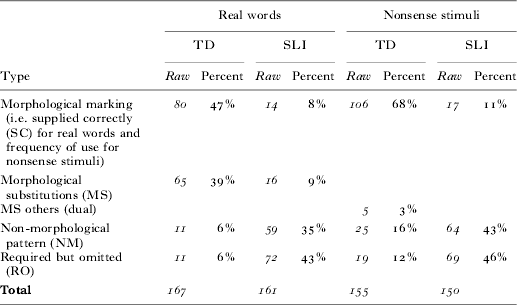
Table 3 reiterates data reported earlier – that the TD children used the required noun inflections in a real word context significantly more (47% of the time) than the group with SLI (8%). Morphological markings were also more common in the TD group's responses to nonsense stimuli (68%) than in the participants with SLI (11%) (χ2 (3, n = 24) = 19·77, p < ·001). As for error patterns in the real words, the TD children substituted morphological forms for plural forms more often (39%) than the group with SLI (9%) (χ2 (3, n = 24) = 8·51, p < ·04). However, the reverse pattern was found in the case of non-morphological markers, whereby the children with SLI resorted more to this strategy (35%) than the TD group (6%) (χ2 (3, n = 24) = 7·60, p < ·05). The children's data also revealed an erroneous strategy of using the singular (no affixation) instead of the inflected plural forms. This pattern was much higher in the SLI (43%) than the TD group (6%) (χ2 (3, n = 24) = 10·1, p < ·02). The same holds true for the nonsense words, as can be seen in Table 3, whereby omissions (χ2 (3, n = 24) = 12·11, p < ·007) and non-morphological forms (χ2 (3, n = 24) = 10·46, p < ·02) were more frequent in the group with SLI than the TD group.
Response patterns for real words vs. nonsense words by the TD and SLI groups (raw scores in italics)
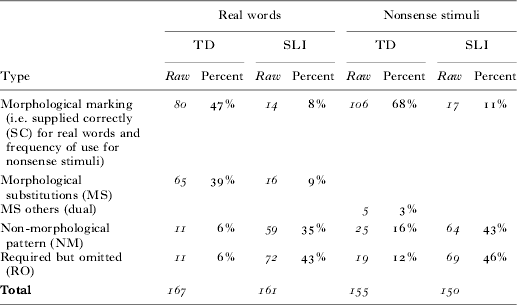
It is clear that the morphological marking, whether correct or incorrect, was the frequent choice for TD children, while omission or non-morphological patterns were considerably less so. On the other hand, the opposite pattern was found in the children with SLI, where omission (43%) and non-morphological marking (35%) were more frequent than correct (SC) (8%) or incorrect noun morphology (MS) (9%). This pattern was consistent with the nonsense words as well.
Morphological substitutions
This section provides more details on the morphological substitutions that were used by the children when presented with real words.
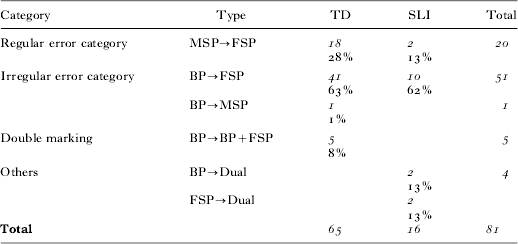
Table 4 shows the first morphological substitution that includes the use of the regular error, MSP → FSP, e.g. sajja:d ‘hunter’ becoming sajja:d-a:t (FSP) instead of sajja:d-i:n (MSP) ‘hunters’. The other one is the use of regular form such as FSP instead of BP (BP → FSP), which appears in high proportions in both groups, while the BP → MSP appeared in a single occurrence in the TD group. FSP, a preferred overgeneralization strategy, was used as a substitute for both the regular MSP and irregular BP contexts. This strategy was employed more by the TD group (Mean = 38·6, SD = 21·2) than the children with SLI (Mean = 9·5, SD = 13) (t(22) = 4·05, p < ·001 [two-tailed]).
Types of morphological substitutions in the real stimuli for the two groups of children – TD and SLI (raw scores in italics)
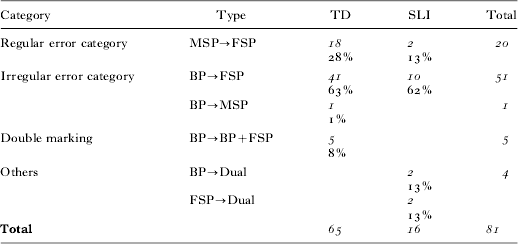
Another type of morphological substitution that was produced by a few TD children (8%; Mean = 2·97) was double marking. Table 4 shows that in five occurrences, three of the TD children used double marking (BP + FSP) in place of BP. For example, the three children said ʧila:b-a:t instead of ʧila:b ‘dogs’, gataw-a:t for gitawa ‘cats’, and qissas-a:t instead of qissas ‘stories’. Their choice of the FSP in this case supports the overgeneralization of the FSP in the language. It is worth mentioning that on four occasions, one of the children with SLI unexpectedly used the dual marker instead of BP (BP/FSP →Dual), as in ba:b-tein instead of abwa:b or biba:n ‘doors’, and sajja:r-tein instead of sajja:r-a:t ‘cars’.
Non-morphological responses
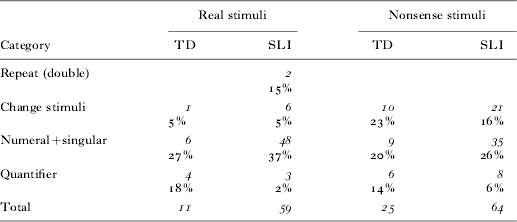
As mentioned earlier, the TD children used morphological marking with the nonsense words 71 percent of the time, while the participants with SLI marked the nonsense words morphologically 11 percent of the time. The non-morphological patterns in real and nonsense words are presented in Table 5.
Non-morphological type responses (NM) in real vs. nonsense words by the TD and SLI groups (raw scores in italics)
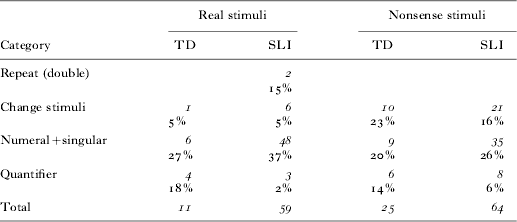
The frequency of non-morphological responses in the SLI group surpassed that seen in the TD children (see total non-morphological in Table 3). Again, there was a discrepancy in the totals of the non-morphological markers in the real (Mean = 6) versus nonsense (Mean = 16) context for the TD group.
With the real words, the singular form was used in two occurrences instead of marking the word for plural (about 15%) in the SLI group. The data also showed negligible occurrence of the ‘changing the stimulus’ pattern, e.g. the use of the BP pattern of one category for the BP pattern of another category with a different CV template as in ʔarnab ‘a rabbit’ becoming *ʔara:ni:b instead of ʔara:nib ‘rabbits’. This appeared infrequently, 5% each in both groups in real words, and slightly higher (23% and 16%) in nonsense words in both TD and SLI, respectively.
Using the periphrastic expression of number sabiʔ ‘seven’ in plural contexts before the singular form as in *sabiʔ sajja:ra ‘seven car’ instead of sabiʔ sajja:r-a:t ‘seven cars’ occurred in both groups: the TD (27%, 20%) and SLI (37%, 26%) with real and nonsense words, respectively. Employing quantifiers such as wa:jid ‘many’ before the singular form, as in *wa:jid sajja:ra ‘many car’ instead of sajja:r-a:t ‘cars’, was also found in real and nonsense words. One child with SLI used the quantifier kiti:r ‘many’ before the singular form.
DISCUSSION
This study explored elicited productions of regular and irregular noun plural inflections in Kuwaiti Arabic-speaking children with SLI and their typically developing age-matched peers using real and nonsense stimuli. Our threefold aim was to determine whether: (a) the performance of the children with SLI differed from those of the TD age controls in the correct use of noun plural inflections in real words; (b) accuracy and frequency varied depending on the type of plural category (FSP, MSP, and BP); and (c) the error patterns of the group with SLI qualitatively differed from those of the TD group.
The results of the present study revealed a significant delay in the performance of the children with SLI compared with age-matched TD peers in the production of the three types of plural formation in Kuwaiti Arabic, both in the composite score of all correct forms and in separate analyses. These results, that children with SLI have problems acquiring the plural inflection in Arabic, confirm what we hypothesized in the introduction section of this article. One could argue that the children with SLI's depressed performance in marking plurals stems from task difficulties. However, this argument is countered by the participants' superior performance in handling the distracter stimuli, whereby they readily changed regular plurals (e.g. kabat–a:t ‘cupboards’) and irregular plurals (e.g. suwar ‘pictures’) to their corresponding singular forms (kabat ‘cupboard’ and su:ra ‘picture’, respectively). Although noun plural inflection in general was a challenge for the SLI and TD groups, their performance varied according to the type of nominal plural marker (i.e. FSP, MSP, or BP) that was elicited. The FSP was not only more accurate in real words but was also the preferred choice in the nonsense context, especially in the TD group.
Qualitative analyses of the data showed that the children with SLI diverged from their age-matched counterparts in the number of errors and their distribution across categories. In real words, the TD children used morphology correctly or incorrectly (i.e. substitutions) significantly more than their peers with SLI. The majority of the children's substitutions were significantly towards FSP and no other patterns such as MSP in lieu of FSP emerged in the data. An analogous picture was also recorded in the nonsense word production task, where the use of morphology was more prevalent among the TD children while non-morphological patterns seemed the norm for the group with SLI. As for a breakdown in the types of non-morphological errors (Table 5), the use of periphrastic expression of number (e.g. *sabaʕ ʔarnab ‘seven rabbit’) (n = 54) was the most frequent pattern followed by quantifiers (e.g. *wa:jidʔ arnab ‘many rabbit’) and modifications in the stimuli (e.g. *ʧaalib for ʧila:b ‘dogs’) (n = 7 each), with negligible instances of repeating the stimuli to signal the plural (n = 2) (e.g. ʧalb ʧalb ʧalb ‘dog dog dog’). In addition to non-morphological errors, the participants of this study displayed a tendency to replace the singular with the inflected plural forms (i.e. required but omitted) in both experimental contexts (real and nonsense), albeit more widespread in the children with SLI than the TD.
Interestingly, there were individual differences among the participants with SLI, showing a developmental spectrum among this group. In particular, three children with SLI stand out; one of them was slightly older than the rest (C17) and the other two were in the upper half (older 50%) (C22 and C23 in Table 2). These children not only produced correct responses but also adopted the overgeneralization strategy of MSP to FSP (13%) and BP to FSP (62%). Most noteworthy was one participant with SLI (C15) who utilized the dual for FSP and BP plural targets (e.g. sa:ʔatein ‘two watches’ for sa:ʔah ‘watch’ instead of saaʔa:t ‘watches’), a pattern not witnessed in any of the other children (TD or SLI group) (Table 4). The remaining children with SLI did not seem to have developed plural morphemes and therefore seemed to resort to other types of strategies (e.g. periphrastic expression of number) that occurred to a lesser extent in the typically developing sample because they seem to have passed that stage.
Comparison with typical and atypical acquisition of nominal plurals in the literature
The observation that the KA children with SLI have noticeable delay in using noun plural inflections is in line with a longitudinal study of three children with language impairment in Egyptian Arabic (Fahim, Reference Fahim2005) and a cross-sectional study on Qatari Arabic (Shaalan, Reference Shaalan2010). The results are also similar to what was found in Hebrew, a language with comparable morphology, in relation to the difference between the SLI and the age-matched group (Dromi et al., Reference Dromi, Leonard and Shteiman1993). The results of the present study are also in agreement with what was reported in Hungarian (Lukács et al., Reference Lukács, Leonard and Kas2010) and Greek (Dalalakis, Reference Dalalakis1996), two morphologically complex languages but typologically different from Arabic, where children with SLI exhibited particular delays in plural inflection compared to typically developing peers.
However, the present findings are at odds with those reported for English and Italian. Oetting and Rice (Reference Oetting and Rice1993) noted that English-speaking children with SLI display a differentiated and productive noun plural inflection system by the age of five. Bortolini et al. (Reference Bortolini, Caselli and Leonard1997) found no significant difference between children with SLI and their MLU-matched controls in use of plural noun inflection in Italian, a language with a rich morphology.
As for plural noun type, our prediction that the feminine sound plural would have a central role was substantiated. Not only was this form more accurate in the case of real stimuli and frequently overgeneralized by the children, it was also the adult participants' predominant choice for pluralizing nonsense words (81·4%). This trend of the FSP being acquired earlier than the two other forms (MSP and BP) in typically developing children has been confirmed in several previous studies of Arabic (e.g. Kuwaiti by Aljenaie et al., Reference Aljenaie, Abdalla and Farghal2011; Jordanian by Daana, Reference Daana2009; Egyptian by Omar, Reference Omar1973; Palestinian by Ravid & Farah, Reference Ravid and Farah1999; Ravid & Hayek, Reference Ravid and Hayek2003; Saudi by Siddiki, Reference Siddiki2002; Nawwab, Reference Nawwab2009).
A common non-morphological error among the children with SLI was the production of singular nouns (uninflected) in lieu of plural targets. This type of error parallels a similar trend that emerged for younger typically developing children reported for other languages (e.g. Clark and Nikitina, Reference Clark and Nikitina2009) as well as children with SLI in Egyptian Arabic (Fahim, Reference Fahim2005), German (Clahsen et al., Reference Clahsen, Rothweiler, Woest and Marcus1992), Greek (Dalalakis, Reference Dalalakis1996), Serbo-Croatian (Ljubešić and Kovačević, Reference Ljubešić and Kovačević1992), and Spanish (Bedore & Leonard, Reference Bedore and Leonard2001). The prevalence of this type of error could be an indication that some of the children are avoiding plurals because they are not competent in using number markers (Hoekstra & Hyams, Reference Hoekstra and Hyams1998). Avoidance of plurals seemed more pronounced in unfamiliar contexts, namely in the nonsense task, in both groups of children. A further analysis of this type of error revealed no clear pattern of avoidance with respect to the three morphological categories, i.e. the number of omissions was comparable whether the target was FSP, MSP, or BP. This is rather surprising, since one would expect this error type to dominate for the MSP and BP targets given that data from typical and atypical Arabic language learners (e.g. Aljenaie et al., Reference Aljenaie, Abdalla and Farghal2011; Fahim, Reference Fahim2005) found these forms (MSP and BP) to emerge later developmentally.
An interesting observation emerges when the findings of this study are compared to those reported for various languages in Stephany and Voeikova (Reference Stephany and Voeikova2009). Like those developing Spanish (Aguirre & Marrero, Reference Aguirre, Marrero, Stephany and Voeikova2009) and Italian (Noccetti, Reference Noccetti, Stephany and Voeikova2009), the participants in this study went through what resembles a ‘pre-morphology’ stage whereby the singular was often used in contexts where the target is plural. During this phase they also often referred to plurality through the use of numerals and quantifiers. What the authors (Stephany & Voeikova, Reference Stephany and Voeikova2009) denote as the ‘proto-morphological stage’ is evidenced in the current study in the emergence of morphological patterns (FSP) that overextended to the other two inflectional categories: MSP, which is less frequent in the language, and BP, which is less transparent. The KA children (especially the TD group) seemed to be transitioning to the stage of ‘morphology proper’, whereby FSP were more accurate than other forms of plural markers.
KA results in the light of SLI theories
It is very likely that language typology affects the development of morphology (nominal plural inflection) in this case in both SLI and typical populations. Nominal plural inflection presents a complex system for learners of Arabic because it does not conform to the regular/irregular split for marking plurals found in Indo-European languages such as English (Ravid & Farah, Reference Ravid, Farah, Stephany and Voeikova2009). KA, like other dialects of Arabic, inflects the plural using three key processes – FSP and MSP follow a rule-based concatenative process (linear suffixation of -a:t for feminine and -i:n for masculine nouns) while BP constitutes a non-concatenative process (non-linear, root-and-pattern plural form) that relies on the internal modification of the singular stem rather than linear affixation. Though the plural morphemes in MSP and FSP are both semantically transparent, the MSP is restricted to a few words that have the feature (agent), and are in many cases (+animate), and are therefore less frequent.
The fact that the broken plural (an irregular, morphotactically less-transparent form) was problematic for the children may be easier to comprehend than the incongruity found in using the two regular forms (FSP and MSP). In other words, there was a discrepancy in the production of the MSP and FSP in favour of the latter, despite the fact that they are equally acoustically salient. Both forms of the plural are regular and both are suffixes made of a long vowel followed by a consonant. The last consonant of the stem is a heavy syllable (CV:C) that attracts stress in most words. It is even easier to inflect the MSP since it simply involves the addition of the suffix to the stem (muʕallim–muʕallim-i:n, ‘male teacher–male teachers’). In the case of FSP, however, the affixation in most cases also involves the deletion of the feminine marker (ah) at the end of the singular word (muʕallimah–muʕallim-a:t, ‘female teacher–female teachers’).
If we take into account Leonard's (Reference Leonard1998) argument that acoustic saliency is only one feature of a general saliency matrix that includes semantic saliency and simplicity, the data of the present study could fit this hypothesis. In fact, the morpheme that is less semantically restricted and therefore more frequent and productive (namely the FSP) is acquired before the semantically restricted, MSP. The broken/irregular plurals are acquired later because they have numerous forms and do not follow a transparent rule, and are therefore learned as lexical items. This is evident in the errors produced by some of the children in this study, where an (already inflected) irregular plural noun is inflected using the ostensible FSP marker (e.g. for the singular ʧalb ‘dog’, they would add the feminine suffix a:t to the correct broken ʧila:b to produce a doubly marked plural *ʧila:ba:t). The assumption that Arabic is a minority default language, where the regular inflection used as the default is the less frequent morpheme in the language has been adequately refuted (Boudelaa & Gaskell, Reference Boudelaa and Gaskell2002). The regular (feminine and masculine combined) are by far more frequent than the irregular plural forms.
According to Paradis and Crago (Reference Paradis and Crago2001), the specific form typical and atypical language learners select as default is often governed by the typology of the target language. Theoretically, the unique typology of Arabic nominal morphology explained above seems to lend support to the view that FSP may very well be the default plural marker. The empirical findings of the present research, as well as those from the Arabic literature (e.g. Aljenaie et al., Reference Aljenaie, Abdalla and Farghal2011; Fahim, Reference Fahim2005), further reinforce this proposition. The results of this investigation highlighted that FSP was not only a popular overgeneralization strategy for the TD children but also constituted the adults' favoured approach for marking plurals in non-Arabic words (nonsense task). The FSP as a substitute also prevailed in the sub-group of children with SLI who did supply correct responses. These children did not differ qualitatively from their typically developing counterparts in their types of errors and strategies. Essentially, their error profiles revealed no arguments to reinforce the hypothesis that the linguistic characteristics of the children with SLI were deviant when contrasted with the TD group. Therefore, in this regard, the development of plural nouns in Kuwaiti Arabic-speaking children appears to be delayed rather than deviant.
Clinical implications and future research
In sum, the above discussion has demonstrated that Kuwaiti Arabic learners with specific language impairment seem to have special challenges with inflectional morphology, just like their counterparts learning English and other languages. However, this study clearly demonstrates that the child's language typology will influence the particular morphosyntactic features that are vulnerable. For example, the Arabic-speaking children (TD) were still struggling with plural noun inflection at the age of five, even though plural markers are acquired early in English (1;10 to 2;9; Brown, Reference Brown1973). The participants with SLI in this study were developmentally behind those reported for children with SLI acquiring English (e.g. Oetting & Rice, Reference Oetting and Rice1993). We propose exploring the possibility of the nominal plural inflection serving as a potential clinical marker in Arabic, given that similar trends were observed in other varieties of Arabic: Egyptian (Fahim, Reference Fahim2005) and Qatari (Shaalan, Reference Shaalan2010). It could be practical from a clinical point of view to examine the FSP in particular, which is acquired comparatively early in TD children and would therefore serve as a reasonably early marker of SLI, based on the results of the present study. However, it would be necessary to control for language development by examining data from typically developing language-matched children in addition to the SLI and chronological age-matched comparison design adopted in the present study.
This study has also contributed another practical benefit – i.e. examining the types of plural categories as well as error patterns can yield insights into the child's stage of development. The errors and the nonsense words confirm that children with SLI do have the morphological rules/features to produce novel words, as found in previous studies in English, for instance in root compounds (Grela, Snyder & Hiramatsu, Reference Grela, Snyder and Hiramatsu2005). Some actually used the default FSP forms and overgeneralized it in either real or nonsense words. The possibility that FSP is a default presents important implications for assessing and treating Arabic speakers with specific language impairment. Clinicians may observe not only higher levels of accuracy in producing this type of plural but also the possibility that FSP becomes the preferred strategy for overgeneralization in children with SLI. The type of error can also be telling – e.g. two children with SLI may score 0% for production of plural inflections; however, the child who substitutes FSP for other forms (MSP and BP) would seem developmentally more advanced than the other whose predominant error pattern is omission (i.e. supplying the singular for the plural) or the use of periphrastic expression. In other words, it may be functional to sort the children according to the stage of plural morphology, using Stephany and Voeikova's (Reference Stephany and Voeikova2009) aforementioned ‘pre-morphology, proto-morphology, and morphology proper’.
This investigation also highlighted that error patterns of Kuwaiti Arabic-speaking children with specific language impairment were not deviant. In essence, the errors of the children with SLI were developmentally similar to those of the TD except for higher frequency of occurrence. These points emphasize the importance of clinicians attending not only to overall accuracy of plural use but also closely examining the types and error patterns when serving Arabic-speaking clients with language learning difficulties.
APPENDIX
Real words and nonsense stimuli used in the study. English meanings for the Arabic words are provided in the gloss