Introduction
Altogether, many authors have studied the staphyilinid fauna (Galli, Reference Galli1985; Reede, Reference Reede1985; Dennis et al., Reference Dennis, Wratten and Sotherton1990, Reference Dennis, Wratten and Sotherton1991; Majzlan & Holecová, Reference Majzlan and Holecová1993; Wardle et al., Reference Wardle, Nicholson and Yeates1993; Heyer, Reference Heyer1994; Knopp, Reference Knopp1997; Krooss & Schaefer, Reference Krooss and Schaefer1998; Andersen, Reference Andersen1991, Reference Andersen2000; Perner & Malt, Reference Perner and Malt2002) but their community structure in conventionally treated agro-ecosystems are still little known. From Europe, Andersen (Reference Andersen1991) presented a list of staphylinid beetles occurring in spring barley, cabbage, carrot, potato, strawberries and grassland fields in Norway. The author found 103,000 specimens belonging to 226 species. The most frequent were: Aloconota gregaria (Erichson), Anotylus rugosus (F.), Athena fungi (Gravenhorst), Amischa analis (Gravenhorst), Tachinus signatus (Gravenhorst) and Philonthus cognatus (Stephens). From Canada Levesque and Levesque (Reference Levesque and Levesque1995, Reference Levesque and Levesque1996) presented a species list occurring in raspberry plantations. The authors presented 81 species and 16,074 specimens (without species of the Aleocharinae subfamily). The most abundant species were Gyrohypnus angustatus Stephens and Tachinus corticinus Gravenhorst. Staphylinid beetles reported from conventionally treated cereal ecosystems in Europe are frequent (Dennis et al., Reference Dennis, Wratten and Sotherton1990, Reference Dennis, Wratten and Sotherton1991; Krooss & Schaefer, Reference Krooss and Schaefer1998; Andersen, Reference Andersen2000; Perner & Malt, Reference Perner and Malt2002). In wheat, the most abundant species were Philonthus cognatus (Stephens), Tachyporus hypnorum (F.), T. chrysomelinus (L.), T. obtusus (L.) and Stenus biguttatus (L.). For the past 20 years, the Game Conservancy has monitored abundances of cereal invertebrates in over 100 fields in Sussex, UK. The total number of invertebrates (excluding Acari, Collembola and Thysanoptera) recorded per sample has dropped by almost half in the course of the study, corresponding to a quarter of what was present in pre-pesticide times. This overall change was the result of widespread decline in Araneae, Lepidoptera, Aphididae (Hemiptera), Symphyta (Hymenoptera), Staphylinidae, Cryptophagidae, Lathridiidae and Lonchopteridae (Diptera); these groups constituted 72%, on average, of the total by number (Aebischer & Potts, Reference Aebischer and Potts1990). Hedgerows act as a corridor of movement and dispersal for many forest species, such as carabids, staphylinids or even small mammals (Burel, Reference Burel1996). Crop field surroundings influence the abundance of pests in several ways. The climatic conditions created by the presence of a forest edge or a hedgerow, for example, gives opportunities for several species to reproduce, especially those that benefit from high humidity and low wind speed. Some insect species also benefit from their winter host being present along hedgerows, such as Rhopalosiphum padi (L.) (Ravn & Holm, Reference Ravn and Holm1997; Magura & Tóthmérész, Reference Magura and Tóthmérész1997; Magura et al., Reference Magura and Tóthmérész1997).
The functional role of rove beetles in agro-ecosystems, the response to prey spatial heterogeneity, the aggregation and the aphid and mildew preferences were studied by other authors (Bryan & Wratten, Reference Bryan and Wratten1984; Sunderland et al., Reference Sunderland, Crook, Staccy and Fuller1987; Dennis et al., Reference Dennis, Wratten and Sotherton1991; Good & Giller, Reference Good and Giller1991). Bryan & Wratten (Reference Bryan and Wratten1984) demonstrated that several species of rove beetles aggregated in patches of aphids and presented a positive numerical response to high aphid densities. Under laboratory conditions, aphid predation was 1 mg day−1 for many of the staphylinid species, which is more than 34% of the body weight. In gut-dissection work carried out by Sunderland et al. (Reference Sunderland, Crook, Staccy and Fuller1987), three categories of food, other than aphids, were identified in the diet of the Tachyporus spp.: non-aphid arthropods, rust and non rust fungi. Dennis et al. (Reference Dennis, Wratten and Sotherton1991) showed that these species have a positive numerical response to high density of rusts and non-rust fungi, while aphid predation decreased significantly at the same time. Other species, such as Philonthus spp., fed only with arthropods, their aphid predation was on average 20 aphid specimens day−1, and there is no record of mycophagy (Good & Giller, Reference Good and Giller1991).
As part of a greater project (Apple Ecosystem Research), faunistic studies have been carried out since 1976 to describe the species composition of arthropod assemblages in conventionally treated apple orchards in Hungary. Mészáros et al. (Reference Mészáros, Ádám, Balázs, Benedek, Csikai, Draskovits, Kozár, Lővei, Mahunka, Meszleny, Mihályi, Mihályi, Nagy, Oláh, Papp, Polgár, Radwan, Rácz, Ronkay, Solymai, Soós, Szabó, Szabóky, Szalay-Marzsó, Sarukán, Szelényi, Szentkirályi, Sziráki, Szeőke and Török1984) examined apple orchards in five localities; Markó et al. (Reference Markó, Merkl, Podlussány, Víg, Kutasi and Bogya1995) investigated the Coleoptera communities in apple and pear orchards in three localities, while Bogya et al. (Reference Bogya, Szinetár and Markó1999) present data about species composition of apple and pear orchard inhabiting Araneae. Altogether, more than 2000 arthropod species were recorded; there is still little known about the staphylinid beetles in apple and pear orchards; and there are no records about the staphylinids occurring in conventionally treated winter wheat (Kutasi et al., Reference Kutasi, Balog and Markó2001; Balog et al., Reference Balog, Markó, Kutasi and Ádám2003).
In this study, our aim was to make a thorough survey of species composition of staphylinid fauna occurring in economically important agricultural fields in Hungary.
Materials and methods
Characterization of the investigated ecosystems and sampling procedures
Investigations in orchards took place over five years (1998–2002) in 11 plantations situated in eight farms. Five farms consisted of one apple orchard each, while three consisted of one apple and one pear orchard (table 1). The investigated farms were in three geographical regions with different environmental conditions. These were agricultural lowland environments (ALE), regularly flooded areas (RFA) and woodland area of medium height mountains (WAM). Four farms were located on sand and four on clay (table 1). Plantations were treated with organophosphate insecticides during the study period. These were applied on average ten times each year.
Geographical localization and characteristics of the investigated orchards.

WAM, woodland area of medium height mountains; ALE, agricultural lowland environment; RFA, regularly flooded area.
Studies in wheat were performed in 2006 and 2007 in four conventionally farmed plots (10 ha each) all surrounded by hedgerows of different sizes. The soil structure was sandy-loam and the treatments consisted of foliar fungicides during the vegetation period. The crop rotation was with sugar-pea (table 2).
Geographical localization and characteristics of the investigated winter wheat farms.

A1 & A2, Farms surrounded by 20-m-wide hedgerows; B1 & B2, Farms surrounded by 40-m-wide hedgerows.
Ten covered pitfall traps (300 cm³ in size, 8 cm in diameter, half-filled with ethylene glycol 30% solution) were placed from the field margins towards the field centre at 10 m intervals within each orchard. Five traps were placed in the middle of the plantation and five in the inner edges. In wheat, 14 traps were used in two replicates for each farm. The first trap was placed in the middle of the hedge, the second at the field margin, while the others towards the field centre at 5 m intervals. Pitfall traps are considered a useful method to study community assemblages of epigeal arthropods (Luff & Eyre, Reference Luff and Eyre1988). Samples were collected fortnightly from April until October in orchards and from April until August in wheat. All staphylinids, even species from Aleocharinae, were sorted and identified up to species level. Species identification was based on the works of Freude et al. (Reference Freude, Harde and Lohse1964, Reference Freude, Harde and Lohse1974), Tóth (Reference Tóth1982, Reference Tóth1984) and Zerche (Reference Zerche1996a,Reference Zercheb).
Laboratory studies of prey preferences
Under laboratory conditions at room temperature, the prey preferences of the dominant species in wheat were studied. In the first experiment, five living individuals of each species (Aloconota gregaria, Philonthus cognatus, Tachyporus hypnorum, T. chrysomelinus and T. obtusus) were placed in 90 mm diameter petri dishes and each was offered 20 adult individuals of Ropalosiphum padi every day for a week. In a second experiment, five individuals of species Staphylinnus caesareus and T. hypnorum were used and each was offered five types of prey daily (eggs of Lema melanopus L., larvae of Apomyza sp., and Phorbia secures Tiensuu, and adults of Haplothryps sp. and Sitobion avenae (F.)) in four exemplars. The partially and/or fully consumed individuals for both experiments, two replications each, were counted and the log10 transformed prey numbers were computed.
Data analyses
The most common species in orchards were determined by investigating their relative abundance and distribution in the cumulative sample and comparing their position in the dominance order in each of the investigated orchards (sum of the rank scores). The most abundant species in each orchard got a rank score of ‘7’, the following species got a rank score of ‘6’, etc. The seventh species in the dominance order got a rank score of ‘1’ and the species with lower abundance than that got a score of ‘0’ (Balog et al., Reference Balog, Markó, Kutasi and Ádám2003). The percentage of species in different fruit, soil and environment were also considered. The Jaccard similarity and diversity between the species collected in different plantations, soil compositions and surrounding habitats were computed. The Jaccard's coefficient is used to compare the species composition of two communities using binary dates and registered only the presence and the absence of the species (Pielou, Reference Pielou1984). The log series Fisher's alpha (ά) index was used as a measure of biodiversity (Krebs, Reference Krebs1989). The alpha diversity index is considered to be superior to commonly used indices because the sensitivity to sample size is low and it uses high discriminate ability (Tóthmérész, Reference Tóthmérész1995; Shah et al., Reference Shah, Brooks, Ashby, Perry and Woiwod2003). The analyses of variance (ANOVA) were performed and similarities were compared with O'Brien and Levene tests to compare the activity density of rove beetles and ground beetles in wheat, and the prey preferences of dominant species under laboratory conditions. Back-transformed means and P<99% confidence limits were considered as statistically significant differences (Tóthmérész, Reference Tóthmérész1995). The following standardizations were used for the test: different fruit species were used as replicate dates from orchards 6, 7 and 8 (apple and pear); soil compositions were used as replicate orchards from farm 3 and 6 (apple) for clay, 7 and 8 (apple) for sand; environmental conditions from farms 3 and 6 were compared with farms 1 and 2, all situated on clay; the apple orchard from farm 4 was compared with apple orchards from farm 7 and 8 all on sandy soil.
Results
Dominance in orchards
Altogether, 5236 individuals were collected belonging to 253 species and 11 subfamilies. Almost 23% of the Hungarian and 13% of the European staphylinid fauna were represented in the orchards. The compositions of the dominant species were similar in all of the orchards; however, species with relative abundance of less than 2% differed from apple to pear. In eight apple orchards, 3859 specimens, belonging to 191 species, were captured; while in three pear orchards, 121 species and 1377 specimens were collected.
Considering different plantations (apple and pear) from the same localities (loc. 6, 7 and 8), the Jaccard similarity was 51.7%. Under different soil compositions, the number of species recorded in sand was 203 species represented by 2724 specimens; while, in clay, it was 146 species with a total number of 2512 specimens, and the similarity was 39.4%.
For species composition in different surrounding habitats, we observed that, in woodland areas of medium height mountains (WAM), there were 141 species and 2340 specimens collected; in agriculture lowland environments (ALE), there were 156 species and 2191 specimens collected; while, in regularly flooded areas (RFA), there were 90 species and 705 specimens collected. The similarities were 22.5% between ALE and RFA, 23.9% between ALE and WAM, and 28.8% between RFA and WAM.
After cumulative assay studies of the communities, we identified the most widely occurring species in conventionally treated agro-ecosystems from Hungary. In orchards, seven species presented a relative abundance of 40%. In dominant order, these were Omalium caesum Gravenhorst, Drusilla canaliculata (F.), Dinaraea angustula (Gyllenhal), Palporus nitidulus (F.), Xantholinus longiventris (Olivier), Xantholinus linearis (Olivier) and Aleochara bipustulata (L.).
For different tree species (apple and pear from farms 6, 7 and 8), the ά diversity was lower for apple and higher for pear orchards but the differences were not statistically significant (F=1.54; P<0.68). The ά diversity was also higher on clay and lower on sand, the difference being not significant (F=1.35; P<0.59). The pooled value of ά diversity was high for RFA and low for ALE with statistically significant differences (F RFA, WAM=54.84; P<0.01; F RFA, ALE=49.82; P<0.01) (table 3).
Number of species, individuals and diversity of rove beetles fauna in Hungarian agro-ecosystems.

A1,2, Cumulative samples from farms surrounded by 20-m-wide hedgerows; B1,2, Cumulative samples from farms surrounded by 40-m-wide hedgerows.
Dominance in wheat
In wheat, a total number of 798 individuals belonging to 20 species of rove beetles were collected. The width of the hedgerows surrounding the farms affected the number of species and individuals representing them. In farms surrounded by 20-m-wide hedgerows, 288 individuals and 13 species were recorded; while, in farms surrounded by 40-m-wide hedgerows, 510 individuals and 18 species were recorded.
Six species were dominant with a relative abundance of 65%. These were Staphylinus caesareus Cederh, Tachyporus hypnorum (F.), Philonthus cognatus (Stephens), Aloconota gregaria (Erichson), Tachyporus chrysomelinus (L.) and T. obtusus (L.). Although species from Tachyporus spp. were dominant in cumulative samples, the activity density decreased considerably for the second half of the vegetation period. Species with bigger body size (S. caesareus and P. cognatus) preferred hedgerows, while small species (A. gregaria and Tachyporus spp.) were frequent in wheat. The pooled value of ά diversity was higher for farms surrounded by 40-m-wide hedgerows and differed significantly from farms with 20-m-wide hedgerows (F=6.05; P<0.001) (table 3).
Activity density in orchards
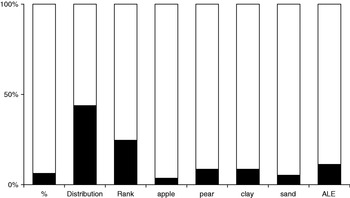
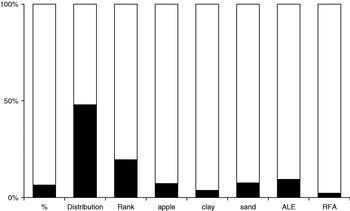
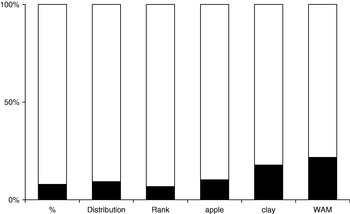
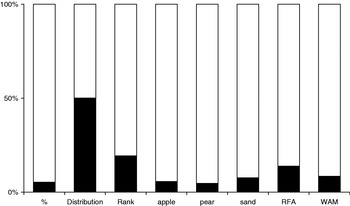
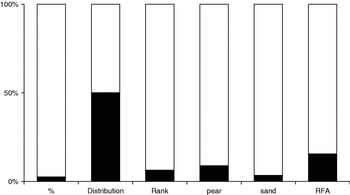
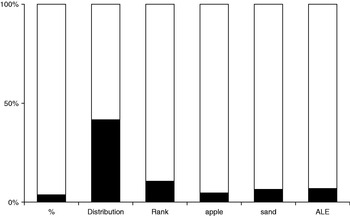
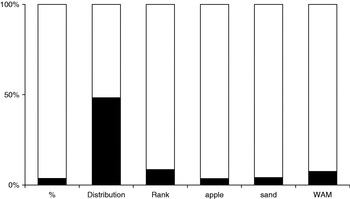
Omalium caesum was common in many of the orchards, and its relative abundance in the total sample was high. The distribution and the sum of the rank scores for this species were also high. Its activity density was higher in pear than in apple and also in orchards on clay in ALE (fig. 1). Similarly, Drusilla canaliculata was common in conventionally treated apple orchards. It was dominant and its distribution and total rank scores were high. Its activity density was higher in apple and in sand in ALE. It can also be found in RFA in relatively low numbers (fig. 2). Dinaraea angustula was present in high numbers in only one commercial apple orchard situated on clay in WAM. Its high number can be explained by irrigation in this orchard. In the cumulative samples, it was dominant, but its distribution was narrow, and its total rank score was, therefore, low (fig. 3). Pitfall trap catches of Palporus nitidulus were high in apple and pear orchards in RFA and in WAM. The species occurred in all of the investigated orchards situated on sand with a high rank sum (fig. 4). Xantholinus longiventris was dominant in pear orchards situated on sand in RFA and occurred in the whole period of vegetation with wide distribution but low rank sum (fig. 5). The greatest number of Xantholinus linearis occurred in apple orchards on sand in ALE with a relatively high distribution and a medium rank sum (fig. 6). The parasitoid species, Aleochara bipustulata, distribution by orchards was high with a relatively low rank sum. It was captured for the duration of the vegetation period in apple orchards on sand in WAM (fig. 7).
The relative abundance, distribution by orchards, total rank score and percentage in different fruit, soil and environment of Omalium caesum in Hungarian agro-ecosystems.

The relative abundance, distribution by orchards, total rank score and percentage in different fruit, soil and environment of Drusilla canaliculata in Hungarian agro-ecosystems.

The relative abundance, distribution by orchards, total rank score and percentage in different fruit, soil and environment of Dinaraea angustula in Hungarian agro-ecosystems.

The relative abundance, distribution by orchards, total rank score and percentage in different fruit, soil and environment of Palporus nitidulus in Hungarian agro-ecosystems.

The relative abundance, distribution by orchards, total rank score and percentage in different fruit, soil and environment of Xantholinus longiventris in Hungarian agro-ecosystems.

The relative abundance, distribution by orchards, total rank score and percentage in different fruit, soil and environment of Xantholinus linearis in Hungarian agro-ecosystems.

The relative abundance, distribution by orchards, total rank score and percentage in different fruit, soil and environment of Aleochara bipustulata in Hungarian agro-ecosystems.

Activity density in wheat
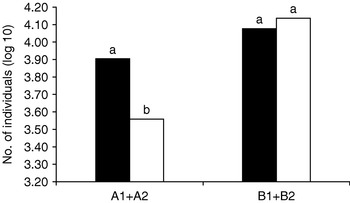
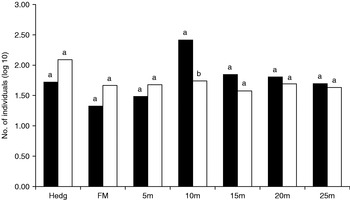
In wheat surrounded by 20-m-wide hedges, the activity density of rove beetles was significantly lower compared with ground beetles (F=10.22; P<0.01). For both groups, the activity density was high in wheat with a 40-m-wide hedges (fig. 8). Comparing the two groups, the activity density was higher for rove beetles towards 5 m, while from 10 m toward the centre of the field, ground beetles presented higher activity. The difference was significant only at 10 m intervals (F=2.02; P<0.01) (fig. 9).
The activity density of ground and rove beetles in winter wheat with different size of hedgerows. A1+A2, cumulative data of farms surrounded by 20-m-wide hedgerows; B1+B2, cumulative data of farms surrounded by 40-m-wide hedgerows; different letters: P<0.01 (■, Carabidae; □, Staphylinidae).

The activity density of ground and rove beetles caught with pitfall traps in winter wheat from the field margin toward interior at 5 m intervals. Hedg, hedgerow; FM, field margin; different letters: P<0.01 (■, Carabidae; □, Staphylinidae).

Prey preferences
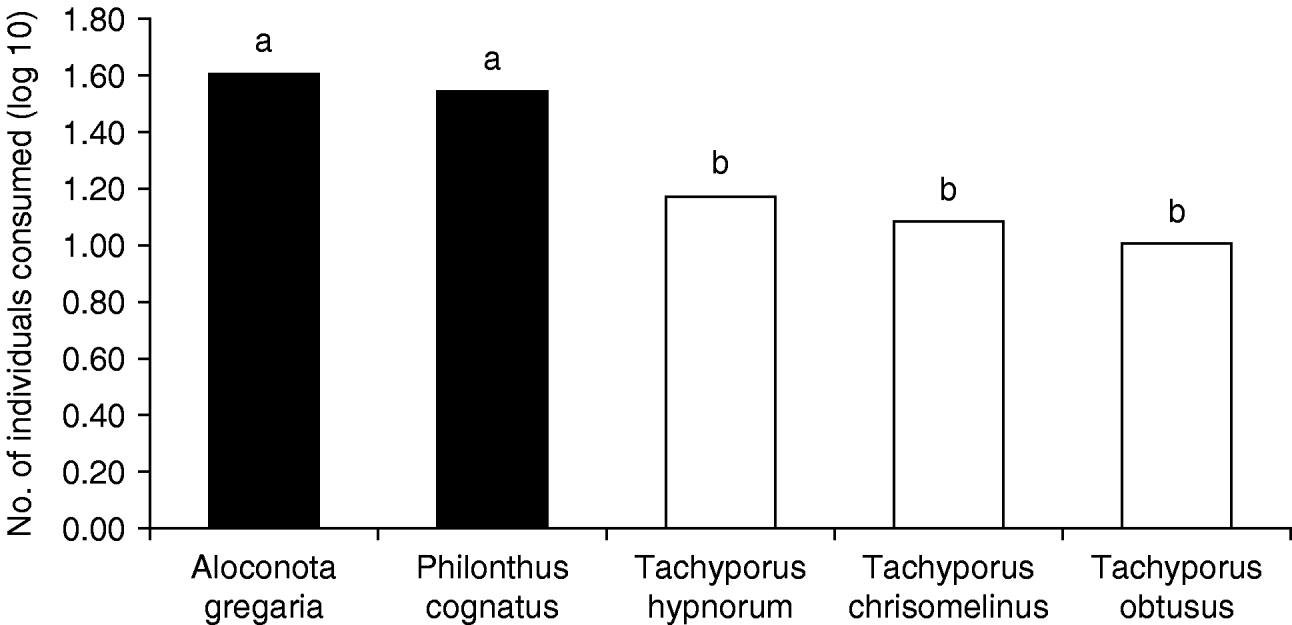
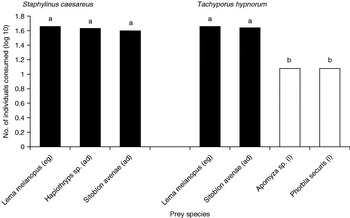
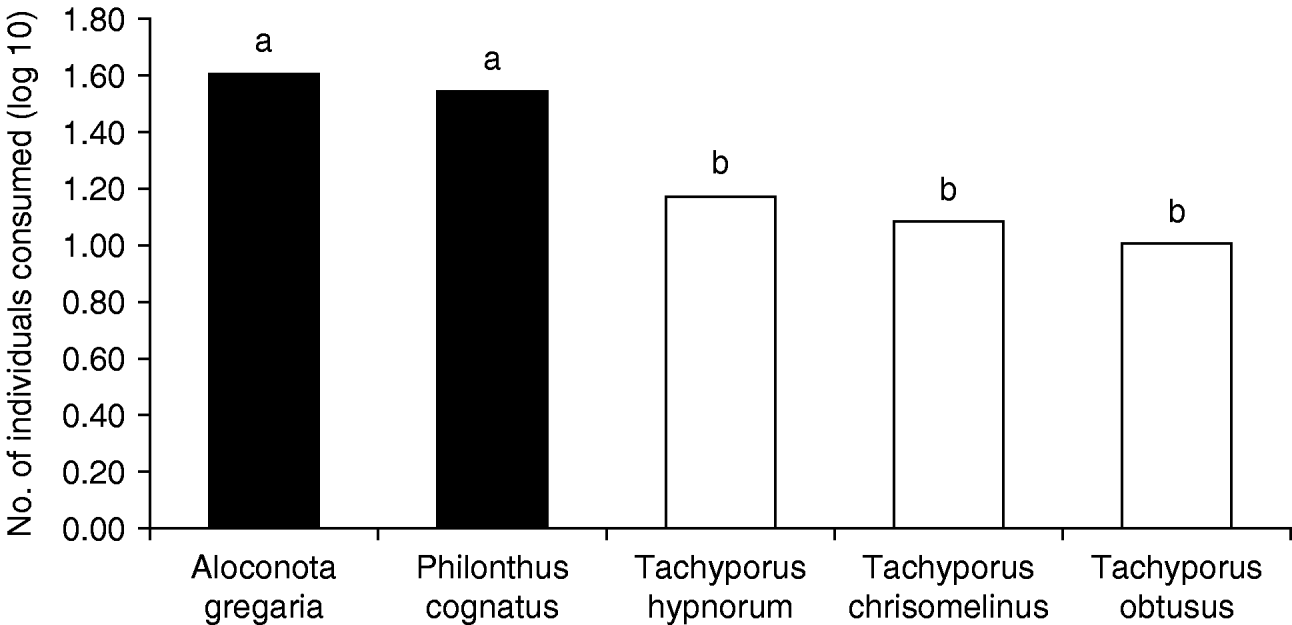
The acceptance of R. padi by rove beetles was high and almost all individuals of prey were partially or totally consumed in 24 h. Comparing different species, a significantly higher number (F=5.2; P<0.01) were consumed by A. gregaria and P. cognatus. Between Tachyporinae, the highest prey preference was observed for T. hypnorum and the least for T. obtusus (fig. 10). For different prey species, the consumption rate of eggs (L. melanopus) and adults (Haplothryps sp. and S. avenae) was high for S. caesareus, but the consumption of larvae (Apomyza sp. and Phorbia secures) was not observed. For T. hypnorus, the consumption rate of eggs (L. melanopus) and adults (S. avenae) was significantly higher (F=4.7; P<0.01) than the consumption of larvae (Apomyza sp. and P. securis); while, for adults, feeding on Haplothryps sp. was not observed (fig. 11).
The consumption rate under laboratory conditions of Ropalosiphum padi adult by dominant rove beetles in wheat. Different letters: P<0.01.
The most widely consumed prey species under laboratory conditions by rove beetles Staphylinus caesareus and Tachyporus hypnorum. Different letters: P<0.01.

Discussion
We identified the most common and perhaps functionally important species in conventionally treated Hungarian agro-ecosystems. Most of the species mentioned in this study have been recorded as frequent in agricultural fields by other authors throughout western Europe (Galli, Reference Galli1985; Reede, Reference Reede1985; Dennis et al., Reference Dennis, Wratten and Sotherton1990, Reference Dennis, Wratten and Sotherton1991; Majzlan & Holecová, Reference Majzlan and Holecová1993; Wardle et al., Reference Wardle, Nicholson and Yeates1993; Heyer, Reference Heyer1994; Knopp, Reference Knopp1997; Krooss & Schaefer, Reference Krooss and Schaefer1998; Andersen, Reference Andersen2000; Perner & Malt, Reference Perner and Malt2002).
We can conclude that the structure of the orchards (defined as the fruit species, the soil compositions and the surrounding habitats) promote the staphylinid fauna in different ways, and all these factors regulate populations. The species composition differed by crop (apple, pear and wheat), soil composition and surrounding habitat. Species diversity is also influenced by these parameters. In wheat, one acute change in species composition was observed during the vegetation period with the decline of Tachyporus spp. occurring equally across all farms. A possible cause was a drop in the availability of fungal food, as the level of mildew and rusts infecting crops dropped in line with the increasing use of foliar fungicides (Aebischer & Potts, Reference Aebischer and Potts1990). As these species have a positive numerical response to the high density of rust and non-rust fungi, the main population regulatory factor in winter wheat is the fungal food density. The high activity density of S. caesareus can certainly be explained with hedgerows, offering similar microclimates as forests.
The dominance and activity density of the staphylinid species in conventionally treated apple and pear orchards are presented for the first time in Hungarian agro-ecosystems. These results can be generalized for the whole central European region. After the cumulative assay studies of the population, we can conclude that the most frequent and functionally important species in conventionally treated apple and pear orchards on clay surrounded by ALE may be Omalium caesum and Drusilla canaliculata. In irrigated orchards on clay surrounded by WAM, Dimaraea angustula may have this functional role. In orchards situated on sand surrounded by ALE, species O. caesum, D. canaliculata and Xantholinus linearis are frequent; while, in WAM, the parasitoid species Aleochara bipustulata can play an important role in Delia spp. pest control. Palporus nitidulus presented high activity density in apple and pear orchards on sand surrounded by WAM and RFA, while Xantholinus longiventris preferred pear orchards on sand surrounded only by RFA.
The consumption rate of prey by the dominant species occurring in conventionally treated winter wheat was relatively high; however, we did not offer any fungal food to compare with insect prey, as mentioned by other authors (Dennis et al., Reference Dennis, Wratten and Sotherton1990). The preferences of R. padi were significantly higher for Aloconota gregaria and Philonthus cognatus compared with Tachyporus spp. This can be explained with high fungal preferences of Tachyporus spp., which means that the offered prey was not its essential food. The prey preferences differed between the two dominant species in wheat (S. caesareus and T. hypnorus). This led us to think that they had not met the prey before; and, over a longer period of time, they could learn to eat the unknown insects. Because these species are generalist predators, their response to prey density and diversity can be described as Type III functional response (Holling, Reference Holling1966). The functional response can determine if a predator is able to regulate the density of its prey, described also by other authors (Schenk & Bacher, Reference Schenk and Bacher2002).
Further research is needed to compare the community structure in plantations with different husbandry techniques and the prey preferences in field of staphylinids.
Acknowledgements
The authors are grateful to László Ádám for identifying the species of Aleocharinae. The work was funded by the Hungarian Research Fund (OTKA no. 023885), by the Bolyai János postdoctoral fellowship (no. BO/00455/04) of the Hungarian Academy of Science and by the European Science Foundation, Short Visit Grant, ‘Behavioural Ecology of Insect Parasitoids – from theoretical approaches to field applications’ (no. 1663). The authors are grateful to Dr Mark Brown and Dr Tibor Hartel for their linguistic review of the manuscript.