


Public discontent with political systems and institutions has become an increasingly salient concern in recent years, particularly as democracies worldwide face mounting challenges to their stability and effectiveness. Widespread political discontent – which undermines public confidence in the political process, erodes the legitimacy of governing institutions, and fuels the rise of populism that threatens liberal democracy (Doyle, Reference Doyle2011; Lipset, Reference Lipset1959; Miller, Reference Miller1974; Mudde, Reference Mudde2004; Mudde and Rovira Kaltwasser, Reference Mudde and Rovira Kaltwasser2017; Urbinati, Reference Urbinati2019) – offers a critical lens for understanding and predicting the erosion of democracy and political conflicts. Nevertheless, the nature, extent, and drivers of political discontent remain debated, with some arguing that the level of political discontent is on a clear increasing trend while others claim that political discontent fluctuates without a clear sign of any trend (Dalton, Reference Dalton2004; Foa and Mounk, Reference Foa and Mounk2016, Reference Foa and Mounk2017; Jennings et al., Reference Jennings2017; Norris, Reference Norris2011).
This debate is largely attributable to differences in how political discontent is conceptualized and measured. For instance, some scholars define it as dissatisfaction with or a lack of diffuse support for the political system, while others frame it as perceptions of low responsiveness, democratic deficits, or dissatisfaction with the current government (Easton, Reference Easton1975; Jennings et al., Reference Jennings, Stoker and Twyman2016; Muller and Jukam, Reference Muller and Jukam1983; Norris, Reference Norris2011). A more pressing issue concerns the incomparability and sparsity of survey data, which have prevented scholars from consistently measuring political discontent across countries and over time. As discussed by Jennings et al. (Reference Jennings2017), the fragmented and uneven availability of relevant data has led researchers to rely on different datasets, resulting in conflicting conclusions about the nature, extent, and causes of political discontent.
To address these limitations, this paper introduces a novel dataset on political discontent that relies on a clearer conceptualization and a more rigorous measurement model, combining survey data from a wide range of countries and regions over several decades. Drawing on David Easton’s (Reference Easton1965) classic distinction between diffuse and specific support for political systems, we define political discontent as dissatisfaction with or a lack of diffuse support for the political system as a whole, rather than disapproval of specific authorities or the incumbent government. The explicit distinction between diffuse and specific support is highly necessary because they have different levels of variation and different consequences for individuals’ political behavior and, in turn, the sustainability of the political system (Citrin, Reference Citrin1974; Craig and Maggiotto, Reference Craig and Maggiotto1981; Miller, Reference Miller1974; Muller and Jukam, Reference Muller and Jukam1983). Our conceptualization of political discontent also includes key components of system support, including perceptions of system responsiveness (external efficacy), trust in political institutions and processes, and perceptions of pervasive political corruption, all of which are interrelated and collectively contribute to the broader concept of political discontent.
Moreover, we employ the Dynamic Comparative Public Opinion (DCPO) model to estimate country-year panels of public political discontent (PPD) around the globe (Solt, Reference Solt2020b) to overcome issues of incomparability and sparseness that often plague survey-based measures of political discontent in previous studies. This approach allows us to combine information from a multitude of survey questions while accounting for differences in question contents and response options. As a result, we generate estimates of the macro-level public’s political discontent across 136 countries and regions over 56 years (1968–2023), which we call PPD scores. Our PPD scores constitute the largest and most temporally and spatially comprehensive dataset on the topic to date.
We further assess the convergent and construct validity of the PPD scores by examining their strong empirical correlations with three types of indicators: (1) the original individual-level survey items used to construct the scores, (2) independent survey items not included in the source data (e.g., evaluations of democratic performance), and (3) conceptually related variables, such as assessments of recent government policy performance. Across all tests, the PPD scores demonstrate robust validity, confirming their reliability for empirical analysis.
Most importantly, with these PPD scores, we can compare trends and determinants of political discontent across countries and regions over decades in a consistent manner. Specifically, in this paper, we focus on developed Organisation for Economic Co-operation and Development (OECD) countries in order to better engage with the existing literature. First, our findings clearly indicate that political discontent has followed an upward trend over time in developed OECD countries, supporting Foa and Mounk’s (Reference Foa and Mounk2016, Reference Foa and Mounk2017) thesis of democratic deconsolidation in developed democracies. Second, among the key factors theorized to influence political discontent, including elections, political institutions, and economic conditions, we find that economic factors emerge as the strongest drivers of discontent, with higher levels of economic development and growth associated with lower discontent and higher unemployment having the opposite effect. In addition, increases in income inequality over time reduce discontent, in accordance with the predictions of system justification and relative power theories. Election years are associated with lower levels of discontent, suggesting that elections can provide an outlet for expressing dissatisfaction and seeking redress, though this effect is weaker than expected. Lastly, power-sharing institutions, such as federalism or parliamentarism, appear to have little impact on discontent, while countries with higher disproportionality in their elections do exhibit somewhat more discontent. These results suggest a greater importance of economic conditions in affecting discontent relative to institutional factors.
By offering a conceptually consistent framework and a comprehensive dataset with strong temporal and spatial comparability, this study contributes to ongoing debates on the trajectories and determinants of political discontent, which have been hindered by inconsistent conceptualization and fragmented survey data. Beyond this contribution, our focus on political discontent speaks directly to recent debates on democratic backsliding and regime stability. To understand cross-national and temporal variations in regime stability, scholars require more than the rich array of political attitude indicators developed in the literature – such as perceptions of incumbent performance, electoral integrity, or external efficacy. Equally important is attention to a general disposition toward the political system that emerges from individuals’ attitudes toward its various components, which we conceptualize as macro level political discontent. Accordingly, the concept of political discontent and the PPD dataset developed in this article provide a more encompassing analytical lens for future research on the role of mass attitudes in democratic backsliding and regime stability.
In the following section, we first review key scholarly debates surrounding the concept of political discontent and clarify our own conceptualization. We then outline our measurement strategy, explaining how it addresses incomparability across different survey datasets, and introduce the PPD scores together with evidence from validity tests. Next, we examine trends in political discontent and its determinants in advanced OECD countries, where prior findings remain mixed, to demonstrate the usefulness of our newly constructed data. In conclusion, we discuss the broader implications of our findings and the directions for future research enabled by the PPD data.
Conceptualizing political discontent
PPD is widely recognized as a critical factor affecting the stability of political systems. Lipset (Reference Lipset1959) argues that public belief in a system’s legitimacy is essential for democratic survival. Similarly, Miller (Reference Miller1974) maintains that a democratic political system cannot endure without majority support, as increasing political discontent among the public raises the potential for revolutionary changes to their political and social system. Widespread political discontent also complicates effective governance, which in turn reinforces dissatisfaction and ultimately erodes public perceptions of the system’s legitimacy over time (Hetherington, Reference Hetherington1998). These concerns have driven extensive research on its contents, sources, and implications. However, scholars have conceptualized political discontent in various ways, ranging from a lack of diffuse support for the political system to perceptions of low responsiveness, democratic deficits, political distrust, and dissatisfaction with the incumbent government (Easton, Reference Easton1975; Jennings et al., Reference Jennings, Stoker and Twyman2016; Muller and Jukam, Reference Muller and Jukam1983; Norris, Reference Norris2011). These differences in conceptualization reflect varying analytical purposes, theoretical motivations, and the available opinion survey items at the time.
This paper conceptualizes political discontent as the lack of diffuse support for a political system, drawing primarily on Easton’s (Reference Easton1965) influential distinction between diffuse and specific political support. While specific support refers to satisfaction with incumbent performance, diffuse support concerns broader system legitimacy and serves as a “reservoir of favorable attitudes or goodwill” toward a political system. The theoretical importance of this distinction is well noted in the literature. Scholars have found that low satisfaction with, or trust in, the incumbent government often fluctuates without a systematic pattern and does not necessarily translate into rejection of the regime itself (Citrin, Reference Citrin1974; Craig and Maggiotto, Reference Craig and Maggiotto1981; Miller, Reference Miller1974). Consequently, specific support is considered variable and less threatening to regime stability, as democratic institutions allow citizens to express dissatisfaction through elections and peacefully change political leadership (Muller and Jukam, Reference Muller and Jukam1983). On the other hand, the erosion of diffuse support provides the public with a normative incentive to seek radical change to the political system as a whole. In this regard, Jennings et al., (Reference Jennings2017) emphasizes that defining discontent in terms of diffuse support enables researchers to distinguish between temporary dissatisfaction and a sustained erosion of system-level legitimacy that could pose a systemic threat.
Our conceptualization of political discontent therefore encompasses several subcomponents related to systematic support. Discontent reflects a lack of external efficacy, that is, a low evaluation of the responsiveness of political authorities in general; a poor evaluation of the trustworthiness and integrity of political authorities in general; and perceptions of the extent of corruption among politicians and public officials (Craig and Maggiotto, Reference Craig and Maggiotto1981; Muller and Jukam, Reference Muller and Jukam1983; Park, Reference Park2011). External efficacy, as one of the key drivers of political discontent, is the belief that the system is unresponsive to the public and prioritizes its own or special interests, which increases the likelihood of the public participating in or endorsing regime-challenging activities that threaten the social and political order (Craig, Reference Craig1980; Jennings et al., Reference Jennings, Stoker and Twyman2016). Recent studies of populism also highlight that low external efficacy is a main source of anti-system sentiments among populist supporters (Mudde, Reference Mudde2004). Political trust, often used as one of measures of political discontent, is conceptually associated with external efficacy: while external efficacy concerns whether the political system functions according to public demands, political trust concerns whether political authorities act in the public interest regardless of public inputs (Craig, Reference Craig1979). Yet, implications of political trust can vary depending on the specific referents of trust (Van der Meer and Hakhverdian, Reference Van der Meer and Hakhverdian2017). For instance, trust in political institutions as a system, such as the party system, politicians, or parliament in general, differs from trust in the incumbent government, as the latter reflects specific support, fluctuates with political cycles, and does not threaten systemic stability (Dalton, Reference Dalton2004; Norris, Reference Norris1999). Accordingly, our conceptualization incorporates trust in political institutions as a system but not trust in incumbent officeholders.
Previous scholarship also emphasizes the perception of pervasive political corruption as an important aspect of political discontent across political regimes and regions (Anderson and Tverdova, Reference Anderson and Tverdova2003; Carothers, Reference Carothers2023; Ecker et al., Reference Ecker, Glinitzer and Meyer2016; Elia and Schwindt-Bayer, Reference Elia and Schwindt-Bayer2022), as people perceive political authorities as working for their own interests over the public interest (Busby et al., Reference Busby2018; Hawkins et al., Reference Hawkins, Rovira Kaltwasser and Andreadis2020; Park, Reference Park2011). Resentment toward political corruption fosters broader skepticism toward political institutions and the system, shaping electoral behavior including voting for populist elites who weaponize anti-corruption and anti-establishment narratives (Breitenstein and Hernández, Reference Breitenstein and Hernández2025; Daniele et al., Reference Daniele, Aassve and Le Moglie2023; Kolberg-Shah and Shin, Reference Kolberg-Shah and Shin2024). Public anger over political corruption has often sparked public protests in authoritarian settings that led to regime collapse (Carothers, Reference Carothers2023).
What is not considered a component of political discontent in our conceptualization merits further discussion. As noted above, we exclude political trust in the incumbent government or in apolitical institutions, as trust in the government is a type of specific support that fluctuates over time and its lack does not pose a serious threat to the political system (Norris, Reference Norris1999). Additionally, in contrast to previous studies that use support for democracy in the abstract as a predictor for the survival of democratic regimes (Claassen, Reference Claassen2020), we do not consider it to be a component of political discontent. This is because support for democracy in the abstract is too prevalent in every country to be a meaningful or analytically useful measure of the extent of political discontent (Dalton et al., Reference Dalton, Sin and Jou2007; Inglehart, Reference Inglehart2003). Its near ubiquity, further, means it relates poorly with measures of support for actual components of liberal democracy: contestation and participation; civil liberties; and institutional constraints on executive power (Hu et al., Reference Hu2025; see also Tai et al., Reference Tai, Hu and Solt2024). Lastly, we exclude satisfaction with democracy in the abstract because the literature shows that this measure functions more as a type of specific support. People tend to have much higher democratic satisfaction when their preferred politicians or parties win elections, while electoral losers tend to have lower democratic satisfaction (Singh and Mayne, Reference Singh and Mayne2023; Van Egmond et al., Reference Van Egmond, Johns and Brandenburg2020).
This conceptualization of political discontent as a lack of diffuse support for the political system carries important theoretical and empirical implications. By encompassing multiple dimensions of system-level evaluations, including external political efficacy, trust in core political institutions, and perceptions of corruption, this approach underscores the theoretical value of political discontent as a comprehensive indicator of the extent to which citizens perceive the political system as illegitimate, untrustworthy, or unresponsive. This breadth also better situates political discontent within currently growing concerns about declining public confidence in political systems, especially in democracies (Foa and Mounk, Reference Foa and Mounk2016, Reference Foa and Mounk2017; Jennings et al., Reference Jennings2017; Norris, Reference Norris2011). Lastly, this conceptualization enables researchers to integrate diverse previous approaches to political discontent, which rely on different measures and often yield conflicting results, within a common and comprehensive framework.
Estimating public political discontent
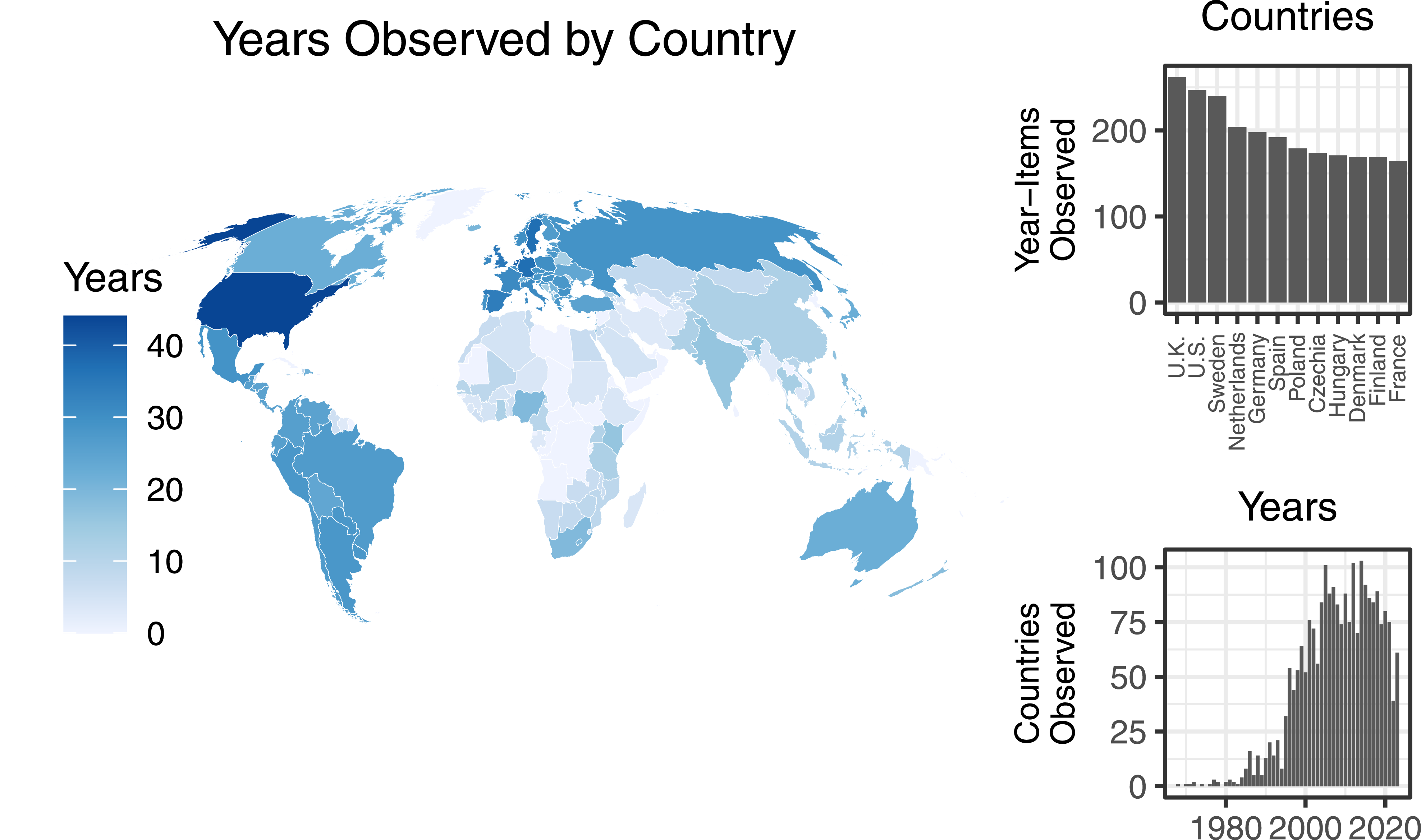
Questions tapping political discontent as conceived above are common in national and cross-national surveys conducted over the past four decades, but no single question is asked in all countries and years. The result is that the relevant data are incomparable, in that they are generated by many different questions, and sparse, in that for many countries and years no question on political discontent is asked at all. We collected 388 different survey datasets with relevant questions, including a total of 111 distinct survey items that were asked in no fewer than five country-years in countries surveyed at least three times (see online Appendix Section A1). These survey items were asked in 136 different countries over the 56 years from 1968 to 2023 comprising 8,957 country-year-item observations altogether. Figure 1 summarizes the coverage of the source survey datasets.
Coverage of countries, years, and items in the source survey datasets. The map on the left shows the number of years for which survey data are available in each country or region. The upper-right panel shows the countries with the largest numbers of year-item observations, and the lower-right panel shows the number of countries with available survey data in each year.

To make use of the large and heterogeneous set of survey items, we estimate a latent variable model of the aggregated survey responses using the DCPO latent variable model. The DCPO model is a state-of-the-art population-level two-parameter ordinal logistic item response theory model with country-specific item-bias terms.Footnote 1
The DCPO model and similar latent modeling approaches have been used in recent years to model public opinion across countries and over time for a variety of attitudes, such as policy ideology (Berwick and Caughey, Reference Berwick and Caughey2025; Caughey et al., Reference Caughey, O’Grady and Warshaw2019; Claassen, Reference Claassen2019; McGann et al., Reference McGann, Dellepiane-Avellaneda and Bartle2019), gender egalitarianism (Woo et al., Reference Woo, Allemang and Solt2023), political interest (Hu and Solt, Reference Hu and Solt2025), and support for gay rights (Woo et al., Reference Woo2025). Conceptually, this approach is analogous to educational testing, where students may take different test forms containing different items, yet their abilities are placed on a common scale through the estimation of item parameters (De Boeck and Wilson, Reference De Boeck and Wilson2004; Fox, Reference Fox2010).
The core logic of a latent variable model is that the probability an individual responds affirmatively to a survey question depends on the respondent’s position on an underlying latent trait – in this case, political discontent. In the DCPO model, specifically, this relationship is characterized by two groups of parameters that characterize each question, difficulty and dispersion, along with a third, country-specific bias parameters. These parameters are explicitly estimated to address the problem of incomparability across survey questions, survey projects, and survey rounds.
In other words, rather than assuming that different survey items are directly comparable, DCPO treats each question – regardless of its wording or source – as its own imperfect indicator of the latent trait and explicitly estimates, using these three sets of parameters, how responses to that question relate to the underlying quantity of interest. In this way, differences across survey instruments are modeled rather than ignored. Each survey question is therefore treated as a distinct measurement instrument, and the model estimates the characteristics of each instrument so that the latent trait can be recovered despite differences among them.
First, the difficulty parameter accounts for the level of the latent trait (i.e., how much political discontent) needed for a respondent to endorse a particular response option of a survey question. That each response evinces varying levels of political discontent is most easily seen with regard to the ordinal responses to the same survey item. For example, responding “strongly agree” to the statement “people like me don’t have any say about what the government does” exhibits more political discontent than choosing “agree,” which is a more discontented response than “disagree,” which in turn is more discontented than “strongly disagree.” Moreover, and more importantly, the difficulty parameter varies across different survey items to reflect that a respondent may need to feel greater discontent to endorse a specific response option for one question compared to endorsing the same level of response for another question. For example, strongly agreeing that “there is widespread corruption among those who govern the country” likely expresses even more political discontent than strongly agreeing that “people like me can probably vote, but we cannot do anything else to influence politics.”
Second, the dispersion parameter accounts for the noisiness (measurement error) in a survey question with respect to the latent trait. A survey question may confuse some respondents or may not align cleanly with the concept of political discontent, reflecting a larger dispersion. If such a question is nevertheless used as an indicator of political discontent, it will exhibit high dispersion. On the contrary, the lower the dispersion, the better that changes in responses to the question map onto changes in political discontent.
Third, to allow for the possibility that translation issues or cultural differences or other idiosyncracies result in the same question being answered differently in different countries, the model estimates country-specific bias parameters that shift the difficulty of all responses for a particular question in a particular country. Together, the model’s difficulty, dispersion, and country-specific bias parameters work to generate comparable estimates of the latent variable of political discontent from the available but incomparable source data.
To address sparsity in the source data – unpolled or thinly surveyed years in each country and region – DCPO uses simple local-level dynamic linear models, i.e., random-walk priors, for each country and region. That is, within each country and region, each year’s value of PPD is modeled as the previous year’s estimate plus a random shock. These dynamic models smooth the estimates of PPD over time and allow estimation even in years for which little or no survey data is available, albeit at the expense of greater measurement uncertainty.
As a result, we generated estimates of the public’s political discontent in all 3,362 country-years spanned by the source data, which we call PPD scores. The PPD scores cover 136 countries and regions worldwide over a period of 56 years (1968–2023). The PPD scores dataset is publicly accessible via the Harvard Dataverse of the article, as indicated in the Data Availability Statement, and open to public use.
Validating public political discontent
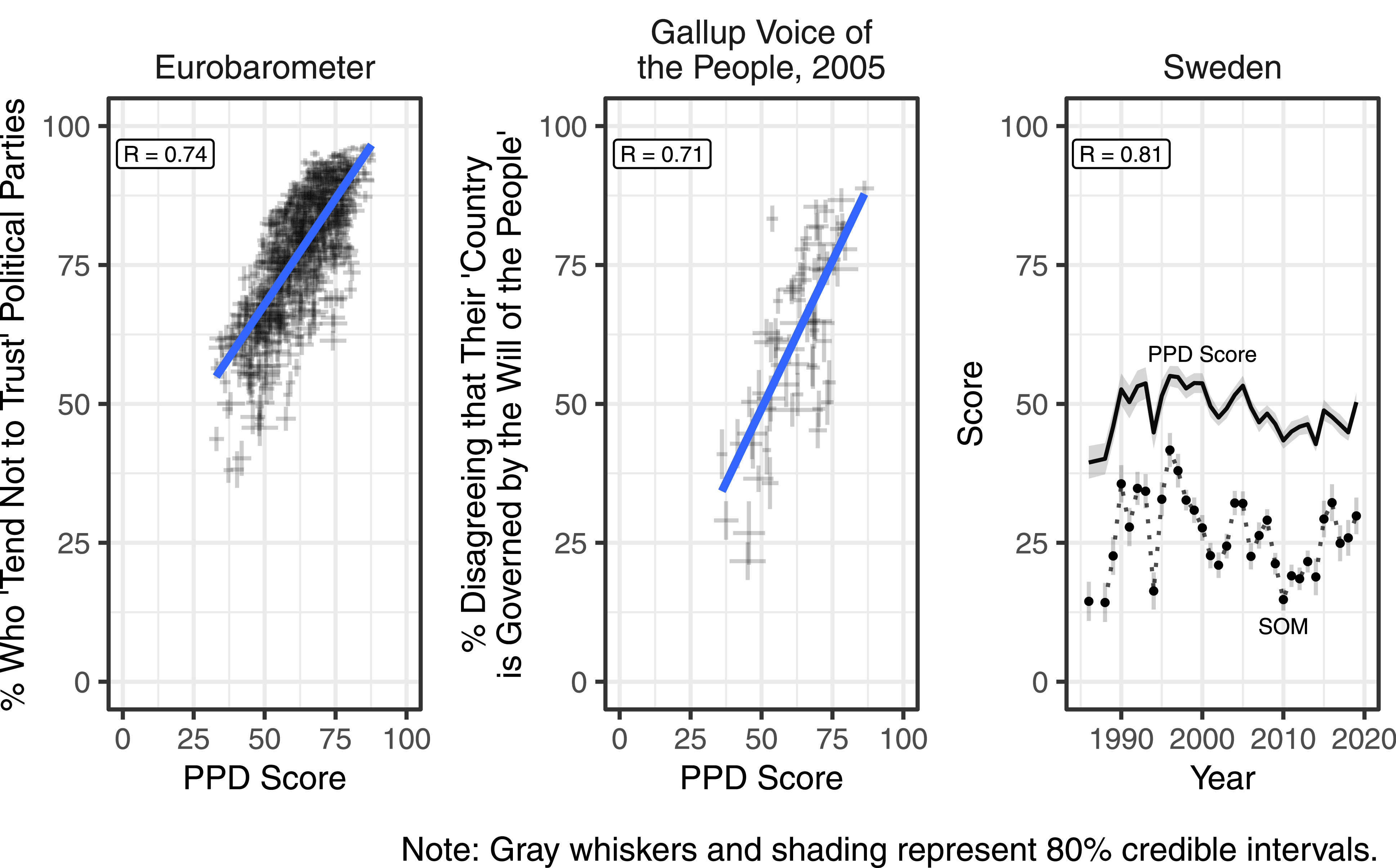
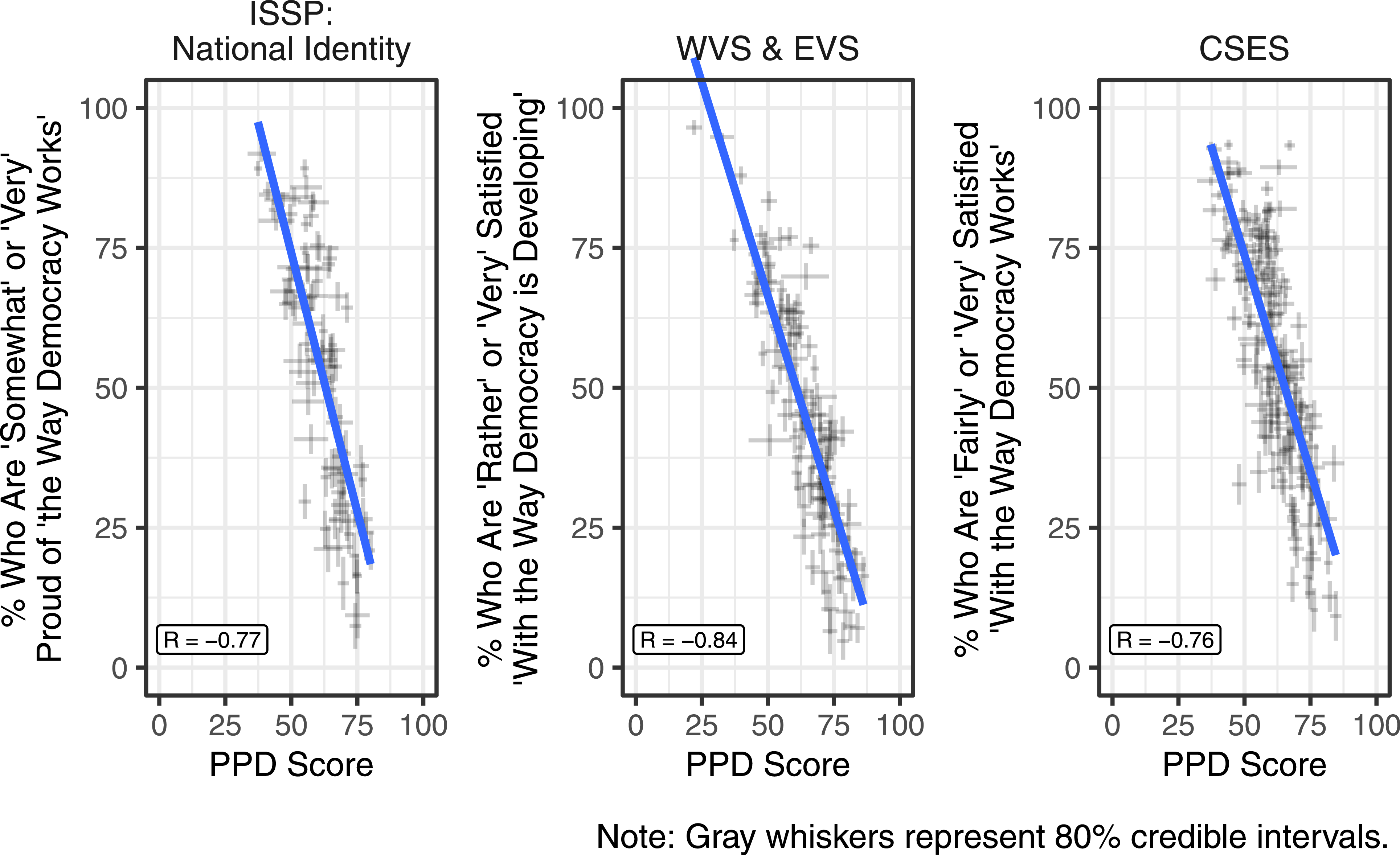
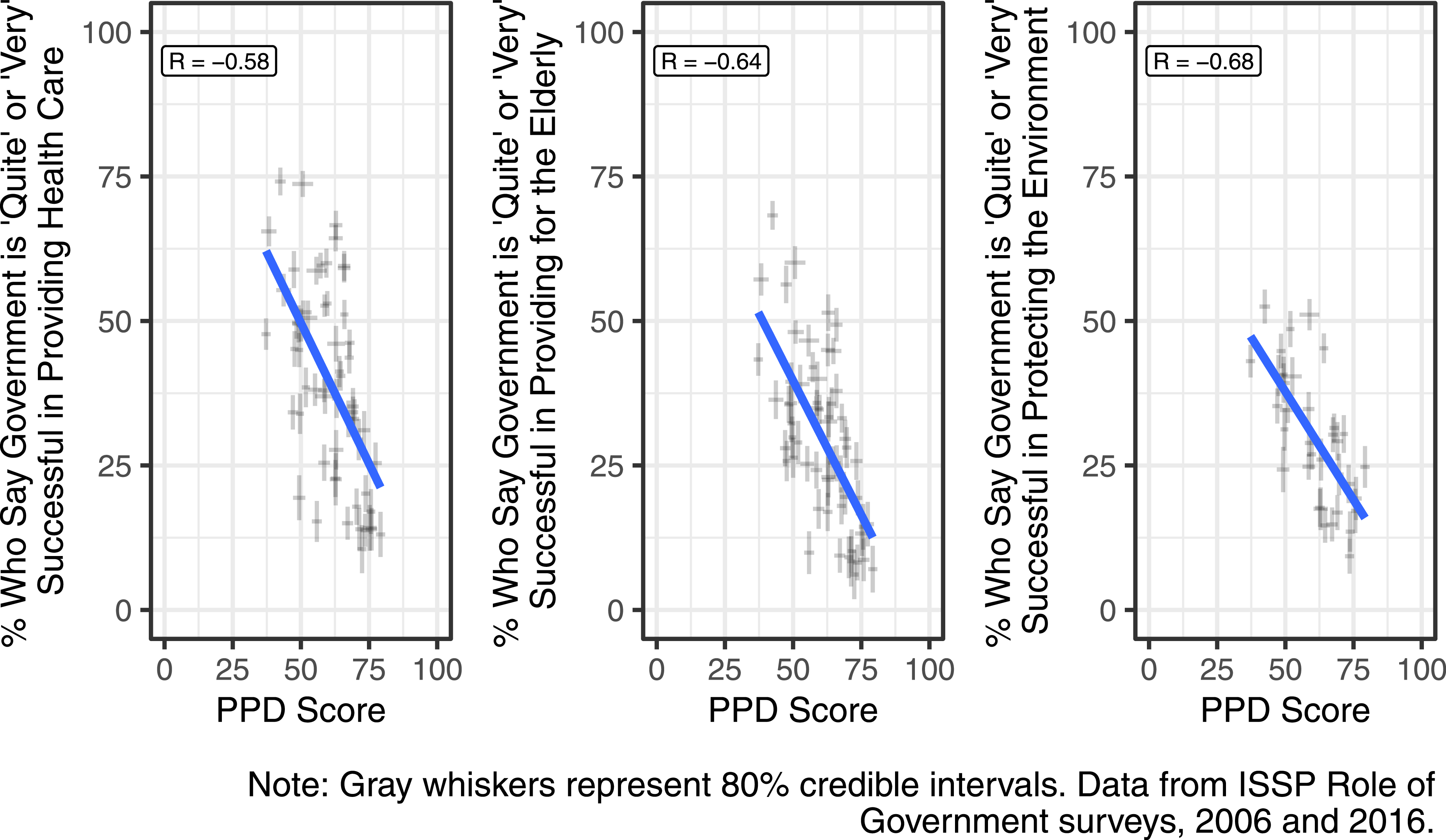
That we can generate estimates of political discontent does not automatically mean that they are suitable for analysis. Validation tests of this novel latent variable, as with any new measure, are therefore essential. To assess the validity of the PPD scores, we conduct three complementary validation exercises: internal convergent validation, external convergent validation, and construct validation. Figure 2, Figure 3, and Figure 4 present the results of these analyses, which together provide evidence of the validity of the PPD measure.
Internal convergent validation: correlations between public political discontent and individual source-data survey items.

External convergent validation: correlations between PPD scores and evaluations of democratic performance.

Construct validation: correlations between PPD scores and views of government success.

Convergent validation refers to tests of whether a measure is empirically associated with alternative indicators of the same concept (Adcock and Collier, Reference Adcock and Collier2001, 540). Here, Figure 1 offers “internal” convergent validation tests (e.g., Caughey et al., Reference Caughey, O’Grady and Warshaw2019, 686; Hu and Solt, Reference Hu and Solt2025, 4): it compares PPD scores to responses to the individual source-data survey items that were used to generate them. On the left, PPD scores are plotted against the percentage of respondents across all country-years who responded “tend not to trust” rather than “tend to trust” to the Eurobarometer’s dichotomous question, “How much trust do you have in certain institutions: Political parties?” This is the single most-asked item in the source data. The middle panel compares PPD scores to responses to the question with the most data-rich cross-section, “Would you say your country is governed by the will of the people?” in Gallup’s 2005 Voice of the People survey (Gallup International, 2007). Finally, the right panel evaluates how well the PPD scores capture change over time by focusing on the item with the largest number of observations for a single country and region in the source data: Sweden’s SOM surveys’ question, “How much confidence do you have in the way the following institutions and groups do their job: The National Parliament?” (University of Gothenburg, 2024). The 80% credible intervals displayed in the panel further illustrate the plausible variation in PPD estimates over time. For instance, the apparent decline around 1994 falls within a range consistent with the political and economic turbulence surrounding Sweden’s EU accession referendum. In all three cases, the correlations, estimated taking into account the uncertainty in the measures, are strong.
External convergent validation assesses whether a measure is empirically associated with alternative indicators of a closely related concept that are not used in its construction. In Figure 3, we present three external convergent validation tests comparing PPD scores to responses to survey items that were not included in the source data used to estimate PPD: items that asked respondents to evaluate “democracy” in their countries and regions. As discussed earlier, we follow Jennings et al. (Reference Jennings2017) in considering these questions to tap specific rather than diffuse support – and given our broad geographic scope, we also wish to avoid assuming that respondents necessarily identify the current political system of their country with democracy – and so exclude them from the latent-variable estimation. Nevertheless, evaluations of democratic performance provide useful alternative indicators of the extent of political discontent and therefore serve as appropriate external benchmarks for validation.
The left panel of Figure 3 shows the correlation between PPD scores and responses from three rounds of the International Social Survey Program’s National Identity module, which asked respondents how proud they were of how democracy works in their country. The center panel plots the correlation between PPD scores and respondents’ reported satisfaction with “the way democracy is developing” in their countries in the World Values Surveys and European Values Surveys. The right panel draws on data from the Comparative Study of Electoral Systems, showing the correlation between PPD scores and the share of respondents who were at least fairly satisfied “with the way democracy works” in their country (The Comparative Study of Electoral Systems, 2015). Across countries and years, and for all three of these survey items, our latent-variable measure of political discontent is strongly and negatively correlated with aggregate positive evaluations of a country’s democracy. Because these items capture closely related but conceptually distinct evaluations of the political system, they provide strong external benchmarks for assessing whether the PPD measure behaves as theoretically expected.
With the success of these tests of convergent validation, we turn to construct validation. Construct validation refers to demonstrating that a measure is empirically associated with measures of other concepts that theory suggests are causally related to the concept the measure seeks to represent (Adcock and Collier, Reference Adcock and Collier2001, 542). Because discontent with the political system should be closely tied to evaluations of recent government policy performance, we assess construct validity by examining the relationship between PPD scores and public evaluations of government effectiveness.
Figure 4 depicts the relationships between PPD scores and three survey items from the International Social Survey Program Role of Government modules(ISSP Research Group, 2018, 2021), which measure respondents’ assessments of the government’s success in providing health care, providing for the elderly, and protecting the environment. All three relationships are negative, as expected, and moderate to strong in magnitude. Together, these results provide evidence of the construct validity of the PPD measure.
The strong performance of the PPD scores in both convergent and construct validation tests, as presented in this section, demonstrate that they are an appropriate measure of the political discontent concept we theorize above and therefore are suitable for use in analyses.
Explaining political dissatisfaction
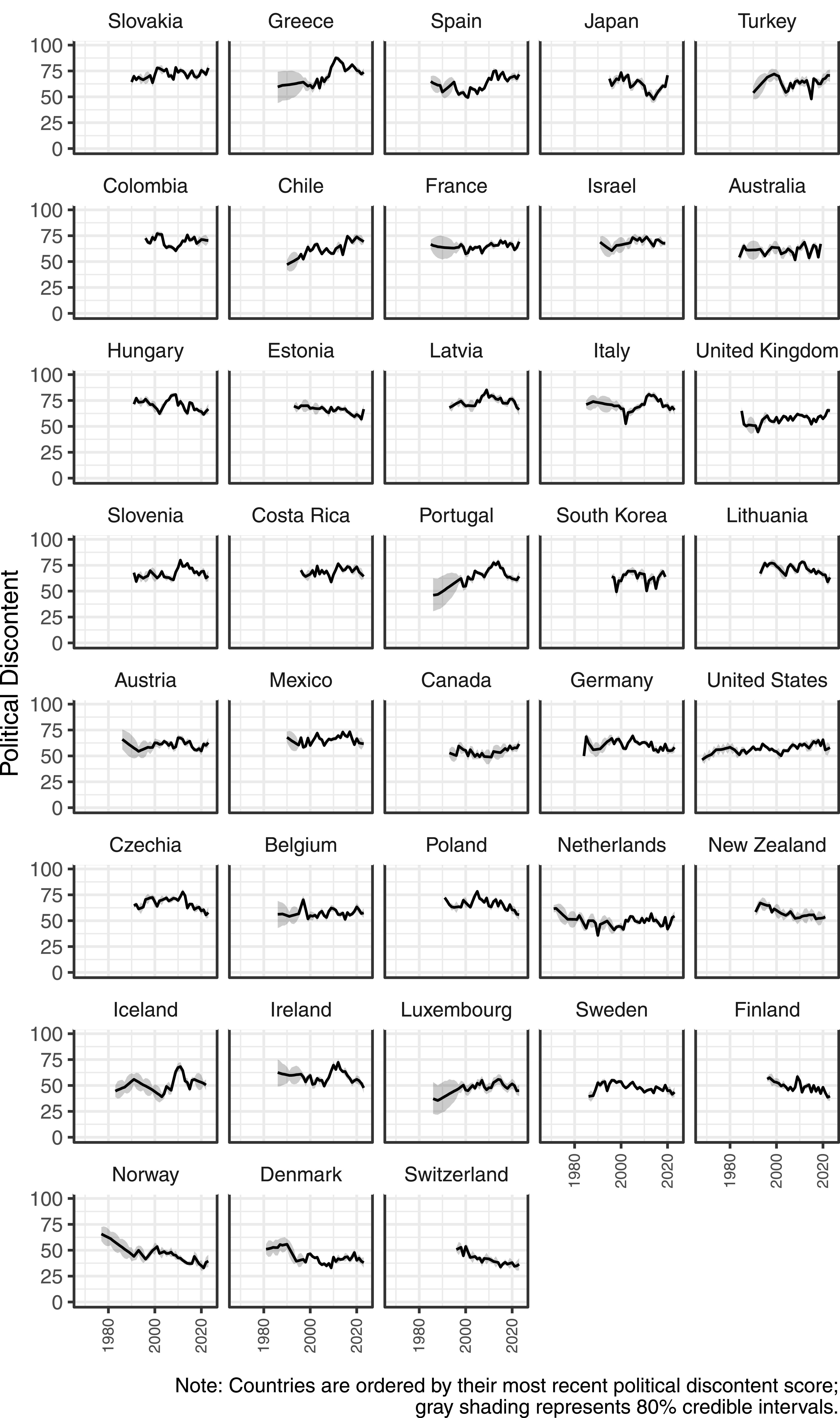
We now focus on a group of countries where discontent has attracted particular public and scholarly concerns, the advanced democracies of the OECD, in order to demonstrate how the newly constructed PPD dataset can be used to address substantive questions in the literature. In Figure 5, we present the evolution of political discontent over time across these OECD democracies. Substantial differences emerge both across countries and over time, raising important questions about the sources of cross national variation and the drivers of temporal change in political discontent. Existing scholarship offers a range of perspectives on if PPD has increased over time and how political and economic contexts shape it, yet empirical findings remain mixed, largely because previous studies rely on different conceptualizations and survey measures. In the following section, we briefly review these theoretical explanations and evaluate their empirical effects using the PPD scores, which provide a comprehensive and unified test of competing explanations.
Political discontent scores over time within OECD democracies.

The first argument deals with the role of elections. Elections provide an opportunity for people to turn their dissatisfaction into ballots for candidates or parties that promise change. Discontented citizens, as a result, gain political fulfillment through voting for a party or a candidate that voices their discontent (Rooduijn et al., Reference Rooduijn, Van Der Brug and De Lange2016; Van der Brug, Reference Van der Brug2003). From this perspective, PPD should be expected to be lower in years of national elections, in which some of the existing discontent could be addressed. However, existing studies also suggest that the effect of election time on PPD could be the opposite. Campaigns expose citizens to more political messages, a significant proportion of which criticize the elites and the system (Lau et al., Reference Lau, Sigelman and Brown Rovner2007; López-Garca and Pava, Reference López-Garca and Pava2019). Particularly, many advanced democracies are experiencing increased levels of false information during elections, which has become a clear danger to the integrity of the political process (Bennett and Livingston, Reference Bennett and Livingston2018). If so, PPD may be expected to be higher at election times.
A second potential source of PPD is the distribution of power created by political institutions. According to prominent democratic theories (Lijphart, Reference Lijphart1999; Norris, Reference Norris2008; Powell, Reference Powell2000), power-sharing systems – parliamentarism, federalism, and proportional electoral rules – aim to generate governments that facilitate broad inclusion and participation, while power-concentrating systems prioritize efficient and accountable majority rule. Kittilson and Schwindt-Bayer (Reference Kittilson and Schwindt-Bayer2010) argue that power-sharing systems not only encourage actual political participation, but also send symbolic signals of inclusiveness to citizens. If so, the publics in countries with parliamentary systems, federalism, and proportional electoral rules should be more likely to perceive themselves as being included and represented in the system and so feel less discontent.
Lastly, economic conditions are argued to be salient sources of political discontent (Quaranta and Martini, Reference Quaranta and Martini2016). For one thing, unfavorable economic conditions fuel social discontent and anxiety about the future among the public, which can easily evolve into anti-establishment sentiment (Kinnvall and Svensson, Reference Kinnvall and Svensson2022). For another, economic indicators are usually used by people to evaluate the performance of the system or government policies (Becher and Donnelly, Reference Becher and Donnelly2013). Hence, poor economic conditions, such as low average incomes, slow growth, and high unemployment are likely to hurt perceptions of institutional quality and so increase PPD. Income inequality may work similarly, but such arguments as system justification theory, which contends that greater inequality triggers in the disadvantaged a psychological need to accept and defend the existing system (see, e.g., Jost, Reference Jost2019), and relative power theory (see, e.g., Solt, Reference Solt2008), which instead sees more inequality as increasing the influence of the rich over the attitudes of the poor, suggest that worsening inequality may actually reduce discontent.
The data we use to test these hypotheses are as follows. The Democratic Electoral Systems (DES) dataset updated in Bormann and Golder (Reference Bormann and Golder2022) provides information about the timing of elections, yielding a dichotomous variable coded one in election years and zero when no election was held. We measure three institutional variables in the same fashion as Kittilson and Schwindt-Bayer (Reference Kittilson and Schwindt-Bayer2010). Parliamentarism is coded dichotomously, one in pure parliamentary systems and zero otherwise, and is sourced from the DES. The federalism variable is also dichotomous: countries with strong federal systems (see Lijphart, Reference Lijphart1999) are coded one and all others coded zero. The Gallagher least-squares index of disproportionality, which measures the disparity between parties’ vote shares and their seat shares (Gallagher, Reference Gallagher1991, 40–41, Reference Gallagher2025), provides our measure of the proportionality of the electoral system. We draw data on economic conditions from two sources. GDP per capita, national GDP growth, and unemployment are from OECD.Stat (OECD, 2024). The Gini index of disposable income inequality comes from the Standardized World Income Inequality Database (Solt, Reference Solt2020a).
The resulting dataset comprises all thirty-eight OECD countries and a total of 1217 country-years. The number of country-years observed per country ranges from sixteen (Turkey) to forty-three (the United States) consecutive years (mean: 32 years, median: 31 years). The advantage in data availability over pooling the responses to a single question is clear: even among these relatively data-rich countries, the two richest single items available – the Eurobarometer’s questions on trust in national parliaments and in political parties – each provide only fewer than half as many country-years for analysis, 582 observations, and these Eurobarometer data naturally entirely exclude the nine OECD members outside Europe.
Pooled time series like these, as Shor et al. (Reference Shor2007) demonstrates, are most appropriately analysed using Bayesian multilevel models with varying intercepts for countries and years. Varying intercepts for each country account for the heteroskedasticity across our spatial units that is generated by omitted variable bias and other sources while also permitting us to include predictors like parliamentarism and federalism that do not vary over time. Varying intercepts for each year take into account “time shocks” that operate on all of our countries simultaneously (Shor et al., Reference Shor2007, 171–72).
We also use the “within-between random effects” specification (see Bell and Jones, Reference Bell and Jones2015). This specification involves decomposing each of our time-varying predictors into its country mean and the difference between each country-year value and the country mean. The time-varying difference variables capture the short-term effects of the predictors, while the time-invariant country-mean variables reflect their long-run, “historical” effects (Bell and Jones, Reference Bell and Jones2015, 137). As Bell and Jones (Reference Bell and Jones2015) show, this is a superior approach for addressing omitted variable bias and endogeneity than fixed effects and other commonly used TSCS specifications.
Finally, we use a Bayesian analysis that allows us to directly incorporate into our model the quantified measurement uncertainty in the data for political discontent and for income inequality, with the estimated values of these two variables treated as random draws from distributions with unknown true means but known standard deviations (McElreath, Reference McElreath2016, 425–31; see also Kurz, Reference Kurz2023, 15.1.2; Tai et al., Reference Tai, Hu and Solt2024). We estimate the model using the brms R package (Bürkner, Reference Bürkner2017).
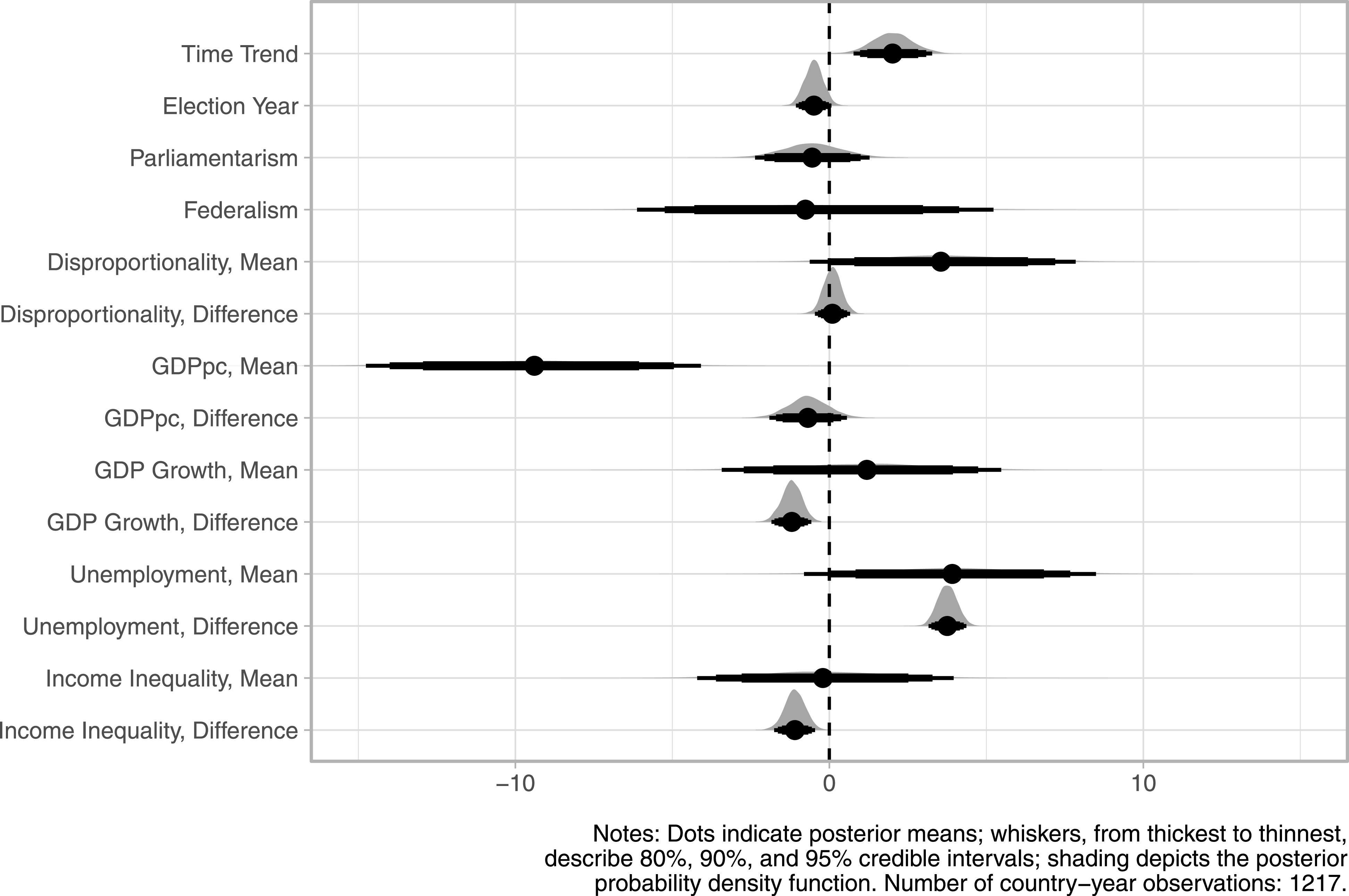
The results of this analysis are displayed in Figure 6.Footnote 2 Narratives of increasing political discontent over recent decades find support in these results. The time trend indicates that discontent has been, on average and net of the other included variables, rising over time in the OECD countries by 0.1 points (95% credible interval: 0.04 to 0.16 points) per year. By this evidence, election years appear to diffuse rather than exacerbate discontent: PPD scores are estimated to be 0.5 points lower in years with elections, with 95.6% of the posterior distribution less than zero. However, the magnitude of this effect is relatively modest compared to other factors, indicating that a single electoral event may be insufficient to meaningfully reduce system-level political discontent among the public.
Predicting public political discontent in OECD countries.

The hypothesis that power-sharing institutions reduce discontent with politics, on the other hand, finds limited support. Countries with parliamentary or federal systems do not exhibit less political discontent than those without, and short-run changes in disproportionality do not trigger declines in PPD scores either. Consistent with the arguments of Kittilson and Schwindt-Bayer (Reference Kittilson and Schwindt-Bayer2010), though, countries with higher mean disproportionality do exhibit more discontent than those with lower mean values: a two-standard-deviation higher mean Gallagher index was associated with 3.6 points more political discontent, and 94.9% of the posterior distribution of this parameter is positive.
The evidence of the importance of economic conditions is, however, strong. Even among these advanced economies, countries with greater mean GDP per capita have lower levels of political discontent: a country one standard deviation above the mean is estimated to have a PPD score 9.4 (95% c.i.: 14.8 to 4.1) points lower than a country one standard deviation below the mean. In the short run, increases in GDP per capita also appear to reduce discontent, with a two-standard-deviation increase associated with 0.7 (95% c.i.: 1.9 to 0.6) points less political discontent (85.6% of the posterior distribution of this parameter was negative). Although mean GDP growth exhibits no evidence of a long-term influence of growth on discontent, in the short run, discontent moves sharply in the opposite direction as growth: a two-standard-deviation increase in growth yields 1.2 (95% c.i.: 1.8 to 0.6) points less political discontent. Unemployment has a major effect on discontent in this analysis. The estimate for the long-term, historical effect of unemployment on political discontent as evidenced by differences in mean levels across countries is 3.9 (95% c.i.: −0.8 to 8.5) points. Year-to-year differences in unemployment work similarly: a two-standard-deviation increase in unemployment has an immediate effect of increasing discontent by 3.8 (95% c.i.: 3.2 to 4.4) points. And, although cross-country mean differences show little impact, increases in income inequality over time work to reduce discontent in accordance with the predictions of system justification and relative power theories, with a two-standard-deviation rise prompting a 1.1 (95% c.i.: 1.8 to 0.5) point fall in PPD scores.
Conclusions
The research on PPD has witnessed many inconsistent findings regarding its temporal trends, causes, and consequences. These inconsistencies largely reflect conceptual fragmentation and measurement constraints arising from the limited availability and comparability of survey items. To address these limitations, this article advances a clearer conceptualization of political discontent as a lack of Easton’s (Reference Easton1965) diffuse support for the political system, integrating multiple dimensions of system-level evaluations emphasized in prior research. This conceptualization underscores the theoretical value of political discontent as a comprehensive indicator of citizens’ perceptions of the political system as unresponsive, untrustworthy, or illegitimate. By centering diffuse support, our approach also situates political discontent within growing scholarly concerns about declining public confidence in political systems. More broadly, this framework offers researchers a clearer reference point for defining the scope and content of political discontent in future studies.
Moreover, using a state-of-the-art latent-variable model, we construct a novel dynamic comparative measure of PPD across 136 countries over 56 years and demonstrate its validity across multiple analyses. With this new dataset, we clearly show a clear rising trend of political discontent across OECD countries, challenging Norris (Reference Norris2011)’s claim that the changes in political discontent are merely “trendless fluctuations” and lending support to Foa and Mounk’s (Reference Foa and Mounk2016, Reference Foa and Mounk2017) thesis of democratic deconsolidation in developed democracies. Our analysis further reveals that the rise of political discontent in the public is largely driven by worsening economic conditions, including low income, slow growth, and high unemployment. Elections appear to diffuse political discontent only modestly, suggesting that system-level political discontent cannot be meaningfully alleviated by electoral events alone. Unlike prior research that relies on single-country evidence (Jennings et al., Reference Jennings2017), our findings draw on the most comprehensive information available across countries and over time, providing firmer empirical grounding for ongoing debates over the trajectories and sources of political discontent.
The time-series cross-national PPD dataset presented in this article is publicly available on the Harvard Dataverse, and it has broad implications for future research. The growing phenomenon of democratic backsliding across diverse regions has generated extensive scholarly inquiry into its underlying causes, with public support for democracy often treated as a central explanatory factor. Yet empirical findings remain mixed (Claassen, Reference Claassen2020; Tai et al., Reference Tai, Hu and Solt2024), in part because measures of democratic support tend to be uniformly high and therefore lack the discriminatory power needed to capture meaningful variation in citizens’ democratic commitment (Dalton et al., Reference Dalton, Sin and Jou2007; Inglehart, Reference Inglehart2003). PPD offers a potentially more informative analytical lens for studying democratic backsliding given its close association with regime-challenging attitudes and behaviors (Craig, Reference Craig1980).
Furthermore, examining the relationship between political discontent and the rise of populism – a prominent contemporary challenge to liberal democracy (Mudde, Reference Mudde2004; Urbinati, Reference Urbinati2019) – as well as its implications for effective governance and public perceptions of political legitimacy (Hetherington, Reference Hetherington1998; Lipset, Reference Lipset1959; Miller, Reference Miller1974), would shed light on how political discontent shapes political engagement and democratic stability. Finally, because the dataset covers most countries and regions worldwide, including non-democracies, it enables systematic analyses of how the causes and consequences of political discontent vary across regime types and so promises new insights into the extent of the importance of public opinion for regime stability.
Supplementary material
The supplementary material for this article can be found at https://doi.org/10.1017/S1755773926100599
Data availability statement
Replication data is available on the Harvard Dataverse (https://doi.org/10.7910/DVN/0II26W), and the work’s complete revision history is available at https://github.com/fsolt/dcpo_discontent.
Funding statement
No external funding was received by the authors.
Competing interests
The authors declare none.


 Open access

