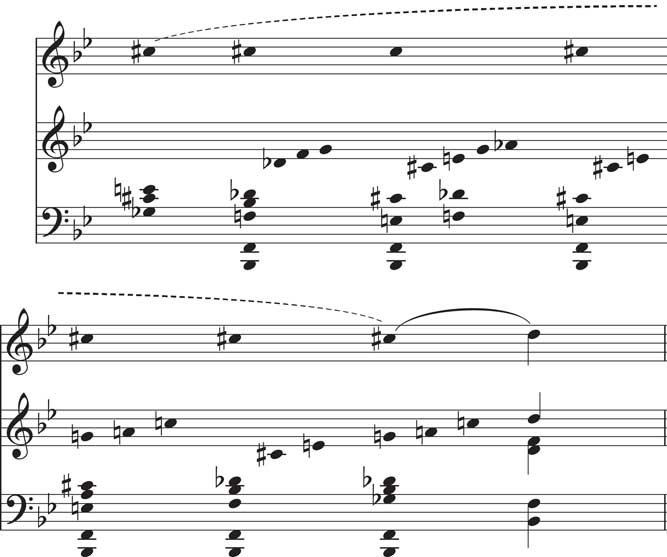
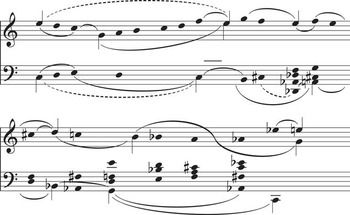
Adorno spoke of Mahler's ‘fractures’; this essay deals rather with fragments, though the two phenomena are related.Footnote 1 ‘Fragments’, however, is an awkward term in Mahler studies; it raises questions both of content (musical and non-musical) and style. Many of Mahler's most fractured passages are indeed made of fragments that cohere by association, though whether this association is one of musical types, shared thematic characteristics, apparently exhausted clichés from historic styles, or memories of programme music is not always exactly clear, and frequently more than one of these elements is involved. Fractured or fragmented passages are not always to be equated with the idea of Klangfläche, though there is an overlap between the phenomena. But by the Ninth Symphony, a style of fragmentary episode had evolved that dispensed with the kind of static background unification through pedals and ostinatos that Klangfläche usually involved. Passages where orthodox continuity falters are encountered in all of Mahler's style periods, but the late works are especially rich in them, and their interpretation has inevitably been coloured by Adorno's writings. The musical materials that comprise the fractures, however, are usually also the substance of those passages where continuity is more conventional. Indeed a passage like the coda of ‘Der Abschied’ derives something resembling a sound sheet out of a continuous, apparently unfragmented music that simply winds down to stasis. In ‘Der Abschied’, Mahler links this remarkable and frequently analysed phenomenon with a picture of Nature that is seductive in its sentimental assurance of a kind of continuity and renewal (though hardly one that would reassure a modern environmentalist). In this essay, I should like to consider some of the mechanics of Mahler's use of fragments and the way that they coalesce; but I will conclude by looking at some implications this has, not so much for Adorno's view of Mahler as for the more generalized picture that has linked Mahler to Vienna and its fin-de-siècle culture. It is my belief that much of our image of Mahler's music is linked to ideas of ‘fin de siècle’ and ‘avant garde’ that are now looking rather outmoded. The Schorske picture of Viennese culture, valuable in its day, may now be in need of a substantial revision. This essay offers a tentative contribution to this revision, without proposing a new grand narrative, which for Mahler studies may no longer be either valuable or necessary.
Not the least remarkable feature of Das Lied von der Erde is its use of chromatic and pentatonic elements in a manner that renders them both distinct and yet homogenous, almost as though Mahler were anticipating Bartók, in demonstrating the modernity of ancient scales when they came in collision with twentieth-century harmony. There have been several considerations of this phenomenon, none more interesting than Stephen Hefling's exploration of specific Eastern forms of pentatonicism, both hemitonic and anhemitonic.Footnote 2 Not surprisingly, it is the former that yields the most intriguing insights. For example, a hemitonic pentatonic collection (Hirajoshi in the terminology provided by Hefling and Peter Revers) not merely ‘fits’ the melodic collection of ‘Dunkel ist das Leben, ist der Tod’, but also underlies at least one complex chromatic chord that in contemporary Western music theory is more compactly referenced in Fortean terms (4–Z29) than in a traditional description as ninth or seventh with added suspension.Footnote 3 On one level, this is a curious demonstration of the exoticism of the material, in a more unusual manner than might have been expected: the scale is Japanese not Chinese. On another, it is hardly a demonstration of systematic incorporation of exotic elements, since in the last resort we do not need Hirajoshi to write a persuasive account of the passages in which it appears, and this is why I say it ‘fits the melodic collection’ rather than claiming a deep-level explanation. It may be a mere coincidence, but even as such it is pleasing both aesthetically and analytically.
When considering the various ways in which Mahler knits together exotic and traditional Western material in Das Lied von der Erde, it is worth remembering that the issue was a live one among Mahler's contemporaries, both as a resource for composers and as a problem for theorists. Peter Revers has given several examples of the latter, dating from 1884 onwards.Footnote 4 The possibility of harmonizing East Asian melodies, handled intuitively by composers such as Mahler and Puccini, admitted of no consensus among theorists. In Das Lied von der Erde, the manner in which pentatony often decorates solidly Western harmonies found an echo in some of the contemporary theoretical writing, with its emphasis on ‘Verzierungstechnik’ and the difficulty with which it might be taken over into contemporary Western music.Footnote 5 The theoretical debate, however, went alongside the setting of specifically eastern melodies, as is sometimes the case in Puccini.Footnote 6 Thus far, research into Mahler's pentatony has revealed scales and fragments of scales rather than melodies, confirming that for Mahler the treatment of the ‘exotic’ was a rather special form of arabesque, or a dissolving agent on Western models.
It is of the nature of exoticism in Western music of the nineteenth century that it tends to be imported as sporadic colouring rather than formal support (opera is obviously a more complex case). In Mahler, as in other composers, the exotic is part of a repertory of devices that would appear fragmentary without a framework of traditional harmony to ensure cohesion; hence Adorno's emphasis on the idea of music as a ‘blotting paper’ that soaks up everything, including the trivial, the exotic, and the historically used-up.Footnote 7 A list of the main motifs of Das Lied von der Erde, and of ‘Der Abschied’ in particular, is usually a compendium of pentatonic fragments, decorative shapes from long-established styles, and expressive gestures that remember the style of musical romanticism without reproducing it. I emphasize ‘Der Abschied’ without wishing to contradict Hefling's implication that the opening movement of Das Lied von der Erde is the most fertile area for such study. But it is in the last song that the most extensive collection of seemingly disparate motifs comes together, alongside a melodic style that Schoenberg characterized as ‘not motival parts of a melodic unit, but words, each of which has a purpose of its own in the sentence’.Footnote 8
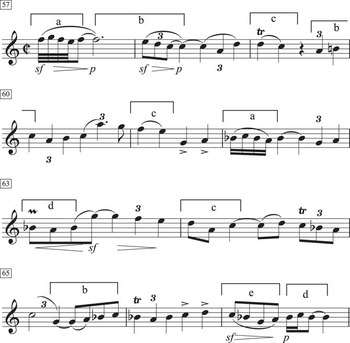
Schoenberg looked at ‘units [that] vary greatly in shape, size and content’, but the light analytical mark-up that he provided (light by comparison with the analyses of Brahms elsewhere in his essay) shows that he was essentially thinking of phrases. If we look more closely beneath the surface, the units to be discerned are no less varied than Schoenberg found in Brahms, but they reveal something of Adorno's idea, in that the melody has absorbed the turn (Ex. 1a), scale segments (Ex. 1b), appoggiaturas (Ex. 1c),Footnote 9 written-out mordents (Ex. 1d), and the ancient nota cambiata figure (Ex. 1e), all in a subtly structured line that owes virtually nothing to pentatony, with or without semitones. This is not a case of the line revealing motivic secrets too crassly, but of a circling around certain lightly fixed points (most obviously C and B♭, which are important also in the background oscillations of clarinet, harp and violas). The complex line embraces motifs and ideas, presented elsewhere in the movement as fragments, without regimenting them into rigid phrases. Schoenberg and Adorno together outline the main paths of later Mahler criticism. On the one hand, there is the idea of a form of composed inauthenticity – a central concept in Adorno – on the other the concept of a musical prose arises inevitably from Schoenberg's conceit that musical units are words. Few writers on Mahler have escaped entirely from one or other of these ideas and more than one has embraced both enthusiastically.
Das Lied von der Erde, ‘Der Abschied’, bars 57–67

The all-pervasive character of the turn (Ex. 1a) in ‘Der Abschied’ has ensured that most analysts have referred to it – in words if not always as a musical example. It is worth pausing for a moment to look at another feature, the nota cambiata figure that is given as Example 1e. It is not introduced here with a view to establishing its presence as a decisive factor in the movement, though some words by a specialist in Palestrina's style are not entirely irrelevant at this point:
The freedom with which the discordant second note of the figure is allowed to clash with other notes sounded against it is remarkable…It seems as if the formula had come to be regarded as an entity capable of standing in its own right against the movement of another voice. This self-sufficiency of decorative figures and formulae was to play a very important part in later contrapuntal technique of the harmonic age; in Palestrina's technique it is evidence of the survival of a linear melodic formula which could be absorbed into a generally euphonious vertical texture without disturbing its character.Footnote 10
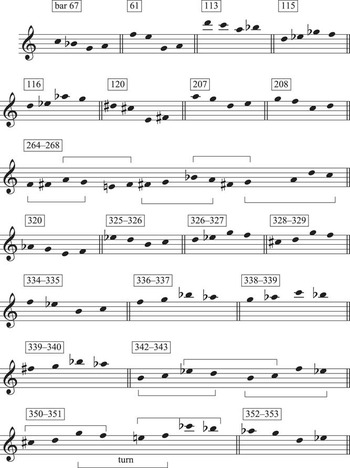
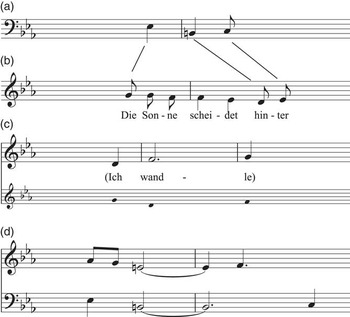
Clearly the ‘rules’ governing such figures in earlier music are hardly applicable to Mahler. But in ‘Der Abschied’, the cambiata certainly seems to fit the role of ‘self-sufficient formula’ that in often euphonious textures operates coherently without losing character – this without ever having been a particularly distinctive feature of Mahler's style in the past. Yet after its ‘official’ appearance in bar 67 (its shape having been anticipated in bar 61), it turns up in bar 113 and begins to eat into the fabric of the melody, sometimes stretched, in the sense that wider downward leaps than the third occur, sometimes inverted, sometimes chromatically distorted. If these are listed in a single example (Ex. 2), they produce a family with suggestions of Hefling's Example 4 (the familiar A–G–E collection), but with a variety of possibilities of extending or leading out of that representation of the basic (pentatonic-derived) cell; as with Hefling's example, the cambiata sometimes coincides ‘with significant tonal articulations’.Footnote 11 Although instantly recognizable as a remnant of an antique polyphonic style, it is easily adaptable to the demands of chromatic writing, both harmonic and melodic, and generates significant melodic tensions in the form of diminished intervals in the minor mode. It is extendable, in that chains of motifs may generate large parts of single melodic lines, and it is easily combined with the turn motif (e.g. bars 350–351). It is particularly prominent after bar 320 in the funeral march. Here it ties in with a figure that Hefling links to other shapes in ‘Der Abschied’, but clearly there is more than one way to relate Mahler's very short fragments of melisma to each other (Ex. 3). While 3a to 3c are Hefling's relationships between the motif introduced in the funeral march (laid out slightly differently), the vocal recitative, and another three-note figure, 3d shows a coming together of the motif and the cambiata shape in bars 320–321 in a splendidly bizarre fragment of counterpoint. If we add to this my ossia in Example 3c, the complex interrelationships between Mahler's fragments become still more obvious.Footnote 12 The implication is that, however we may view the exotic in Mahler, the manner of its integration inevitably exposes traits of Western music of earlier centuries. Whether this is exactly what Adorno had in mind when writing of ‘abolishing the distinction’ between recognizing ‘directly musical qualities and their technical organization’ and ‘the spirit of the music’ is hardly clear (the section on Das Lied von der Erde is as densely packed as anything in Adorno's Mahler).Footnote 13 Perhaps it is more the case that, in contrast to the predominant emphasis in recent Mahler studies on an exotic distance leading to musical modernism, the writer on Das Lied should not forget the Western past, with its melodic conventions that do ultimately hold the work together, in spite of the insistence on exoticism moulding ‘the whole texture’.Footnote 14
Das Lied von der Erde, ‘Der Abschied’, instances of the nota cambiata figure

Das Lied von der Erde, ‘Der Abschied’, (a) bars 309–310; (b) bars 19–20; (c) bars 236–238 (with ossia from bars 213–214); (d) bars 320–1

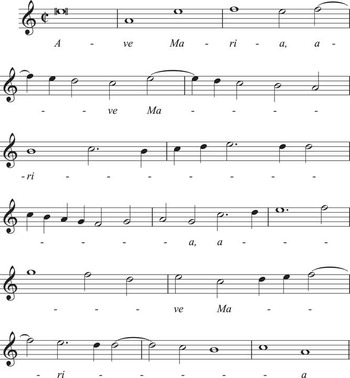
In 1938, Ernest Newman brought the ‘exotic’ and antique elements in ‘Der Abschied’ into a brief comparison that was inevitably sharply polemical given the date and the political pressures on musicology within Germany.Footnote 15 It is now rather curious to read his comment to the effect that when German musicologists write ‘Oriental’ they mean ‘Semitic’, since that casts an odd shadow forward to one of Adorno's most acute passages on Das Lied von der Erde, in which ‘What is Jewish in Mahler does not participate directly in the folk element, but speaks through all its mediations as an intellectual voice.’Footnote 16 Newman quotes the same melody as did Schoenberg, and also the first vocal entry of ‘Der Abschied’, in order to set up a comparison. Lurking behind Newman's comparison is a notion of musical progress that is curiously similar to Webern's argument, in The Path to the New Music, that developments in musical parameters inevitably take place with some degree of alternation.Footnote 17 Thus Mahler's melodic writing in ‘Der Abschied’ represents a process of liberation from the ending of the era of mainly harmonic development. The quotation of an Ave Maria by Palestrina, complete (appropriately enough in this context) with nota cambiata (Ex. 4) is meant to contrast with ‘a typical four-square “classical” melody’, though no sample of the latter is given.Footnote 18 Instead comparison is inevitably made with the examples from Mahler, and is worth considering in a little detail. The various melodies are at their closest in the use of varieties of stepwise movement, furthest in their use of leaps, which (excluding the cambiata) in Palestrina usually involve fifths and fourths, whereas Mahler inevitably highlights ascending and descending sixths. His use of fourths is also rather different from the Palestrina example in that they reinforce the fifth and sixth scale degrees of F major (D–A–C–G, in Example 1, in itself a motif of the movement, as at bars 84–5, transposed to A–E–G–D) rather than acting as strong tonal anchors. Newman's point nonetheless is valid. The suppleness of Mahler's melody may be flavoured with the mysterious Orient, but it recaptures something that Western art music had marginalized in the centuries since Palestrina's time.
Palestrina, Ave Maria, highest voice, opening

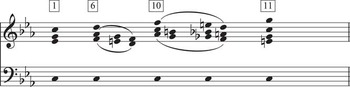
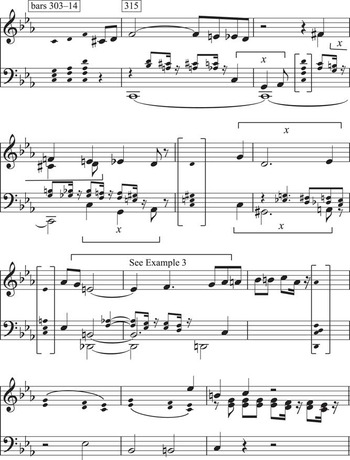
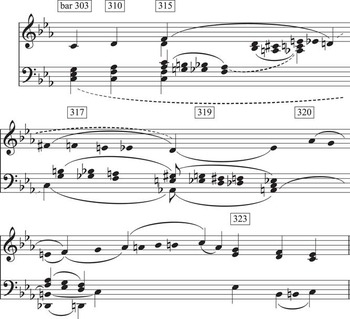
The harmonic-contrapuntal style that embraces Mahler's at once fragmentary and melismatic late style has been analysed repeatedly, and the principles underlying it are reasonably well known. Christian Wildhagen speaks of the ‘dominance of the purely linear’, which is indeed of vital importance for the last works in many passages, most notably in the first movement of the Ninth Symphony.Footnote 19 In ‘Der Abschied’, however, the controlling force of the pedal note is still in place for much of the movement. C underpins the first 33 bars, either as unadorned pedal or in Mahler's favourite ‘drum fourths’ with the dominant. Thereafter, standard progressions of common-practice tonality (I–IV–I–V–I) act as harmonic glue to the figures above. While the pedal C remains in force, the melodic movement, for all the wriggling turns of the woodwind, clings to a plain progression enlivened by linear chromaticism (Ex. 5). So unexceptional is this motion that it comes as a surprise to note that one of the most alarming and fragmentary passages in the movement, the grinding, halting introduction to the funeral march at Figure 38, starts out from more or less the same premises: a tonic pedal, the same harmonic shift above, and linear chromaticism. But the latter now proliferates so alarmingly, and the three-note figure (x in Ex. 6) intrudes its complicating appoggiatura with such apparent randomness, that the relatively simple Example 5 is transformed via the foreground complexities of Example 6 into Example 7, related but inevitably more obscure in its hesitant revolution around fixed points. This partly helps to explain why (to these ears) Figure 38 has always felt like the beginning of a transfigured formal reprise, though reflection admits the justice of the label Zwischenspiel that Hermann Danuser prefers.Footnote 20 The most extreme sounds in this passage come precisely at the point where the pedal C ceases to sound and the various clashing lines threaten to cast off into unknown territory. At this moment the ‘dominance of the purely linear’ becomes accomplished fact, but at the level of small units each barely more than a bar in length.
Das Lied von der Erde, ‘Der Abschied’, outline harmonies of bars 1–11

Das Lied von der Erde, ‘Der Abschied’, outline harmonies of bars 303–325

Das Lied von der Erde, ‘Der Abschied’, voice-leading sketch of bars 303–325

In ‘Der Abschied’, the fragmentary units coalesce and dissolve in several different ways. Motifs that are barely more than signals join into melismatic lines of both Eastern and Western provenance. Their harmonic organization is often linked to extremely simple diatonic foundations (the voice exchange or progressions in parallel 6-3 s). When the units are set in simple adjacency, the pedal is more likely to be the means of holding texture and sentence construction together. Techniques such as Klangflächen, on the other hand, tend to be linked to collages of units that have some point of textual reference in nature, as at the start when the voice sings of sunset and mountains. Later, birdsong is usually linked to some sort of sound-sheet texture, most obviously at Figure 18, and more enigmatically at Figure 36; in the former, the texture is based on A–C, which gradually leads to the plain assertion of a pedal A for the voice's second recitative; in the latter, the same minor third slips to G–B♭, which eventually acts as a ‘modal dominant’ for the return of C minor. By this stage of the movement, even the basses’ tremolo on C and E♭ has the force of a motivic allusion, so widespread has the minor third as self-contained unit become (there is of course precedent for this in Mahler's A-minor music, such as the second movement of the Fifth Symphony, and most of the Sixth). In the face of such reinvention of simple intervals, and the repeated pedal effects, genuine chromatic chordal progressions shrink to the more human drama, whether it be ‘müden Menschen’ or a ‘wanderer’ waiting for a friend who has long kept him waiting. Even in such cases, the music is liable to freeze in static contemplation of beauty, as at the famous heterophony of Figure 30, which frames the singer strolling up and down with a lute that rustles indeterminately in mandolin and harp, but also clearly prefigures ‘die liebe Erde’ of the coda.
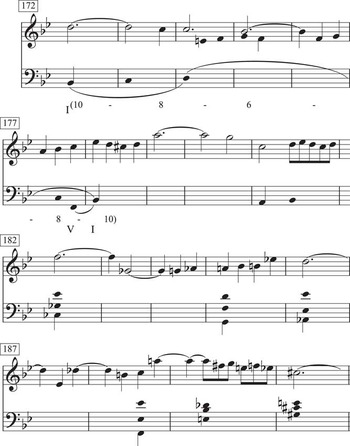
In these triple-metre sections, the question of the ‘exotic’ tends to be more marginal, and conventional chromaticized harmony supports traditional melodic construction. Thus, the heterophony of Figure 30 is an interlude in music that is constructed according to quite simple Western models. From Figure 24, the substance of the texture is voice exchange and cadence, with the ubiquitous turn decorating melody and inner part (Ex. 8). Side-slipping chromaticism then enters, but the expressive force resides at least as much in the transferred and delayed resolution of tension in the melody as in the choice of chromatic resources. These eventually incorporate the material derived from pentatony, but in harmonies that tame western chromaticism to static expression; the pentatonic decoration becomes an expression of harmonic tension and uncertainty, and once again a pedal anchors the drifting inner parts and the melismatic flute collections (Ex. 9). Lurking behind this passage is the old conflict of mode between major and minor that has characterized Mahler almost from the beginning of his career as a symphonist. Here, however, it is disguised by enharmony, and by the neighbouring E♮, albeit anchored over a drone pedal in B♭. What truly complicates the passage is the way in which the familiar three-note collection that Hefling called the basic cell infiltrates the texture, with little reference to the underlying harmonies: as D♭–F–G, it forms with B♭ an added sixth; as E♮–G–A♭ it starts to acquire a more purely contrapuntal significance; and as G–A–C it grates with the violins’ sustained C♯, but is softened by dynamics and tone colour. In none of these forms does it belong with a specific pentatonic collection as cited by Hefling. Rather it seems to grow out of a triadic construct that is not identical with the underlying harmonies. By the time that it reaches its full form, in bars 195–8, it embraces the opening violin collection of ‘Der Trinklied’ in two variant forms: A–G–E with both C♮ and C♯. The triple-metre sections thus alternate between those that are constructed from conventionally chromatic harmony with orthodox melodic continuity, and static sections built on fragments that either are pentatonic or cross pentatonic elements with major–minor harmony.
Das Lied von der Erde, ‘Der Abschied’, harmonic outline of bars 172–190

Das Lied von der Erde, ‘Der Abschied’, harmonies and pitch collections in bars 190–9
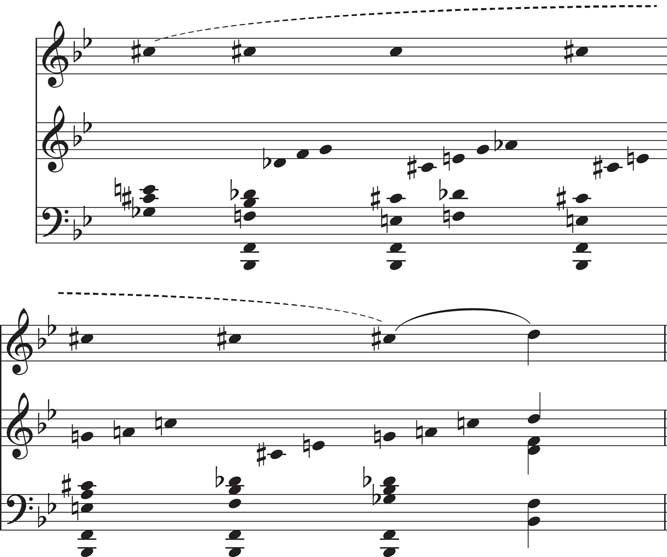
Something similar may be observed in the coda. The familiar voice exchange figure returns (Ex. 10). It is complicated by enharmony, leading to secondary dominants, and generating familiar chromatic resources: German sixth, half-diminished seventh and augmented triad. These serve to obscure tonality in a manner certainly no more alarming than similar phenomena in Wolf.
Das Lied von der Erde, ‘Der Abschied’, voice-leading sketch of bars 460–487

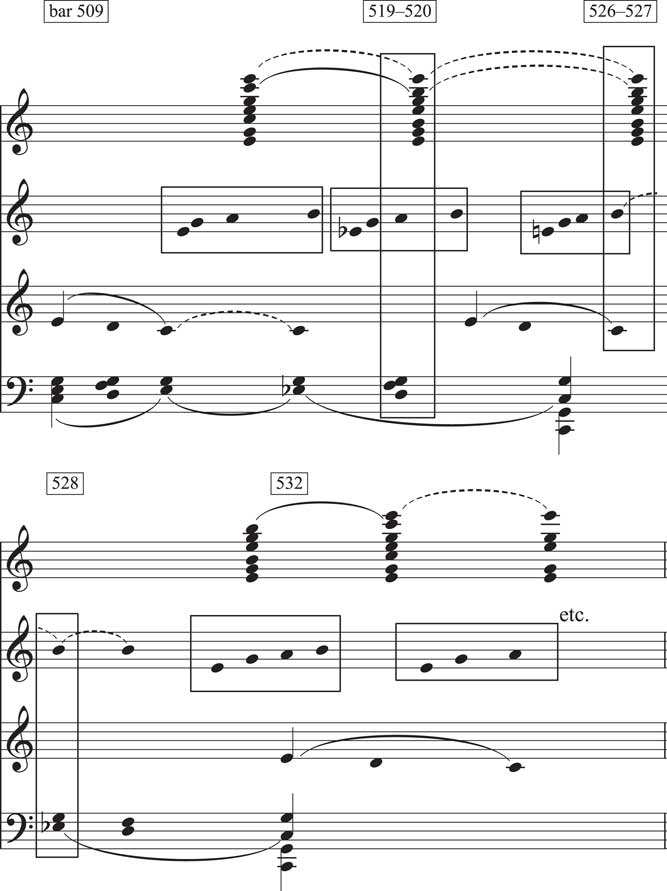
This final C major section of ‘Der Abschied’ is the locus classicus for Mahler's various balancing acts between pentatony and common-practice tonality, enlivened with modernist gestures such as the whole-tone scale segments that act as a protracted form of upbeat to the section (bars 453–9). It is also the point at which Mahler offers his most general literary statement about earth and nature. There have been many attempts to describe what happens in this closing section, such as Revers’ succinct encapsulation (‘extreme elongation of motif d2 … stagnation of harmonic progression, which successively is reduced to the C major triad’), or Danuser's even more concise ‘repetition, rhythmic augmentation, motivic liquidation’.Footnote 21 By motif d2, Revers refers to the pentatonic collection and the derived flute motif given in the second stave of Example 11; his point, then, is to show a different way of looking at the phenomenon described by Hefling, when he comments that ‘at length B♮, leading tone to the tonic, is lost (after Fig. 67–5).’Footnote 22 The fate of the leading note is indeed interesting, perhaps more so than the famous truncation of  in the repeated ‘ewig’ of the voice part. It is of course bound up with the reduction of a strong dominant progression to a much weaker form of cadencing. Although Mahler permits a strong V–I movement in the bass in bars 465–466, and leaves ‘(all-)überall’ poised in ecstatic counterpoint with the violins over a dominant pedal, this sense of a strong bass then fades away into voice exchanges in a variety of chromatic decorations (inevitable turns at bar 495 onwards, and appoggiaturas from bar 509).
Das Lied von der Erde, ‘Der Abschied’, voice-leading, pentatonic pitch collections, and arpeggiated melismas in bar 509 to the end of the movement
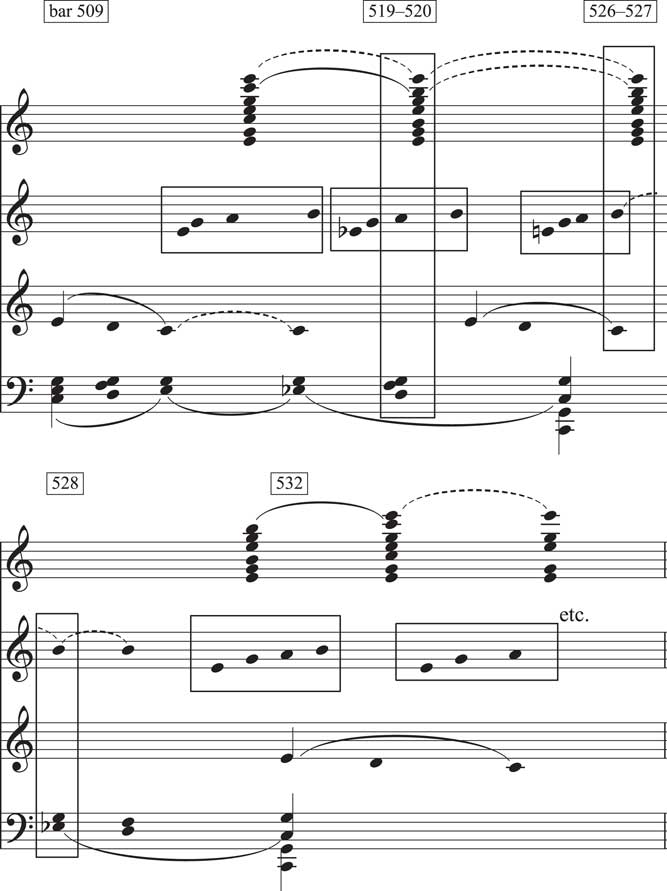
As if to emphasize the loss of harmonic and tonal momentum, the celesta and harp gain prominence, and their harmonies emphasize the leading-note as a melodic phenomenon that is only resolved at a distance in the increasingly wide-spread harp and celesta flourishes. Thus the chordal changes in celesta and harp represent C major and E minor, but the latter only as higher dissonance to the more directed harmonic motion underneath; the result is a curious randomness to the harmonies, as reflected in the cross-stave boxes of Example 11. The gently drifting harmonies in the lowest stave are essentially voice exchanges on a C major triad with passing notes, but the familiar Mahlerian fall of the third from major to minor still operates, both in the lowest part and in the flute pentatonic flourishes (second stave). Not only does Mahler remember his ancient major–minor changing effect (attenuated by the suggestion of E minor harmony in the celesta), but the pentatonic collection is converted into a whole-tone collection, such as was heard (in transposed form) in the upbeat to the whole section: E♭–(F)–G–A–B. As the leading-note is marginalized and rendered weak in the pentatonic and whole-tone fragments, so its complicating role in the arpeggiated celesta and harp roles shrinks to a minor third, E–G, wide-spread and attenuated, containing neither C nor B. Modernist resources such as the whole-tone fragment float in the same drifting voice exchange as pentatony and the major–minor changing chord, with the leading note rendered weak and deprived of an immediate resolution (though Mahler's final chord, for all the talk of verticalizing a horizontal motif, can hardly be heard as anything other than a resolution).Footnote 23
What kind of landscape do such fragmentary moments of stasis evoke? Raymond Monelle encapsulated one strand of Mahler interpretation when he noted ‘Thus Mahler saw himself ideally as a voice of nature’.Footnote 24 Adorno noted the ‘pseudomorphous’ character of nature in Das Lied, speaking of ‘a porcelain China and the artificially red cliffs of the Dolomites [that] border on each other under a mineral sky’.Footnote 25 But he was also sufficiently tempted by comparison with New German models to indulge in a fantasy that located Das Lied with works by Siegmund von Hausegger and Waldemar von Baussner; Mahler's title shares their pomposity but the music punctures it by ‘its mourning truth’.Footnote 26 This is the prelude to a truly extraordinary passage in which Adorno attempts to create an atmosphere for ‘Erde’ in language that clearly points more to negative dialectics than to Mahler. Yet to consider Das Lied in a New German context is not perhaps as absurd as Adorno's deliberately provocative choice of works might suggest; it is not without precedent to consider the Eighth Symphony alongside the founding New German master's Faust Symphony. Part of Adorno's point is the bold nature of Mahler's title, which probably inspired his choice of Baussner's Hohes Lied vom Leben und Sterben. But the historical proximity of Das Lied to Hausegger's Natursymphonie undeniably was a temptation too far for Adorno’ purposes.
When the opening's of Das Lied and the Natursymphonie are compared, the idea of the echoing horn calls brings an immediate common use of musical imagery. Later in Hausegger's first movement, pedals and dense textures packed with solo instrumental detail further help to locate Hausegger and Mahler as contemporaries. Yet for all the many points where their musical languages overlap, there is a central difference in tone. In the absence of texts for much of his symphony, we are driven to guess at Hausegger's precise expressive intention; but there is a vein of the Romantic sublime, in his contemplation of the vastness of landscape, that issues as melody of ‘high style’, supported by diatonic homophony, framed in harp tone, and sung by high violins, in a manner that inevitably draws comparison with Strauss in his sublime manner. When Mahler approaches the literary sublime in ‘Der Abschied’ there are still points of contact, but they reside in harmony rather than melody and sonority. The pretensions to reverence before Nature, which carry Hausegger to his vast and sonically not-unimpressive climaxes, dissolve in ‘Der Abschied’ to something that we can describe as porcelain or mineral if we choose, but that resolutely avoid many of the clichés of nineteenth-century musical landscape painting. The best work for comparison with the ‘Natursymphonie’ may well be the Eighth Symphony, since in both cases the music arrives at an overwhelming contemplation of eternity to words by Goethe (the ‘Proömium’ from Gott und Welt in Hausegger's case) that seem infinitely remote in atmosphere from ‘Der Abschied’.
Symphonic mountain music of the kind that Hausegger supplied (roughly speaking, the Romantic sublime) and that Mahler approached in ‘Der Abschied’ (less easily categorized in the clichés of aesthetic criticism) exists at some distance from the merely picturesque. A third work for comparison, Raff's Symphony No. 7, ‘In den Alpen’, helps to establish some further shades of tone in this difficult area. Thus, the ‘Wanderung im Hochgebirg’ with which it begins is dominated by pedals, and by a self-consciously elevated theme that is rich in fourths and also includes a very prominent nota cambiata. Later, the three-note version of the latter appears and even prompts the odd incidental moment of pentatonic figuration.Footnote 27 But the figural foreshadowing of Mahler is curiously irrelevant to any comparison of tone between Raff's symphony and Das Lied von der Erde. The cambiata is a clue to both composers’ intentions, but they are radically different. In Mahler the cambiata is part of the fragmentary apparatus that constructs the melismatic and funerary sections of the work. In the hand of the lukewarm New German (but always pedagogical) Raff, it has the certain promise that the theme of which it is part will eventually become a fugue subject. His symphony is a vigorous stroll leading ultimately to ‘Abschied’, but the latter is a triumphant coda, which ties in curiously with its predecessor. For Raff's Sixth Symphony promised that after death would come not the renewal of nature for others, but ‘Honour’.Footnote 28 If one views the New German School as an offshoot of aesthetic debates about realism, it becomes possible to interpret Mahler as qualitatively different from Liszt and his associates, offering not ‘Realidealismus’ but ‘rather the radical realism of 1848 that also might have let the humiliated and deprived speak in music’; but that line of thought also notes that Mahler's picture is of ‘the vulnerable sound of nature sometimes harshly brought to silence.’Footnote 29
In the last resort, comparisons with Mahler and New German nature depictions are unlikely to yield much that is truly insightful beyond a certain repertory of ‘Alpine’ devices. Thus, the shawm and alphorn that resound throughout much nineteenth-century mountain music are undoubtedly evoked in ‘Der Abschied’. But the sound of horns is not framed as it was in Schubert's setting of Mayrhofer's ‘Abschied’, by the horn fifth idiom which is still a topos in earlier Mahler, Hugo Wolf, and Richard Strauss. Horn tone in Mahler's ‘Abschied’ is part of the melodic web; if it evokes a topos, it is the lamenting Seufzer figure of the opening bars and the funeral march, or the birdsong turn at Figure 18.Footnote 30 The shawm, still a topos of mountain landscape in d'Albert's Tiefland, is only approximated in oboe and clarinet tone, but this is so heavily infiltrated by arabesque that simple equations with landscape are lost. Julian Johnson has noted that ‘the association of pedal points with the idea of nature is rooted deep in the history of tonal music’, and ‘Der Abschied’ is clearly no exception, but by this stage in Mahler's music the pedal had become something that resisted limitation to landscape.Footnote 31 Eggebrecht claimed that the significance of the birds in Das Lied, as a whole, resided in their ‘rendering concrete’ the notion that their indifference to the natural world was a kind of ‘model and trigger for fading away into another world.’Footnote 32 His point is that we should interpret natural imitation in Mahler according to context, which is fine as far as it goes, but it offers no insight into how nature depiction in ‘Der Abschied’ moves beyond that in the Third Symphony. Nietzschean echoes can be found in both Das Lied and the Third Symphony, but the deeply withdrawn mood is hardly Nietzschean in any thoroughgoing sense. The heavy qualification that marked some of the clues to the Third Symphony's content (‘My Gay Science‘) is enacted in ‘Der Abschied’. Zarathustra's mountains are indeed a consolation as sphere for thought; Mahler's offer a more muted reflection on life and its disappointments.
‘Der Abschied’ makes one last allusion to a minor topos in Mahler's music, the theme of the Wanderer. What may be minor in the music can of course be traced much more widely in his life, where his own comments on exile lead one to assume that he knew all too clearly how apt the notion of a journeyman was to his career as a conductor. If we exclude such considerations from the music and interpret narrowly, however, the topos is essentially confined to early works, to the wandering minstrel of Das klagende Lied and to the hero of Lieder eines fahrenden Gesellen. In ‘Der Abschied’ the motif returns, not so much in the first poem where ‘wandle’ clearly indicates not wandering but strolling up and down while waiting. But ‘wandre’ and ‘wandle’ in Mahler's expansion of the second poem is evidently something more purposeful in its suggestion of a journey to the mountains.
A recent study by Andrew Cusack has looked at the figure of the Wanderer in nineteenth-century literature in great detail.Footnote 33 As with so many grand themes in this period, there is a clear starting point in Goethe, whose knowledge of Mahler's favoured mountain terrain is pre-echoed here and there in the Italienische Reise, as he meditated on the Kalkalpen and followed the Adige at the Dolomites’ western edge.Footnote 34 Perhaps inevitably, the topos is far stronger in German literature before 1850 than after, which partly explains the curiously anachronistic character of the verse in Mahler's early song cycle. Cusack's list of candidates for the role of Wanderer include ‘the itinerant players, pedlars, journeymen, gypsies, and migrants who thronged the roads throughout the eighteenth and nineteenth centuries, as well as the artists, scientists, explorers, and students who, from the early phase of Romanticism onwards, also identified themselves as wanderers.’Footnote 35 Mahler's minstrel in the early cantata might, at a stretch, be emblematic of the second group (and thus possibly a pale likeness of the composer himself), whereas his journeyman might belong with the first (without being any less a self-image of Mahler as sentimentalized in verse). Once these parallels have been drawn, however, it is striking how completely lacking in context the wanderer in Mahler is depicted. His journeyman exists without any framework. The trade in which he earned his status is mysteriously unidentified: he is a wanderer, ultimately, in the final song, simply because he wanders. Of the positive themes analyzed by Cusack, there is no trace: ethical striving, aesthetic education, testing and purification, reintegration, are all absent. If Mahler's journeyman is compared with an earlier Austrian wanderer, the hero of Stifter's Der Nachsommer, then indeed his wandering is aimless, beside the latter's Bildungsweg. The comparison of the two almost acts out a parable from Carl Schorske, with Stifter possibly presenting the image of wandering for the liberal fathers, Mahler's wanderers as the sons in rejection.Footnote 36
The meagre references to wandering in ‘Der Abschied’ serve to clinch Mahler's attitude to the Wanderer, in that it brings the themes of renunciation and nature as mountain landscape into close proximity, a motif that is also to be found in Goethe, together with the therapeutic dimension that ultimately is the only remedy in Lieder eines fahrenden Gesellen. In that cycle, losing oneself in nature is the only cure for a broken heart, and one suspects that to cure is also to kill. Cusack notes that ‘To conceive of nature as unending flux, constantly bringing forth new forms, was in one respect a liberating idea, but it also gave rise to an uneasy awareness of the inexhaustibility of the universe.’Footnote 37 This is not quite identical to the state of mind at the close of ‘Der Abschied’, where flux is to some extent controlled by the idea of seasonal rebirth (with an inevitable hint of Nietzschean recurrence). But it cements firmly in place the idea that the poems of ‘Der Abschied’, in the form that Mahler shaped them, essentially are a commentary on the Wanderer topos, complete with themes isolated in Cusack: renunciation and the Alps as in Wilhelm Meisters Wanderjahre, tearful leave-taking from a friend as in Tieck's Franz Sternbalds Wanderungen, the circularity of wandering, identification with nature, the sacrifice of ‘all forms of human sociability, including friendships’, and ‘the longing for distant horizons and for transcendence in the widest sense.’Footnote 38 Essentially ‘Der Abschied’ sees the negative aspects of wandering, as described in aphorism 638 of Nietzsche's Menschliches: Allzumenschlies, while offering its positive aspects – ‘the gifts of all those free spirits who are at home in mountain, wood, and solitude’ – as a guarded consolation, if we can equate Mahler's vision of spring renewal with Nietzsche's ‘philosophy of the morning’.Footnote 39 Thus I am not sure that we can accept Hefling's equation of the Wanderer in ‘Der Abschied’ with the ‘fahrender Gesell’ unless we allow that the shallow figure of the latter has been rendered wise by experience (and thus becomes a kind of Parsifal, whose wandering in Act III is indeed an instance of Cusack's ‘testing and purification’ through separation).Footnote 40
‘Wandering’ is yet another theme that is incorporated into ‘Der Abschied’, as a fragment bereft of the associations that usually circumscribe the subject. One writer on Mahler has described his music as man in ‘the internal space created by the closed circle of houses in the ghetto’; within that circle…
…nature and man, angels and beggars, choirs and klezmer and military bands, Chinese girls with flowers and dead children… are sublimated, amplified and distorted in Mahler's hands, through prisms of distance, dream and irony. Nature is never realistically depicted; folk tunes never appear undisguised; there is no portrait of a hero; the narrator's voice is drowned and multiplied in a counterpoint of many voices.Footnote 41
This is another reading of Adorno's point about the intellectual tone of Mahler's music that sees (inter alia) something Jewish even in the Chinoiserie of Das Lied von der Erde. The bruised heart of the poet in ‘Der Abschied’ seeks a similar kind of solace, perhaps, to one of Heine's voices in the Harz, without its ironic counterpoint:

There is no suggestion in ‘Der Abschied’ of an alternative point of view akin to Heine's mocking coda:

Nor does Mahler attempt to puncture the illusion that solace is truly achievable in the mountains, as Heine does when he notes:
Man schlägt immer Seitenwege und Fußsteige ein und glaubt dadurch näher zum Ziele zu gelangen. Wie im Leben überhaupt, geht's uns auch auf dem Harze. You keep taking side-roads and footpaths, thinking these will bring you nearer to your goal; the Harz mountains are like life in general.Footnote 44
Mahler's tone is distance and dream; but the kind of irony that has been widely discussed in Mahler's music is missing from ‘Der Abschied’, perhaps even from the bulk of Das Lied.Footnote 45 Thus the ‘counterpoint of many voices’ tends to be absorbed into one perspective rather as the music is soaked up by the picture of nature's renewal.
There can be no doubt that understanding of Das Lied von der Erde in recent decades has proceeded through a greater appreciation of its ‘exotic’ element. From a time when the pentatonic elements were regarded as a fascinating surface colouring, scholars like La Grange and Mitchell have led the investigation of the texts, while others such as Hefling (underscored by the theoretical work of Revers) have given a greater insight into the kind of scales and collections that might operate in the work. Yet as I hope to have shown in this brief investigation, Das Lied von der Erde remains a work of Western art music, saturated in cultural references to themes deeply anchored in the German and Austrian Romantic and post-Romantic worlds. How this affects present-day appreciation of the work is complex and uncertain. At the height of what has sometimes been described as ‘the Schorskean Paradigm’, it was possible to integrate Mahler into ‘the generational revolt’ against liberalism by invoking his apparent espousal of ‘the baroque Catholic tradition’.Footnote 46 That this might have the drawback of presenting the Eighth Symphony, Mahler's least ‘modernist’ work, as the most symptomatic of its time, was partly acknowledged by Schorske when he noted that it ‘expressed the powerful commitment to art as a source of life that late liberal Viennese culture prized as perhaps no other culture had done before it’.Footnote 47Das Lied von der Erde fits into this classic paradigm as uncertainly as does the Eighth Symphony. It is related to ‘the high aesthetic lifestyle and cultivated hedonism of the Secession and its patrons’ but ultimately as critique; this brought it into line with the ‘ethical modernists’ (Karl Kraus and the Second Viennese School included) and a rejection of ‘the whole cult of art and beauty’ through a ‘Klangaskese’ that was ‘economical, …anti-sensuous, ruthless’.Footnote 48 At best, this is a very partial summing-up of what Mahler in general and Das Lied in particular convey, as can be demonstrated by considering the often extravagant and almost romantic language into which Schoenberg, for one, often descends when talking about Mahler. Schoenberg may have written about ‘the briefest and most delicate forms’ in Das Lied, but this is hardly a description of more than two or three of the songs; while the description that best fits ‘Der Abschied’, ‘the finite nature of earthly things’ is far from being a necessary endorsement of Klangaskese.Footnote 49 Corresponding to the latter quality might be the description of ‘the almost unexampled objectivity’ of his instrumentation, but this is put at the service of ‘grunts and groans’, crashes, crumbles, delicacy, and fragrance.Footnote 50 It is no longer entirely adequate to describe ‘Der Abschied’ as critique and rejection of the Secession; part of it, the least fractured, is still in love with the aesthetic depiction of nature. The view may have the advantage of tying Mahler's fragments firmly to a modernist aesthetic, but it does so at the expense of the numerous links between ‘Der Abschied’ and the Romantic and Post-Romantic past, even if the links are themselves rendered subtly problematic by a critical internal voice.
To say this is to fall into step with the waning of the ‘Schorskean paradigm’ that can be seen in spheres other than musicology. Admittedly, the paradigm has proved very tenacious in the field of cultural studies: variations of it can be found in the persistent distinction between a fin-de-siècle mentality and the idea of an avant garde, the latter represented by a generation of the eighties ‘when one crisis topped another’.Footnote 51 According to the views expressed in one symposium, however, the notion of a generational revolt against the failings of liberalism is not as plausible as once seemed.Footnote 52 The grounds for objection to this famous and tempting thesis are threefold: its vision of Vienna ‘vibrant with intellect and sex’ is as much myth as reality; it makes history out of the ‘retreat from the historical’ to the cultural; it is too closely linked to an ‘axiomatic assumption’ about autonomous organic works of art, which one authority relates specifically to Adorno, as high priest of modernism,Footnote 53 though the liberal era lies behind it in the apparently conservative person of Hanslick. In modern critiques, Schorske resorted to ‘collage-like, fragmented strategies’, driven by ‘aesthetic sensibility’ rather than ‘ideological narrative.’Footnote 54
There is an intriguing intellectual knot at the heart of this critique. While Adorno's starting point may well have been the autonomous artwork, there can be no doubt that, certainly by the time of his Mahler book, the whole notion of the autonomous work had become, if not suspect, at least highly fragile in his thinking. That Adorno smuggled into his Mahler book various ideas and suggestions that amounted to a furtive critique of his earlier writings is now acknowledged by such writers as Max Paddison and Peter Franklin.Footnote 55 In its wake have come interpretations of Mahler that have embraced precisely ‘collage-like, fragmented strategies’ that dwell on cultural rather than historical and ideological narratives, while the historians of Mahler's historical period have sought to recover a narrative that is not dependent on a cultural theory about generational conflict. (In this respect the work of John Boyer, Pieter M. Judson, and others has been highly instructive as to the real complexities of Viennese liberalism.)Footnote 56 There is little doubt that much of the work in this field has yet to yield ‘a viable model for the cultural history of modernism’.Footnote 57 For Mahler studies there must be a rather more specific addendum that his achievement in Das Lied von der Erde, and ‘Der Abschied’ in particular, must continue to occupy a rather lonely niche: exotic in detail, Western in musical language; modern in outlook, and fragmentary in point of origin; visionary, but offering limited consolation. That it has as companions such hesitant assertions of a progressive aesthetic as the Lyric Symphony of Zemlinsky or the Third Symphony of Szymanowski, works that still retain elements of the Romantic sublime crossed with the exotic, is confirmation that there may be generalizations to be made, but perhaps not within the discourse of modernism as framed in the last century.