IntroductionFootnote 1
This article offers an in-depth study of a Neo-Sumerian statuette (c. 2150–2004 b.c.) that has received little scholarly attention since its discovery in the late nineteenth century, with the notable exception of publications on the Tello excavationsFootnote 2 and Agnès Spycket's survey of ancient Near Eastern statuary.Footnote 3 It was found “in the excavations of the Tello edifice”Footnote 4 in August 1881, as recorded in the archives of the Louvre Museum,Footnote 5 and was included in a second shipment of objects sent to Paris.
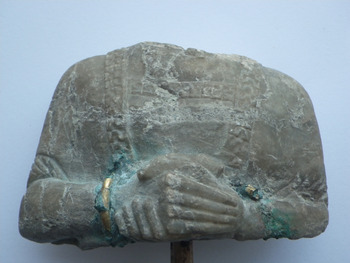
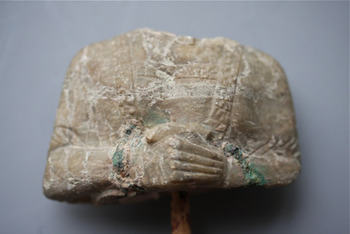
The statuette is carved in a soft gypsum alabaster and has survived in a very partial state.Footnote 6 All that remains is the upper body; the neck and head are missing, as is the body below the waist (Fig. 1; table 1, 4).Footnote 7 It depicts a female with her hands clasped at the front. Remarkably, each wrist is adorned with a bracelet formed from smooth, undecorated copper bands covered in gold leaf. Her garment criss-crosses at the back and falls in two parallel sections in front, revealing an undergarment—or a fold of the same draped material—with a horizontal neckline. All the edges of the garment are trimmed with a braid in an interlocking “S” pattern, except at the elbows, which are fringed.
The statuette in its current condition. Photograph © A. Thomas

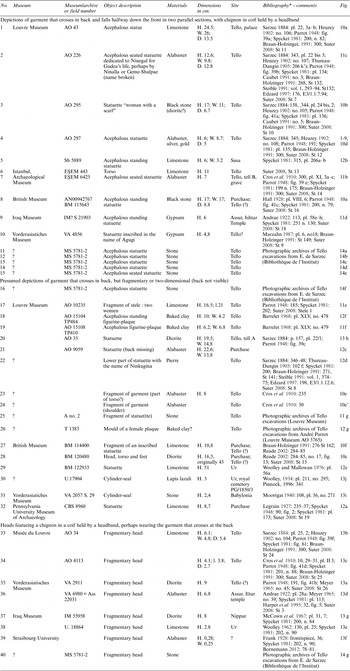
Statuettes wearing a garment that crosses at the back together with a chignon in a coif held by a headband

Recent restoration work and analysis have revealed technical aspects relating to the methods of manufacture of the statuette as well as its original appearance. This has also provided an opportunity to comment on the statue's dress, which appears to be specific to a set of female figurines probably depicting royal princesses of Lagash.
A composite statue with lavish finery
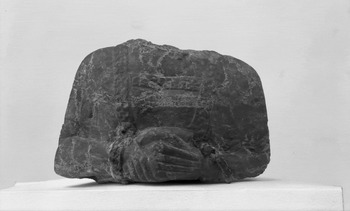
The statuette wears a bracelet on each wrist. These two pieces of jewellery were noted when the item was discovered, earning it publication by Léon Heuzey at the start of a separate section of the Louvre's catalogue of Chaldean antiquities that was devoted to such rare works “with inlay”.Footnote 8 Initially put on display in the Louvre, it was later transferred to storage at an unknown date. Subsequently, an accident or inopportune restoration resulted in the loss of part of the bracelet on the left wrist; it appears complete in a photograph published in 1981, although this may have been taken a few years earlier (Fig. 2).Footnote 9 The late nineteenth-century descriptions referred to above state that the bracelets were gilded. However, they subsequently suffered from an actively corrosive process that covered them entirely so that the original surface became hidden.Footnote 10 Nothing remained of the gilded appearance noted by the excavators until recent restoration work revealed it once again (Fig. 1).Footnote 11
View of the statuette with two complete bracelets. Photograph © Musée du Louvre, Department of Near Eastern Antiquities

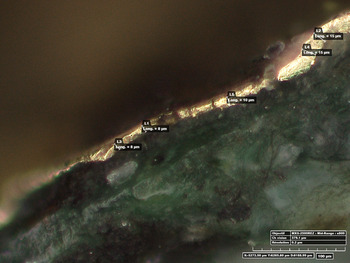
Each copper bangle—3 centimetres in length for the right bracelet, 2.5 centimetres for the left—is covered in leaf composed of gold that is alloyed with silver and copper.Footnote 12 This leaf is eight to fifteen microns thick (Fig. 3),Footnote 13 and was probably applied by lamination rather than hammering, which would have yielded a much thinner foil. The leaf—or perhaps, given its thickness, better described as a sheet—is visible right to the edge of the bangles, suggesting that it was applied to the bracelets before they were attached to the statuette.Footnote 14
Digital microscope measurements of the gold leaf on the left bracelet. Photograph © D. Robcis, C2RMF

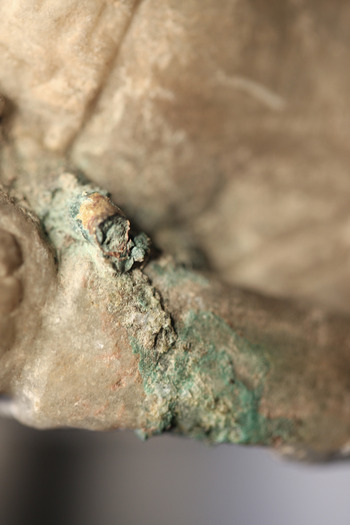
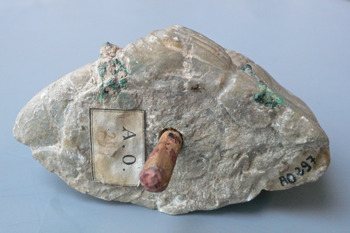
The bangles were set in symmetrical grooves cut into each wrist. The grooves are all the more apparent in that the statuette's left bracelet is displaced diagonally toward the elbow (Figs. 4 and 5). This change in angle might have occurred at the outset, if the bangle proved to be longer than expected, or might have resulted from later slippage, perhaps when the statuette was buried. Whatever the cause, the displacement occurred sufficiently early on to prevent any trace of corrosion in the groove in which the bracelet was originally intended to sit. The ends of the two bangles were held in place by copper alloy pins within the recess created by the undercutting that formed the arms and hands at the level of the current break (Fig. 6).
The statuette prior to restoration. Photograph © C. Pariselle

Detail of the groove on the left wrist. Photograph © C. Pariselle

Details of the pins on the lower ends of the bracelets. Photograph © C. Pariselle

With additions in a gold-silver alloy—the metals having come from Anatolia, Iran, or even farther awayFootnote 15 —this statuette testifies to the lavish ornamentation of composite statues from the ancient Near East, only a few examples of which survive today. Such ornamentation takes the form on other statues not only of bracelets but also necklaces and earrings, as well as the inlaid elements of eyes and hair.Footnote 16
Possible polychromy
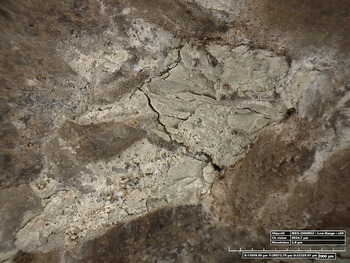
Whilst the inlaid metal bracelets provided a contrast of colour and material against the stone of the statuette, it is also possible that specific areas or the entire surface of the figure was painted. Indeed, vestiges of what might have been a ground layer can be seen with the naked eye on various parts of the statuette, notably on the chest and the back (Fig. 7): a material visibly different from the stone, and which seems to have contracted. The stone from which this statuette is carved is particularly heterogeneous, displaying stains and other imperfections, notably a large horizontal vein crossing the entire width of the chest below the braid, as well as other small cracks and incrustations. A ground layer would have smoothed the overall appearance by filling cracks and masking irregularities. Furthermore, this would have favoured the application of coloured pigments. However, we cannot exclude deterioration of the alabaster itself as a possible cause—indeed, the shrunken layer is largely composed of calcium carbonate and gypsum, which are also found in the gypsum alabaster from which this statuette was made. Unfortunately, if the layer was designed to function as a ground prior to the application of paint its composition is much too similar to that of the deteriorating statuette to distinguish between the two.Footnote 17
Digital microscope image showing a possible layer of ground on the back of the statuette. Photograph © D. Robcis, C2RMF

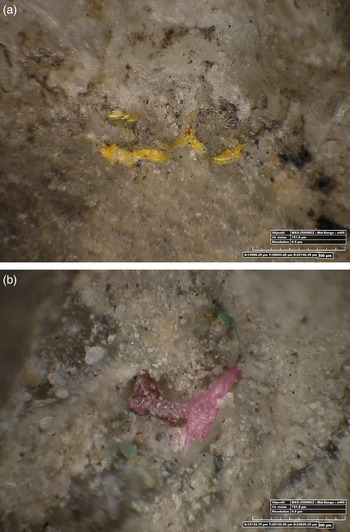
The use of a digital microscope has revealed, however, small dots of colour at a number of places on the statuette: a micro-dot of red on the neckline in the middle of the horizontal braid, as well as on the left bracelet; a yellow dot on the neckline; and some malachite on the back—the latter may, however, simply be the effect of oxidation (Figs. 8a–b). Yet again it is possible that these are concretions or other deposits related to the burial of the statuette or to external “pollution” where the composition is similar to that of vestigial pigments. It is nevertheless tempting to correlate the presence of red and perhaps yellow with the location of what would have been a carved or painted necklace: although no visible trace survives on this figure, a necklace is present on comparable and sufficiently well-preserved statuettes.Footnote 18 It is also possible that the skin was painted yellow,Footnote 19 since dots of yellow colour remain visible on some comparable female statuettes from Lagash ( table 2: 15 at the wrist; table 1, 27 on the left cheek, and possibly I, 26 at the left base of the neck). Besides the potential use of colour on a necklace or skin, it is also possible that the yellow was used to highlight the braiding; a fragment of a garment bears traces of blue on the fringe ( table 1: 18) and this may have been part of the same statue as a female head ( table 1: 27) from the Second Dynasty of Lagash where traces of blue are visible to the naked eye on the forehead.Footnote 20 Finally it is worth noting that red Footnote 21 might have been the original colour of the garment that crosses at the back, as the surviving evidence suggests for the so-called “woman with a scarf” ( table 1: 3), specifically on several places of the dressFootnote 22 as well as on the front of the headband (one dot) and on the back of the coif (three dots of red).Footnote 23 The question arises as to whether there existed red garments crossing at the back with blue fringing and/or if some of these garments were red while others were blue, perhaps depending on the role of the women wearing them.
a. Detail of yellow colouring on the front neck. Photograph © D. Robcis, C2RMF; b. Detail of red colouring on the front neck. Photograph © D. Robcis, C2RMF

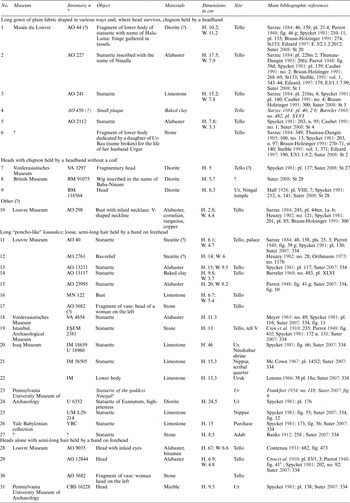
Non-divine female statuettes wearing alternate garments to those in table 1. Exceptions to the standard combination of hairstyle and garment appear in italics Representations on cylinder-seals are not included (see Suter Reference Suter2008: table 2).

Thus the garment of the statuette could have been painted red—perhaps over a preparatory ground layer—which may correspond to its colour in reality (including the so-called coif, which looks to have been made of a similarly fine textile),— possibly with blue fringes and braiding and the use of red and yellow.
The statuette's dress and jewellery within a wider corpus
This female statuette is dressed in a garment with complex draping and refined trimming of a type known from only a number of other surviving female figures, at most forty, for which see table 1.
An unusual and prestigious garment
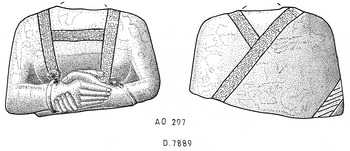
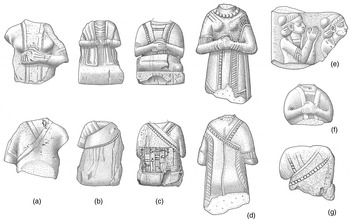
The garment is characterized by the way it crosses at the back but falls straight in front in two parallel sections approximately to the knees, over an underlying fold (?) of apparently plain fabric marked by a horizontal neckline (Fig. 9; table 1: 4).Footnote 24 On the basis of several almost complete statues where the lower sections has survived, the garment would have descended to the feet (Figs. 10b–d, 11a–b, 11d–g, 12e; table 1: 2, 5, 7, 9, 15, 18, 22, 26, 32). A single rectangular piece of fabric of very large size can be arranged in this way,Footnote 25 as demonstrated by Léon Heuzey,Footnote 26 and followed by Eva Strommenger.Footnote 27 Such lengths of cloth to make garments existed at least since the Akkadian period, as shown by statues of King Manishtushu, but being more difficult to make, they must have been a luxury item, possibly reserved for ceremonial, perhaps exclusively princely, dress. Furthermore, the overall dress has the same remnants of colours, as also seen on the “woman with a scarf” figurine,Footnote 28 which would be logical for the use of one large piece of textile. Although less probable, given that it would have been more complicated to make, this dress might have been composed of several smaller pieces of fabric. In that case the outfit would have included two or three items of clothing: a kind of cloak worn over a long gown.Footnote 29 In any event, it must have involved complex drapery of one or several pieces of material without the need to cut the garment to shape. The fabric may have been fine linen or wool; possibly wool if it was coloured since linen is more difficult to dye.
a. Detail of red colouring on the front neck. Photograph © D. Robcis, C2RMF; b. Detail of yellow colouring on the front neck. Photograph © D. Robcis, C2RMF

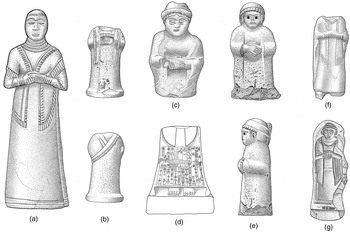
a. Female figure, Tello. Paris, Louvre Museum, inv. AO 43: front and back; b. Seated female figure, Tello. Istanbul Archaeological Museum, inv. EŞEM 6425: front and back, after Parrot Reference Parrot1948, fig. 39e; c. Inscribed seated female figure, Tello. Iraq Museum, inv. S 21903: front and back after Andrae Reference Andrae1922, pl. 58e–h; d. Female figure, Assur. Louvre Museum, inv. AO 226: front and back; e. Fragment of stone stele depicting two women, Tello. Louvre Museum, inv. AO 10235; f. Baked clay plaque of a female figure, Tello. Louvre Museum, inv. AO 15108; g. Female figure, Tello: back after an archive photograph from the Tello excavations (A no. 2). All drawings © C. Florimont, DAO

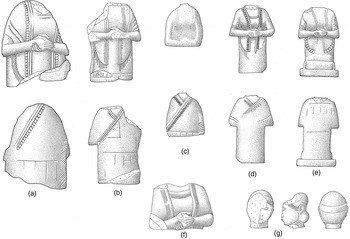
a. Female figure. Pennsylvania University Museum of Archaeology, inv. CBS 8960: front after Spycket Reference Spycket1948: 90, fig. 2; b. Female figure, Susa. Louvre Museum, inv. Sb 5589: front and back; c. Female figure. Louvre Museum, inv. AO 9059: front; d. Lower part of a statuette inscribed with the name of Ninkagina, Tello: front after Sarzec Reference Sarzec and Heuzey1884: 34; e. Female figure, Ur. British Museum, inv. BM 122933: front; f. Baked clay plaque of a female figue, Tello. Louvre Museum, inv. AO 15104. All drawings © C. Florimont, DAO

a–e- Female figures, Tello: front and back drawn after archival photographs from the Sarzec excavations (Bibliothèque de l'Institut); f. Female figure, Tello: front after ancient pictures from Sarzec excavations (Bibliothèque de l'Institut); g. Fragmentary female head, Tello: after ancient pictures from Sarzec excavations (Bibliothèque de l'Institut). All drawings © C. Florimont, DAO

The corpus
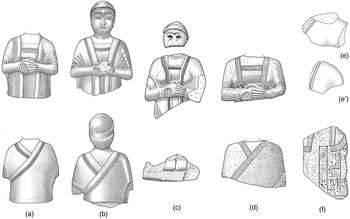
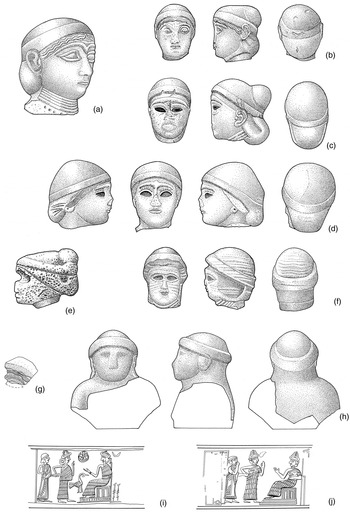
Fifteen statuettes are sufficiently well-preserved to show both the front and back of the garment, some of which still have the head and/or lower part of the body preserved ( table 1: 1–15).Footnote 30 A further seventeen fragments of statues may represent parts of the same type of garment. One example represents the lower half of a statue with its back missing (Fig. 11d; table 1: 22), two others are fragments of dress (Figs. 13e–e’; table 1: 23–24), with insufficient details to confirm the exact type represented with any certainty but they include a comparable decorative border and probably belong to a statue with a head coiffed like the other women in the series.Footnote 31 Another fragment (Fig. 13f; table 1: 27) is similarly problematic but it does show clearly two sections of garment with fringes identical to the more complete statues. Further examples include low relief plaques of four female figures where their backs are not visible, but their garments are nevertheless arranged in front exactly like ten of the best preserved statuettes that wear a chignon under a coif held by a headband (Figs. 10e–f, 11f–g; table 1: 17–19, 26).Footnote 32 This arrangement is also suggested for the images of women shown on two cylinder-seals (Figs. 14i–j; table 1: 29–30Footnote 33 ) wearing a similar headdress, jewellery and a garment with a part that falls to the knees at the front (without revealing whether there is a second, parallel section at the front or whether the garment crosses at the back). Finally, a lack of surviving details on seven other sculptures make it difficult to be certain that the same dress is depicted: one is simply represented too schematically (Fig. 14h; table 1: 20), four have backs that are either too schematic or damaged (Figs. 11a, 11c, 11e, 13c; table 1: 21, 28, 29,Footnote 34 32), whilst only archival photographs of the back of one statue and the front of another are known to the present author (Figs. 10g, 12f; table 1: 25, 16). As discussed below, based the examples which have retained their head and on two-dimensional representations showing the garment that crosses at the back ( table 1: 3, 17, 28, 29, 32 and maybe 20–21), it can be assumed that eight heads featuring a chignon under a coif held by a headband wore this same garment (Figs. 12g, 14a–f; table 1: 33–40).
a. Female figure, Tello (?). British Museum, inv. BM 115643: front and back; b. Female figure called “Woman with a Scarf”, Tello. Louvre Museum, inv. AO 295: front and back; c. Fragmentary female figure (head, torso and feet), Tello (?). British Museum, inv. BM 120480: front; d. Female figure, Tello. Louvre Museum, inv. AO 297: front and back; e. and e’. Fragments of a garment, Tello: drawing after Cros, Reference Cros, Heuzey and Thureau-Dangin1910, 30 and 235; f. Fragment of garment, Tello (?). British Museum, inv. BM 114400. All drawings © C. Florimont, DAO

a. Fragmentary female head, Tello (?).Vorderasiatisches Museum, inv. VA 2911: left side; b. Fragmentary female head, Tello. Louvre Museum, inv. AO 34: front, left side and back; c. Fragmentary female head, Tello. Louvre Museum, inv. AO 4113: front, left side and back; d. Fragmentary female head, Assur. Vorderasiatisches Museum, inv. VA 6980: right side, front, left side and back after Andrae Reference Andrae1922: pl. 28a; e. Fragmentary female head, Ur. Iraq Museum, inv. U. 18864: left side after Woolley Reference Woolley1962: pl. 25; f. Fragmentary female head. Strasbourg University: front, left side and back after Bornemann Reference Bornemann2012: 78–81; g. Fragmentary female head, Nippur. Iraq Museum, inv. IM 18864: after McCown Reference McCown, Haines and Hansen1967: pl. 31, 7; h. Fragmentary female statue, Tello. Louvre Museum, inv. AO 35: front, left side and back; i. Cylinder-seal, unknown provenance. Vorderasiatisches Museum, inv. VA 2057: after Moortgat, Reference Moortgat1940: pl. 36, no. 271; j. Cylinder-seal, Ur. Drawing after Woolley, Reference Woolley1934: pl. 211, no. 295. All drawings © C. Florimont, DAO

An attempt to reconstruct the statue's appearance
Among the statuettes wearing the garment under discussion and where the heads have survived intact, all are coiffed in the same manner. It is therefore plausible that eight fragmentary heads with a similar coiffure, namely a chignon wrapped in a fine scarf, or coif,Footnote 35 and held in place by a headband, may have been originally dressed in the garment that crosses at the back (Fig. 12g, 14a–f; table 1: 33–40). The actual headband was perhaps of precious metal, as with known examples of earlier date.Footnote 36 It is also possible that a hair-ring or some other hair jewel held the bun in place; such contemporary jewels have been found in excavations.Footnote 37
Eleven of the women wear jewellery: necklaces around their necks and/or bracelets at their wrists.Footnote 38 This does not, however, appear to have been worn consistently since depictions of jewellery are found on only a few sculptures. Ten to thirteen pieces show necklaces (Figs. 10d, 11a, 11f–g, 12g, 13c, 13d(?), 14a, 14c, 14f, 14j; table 1: 9, 18, 26, 28, 30, 32, 34, 35, 39, 40Footnote 39 , 39 and perhaps also 4—if painted—, 7, 19, and 31—that have very schematic representations). These mostly take the form of a multi-strand necklace—possibly made of linked chainsFootnote 40 or beads of indeterminate shape—covering the neck like a “choker”,Footnote 41 although three statuettes wear a necklace clearly made of circular beads (Figs. 10d, 10f, 14a; table 1: 9, 19, 35). Based on the evidence of the statuette illustrated in Fig. 14a ( table 1: 35), this collar of round beads could be worn as a single strand combined with a multi-strand necklace—it is unclear if the latter is formed from beads.Footnote 42 Five women of the corpus wear bracelets (Figs. 10b, 10d, 11a, 11b, 13d; table 1: 4 [inlaid bracelets], 5, 7, 9, 32 [carved bracelets]). Many of the remaining statuettes are too fragmentary and/or too schematic, but there is a clear absence of bracelets on six figures (Figs. 10a, 10c, 10f, 12a, 13a–b, 13c; table I: 1, 2, 3, 11, 19, 28) and an absence of a necklace on at least four (Figs. 10e, 11c, 11e, 13a, 10c [?], 11b [?], 13a [?]; table 1: 1, 17, 21, 29 and perhaps 2, 5, 8) while two incomplete statuettes (Figs. 11e, 13a; table 1: 8, 29) and figures on a relief (Fig. 10e; table 1: 17) do not wear jewellery.
Some of the sculptures of the corpus might have earrings (Fig. 14a, c and d; table 1: 34–35 [carved?] and 36 [originally inlaid, based on a still-visible pair of holes]). None of the figures appear to wear finger rings, but these may not have been considered significant, as perhaps was also the case with pins and personal seals. As already discussed, one should not rule out the possibility that some jewellery may have been indicated by paint, while other items were inlaid in metal and/or stone.
Variations in design
On statuettes where this type of garment is being worn using the same method of draping and adornment with decorative edging and simple fringes, that is to say, without knotted tassels. The edging is visible along the sections that cross at the back and fall straight in front, as well as across the horizontal neckline. The fringe must have run along the outer edge of the cloth—assuming the garment was made from a single piece of fabric—because it is visible only at the arms (which are shown covered by the fabric to varying lengths, since the wrapped material could be easily pushed up to reveal more of the arm) as well as along the bottom of the parallel sections falling in front (based on the best-preserved and detailed examples: Figs. 10b–c, 10d, 11a–b, 11d, 11f–g, 12b, 12d–e, 13f; table 1: 2, 5, 7, 9, 12, 14–15, 18, 22, 26–27, 32).Footnote 43 The only details that vary on these standard depictions of the garment are the pattern of the decorative edging and the choice of shoulder that takes the uppermost piece of crossed fabric—this passes over the right shoulder in most cases, with the exception of two figures where it is the left shoulder that is coveredFootnote 44 (Figs. 10c–d; table 1: 2, 9).Footnote 45 With regard to the decorative borders or braid, three main groups can be identified as described below:Footnote 46
Group 1
Interlinking “S” patternFootnote 47 along the edge (nine examples: table I: 3, 4, 8, 13–15, 16, 27–28). Heuzey has described it as a “twisted loop fringe” that may have been embroidered or openwork.Footnote 48 In a few cases (see table 1: 4, 8) this pattern involves stiffer lines, indeed rectilinear ones approaching the shape of a “5”.
Group 1’
Comma pattern (two examples: table 1: 23–24). This edging is characterized by upward-pointing commas, and is seen only on two fragments of garments not conclusively identified as crossing at the back and falling straight in front over a horizontal panel. Furthermore, they are known only from drawings that are not necessarily reliable; this pattern could thus have been very similar to the “S” pattern.
Group 2
Scalloped or tufted and hatch pattern (nine examples: table 1: 1, 2, 5, 7, 9, 11, 12, 17, 19, 25, 32). Along the border is a series of small rectangles with rounded edges ( table 1: 2, 7, 19), similar to the scalloping or tufting found on sculptures of the Akkadian period. For actual garments, these were probably made separately as appliques. Within this same group can be included depictions which comprise a series of parallel hatching, perhaps fringing. This pattern is similar to examples known from the edges of garments on statues of Gudea.
Group 3
No edge decoration, just a simple fringe running along the bottom of the two sections of fabric falling in front (four examples: table 1: 21–22, 29 and perhaps 18). Here the only evidence is either an inadequate photograph (table I: 18) or very schematic and fragmentary statuettes ( table 1: 21, 29), which leaves some doubt as to the actual absence of decorative edging. The accuracy of a drawing of one statuette (table I: 22) is confirmed by a recently rediscovered excavation photograph.
The significance of the various edging decorations, if any existed, remains totally unknown. Similarly, due to the lack of surviving inscriptions it is hard to determine if levels of status were implied by the type of stone used to depict the women, either a local white stone (including alabaster, gypsum, limestone: table 1: 1–2, 4–7, 9–17, 21, 23–27, 29, 32, 33–34, 36, 38–39) or, less often, an imported black stone that can be assumed to have been more prestigious (steatite, diorite: table 1: 3, 8,20, 28, 35–37 and maybe 22). Similarly, status might have been indicated by scale: three statuettes ( table 1: 1, 22, 29) that are much taller than the others in the corpus, which were all otherwise approximately 25 centimetres high.
A costume for court women, perhaps the wives of rulers
Based on the garment's decoration and that it was probably made from a large and therefore expensive piece of fabric, the woman wearing it would have occupied a privileged social position; something also suggested by the jewellery shown on some of the sculptures. The statues were not intended to represent goddesses given the absence of the horned head-dress conventionally worn by deities since the Akkadian period. They do, however, wear the chignon—though covered by a coif—as did deities and kings until at least Akkadian times.Footnote 49 In fact, this headdress held by a headband may have been a distinctive sign of the wearer's royal status,Footnote 50 as was perhaps was its colour.
Of particular significance in regard to their possible royal status is that two of the statuettes in this corpus bear inscriptionsFootnote 51 stating that they represent wives of Lagashite rulers—a third statuette (table I: 10)Footnote 52 is inscribed with the name of Agugi, wife of Lu-duga but neither name is known from other sources. One statuette of a royal wife ( table 1: 2) bears a lacunary dedication for Gudea's life that Vincent Scheil has linked to the text on an altar dedicated by Gudea's first wife, Ninalla,Footnote 53 who may therefore be the subject of this sculpture (alternatively, it could represent his second wife, Gemeshulpae, see below).Footnote 54 The second statuette ( table 1: 22) is inscribed with the name of Ninkagina, second wife of Ur-gar and perhaps the mother of the ensi Nammahani,Footnote 55 who allegedly reigned a few years after Gudea.Footnote 56
Consequently, it is tempting to view these female figures as royal women or princesses at the court of Lagash, although it is unclear whether they represent exclusively wives of rulers or may also have been mothers, daughters, sisters, or other relatives of the king. Certainly the inscribed examples refer to wives of rulers. Julia Asher-GreveFootnote 57 has suggested that the statuette dedicated to Gudea (Fig. 10c; table 1: 2), who is shown seated with both legs drawn up under her to the right,Footnote 58 is Gemeshulpae, arguing that the unusual posture of the figure may have indicated her rank as subordinate to the ruler's first wife Ninalla who is identified with another standing statuette ( table 2: 2).Footnote 59 Unfortunately, as many of the statuettes are very fragmentary and their inscriptions are missing, the only other statuettes seated in this fashion (Figs. 10b, 12e; table 1: 7, 15) cannot be identified. Furthermore, Ninkagina, who was the second wife of Ur-gar, appears standing ( table 1: 22). Her stance, however, may be due to the fact that she is described as the daughter of Kaku, possibly king of Ur, and her royal connection may have taken precedence over her rank as a wife.Footnote 60 It is noteworthy that a fragment of a stela shows two women together wearing this same costume ( table 1: 17), although colour might have originally distinguished them. The relief perhaps represents the two wives of a ruler, though it is not known if Neo-Sumerian Lagashite rulers had more than one wife simultaneously.Footnote 61
A possible costume for ladies at worship
On the few representations of these women in a context, they appear as worshippers: either clapping their hands, probably participating in a ritual ceremony (Fig. 10e; table 1: 17) or—if the two seals mentioned above do depict this costume (Fig. 14i–j; table 1: 30–31)—they stand in front of a major seated deity to whom they are introduced by a minor god, in the manner of kings known from contemporary seals. Moreover, except for the two ladies clapping their hands, all the other women of the corpus have their hands clasped in a position exactly like that found on the many statues of Gudea in a gesture of prayer.Footnote 62 This might suggest that the statuettes depict princesses engaged in worship that were perhaps dedicated in temples (as indicated by the text on the inscribed examples). Indeed, one sculpted head in the corpus was discovered in a temple, albeit at Assur ( table 1: 36).Footnote 63 In this regard, it is noteworthy that the only two female figures interpreted as dressed in the crossed-back garment where their feet survive, are barefoot (Figs. 11d, 13c; table 1: 22, 28).Footnote 64
Apart from the specific garment crossing at the back and falling straight in front in two parallel sections roughly to the knees, plus the “coif”, these statuettes bear comparison with other contemporary depictions of women from Lagash who wear either a garment called a kaunakes (because it resembles thick, tufted wool) or a long, apparently plain but fringed gown, rather than the garment that crosses at the back ( table 2). These two other costumes allow more to be said about the women in our corpus.
A group of twenty-one figures ( table 2: 11–31) comprises women wearing a kaunakes falling to their ankles, covering the top part of the body like a poncho in so far as no slits can be detected anywhere in the garment. The outfit may therefore have consisted of two garments, consisting of a gown or long skirt underneath the “poncho”. Based on the most complete examples, this dress was worn with semi-long hair loose at the back but held by a headband at the level of the forehead.Footnote 65 In these particular examples the women are shown seated in a chair, like enthroned kings and deities. The best-preserved examples wear multi-strand necklaces but no bracelet.Footnote 66 They look very similar to female deities but according to the few extant inscriptions and based on comparison with the relief depicting Enheduana,Footnote 67 the daughter of Akkadian king Sargon and high priestess of the Moon-god at Ur, the women wearing the kaunakes are understood to be high priestesses.Footnote 68
In contrast, a second group of ten statuettes consists of women wearing a long gown of plain fabric edged with a fringe and sometimes decorative borders; judging from the best preserved examples, all are shown standing. Their long plain gown appears to have been draped in various ways—a simple panel falling to the side in front and back, or with the chest panel allowed to drop into a V-shape. In fact, the garment that crosses at the back must have been formed from a similar large piece of fabric with decorated edges, and would seem to have been closely comparable to the other garments if only in terms of their arrangement. Indeed, one of these figures is inscribed with a prayer for the life of Gudea, and perhaps depicts the ruler's first wife Ninalla; since the sign nin is still visible ( table 1: 2). Furthermore, included in this heterogeneous group is a fragment of a section of fabric draped down the back of a figure that is inscribed with the partial name of a daughter of Ur-Bau and probably wife of the ensi Urgar, to whose life this statuette is dedicated ( table 2: 6). A fragment dating to the later Third Dynasty of Ur of a lavish garment edged with a tasselled fringe is inscribed with the name of Hala-Lama, daughter of Lugirizal, governor of Lagash in the time of Shulgi of Ur, to whose life this statuette is dedicated ( table 2: 1). There also survives a fragment of wig ( table 2: 8) showing the chignon held by a headband which would normally be associated with the long undecorated garment. The wig is, however, inscribed with the name of Baba-Ninam, cup-bearer of Ur-Ningirsu and is thus the only known example of the dedication of a female statue of this type by a male.Footnote 69 Consequently, it seems that this type of costume was worn by court women who, judging from the sufficiently well preserved sculptures, also have their hands clasped together as if in prayer. This costume is the closest to both the crossed-back garment and also the wrapped costume worn by rulers and anonymous court males. It is difficult to determine, however, if this particular draped garment was associated with specific contexts such as worship, or was worn by only certain court women (wives and also daughters of rulers according to associated inscriptions). All the well-preserved figures have their hair arranged in chignon without a coif.
In summary, the loose hair of high priestesses was held in place by a band across the forehead while they were dressed in the long kaunakes, whereas other royal women would have had a chignon and worn a long dress wrapped in various styles, including the garment that crosses at the back (the chignon being coifed in this specific case). There is no indication of a specific function of the chignon, nor any explanation for the presence or absence of jewellery.Footnote 70 Based on inscriptions—the contents of which may not be representative, given that so few survive—a variously wrapped garment, including the one that crosses at the back, combined with a chignon, is attested for Lagashite court women, especially—but not only—wives of the ruler. Since only high priestesses wore their hair loose and since they were unmarried women, it is possible that the chignon was worn by married women, or perhaps loose hair was limited to the specific status of high priestess. Regarding the women with a chignon, if Ninalla, draped in a different garment from the crossed-back model, originally wore an chignon without coif, as the standard combination allows us to surmise, then it would demonstrate that the coif was not necessarily reserved for married women, as later texts from beyond Lagash might suggest.Footnote 71 In this case, it may be possible that the coif or textile covering the head of a woman wearing the long crossed-back garment was reserved for the depiction of wives of rulers at a specific moment of worship rather than because they were royal spouses. On the evidence of these three costumes or combinations, primarily characterized by a type of garment—or its arrangement—and associated hairstyle, these figures were not necessarily intended as physical likenesses yet perhaps intended as portraits of office that indicate status through dress and/or coiffure that would have made it possible to identify a princess and her role in the same way as would an inscription.Footnote 72
The headband is the only element common to the various costumes discussed here, including the one apparently restricted to high priestesses. Since all the women were members of the royal court—or more specifically members of the royal family—this headband, which is comparable to the one seen on kings and deities, may have been a royal attribute, as has already been assumed for high priestesses. Given that these women are also all depicted as worshippers, the headband had perhaps both a religious and royal association.Footnote 73
Dress specific to the Neo-Sumerian court at Lagash?
Whilst representations of court women have been found in large numbers from earlier periods,Footnote 74 the corpus of female statuettes discussed here remains exceptional in quantity, especially if we include the women dressed in all three styles of garments. The vast majority of the statuettes appear to have derived from Tello, and the few examples known from Ur, Uruk, Nippur, Adab, Assur or Susa may have perhaps reached these cities as a result of diplomatic exchanges with the state of Lagash; unless their appearance there is the result of the vagaries of excavation. It is significant that the combination of chignon with scarf or coif held by a headband together with the crossed-back garment is known from a group of statuettes found at Tello, including those from the antiquities market, some of which are assumed to have originated from this site.Footnote 75 But this pattern may only be due to the paucity of depictions of “princesses” outside the court of Lagash, as suggested by two figures and one seal from Ur, one from Nippur, one from Susa and two examples found much further north at Assur ( table 1: 5, 9, 29–30, 36–38). According to archaeological evidence, however, the combination of features discussed here may have its earliest occurrence at Lagash.
Nevertheless, this set of richly dressed female figures, although smaller in scale than the statues of the rulers of Lagash—Ur-Bau, Gudea, and Ur-Ningirsu,—perhaps reflects an unusual role played by women at the court of Lagash, at least in terms of court imagery. There may be a correlation with the fact that the lineage of the Second Dynasty of Lagash was largely perpetuated through women,Footnote 76 three of Ur-Bau's sons-in-law having succeeded him by marriage.Footnote 77
Furthermore, this overall dress, combining the garment that crosses at the back and falls in two panels in front with chignon under a coif held by headband, plus possible bracelets and/or necklace(s), is well attested only in the Neo-Sumerian period and may be specific to that era.Footnote 78 The “fashion” for this particular arrangement nevertheless seems to have inspired a few echoes in the outfits of women from the later Middle Bronze Age.Footnote 79 These are not completely similar, however, because some of the garments appear to have been cut to shape rather than draped.
Conclusion
With her gilded bracelets, draped dress and refined decoration apparently reserved for court women,—as well as the possible application of significant colours over a potential ground layer—the statuette of a woman that prompted this study offers exceptional testimony to the quality of small statuary during the Second Dynasty of Lagash. Probably representing a worshipping princess, perhaps more specifically a ruler's wife, it also provides valuable information on the splendour of depictions of women at the court of Lagash. It is additionally one of an outstanding group of images representing non-divine females, so rare among known monuments from the ancient Near East.