Introduction
Suicide is a significant public health problem and is one of the primary causes of premature death and years of life lost worldwide (WHO, 2001; St-Laurent and Gagné, Reference St-Laurent and Gagné2008; Statistics Canada, 2012). In Canada, as well as internationally, the province of Quebec has one of the highest rates at 14.4 suicides per 100,000 inhabitants (St-Laurent and Gagné, Reference St-Laurent and Gagné2008). Until recently, the National Institute of Public Health in the province reported that older male adults aged 65 years and over had the lowest suicide rates among all age groups. Today, they present one of the highest rates at 20.3 suicides per 100,000 (Boyer et al., Reference Boyer, St-Laurent, Préville, LéGaré., Masé, Poulin and statistique du Québec2001). In fact, although the proportion of older people living in Quebec (15.8%) is similar to other provinces (14.2%) reports have shown that Quebec males represent 28.4% of all Canadian suicide deaths in this age group (St-Laurent and Gagné, Reference St-Laurent and Gagné2008; Statistics Canada, 2012).
Earlier population surveys have shown an important association between suicidal ideation and suicide attempts (LéGaré et al., Reference LéGaré, Lebeau, Boyer, St-Laurent and du Québec1995; Boyer et al., Reference Boyer, St-Laurent, Préville, LéGaré., Masé, Poulin and statistique du Québec2001). International data from the World Health Organization (WHO) World Mental Health Surveys (Borges et al., Reference Borges2010) showed that for both developed and developing countries, 30% of suicidal thoughts pass to serious planning of which 50% lead to an attempt of suicide. With regards to suicidal ideation in older adults an important contributing factor, apart from socio-demographic and economic factors, is the presence of mood disorders such as depression and anxiety (Forsell et al., Reference Forsell, Jorm and Winblad1997; Scocco et al., Reference Scocco, Meneghel, Caon, Dello Buono and De Leo2001; Vasiliadis et al., Reference Vasiliadis, Gagné and Préville2012). Studies have also shown that older adults with depression are less likely to consult for their mental health problems which leads to an undertreatment of these disorders (Klap et al., Reference Klap, Unroe and Unützer2003) and eventually a worse clinical prognosis and higher risk of suicide (CDC, 2012). In fact, in Quebec, only 42% of older adults with a mood or anxiety disorder consulted for their mental health problems in the past year (Préville et al., Reference Préville2008). A recent large population-based survey similarly showed that less than 50% of older adults with suicidal ideation had consulted for their mental health problems. Of these, 32% had consulted any type of specialized mental health service and 23% had consulted general medical services in the previous year (Corna et al., Reference Corna, Cairney and Streiner2010). These findings underline the potential impact of routine screening of suicidal ideation and treatment of related symptoms of depression in older adults.
To date the literature on health service-seeking behaviors of older adults with suicidal ideation are scarce. Further, previous research has shown different patterns of mental disorder and service utilization rates associated with age and gender. In contrast to younger cohorts, studies have shown that older females are less likely to report depression than older male adults and that service use for mental health reasons decreases with age in females but increases in males (Mosier et al., Reference Mosier2010). The objectives of this study are to therefore carry out gender-specific analyses and to ascertain the determinants of antidepressant and mental health service use in a representative sample of community-dwelling older adults reporting suicidal ideation. Using both survey and administrative data will increase the validity of our results. This study will highlight disparities regarding barriers to mental health care in these populations and inform public health suicide prevention campaigns.
Methods
Data used in this study came from the ESA study (Enquête sur la Santé des Aînés), conducted in 2005–2006 using a probabilistic sample of French speaking community-dwelling older adults (94% of the population of Quebec speaks French). Subjects living in the northern regions of Quebec were excluded on feasibility grounds. A random telephone number generation method was used to develop the sampling frame of the study, which included stratification according to three geographical areas: (1) metropolitan, (2) urban, and (3) rural. In each geographical area, a proportional sample of households was constituted according to the 16 administrative regions of Quebec. A random sampling method was also used to select only one older adult (65 years of age and over) within the household. Among the eligible population, 70% (n = 2,811) participated in the ESA survey at baseline. Analyses did not show any significant difference between participants and non-participants with respect to age, gender, and region of residence.
The study was approved by the University of Sherbrook's Ethics Committee. Briefly, data for the ESA study was collected during an in-home interview by trained health professionals and staff members of a national polling firm. A written consent to conduct the interview was obtained at the beginning of the interview from all respondents. Respondents (n = 27) presenting severe or moderate cognitive problems based on the Mini-Mental State Examination (<22) (Crum et al., Reference Crum, Anthony, Bassett and Folstein1993) were excluded at the beginning of the questionnaire. At the end of each interview, respondents were invited to give a written consent to obtain data on their use of health and pharmaceutical services from the Régie d'Assurance Maladie du Québec (RAMQ) (Quebec's health insurance plan) and the Ministry of Health's MED-ECHO database on hospitalizations. Of the 2,784 respondents completing the interview, 90% gave their consent to access their RAMQ files. Analyses did not show any significant difference between those who consented (n = 2,503) and those who did not (n = 281) with respect to suicidal ideation and depression (p = 0.59) and anxiety (p = 0.05). Data from the ESA survey was linked with individual information from the RAMQ's medical and pharmaceutical services registers and MED-ECHO database using the respondents’ health insurance number or, in the case where this number was missing, using the name, gender, address as well as the respondents’ month and year of birth. The RAMQ file contains all claims for medical services paid for by the Quebec's Medicare system. The pharmaceutical services register contains the code of the medicine prescribed, the quantity, the dosage, the dates of distribution as well as the length of treatment. A success rate of 99.6% (n = 2,494) was obtained in linking of the data sets. Finally, among the 2,494 respondents with linked RAMQ data, 80.4% (n = 2,004) completed the 12-month follow-up interview.
There was no significant difference between those who did and did not complete the second interview with respect to age (p = 0.77); sex (p = 0.93); marital status (p = 0.15); having attained post-secondary education (p = 0.17); living in a rural area (p = 0.74); self-perceived mental health (p = 0.82); or the probable presence of depression (p = 0.38) or anxiety (p = 0.47) at the baseline interview. Among the losses to follow-up, 3% died in the year post-baseline interview. These participants were more likely to be older (p < 0.001), males (p = 0.02), and have more than three chronic conditions (p = 0.007) but not more likely to have reported suicidal ideation, depression, or anxiety at baseline.
Measures
Outcome measures of interest
The two-year prevalence of mental health service use was ascertained from respondent self-report data at baseline and follow-up interviews and identified with the following questions: “Did you ever consult in person or by telephone a health professional for your mental health problem?” and “Did you consult in the past 12 months?”
The two-year prevalence of antidepressant use (yes/no), in the year prior and following baseline interview, was identified from the RAMQ pharmaceutical services registry which includes, for each Quebec resident with public drug insurance, each drug dispensed (DIN), the quantity, dosage, the date the prescription was filled, and the length of treatment. The following classes of antidepressants were found: selective serotonin reuptake inhibitors, serotonin antagonist and reuptake inhibitors, serotonin–norepinephrine reuptake inhibitors, and norepinephrine and serotonin modulators and tricyclics.
Independent variables of interest
Suicidal ideation was assessed at baseline interview and at one-year follow-up, representing therefore a two-year prevalence. Respondents who were screened into the depression module were asked the following question: “During the past year and thinking of the period, lasting two weeks or more, where your symptoms were the most severe, did you have a period of at least two weeks when you thought that you would be better off dead?” For respondents who were not screened into the depression module, the presence of suicidal thoughts was also ascertained by asking the following question: “During the last 12 months, did you have a period of 6 months when you thought you would be better off dead?” Finally, all respondents were also asked, at a later time during interview: “During the last 12 months, did you seriously think to commit suicide or to take your own life?” followed by “Did you imagine a specific plan to commit suicide,” “Did you attempt suicide or take your own life?” The endorsement of any of these questions at either time period was considered as a yes to suicidal ideation.
The respondent's past year mental health status at baseline and follow-up interview was measured using a computer-assisted questionnaire: the ESA Diagnostic Questionnaire (ESA-Q), which was based on DSM-IV criteria (APA, 1994). Briefly, respondents who presented either depressed mood or loss of interest or pleasure in usual daily activities nearly every day and most of the day during at least two consecutive weeks, who also reported impairment in at least one area of social functioning, and who reported at least two of the seven associated symptoms of depression, were categorized positively for depression. If reported symptoms were due to a physical disease, drug addiction, or grief, they were not considered to have depression. Respondents who met DSM-IV criteria (APA, 1994) for panic disorder, agoraphobia, generalized anxiety disorder, obsessive compulsive disorder, social and specific phobia during the preceding year, and who reported impairment in at least one area of social functioning were classified as having anxiety. If symptoms were attributed to a physical health problem, respondent was not considered to have anxiety.
The number of chronic conditions was assessed through self-reported data. Respondents were asked the following: “To your knowledge and diagnosed by a health professional, a medical doctor, do you have any of the following diseases:. . .” The chronic health problems (0–20), as defined in the International Classification of Diseases, version 10, developed and revised by the WHO (2004), included the following: e.g. arthritis, cardiac disease, disorders of the digestive system, endocrine system, diabetes, diseases of the kidney, liver, lungs, eyes, and psychiatric conditions such as schizophrenia.
The number of daily hassles was also considered in this study and measured with a French version of the Daily Hassle Scale (DHS) (Kanner et al., Reference Kanner, Coyne, Schaefer and Lazarus1981). Vézina and Giroux (Reference Vézina and Giroux1988) revised this version for the elderly which produced a Cronbach a of 0.90 and test–retest reliability coefficients of 0.79 for the frequency of hassles. The ESA version, a 30-items scale (DHS-30) ranging from 0 to 30, included seven items that described hassles relevant to older people. Higher scores translated into a higher number of daily stressors.
Social support was measured using three questions from the Quebec Health and Social Survey (ISQ, 1998) which included: (1) the availability of a confidant to talk about various problems; (2) the presence of someone who could provide instrumental help, and (3) the presence of someone who could provide emotional support.
Benzodiazepine use (yes/no) was also identified from the RAMQ pharmaceutical services registry, which includes, for each Quebec resident as previously mentioned, information on each drug dispensed.
Self-reported mental health was assessed by asking respondents how they rated in general their mental health as compared to people their own age and possible responses were excellent, very good, good, mediocre, and bad.
Other variables of interest considered included age (65–74 years and 75 years and over), marital status (married vs. separated/divorced/widowed/never married), education (0–7 years and 8 years and over), income (divided into two categories: less than $15,000 and $15,000 and over), and region of residence (urban/rural vs. metropolitan).
Analyses
Gender-specific multivariate logistic regression analyses were carried out to model the association between (i) suicidal ideation and the use of mental health services and (ii) suicidal ideation and antidepressant use, controlling for a number of socio-demographic and economic factors, social support, daily hassles, the presence of chronic physical conditions and depression, anxiety, and self-rated mental health. Additional analyses restricted to respondents reporting suicidal ideation were carried out to model the association between mental health service and antidepressant use as a function of sex and independent variables of interest. Wald c 2 statistics were used to assess gender-specific differences. All results presented were weighted to ensure that the true proportion of older adults within each of the regions and geographical areas were reflected in the analysis. The weight represented the inverse of each respondents probability of selection. Analyses were carried out with the SAS version 9.1 statistical software package.
Results
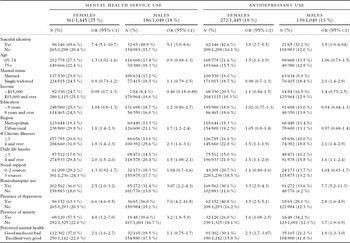
The characteristics of the ESA survey respondents are presented in Table 1. The results show that 8.5% (n = 211) of participants reported suicidal ideation and 21.9% (n = 547) had consulted for mental health reasons and 16.5% (n = 411) had been dispensed an antidepressant in the year prior and following the interview.
Characteristics of study sample as a function of antidepressant and mental health service use

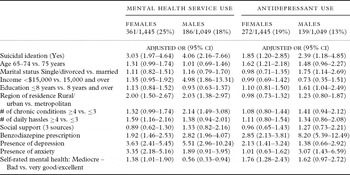
The gender-specific multivariate analyses presented (Table 2) show that for both males (4.06 Odds Ratio (OR); 95% Confidence Interval (CI): 2.16–7.66) and females (3.03 OR; 95% CI: 1.97–4.64) suicidal ideation was associated with increased mental health service use. Among the other variables studied, higher mental health service use was associated with lower income in males (4.98 OR; 95% CI: 1.86–13.31); living in an urban/rural region for both males (2.03 OR; 95% CI: 1.38–2.97) and females (2.00 OR; 95% CI:1.50–2.67), having more than four chronic conditions in males (2.14 OR; 95% CI: 1.49–3.08), reporting more than four daily hassles in female (1.59 OR; 95% CI: 1.16–2.16); the presence of depression in both males (5.51 OR; 95% CI: 2.96–10.24) and females (3.63 OR; 95% CI: 2.41–5.45); the presence of anxiety in females (3.35 OR; 95% CI: 2.18–5.16); and the prescription of benzodiazepines in both males (2.82 OR; 95% CI: 1.96–4.07) and females (1.92 OR; 95% CI: 1.46–2.53). Self-rated mental health was also associated with service use for both males (0.56 OR; 95% CI: 0.33–0.94) and females (1.38 OR; 95% CI: 1.01–1.90).
Gender-specific multivariate analyses on the determinants of antidepressant and mental health service use

When looking at the multivariate analyses of antidepressant use (Table 2), the results show that for both males (2.39 OR; 95% CI: 1.18–4.85) and females (1.85 OR; 95% CI: 1.20–2.85) the presence of suicidal ideation is associated with increased antidepressant use. Antidepressant use was also associated with younger age in females (1.62 OR; 95% CI: 1.21–2.18), single or divorced in males (1.75 OR; 95% CI: 1.14–2.69), lower education in males (1.61 OR; 95% CI: 1.04–2.49), the prescription of benzodiazepines in both males (8.20 OR; 95% CI: 5.39–12.49) and females (2.85 OR; 95% CI: 2.13–3.81), the presence of depression in females (2.13 OR; 95% CI: 1.41–3.24) but the presence of anxiety in males (3.07 OR; 95% CI: 1.43–6.59), and worse self-rated mental health in females (1.76 OR; 95% CI: 1.28–2.43).
The adjusted analyses restricted to respondents with suicidal ideation (n = 211) did not show any significant association between sex and mental health service use (1.55 OR; 95% CI: 0.75–3.22) or between sex and antidepressant use (0.95 OR; 95% CI: 0.44–2.05). Among these respondents, mental health service use was significantly associated with the presence of depression (1.98 OR; 95% CI 1.05–3.75). When looking at antidepressant use, the adjusted estimates showed a significant association with lower age (1.97 OR; 95% CI: 1.04–3.88), the presence of depression (2.13 OR; 95% CI: 1.12–4.05), the prescription of a benzodiazepine (3.24 OR; 95% CI: 1.64–6.41), and worse self-rated health (1.90 OR; 95% CI: 1.02–3.55).
Discussion
This study added to the present day scarce literature on the gender-specific determinants of antidepressant and mental health service use associated with suicidal ideation in community dwelling older adults while using both survey and administrative data allowing for the control of a number of socio-demographic, economic, and clinical factors and increasing the validity of results.
The two-year prevalence of suicidal ideation in this population reached 8.4% and is similar to previous reports showing rates reaching 9.5% (Scocco and De Leo, Reference Scocco and De Leo2002; Kim et al., Reference Kim, Bogner, Brown and Gallo2006). Among those reporting suicidal ideation, 20.3% had persistent suicidal ideation at one-year follow-up. This is much higher than estimates that have been reported for the adult population (Gunnell et al., Reference Gunnell, Harbord, Singleton, Jenkins and Lewis2004). In males, the prevalence of antidepressant and mental health service use in respondents with suicidal ideation reached 32.2% and 48.9%, respectively. In females the corresponding rates were 42.6% and 65.6%. These estimates are similar to prior studies reporting on health service use rates in respondent with mental disorders (Mosier et al., Reference Mosier2010).
Our results show that for both males and females suicidal ideation is associated with increased antidepressant use and mental health service use. Other determinants of mental health service use for both genders included living in an urban/rural region, the use of benzodiazepines, the presence of depression, and self-rated mental health. In males, other significant determinants included lower income and an increased number of chronic health conditions. In females, an increased number of self-reported daily stressors and the presence of anxiety were also significantly associated with mental health service use. Interestingly, with regards to self-reported mental health, males with a worse rated mental health are less likely to use services than males with better-reported mental health; whereas in females, worse rated mental health is associated with a higher likelihood of mental health service use.
A common significant predictor of antidepressant use for both genders included the prescription of benzodiazepines. In females, significant determinants of antidepressant use included younger age, the presence of depression, and a worse self-rated mental health. In males, antidepressant use was associated with single or divorced marital status, lower education, and the presence of anxiety. Overall, these determinants are consistent with prior studies (Wang et al., Reference Wang2005; Vasiliadis et al., Reference Vasiliadis, Tempier, Lesage and Kates2009).
When looking specifically at respondents with suicidal ideation, gender was not associated with antidepressant use and mental health service use. Significant factors of mental health service use included the presence of depression. Significant factors associated with antidepressant use in respondents with suicidal ideation included depression, a worse self-rated mental health, and the use of benzodiazepines in the same study period. Earlier studies have also shown an association between the prescription of benzodiazepines and the presence of suicidal ideation (Bossé et al., Reference Bossé2011), although the temporal sequence of the association was not clear.
A number of limitations should be kept in mind when interpreting the results. First, the study population included a representative sample of French speaking older adults living in the community in province of Quebec and excluded the northern regions and people residing in institutions and the homeless. We cannot therefore extrapolate the conclusions to these groups, which is usually present with more complex mental health problems and health service use patterns. Second, the assessment of the presence of depression and anxiety and self-rated mental health were self-reported and may be subject to recall and social desirability bias. Third, the psychometric properties of the ESA questionnaire were not directly assessed. However, in order to reduce the potential for biases, all health professional were trained in interviewing techniques and used highly standardized procedures. Fourth, the definition of suicidal ideation includes passive (i.e. suicidal thoughts) and active (i.e. serious planning and attempting) ideation as distinguished in the literature (Szanto et al., Reference Szanto1997). The few respondents with active suicidal ideation limited additional analyses restricted to active and passive ideation. Fifth, the cross-sectional nature of the data does not permit to study the temporal sequence regarding suicidal ideation, health services, and antidepressant use, nor does it allow the study of the quality and adequacy of care. Reverse causality may be present, as some research has suggested increased suicidal thoughts associated with some antidepressants. Sixth, the loss to follow-up was not at random; those with missing data at the follow-up interview were more likely to be males, older, and report a higher number of chronic conditions, which may be associated with a higher probability of suicidal ideation. However, these participants who did not complete the second interview were not more or less likely to report depression or anxiety and the results are less likely to be subject to follow-up bias. Finally, although we controlled for a number of socio-demographic and economic factors and physical and mental health status, it is possible that our results are subject to residual confounding.
Conclusion
The most important finding of this study is that there were no barriers to mental health service use and antidepressant use in this public-managed healthcare system for older male adults with lower socio-economic and education status. This is in contrast to findings in the adult population where such barriers have been observed in access to certain mental health services (Vasiliadis et al., Reference Vasiliadis, Tempier, Lesage and Kates2009). The lower use of antidepressants in higher educated males may be the product of being more aware of adverse side effects or other factors associated with higher education levels. Males, however, were less likely to consult mental health services than females when their mental health was judged poorly. Males were also more likely to be dispensed a benzodiazepine and antidepressant than females while for controlling a number of individual factors. Future research should focus on whether males are seeking services at a later or more severe state of their symptoms thus requiring more aggressive treatment. Among respondents with suicidal ideation, this study also found that younger respondents were more likely to be dispensed an antidepressant as were those also using benzodiazepines. This raises the question whether physicians are undertreating the symptoms of depression or are reluctant to prescribe additional psychotropic medications in those aged 75 years and over for fear of the effects of polypharmacy. Increased promotion campaigns sensitizing men to the prodromal symptoms of depression and the need to foster access to mental healthcare when the disorder is manageable may be needed. Further, in light of the decreased prescription of antidepressants in the elderly by physicians, policies should focus on increasing access to evidence-based therapies such as psychotherapy as a possible treatment option for depression and related symptoms.
Conflict of interest
None.
Description of authors’ roles
Helen-Maria Vasiliadis, the corresponding author, carried out the analyses and interpretation of results and writing of the paper. Sarah Gagné contributed to the literature review and writing of the paper. Natalia Jozwiak contributed to the literature review and writing of the paper. Michel Préville was responsible for the ESA survey and data collection and contributed to the interpretation of results
Acknowledgments
This study was supported by a Canadian Institutes of Health Research (CIHR) operating grant (200403MOP) and a Quebec Health Research fund - Fonds de recherche en Santé du Québec (FRSQ) (ref: 9854). Dr. Vasiliadis is a J2 Research Scholar with the Fonds de la Recherche en Santé du Québec. The authors would like to thank Ouahiba Djouder for her statistical support.