Academics and journalists share the same professional goal of creating and disseminating knowledge. But aside from this fundamental similarity they have contrasting priorities, work routines and specialized languages.Footnote 1 These differences have given rise to a relationship that, when not characterized by mutual neglect, is awkward and strained. The media have played a major role in the critical narrative about academics disconnected from the real world on the outside of the ivory tower, “complacently and indulgently oblivious to ‘ordinary’ peoples' lives and priorities.”Footnote 2 Academics scorn the media's tendency to dumb down and sensationalize, and to negate the nuance and gradation that specialists hold dear. Journalists and academics are awkward bedfellows, but developments in the two professions are demanding closer and more frequent interactions. In terms of academia – the primary concern of this article – the increasing demands on scholars to engage with the media, and concerns about the motivation and form of these encounters, highlight the need to examine the relationship more closely.Footnote 3
Public interest in China in the West is strong and will continue to be driven by China's growing global engagement and significance. To the extent that media discourses and “popular geopolitics” have an effect on public opinion and policymakers, it is of substantive importance that China scholars contribute their understanding and perspectives to public discourses on China. As Mawdsley,Footnote 4 JohnstonFootnote 5 and others have shown, problematic media narratives, sometimes playing to negative stereotypes, can quickly become the basis of popular misconceptions about China.Footnote 6 Currently, a small proportion of China scholars are actively using their knowledge to inform and improve public understanding of the issues they study. The objective of this article is not to convince sceptical, or even “mediaphobic,” colleagues that they should be doing media work, but to begin to redress the deficit in our understanding of the process in the field of China studies. The pool of scholarly dialogists is limited by the incentive structure within academia that forces scholars, particularly early career scholars, to concentrate their energies on activities that will increase their chances of career progression: peer review publications and research income applications. Despite universities' increasing consciousness of public relations and “brand building” activities, the incentive structure is unlikely to change much in the near term, restricting media work to well-established, tenured academics who can afford the “luxury” of doing it. However, by identifying some of the obstacles that currently hinder our interactions with the media, I argue that the efficiency of the process can be improved so that the penalty for doing media work can be alleviated. Advancing our understanding of the interaction between journalists and scholars is a first step toward improving our relationship and raising the quality of information that the public receive; a goal that journalists and academics share in common. In providing practical advice for improving the effectiveness of our co-operation, I hope this article will stimulate further reflections by both academics and media professionals.
An Awkward Relationship
The twin processes of specialization and professionalization have concretized academics' detachment from the world outside of specialist clusters.Footnote 7 Measures of research output, the major determinant of career progression, incentivize academics to talk to other specialists, for instance in peer review publications, rather than engaging with external audiences.Footnote 8 Furthermore, the disciplinary upbringing of most academics as specialists in very narrow areas means that few have the broad knowledge base, or the communication skills, to become “public intellectuals.”Footnote 9 Even where the will exists for scholars to interact with the media, many are unaware or unprepared to deliver what is required. Thus, many of the journalists surveyed for this article reported a significant disconnect between the interests articulated by their scholar interlocutors and the priorities they ascribed to their reading and viewing audiences.Footnote 10 These concerns echo findings in a reportFootnote 11 on the incongruity of some academic initiatives to reach out to the media: authors seeking publicity for a new book, bulk quotes sent out by university press officers, and “statements of the blindingly obvious” that fail to add value.Footnote 12
According to responses collected for this article, China scholars are concerned about being asked by journalists and producers to oversimplify, disregard nuance or burnish editorial lines. Others resent unpaid and unattributed background interviews that enable journalists to “pass off hard-earned knowledge as their own.” Research on scholar–journalist encounters in the field of security studies finds further concerns about serving others' agendas, losing control, and incurring reputational costs.Footnote 13 In the field of political science, scholars invoke the dangers of editorial slant, leading questions and the tyranny of the sound bite.Footnote 14 These attitudes reflect three traits of the news media: short attention spans and churning news cycles, the preference for drama, human interest and storylines, and the conflation of opinion with analysis.Footnote 15 The “always-on,” “always-moving” information environment demands a modus operandi that runs contrary to the values that academics inculcate through long years of training: considered reflection, attention to detail and acknowledgment of uncertainty.
As the neoliberal transformation of higher education continues apace in many parts of the world,Footnote 16 traditional scholarly reticence towards the media has come under pressure. Governments and funders are demanding strategies for “placing the product of university-based labour in the service of wider public discourse.”Footnote 17 Where academic research is directly or indirectly funded by public money, policymakers and institutions that support academic endeavours are demanding researchers demonstrate the “value” and “impact” of their work. One aspect of this requirement is to engage with actors outside the academy and participate in public debates and discourses. In the UK and Australia, external engagement has been codified as part of the criteria for “research excellence,” which directly affects the level of research funding that public universities receive.Footnote 18 A corollary development is the commercialization of academic institutions. Higher education is a lucrative and competitive global industry and university administrators are increasingly conversant in business models, brand development strategies and student experience metrics.Footnote 19 Like other commercial enterprises, the “corporate university” has a hunger for publicity and uses media attention as a measure of its success.Footnote 20 The resulting expectation in many universities is that academics should add media activities to their core duties. Yet, while universities perceive benefits in their academics generating media exposure, administrative loads or publishing expectations are rarely reduced in order to accommodate this activity, and it seldom directly benefits promotion prospects or tenure files.
The “promotional culture” of the corporate university goes hand-in-hand with the “content hunger” of the media,Footnote 21 which has grown rapidly with the expansion of traditional media outlets' activities online and the rise of online-only media. In some cases it serves the media to exploit the “symbolic power of the academic expert,”Footnote 22 with its notion of political neutrality and detached erudition. In other cases, the increasing demand for academics is simply a function of the need to fill space, with journalists and bookers sending out last-minute appeals in the hope of securing an academic, any academic, before deadline. This is one example of the mixed messages that scholars are receiving about the value of working with the media. If journalists really value scholarly contributions why do they apparently expend little effort to identify appropriate experts and then leave it until the last minute to contact them? Why, in the words of one academic, do they treat their interactions with scholars like a “late night booty call,” i.e. a last-minute summons to an ad hoc sexual encounter?Footnote 23
Academic–Media Engagement in the China Field
To investigate the nature of interactions between China scholars and journalists, I conducted two surveys. The Scholars Survey sought responses to 15 items relating to China scholars' experiences and attitudes towards working with the media.Footnote 24 The Media Survey sought responses to a 13-point web-based survey disseminated via the Foreign Correspondents' Club of China.Footnote 25 The sample is not random and suffers from response bias. Despite an explicit invitation to academics with no experience or desire to do media work, those with a positive interest in the media were more likely to respond. In fact, only 10 per cent of academic respondents reported that they did no media work at all, which I suspect is unrepresentative of the China studies field as a whole. It is important to recognize this limitation, but as a source of information on the behaviours and attitudes of relatively media-savvy colleagues, these data allow us to identify areas that are working and others that require adjustment.
Giving interviews was the most common form of scholarly engagement with the media (50 per cent of respondents did this several times a year, including 12 per cent who did so several times a month), followed by writing for online media (42 per cent), appearing in broadcast media or writing a print op-ed (both 21 per cent). Senior academics reported receiving more interview requests and appeared to a greater extent on broadcast and in print media than their early career counterparts. While early career colleagues were not as frequently sought out by journalists, they were more likely to contribute online media articles, suggesting that this is an effective way for less experienced researchers to join public discourses.Footnote 26 Political scientists in the sample were particularly in demand, followed by economists, historians and other social scientists. Despite already being relatively active, 44 per cent of respondents said they would like to increase their media activities, while the same proportion thought the amount they do now is about right. Only 4 per cent wanted to do less, and the remainder didn't want to work with the media at all.
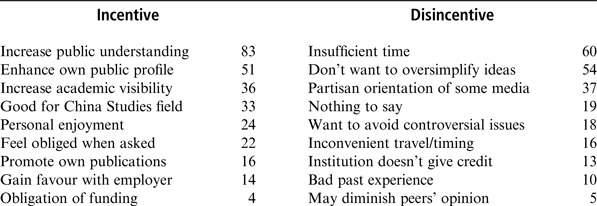
Of the range of incentives for doing media work (see Table 1 below), the overwhelming choice was an altruistic one: 83 per cent of respondents did so in order to increase public understanding of issues relating to China. Among US-based scholars this motivation was almost unanimous. One-third of respondents chose another altruistic reason for working with the media, namely the health of the China studies field. Of the more individual incentives, enhancing one's public profile was the most common response (51 per cent), while personal enjoyment was a factor for one quarter of respondents. Doing media work to gain favour with the employing institution was cited by just 14 per cent of respondents. For the China scholars in this sample, media work appears to be a labour of love, providing knowledge for the good of society and the field rather than potential rewards from employers. The major disincentive for working with the media, cited by 60 per cent of respondents, was a lack of time. Lack of credit from employers was an issue for a small proportion (14 per cent). Slightly over half of respondents saw over-simplification as a disincentive, while around one-third were put off by the partisan orientation of some media outlets. Just 5 per cent of respondents cited potential reputation costs among peers as a disincentive, contrary to earlier findings in other fields where scholars' media activities are reported to be a source of resentment, ridicule and jealousies among colleagues.Footnote 27 Regarding problems in their prior experiences with the media, the most common issue, cited by over half of the respondents, was receiving requests on unreasonably short notice. This was closely followed by the issue of being asked questions outside of their expert area (46 per cent). These two complaints also featured consistently in scholars' open comments and in my view are among the most serious impediments in the way that scholars and journalists currently interact. Further problems involved being pushed to give strong opinions (29 per cent) and being misquoted (28 per cent).
Which of these factors incentivize/dis-incentivize your media work?

Source: Author's Scholar Survey.
Note: Cell entries are % of respondents. N = 160. Multiple choices allowed.
Turning to the Media Survey, most of the respondents indicated that they were expected to be all-rounders covering a huge range of topics related to China. As generalists covering a lot of ground, a substantial majority (88 per cent) said it was very important that academics were able to provide specialist information they might be unaware of. Two-thirds said that it was very important for academics to provide an opinion, while providing background information was very important for 62 per cent of respondents. While this is a clear statement of the utility of China scholars' general and specific knowledge, journalists appear less eager to hear about academics' own research findings or indeed broader insights from academia. One fifth of respondents said that neither of these potential contributions were considerations for them, although one-third said they used academic publications as a way of identifying scholars to contact. Given the unenviable time pressures under which they often work, most journalists relied heavily on a roster of existing academic contacts. While this may help explain the relatively small pool of China scholars who regularly feature in the media, there is a positive message for other colleagues wishing to participate: reach out and make yourself known to journalists as the expert in your area. Noting appearances that scholars made in other media (74 per cent) and recommendations (72 per cent) were the other main methods that journalists use to choose academics, both of which suggest that once an academic does some media work, more may follow.
Journalists were asked to rate the importance of several different factors in their interactions with academics. More than anything else they identified possession of particular expertise as “very important.” Yet, while specialist knowledge is the obvious source of value-added, the more pragmatic matter of availability was very important for more than two-thirds of journalists. The prestige of an academic's institution and an academic's name recognition were negligible compared to the possession of particular expertise. Thinking about their previous experiences dealing with academics, two-thirds of journalists reported availability as having been problematic. More than half noted academics' difficulties with concision and 41 per cent remarked on the use of jargon and overly academic language. Yet none of these issues has diminished the demand for scholarly exchanges, with nearly three-quarters of journalists saying they seek out China scholars several times a month, with the remaining quarter doing so several times a year.
Improving Scholar–Journalist Interactions
The survey responses reported above provide some indication of the attitudes, experiences and problems of scholar–journalist encounters in the China field. What can be done to improve this engagement? Drawing on a series of open-ended questions that I asked scholars and journalists, there are several areas that can be improved. First, the China scholars in my sample suggest that journalists need to work harder to identify appropriate sources of expertise. They noted that they were too frequently asked to comment on topics far removed from their interests and “being put on the spot to speak on topics [they] know little about.” Since access to specialist knowledge is the main reason journalists seek to engage academics, identifying the right person is crucial. In lieu of a database of contacts, journalists should invest more time to familiarize themselves with scholars' bios and CVs before making an approach, and scholars should ensure that their profiles are clear and easily accessible online to facilitate this process. The second major issue relates to the length of notice that scholars generally receive when contacted by journalists. The consensus is that it is unreasonably short, and for some scholars this is an impediment to further engagements (“I would do more but you have to fit their times, at the last moment”). This way of operating “does not match particularly well with academic schedules.” One scholar asked journalists to remember that “professors are under enormous pressure to do scholarly work, teach, and engage in service,” responsibilities that cannot be dropped or easily moved at the last minute. Several scholars suggested that making advance contact via email, sending questions prior to interview and providing sufficient time for preparation would make a crucial difference to their ability and willingness to accept media requests.
However, there may be a way to ameliorate the friction caused by incompatible work routines. As one scholar put it, “I can't respond to calls out of the blue: Unless we have a prior relationship” (my italics). Scholars said they want ongoing and personalized working relationships with journalists, rather than the “fast and utilitarian ‘I am looking for a fast quote on a piece that is almost done.’” Journalists should maintain channels of communication so that “the academic feels there is an open door for occasionally sending unsolicited advice or a brief on a given issue.” Establishing longer-term working relationships may also help to ameliorate two further areas of concern. First, several scholars stated that they were often unclear of what was required of them in a particular engagement, and as a result felt unprepared and uncomfortable. On a practical level, some scholars wanted “more insight into the specific topics they'd like me to speak about so I can prepare.” Several respondents felt that they received inadequate information about the “purpose, context and audience” of an interview. For some this led to tensions and ill-feeling when quotes or interviews were not ultimately used. Others saw this information as an opportunity to “help academics learn how to communicate by giving clear signals about what is wanted in a particular media encounter.” Finally, some scholars were unhappy about the convention of not allowing quotes to be checked before publication.
For journalists the major obstacles in working with academics were availability and responsiveness. Many respondents shared the opinion that “understanding the immediacy of media is fundamental for good cooperation between journalist and academics.” If messages are not promptly answered journalists “will move on,” whereas they will return to those who are willing to make time. One journalist pointed out that “if unavailable, just say so: leaving journalists in the lurch is a hassle.” The second issue pertains to the way that academics express themselves. One respondent advised scholars “realize that we're not experts, so be patient and try to simplify things.” Clarity was an issue with audiences in mind too. One journalist pointed out that “our readers don't know much about the subject so straightforward language without too much jargon/academese is good.” Another argued that “much academic writing is very hard even for well-educated people to understand, and this bleeds over into conversation.” Concision was also an issue, as the space available to report scholars' musings is usually very limited, learning to express ideas succinctly in clear language is crucial.
Just as China scholars hope for ongoing relationships, so do the journalists, encouraging scholars to be proactive in introducing themselves. Several commented that “journalists gladly receive emails out of the blue from academics they do not yet know.” One reason is that many journalists “are not long-term China watchers and it takes time to get to know the academic community.” Several journalists welcomed emails with points of view on current or ongoing issues, and several others suggested sending research papers and articles. When scholars have something to say on an issue they should make the first move and should not “expect that we'll automatically think of you.” Ultimately, advised one journalist, “if you would like your voice to be heard, shout!” A related issue is that scholars can help journalists find them by having a recognizable digital profile, at minimum a personal homepage “including contacts, areas of research and media appearances.” Invoking debates around open access in the academy, several journalists asked that academics make their research accessible and not hidden behind publishers' paywalls. Finally, the advice to China scholars that came up most frequently was to actively use social media, especially Twitter, as the most effective way to “stay part of the conversation,” raise profiles and start relationships. One journalist commented that “every reporter in China is on Twitter and we look for links and context and brief analysis.” Another stated that “on breaking stories I go to Twitter [to see] who is paying attention, who has an interesting angle and who has the bona-fides to discuss the topic and often send them a direct message or email.” Twitter was also described as an effective way to demonstrate the desired attributes of concision and clarity, with one journalist noting that “people who Tweet tend to be knowledgeable and concisely quotable.”
Conclusion
Public interest in China, as reflected in the level of media attention, is burgeoning in the West and elsewhere in the world. According to the PRC Ministry of Foreign Affairs, as of March 2013, 441 media outlets from 59 different countries employed 661 foreign journalists based in China. Major organizations like The New York Times, Bloomberg and The Wall Street Journal have dozens of reporters working in and on China. In 2012, The Economist launched a section on China, the first dedicated country section since the equivalent section on the US was inaugurated 70 years earlier. Journalists working for print, broadcast and online media outlets around the world are eager to engage with China scholars, to benefit from their expert insights and bring their views to publics. Bluntly put, China correspondents, editors and other media professionals working on China want to hear from China scholars. While acknowledging the structural disincentives that hinder all academics' engagements with the media, China scholars' input into public discourses is increasingly important. Media discourses on China are the main way in which publics receive information about China, and erroneous or un-nuanced views can quickly become conventional wisdom. Since many journalists reporting on China are generalists rather than China specialists per se, the depth and gradation of China scholars' understandings can provide a corrective that journalists welcome and publics benefit from.
The objective of this article has been to illuminate aspects of how China scholars and journalists currently interact, and to identify means to increase efficiency and effectiveness. Survey responses from China scholars and journalists suggest that contrasting work routines and the concept of time and timeliness are formidable entry barriers to all but the most determined academics. However, this issue may not be intractable, if China scholars and journalists are able to build up ongoing relationships and the trust and reciprocity that go with that. Fortunately, establishing such relationships is something for which a large majority of scholar and journalist respondents in my surveys indicated great enthusiasm. Furthermore, many respondents were very positive about the personal benefits of engagement. Scholars noted the capacity for knowledge exchange and making contacts, the opportunity to improve communication skills, to think about research questions and results from a different perspective, and even “trade my information for their information on my research topic.” For their part many journalists reported that “talking to academics and benefitting from their expertise is one of the aspects of my job I really enjoy.” And as one journalist put it, at base “it's about cooperation to meet a mutual goal; educating and informing the reader/viewer.” The message from journalists to China scholars is quite clear: if you have something to say, we want to hear from you. Colleagues who want to accept this invitation should take the initiative to reach out to journalists, for example on Twitter, and ensure that their digital profiles and research publications are visible and accessible.
To re-iterate, this article is not about changing sceptical minds or convincing academic colleagues to engage with the media. Clearly engaging with the media is not something that appeals to every academic and I agree that “no one should feel pressured into media work if it does not cohere with their personality and skills.”Footnote 28 That said, there are many different ways of interacting with the media, particularly given the growing prevalence of online media, and many of the requisite skills are trainable. Starting small is a good idea particularly for early career academics. Appearing in local media or writing for online publications may lack the prestige of international broadcasters and broadsheets, but they are an excellent way of learning the ropes, finding out what type of media work you are suited to, and developing a portfolio to show potential collaborators in more prestigious outlets (and university administrators). It will also help increase confidence: something that one journalist commented is a particular issue for women who “often turn down interviews from a lack of confidence when their work is terrific and very relevant.” Finally, the key to a successful and rewarding engagement with the media is to conceive it in positive terms. As Cowley puts it, “if you see engaging with the media as a troublesome extra, something that takes you away from your proper job, then that is exactly what it will become.”Footnote 29