Introduction
Limnos is the eighth largest island of Greece and the biggest in the phytogeographical region of the North Aegean (NAe) as defined by Strid & Tan (Reference Strid and Tan1997). The flora of the island comprised until now about 681 plant taxa (Panitsa et al., Reference Panitsa, Snogerup, Snogerup and Tzanoudakis2003). Information concerning geomorphology, climate and previous investigators is to be found in the same article.
The present study aims to add new data on the indigenous and adventive flora of Limnos. It aims also to register the ecological factors which are related to recent changes and floristic dynamics in a large Aegean island. For each newly recorded taxon, local distribution and habitat types are presented.
Material and Methods
Collections and field observations were made in August 2013. All specimens are kept temporarily in my personal herbarium and will be lodged in the Herbarium of Goulandris Natural History Museum (ATH). For identification, Tutin et al. (1968–1980, 1993), Davis (1965–1985), and Strid & Tan (Reference Strid and Tan1997, Reference Strid and Tan2002) were used. Nomenclature mainly follows Dimopoulos et al. (Reference Dimopoulos, Raus, Bergmeier, Constantinidis, Iatrou, Kokkini, Strid and Tzanoudakis2013), Strid & Tan (1997, Reference Strid and Tan2002), Greuter et al. (1984–1989), Greuter & Raab-Straube (Reference Greuter and Raab-Straube2008), Tutin et al. (1968–1980, 1993) and Davis (1965–1985). Information concerning the geographical distribution range of several taxa in Greece was extracted from Dimopoulos et al. (Reference Dimopoulos, Raus, Bergmeier, Constantinidis, Iatrou, Kokkini, Strid and Tzanoudakis2013).
The families, genera, species and subspecies are listed within the major taxonomic groups in alphabetical order. Names of taxa not native to the area are in square brackets. Transliteration of localities is in accordance with Flora Hellenica (Strid & Tan, 1997, Reference Strid and Tan2002). With a few exceptions, only taxa to my knowledge new for the investigated area appear in the catalogue given below. The following abbreviations are used: Bal. = E. Baliousis, followed in most cases by a collection number of a herbarium specimen, obs. = field observation, phot. = photograph.
List of Localities and Habitats
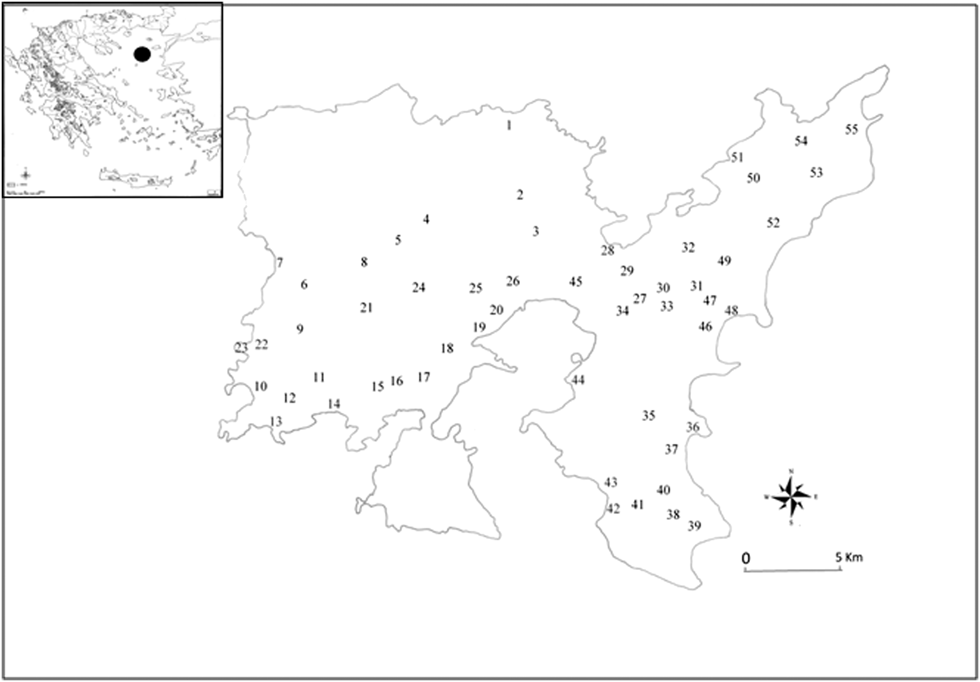
Localities (Fig. 1)
1.Between Faraklo and Papias beach, 39°59′24″N, 25°02′52″E, 20 viii 2013.
Geographical position of Limnos in Greece and a map of the investigated area.

2.c.2 km N of Atsiki, 39°57′27″N, 25°13′07″E, 20 viii 2013.
3.Atsiki, 39°56′54″N, 25°13′18″E, 20 viii 2013.
4.Dafni, 39°56′59″N, 25°09′58″E, 20 viii 2013.
5.Sardes, 39°56′23″N, 25°08′25″E, 20 viii 2013.
6.Kaspakas, 39°54′54″N, 25°04′57″E, 20 viii 2013.
7.Agios Ioannis, 39°55′28″N, 25°04′08″E, 20 viii 2013.
8.Between Sardes and Kornos, 39°55′49″N, 25°07′34″E, 20 viii 2013.
9.Between Myrina and Therma, 39°53′51″N, 25°05′51″E, 20 viii 2013, 23 viii 2013.
10.Platis Gialos, 39°51′25″N, 25°04′01″E, 21 viii 2013.
11.Mt Kakavos, 39°51′52″N, 25°05′20″E, 21 viii 2013.
12.Thanos, 39°51′17″N, 25°05′14″E, 21 viii 2013.
13.Thanos beach, 39°50′23″N, 25°04′53″E, 21 viii 2013.
14. Evgati, 39°51′12″N, 25°06′50″E, 21 viii 2013.
15.Kondias, 39°51′47″N, 25°08′53″E, 21 viii 2013.
16.East of Kondias, 39°52′05″N, 25°09′16″E, 21 viii 2013.
17.Tsimandria, 39°52′11″N, 25°10′26″E, 21 viii 2013.
18.Portianou, 39°52′57″N, 25°10′43″E, 21 viii 2013.
19.Nea Koutali, 39°53′41″N, 25°11′56″E, 21 viii 2013.
20.Kallithea, 39°54′07″N, 25°12′31″E, 21 viii 2013.
21.Therma, 39°54′20″N, 25°07′16″E, 21 viii 2013.
22.Mirina, 39°52′47″N, 25°03′48″E, 20–24 viii 2013.
23.Castle of Mirina, 39°52′38″N, 25°03′21″E, 21 viii 2013.
24.Agios Dimitrios, 39°54′42″N, 25°09′04″E, 22–23 viii 2013.
25.Livadochori, 39°54′40″N, 25°11′45″E, 22 viii 2013.
26.NW of the airport, 39°55′10″N, 25°13′29″E, 22–23 viii 2013.
27.Between Romanou and Repanidi, 39°54′55″N, 25°17′57″E, 22 viii 2013.
28.Kotsinas, 39°56′24″N, 25°16′57″E, 22 viii 2013.
29.Between Kotsinas and Repanidi, 39°55′52″N, 25°17′33″E, 22 viii 2013.
30.Between Repanidi and Kondopouli, 39°55′28″N, 25°18′59″E, 22 viii 2013.
31.Kondopouli, 39°55′38″N, 25°19′58″E, 22 viii 2013.
32.Between Kondopouli and ancient Ifestia, 39°56′33″N, 25°19′48″E, 22 viii 2013.
33.Between Kondopouli and Romanou, 39°55′04″N, 25°19′22″E, 22 viii 2013.
34.Romanou, 39°54′21″N, 25°17′23″E, 22 viii 2013.
35.Kaminia, 39°51′50″N, 25°19′09″E, 22 viii 2013.
36.Ancient Poliochni, 39°51′15″N, 25°20′36″E, 22 viii 2013.
37.Close to Kokkinovrachos beach, 39°51′02″N, 25°20′10″E, 22 viii 2013.
38.Between Agia Sophia and Fisini, 39°49′27″N, 25°20′17″E, 22 viii 2013.
39.Fisini, 39°48′50″N, 25°20′51″E, 22 viii 2013.
40.Agia Sophia, 39°49′48″N, 25°19′44″E, 22 viii 2013.
41.Between Agia Sophia and Skidi, 39°49′29″N, 25°18′50″E, 22 viii 2013.
42.Skidi, 39°49′16″N, 25°17′44″E, 22 viii 2013.
43.Between Skidi and Parthenomitos, 39°49′45″N, 25°17′45″E, 22 viii 2013.
44.Moundros, 39°52′30″N, 25°16′13″E, 22 viii 2013.
45.Lichna, 39°55′22″N, 25°15′13″E, 23 viii 2013.
46.NE of Chortarolimni, 39°54′34″N, 25°20′02″E, 23 viii 2013.
47.Kalliopi, 39°55′06″N, 25°20′32″E, 23 viii 2013.
48.Keros beach, 39°54′50″N, 25°21′59″E, 23 viii 2013.
49.Between Kondopouli and Agios Alexandros, 39°56′45″N, 25°21′06″E, 23 viii 2013.
50.Close to Neftina beach, 39°58′39″N, 25°21′45″E, 23 viii 2013.
51.Neftina beach, 39°59′06″N, 25°21′15″E, 23 viii 2013.
52.Northern margins of Aliki, 39°57′25″N, 25°22′36″E, 23 viii 2013.
53.Panagia, 39°59′56″N, 25°24′23″E, 23 viii 2013.
54.Between Zematas and Plaka, 39°59′55″N, 25°23′58″E, 23 viii 2013.
55.Plaka, 40°00′21″N, 25°25′39″E, 23 viii 2013.
Habitats
a.Street margins, edges of pavements and other disturbed places.
b.Gardens, flowerbeds.
c.Stone walls and dry stone walls.
d.Road margins.
e.Ditches, streambeds and other moist to wet habitats.
f.Cultivated fields.
g.Uncultivated and fallow fields.
h.Saline flats.
i.Sandy shores.
j.Volcanic rocks.
k.Sarcopoterium spinosum (L.) Spach dominated phrygana vegetation.
List of Taxa
Spermatophyta
ANGIOSPERMAE – DICOTYLEDONES
Aizoaceae
[Aptenia cordifolia (L.f.) Schwantes] – 22a, Bal. obs.; 44a, Bal. obs. – This is the first record of this species in the NE Aegean islands.
[Carpobrotus edulis (L.) N.E.Br.] – 7d, Bal. obs.
Amaranthaceae
[Amaranthus blitoides S.Watson] – 49f, Bal. 9221; 22a, Bal. 9239.
[Amaranthus caudatus L.] – 4a, Bal. 9129. – Apparently a casual escape. This is the first record of this species in the NE Aegean islands.
[Amaranthus hybridus L.] – 6d, Bal. 9131; 16d, Bal. 9154.
[Amaranthus retroflexus L.] – 49f, Bal. 9222; 26f, Bal. 9228; 2d, Bal. obs.; 5a, Bal. obs.; 7b, Bal. obs.; 10g, Bal. obs.; 12f, Bal. obs.; 17f, Bal. obs.; 22a, Bal. obs.; 28a, Bal. obs.; 33f, Bal. obs.; 34b, Bal. obs.; 40a, Bal. obs.; 46f, Bal. obs.; 55b, Bal. obs. – A serious weed of cultivated fields.
[Amaranthus viridis L.] – 22a, Bal. 9238; 15a, Bal. obs.
Apiaceae
Ammi majus L. – 30g, Bal. 9169.
Bupleurum euboeum Beauverd & Topali – 52h, Bal. 9219. – This is the first record of this species in the NE Aegean islands.
Thapsia garganica L. – 41d, Bal. 9198.
Asteraceae
Carthamus dentatus (Forssk.) Vahl s.l. – 44d, Bal. 9235; 1d, Bal. obs.; 8d, Bal. obs.; 10d, Bal. obs.; 14d, Bal. obs.; 23a, Bal. obs.; 32d, Bal. obs.; 33d, Bal. obs.; 41d, Bal. obs.; 54d, Bal. obs. – Very common at roadsides and in overgrazed fields throughout the island.
Centaurea calcitrapa L. – 5a, Bal. 9136; 15a, Bal. obs.
Cirsium creticum (Lam.) d’Urv. subsp. creticum – 37e, Bal. 9195.
Cirsium vulgare (Savi) Ten. – 30g, Bal. 9165; 29g, Bal. obs.; 33g, Bal. obs.; 45g, Bal. obs.
Dittrichia graveolens (L.) Greuter – 22a, Bal. 9245; 1d,g, Bal. obs.; 7g, Bal. obs.; 10g, Bal. obs.; 12a, Bal. obs.; 14g, Bal. obs.; 18g, Bal. obs.; 29g, Bal. obs.; 33g, Bal. obs.; 49g, Bal. obs.; 55g, Bal. obs. – Very common in harvested cereal fields.
[Erigeron bonariensis L.] – 22a, Bal. 9247; 39a, Bal. obs.; 47a, Bal. obs.
[Erigeron canadensis L.] – 30g, Bal. 9164; 25g, Bal. obs.; 32g, Bal. obs.; 33g, Bal. obs.; 35d, Bal. obs.; 38g, Bal. obs.; 47g, Bal. obs.; 49g, Bal. obs.
[Erigeron sumatrensis Retz.] – 30g, Bal. 9173; 21a, Bal. obs.; 25g, Bal. obs.; 33g, Bal. obs.; 38g, Bal. obs.; 44g, Bal. obs.; 46f, Bal. obs.; 50g, Bal. obs.
Lactuca saligna L. – 22a, Bal. 9241.
[Symphyotrichum squamatum (Spreng.) G.L.Nesom] – 51g, Bal. 9204; 2d, Bal. obs.; 3a, Bal. obs.; 4a, Bal. obs.; 5a, Bal. obs.; 9d, Bal. obs.; 10g, Bal. obs.; 13g, Bal. obs.; 15a, Bal. obs.; 17a, Bal. obs.; 18a, Bal. obs.; 19a, Bal. obs.; 21a, Bal. obs.; 22a, Bal. obs.; 26f, Bal. obs.; 28a, Bal. obs.; 32f, Bal. obs.; 33g, Bal. obs.; 35g, Bal. obs.; 40a, Bal. obs.; 44g, Bal. obs.; 45g, Bal. obs.; 46f, Bal. obs.; 47g, Bal. obs.; 55g, Bal. obs.
Cactaceae
[Opuntia ficus-indica (L.) Mill.] – 32g, Bal. obs.; 35d, Bal. obs.; 40k, Bal. obs.
Chenopodiaceae
Atriplex rosea L. – 28i, Bal. 9157.
Chenopodium album L. – 10d, Bal. 9143; 49f, Bal. 9223; 7f, Bal. obs.; 12f, Bal. obs.
[Chenopodium giganteum D.Don] – 3a, Bal. 9120; 24d, Bal. 9233. – Obviously a recent introduction. Considering its rapid expansion in Attiki (personal observations) this species has the potential to increase its distribution in the island. This is the first record of this species in the NE Aegean islands.
[Dysphania ambrosioides (L.) Mosyakin & Clemants] – 3a, Bal. 9119; 16e, Bal. 9152; 22a, Bal. 9236; 5a, Bal. obs.; 15a, Bal. obs.; 20d, Bal. obs.; 39a, Bal. obs.
Salsola soda L. – 52h, Bal. 9212.
Convolvulaceae
Cressa cretica L. – 52h, Bal. 9217.
[Cuscuta campestris Yunck.] – 13g, Bal. 9148.
[Ipomoea purpurea (L.) Roth] – 7d, Bal. 9133.
Euphorbiaceae
Euphorbia chamaesyce L. – 36a, Bal. 9185.
[Euphorbia maculata L.] – 5b, Bal. 9138; 22a, Bal. 9156; 26d, Bal. 9232; 36a, Bal. 9186a; 36b, Bal. 9186b. – Some of the collecting localities are in gardens, flowerbeds and nearby man-made habitats from which its method of introduction may be inferred. The biggest populations though were observed on gravelled road margins near the airport and in the archaeological site of Poliochni. This highlights its potential to increase its distribution in open disturbed ground. There is no doubt that it is fully naturalised and spreading.
Euphorbia peplis L. – 42i, Bal. phot.
[Euphorbia prostrata Aiton] – 22a, Bal. 9237. – Obviously a recent introduction in the island. It was only collected in the capital Mirina. If we take into consideration its successful establishment in various anthropogenic habitats of Attiki (Baliousis, Reference Baliousis2011; Baliousis & Yannitsaros, Reference Baliousis and Yannitsaros2011 and personal observations) we may expect that it is only a matter of time before it is found in other areas of the island too.
[Ricinus communis L.] – 47a, Bal. obs. – An escape from cultivation.
Fabaceae
[Medicago sativa L. subsp. sativa] – 9d, Bal. 9234; 24a, Bal. obs.
Trifolium fragiferum L. – 37e, Bal. 9191.
Gentianaceae
Schenkia spicata (L.) G.Mans. – 52h, Bal. 9215.
Lamiaceae
Salvia viridis L. – 32d, Bal. 9174.
Myrtaceae
[Eucalyptus camaldulensis Dehnh.] – 21d, Bal. obs.
Nyctaginaceae
[Mirabilis jalapa L.] – 3a, Bal. obs.; 4a, Bal. obs.; 5a, Bal. obs.; 6a, Bal. obs.; 12a, Bal. obs.; 15a, Bal. obs.; 17a, Bal. obs.; 24a, Bal. obs.; 31a, Bal. obs.; 34a, Bal. obs.; 39a, Bal. obs.
Onagraceae
Epilobium hirsutum L. – 16e, Bal. 9150; 43e, Bal. obs.; 54e, Bal. obs.
Oxalidaceae
Oxalis corniculata L. – 5b, Bal. obs.; 22a, Bal. obs.
Phytolaccaceae
[Phytolacca americana L.] – 6e, Bal. phot.; 11a, Bal. obs.; 15b, Bal. obs.; 53a, Bal. obs.; 55a, Bal. obs. – Vigorous stands of this species were observed throughout the island. Its distribution though is mainly restricted to settlements and nearby.
Plantaginaceae
Plantago major L. s.l. – 22e, Bal. phot.
Polygonaceae
Polygonum icaricum Rech.f. – 11j, Bal. 9145. – A Greek endemic known from a few Aegean islands such as Samothraki, Ikaria and Chios (Snogerup & Snogerup, Reference Snogerup, Snogerup, Strid and Tan1997). Its occurrence in Limnos fills the gap between these islands.
Portulacaceae
Portulaca oleracea L. subsp. oleracea – 13b, Bal. obs.; 22a, Bal. obs.; 34b, Bal. obs.
Primulaceae
Samolus valerandi L. – 37e, Bal. 9190.
Ranunculaceae
Consolida regalis S.F.Gray subsp. paniculata (Host) Soó – 3g, Bal. 9121; 30g, Bal. 9170; 32d, Bal. 9175; 49f, Bal. 9225. – This taxon has been recorded from Limnos in the dot maps of Flora Hellenica (Strid & Tan, Reference Strid and Tan2002). It seems to be widespread in the island.
Rosaceae
[Prunus dulcis (Mill.) D.A.Webb] – 8g, Bal. obs.; 35g, Bal. obs. – A significant number of young individuals were found growing at a distance from cultivated plants.
Solanaceae
[Datura innoxia Mill.] – 7a, Bal. phot.; 17d, Bal. obs. – Only a few isolated individuals were observed in the above mentioned localities.
[Datura stramonium L.] – 6d, Bal. obs.; 10d, Bal. obs.; 26f, Bal. obs.; 48d, Bal. phot.; 49f, Bal. obs. – Unlike Datura innoxia, this species forms locally impressive stands in coverage and abundance. In these localities it constitutes a serious weed of cultivated land.
Verbenaceae
[Lantana camara L.] – 7a, Bal. obs.; 34a, Bal. obs. – This is the first record of this species in the NE Aegean islands.
Veronicaceae
[Antirrhinum majus L. s.l.] – 5c, Bal. phot.; 15a, Bal. obs.; 22a, Bal. obs.; 24a, Bal. obs.; 39a, Bal. obs.
[Cymbalaria muralis G.Gaertn., B.Mey. & Schreb. subsp. muralis] – 4c, Bal. 9113.
Kickxia elatine (L.) Dumort. subsp. crinita (Mabille) Greuter – 3g, Bal. 9126; 10d, Bal. 9141; 22a, Bal. 9246; 30g, Bal. 9166b.
Kickxia spuria (L.) Dumort. subsp. integrifolia (Brot.) R.Fern. – 30g, Bal. 9166a.
Vitaceae
[Parthenocissus quinquefolia (L.) Planch.] – 5a, Bal. phot. – Obviously a garden escape.
Zygophyllaceae
Tribulus terrestris L. – 7a, Bal. obs.; 9d, Bal. obs.; 10g, Bal. obs.; 12a, Bal. obs.; 15a, Bal. obs.; 19a, Bal. obs.
ANGIOSPERMAE – MONOCOTYLEDONES
Agavaceae
[Agave americana L.] – 8g, Bal. obs.
Cyperaceae
Cyperus rotundus L. – 22b, Bal. 9251.
Juncaceae
Juncus articulatus L. – 37e, Bal. 9192; 54e, Bal. 9210.
Poaceae
Digitaria sanguinalis (L.) Scop. – 7d, Bal. 9132; 3a, Bal. phot.; 6a, Bal. obs.
Echinochloa crus-galli (L.) P.Beauv. – 5b, Bal. 9140; 26g, Bal. 9229; 9d, Bal. obs.; 15b, Bal. obs.; 22b, Bal. obs.
[Eleusine indica (L.) Gaertn.] – 22a, Bal. 9240.
Eragrostis cilianensis (All.) F.T.Hubb. – 49f, Bal. 9224.
[Paspalum distichum L.] – 22e, Bal. 9250; 48e, Bal. 9200.
[Setaria adhaerens (Forssk.) Chiov.] – 5b, Bal. 9139; 22a, Bal. 9244. – This is the first record of this species in the NE Aegean islands.
[Setaria pumila (Poir.) Roem. & Schult.] – 26f, Bal. 9230.
Sorghum halepense (L.) Pers. – 26f, Bal. 9227; 9d, Bal. obs.; 10g, Bal. obs.; 12g, Bal. obs.; 16g, Bal. obs.; 44f, Bal. obs.; 49g, Bal. obs.
Typhaceae
Typha domingensis (Pers.) Steud. – 43e, Bal. 9197; 54e, Bal. 9211.
Discussion
Sixty-nine new plant taxa were registered during field work conducted throughout the island in the summer of 2013. As a result, the flora of Limnos now comprises 750 taxa. A significant number of the new records (50.7%) are of adventive species. This indicates the intense human intervention in the island and reflects in general contemporary dynamics which have resulted in changes of the flora of some islands in Greece. A similar trend has been registered in areas of mainland Greece with intense human influence such as in the case of Mt Pendelikon (Baliousis, Reference Baliousis2011; Baliousis & Yannitsaros, Reference Baliousis and Yannitsaros2011). Most of the aliens (two-thirds) are taxa of American origin. Some of them are fully naturalised and have increased their distribution throughout the island. The most aggressive alien species which exhibit the highest invasive potential and occupy many hectares of arable land and other man-made habitats are Erigeron sumatrensis, Erigeron canadensis, Symphyotrichum squamatum, Amaranthus retroflexus, Amaranthus blitoides and Datura stramonium.
Erigeron sumatrensis, Erigeron canadensis and Symphyotrichum squamatum are by far the most successfully established, especially in the eastern part of the island, and present the highest rates of expansion. These three neophytes produce very large quantities of wind-dispersed diaspores (Danin, Reference Danin1976), up to more than 200,000 seeds per plant in the case of Erigeron canadensis (Bhowmik & Bekech, Reference Bhowmik and Bekech1993; Weaver, Reference Weaver2001). They have the ideal seed dispersal mode (anemochorous), enabling them to increase their distribution rapidly in a windswept island such as Limnos. The rapid expansion in geographical range of glyphosate-resistant Erigeron canadensis in the USA is largely the result of long-distance seed dispersal (Dauer et al., Reference Dauer, Mortensen and Vangessel2007). The most successful coloniser among them, with the highest rates of invasion, is Erigeron sumatrensis. This species, often together with Erigeron canadensis, covers vast areas of fallow and uncultivated fields especially in the eastern part of the island. These three weeds have also greatly affected the famous vineyards of Limnos. They have a profound impact on the physiognomy of these areas of the island and on its agricultural economy in general. Together with Xanthium orientale L. subsp. italicum (Moretti) Greuter, and Amaranthus spp., they are the most characteristic species of the summer flora of the island.
Rural depopulation has also played an important role. Deserted arable land, a common feature in eastern Limnos, has presented them with an ideal open habitat for invasion and establishment. In North America, Erigeron canadensis increasingly occurs as a weed of arable fields where tillage has been reduced or eliminated (Kapusta, Reference Kapusta1979; Buhler, Reference Buhler1992; Weaver, Reference Weaver2001; Dauer et al., Reference Dauer, Mortensen and Vangessel2007).
Erigeron sumatrensis, Erigeron canadensis and Symphyotrichum squamatum are often accompanied by native species such as Dittrichia viscosa (L.) Greuter, especially in poorly drained, flat areas. As a consequence of the geomorphology and inadequate drainage systems, significant amounts of water penetrate the soil and enrich its lower layers with moisture. The accumulated moisture becomes gradually available to the plants during late spring and summer.
A representative soil sample collected in Moundros shows that the soil texture is sandy clay loam (SCL) in the upper soil horizons to clay loam (CL) and clay (C) in the lower ones. Soil content in clay ranges from 29 to 46% (Prifti, Reference Prifti2010). Clay has a very high water holding capacity; it also retains nutrients very well (Georgiadis, Reference Georgiadis2004). The fairly high amounts of clay seem to be another ecological factor that may explain the reproductive success and impressive abundance of these species, especially in the case of Erigeron canadensis. In Israel, it is reported that this species prefers moister habitats than other alien species such as Erigeron bonariensis which are also present there (Danin, Reference Danin1976). It appears that its distribution pattern in eastern Attiki follows the moister man-made habitats of this region of Greece. Personal observations in the South Aegean islands also confirm this pattern of distribution. Erigeron canadensis is rare or absent from Aegean islands such as Astipalea, Karpathos, Kasos, Donousa and Amorgos, where the bioclimatic conditions are drier. Even in Crete, the largest island of Greece, Erigeron canadensis and the other alien species mentioned above do not present the same rates of invasion (personal observations during the years 2011 and 2012). Further study is needed in order to specify all the ecological factors that may explain these differences.
These aggressive aliens have displaced species of the native flora in their distribution range. They constitute a real threat to the latter category of plants and to the ecological balance of the natural and semi-natural ecosystems of the island. Many of the indigenous taxa which occupy similar habitats are practically absent where the invasive alien species form dense populations. Among the locally displaced indigenous plants worth mentioning are Consolida regalis subsp. paniculata, Nigella arvensis L., Convolvulus arvensis L., Polygonum spp. and Heliotropium spp. Even populations of Dittrichia viscosa, a species that frequently coexists with dense populations of invasive plants such as Erigeron canadensis, Erigeron sumatrensis and Symphyotrichum squamatum, may decline in number and vigour in the near future. Symphyotrichum squamatum and Xanthium orientale subsp. italicum are also very effective colonisers in moderately saline semi-natural habitats, where they constitute the dominant taxon locally. In this case they compete with indigenous plants such as Limonium spp.
Their success can also be attributed to their genetic background. They are not only capable of producing great numbers of seeds. Erigeron sumatrensis has a further advantage: the seedlings from the autumn germination develop a leaf rosette which facilitates their competition with species germinating in spring (Danin, Reference Danin1976). Erigeron canadensis is also known to contain phytotoxic compounds which can inhibit germination and reduce early seedling growth in several species (Shaukat et al., Reference Shaukat, Munir and Siddiqui2003).
The most widespread species of the American genus Amaranthus are A. retroflexus, A. blitoides and A. albus L. They represent some of the characteristic species of the weedy flora of cultivated fields. Their dispersal is favoured mainly by the implementation of agricultural techniques such as ploughing.
Unlike the above discussed xenophytes, Solanum elaeagnifolium Cav., a serious invasive species in other parts of Greece (Economidou & Yannitsaros, Reference Economidou and Yannitsaros1975; personal observations), has a patchy distribution pattern in Limnos. It is represented by only two small populations observed in Moundros and Platis Gialos, though it has existed in the island for a fairly long time (Browicz, Reference Browicz1991).
Apparently, the remaining new xenophytes registered in the island of Limnos have narrower ecological ranges or they have been introduced more recently. As a consequence, they present a more local distribution pattern and currently do not constitute a severe threat to the agricultural economy and natural ecosystems of the island. Monitoring their populations in the years to come will allow us to assess more precisely their status, dynamics and invasion potential.
Acknowledgements
I should like to thank the reviewers of the manuscript for their valuable comments and suggestions.