


A long line of research shows persistent group differences in political knowledge, with women and racial minorities scoring lower on average than men and white respondents (Abrajano Reference Abrajano2010; Delli Carpini and Keeter Reference Carpini, Michael and Keeter1996; Fraile Reference Fraile2014; Jerit and Barabas Reference Jerit and Barabas2017; Mondak Reference Mondak1999; Mondak and Anderson Reference Mondak and Anderson2004; Prior and Lupia Reference Prior and Lupia2008; Verba, Nie, and Kim Reference Verba, Nie and Kim1993). These gaps are troubling because they raise concerns about unequal political influence: political knowledge consistently predicts political engagement, vote choice, attitude stability, and the ability to hold elected officials accountable (Delli Carpini and Keeter Reference Nie, Junn and Stehlik-Barry1996; Galston Reference Galston2001; Gilens Reference Gilens2001; Meirick and Wackman Reference Meirick and Wackman2004; Nie, Junn, and Stehlik-Barry Reference Nie, Junn and Stehlik-Barry1996; Siegel-Stechler Reference Siegel-Stechler2019; Zaller Reference Zaller1992).
However, many scholars have argued that canonical political knowledge batteries undervalue what women and racial minorities know by focusing overwhelmingly on elite politics, national institutions, and white- and male-dominated domains (Barabas et al. Reference Barabas, Jerit, Pollock and Rainey2014; Dolan Reference Dolan2011; Hutchings Reference Hutchings2001; Pérez Reference Pérez2015). Consistent with this critique, incorporating gender- or race-relevant knowledge items—such as knowledge of female officeholders or minority-focused policy issues—tends to narrow or reverse observed knowledge gaps (Abrajano Reference Abrajano2015; Dolan Reference Dolan2011; Dolan and Hansen Reference Dolan and Hansen2020; Jackson Reference Jackson2025; Kraft and Dolan Reference Kraft and Dolan2023; Pérez Reference Pérez2015).
Although most revised knowledge measures remain anchored to an elite-institutional model of politics—knowledge of elected officials, legislatures, courts, national elections, and so on—one promising strand of research demonstrates the value of moving beyond the elite political domain (Cohen and Luttig Reference Cohen and Luttig2020; Cramer and Toff Reference Cramer and Toff2017; Jackson Reference Jackson2025; Stolle and Gidengil Reference Stolle and Gidengil2010; Weaver, Prowse, and Piston Reference Weaver, Prowse and Piston2019). Stolle and Gidengil (Reference Stolle and Gidengil2010), for example, find that Canadian women know more about how to access government benefits and services than men, whereas Cohen and Luttig (Reference Cohen and Luttig2020) demonstrate that Black Americans know significantly more about victims of police violence than their white counterparts. Related work examines experiential knowledge of state coercion in highly policed communities and how incorporating identity-relevant knowledge can shift group differences (Jackson Reference Jackson2025; Weaver, Prowse, and Piston Reference Weaver, Prowse and Piston2019). Together, this strand of literature suggests that group-knowledge patterns can look fundamentally different when political knowledge is measured outside the elite-institutional domain. However, these “domain-expanding” interventions also shift the type of knowledge: from institutional knowledge to more procedural or experiential forms of knowledge. This raises a central question: Do familiar knowledge gaps persist when political knowledge is measured using the canonical logic—generalizable, factual knowledge of institutions used to evaluate politics and policy—but in a different domain of governance?
To answer this question, I introduce a welfare-state knowledge battery that extends the domain of political knowledge while holding constant the canonical emphasis on factual institutional knowledge. Unlike existing “domain-expanding” measures that capture procedural or experiential knowledge—such as knowledge of how to access welfare (Stolle and Gidengil Reference Stolle and Gidengil2010), of specific instances of state violence (Cohen and Luttig Reference Cohen and Luttig2020), or how to navigate state coercion (Weaver, Prowse, and Piston Reference Weaver, Prowse and Piston2019)—this battery measures generalizable, factual knowledge of institutions: what welfare programs do, whom they serve, and how authority is organized. In this way, I extend the domain of political knowledge while preserving the canonical logic and measuring precisely the kind of information that citizens use to evaluate and form opinions about welfare politics and policy. This approach therefore allows me to examine whether familiar gender and racial gaps persist when political knowledge is measured with the canonical logic in a major domain of governance: the welfare state.
Using original, nationally diverse survey data from the United States, I compare the canonical measure of political knowledge with a novel battery measuring knowledge of major welfare programs. The results reveal a pronounced shift in group-knowledge patterns. In line with established findings, women and racial minorities score lower on canonical items. However, women know significantly more about the welfare state than men, and racial minorities score indistinguishably from white respondents. Pooled models confirm that gender and racial knowledge gaps differ significantly across domains. Together, these findings demonstrate that group differences in political knowledge are domain-specific and that canonical measures obscure political expertise among groups typically characterized as less knowledgeable.
This article makes three main contributions. Conceptually, it challenges prevailing assumptions about group-knowledge differences by demonstrating that knowledge gaps are domain-specific. By extending the canonical logic of measurement to a new domain, I show that women and racial minorities possess politically consequential knowledge that canonical measures systematically overlook—specifically, knowledge of how welfare institutions are structured and whom they serve. Methodologically, I show that measurement choices fundamentally shape what we conclude about political knowledge distributions and underscore the need to diversify political knowledge batteries beyond the elite-institutional domain. Normatively, the article questions whose realities canonical concepts represent and illustrates the value of concepts that capture the political experiences of a broader range of citizens.
Rethinking Political Knowledge through the Welfare State
Political Knowledge: The Canonical Framework and Critiques
Political knowledge has long been understood as the factual information that citizens need to connect their preferences to politics, evaluate government performance, and exercise democratic accountability (Delli Carpini and Keeter Reference Carpini, Michael and Keeter1996; Galston Reference Galston2001; Gilens Reference Gilens2001). In this canonical framework, an informed citizen is one who can identify political officeholders, understand the structure of national institutions, and recall basic factual information about public affairs. Political knowledge batteries have thus historically focused on questions about who holds political power and how national political institutions function.
Within this measurement tradition, one of the most robust empirical findings is that women and racial minorities score lower on political knowledge batteries than male and white respondents (Abrajano Reference Abrajano2010; Abrajano and Alvarez Reference Abrajano and Alvarez2010; Delli Carpini and Keeter Reference Carpini, Michael and Keeter1996; English Reference English2026b; Fraile Reference Fraile2014; Mondak and Anderson Reference Mondak and Anderson2004; Verba, Nie, and Kim Reference Verba, Nie and Kim1993). These gaps are remarkably consistent and central to debates about political inequality: if knowledge predicts political participation, opinion stability, and the ability to hold elected officials accountable, then systematic group differences raise concerns about unequal political voice and civic competence.
In response to this literature, however, a sizable body of work demonstrates that canonical knowledge batteries do not measure political knowledge in a vacuum. Instead, they systematically encode biased assumptions of what “counts” as political knowledge by focusing disproportionately on white male officeholders and political domains that reflect historically elite, white, and male concerns. Accordingly, gender and racial gaps in political knowledge tend to shrink or reverse when researchers expand political knowledge questions to include female and minority politicians and political issues relevant to women and racial minorities (Abrajano Reference Abrajano2015; Barabas et al. Reference Barabas, Jerit, Pollock and Rainey2014; Dolan Reference Dolan2011; Dolan and Hansen Reference Dolan and Hansen2020; Jackson Reference Jackson2025; Kraft and Dolan Reference Kraft and Dolan2023; Pérez Reference Pérez2015).
Although most knowledge-gap critiques of this kind focus on expanding the elite-institutional domain—that is, by adding women and minority issues to canonical items—a growing line of work examines political knowledge beyond elite national politics (Cohen and Luttig Reference Cohen and Luttig2020; Cramer and Toff Reference Cramer and Toff2017; Jackson Reference Jackson2025; Stolle and Gidengil Reference Stolle and Gidengil2010; Weaver, Prowse, and Piston Reference Weaver, Prowse and Piston2019). This work shifts attention to domains in which citizens encounter the state through policy implementation, administration, and coercion; it suggests that group-knowledge patterns may look different when measured outside traditional institutional arenas.
The Case for Extending the Canonical Logic to the Welfare State
This shift beyond elite-institutional politics can be understood as a broader move toward domains of everyday governance. By everyday governance, I refer to the administrative, bureaucratic, and coercive settings in which citizens routinely encounter the state outside elections and national political institutions. In these settings, political authority is exercised through policy implementation, administrative discretion, and direct interactions with state actors, rather than through representation or electoral competition. These settings include public assistance programs, policing and the criminal justice system, and other policy arenas that structure daily life and shape citizens’ political experiences and interpretations.
Multiple strands of scholarship move the study of political knowledge in this direction. Stolle and Gidengil (Reference Stolle and Gidengil2010) show that Canadian women know more than men about how to access welfare programs, pointing to a domain of knowledge organized around care work, household management, and interactions with state bureaucracies. Cohen and Luttig (Reference Cohen and Luttig2020) demonstrate that Black Americans possess greater knowledge of state violence exercised through policing and the criminal justice system. Related work emphasizes how political knowledge emerges through direct, often involuntary interactions with coercive state institutions, producing detailed, experience-based understandings of how state authority operates in practice (Weaver, Prowse, and Piston Reference Weaver, Prowse and Piston2019). Cramer and Toff (Reference Cramer and Toff2017) similarly move beyond elite-institutional politics by highlighting how citizens interpret political information through everyday experience and social context. Finally, Jackson (Reference Jackson2025) examines political knowledge relevant to the lived experiences of Black women and finds that canonical gaps are reversed in the context of Black-women–specific knowledge.
This strand of literature demonstrates that political knowledge varies across governance domains and that group-knowledge hierarchies can look fundamentally different outside elite institutions. However, these “domain-expanding” approaches do more than shift the domain of political knowledge: they also measure different types of knowledge. Stolle and Gidengil (Reference Stolle and Gidengil2010), for instance, focus on procedural knowledge (how to access services), whereas Cohen and Luttig (Reference Cohen and Luttig2020) measure case- or event-based knowledge (e.g., specific instances of police violence). Weaver, Prowse, and Piston (Reference Weaver, Prowse and Piston2019) examine experience-based understandings of how state coercion operates in practice. Cramer and Toff (Reference Cramer and Toff2017) emphasize interpretive knowledge derived from personal experience and social context, whereas Jackson (Reference Jackson2025) examines knowledge grounded in lived experience, including knowledge of discrimination and event-based knowledge of police violence. This literature thus examines forms of political knowledge rooted in lived experience, state encounters, and interpretation, rather than the abstract, institutional focus of the canonical measure. In other words, it expands the study of political knowledge by shifting both the domain and the type of knowledge being measured.
This distinction matters because these alternative types of political knowledge do not preserve the logic of canonical measurement. In this article, I extend the domain of political knowledge to the welfare state while holding constant the canonical emphasis on generalizable, factual knowledge of institutional structure. Rather than measuring how individuals personally navigate programs or recall specific state actions, my operationalization captures what welfare programs do, whom they serve, and how political authority is organized. In other words, I change the domain while retaining the type of knowledge measured in the canonical framework. This approach allows me to directly examine whether familiar knowledge gaps persist when the domain shifts, but the measurement logic remains constant. In what follows, I make a more detailed case for a political knowledge battery that follows the logic of the canonical measure but shifts the content to the welfare state.
First, why use the welfare state as the political domain of interest? Decades of scholarship show that the welfare state is one of the most pervasive sites of government for many citizens (Mettler Reference Mettler2011; Orloff Reference Orloff1993; Schneider and Ingram Reference Schneider and Ingram1993; Soss Reference Soss1999). Moreover, women and racial minorities disproportionately interact with welfare programs not only because of structural inequalities in income, employment, and caregiving responsibilities but also due to gendered and racialized program design and administrative burdens (Glenn Reference Glenn2010; Hancock Reference Hancock2004; Herd and Moynihan Reference Herd and Moynihan2018; Michener Reference Michener2018; Morgan Reference Morgan2006; Soss, Fording, and Schram Reference Soss, Fording and Schram2011). As such, the welfare state provides a strategic domain for assessing whether political knowledge gaps persist across domains or instead reflect the narrow content of the canonical measure.
Second, why extend the canonical logic of political knowledge (i.e., why hold constant the type of knowledge)? As discussed, existing domain-expanding contributions measure important forms of procedural and experiential knowledge—the ability to recall specific cases of carceral violence (Cohen and Luttig Reference Cohen and Luttig2020), for instance, or knowing how to access welfare (Stolle and Gidengil Reference Stolle and Gidengil2010). Although these types of knowledge are undoubtedly politically consequential, they do not capture the kind of generalizable, institutional knowledge that canonical measures are designed to assess: knowledge of what programs do, whom they serve, and how they are structured—that is, the kind of knowledge that equips citizens to evaluate welfare politics and policy. The measure developed here preserves this canonical logic while shifting the domain of inquiry to a core site of government interaction.
Group-specific Expectations across Domains
This framework yields clear expectations about how political knowledge should vary across domains and social groups. The canonical measure of political knowledge emphasizes elite officeholders and national political institutions, arenas historically dominated by men and shaped by elite-centered patterns of political socialization. Because access to and familiarity with these political arenas are unequally distributed by race and gender, long-standing gender and racial gaps should reproduce in the canonical knowledge domain. By contrast, welfare-state knowledge captures awareness and understanding of programs that organize everyday governance and are disproportionately structured by gendered and racialized patterns of state exposure and program use. As a result, group-knowledge differences should narrow in the welfare domain and may, in some cases, reverse relative to canonical knowledge measures.
Data and Measurement
To examine canonical political knowledge and welfare-state knowledge, I fielded an original survey to a nationally diverse sample of 1,362 American adults on Prolific in Fall 2025.Footnote 1 Compared to convenience samples such as MTurk, Prolific respondents tend to be more attentive and more demographically diverse, although like other online samples, they skew younger and are more educated than the US population (Albert and Smilek Reference Albert and Smilek2023; Peer et al. Reference Peer, Rothschild, Evernden, Gordon and Damer2021). To address these imbalances, I applied post-stratification weights in addition to front-end quota sampling to ensure representativeness by gender, age, race and ethnicity, and political affiliation. I constructed these weights using population estimates of gender, age, race/ethnicity, education, and income from the 2024 American Community Survey.Footnote 2 Because there were some missing cases on weight dimensions, my final sample size is 1,304. This sample also excludes the 35 respondents who failed an attention check.Footnote 3
Table 1 presents the questions and correct answers for the canonical and welfare-state knowledge batteries. To measure canonical political knowledge, I use a five-item multiple choice battery designed to capture knowledge of political institutions, elected officials, and how government works. In line with the existing literature, I use Delli Carpini and Keeter (Reference Orloff1993) as a starting point for selecting and wording questions. I scored each response as correct (1) or incorrect (0) before summing and scaling each respondent’s score to run from 0 to 1. Survey respondents received the canonical items in random order.
Political Knowledge Items: Canonical and Welfare State

Table 1 Long description
The table is divided into two sections.
Panel A, titled Canonical political knowledge, contains five items:
1. Which party currently has a majority of seats in the House of Representatives? Answer: Republican Party.
2. What majority is needed in the House and Senate to override a presidential veto? Answer: Two-thirds.
3. Which party is considered more conservative at the national level? Answer: Republican Party.
4. Whose responsibility is judicial review? Answer: Supreme Court.
5. What office is currently held by J. D. Vance? Answer: Vice president.
Panel B, titled Welfare-state political knowledge, contains five items:
1. Which group receives S N A P benefits at the highest rate? Answer: Households with children.
2. Which level of government sets most eligibility rules and benefit levels for T A N F? Answer: States.
3. What is generally required of most adults receiving T A N F cash assistance? Answer: Participating in work or job-training activities.
4. What can S N A P benefits be used to purchase? Answer: Groceries and cold food items.
5. Which of the following determines a household’s S N A P benefit amount? Answer: Household income and size.
A note at the bottom indicates that correct answers are in italics and items were presented in random order.
Note: Correct answers in italics. Items presented in random order in each battery.
To measure welfare-state knowledge, I use a five-item multiple choice battery designed to capture knowledge of core public assistance programs. As discussed earlier, this measure is designed to parallel the logic of the canonical political knowledge measure. Accordingly, the items assess factual knowledge of how social policy is structured: whom welfare programs serve, what benefits can be used for, which level of government holds authority over eligibility and benefit design, and the rules that govern program generosity. By focusing on institutional architecture rather than procedural know-how or lived experience, the measure mirrors the logic of canonical knowledge items, which aim to assess citizens’ understanding of political institutions and policies as objects of evaluation. Each response was scored as correct (1) or incorrect (0) and each respondent’s summed score was scaled from 0 to 1, thereby matching the scale of the canonical knowledge measure. Respondents received the welfare items in random order.
Following standard practice, I gave respondents an “I don’t know” (DK) option for each knowledge item (Brown and Pope Reference Brown and Pope2021; Delli Carpini and Keeter Reference Orloff1993; Jessee Reference Jessee2017; Luskin and Bullock Reference Luskin and Bullock2011; Sturgis, Allum, and Smith Reference Sturgis, Allum and Smith2008). However, prior work shows that DK responses are not evenly distributed across groups, with women more likely to select those responses than men (Ferrín et al. Reference Ferrín, Fraile, García-Albacete and Gomez2017; Lizotte and Sidman Reference Lizotte and Sidman2009; Mondak and Anderson Reference Mondak and Anderson2004). To assess whether differential DK patterns might affect the analyses, appendix S3.4 examines DK rates across items and demographic groups. As shown there, DK responses are not uniformly higher for welfare items and are instead concentrated in a small number of items, particularly those involving greater administrative complexity. Moreover, although DK rates vary somewhat across groups, these differences do not consistently favor one battery over the other. Together, these patterns suggest that any cross-domain differences are unlikely to be driven by differential guessing or systematic differences in DK responding. As an additional robustness check, appendix S3.4 also shows that the main results are substantively similar when DK responses are treated as missing rather than incorrect.
Item selection for the welfare battery followed three explicit criteria. First, to maintain conceptual equivalence with the canonical framework, the welfare items focus on general structural features of US social policy: whom programs serve, what benefits can be used for, and which level of government controls eligibility and benefit rules. Second, items were required to be politically consequential, tapping information that citizens plausibly use when evaluating welfare debates about who receives benefits, work requirements, program generosity, and federal–state authority.Footnote 4 Third, items had to be general and widely applicable, rather than tied to specific administrative experiences, so that the measure assesses policy and institutional understanding rather than personal program navigation.
Within this framework, SNAP and TANF offer particularly appropriate policy contexts. First, they are among the most salient, frequently debated, and widely studied public assistance programs in the United States. Second, they represent two distinct welfare logics: a near-universal food assistance program with federally defined benefit structures (SNAP) and a time-limited cash assistance program administered with substantial state discretion (TANF). Together, these programs allow the battery to span variation in program design while holding constant the type of institutional knowledge being measured. The resulting battery thus captures the kind of knowledge that citizens need to evaluate welfare policy.
Because this article’s contribution rests on comparing political knowledge across domains of governance, I assessed the psychometric properties of both batteries to evaluate item quality, dimensionality, and potential sources of measurement artifact. First, item-level diagnostics indicate that both the canonical and welfare batteries span a meaningful range of difficulty (appendix S3.1). Within the canonical battery, the proportion of correct responses ranges from 0.73 to 0.96. The welfare battery exhibits greater variation in difficulty, with the proportion of correct responses ranging from 0.35 to 0.98. Although the welfare items span a broader range of difficulty, they are not uniformly more difficult than the canonical items. Item discrimination is also similar across the two batteries, indicating that the results are not driven by differences in item quality in the welfare battery.
Internal consistency (Cronbach’s alpha) and inter-item correlations (tables A4 and A5) indicate that each battery functions as a reasonably coherent measurement scale. Alpha values are around 0.45, which is consistent with the modest internal consistency often observed in short factual knowledge batteries (Gidengil et al. Reference Gidengil, Meneguello, Shenga and Zechmeister2016; Jackson Reference Jackson2025; Mondak Reference Mondak2001; Mondak and Anderson Reference Mondak and Anderson2004).Footnote 5 To assess whether canonical and welfare-state knowledge reflect a single underlying dimension or distinct domains of political knowledge, I further examined cross-domain correlations and exploratory factor analyses (appendixes S3.2 and S3.3). Item-level correlations across domains are weak: the average tetrachoric correlation between canonical and welfare items is 0.10, and the correlation between the additive canonical and welfare scales is similarly low (0.14). Factor analyses reinforce this distinction: a one-factor solution fits the data poorly, whereas a two-factor solution cleanly separates the canonical and welfare items. Together, these results show that individuals who are highly knowledgeable about elite political institutions are not necessarily knowledgeable about the welfare state, thereby indicating that the two batteries capture substantively distinct dimensions of political knowledge.
Group Differences in Canonical and Welfare-State Knowledge
Gender Differences across Knowledge Domains
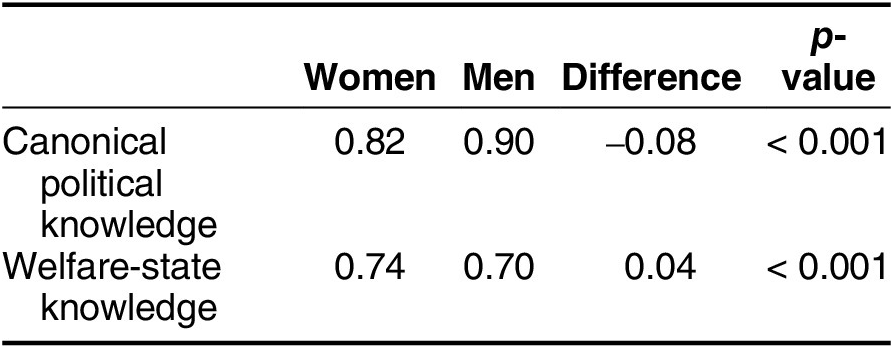
Guided by the framework in the section, “Rethinking Political Knowledge through the Welfare State,” this section examines whether gender and racial gaps persist when knowledge measures focus on the welfare state, rather than on elite political institutions. I begin by examining gender differences across the two knowledge batteries. Table 2 reports weighted mean knowledge scores for women and men on the canonical items and the welfare items. Consistent with established findings, women score lower than men on the canonical battery. Specifically, women score 0.82 on the 0–1 canonical scale, compared to 0.90 among men, a statistically significant difference of eight percentage points (p < 0.001). This pattern replicates the canonical gender gap documented across multiple surveys and contexts (Delli Carpini and Keeter Reference Carpini, Michael and Keeter1996; Jerit and Barabas Reference Jerit and Barabas2017; Mondak and Anderson Reference Mondak and Anderson2004).
Gender Variation across Knowledge Domains

Table 2 Long description
The table consists of five columns: Knowledge Domain, Women, Men, Difference, and p-value. The data is presented in two rows:
* Canonical political knowledge: Women 0.82, Men 0.90, Difference -0.08, p-value less than 0.001.
* Welfare-state knowledge: Women 0.74, Men 0.70, Difference 0.04, p-value less than 0.001.
Notes indicate these are weighted means where the difference is calculated as women minus men. All p-values are derived from weighted two-sample t-tests. Knowledge variables are scaled from 0 to 1.
Notes. Weighted means. Difference is women minus men. All p-values from weighted two-sample t-tests. Knowledge variables scaled 0–1.
However, this pattern reverses in the context of the welfare state. Consistent with the theoretical expectations developed earlier, women score higher than men on the welfare knowledge battery (0.74 vs. 0.70), a statistically significant difference of four percentage points (p < 0.001). Taken together, the gender gap swings by 12 percentage points across domains. This reversal contrasts with the canonical gender gap and demonstrates that gender differences in political knowledge depend on the political domain in question: women perform worse than men on elite-institutional questions but outperform men when questions focus on the welfare state. As such, this finding is consistent with a broader literature showing that gender differences in political knowledge vary with the substantive content of knowledge items (Barabas et al. Reference Barabas, Jerit, Pollock and Rainey2014; Dolan Reference Dolan2011; Kraft and Dolan Reference Kraft and Dolan2023; Stolle and Gidengil Reference Stolle and Gidengil2010).
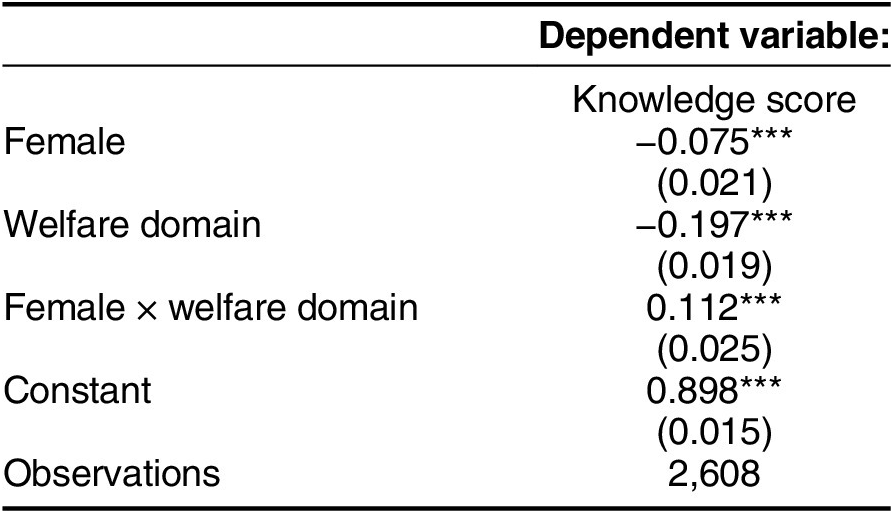
To formally test whether the gender gap differs across domains, I pooled the canonical and welfare-state knowledge items into a single stacked dataset in which each respondent contributed two observations—one for each knowledge domain—and estimated a survey-weighted linear regression predicting knowledge as a function of gender, domain, and their interaction, with standard errors clustered by respondent. Table 3 presents the results. The negative coefficient on female (-0.075, p < 0.001) captures the gender gap in the canonical domain. The key term of interest is the interaction between female and the welfare domain. The positive, significant interaction term (0.112, p < 0.001) indicates that the gender gap shifts by roughly 11 percentage points when moving from canonical knowledge to welfare-state knowledge. Substantively, this represents a reversal in political expertise: women score around eight percentage points lower than men on canonical items but four percentage points higher on welfare items.Footnote 6
Gender Knowledge Gaps across Domains

Table 3 Long description
The table presents results from a survey-weighted linear regression. The dependent variable is Knowledge score.
* Female: coefficient of minus 0.075 with three asterisks, standard error 0.021.
* Welfare domain: coefficient of minus 0.197 with three asterisks, standard error 0.019.
* Female times welfare domain: coefficient of 0.112 with three asterisks, standard error 0.025.
* Constant: 0.898 with three asterisks, standard error 0.015.
* Observations: 2,608.
Notes indicate that data are stacked so each respondent contributes two observations. Standard errors are clustered by respondent. Three asterisks denote p less than 0.001.
Notes. Survey-weighted linear regression. Data are stacked such that each respondent contributes two observations (canonical and welfare knowledge). Standard errors are clustered by respondent. *p < 0.05; **p < 0.01; ***p < 0.001.
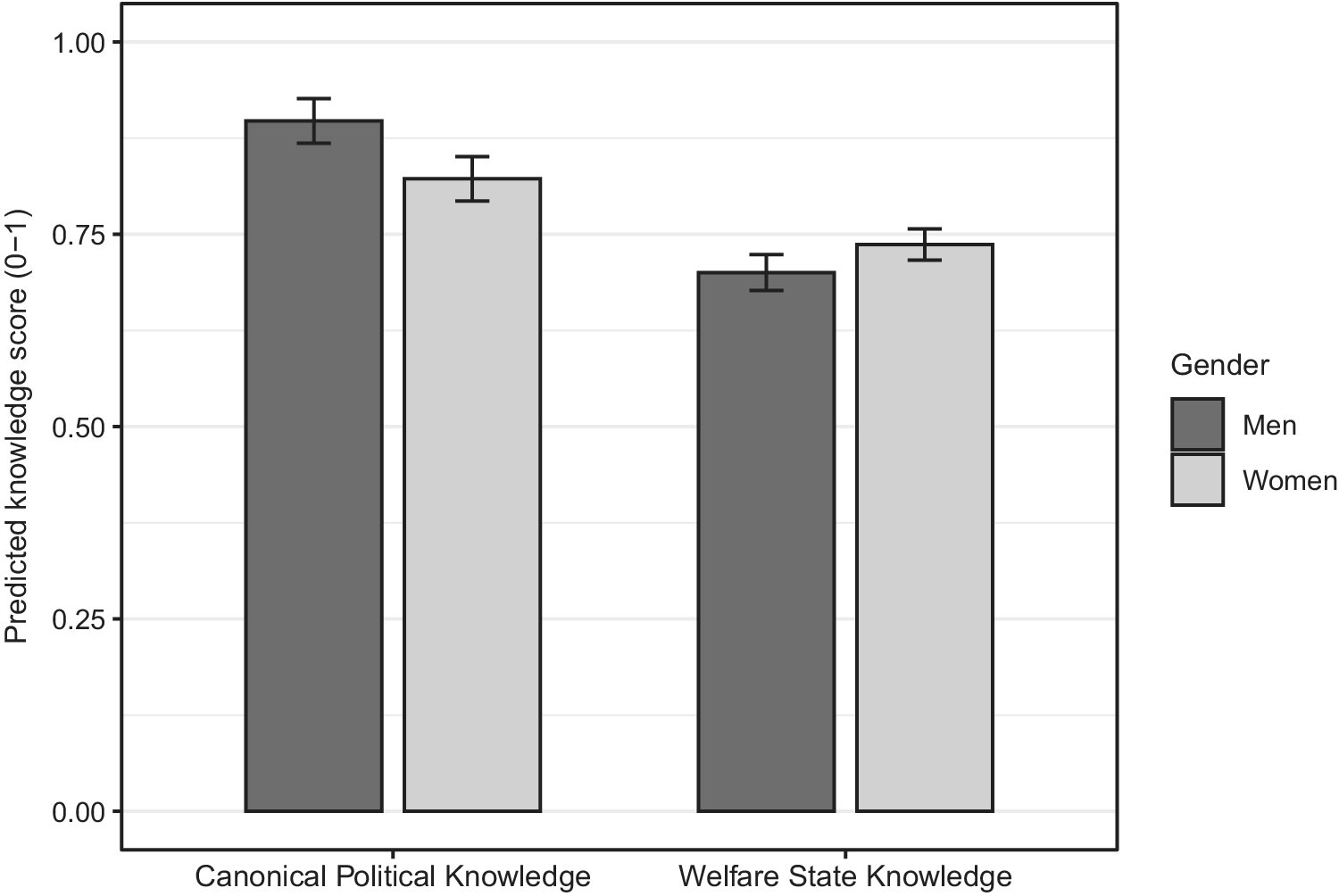
Figure 1 plots predicted knowledge scores from the pooled, survey-weighted model by gender and knowledge domain. The figure shows a clear domain-specific pattern: women score lower than men on canonical political knowledge but higher on welfare-state knowledge. This reversal indicates that observed gender gaps in political knowledge depend on the domain of governance being measured. Canonical items emphasize elite-institutional knowledge, where men have an advantage, whereas welfare items capture knowledge of how public assistance programs are structured and operate, where women demonstrate greater expertise.
Predicted Political Knowledge across Domains by Gender
Notes. Predictions are from survey-weighted stacked model; 95% CIs clustered by respondent.

Figure 1 Long description
The Y-axis is labeled Predicted knowledge score 0-1, ranging from 0.00 to 1.00 in increments of 0.25. The X-axis contains two categories: Canonical Political Knowledge and Welfare State Knowledge. A legend on the right identifies dark gray bars as Men and light gray bars as Women.
* In the Canonical Political Knowledge category, Men have a higher predicted score of approximately 0.90, while Women have a lower score of approximately 0.82.
* In the Welfare State Knowledge category, the trend reverses: Men have a lower score of approximately 0.70, while Women have a higher score of approximately 0.74.
All bars include vertical error bars representing 95 percent C I s. The error bars for Canonical Political Knowledge do not overlap, whereas the error bars for Welfare-State Knowledge show a slight overlap.
Racial Differences across Knowledge Domains
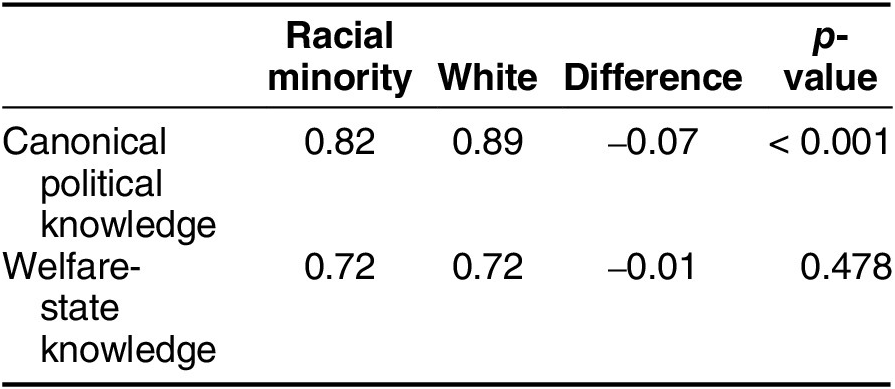
Turning next to racial differences in canonical and welfare-state knowledge, table 4 reports the weighted mean knowledge scores for white respondents and racial minorities, defined here as respondents identifying with any nonwhite racial group on the survey (Black, Hispanic/Latino, Asian, or other). In line with existing research (Abrajano Reference Abrajano2010; Abrajano and Alvarez Reference Abrajano and Alvarez2010; Delli Carpini and Keeter Reference Carpini, Michael and Keeter1996; Verba, Nie, and Kim Reference Verba, Nie and Kim1993), there is a sizable racial gap in canonical knowledge: white respondents score seven percentage points higher than racial minority respondents (0.89 vs. 0.82, p < 0.001).
Racial Variation across Knowledge Domains

Table 4 Long description
The table consists of four columns of data categorized by two knowledge domains. The columns are labeled Racial minority, White, Difference, and p-value.
* Row 1, Canonical political knowledge: Racial minority mean is 0.82, White mean is 0.89, Difference is minus 0.07, and the p-value is less than 0.001.
* Row 2, Welfare-state knowledge: Racial minority mean is 0.72, White mean is 0.72, Difference is minus 0.01, and the p-value is 0.478.
Notes indicate these are weighted means where the difference is calculated as racial minority minus white. All p-values are derived from weighted two-sample t-tests. Knowledge variables are scaled from 0 to 1.
Notes. Weighted means. Difference is racial minority minus white. All p-values from weighted two-sample t-tests. Knowledge variables scaled 0–1.
However, this pattern does not extend to the welfare domain. On the welfare battery, the racial gap narrows substantially and is statistically indistinguishable from zero (p = 0.478). Across the two domains, the racial gap narrows by around seven percentage points: from a seven-point deficit on canonical knowledge to a one-point difference indistinguishable from zero on welfare-state knowledge. This attenuation contrasts with long-standing racial knowledge gaps and indicates that racial knowledge differences are domain-dependent: they are large in the elite-institutional domain and narrow in the welfare domain. This finding is thus broadly consistent with work showing that group differences in political knowledge vary with the domain and content of questions (Abrajano Reference Abrajano2015; Cohen and Luttig Reference Cohen and Luttig2020; Jackson Reference Jackson2025; Pérez Reference Pérez2015).Footnote 7
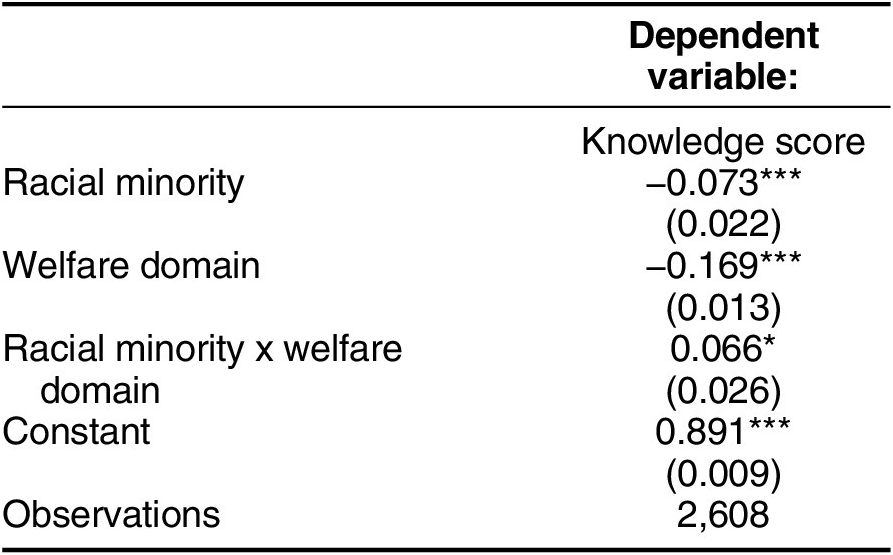
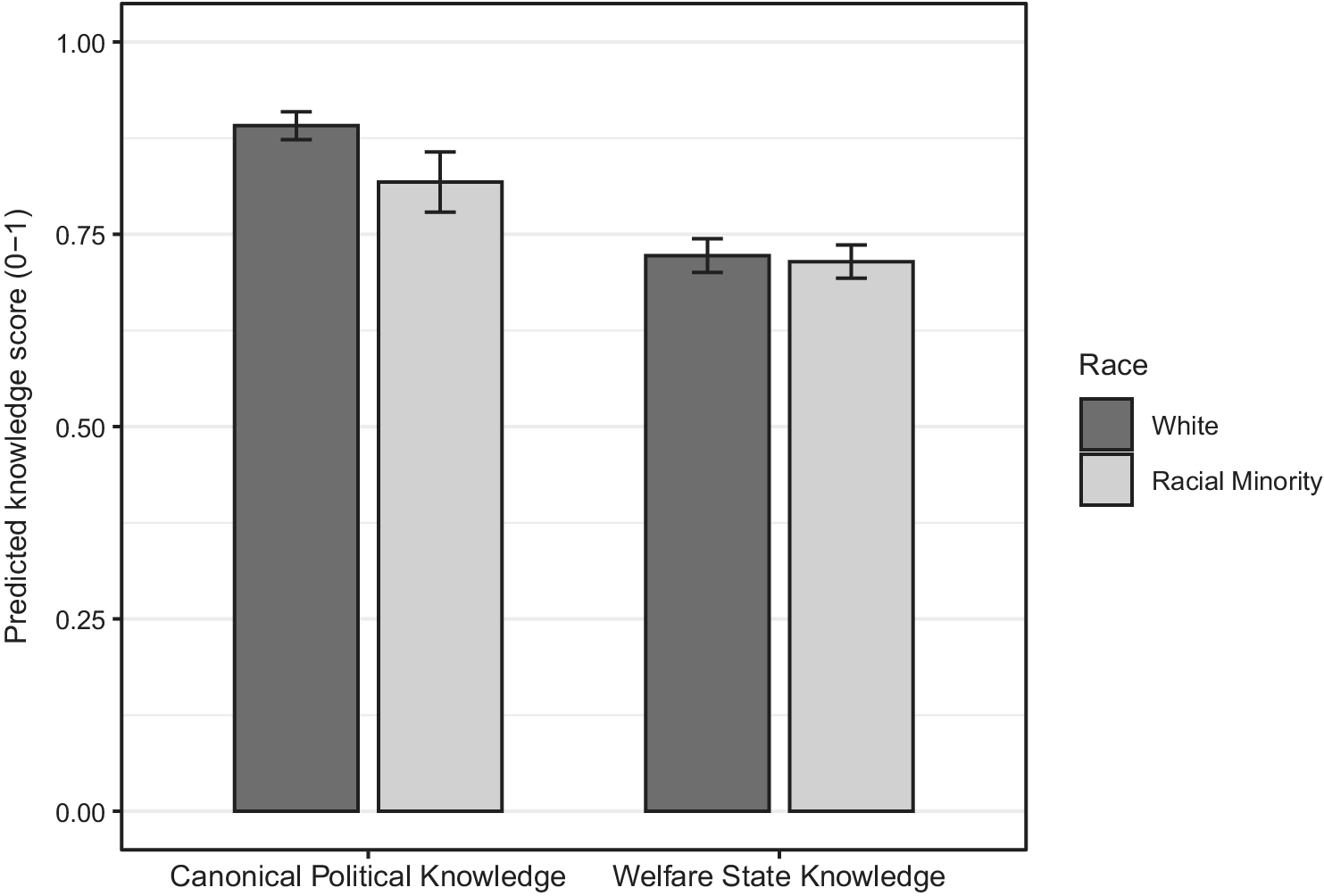
Next, I pooled the canonical and welfare items into a single stacked dataset in which each respondent contributes two observations and estimate a survey-weighted linear regression. This regression predicts knowledge as a function of race, domain, and their interaction, with standard errors clustered by respondent (table 5). The negative coefficient on racial minority (–0.073, p < 0.001) represents the racial gap in canonical knowledge. The key term is the interaction between race and the welfare domain. This interaction is positive and statistically significant (0.066, p < 0.05), indicating that the racial gap narrows significantly in the context of the welfare state. Figure 2 illustrates this pattern: predicted scores for white and minority respondents differ markedly on canonical knowledge, but are nearly overlapping in the welfare domain.Footnote 8
Racial Knowledge Gaps across Domains

Table 5 Long description
A table presenting results from a survey-weighted linear regression where the dependent variable is Knowledge score. The data includes 2,608 observations.
* Racial minority: coefficient of minus 0.073 with three asterisks, standard error 0.022.
* Welfare domain: coefficient of minus 0.169 with three asterisks, standard error 0.013.
* Racial minority x welfare domain: coefficient of 0.066 with one asterisk, standard error 0.026.
* Constant: 0.891 with three asterisks, standard error 0.009.
Notes indicate that data are stacked with two observations per respondent (canonical and welfare knowledge) and standard errors are clustered by respondent. Significance levels are indicated by asterisks: one asterisk for p less than 0.05, two asterisks for p less than 0.01, and three asterisks for p less than 0.001.
Notes. Survey-weighted linear regression. Data are stacked such that each respondent contributes two observations (canonical and welfare knowledge). Standard errors are clustered by respondent. *p < 0.05; **p < 0.01; ***p < 0.001.
Predicted Political Knowledge across Domains by Race
Notes. Predictions are from survey-weighted stacked model; 95% CIs clustered by respondent.

Figure 2 Long description
The Y-axis is labeled Predicted knowledge score 0 to 1, with increments of 0.25. The X-axis displays two categories: Canonical Political Knowledge and Welfare State Knowledge. A legend on the right identifies dark gray bars as White and light gray bars as Racial Minority.
* For Canonical Political Knowledge, the White group has a score of approximately 0.89 with a small error bar. The Racial Minority group has a lower score of approximately 0.82 with a slightly larger error bar.
* For Welfare State Knowledge, the scores are nearly equal. The White group has a score of approximately 0.72, and the Racial Minority group has a score of approximately 0.71. Both groups have similar error bar ranges in this category.
All bars include vertical error bars representing 95 percent C I s.
Intersectional comparisons (tables A11 and A12 in appendix S5) show that the canonical knowledge hierarchy is strongly stratified by both race and gender: white men score the highest, white women and racial-minority men score lower by roughly nine percentage points, and racial- minority women score the lowest. These patterns closely mirror the canonical knowledge hierarchy documented by Delli Carpini and Keeter (Reference Carpini, Michael and Keeter1996), in which white men score highest and Black women lowest. In the welfare domain, however, this hierarchy is substantially attenuated. White women and racial-minority women score slightly higher than white men, whereas racial-minority men score slightly lower, although the latter difference is not statistically significant. As such, the canonical battery reproduces a racialized and gendered hierarchy that places racial- minority women at the bottom, but the welfare battery does not reproduce this hierarchy in the same way. This pattern indicates that intersectional disadvantage is not an inherent feature of political knowledge but depends in part on the domains of knowledge being measured.
Interestingly, the domain-specific narrowing and reversal of gender and racial gaps are not driven solely by differential contact with welfare programs. Appendix S7 reports knowledge means for respondents with and without welfare-state contact, defined as direct program use, household use, or welfare-related employment. Large gender and racial gaps in canonical knowledge persist regardless of whether respondents have had welfare contact. By contrast, the gender gap in welfare knowledge reverses among respondents with and without welfare contact. Racial gaps also narrow relative to the canonical domain in both contact groups. Among respondents without welfare contact, racial-minority respondents slightly outscore white respondents. Racial-minority respondents with welfare contact score slightly lower than white respondents but by a substantially smaller margin than in the canonical domain. These results indicate that the narrowing, and in some cases reversal, of group differences in welfare-state knowledge cannot be attributed simply to higher rates of program contact.
Together with the main results, this welfare contact analysis points to broader group differences in political learning pathways and information environments. These patterns are consistent with the multiple pathways through which citizens may acquire political information about the welfare state. First, women and racial minorities interact differently with the welfare state due to gendered caregiving roles, historically racialized program design, and unequal exposure to poverty governance. These patterned encounters shape familiarity with program rules, eligibility criteria, and administrative authority. Second, information about welfare programs diffuses through social networks—families, schools, workplaces, and local communities—creating learning environments that channel information about public assistance in ways that diverge from information flow about elite officeholders and institutions. Finally, media coverage of welfare politics routinely foregrounds the features captured in the welfare battery and exposes citizens to program details even in the absence of welfare-state contact. Although this article does not adjudicate between these mechanisms, its findings are consistent with the existence of multiple pathways of political learning.
Overall, the results in this section are consistent with the theoretical framework developed earlier. This framework predicts that canonical measures would exaggerate group differences by privileging elite-centered political content, while applying the same measurement logic to the welfare domain would attenuate or reverse these gaps. The observed patterns align with this expectation: gender gaps reverse in the welfare domain, with racial gaps narrowing to the point of statistical indistinguishability. Shifting the focus of measurement from elite institutions to other domains of governance thus shows that canonical measures obscure or misrepresent group differences in political competence. Together, these patterns underscore the conceptual value of moving beyond the canonical knowledge battery: the content of political knowledge measures shapes who appears politically knowledgeable and competent. The following section considers the broader conceptual, methodological, and normative implications of these findings for the study of political knowledge and behavior.
Discussion and Conclusion
This article examines whether long-standing gender and racial gaps in political knowledge are stable across domains of governance. Consistent with the framework developed here, I show that group differences in political knowledge are domain-dependent. Familiar gender and racial gaps appear when political knowledge is measured using canonical, elite-centric items. When measurement shifts to the welfare state, however, the racial gap narrows substantially, and the gender gap reverses. Together, these findings demonstrate that group knowledge gaps are not fixed attributes but products of what scholars choose to measure.
An important clarification is that welfare-state knowledge as measured here is distinct from procedural knowledge of how to navigate welfare programs and experiential knowledge derived from direct program use. Procedural knowledge might concern how to apply for benefits, which offices to contact, or how to comply with administrative requirements. Experiential knowledge is derived from encounters with and direct navigation of welfare institutions. By contrast, the measure in this article captures institutional facts about program design: whom programs serve, what benefits can be used for, and which levels of government exercise authority. This distinction matters conceptually. This kind of institutional knowledge is precisely the type of information that citizens draw on when evaluating policy proposals, attributing responsibility, and forming political opinions about welfare reform. The finding that group differences reverse or attenuate at this level suggests that women and racial minorities possess policy-relevant understandings that canonical measures systematically overlook.
Conceptually, these results contribute to debates about what political knowledge measures are taken to represent (e.g., Cohen and Luttig Reference Cohen and Luttig2020; Cramer and Toff Reference Cramer and Toff2017; Delli Carpini and Keeter Reference Carpini, Michael and Keeter1996; Dolan Reference Dolan2011; Kraft Reference Kraft2023; Weaver, Prowse, and Piston Reference Weaver, Prowse and Piston2019). The canonical measure captures one slice of the information that citizens use to form political opinions and navigate political life. In practice, however, it is often used as a comprehensive proxy for political competence. The results here suggest that this approach is incomplete: performance on canonical items does not generalize to the welfare state—one of the most frequently encountered, consequential, and politically contested sites of state interaction. The reversal and attenuation of knowledge gaps in this domain therefore challenge the notion that political knowledge can be captured by a single-domain, canonical concept.
Methodologically, these conceptual insights have important implications for the study of political knowledge. Specifically, they suggest that political knowledge batteries should draw on multiple domains of governance, rather than relying exclusively on elite-institutional content. If group-knowledge differences are domain-dependent, then a single, elite-centered battery risks overstating the political competence of some groups while understating that of others. A multi-domain approach could provide a more complete assessment of political knowledge by capturing the varied state interactions and information environments through which different groups of citizens learn about politics. Developing such a battery is a promising direction for future research. Without such an approach, scholars risk mistaking domain-specific familiarity with elite institutions for general political competence.
Finally, and normatively, this article raises questions about whose political experiences are made visible by canonical concepts in political science. Canonical knowledge measures are regularly used to assess political competence and civic preparedness. Yet, if knowledge gaps reverse or narrow across domains of governance, this framework risks obscuring forms and patterns of political expertise. In other words, inferences about political competence and inequality depend on the slice of the political world we choose to measure. Recognizing that different groups of citizens encounter different parts of the state in different ways and incorporating that reality into our measures are essential for producing more representative scholarly accounts of political behavior. This article contributes to this effort in the context of political knowledge, thereby joining recent work that develops more representative measures of core political concepts, including political efficacy (Phoenix and Chan Reference Phoenix and Chan2022), political trust (Chudy and Engelhardt Reference Chudy and Engelhardt2026), participation norms (Anoll Reference Anoll2018), political discussion (English Reference English2026a), punitive attitudes (Jefferson Reference Jefferson2023), and ideological identification (Jefferson Reference Jefferson2024).
Several limitations and directions for future research are worth noting. First, the analysis draws on an original survey conducted in the United States, and the findings should be interpreted with that institutional context in mind. The structure, visibility, and politicization of the welfare state vary substantially across countries, as do gendered and racialized patterns of interaction with public institutions. Replicating this approach in comparative perspective—particularly in social democracies with more universalistic welfare regimes or in contexts where welfare provision is more fragmented—would help establish the scope conditions of the argument. Such extensions could clarify whether domain-specific variation emerges primarily in means-tested systems characterized by administrative complexity and moralized policy debates or whether similar patterns appear across welfare regimes.
Second, the welfare knowledge battery developed here is intentionally narrow and institutional in focus. Although this design choice is central to the article’s conceptual contribution—extending the logic of canonical political knowledge rather than measuring procedural, experiential, or event-based knowledge—it necessarily captures only a subset of welfare-related political understanding. Future work could expand this approach by incorporating additional policy domains, such as healthcare, housing, or childcare, or by constructing multi-domain batteries that systematically vary the type of political knowledge being measured—for instance, elite-institutional, procedural, experiential, and event-based. Such an approach would allow scholars to assess whether the findings in this article reflect a broader pattern of political learning or depend on the domain or type of knowledge being measured. Future research could also extend the canonical, institutional approach to other arenas of governance—such as policing and the criminal justice system or the immigration bureaucracy—to evaluate whether these patterns extend beyond the welfare state.
Third, although the analyses here document clear group patterns across domains, they do not adjudicate between the mechanisms through which citizens acquire political knowledge. The results are consistent with multiple pathways, including differential exposure to policy-relevant information through caregiving roles, community networks, workplaces, and media coverage of welfare politics. Identifying which pathways matter most—and how they interact with political socialization in schools and civic education curricula—remains an important task for future research. Mixed-method approaches combining survey data with qualitative interviews or network-based measures of information flow may be especially useful in unpacking these processes.
This article’s focus, however, is to examine group patterns of welfare-state knowledge. The findings underscore a broader normative and empirical lesson: assessments of political knowledge and competence depend on what we count as political. When researchers focus exclusively on elite institutions, they risk mischaracterizing the distribution of political expertise and reinforcing narrow definitions of political competence. When the domain of political knowledge shifts to sites of everyday governance—such as the welfare state—women and racial minorities appear at least as knowledgeable as groups traditionally viewed as more informed. These patterns indicate that assessments of political knowledge depend on which domains of governance are treated as political and that broadening those domains is essential for producing a more complete account of political behavior.
Supplementary material
To view supplementary material for this article, please visit http://doi.org/10.1017/S1537592726105933.
Acknowledgments
For helpful comments and conversations on this article, I am grateful to Enrique Quezada, Lauren Davenport, Roxanne Rahnama and participants in her Gender and Politics class at Stanford, Hesham Sallam, Jas Sullivan, Hannah Walker, and participants in Stanford’s Workshop on Critical Research on Authoritarianism, Democracy, Law, and the Economy (CRADLE). This research was supported by APSA’s Women, Gender & Politics Section and the Carrie Chapman Catt Prize for Research in Women and Politics. AI tools were used to proofread the manuscript and prepare the replication archive.



 Open access

