


How citizens respond to competing elite communications is a fundamental issue in the study of public opinion. In elections and debates over public policy, voters are inundated by messages from opposing sides. Groups engage in continual appeals to reinforce supporters and persuade those who are undecided. Given the dynamic nature of competition over time in democratic politics, it is surprising that research on the impact of mass communications on public opinion has focused almost exclusively on short-term effects (e.g., Gaines, Kuklinski, and Quirk Reference Gaines, Kuklinski and Quirk2007, 6–8).
Numerous studies show that one-sided messages emphasizing either positive or negative aspects of an issue can change peoples’ preferences. For example, popular support increases for government programs to help the poor if people are told such programs increase equality of opportunity. But support decreases if people are told the programs will require higher taxes. An important qualification, however, is that when individuals receive competing messages from each side, the opposing effects of the messages often cancel each other. Therefore, when told the programs will not only increase opportunities for the poor but also require higher taxes, people tend to take moderate positions (e.g., Sniderman and Theriault Reference Sniderman, Theriault, Saris and Sniderman2004).
The conclusions of virtually all such studies—conducted on a multitude of issues—are based on the immediate effects of communications and therefore have not addressed the durability of opinion changes or, more generally, the impact of the timing of messages on public opinion. We know little about how the public processes sequences of messages received at different points in time rather than simultaneously. In campaigns and policy debates that last weeks or months, public responses to a single message should be viewed in the context of how opinions develop and change over the course of the full debate. Is the timing of exposure to an argument relevant to its overall effect? For example, what happens to public opinion if the proponents of government assistance to the poor publicize their equal opportunity message before opponents can warn of tax hikes? Do such competing messages still cancel one another, or is opinion arbitrarily shaped by the earliest or latest messages? What conditions make one or the other of these outcomes more likely?
We argue that understanding the magnitude of communication effects at any point in time requires an over-time framework in line with actual campaigns and policy debates. In the next section, we start by presenting a conceptual framework that places any communications study in a time frame that includes pretreatment events (that occur before a given communication) and posttreatment events (that occur after a given communication). Then we offer an explanation of opinion formation over time that centers on the concept of attitude strength, from which we derive hypotheses about the longevity of a communication's effect and the conditions under which an early or later communication will be more influential. We test the hypotheses using data from two experiments that measure public opinion over time in response to alternative sequences of information. In our conclusion, we discuss the implications of our findings for understanding the power of communications in contemporary politics.
CONCEPTUAL SCHEME FOR OVER-TIME ANALYSIS
We begin by providing a conceptual scheme for studying mass communication effects over time. In contrast to nearly all past research that focuses on the immediate impact of a message, we emphasize the variable effect of a message depending on its temporal and competitive context. Indeed, all communication effects are conditional on past and future events, as described by the following scheme.
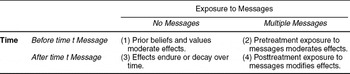
We conceptualize a “campaign” (a term we use to capture electoral campaigns and policy debates) as a sequence of exposures to messages about an issue. Using t as our reference point to indicate exposure at time t to a given message, we divide the pre-t and post-t periods according to whether additional communications were received before and after t. The four states in Table 1 therefore represent all possible sequences of exposure to communications from the start of the campaign to time t and from t to the end of the campaign (setting aside no exposure altogether).
Time and Communication Effects

Individuals in cell 1 have not received any communications about the issue prior to t, whereas those in cell 2 were exposed to previous messages. Individuals who receive no further communications on the issue after t fall in cell 3, whereas those who are exposed to additional messages are in cell 4. Therefore, any individual's exposure to communications over the duration of the campaign can be represented by a combination of two cells drawn across the two periods. For example, an individual who received no message before t and multiple messages after t would fall in cells 1 (pre-t) and 4 (post-t).
Most studies of communication effects have been one-shot tests of a message without regard for whether participants fall in cell 1 or cell 2. If we consider the message at time t to be an experimental treatment, then individuals who begin the study in the state described by cell 1 are a reasonably clean slate because they have learned nothing about the issue. Their reactions to the message, however, will still be affected by the values they hold, which is why researchers routinely control for values relevant to the issue when estimating the effect of the message (e.g., Brewer Reference Brewer2003; Chong and Druckman Reference Chong and Druckman2007a, Reference Chong and Druckman2007b).
Researchers have generally ignored the potential impact of prior exposure to relevant messages (cell 2 in Table 1). Individuals in cell 2 who were previously exposed to discussions of the test issue might react differently to the treatment than those encountering the issue for the first time. In particular, their opinion on the issue at the start of the study may already reflect the influence of the argument being tested, thus making them immune to further persuasion by that message. This means only the argument exhibited no effect in the study, not that it had no impact in reality (Gaines, Kuklinski, and Quirk Reference Gaines, Kuklinski and Quirk2007, 13, 17; Slothuus Reference Slothuus2008).
Few studies have examined the opinion processes represented in cells 3 and 4. Cell 3 describes a posttreatment trajectory in which individuals do not receive any additional exposure to communications (de Vreese Reference de Vreese2004; Druckman and Nelson Reference Druckman and Nelson2003; Druckman et al. Reference Druckman, Hennessy, Charles and Weber2010; Mutz and Reeves Reference Mutz and Reeves2005; Tewksbury et al. Reference Tewksbury, Jones, Peske, Raymond and Vig2000). In this case, we are interested in the durability of effects—to the end of the campaign or policy debate—in the absence of further stimulation. The original effects may vanish on their own or, alternatively, they may persist or become even stronger. In any event, these posttreatment updates may cause us to reassess the significance of the original findings.
Finally, cell 4 describes individuals who receive additional messages about the issue following treatment at time t. There has been mainly speculation, but little empirical work, on the effects of communication under different conditions of democratic competition (although see Lecheler and de Vreese Reference Lecheler and de Vreese2010; Matthes and Schemer Reference Matthes and Schemer2010; Mitchell and Mondak Reference Mitchell and Mondak2007). In research on framing effects, for example, work involving multiple frames almost always focuses on a single period (e.g., Chong and Druckman Reference Chong and Druckman2007b; Druckman et al. Reference Druckman, Hennessy, Charles and Weber2010; Hansen Reference Hansen2007; Sniderman and Theriault Reference Sniderman, Theriault, Saris and Sniderman2004), with participants encountering all frames (e.g., the welfare equal opportunity frame and the welfare tax frame) in one session rather than over time. When a series of messages representing opposing positions is received over time, the effect of individual messages depends on rates of learning and decay of opinion under the pressure of competition.
Our analysis in this article focuses on the campaign processes described in cells 3 and 4 of Table 1. Our goal is to explain how individuals process a sequence of messages received over time to arrive at an opinion on an issue. We examine when a communication effect will endure, fade, or be outweighed by other communications involving competing arguments.
PSYCHOLOGY OF OVER-TIME OPINION FORMATION
Our hypotheses about opinion formation in competitive campaigns derive from assumptions about how people process information. We expand on prior work that explores the effects of competing messages and, like much of that work, we focus on framing effects. A framing effect occurs when a communication changes people's attitudes toward an object by changing the relative weights they give to competing considerations about the object (Druckman Reference Druckman2001a, 226–31). A classic example is an experiment in which participants are asked if they would allow a hate group to stage a public rally. Those participants randomly assigned to read an editorial arguing for allowing the rally on free speech grounds express more tolerance for the group than those who alternatively read an editorial arguing that the rally will endanger public safety (Nelson, Clawson, and Oxley Reference Nelson, Clawson and Oxley1997).Footnote 1 Framing is effective in this instance because the communication plays on the audience's ambivalence between free speech and social order.
A frame's effect depends on various factors, including its strength or persuasiveness (e.g., does it resonate with people's values?) (Chong Reference Chong2000; Chong and Druckman Reference Chong and Druckman2007a, Reference Chong and Druckman2007b),Footnote 2 attributes of the frame's recipients (e.g., their values or party identification can moderate the impact of a frame) (Berinsky Reference Berinsky2007; Cohen Reference Cohen2003; Lenz Reference Lenz2009), and the political context. As mentioned, in competitive environments—where individuals are exposed concurrently to each side's strongest frame (e.g., free speech vs. public safety)—the frames tend to cancel out and exert no net effect (e.g., Chong and Druckman Reference Chong and Druckman2007b; Druckman et al. Reference Druckman, Hennessy, Charles and Weber2010; Hansen Reference Hansen2007; Sniderman and Theriault Reference Sniderman, Theriault, Saris and Sniderman2004).
It is, however, unclear whether messages will cancel out when they are received at different times. Will the effects of frames that shape opinions at one point in time persist into the future? Will competition cancel the effects of opposing frames if the frames are received sequentially over time rather than simultaneously? We posit that the answers to these questions depend on the strength of the particular attitudes formed in response to communications (note our use of attitude strength is not to be confused with a frame's strength).
By definition, a strong attitude persists and resists change (Krosnick and Petty Reference Krosnick, Petty, Petty and Mahwah1995; Krosnick and Smith Reference Krosnick, Smith and Ramachandran1994; Miller and Peterson Reference Miller and Peterson2004; Visser, Krosnick, and Simmons Reference Visser, Krosnick and Simmons2003). For most political issues, individuals tend to hold relatively weak attitudes—they do not carry long-standing attitudes, but instead construct their attitudes when needed by drawing on accessible considerations about the object they are evaluating. Kinder (Reference Kinder, Gilbert, Fiske and Lindzey1998, 814) explains that “The presumption that citizens keep a running tally [i.e., standing strong attitudes] of all the various and assorted topics that define the politics of their time seems, well, presumptuous” (italics in original; also see Druckman and Lupia Reference Druckman and Lupia2000; Fazio Reference Fazio, Petty and Krosnick1995, 249).Footnote 3 We thus expect, as a general rule, that communication effects will decay over time as the considerations behind the opinion become less accessible. An important consequence of decay is that sequential competition between frames will result in “recency” effects rather than cancellation of opposing effects. Given a sufficient interval between communications, early frames will lose their influence, and frames received later in time will have a disproportionate impact on preferences.
The few experimental studies that retest opinions support our general premise that in the absence of additional communications, framing effects rapidly decay over time. Several experiments show that the effects induced by the treatment vanish after several days (e.g., de Vreese Reference de Vreese2004; Druckman and Nelson Reference Druckman and Nelson2003; Mutz and Reeves Reference Mutz and Reeves2005; Tewksbury et al. Reference Tewksbury, Jones, Peske, Raymond and Vig2000). Gerber et al. (Reference Gerber, Gimpel, Green and Shaw2007) report similar fading in their field experimental study of the 2006 Texas gubernatorial campaign: advertisements immediately move public opinion in favor of the ad's sponsor, but the effects decay rapidly, with candidate preferences quickly reverting to levels observed prior to the ad (also see Hill et al. Reference Hill, Lo, Vavreck and Zaller2008). Observational studies also show that movements of public opinion in response to political events are often short lived (e.g., voters focus more heavily on recent economic conditions than on circumstances that prevailed previously in the presidential term; see Achen and Bartels Reference Achen and Bartels2004; Hibbs Reference Hibbs2008).
All of that said, we also expect significant individual and contextual variation in the rates of decay. Individual and circumstantial factors will contribute to formation of stronger opinions that endure and resist change.Footnote 4 Attitudes increase in strength, for example, when they are more extreme, more accessible, and deemed more personally important (e.g., Krosnick and Petty Reference Krosnick, Petty, Petty and Mahwah1995). Of particular interest when it comes to over-time communication dynamics is that attitude strength depends on the processes by which the attitude is formed and updated (e.g., the amount of elaboration, type of processing) (Bizer et al. Reference Bizer, Krosnick, Holbrook, Wheeler, Rucker and Petty2004, 215–16; Krosnick and Petty Reference Krosnick, Petty, Petty and Mahwah1995, 5; Miller and Peterson Reference Miller and Peterson2004, 848–49). If individuals process early communications in a manner producing stronger attitudes, then this will increase the persistence of those attitudes and accentuate the effect of early communications relative to later communications.
We focus on two dynamics affecting attitude strength that may generate deviation from our baseline expectation of decay and recency effects (leading to stronger, enduring, and less vulnerable attitudes). First, individuals vary in their tendency to form spontaneous evaluations when processing information. An individual's “need to evaluate” (NE) is a trait reflecting one's “propensity to engage in evaluation” (Jarvis and Petty Reference Jarvis and Petty1996, 172). People with a high NE develop stronger attitudes and more opinions on subjects ranging from personally relevant matters to more remote topics (Bizer et al. Reference Bizer, Krosnick, Holbrook, Wheeler, Rucker and Petty2004, 998). As Hermans, De Houwer, and Eelen (Reference Hermans, De Houwer and Eelen2001, 159) explain, individuals with a high NE “possess stronger object-evaluation associations due to their chronic evaluative responding” (also see Bizer et al. Reference Bizer, Tormala, Rucker and Petty2006, 1000). In addition to holding more opinions on more topics, individuals with a high NE also tend to develop more organized attitudes (e.g., more ideologically constrained attitudes) that structure opinions across issues (Druckman and Nelson Reference Druckman and Nelson2003; Federico and Schneider Reference Federico and Schneider2007; Jarvis and Petty Reference Jarvis and Petty1996, 1006).Footnote 5
Second, attitude strength will be influenced by whether individuals form and update attitudes favoring either an online or memory-based approach. When individuals process a message about an issue online, they routinely integrate the various considerations contained in the message into an overall issue evaluation. Individuals then store the summary evaluation in memory, possibly forgetting the original considerations that contributed to the tally. When asked subsequently for their attitude toward the issue, individuals retrieve and report their overall online tally rather than reconstruct and evaluate the specific pieces of information that comprise this summary (e.g., Druckman and Lupia Reference Druckman and Lupia2000; Hastie and Park Reference Hastie and Park1986; Lodge and Steenbergen Reference Lodge, Steenbergen and Brau1995).Footnote 6 Individuals who use memory-based information processing, in contrast, store considerations about the issue in memory without necessarily forming an overall judgment, and subsequently, retrieve and evaluate accessible considerations when asked their opinion about the issue (Bizer et al. Reference Bizer, Tormala, Rucker and Petty2006, 646).Footnote 7
Because online processors actively integrate information into judgments, they tend to develop stronger attitudes, as indicated by the certainty with which they hold their views and higher correlation between their attitudes and behavioral intentions (Bizer et al. Reference Bizer, Krosnick, Holbrook, Wheeler, Rucker and Petty2004; Reference Bizer, Tormala, Rucker and Petty2006, 647). It follows that online processors will also hold more stable attitudes because they can summon a readily accessible online evaluation each time they report their attitude, whereas the attitudes of memory-based processors at any given time are based on imperfect and variable recall of details (Briñol and Petty Reference Briñol, Petty, Albarracín, Johnson and Zanna2005, 583). Furthermore, because online processors form stronger attitudes in evaluating early communications about an issue, they are inoculated to a greater degree against the influence of later messages (Tormala and Petty Reference Tormala and Petty2001, 1600–1).
In sum, we hypothesize that both high NE and online processing will produce stronger attitudes that (1) increase attitude stability over time and (2) reduce the influence of later communications relative to previous communications.
EXPERIMENTAL TESTS OF COMPETITIVE FRAMING OVER TIME
We conducted two experiments on two political issues to test these hypotheses. We designed both experiments to improve on static analyses in which all information is received concurrently. Details on the design of the two experiments vary and are elaborated in this section.Footnote 8 Here we explain the rationale we used to select the issues.
We designed the first experiment around the renewal of the U.S. Patriot Act, which was a piece of legislation enacted shortly after the terrorist attacks of September 11, 2001, to increase the powers of law enforcement agencies to monitor communications, records, and financial transactions in an effort to identify terror threats.Footnote 9 The second experiment focused on the issue of urban growth and conservation. Several features of these issues make them suitable for our tests of opinion change over time in response to competing messages:
• Both issues received periodic local and national media coverage. Over the past decade, the pace and location of urban growth has been the subject of hundreds of referenda and initiatives across the United States. Intense debate about the Patriot Act occurred at the time of its adoption and, more recently, when some of its provisions were up for renewal.
• Opinions on these issues are liable to change, which allows us to test hypotheses about the moderating effects of attitude strength before people develop hardened opinions. Although we suspect our issues are fairly representative in the sense of being salient but not intensely debated, we also recognize the dynamics may differ if we had included a more hot button issue, such as abortion, on which individuals likely hold very strong opinions. In our conclusion, we discuss how the dynamics of opinion change might be modified on such issues.
• Attitudes on these issues are ideologically structured along economic and social dimensions in the same way as other political issues. The urban growth issue touches on tangible concerns about the pace of development in one's community and the preservation of the environment, whereas the Patriot Act raises concerns about the proper balance between national security and civil liberties. Opinions about the Patriot Act divide more sharply along partisan lines, but we found in our analysis that partisanship does not cause immunity to strong arguments on either issue (c.f., Best and McDermott Reference Best and McDermott2007).Footnote 10
In constructing the frames on each issue, we strived for realism by using content analysis of news coverage and prior research on the Patriot Act and urban growth to identify the actual frames that have appeared in public discussions of these issues. Background on the urban growth issue also drew on interviews with campaign consultants on both sides of the issue who discussed the frames they used to try to win support for their position (Chong and Wolinsky-Nahmias Reference Chong, Wolinsky-Nahmias, Martinez and Craig2005). Our restriction of the experimental design to a small number of competing frames is both methodologically practicable and realistic. Chong and Druckman's (Reference Chong, Druckman, Bucy and Holbert2010) content analysis finds that, over the course of coverage, arguments will be repeated with varying frequencies, but each side on the issue tends to concentrate on a small number (one or two) of frames that are presumed to be stronger or more effective arguments (also see Hänggli Reference Hänggli2010).
PATRIOT ACT EXPERIMENT
We conducted our Patriot Act experiment via the Internet with a sample drawn to be representative of the U.S. population. A total of 1,302 individuals completed the experiment, which focused on support for or opposition to the Patriot Act.Footnote 11 Opinions about the act, although colored by partisanship, also reflect a value trade-off between personal safety (from terrorism) and civil liberties. We collected data at two points in time, about 10 days apart. Participants answered basic demographic questions at the start of the time 1 (T1) questionnaire, and additional demographic and political questions after completing the time 2 (T2) questionnaire. Our main dependent variable in both periods is the extent to which one opposes or supports the Patriot Act, measured on a 7-point scale with higher scores indicating increased support (for question wording, see online Appendix A, available at www.journals.cambridge.org/psr2010010).
There are three key elements to our design. First, we used pretests to select two competing “strong” frames (see note 2): a Strong-Pro (SP) frame that emphasizes the threat of terrorism (e.g., the act improves the government's ability to identify terrorist plots) and a Strong-Con (SC) frame that points to the act's infringement on civil liberties (e.g., the act expands the government's search and surveillance powers).Footnote 12 Examples of the Civil Liberties frame appear in online Appendix B; the Terrorism frame is analogous and is available from the authors. Second, we investigate the endurance of T1 framing effects when there is (1) no subsequent exposure to additional frames (cell 3 of Table 1) and (2) exposure to a competing frame at T2 (cell 4 of Table 1). Third, we used a standard procedure to manipulate the strength of attitudes formed in response to frames by exogenously inducing either memory-based (MB) or online (OL) processing of messages (e.g., Bizer et al. Reference Bizer, Tormala, Rucker and Petty2006; Hastie and Park Reference Hastie and Park1986; Mackie and Asuncion Reference Mackie and Asuncion1990). Participants read a series of framed statements (varying by condition) about the Patriot Act, taken from newspaper coverage.Footnote 13 For the OL manipulation, designed to produce stronger attitudes, respondents were instructed to evaluate each statement according to the extent to which it decreased or increased their support for the act. Respondents in the OL condition were also told they would be asked to report their attitude toward the Patriot Act 10 days later (Hastie and Park Reference Hastie and Park1986). In the MB manipulation, intended to produce weaker attitudes, respondents were asked to rate each statement according to the extent it seemed “dynamic” (i.e., used more action-oriented words); these respondents were not informed that they would be asked for their opinion on the issue. Examples of the manipulations appear in online Appendix B.
We randomly assigned participants to 1 of 16 conditions, including a control group. Respondents in the control group received no frames at either T1 or T2, and were not instructed on how to process information (i.e., there was no manipulation of their processing mode).Footnote 14 In the other 15 conditions, we tested how individuals responded to sequences of messages using one of three forms of information processing; respondents were either manipulated to use MB or OL processing in evaluating the messages or not manipulated at all (i.e., they evaluated the information as they would normally without prompting). Within each processing group (i.e., MB, OL, or no manipulation), there was a set of conditions that involved exposure to frames only at T1 (i.e., there was no T2 frame). These conditions exposed respondents to the Terrorism (SP) frame, the Civil Liberties (SC) frame, or both frames simultaneously. This adds up to 9 conditions that vary processing mode (MB, OL, or no manipulation) and T1 frame exposure (SP, SC, or SP-SC). These conditions allow us to measure how much the observed framing effect at T1 persists or decays over time in the absence of new communications at T2. We can also compare across processing modes to test whether the rate of decay varies according to an individual's motivation to form strong attitudes. A list of these conditions appears in the upper half of the first column of the table in online Appendix C, available at www.journals.cambridge.org/psr2010010.
Another set of conditions within each processing group included exposure to frames at both T1 and T2. Respondents received one frame at T1 (either SP or SC) and the contrary frame at T2. This equals an additional 6 conditions that vary processing mode (MB, OL, or no manipulation) and the T1and T2 frame sequence (SP at T1 and SC at T2, or SC at T1 and SP at T2). These conditions with T2 frames never involved simultaneous exposure to both SP and SC. The bottom half of the table in online Appendix C lists these conditions. By comparing respondents’ attitudes toward the Patriot Act in these “competition over time” conditions to the attitudes of individuals who received competing frames simultaneously, we can determine whether the timing and sequence of messages changes the impact of competition. We can also test whether processing mode affects the relative impact of early versus late messages.Footnote 15
We expect that the results of exposure to one- or two-sided frames at T1, across all conditions, will confirm the findings of past one-shot experiments. Specifically, exposure to the Terrorism (SP) frame will increase support, exposure to the Civil Liberties (SC) frame will decrease support, and exposure to both frames will produce no effect (cancel out) relative to the control group. Processing mode should not affect the magnitude of framing effects at T1, but instead should affect the strength of T1 attitudes. The effects of processing mode, therefore, should be manifest at T2 because individuals who form stronger T1 attitudes will be more likely to retain the effects of T1 frames and resist the effects of T2 frames.
For individuals who receive a one-sided frame at T1, but no T2 frame, we expect that the T1 framing effect will fade over time at different rates, depending on processing mode. The framing effects should disappear most quickly among MB processors and be most likely to persist among OL processors. We assume individuals in the “no manipulation” conditions will be relatively unmotivated like MB processors; if so, they too should form weak attitudes at T1 that decay at a rate similar to that of MB processors.Footnote 16 For individuals who receive competing frames at T1, but no additional T2 frame, we expect the absence of a framing effect at T1 will carry over to T2, regardless of processing mode.
When individuals receive competing frames over time (i.e., a one-sided frame at T1 and the opposing frame at T2), differential rates of decay of the T1 framing effect should produce T2 opinions that vary significantly by processing mode. We expect the T2 attitudes of MB processors and those who are not manipulated will largely reflect the influence of the most recent T2 frame, whereas the T1 frame will show little residual effect. In contrast, we predict OL processors will form strong attitudes in response to the T1 frame, leading either to a primacy effect at T2 (in which the T1 frame dominates) or to a balancing of opposing frames.
Results
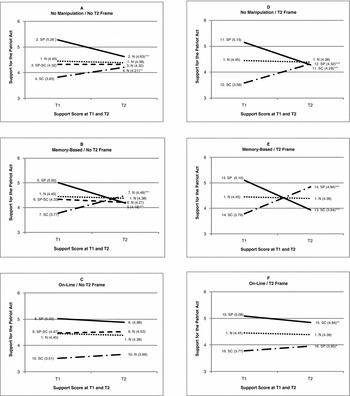
We present the results in Figure 1 using a series of graphs that plot mean support for the Patriot Act at T1 and T2, for each processing mode, following exposure to each sequence of frames. Figures 1A–C display mean opinion when there is exposure to frames at T1 but no exposure to a T2 frame. Figures 1D–F show support for the Patriot Act in response to competing frames received over time at T1 and T2. In Figure 1, SP refers to exposure to the Terrorism frame, SC refers to exposure to the Civil Liberties frame, and N indicates no frame exposure at the given time. We also number the conditions to facilitate identification of specific findings. Online Appendix C reports the same mean scores, along with standard deviations, Ns, amount of change over time (i.e., T2 – T1 mean), and whether there is a T2 framing effect (i.e., whether the group mean in a given condition is significantly different from the T2 control group).
Patriot Act Support by Experimental Condition

The results offer strong support for our T1 predictions. In every case—regardless of condition—T1 exposure to the Terrorism (SP) frame significantly increases support, exposure to the Civil Liberties (SC) frame significantly decreases support, and exposure to both frames has no significant effect. For example, in Figure 1A, both the SP mean of 5.28 and the SC mean of 3.83 differ significantly from the control mean of 4.45, but the SP-SC mean of 4.32 is indistinguishable statistically from the control mean. Using the data contained in online Appendix C, we find that all one-sided frames produce significant effects at T1 at the 0.01 level. Also, we find no evidence that processing mode influences T1 opinions (i.e., the reactions to the T1 frames were the same across processing manipulations).Footnote 17
We next turn to over-time dynamics by looking at the change in opinion from T1 to T2. Asterisks designate conditions with statistically significant over-time movement; as mentioned, the precise amount of opinion change over time (i.e., T2 – T1) for each condition is reported in online Appendix C. We identify significant T2 framing effects—based on the difference between the T2 condition means and the T2 control mean of 4.38—even though they are not noted in Figure 1 (however, see the final column of the table in online Appendix C).
In the conditions where respondents received both frames at T1 (Figures 1A–C, conditions 3, 6, and 9), there was no significant change between T1 opinion and T2 opinion and no significant T2 framing effects. This was expected: regardless of processing mode, exposure to competing frames at T1 produced no significant framing effects at T1, and opinions at T2 continued to resemble the control group at T2.
There is more opinion change to explain in the other conditions. Among individuals who were not manipulated (Figure 1A), the one-sided framing effects manifest at T1 had vanished by T2. For example, individuals in condition 4 who received the Civil Liberties (SC) frame at T1 expressed an average T1 opinion of 3.83, which significantly differed from the control group mean at T1. However, by T2, their mean opinion had returned to 4.21 (a significant change of 0.38), which no longer differed significantly from the control group. Likewise, in condition 2, exposure to the Terrorism (SP) frame at T1 significantly moved opinion to 5.28; however, by T2, opinion had reverted to 4.63 (a significant change of –0.65), which does not differ from the control group. Framing effects clearly decayed when there was no manipulation of processing mode and no further exposure to additional messages.
We find similar fading of framing effects among MB processors who received only T1 frames. Figure 1B shows that the significant T1 framing effect produced by exposure to the Civil Liberties (SC) frame had disappeared by T2, as average opinion shifts back from 3.77 at T1 to 4.49 at T2 (a 0.72 increase). Similarly, the T1 framing effect caused by the Terrorism (SP) frame had vanished by T2 with opinion shifting from 5.00 to 4.18 (a 0.82 decrease). As predicted, when individuals are induced to form weaker attitudes, those attitudes are prone to decay. The similarities we observed in rates of decay in the MB and no manipulation conditions suggest, as expected, that respondents who were not manipulated tended toward using memory-based processing of information.
We see sharply contrasting results for the OL processors depicted in Figure 1C. When individuals are strongly motivated to evaluate information, they tend to form stable preferences on issues in response to frames. The initial framing effects manifest at T1 endured over the 10-day interval between observations. For example, in condition 10, the significant effect of the Civil Liberties (SC) frame at T1 is sustained at T2; the average T1 opinion of 3.51 is virtually identical to the average T2 opinion of 3.66. Similarly, in condition 8, those receiving the Terrorism (SP) frame at T1 displayed almost no change in opinion over time. In both cases, the T2 attitudes of OL processors remain significantly different from the T2 control group mean.
Previously, we saw that individuals who were exposed at T1 to both the Terrorism (SP) and the Civil Liberties (SC) frames (i.e., conditions 3, 6, and 9) expressed opinions that were indistinguishable from the control group. Figures 1D–F present the results for conditions in which respondents received the same two frames, but across two periods. Respondents received the Civil Liberties (SC) frame at T1 and the Terrorism (SP) frame at T2, or the reverse. If the timing of the messages does not affect their power, then the frames will cancel each other in these over-time exposure conditions as they did in the simultaneous exposure conditions. But if there are framing effects at T2, this means the earlier or the later frame exerts a disproportionate impact. In either event, the passage of time changes the relative impact of competing frames.
The data confirm the sequencing of messages over time had a significant impact on the T2 opinions of MB and OL processors. In neither group did sequential exposure produce the same opinion as simultaneous exposure. The direction of the bias, however, varies by processing mode. Individuals in the MB conditions (Figure 1E) gave outsized weight to the second (or last) frame they received at T2 (i.e., a recency effect). In contrast, the T2 opinions of individuals in the OL conditions (Figure 1F) were disproportionately influenced by the first frame they received at T1, whether it was for or against renewal of the Patriot Act (i.e., a primacy effect). The symmetry is striking both within and between processing modes: MB processors in condition 13 who received the con-argument last (SP-lag-SC) had a mean opinion of 3.94, which was 0.46 less supportive of the Patriot Act than the control group at T2, but those in condition 14 who received the pro-argument last (SC-lag-SP) had a mean opinion of 4.84, which was 0.46 more supportive than the control group. OL processors were just the opposite: those in condition 15 who received the pro-argument before the con-argument (SP-lag-SC) had a mean opinion of 4.84, which was 0.46 more supportive of the Patriot Act than the control group at T2, but they were 0.43 less supportive (mean opinion of 3.95 in condition 16) when they received the con-argument before the pro-argument (SC-lag-SP).Footnote 18
We expected individuals who were not manipulated to respond to competing frames over time in the manner of MB processors. We saw previously in Figure 1A that T1 framing effects decayed significantly in this group, so we expected the more recent T2 frames to dominate overall opinion. However, contrary to our prediction, Figure 1D shows that the timing of messages does not change the outcome of competition for individuals who were not manipulated. Instead, there is balancing of the T1 and T2 frames, leading to an overall mean that is virtually identical to the control group. For example, those exposed to the Terrorism (SP) frame at T1 and the Civil Liberties (SC) frame at T2 did not end up significantly less supportive than the control group, as we would expect if the T1 framing effect vanished and was replaced by the impact of the T2 frame. In general, receiving the two frames over time produces a net effect that is similar to simultaneous exposure—in both cases, average opinion is indistinguishable from the control group mean. We comment later on the possible dynamics behind this result (also see note 19).
To summarize our Patriot Act experiment results:
• Frames received at T1 had a significant effect on the opinions of individuals who were not manipulated to use either MB or OL processing, but these effects decayed by T2 without further communications.
○ Nonetheless, when these individuals received a contrary T2 frame that challenged the T1 frame, the effects of the T1 and T2 frames offset to produce moderate opinions. Therefore, the opinions generated by simultaneous and sequential competition were not significantly different among these individuals.
• Framing effects at T1 also decayed by T2 among MB respondents. Because T1 frames quickly become inaccessible, MB processors were highly susceptible to the influence of a contrary T2 frame. Competition over time produced recency effects rather than balancing because MB processors gave greater weight to the last (randomly assigned) message they received.Footnote 19
• OL processors formed stronger opinions when exposed to T1 frames. Their T1 opinions not only endured but also provided a defense against contrary T2 frames. When OL processors received competing frames over time, their opinions largely reflected the influence of the T1 frame. Competition over time therefore did not lead to balancing of opposing frames, but to a primacy effect in which the first (randomly assigned) frame was given disproportionate weight.
• The results demonstrate the importance of accounting for the dynamics of opinion over time under conditions described by our conceptual scheme in Table 1. Communication effects change over time; whether they fade when no additional messages are received (cell 3), or when there is subsequent exposure to competing messages (cell 4) depends on how people process information.
URBAN GROWTH EXPERIMENT
We implemented our urban growth experiment in Minneapolis, where the issue had received periodic attention. We recruited participants from the University of Minnesota and the general public by inviting them to take part in a public opinion study in exchange for a cash payment. A total of 749 participants took part in the two experimental stages, this time separated by a 3-week interval. The first stage occurred in a laboratory, and the second occurred via e-mail (using the same response mode/questionnaire structure). In the initial session, respondents first completed a background questionnaire that asked basic demographic and political questions.
After completing the T1 background questionnaire, participants were introduced to a proposed urban growth management policy (in the city where the experiment took place) that would (1) channel development toward the city's center by prohibiting development in certain parts of the city, (2) require developers to pay for infrastructure in new developments, and (3) involve direct citizen input in implementing the plan. These details echo ongoing contemporary discussions about urban growth in the city where the study occurred and also correspond to the particulars of growth management proposals in other cities (e.g., Portland, OR; Phoenix, AZ). We then informed participants that the proposed policy would be debated over the next few months and mentioned that local newspapers already have published various editorials on their Web sites about the issue. We randomly assigned participants to 1 of 17 conditions. In the control condition, participants received a neutral description of the issue and were asked to complete a questionnaire. Those in 1 of the 16 treatment conditions read one or more opinion editorials from a major local newspaper's Web site. Each T1 article was built around one of four frames defined by their direction (Pro or Con in relation to the proposal) and relative strength (Strong or Weak). We determined a frame's strength by asking pretest participants to judge the frame's effectiveness, with weak frames being judged as relatively ineffective (Chong and Druckman Reference Chong and Druckman2007b, note 2)
The Strong-Pro (SP) frame argued that limiting development would preserve open space and protect the natural landscape. The Strong-Con (SC) frame invoked the law of supply and demand in arguing that limiting development would raise housing costs. The Weak-Pro (WP) frame explained that concentrating growth in certain parts of the city would contribute to the development of stronger communities, whereas the Weak-Con (WC) frame criticized the policy on the grounds that it required voters to participate on issues that were beyond their competence.Footnote 20 In what follows, we refer to the frames as Open Space (SP), Economic (SC), Community (WP), and Voters (WC).
Our inclusion of weak frames allowed us, in other work, to study the impact of strong and weak frames at one point in time (Chong and Druckman Reference Chong and Druckman2007b); we found that weak frames tend to have little direct effect at T1. The weak frames also enable an over-time investigation of mixes of frames that was not possible in the Patriot Act experiment, which used only strong frames.Footnote 21
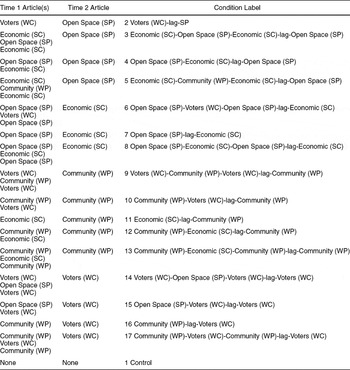
The first column of Table 2 lists the mix of frames to which respondents were exposed in each condition (at T1). The treatments introduce an array of competitive conditions that vary the strength and number of frames that participants receive. After reading the articles, participants were administered another questionnaire containing the key dependent variable: “Do you oppose or support the overall proposal to manage urban growth in the city?” Participants expressed their T1 opinion on a 7-point scale with higher scores indicating greater support.
Urban Growth Framed Articles over Time

Three weeks later, we recontacted participants at T2.Footnote 22 Participants in the original control group (condition 1) were retested without any additional treatment. Participants in the remaining 16 conditions read an additional article on the urban growth issue that drew on one of the original frames. Sometimes, the T2 editorial repeated a frame that the participant had received previously, and sometimes it was a new frame. The specific article received by participants in each of the 16 treatments is listed in the second column of Table 2. The last column of Table 2 lists, by condition number, the entire sequence of articles with the term “lag” used to mark the 3-week interval between exposures. In contrast to the Patriot Act experiment, we do not include conditions here that provided a T1 but no T2 frame (i.e., we look only at cell 4 in Table 1).
Notice that the conditions vary by whether the T2 frame is strong or weak. Conditions with strong T2 frames resemble sequences we explored in the Patriot Act experiment. We use the weak T2 frame conditions to investigate whether exposure to weak frames at T2 can influence T2 opinions by inducing elaboration and recollection of the T1 frame(s)—even if weak frames have no effect on their own. This would be similar to our finding in the Patriot Act experiment that a T2 frame can prompt individuals (in the no manipulation conditions) to recall an opposing T1 frame (thus resulting in balancing).
After receiving the T2 frame, respondents completed a brief questionnaire that included the same policy question asking whether they supported the proposal to manage urban growth using a boundary and other regulations.Footnote 23 Their answers to this question constitute their T2 opinions (i.e., our T2-dependent variable).
Unlike the Patriot Act experiment, we do not directly manipulate attitude strength. Instead, we operationalize strength by measuring individuals’ need-to-evaluate (NE) on the T1 questionnaire. Our NE measure consists of three items that ask individuals whether they tend to have opinions about most things, whether they tend to have more opinions than others, and whether they tend to hold definite opinions or remain neutral on most issues. These three items appeared in the 1998 National Election Study (NES) pilot, and the first two items have been included in subsequent NES surveys (for question wording, see online Appendix A). We create an overall NE measure by standardizing each item on a 0-to-1 scale before averaging them, meaning that higher scores indicated a higher NE (Bizer et al. Reference Bizer, Krosnick, Holbrook, Wheeler, Rucker and Petty2004, 1005).Footnote 24
As explained, we expect that individuals with a high NE will form stronger attitudes at T1 than will individuals with low NE. Therefore, we hypothesize that the T1 framing effect is more likely to endure among high NE individuals, leading these individuals to be less affected by the latest (T2) message.
Results
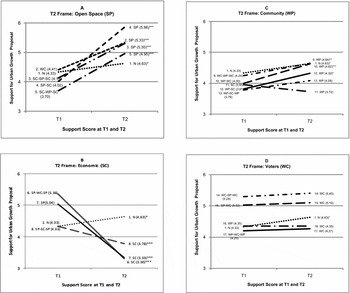
We present the results in graphs analogous to the ones used in the Patriot Act experiment—each graph plots average T1 and T2 opinions for the given condition. Statistical details on each condition, as well as the magnitudes of over-time change and T2 framing effects, are contained in online Appendix D. We divide the conditions into Figures 2A–D based on the frame respondents received at T2: Open Space (SP) (Figure 2A), Economic (SC) (Figure 2B), Community (WP) (Figure 2C), and Voters (WC) (Figure 2D). “N” indicates “no frame,” as previously, but applies this time only to the control group, which we include in each graph as a point of reference.
Urban Growth Proposal Support by Experimental Condition

At T1, we again see strong evidence for conventional framing effects. In every case where only one strong frame was offered at T1—that is, either the Open Space (SP) frame or the Economic (SC) frame—opinion moved significantly in the direction of that frame. This occurred regardless of whether there was exposure to weak frames [in addition to the strong frame(s)]. We also find that when only one or more weak frames appeared at T1, there are no significant framing effects (see also Chong and Druckman Reference Chong and Druckman2007b; Druckman Reference Druckman, Schaffner and Sellers2010). Finally, when individuals received both strong frames at T1, the frames offset each other. In sum, at T1, strong frames exerted significant effects, weak frames did not, and competing strong frames canceled out. (These statistical tests are based on the data in the table in online Appendix D. We also provide a regression analysis of T1 effects in online Appendix E. Both supplements are available at www.journals.cambridge.org/psr2010010) We neither expected nor do we find that our attitude strength construct—NE—moderates the impact of the T1 frames. These analyses appear in online Appendix E. The NE measure will presumably only matter at T2 once attitudes are formed; we return to this possibility later.
As in the Patriot Act experiment, we explore over-time dynamics by focusing on opinion change from T1 to T2, as reported in Figures 2A–D. Asterisks designate conditions with statistically significant over-time movement (also see online Appendix D). We again report, when relevant, the presence of T2 framing effects (i.e., comparisons with the T2 control mean of 4.63; see the final column of the table in online Appendix D). For conditions involving strong opposing frames received across two periods (conditions 3–8 in Figures 2A and 2B), the presence of a T2 framing effect suggests the passage of time changes the impact of a set of messages (as was the case in the Patriot Act experiment).Footnote 25
Figures 2A and 2B present results for conditions with a strong T2 frame. In every case, there is significant opinion change in the direction advocated by the T2 frame, reflecting a combination of decay of the T1 framing effect and a recency effect. We can gauge the extent of the decay and recency effect by comparing T2 opinion after exposure to both the T1 frames and the strong T2 frame, against T1 opinion following exposure only to the same strong frame. For example, condition 7 in Figure 2B shows that T1 exposure to the Open Space (SP) frame leads to a mean opinion of 5.04. In comparison, Figure 2A reveals that 5.04 either is less than or approximately equal to all T2 average opinions of respondents who received the T2 Open Space (SP) frame. Similarly, in Figure 2C, condition 11 shows an average opinion of 3.95 for those exposed at T1 to the Economic (SC) frame, which is greater than all Figure 2B means where respondents received the same frame at T2. These results indicate the effect of the T2 strong frames equaled or exceeded their effects at T1—even in cases where the T2 frames were preceded by contrary strong frames received previously at T1. In general, regardless of what combination of frames was received at T1, individuals who received a strong T2 frame reacted as if the T2 frame was the only message they had ever encountered (and they often showed even greater opinion change than when they received the frame alone at T1).
With one exception, all T2 effects reported in Figures 2A and 2B reflect significant T2 framing effects, always in the direction of the T2 frame. [The exception is the SC-WP-SC-lag-SP combination (condition 5) in Figure 2A, which just misses significance; see online Appendix D.] When there is a delay between opposing strong frames, the messages do not cancel each other as they do when received at one point in time. For example, in Figure 2A (condition 4), individuals who received SP-SC at T1 have a mean opinion (4.02) that does not differ from the control group. But individuals who received SP-lag-SC (Figure 2B, condition 7) showed a substantial framing effect at T2; their mean opinion of 3.33 is strongly biased in the direction of the more recent frame.
The decay of T1 framing effects in competitive conditions in the urban growth experiment contrasts with what we found in the Patriot Act experiment for nonmanipulated respondents. In the Patriot Act experiment, individuals in the no manipulation conditions balanced pro and con frames received over time (i.e., the frames canceled and overall opinion was indistinguishable from the control group mean). This difference between experiments might be due to the longer delay between exposures in the urban growth study (3 weeks vs. 10 days) and the lower salience of the urban growth issue, both of which may contribute to the decay of the T1 framing effect.
Turning to Figures 2C and 2D, we find some surprising results. In conditions involving exposure to strong T1 frames and weak T2 frames, we expected the T1 framing effects to decay significantly over time and the T2 weak frames to register insignificant effects. The net result of these two tendencies would be a reversion to the control group mean. Instead, we find systematic evidence of the persistence of T1 framing effects (i.e., lack of significant decay). There are five conditions (conditions 11–13 in Figure 2C and conditions 14 and 15 in Figure 2D) in which a weak T2 frame follows a strong contrary frame at T1. In four of the five cases (the exception being condition 12 in Figure 2C), the overall T2 opinion is not significantly different from T1 opinion, and the change of opinion is only marginally significant in the remaining case. Persistence is the rule rather than decay.
These results suggest exposure to the weak T2 frame increases the accessibility of the strong T1 frame even if the T2 frame does not change opinion, perhaps because encountering a weak argument motivates a search for superior counterarguments. However, we do not discern an obvious pattern in the circumstances when a T2 frame will stimulate recall of the T1 frame. As witnessed, in the urban growth experiment, strong T2 frames tend to dominate strong opposing frames received at T1. In the Patriot Act experiment, competition over time led to the balancing of opposing strong frames among individuals who were not manipulated to use either MB or OL processing. Variations across the two experiments that we cannot test systematically but that deserve further examination in future studies include the salience of arguments on the issue, the time span between exposures to competing frames, and the characteristics of frames that stimulate counterargument. It stands to reason that shorter intervals between exposures and more salient issues would increase the tendency for competing frames to cancel even when they are received sequentially over time.
Need-to-evaluate Effects We expect the amount of opinion change between T1 and T2, and therefore the magnitude of either primacy or recency effects at T2, to be moderated by an individual's NE. As explained, those with high NE scores will form stronger attitudes on the urban growth issue in response to the T1 treatment, making their opinions more stable and less susceptible to recent frames (i.e., recency effects).Footnote 26 Indeed, rather than showing a recency effect, the opinions of high NE individuals may be shaped disproportionately by early messages (a primacy effect). We explore these possibilities by focusing on the effect of NE on the amount of change in opinion between T2 and T1 opinions (see online Appendix D for the T2-T1 values by condition).
The more opinion changes between T1 and T2, the greater the influence of the most recent T2 frame because all significant changes between T1 and T2 represent movement in the direction of the last frame (i.e., a recency effect). When opinion does not change between T1 and T2 (i.e., the change is 0), it indicates the persistence of any T1 framing effect. We expect the attitudes of those with high NE to show persistence of any T1 effects and to be less affected by the most recent frame. Thus, as NE increases, we expect the amount of T2-T1 change to move toward 0 because these individuals will exhibit stability of T1 opinions.
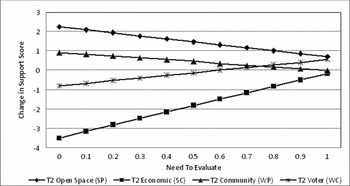
We graph the relationship between NE and T2-T1 opinion change in Figure 3 for each set of conditions that received a given T2 frame.Footnote 27 The plots come from simple regressions of our difference variable on NE. (Details of these regression models are available from the authors; in every case, the NE variable is significant at the 0.05 level.) At every NE level, the two strong frames are consistently more potent in changing opinions than are the two weak frames. The impact of any given T2 frame, however, is much greater at lower values of NE than at higher values. As individuals’ NE scores increase, the difference between T1 and T2 opinion diminishes and approaches 0. Therefore, as we move from low to high on the NE scale, we go from strong recency effects among low scorers to approximately equal balancing of early and late frames among those who score moderately high on the NE scale, and, finally, to strong primacy effects among those who score at the very top end of the NE scale.
Impact of Processing Mode on Opinion Change from Time 1 to Time 2

The graph reinforces our previous observation that recency effects predominate when the last message is a strong frame. Even individuals with a 0.8 score on the 0-to-1 NE scale are affected significantly by the strong T2 frames; for example, those who received the Open Space (SP) frame become nearly 1 full point (on a 7-point scale) more supportive of regulating growth, whereas those who received the Economic (SC) frame become 1 full point less supportive. High NE clearly leads to more stable opinions and diminishes the impact of the latest frame, but staunch resistance to the T2 frame's effect occurs only at the maximum NE levels. This is not to dismiss the stability of the high NE individuals—indeed, 25% of our sample has an NE score of 0.80 or higher—but, the modal outcome in response to frames received over time is a recency effect.Footnote 28
To summarize our urban growth experiment results:
• Our baseline expectation that framing effects decay over time was confirmed. Although strong T1 frames had a significant influence on opinions at T1, this effect decayed over time and T2 opinions were more heavily influenced by the more recent strong T2 frame. In contrast to simultaneous competition, sequential competition produced significant recency effects rather than balancing.
○ This result contrasts with our finding in the Patriot Act experiment where exposure to two strong frames over time had a canceling effect in the no manipulation conditions. The difference may stem from the longer delay between messages in the urban growth experiment and lesser salience of the urban growth issue.
• Framing effects created by strong T1 frames, however, tended to persist through T2 when followed by exposure to a weak T2 frame. A weak T2 frame may counteract decay of the T1 effect by motivating respondents to search for a stronger frame. Although the T2 weak frame had no direct effect on opinions, it may have stimulated recall of the T1 strong frame.
○ This is consistent with the Patriot Act results, where the T2 strong frame appeared to prompt consideration of the T1 frame.
• Individuals with a high NE formed stronger and more durable attitudes in response to communications. Therefore, the relative weight given to early and late frames varied by an individual's NE. Recency effects were large at low levels of NE, but diminished in size as NE increased. At moderate to high levels of NE, balancing occurred because both early and late frames influenced overall opinion; however, at the highest levels of NE, primacy effects prevailed because only the first frame shaped opinion, whereas the last frame had no effect.
• These results reveal the varieties of attitude change that can occur when multiple competing messages are received over time (cell 4 of Table 1). Depending on the sequence of messages and how information is processed, later messages can be rejected, offset or dominate previous messages, or stimulate recall of previous arguments.
CONCLUSION
We examined how people are influenced by competing messages about political issues received over the course of a campaign or debate. Not only were people's attitudes affected by the content of messages, but the sequence and timing of communications also had a significant impact. Both experiments demonstrate that competition between messages received over time and direct competition between messages at the same time yield significantly different preferences. When competing messages are received simultaneously, individuals can weigh the relative merits of opposing arguments. But when people receive competing messages across different periods rather than concurrently, the accessibility of previous arguments tends to decay over time. Consequently, individuals typically give greater weight to the more immediate cues contained in the most recent message. Democratic competition thus may reduce or eliminate framing effects only when people are presented with opposing frames at the same time (e.g., Chong and Druckman Reference Chong and Druckman2007b; Hansen Reference Hansen2007; Sniderman and Theriault Reference Sniderman, Theriault, Saris and Sniderman2004).
Although both experiments captured the general tendency of framing effects to decay over time, we also found significant individual variation in the strength and stability of attitudes. Some individuals are more motivated to process information in a manner that generates strong attitudes. These strong attitudes are more likely to endure over time and to be sustained in the face of contrary information. We looked specifically at the moderating effects of an individual's mode of processing information (online vs. memory-based processing) and NE.Footnote 29
Two potential anomalies in our results bear greater scrutiny. Among individuals in the baseline (no manipulation) group in the Patriot Act experiment, T1 framing effects decayed when there was no further T2 exposure, but T1 frames unexpectedly offset opposing T2 frames in competition over time. Similarly, in the urban growth experiment, exposure to a strong frame at T1 followed by a weak contrary frame at T2 produced opinions that continued to be shaped significantly by the previous T1 frame.
These results suggest that persistence of framing effects may be related to contextual factors such as the salience of the issue, the duration of time between messages, or the particular combination of frames received. The interval between exposures in the Patriot Act experiment was only 10 days compared to the 21-day gap between T1 and T2 frames in the urban growth experiment. When combined with the greater salience of the Patriot Act issue, the shorter time frame may have increased the accessibility of competing strong frames even when exposure was sequential over time (for individuals not induced to process in an MB or OL manner). In the urban growth experiment, weak frames encountered at T2 may have stimulated a search for better arguments, leading to the recall of strong frames received at T1. This psychological process may resemble the “contrast effects” we found in our previous research (Chong and Druckman Reference Chong and Druckman2007b), which showed that a contrasting combination of strong and weak competing frames can magnify the influence of the strong frame by heightening the strength of the argument it conveys.
The marginal difference in salience between the Patriot Act and urban growth issues is probably less significant than the low absolute levels of knowledge that people possess on most issues, including the two we studied. Survey analyses of attitudes toward the Patriot Act show the public is largely uninformed about the provisions of this complex legislation. Although individuals are able, in varying degrees, to draw on their values, partisanship, and familiarity with relevant arguments to evaluate this issue, they are, in general, significantly influenced by the most recent cues and information they encounter. Survey experiments confirm that public support for the Patriot Act fluctuates considerably depending on the structure and wording of questions (Best and McDermott Reference Best and McDermott2007). Our experiment using the Patriot Act showed furthermore that such framing effects are short lived for most respondents. Individuals are moved by how the issue is framed if their opinions are recorded immediately, but (with the exception of highly motivated individuals) they tend to return quickly to their original position. Public opinion toward the Patriot Act might nevertheless appear relatively stable over time despite the rapid decay of communication effects if opinion is refreshed intermittently by repetition of arguments in the media (or perhaps as long as survey organizations frame their questions about the issue in an identical manner over time).
Decades of research on public opinion and political participation have depicted a citizenry that holds weak and pliable attitudes toward politics. However, several factors can help mitigate individual susceptibility to manipulation through political communications. First, individuals can compensate for their lack of detailed knowledge by using partisan cues to judge issues (Druckman Reference Druckman2001b). Second, individuals can evaluate competing positions on an issue by siding with arguments that are consistent with their political values (Chong Reference Chong2000). These stable, highly accessible predispositions provide individuals with a consistent basis for evaluating communications and resisting arbitrary framing effects. In supplementary analyses available from the authors, we found that attitudes toward the Patriot Act were more strongly influenced by both partisanship and values than exposure to frames, although frames still exerted a significant influence on individual preferences after accounting for these predispositions.
A third stabilizing factor is more effortful processing of political information. The public's lack of motivation to engage deeply in politics does not mean they are unable to evaluate information more deliberately. Our experiments not only demonstrate that it is possible to induce elaborated processing of political arguments, but also that deliberate processing leads to stronger attitudes that endure and resist opposing arguments. Motivated processing of information, therefore, offers additional defenses against arbitrary framing effects in concert with partisan identifications and general political values.
Indeed, the manipulation of OL processing appears to have worked too well because OL processors proved virtually impervious to later arguments after they had formed their opinions on the basis of the first (randomly assigned) arguments they encountered. Too much stability verges on unhealthy rigidity. In comparison, only individuals at the highest levels of the NE scale showed comparable primacy effects in the urban growth experiment. Although it is essential to a democratic system that people have preferences and that such preferences withstand arbitrary framings of issues and choices, it is also desirable that people remain willing to entertain alternative arguments and solutions, as well as the possibility that their own beliefs are fallible. The same caution applies to the role of partisan and ideological values in counteracting framing effects. Political predispositions should not be so dominant as to overwhelm any potential influence of new information contained in frames. A crucial empirical question is whether there are contextual factors that can motivate individuals to give appropriate weight to both long-term factors (i.e., identifications, values, and prior attitudes) and new information. A more fundamental normative issue is what constitutes a proper balance between predispositional and informational factors in political decision making?
Future research should also examine the dynamics of opinion in alternative competitive contexts and on different issues. Campaigns vary in the intensity of debate, which can be simulated in experiments (within practical constraints of maintaining an experiment over time and preventing panel attrition) by manipulating the frequency of exposure and the intervals between messages. To test our predictions about over-time movement, we deliberately selected two issues (regulating urban growth and renewal of the Patriot Act) on which people were likely to be susceptible to influence by communications. We believe that the dynamics we observed on our experimental issues would be characteristic of any topic of moderate salience, which given the generally low levels of political engagement by the public perhaps describes the status of most political issues.
Although our experimental results are inevitably bound to some degree by the substantive issues we have chosen, our conceptual framework and psychological theory provide guidance about the dynamics of opinion on other types of issues (e.g., cell 1 of Table 1). Issues that evoke passionately held values should be less susceptible to framing effects. Partisan and ideological values, in particular, will be more strongly connected to issues that have been subject to regular elite debate. On such issues, framing effects are more likely to be moderated by predispositions if individuals can use partisan and ideological cues to evaluate the strength of frames.
The effectiveness of any particular communication strategy will depend on the characteristics of the target audience (specifically, its values, knowledge, and processing style), the availability and applicability of the frames employed (i.e., whether they are strong or weak), and the degree to which there is competition and debate over the issues. The magnitude of framing effects at different junctures of a campaign depends on the extent to which citizens learn and retain information. Individuals who more efficiently process and store information—the online processors and those with a strong NE—are less likely to be moved by the latest frame because they are stabilized by the attitudes they have developed in prior phases of the campaign. Indeed, there are promising hints in the data that longer-term exposure to debate (beyond the two-round campaign we simulated) would gradually familiarize motivated individuals with both sides of the issue and diminish the subsequent influence of one-sided frames.Footnote 30
Evidence can be drawn from our experiments to recommend campaigning early (to shape the initial attitudes of online processors or those high in NE), often (to ensure continual engagement and competition with opposing ideas), and late (to take advantage of rates of decay of opinion, particularly among memory-based processors or those low in NE). Early campaigning aimed at motivated individuals can create initial attitudes that have inertia over the course of the campaign. Continual engagement and repetition of themes is necessary because opinions tend to weaken over time unless they are periodically reinforced, leaving audiences susceptible to the most recent frames received.
Finally, our findings have implications for the evaluation of democratic practice. Competition is the sine qua non of democracy, but the form it takes has different consequences for public opinion. We have focused our attention on the variable effects of competing communications depending on their timing in a campaign. Our results point to the importance of analyzing competition within a dynamic framework that accounts for both the balance and order of messages and for how individuals process information. Competition does not have equal effects or confer equal benefits on all citizens because individuals learn and forget information at different rates over time. Although some individuals balanced competing messages received over time, most individuals were shown to be vulnerable to the vagaries of timing and the framing of communications.




Comments
No Comments have been published for this article.