

Introduction
In its previous mandate (2019–2024), the European Commission advanced an ambitious legislative agenda to embed sustainable trade objectives within its internal and external economic policies. Flagship initiatives—notably the Corporate Sustainability Due Diligence Directive (CS3D), the Corporate Sustainability Reporting Directive (CSRD), the EU Deforestation Regulation, and the Carbon Border Adjustment Mechanism (CBAM)—aimed not only at enhancing global environmental and labor standards, but also at transforming global value chains (GVCs), by requiring firms selling to the EU market to internalize (or at least take responsibility for) the environmental and social externalities of global production within their cross-border operations. This approach was rooted in EU policymakers’ long-standing belief in the “Brussels effect”—their ability to leverage market access to shape global regulatory convergence.Footnote 1 These initiatives were intended to enter into force progressively from 2025 onwards, marking a decisive shift towards rule-based sustainability governance of GVCs.
However, within weeks of taking office, the new European Commission (2025–2029) announced that it would undertake a series of “Omnibus” reform packages, signaling a sharp departure from this regulatory trajectory.Footnote 2 Officially presented as an exercise in “simplification” to reduce “administrative burdens,” the packages were framed as technical measures.Footnote 3 Yet it rapidly became apparent that the initiative went well beyond procedural adjustment. The first Omnibus proposed substantive revisions to two core Directives—CSRD and CS3D—as well as changes to the operation of CBAM, thereby reopening cornerstones of the EU’s sustainability governance framework before they had even entered into force.
This move triggered immediate opposition from civil society organizations and trade unions, who interpreted Omnibus I as a rollback of hard-won social and environmental protections in the name of “competitiveness.” More than 170 organizations jointly rejected the initiative,Footnote 4 while trade unions denounced it as “a gift to corporate lobbyists at the expense of workers and the planet.” Footnote 5 Coming in a context where public support for the Directive was strong,Footnote 6 the speed and scale of this reversal is striking. The central puzzle addressed in this article is thus: what (geo)political processes led the EU to dilute its most ambitious sustainability-oriented trade regulation at precisely the moment it was poised for implementation?
This process unfolded in a context that was increasingly framed as economically and geopolitically constraining. The return of Donald Trump to the U.S. presidency in 2025, the growing politicization of transatlantic trade relations,Footnote 7 and the continuation of the war in Ukraine were widely invoked by European actors as evidence of a fundamentally altered external environment.Footnote 8 Within this framing, notions of “risk,” “urgency,” and “competitiveness” acquired renewed prominence in debates over the EU’s regulatory trajectory. Importantly, this narrative did not emerge ex nihilo. It resonated with long-standing tensions between regulatory ambition and economic performance in EU discourse, most recently articulated in the Draghi Report, a 2024 report on EU competitiveness commissioned from the former head of the ECB that criticized excessive regulation.Footnote 9 What changed between the last legislature and the second Von der Leyen Commission, was the way in which these elements were prioritized, reassembled and politically mobilized to legitimize a rapid reconsideration of the EU’s sustainability-oriented trade agenda.
Against this backdrop, this paper examines how key actors in the EU policy arena—policymakers, business representatives, trade associations, NGOs, and trade unions—interpreted and responded to this shifting context. It analyses how appeals to “geopolitics” and “competitiveness” enabled a process of regulatory recalibration of the EU’s sustainable trade agenda, and how actors engaged in the debate adjusted their strategies, expectations, and modes of mobilization in response. In so doing, the article focuses on the mechanisms through which geopoliticization—defined as “a process through which geopolitical considerations gain importance relative to others”Footnote 10 —interacted with internal policy coalition dynamics to produce concrete regulatory outcomes.
Like the other contributions to this Special Issue, our study must confront the issue of observational equivalence. The Omnibus reform could plausibly be attributed to several factors—geopoliticization, domestic political contestation, or conventional business lobbying. Rather than seeking to establish geopoliticization as the sole cause of regulatory recalibration, our objective is to identify the mechanisms through which geopolitical considerations became increasingly salient relative to alternative explanations. By combining documentary analysis, lobbying data, and repeat interviews with many of the same actors over time, we trace how geopolitical narratives interacted with existing business interests and coalition dynamics, increasing the political leverage of some actors over others. Although this did not render conventional economic interests irrelevant, it certainly changed the power dynamics at play.
This article thus contributes to research on the geopoliticization of trade and GVCs by shifting the focus from regulatory outcomes to the meso-level political mechanisms through which geopolitical narratives reshape regulatory authority. Instead of assuming that competitiveness pressures or geopolitical risks mechanically produce regulatory change, we examine how these considerations were politically constructed, strategically mobilized, and selectively amplified relative to alternative economic and political explanations. By tracing how core actors repositioned themselves during the revision of CS3D, the article shows how geopoliticized narratives rebalanced competing business coalitions and facilitated regulatory backtracking through strategies of anticipatory and reactive blame avoidance. In so doing, the article contributes to the meso-level research agenda outlined in the introduction to this issue, by examining how macro-level geopolitical developments are translated into regulatory change through domestic political processes. Rather than treating geopoliticization as an exogenous driver of policy outcomes, we identify the coalition dynamics, strategic framing, and patterns of political mobilization through which geopolitical considerations reshape regulatory authority over GVCs.
Conceptually, we advance the notion of geopoliticized regulatory recalibration to capture this process of adjustment of regulatory ambition and scope through the strategic mobilization of geopoliticized narratives to advance dominant interest coalitions and their policy programs. Empirically grounded in the EU’s regulation of GVC sustainability, this approach offers broader insights into how regulatory power is exercised—and constrained—in an era of trade fragmentation, politicized interdependence, and intensified contestation across interest groups.
The article proceeds as follows. The next section develops an analytical framework linking geopoliticization, coalition politics, and policy dismantling to explain how geopolitical pressures are translated into regulatory change. The subsequent section outlines the methodology and data. The empirical analysis then traces the emergence of CS3D, the political and geopolitical framing surrounding the Omnibus reform, before leveraging lobbying data and interviews to explore the shifting strategies and influence of key business and civil society actors during the revision process. The final section draws out the implications for theories of business power, regulatory authority, and policy dismantling in the context of transnational economic governance and reflects on how our findings advance understanding of the processes underlying policy construction and dismantling. We also suggest how the concept of geopoliticized regulatory recalibration could be mobilized to understand similar processes in other domains.
Theoretical framework: geopoliticization, coalition politics, and regulatory change
Understanding how sustainability-oriented regulation can be rolled back in the absence of electoral pressure or policy failure requires integrating insights from three bodies of scholarship: research on the geopoliticization of EU trade policy and regulatory power; the political dynamics of policy dismantling and blame avoidance; and the role of business and societal actors in shaping regulatory outcomes. Rather than treating these as parallel contributions, this section reads them sequentially to illuminate how macro-level geopolitical dynamics interact with meso-level institutional and coalition dynamics to produce concrete regulatory change.
Figure 1 summarizes the analytical framework. We argue that, in contexts where regulation has external effects, regulatory change emerges from the interaction between external geopolitical pressures and domestic political dynamics. Geopoliticization and foreign regulatory pressure shape the context in which EU policymakers operate, but they do not determine regulatory outcomes. Rather, outcomes depend on how political and societal actors mobilize these external pressures within the EU policy process. Political actors influence agenda-setting, procedural choices, and policy justification, while societal actors seek to shape outcomes through coalition-building and lobbying. The interaction between these actors can rebalance policy coalitions, amplify some interests over others, and alter the political feasibility of regulatory change. We conceptualize this process as geopoliticized regulatory recalibration: the adjustment of regulatory ambition through the strategic mobilization of geopolitical pressures within domestic regulatory politics.
EU regulatory outcomes in a geopoliticized trade environment: a theoretical framework.

The international environment: geopoliticization and the EU’s regulatory power
EU trade policy has long been understood to be the product of interactions between external pressures and internal institutional dynamics.Footnote 11 Politicization is commonly understood as the concurrent increase in the salience and contestation of policy issues.Footnote 12 High-profile trade policy controversies such as ACTA,Footnote 13 TTIP,Footnote 14 and CETA, have illustrated how trade policy can move from the realm of “quiet politics”Footnote 15 to more visible and contentious forms of “noisy politics.”Footnote 16 In the latter, public scrutiny, interest group mobilization, and political activism reshape both policy content and decision-making dynamics. Importantly, this literature has moved beyond treating politicization as an outcome, instead analyzing how actors adapt to heightened contestation. For instance, research has shown how institutional position, actor type, and issue framing can condition their choice of strategies such as confrontation, avoidance, free-riding, or bandwagoning.Footnote 17
More recently, scholarship has focused on the geopoliticization of EU trade policy—a process through which geopolitical considerations gain importance relative to market logics, reframing relations of interdependence in terms of security, power rivalry, and autonomy.Footnote 18 The EU’s longstanding neoliberal consensus on trade has been challenged by Covid-19, US–China rivalry, the weaponization of interdependence, and the resurgence of protectionist industrial policy in major economies.Footnote 19 The EU’s “Open Strategic Autonomy” agenda reflects this shift.
These developments also have implications for the EU’s regulatory authority. The EU’s capacity to shape global standards through the “Brussels Effect” ultimately depends on sustained political support for ambitious regulation.Footnote 20 GVCs function as key transmission channels through which EU regulatory requirements cascade along cross-border production networks.Footnote 21 Yet rising geopolitical tensions have increasingly linked regulatory policy to concerns about competitiveness, economic security, and de-risking. This has generated what some have described as a “deregulation dilemma”: pressure to streamline or roll back the very regulatory frameworks through which the EU projects its regulatory influence internationally.Footnote 22 Geopoliticization therefore creates the conditions under which regulatory recalibration becomes more likely, although it cannot alone explain why recalibration occurs in some cases and not others.
Coalitions and narratives within EU politics
Shifts in the international environment do not translate automatically into regulatory outcomes. Whether geopolitical narratives produce regulatory rollback depends on how they are taken up, mobilized, and legitimized by actors within EU domestic politics. The analytical focus therefore shifts to domestic politics: how EU political and administrative actors define policy problems, how business and societal actors mobilize around them, and how these interactions shape regulatory change.
In the EU, policy rollback is shaped by the capacity of well-positioned actors—Commission officials, parliamentary majorities, member state governments—to define dominant interpretations of policy problems and create political space for regulatory retrenchment.Footnote 23 The literature on policy dismantling is useful in this regard. Dismantling is defined as any policy change that directly reduces either the density or the intensity of existing policies: density referring to the scope of instruments, actors, or transactions covered, and intensity to the stringency of regulatory obligations and enforcement mechanisms.Footnote 24 Dismantling is politically difficult, as policymakers risk being held responsible for visible losses. This generates strong incentives for blame avoidance—strategies that minimize the political costs of rollback by limiting its visibility or diffusing responsibility.Footnote 25 Two sequential forms of blame avoidance have been identified.Footnote 26 Anticipatory blame avoidance involves pre-emptive efforts to reduce the likelihood of blame attribution. Reactive blame avoidance follows once contestation has intensified: responsibility for rollback is externalized to pressures presented as constraints beyond policymakers’ control. In multi-level governance settings, this diffusion of responsibility across institutional levels and external actors is especially effective,Footnote 27 and is amplified when external geopolitical constraints can be credibly invoked.
By participating in the policy process, business and societal actors also shape regulatory outcomes, but their influence is neither fixed, nor evenly distributed. Organized business interests often enjoy structural advantages, including superior resources, technical expertise, and privileged access to decision-makers. This can translate into significant influence, especially in complex and technical policy domains.Footnote 28 At the same time, a large body of research cautions against treating business power as either uniform or automatic.Footnote 29 Instead, business influence in the EU is fragmented, conditional, and mediated by institutional context and issue framing.Footnote 30 Business actors, like other interest representatives, have a variety of tactics at their disposal including, not just direct appeals to policymakers, but “outside” lobbying defined as “…tactics that indirectly address policymakers through mobilizing and raising the awareness of a broader audience.”Footnote 31 As we will see below, both types of tactics are evident in the CS3D debate.
Whether these lobbying strategies translate into policy influence depends on how business interests are organized and on the institutional and political environment in which they operate. Early work demonstrated how sectoral winners and losers mobilize at both the national and EU levels to shape trade policy preferences within a multi-level governance system.Footnote 32 Yet historical analyses showed that shifts in institutional structures and bargaining power can generate outcomes that do not reflect business preferences, underscoring the importance of broader political context in conditioning influence.Footnote 33 More recent studies highlight that when interests diverge within the business community, individual firms may bypass sectoral associations and lobby EU institutions directly, strategically selecting venues and moments across the policy cycle (so called “venue shopping”).Footnote 34 At the same time, firms tend to avoid lobbying alone on highly politicized topics, leaving trade associations to take policy stances on controversial issues.Footnote 35 Overall, industrial fragmentation can weaken aggregate business influence, particularly where import-dependent firms diverge from more protectionist industry coalitions.
Meanwhile, civil society actors can successfully influence policy by forming broad coalitions, increasing issue salience and encouraging certain firms to break ranks with their peers,Footnote 36 including in the case of CS3D.Footnote 37 Business success tends to depend on alignment with key institutional actors, low public salience, and the absence of strong counter-mobilization by NGOs or public opinion,Footnote 38 although salience has been shown to wane over time, providing an opportunity for business to reopen debates.Footnote 39 In trade policy, the capacity to mobilize broad and internally diverse coalitions has been shown to facilitate liberalization, while fragmented or contested coalitions often face greater political resistance.Footnote 40
The implication is that institutional context affects not only what actors want, but whose preferences are heard. Under conditions of geopoliticization, claims about competitiveness, security, and urgency can increase the influence of actors whose demands align with dominant political priorities, while reducing the leverage of coalitions that had supported regulatory expansion. Coalition politics therefore operates through selective access and narrative amplification rather than through a stable hierarchy of interests. The same constellation of actors may carry very different weight depending on whether the dominant policy narrative emphasizes sustainability commitments or geopolitical vulnerability.
Geopoliticized regulatory recalibration: integrating the framework
The preceding discussion suggests that regulatory change under conditions of geopoliticization is best understood as a political process rather than as a direct response to external constraints. Geopolitical developments may alter the environment in which policymakers operate, but they influence regulatory outcomes mainly through their interaction with domestic institutions, coalitions, and political strategies. We refer to this process as geopoliticized regulatory recalibration: the adjustment of regulatory ambition through the political mobilization of geopolitical pressures within domestic regulatory politics.
This perspective directs attention to the mechanisms through which geopolitical pressures are translated into regulatory outcomes. As geopolitical concerns gain salience, some actors and interactions become more politically relevant than others. Arguments centered on competitiveness, economic security, or strategic vulnerability may resonate more strongly with decision-makers than competing claims grounded in sustainability or social objectives. In turn, this can rebalance policy coalitions, altering which interests gain access to policymakers and which preferences are reflected in regulatory outcomes.
These shifts also shape how regulatory change is justified. Where rollback is contentious, policymakers have incentives to minimize its political costs. They may initially present substantive reforms as technical adjustments or simplification measures, thereby reducing the likelihood of early opposition. Once contestation emerges, responsibility can be shifted onto external constraints such as geopolitical rivalry, economic uncertainty, or foreign regulatory pressure. In this way, geopolitical pressures become not only a source of policy change but also a means to instill it with political legitimacy.
The framework therefore treats regulatory outcomes as contingent rather than predetermined. Whether geopolitical pressures contribute to regulatory expansion, recalibration, or dismantling depends on the interaction between actors, coalition dynamics, and the legitimacy of competing interpretations of the external environment. The empirical analysis that follows examines these dynamics in the case of the CS3D Omnibus reform, showing how geopolitical pressures, coalition rebalancing, and blame avoidance combined to facilitate regulatory rollback.
Methodology
This study adopts a qualitative case study design aimed at reconstructing the sequence of events and identifying the political mechanisms through which regulatory recalibration unfolded. Our analysis is centered on the revision of the CS3D within the EU’s 2025 Omnibus I reform. While this package covers three regulatory initiatives with distinct objectives and technical features, the analysis focuses on CS3D for both analytical and empirical reasons. Substantively, CS3D is the component of Omnibus I that most directly targets the governance of GVCs, as it sought to regulate corporate behavior along transnational production networks through binding due diligence obligations. This makes it a particularly appropriate case for examining how regulatory authority, business influence, and geopolitical framing interact in EU trade and regulatory politics. Politically, it also emerged as the most contested element of the reform, especially in the context of transatlantic trade tensions. Although CS3D is not a traditional trade policy measure, it seeks to regulate trade and was explicitly referenced in the EU–US trade agreement.Footnote 41 It has also attracted sustained criticism from US business groups,Footnote 42 legislators,Footnote 43 and even local US law enforcement officials,Footnote 44 rendering it a salient case through which to examine the interaction between geopoliticization, regulatory rollback, and business influence.
Empirically, our analysis draws on a combination of documentary sources and semi-structured interviews. Documentary material includes official EU documents, legislative texts, policy communications, press releases, position papers from business associations, NGOs, and trade unions, as well as relevant coverage in the specialized press. These sources provided insight into the formal positions adopted by key actors and the public framing of the Omnibus reform. They also allowed for systematic comparison between the original CS3D negotiations and the subsequent revision process.
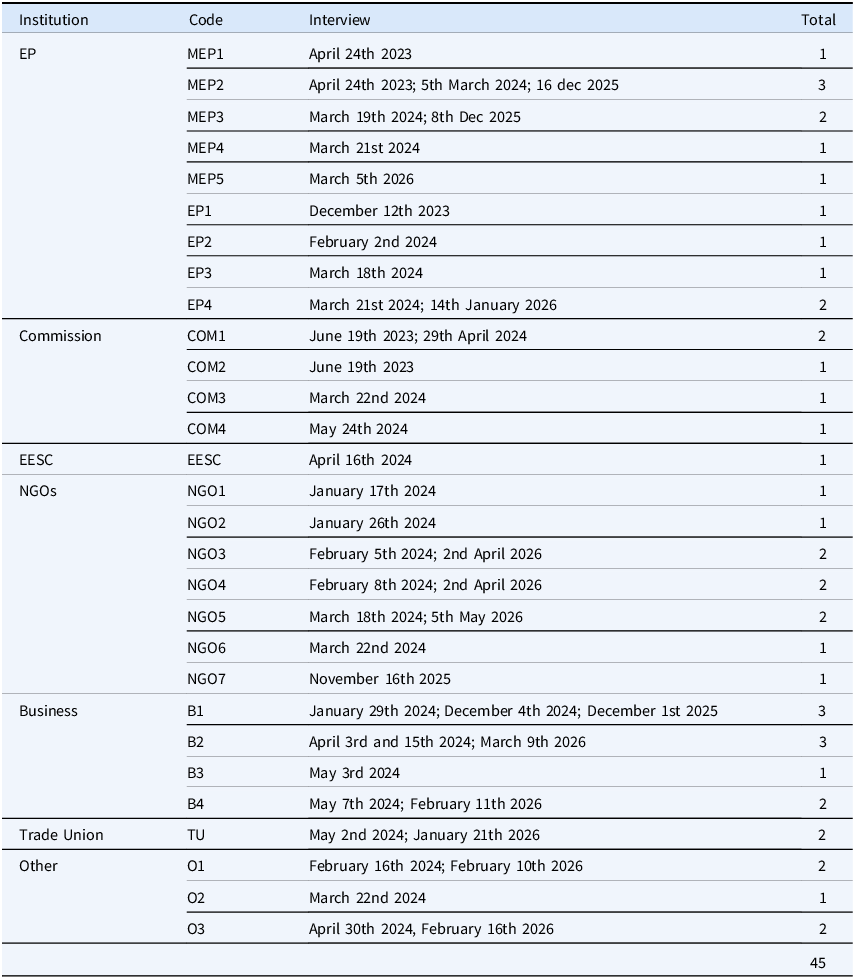
This documentary analysis was complemented by analysis of lobbying data and 45 semi-structured interviews designed to capture actor perceptions, strategies, and shifts in expectations over time. We extracted the information on lobbying activity in the European Parliament from the administrative file for CS3D and Omnibus and analyzed these data to identify the key actors in the debate. This both provided us with a detailed overview of lobbying activity and helped us to identify appropriate interview subjects. The study employed a two-stage interview design. Our first wave of 31 interviews was conducted during the 2023-2024 negotiations leading to the adoption of CS3D. We targeted the most active interest groups, but also used snowballing techniques asking initial interviewees to recommend other actors. These interviews focused on understanding how a sufficiently broad political and societal coalition emerged around an ambitious and extraterritorial regulatory initiative, and how it managed to secure such an outcome despite strong business pushback. A second wave of 14 interviews was conducted in 2025–2026, as the Omnibus reform was being prepared and finalized.Footnote 45 These interviews revisited many of the same interlocutors and concentrated on their perceptions of the motivations behind the reform, which actors and narratives gained prominence, how geopolitical pressures were weighed against other drivers, and how these shifts affected their strategies and expectations over time.
Interviewees included EU policymakers and parliamentary staff, representatives of business associations, trade union officials, NGO representatives, and policy experts closely involved in the CS3D process. Given the sensitive and conflictual nature of the discussions, all interviews were conducted under conditions of anonymity. Interviewees are therefore identified only by their institutional role or organization. A full list of interviews is provided in Appendix 1. Interviews were in English, lasted between 60–90 minutes and were transcribed before being coded. Coding proceeded in two stages, following a hybrid approach to thematic analysis.Footnote 46
First, transcripts were coded inductively to identify recurring themes, actor perceptions, and emerging explanations of the Omnibus reform. This open coding process generated a set of data-driven categories relating to changes in the political context, lobbying strategies, access to decision-makers, and perceptions of geopolitical pressure. In the second stage, these codes were reviewed and organized deductively in relation to the analytical framework developed above: geopoliticization, coalition politics, and regulatory change. Particular attention was paid to evidence of (1) geopoliticized narratives and their mobilization, (2) shifts in coalition dynamics and patterns of access, and (3) anticipatory and reactive blame avoidance strategies. Coding was iterative, moving repeatedly between interview transcripts, documentary evidence, and the emerging analytical categories to ensure that theoretical interpretations remained grounded in the empirical material. In the next two sections we draw on these interviews to help us understand both the process of reform and the underlying motivations behind it.
Understanding the context: CS3D and the political dynamics of the Omnibus
Baseline: what CS3D was designed to do (and why it mattered)
The CS3D was designed to establish a common EU framework for how companies should identify, prevent, mitigate, and account for adverse human rights and environmental impacts linked to their operations across transnational production networks. Rather than relying on voluntary corporate social responsibility instruments—such as audits, certifications, codes of conduct, or multi-stakeholder initiatives—CS3D sought to translate emerging norms of responsible business conduct into binding legal obligations. In so doing, it marked the first ambitious attempt to govern sustainability outcomes along GVCs connected to the EU market.Footnote 47
The policy intensity and policy density of the initial CS3D were both relatively high. In terms of density, the Directive was designed to apply to large firms operating in the EU market, defined as companies with more than 1,000 employees and a global turnover of at least €450 million. Application was to be phased in, beginning in 2027 with the largest companies—those employing more than 5,000 workers and generating over €1.5 billion in turnover. Crucially, these thresholds applied not only to EU-headquartered firms, but also to non-EU companies active in the EU market above the same turnover levels. Supporters viewed this extraterritorial dimension as essential to preventing regulatory arbitrage and ensuring a level playing field (TU, May 2024; MEP1, MEP 2, April 2023), while critics framed it as an assertion of unilateral transnational regulatory reach.Footnote 48
In terms of intensity, CS3D imposed substantive behavioral obligations backed by enforcement mechanisms intended to make compliance credible. Firms were required not only to identify and report risks, but to take action to prevent or mitigate harm linked to their chain of activities. The Directive included provisions for administrative sanctions and civil liability where companies failed to meet these obligations, with potential fines reaching up to 5 percent of global turnover. These enforcement provisions distinguished CS3D from voluntary sustainability initiatives and were explicitly designed to incentivize changes in sourcing practices, contractual arrangements, and internal governance structures.
Three design features were particularly consequential—and would later become focal points of contestation. First, the scope of due diligence obligations, including the extent to which firms were expected to look beyond their direct (Tier 1) business partners, made CS3D operationally demanding. Second, the liability and enforcement regime, especially the possibility of civil liability, raised concerns among business actors about legal exposure and litigation risk. Third, the breadth of firm coverage, including the inclusion of non-EU companies and the relatively low thresholds for application, amplified debates about competitiveness, proportionality, and extraterritoriality.
The Directive was an ambitious attempt to reconfigure corporate accountability across fragmented GVCs. Compliance with CS3D implied changes in internal risk-management systems, supplier relations, monitoring practices, and, in some cases, decisions about disengagement from high-risk contexts. These adjustments are costly, unevenly distributed across firms and sectors, and difficult to standardize—features that would later feed into claims about administrative burden and feasibility.
CS3D thus represented a high-water mark in the EU’s attempt to embed binding corporate obligations along GVCs. Its combination of extraterritorial reach, enforceable duties, and broad firm coverage helps explain both the coalition that initially supported its adoption and the intensity of the backlash that emerged once the political context shifted. Understanding this baseline is essential for the analysis that follows: the Omnibus reform primarily targeted these core design features, reducing both the intensity and the density of the Directive while formally preserving its overall architecture.
The Omnibus reform as anticipatory policy dismantling
The Omnibus process marked a decisive break in the trajectory of EU GVC regulation, not because it repealed CS3D outright, but because it reopened and diluted its core provisions before the Directive had entered into force. This timing is central to understanding the reform as a case of anticipatory policy dismantling. Rather than responding to implementation failures or demonstrated economic costs, the European Commission sought to recalibrate the Directive pre-emptively, framing the reform as a technical exercise in “simplification” required by an urgent and deteriorating economic and geopolitical context.
This geopolitical context was a key motivator justifying action. In the speech to the Parliament in which Von der Leyen announced the Omnibus, she framed the challenges facing Europe in terms of an increasingly conflictual global environment: “A world in which every weakness is weaponized, every division pounced upon and every dependency exploited. Our freedom and sovereignty depend more than ever on our economic strength. Our security depends on our ability to compete, innovate and produce.”Footnote 49 Here and in later speeches,Footnote 50 the simplification agenda was squarely presented as an integral part of the EU’s struggle for self-preservation in a combative world. Competitiveness was not a “nice-to-have” option, but a “must-have” for Europe’s security.
Formally, the Omnibus I package encompassed revisions to several legislative instruments—CBAM, CSRD, and CS3D. While the CBAM adjustments were relatively narrow and uncontroversial, the proposed revisions to CS3D and CSRD were substantive and politically contentious. Although CSRD and CS3D are legally distinct instruments, their revision was bundled into a single legislative process, effectively narrowing the scope of debate and reducing policy density by merging two previously separate regulatory trajectories.
This Omnibus process was highly unusual. While EU legislation usually includes review clauses and is subject to periodic evaluation, revising Directives that were not yet in force represented a sharp departure from standard practice. The Commission justified this exceptional approach by invoking urgency, including in terms of the deteriorating geopolitical context discussed above. In its proposal, it argued that the “…current economic environment, characterized by rapid technological advancements, shifting consumer demands, and increased global competition…” required swift action, making a full impact assessment impossible.Footnote 51 The Commission further claimed that extensive consultations conducted during the original legislative processFootnote 52 provided sufficient feedback to inform the revisions, thereby justifying derogation from established “Better Regulation” procedures.
This framing was contested. Civil society organizations challenged the process before the European Ombudsman, who concluded that the Commission’s approach amounted to maladministration. In particular, the Ombudsman criticized the extreme compression of internal consultation—limited to a 24-hour period over a weekend—and the expansive use of “urgency” as a justification for bypassing standard procedural safeguards.Footnote 53 These findings underscore the extent to which the Omnibus relied on anticipatory blame avoidance: by framing regulatory recalibration as an unavoidable response to external pressures, the Commission sought to limit contestation and diffuse responsibility before opposition could fully mobilize.
Substantively, Omnibus I targeted precisely the three core design features described above—due diligence scope, civil liability, and firm coverage—reducing both policy density and intensity while formally preserving the Directive’s overall architecture. The Commission’s reliance on the Draghi Report illustrates how anticipatory blame avoidance operated discursively. Both the Commission and business actors supporting the Omnibus cited Draghi’s warning that “regulatory burden” was undermining “EU competitiveness.”Footnote 54 Yet this invocation was selective. The short version of the report made no reference to sustainability reporting or due diligence, and even the long version only mentioned CSRD and CS3D briefly among a broader list of regulatory challenges, emphasizing difficulties for SMEs and the need for clearer guidance, rather than wholesale revision. The heavy reliance on this report to justify far-reaching changes to CS3D thus functioned less as an evidence-based assessment than as a legitimizing device, anchoring regulatory rollback in the narrative of economic urgency. As one actor in the EP observed: “Everyone’s saying they [the Commission and EP supporters] have read half the Draghi report. They read the bit in which they say we need to simplify….”Footnote 55
In summary, the emergence of the Omnibus reform illustrates how policy dismantling can proceed through selective recalibration rather than overt repeal. By showing willingness to preserve the formal architecture of CS3D, while weakening its scope and enforcement, the Commission sought to reduce both policy density and intensity in ways that were politically acceptable. Framing these changes as technical simplification, on the one hand, and as a necessary response to external economic and geopolitical pressures, on the other, allowed the Commission to pre-empt blame and limit early opposition. It is notable that, while these changes were formally initiated by the Commission, the choice to initiate the process and its political viability depended on concurrent shifts in coalition dynamics and actor mobilization, examined in the next section.
Explaining regulatory rollback
Mapping the changing lobbying landscape
In order to explore how the debate evolved and identify the key actors for our interviews, we first extracted data on lobbying by interest groups on the CS3D and the Omnibus. In the European Parliament, these details are attached to the legislative file. We analyzed both the type of actors lobbying and their nationality. In terms of the key actors, as we can see in Table 1, there was intense lobbying on both procedures. Although there were slightly fewer meetings on Omnibus than CS3D, that also reflects the fact that the former was fast tracked through the house, with all the meetings happening within a period of 11 months (December 2024-November 2025), while for CS3D the period was two years (February 2022–February 2024). Overall, we can see that, while activity by trade associations, banks and consultants was fairly stable, individual companies were much more active on the Omnibus, while NGOs and trade unions had fewer meetings.
Meetings with MEPs and their offices on CS3D and Omnibus I

Table 1. Long description
A table comparing lobbying meetings on CS3D and Omnibus. The table has 2 rows and 8 columns. The columns are labeled as Trade associations, Firms, NGOs, Financial sector, Certifiers/consultants, Trade Unions, Others, and Total. The row labels are CS3D and Omnibus. Row 1: CS3D, 121, 74, 153, 31, 36, 20, 76, 511. Row 2: Omnibus, 119, 136, 79, 33, 42, 7, 35, 451.
Source: Own analysis based on EP declarations.
Given the extensive lobbying by individual firms on CS3D, as well as NGO reports that non-EU firms, especially American companies, had been very active on the file,Footnote 56 we also compared the activity of firms by country of origin. We differentiated between US, other non-EU, German and French (the two member states with existing due diligence regulations) and others. The results are presented below in Table 2.
Nationalities of individual firms who met with MEPs on CS3D and Omnibus I

Table 2. Long description
A table comparing the nationalities of firms who met with MEPs on CS3D and Omnibus I. The table has two rows and five columns. The columns are labeled US, Other non-EU, Germany, France, and Other EU. The row labels are CS3D and Omnibus. Row 1: CS3D, US 16, Other non-EU 3, Germany 18, France 10, Other EU 27. Row 2: Omnibus, US 36, Other non-EU 15, Germany 25, France 20, Other EU 44.
Source: Own analysis based on EP declarations.
It is clear from the tables that EU firms were more active on Omnibus than CS3D, with German firms lobbying hard on both procedures and the French more active on Omnibus. However, the strong efforts by non-EU firms, especially US companies, to influence the process were noteworthy. Meetings with US firms, as well as with others from outside the EU (8 Japanese, 4 UK and 3 Korean), were far more numerous on Omnibus than on CS3D. This activity is unusual. Foreign firms usually do not make strong efforts to influence policy in host country contexts. They tend to use indirect means to influence policy, like creating ad-hoc alliances with domestic firms or organizations.Footnote 57 As CS3D was an extra-territorial law with direct effects on non-EU firms, clearly several were concerned enough about these effects to invest in putting their case directly to key actors.
Coalition rebalancing and selective amplification under geopoliticization
Beyond quantitative lobbying efforts, it is also important to analyze the strategic mobilization of arguments in the debate. The framing of “simplification,” “competitiveness” and “geopolitical pressure” did not emerge in a political vacuum. While the formal positions of many actors on CS3D remained broadly consistent with those expressed during the initial legislative negotiations, the relative weight of these positions changed markedly once geopoliticized narratives emerged and consolidated. The discursive appeal to these arguments reconfigured coalition dynamics within EU regulatory politics, selectively amplifying the voices of some actors while marginalizing others.
The new US administration as a catalyst for geopoliticization
The revision of the EU’s sustainable trade agenda unfolded against a backdrop of intensifying weaponization of trade policy under the Trump II administration. US tariff policy increasingly rewarded countries perceived to be supportive of US policy and penalized independence, even for close allies.Footnote 58 This shift blurred the boundaries between trade policy and a wide range of domestic and regulatory issues, expanding the scope of what could be placed “on the table” in trade negotiations.
This logic was evident in the EU–US trade framework announced in July 2025. While the agreement addressed conventional trade issues, it also explicitly referenced several EU sustainability measures, including CS3D. The EU committed to working “…to address US concerns regarding the imposition of CS3D requirements on companies of non-EU countries with relevant high-quality regulations.” Footnote 59 Sustainability regulation therefore became directly entangled in transatlantic trade relations, transforming CS3D from an internal regulatory initiative into a point of geopolitical contention.
US opposition to CS3D was not new. Business groups had long criticized the Directive as overly burdensome and extraterritorial. They warned/threatened that the latter feature “opens the possibility of retaliatory measures against the EU and its partner companies, whether in the US or in a different country.”Footnote 60 Republican lawmakers sent a letter to Treasury Secretary Yellen in September 2024, claiming that: “The CS3D’s extraterritorial scope amounts to a serious breach of US sovereignty and a direct threat to the global competitiveness of American companies,” and asking the Biden administration to push for its repeal or substantial modificationFootnote 61 . Although the US reacted to this pressure, it did so in standard diplomatic fashion: “Because it was the Biden administration, they said: ‘Right, we’ll have the meetings, we’ll voice our concerns, but that’s it. And that’s what they did.”Footnote 62
What changed after 2025 was the intensity, coordination, and credibility of political pressure directed at EU sustainability regulation. The Trump administration adopted a markedly more confrontational stance toward CS3D, reinforcing long-standing business opposition with explicit legislative and executive threats. In March 2025, Republican Senator Hagerty introduced a bill seeking to prohibit companies deemed “integral to the national interests of the United States” from complying with CS3D proposing sanctions including exclusion from federal contracts and fines of up to $1 million.Footnote 63
This initiative was accompanied by coordinated pressure from other political actors. Hagerty and four chairs of key Congressional and Senate committees jointly urged the administration to seek an indefinite pause to CS3D, arguing that it threatened “economic productivity, corporate governance principles, and jurisdictional sovereignty.”Footnote 64 At the state level, sixteen Attorneys General warned major US technology firms that compliance with CS3D could be unlawful, explicitly cautioning against the incorporation of EU-driven Diversity Equity and Inclusion and Environmental and Social Governance practices.Footnote 65 High-level executive signaling further amplified these messages. In a joint letter, widely interpreted as linking regulatory rollback to continued access to gas, the US Secretary of Energy and his Qatari counterpart characterized CS3D as an “existential threat” to the EU’s industrial economy.Footnote 66
Taken together, these actions transformed CS3D from a contested regulatory initiative into a focal point of transatlantic economic confrontation. Its high profile as a key part of the EU’s legislative push for sustainable business made it particularly vulnerable to US pressure. As one informant observed: “It’s such a symbolic piece of legislation”,Footnote 67 and US firms had long campaigned against it: “…they [US business] hated the CS3D all the way through.”Footnote 68 The support from the US administration emboldened these voices: “…what we were able to see with him [Trump] taking office is that the industry, fossil fuels, etc., that he wanted to promote, was just more encouraged to take up this space here in Brussels. They were more visible.”Footnote 69 For EU policymakers, the combination of legislative threats, executive signaling, and coordinated business mobilization lent credence to the notion that CS3D was a key source of “geopolitical tensions” that needed to be addressed. This made geopolitics a powerful lever legitimizing regulatory recalibration through Omnibus reform.
Shifting business discourse: leveraging geopolitics within a concerted push for “competitiveness”
These external shifts interacted with internal business mobilization. During the initial CS3D negotiations, business positions were fragmented. While some sectoral associations expressed reservations, a coalition of “progressive” firms and industry groups publicly supported binding due diligence as a means of creating a level playing field and mitigating reputational risk.Footnote 70 These actors often coordinated with NGOs and trade unions, contributing to an unusually broad pro-regulatory coalition.Footnote 71 One informant commented: “…this whole alliance that they put together…I mean, it’s… one of the strongest I’ve experienced in the work that I do.”Footnote 72 By contrast, in the Omnibus phase, business mobilization became both more asymmetric and more transnational.
Mainstream EU business associations, such as Business Europe, largely reiterated prior positions calling for reduced administrative burden, greater legal clarity, protection for SMEs.Footnote 73 However, these demands gained greater traction in the revised political context. In parallel, US-linked business actors and associations, notably AmCham and its member companies, intensified their engagement with EU institutions.Footnote 74 Public position papers emphasized the extraterritorial implications of CS3D, the risks of regulatory divergence, and the potential for retaliation.Footnote 75 These arguments were not new. EP interviewees confirmed that similar reasoning had informed US companies’ initial positions on CS3D.Footnote 76 However, unlike during the original legislative process, these arguments were now reinforced by explicit geopolitical threats and trade policy leverage emanating from the US administration.
Importantly, the amplification of these voices was not based on unanimity within the business community, or lack of action by civil society. Progressive firms and sustainability-oriented business associations continued to oppose reopening CS3D, warning that regulatory rollback would undermine investments already made to comply with the Directive. There were several coordinated business efforts to resist the widespread revision of CS3D, including a joint statement by ten large companies and two ethical trading organizations,Footnote 77 appeals from sustainable trade groups,Footnote 78 and a broader statement signed by 382 companies, investors, and financial institutions emphasizing the importance of preserving the core of the EU’s sustainable finance framework.Footnote 79
The strongest advocates for CS3D were often firms from consumer-facing industries with complex supply chains who had long been subject to intense public pressure and had been forced to respond by undertaking substantial investments in due diligence. They were seeking a more level playing field. These included cocoa and coffee (Nestle, Ferrero) and fashion (H&M, Inditex).Footnote 80
Yet campaigners felt that this public support was not adequately backed up by intensive lobbying, while “the other side” was very active: “…they were getting real life pressure from businesses from all levels. They were getting CEOs making phone calls, people going to ministers… that’s what pressure is. They actually didn’t do any of the public stuff and went completely bilateral.”Footnote 81 Thus, while CS3D’s supporters were both less vocal and more focused on outside lobbying strategies, proponents of deregulation were bombarding MEPs and the Commission with direct messaging—classic “inside” lobbying strategies.
Civil society actors that had supported the adoption of the CS3D strongly opposed its revision. Over 170 NGOs warned that rollback would reward laggards and undermine any potential positive regulatory spillovers elsewhere,Footnote 82 while trade unions denounced the Omnibus as a “disastrous package” driven by a deregulation agenda.Footnote 83 At the institutional level, as mentioned above, NGOs successfully challenged the revision process itself, through a complaint to the European Ombudsman. These “outside” lobbying strategies which sought to impact on public opinionFootnote 84 persisted throughout the debate. At the same time, as we will discuss further below, “inside” strategies—direct contact with policymakers—became more difficult for progressive voices.
Sustained mobilization did not necessarily translate into political influence. Several interviewees emphasized that, once competitiveness and geopolitical vulnerability became dominant reference points in the debate, support from a limited number of large firms and civil society organizations was insufficient to counterbalance the coordinated pressure of influential business actors aligned with the Commission leadership.Footnote 85 With influential peak business associations meeting regularly with policymakers to stress the need to prioritize competitiveness, the influence of progressive actors waned. As one EP assistant observed: “If like every major business association in Brussels is against the CS3D, it doesn’t matter if you have 20 companies writing letters saying risk-based approach is a great idea.” Footnote 86
Interviewees also emphasized that support for the Omnibus within the business community was far from uniform. Although several peak business associations publicly backed the reform, internal debates were often contentious: “… there are real transition struggles within the big industry associations, between the members who transition and between those that don’t want to or don’t transition. And that power struggle just led to them falling back on the lowest common denominator…”.Footnote 87 Such divisions may help explain the relatively high number of individual firms active on the Omnibus debate. Previous research suggests that when trade associations struggle to articulate a common position, individual firms are more likely to engage directly with policymakers.Footnote 88
At the same time, several informants considered that, once the CS3D became even more politicized, business support became slightly more muted, especially as CEOs became involved: “…the CEO level with the political discussion and the narrative changing was more and more reluctant to actually engage publicly”.Footnote 89 This is consistent with prior research which finds that individual firms avoid engaging in very politicized debates, relying on their trade associations to push their positions.Footnote 90 In internal debates within these associations, certain member firms even reportedly flipped from actively supporting CS3D to aggressively lobbying for rollback: “…companies that surprised me that were very pro sustainability and then all of a sudden they were very very strong on having an ambitious Omnibus…”.Footnote 91 This change was attributed less to political shifts than to internal corporate realization of the extent of the impacts of CS3D. Thus, while progressive firms were forced to become more active in response to more conservative positions from trade associations, others retracted support and/or relied on peak associations to push their interests, while advocates for reform intensified pressure.
However, EU industry generally stopped well short of calling for the repeal of CS3D advocated by US industry and the Trump administration. One notable exception was a joint letter sent by the CEOs of Siemens and Total to Macron and Merz in October 2025, following a Franco-German business meeting in Evian, which called for the repeal of CS3D. They claimed to talk on behalf of the 40 odd companies present, but many of these firms subsequently publicly decried the letter and reiterated their support for CS3D.Footnote 92 As one of our interviewees commented: “It was one of the moments that could have, yeah, have thrown everything under a bus, but because they really overplayed their hand, it worked against them, as others became more vocal in support of CS3D…”. Footnote 93 Thus, most of these large EU companies, when placed in the position where they had to take a stand, supported the broad objectives of CS3D.
Internal drivers: shifting power balance and policy coalitions among political and administrative actors
As geopoliticized discourse was gaining traction, an important shift occurred within the EU’s internal decision-making machinery. The 2024 European Parliament elections produced a legislature that was significantly more right-leaning than any of its predecessors, with the far right increasing both seat share and bargaining leverage. This change had been anticipated and indeed was one of the reasons that the progressive coalition had prioritized agreeing CS3D before the elections.Footnote 94 The shift had important implications for the CS3D revision. Yet several informants felt this was not initially understood by progressive actors: “…probably the [progressive] business was underestimating what could then happen also in the parliament.” Footnote 95 Whereas the original Directive had been shepherded through Parliament by a Social Democrat supported by a progressive policy coalition including Greens, Liberals and parts of the center-right European People’s Party (EPP), the Parliament’s position on the Omnibus was drafted by a rapporteur from the EPP. This reassignment of the file reflected the fact that the power of the centrist coalition was substantially reduced, such that any compromise required full support from the EPP.
This shift in the balance of power culminated in an unprecedented procedural outcome. Unable to secure agreement with Social Democrats and Greens on key issues like the deletion of the climate transition plan and substantially reducing scope, the EPP rapporteur built a majority with far-right parties. This marked the first time that the long-standing “cordon sanitaire,” under which mainstream parties refused to cooperate with the far right, was breached in the EP. The resulting parliamentary position substantially weakened CS3D, notably by raising the threshold of firms covered and narrowing their substantive obligations.Footnote 96 As several interviewees emphasized, this outcome was not a reflection of a sudden change in preferences, but of the transformation in the arithmetic of political coalition-building.Footnote 97
At the same time, dynamics within the European Commission further contributed to the rebalancing of coalitions. Although the Commission President was reappointed, the composition and internal balance of the new College shifted, with fewer Commissioners from parties traditionally supportive of ambitious social and environmental regulation. Civil society representatives acknowledged that they may have initially underestimated the importance of this shift: “…we’ve maybe missed some of those moments of agenda setting, at least on the conservative side.”Footnote 98 In this new context, interviewees consistently reported that the Omnibus process was driven by the Commission President’s cabinet and senior political advisers with internal Commission expertise sidelined: “there were announcements that were not really discussed with the relevant services. I think that the Omnibus announcement was a surprise also to certain DGs.”Footnote 99 Decisions and key orientations were made at the top, by the President: “Clearly the Commission has been… they have been silenced, right?”. Footnote 100 The fact that experts in the Commission services declined to be interviewed in our later interviews leant support to these claims.
External expertise was also selectively integrated. NGOs reported that access to key policymakers became restricted: “…we had fewer meetings… everything was much more difficult to arrange.”Footnote 101 Few civil society actors were included in the brief public two-day consultation meetings undertaken before the Omnibus proposal. The first day was reserved specifically for 40 business actors and only a few NGOs were invited to the second day.Footnote 102 One progressive business actor remarked: “I cannot describe it as a consultation, because it wasn’t a consultation, it was a behind-closed-door meeting with only a selected group of companies and stakeholders…”.Footnote 103 Those that were included felt sidelined: “We were listened to but not heard.”Footnote 104
Several informants felt that the key institutional actors had no interest in having a substantive debate about improving the Directive and making it more effective. One EP actor observed: “There was room for real simplification, but they didn’t care about that. They just cared about deleting climate plans and limiting the scope as much as possible. Deregulation was their objective, not simplification.”Footnote 105 The fact that the EP followed the Commission in adopting an “urgent” procedure also cut down on the usual procedures for external consultation in that forum.Footnote 106
Although the Ombudsman’s finding of maladministration lent credibility to these criticisms, it did not substantially alter the political trajectory of the reform. Centralization reduced the influence of the technical and legal expertise that had shaped the original CS3D proposal and increased the salience of politically resonant narratives centered on geopoliticized competitiveness and urgency. Nevertheless, several interviewees highlighted that the Commission services and parliamentary colleagues with extensive technical expertise did ensure some damage limitation, largely operating “under the radar”: “We were able to safeguard a number of issues just on a technical level, because some of the others didn’t care or didn’t understand some of these details.” Footnote 107 Yet others noted that the high profile of CS3D limited the extent to which this was possible: “…you’d really want files that haven’t become so politically toxic yet, to try and sneak in and mainstream some technical ideas.”Footnote 108
These relational and procedural developments illustrate how geopoliticization rebalanced coalition dynamics within EU regulatory politics, as narratives centered on competitiveness, urgency, and geopolitical vulnerability gained salience. Business actors aligning with these narratives were given disproportionate access and influence, while the representatives that had been the motor behind regulatory expansion—NGOs, trade unions, and progressive firms—found their access and leverage diminished, forcing them to focus on “under the radar” technical pushback. This selective amplification of certain voices was central to enabling anticipatory policy dismantling. As the next section will show, once contestation intensified, these same dynamics facilitated reactive blame avoidance, allowing EU policymakers to justify regulatory rollback by externalizing responsibility to geopolitical pressures beyond their control. This process is akin to the “political construction of helplessness” which Weiss argues has long been used to justify deregulation in the context of globalization.Footnote 109
From anticipatory to reactive blame avoidance: legitimizing the rollback
While Omnibus I was initially framed as a technical exercise in regulatory simplification, contestation intensified rapidly once the scope and substance of the proposed revisions became clear. As civil society organizations, trade unions, and parts of the business community mobilized against the reform, the Commission’s anticipatory strategy of minimizing visibility and pre-empting opposition gave way to a more explicit form of reactive blame avoidance. At this stage, responsibility for regulatory rollback was increasingly externalized, with geopolitical pressures and economic vulnerability invoked as constraining forces beyond the Commission’s control.
Interview evidence suggests that this narrative shift was neither accidental nor purely rhetorical. Once the Omnibus entered parliamentary debate and public scrutiny increased, Commission representatives and supportive actors increasingly emphasized the changed international environment and the threats it posed to competitiveness as the primary drivers of reform. References to US trade policy, the threat of tariffs, and the weaponization of market access provided further justification for the recalibration of sustainability regulation. As one MEP’s assistant put it, “every decision that happens here at the moment has to be viewed in light of the current policy of the US administration…”.Footnote 110 In this framing, rollback was presented not so much as a conscious political choice, but as a defensive necessity in a more hostile global economy.
This externalization of responsibility was reinforced by concrete signals from the US. Interviewees across institutional and societal positions referred to the credibility of US pressure as a qualitative change relative to the earlier CS3D debate. While US firms had long criticized the Directive, following the change in administration, the combination of explicit trade threats, legislative initiatives in the US, and coordinated messaging by US business actors transformed these critiques into a powerful political resource for those seeking to justify retrenchment. As one trade association observed, although the push for reform was primarily European: “…of course if you have the big stick from the US this also plays a role in the mind of the politicians of the MEPs and also of the European Commission.” Footnote 111 The strength of that “stick” was also significant. One NGO representative noted, “it’s one thing to criticize [the law] and to say that we’re not happy with it, it’s quite another to threaten to put enormous tariffs on us if we don’t get rid of it….”Footnote 112
Reactive blame avoidance also operated through temporal framing. Interviewees, even those that supported CS3D, recognized that it was conceived in a “different world”—prior to the Covid-19 pandemic, Russia’s invasion of Ukraine, and the renewed weaponization of trade relations. As one parliamentary actor observed, “we planned the initiative report pre-COVID, in 2019, which was a completely different assessment of European competitiveness than it is now.”Footnote 113 By stressing that the Directive was designed for an outdated context, policymakers could argue that recalibration was a pragmatic response to unforeseen circumstances, rather than a reversal of normative commitments. In her State of the Union address in September 2025, the EU president spoke extensively about the emerging existential threats to the EU and underlined: “Europe’s independence will depend on its ability to compete in today’s turbulent times.”Footnote 114
The shift from anticipatory to reactive blame avoidance also altered how responsibility was distributed across EU institutions. As criticism of CS3D mounted in Parliament and in some Member States,Footnote 115 Commission representatives increasingly framed the Omnibus simplification agenda as a response to political priorities around competitiveness and regulatory burden endorsed by business, Member States and institutional actors. Conversely, parliamentary actors opposed to reform emphasized Commission initiative and external pressure.Footnote 116 This mutual deflection blurred lines of accountability, making it difficult to attribute responsibility for specific elements of the rollback to any single actor. Such diffusion of responsibility is a well-documented feature of blame avoidance in multi-level governance systems,Footnote 117 and it was amplified in this case by the invocation of external geopolitical constraints.
The Omnibus reform thus illustrates how anticipatory and reactive blame avoidance can operate sequentially in the dismantling of regulatory policy. Initial efforts to depoliticize reform through procedural exceptionalism and technical framing faced growing contestation. In this context, Commission representatives and supportive actors frequently pointed to geopolitical pressures and economic vulnerability to justify the urgent need for regulatory changes. By tracing this transition from anticipatory to reactive blame avoidance, our analysis highlights how geopoliticization reshapes not only regulatory outcomes, but also the politics of legitimization surrounding them. The recalibration of CS3D was thus not simply the product of external constraints, or domestic preference change, but the result of a dynamic interaction between shifting geopolitical narratives, coalition rebalancing, and strategies of responsibility management.
To summarize, Figure 2 brings together the mechanisms identified in the preceding sections. It shows how geopolitical shocks provided resources that could be mobilized by pro-reform actors, how this interacted with coalition rebalancing within the EU political arena, and how selective amplification and blame-avoidance strategies combined to facilitate the rollback of the CS3D through the Omnibus process.
Geopoliticized regulatory recalibration in action: the CS3D Omnibus case.

Discussion and conclusions
Our analysis of the reform of CS3D suggests that the effects of geopoliticization on regulatory outcomes are mediated through domestic political processes. Rather than producing regulatory change directly, geopolitical pressures reshaped the political environment within which actors competed for influence, altering coalition dynamics and the legitimacy of regulatory retrenchment. This concluding section discusses the broader implications of these findings for research on business power, policy dismantling, and the governance of sustainability in GVCs.
Our first contribution concerns the relationship between geopoliticization and business power. Existing research has long emphasized that business influence is neither automatic nor uniform, but fragmented, conditional, and mediated by institutional context.Footnote 118 Our findings reinforce this view, while adding crucial temporal and contextual dimensions: over time, geopoliticization can reshape not only business preferences, but the relative weight accorded to competing business voices in policy processes. What changed during the Omnibus process was not so much the configuration of preferences, as the political value accorded them. The voices in favor of regulation, so important to the initial debate, had not disappeared. Rather, those opposing CS3D were selectively amplified.
This finding advances existing work on business coalition politics by showing how processes of geopoliticization can act as amplifiers, selectively elevating some interest groups’ narratives over others. We do not argue that internal political contestation and economic concerns were not important in the debate. Clearly they were, yet the simultaneous presence of geopolitical pressures enabled those who supported reform to define the dominant, legitimate narrative that set the reform agenda, thereby undermining the powerful coalition that had pushed for CS3D in the first place. In an increasingly geopoliticized global economy, this suggests that scholars of business power need to pay closer attention to how institutional interpretations of external political contexts shape the opportunity structures through which firms and associations seek influence.Footnote 119
The second contribution of our work lies in extending policy dismantling theory to the realm of externally oriented regulation. Much of the dismantling literature has focused on purely domestic contexts.Footnote 120 The CS3D case demonstrates that dismantling can also occur in domains where regulation targets transnational economic activity. Indeed, our findings suggest that such dismantling follows a distinct logic. Because such policies implicate international partners and global markets, external actors can be mobilized both as supporters and as constraints. This expands the repertoire of blame avoidance strategies available to policymakers and reduces the political costs of deregulation. The CS3D case thus shows how geopoliticization can lower the barriers to dismantling by providing a credible external justification for policy reversals. The interaction between external pressures, coalition politics, and blame avoidance therefore calls for a more integrated analytical framework.
Our third contribution is to develop the concept of geopoliticized regulatory recalibration to provide such a framework. It bridges the literatures on geopoliticization, business power, and policy dismantling by focusing attention not only on outcomes, but on the mechanisms through which they emerge—coalition rebalancing, selective amplification, and blame avoidance. It captures how geopolitical arguments can be leveraged to legitimize and facilitate both regulatory expansion and regulatory retrenchment. Beyond the case of the Omnibus reform, our findings thus contribute to the broader analytical agenda advanced in this Special Issue. Specifically, they illustrate how the effects of geopoliticization on GVC governance are not direct, but are rather mediated through meso-level political processes. The case demonstrates that the effects of geopoliticization arise not simply because geopolitical developments alter the strategic context, but also because political actors mobilize and interpret them in ways that reshape coalition dynamics, patterns of political mobilization, and the narratives through which regulatory change becomes politically feasible.
Beyond its theoretical contribution, this perspective also highlights the practical consequences of regulatory recalibration for the governance of GVCs and the credibility of regulatory commitments. By demonstrating how regulation can be subject to anticipatory rollback in response to shifts in the geopolitical context, the Omnibus has the potential to change firm behavior. Uncertainty may affect firms’ willingness to adapt to regulation. Understanding the political conditions under which regulatory commitments are sustained or withdrawn is therefore central to assessing their potential to impact on business strategy. This is especially so in the EU, where the Sustainability Omnibus is just the first in a wave of such simplification initiatives. The Commission subsequently announced that it was proposing to withdraw 25 legislative proposals and repeal one.Footnote 121 Clearly such uncertainty about future regulatory trajectories undermines the “Brussels Effect,” making it less likely that the EU will inspire other jurisdictions to develop similar legal frameworks.
While our analysis has focused on a single EU case, the implications extend beyond the regulation of GVC sustainability and the European context. Similar patterns of anticipatory recalibration and coalition rebalancing may be observable in other policy areas where regulatory authority intersects with geopolitical rivalry. Future research across policy domains and policies could help identify the conditions under which regulatory regimes are more resilient to geopolitical pressure and the institutional features that facilitate or constrain anticipatory dismantling.
In conclusion, although the rollback of CS3D does not signal the end of the EU’s sustainable trade agenda, it reveals its political fragility in a more contested global order. Understanding how regulatory authority is recalibrated under geopolitical pressure requires attention not only to external constraints, but also to the internal politics of legitimization and coalition formation. By opening this black box, the article contributes to a deeper understanding of the changing politics of business regulation in an era of geopoliticized interdependence.
Acknowledgements
We are grateful to the Special Issue editors and the three anonymous reviewers for their valuable feedback on this article. Any remaining errors or omissions are our own.
Competing interests
The authors declare none.
Appendix
List of interviews

Table A1. Long description
A table listing interviews by institution, code, date, and total count. The table has 45 rows and 4 columns. Columns are labeled Institution, Code, Interview, and Total. The table includes institutions such as EP, Commission, EESC, NGOs, Business, Trade Union, and Other. Each row lists the institution, a specific code, the interview date(s), and the total number of interviews. For example, EP with code MEP1 has an interview on April 24th, 2023, and a total of 1. The table provides a detailed schedule of interviews across various institutions and dates.
Note: MEP (MEP assistant); EP (Member of EP staff); O (Other actor—think tank, non-NGO activist).
Source: Own elaboration.





 Open access

