Introduction
Toxocariasis has a worldwide distribution, with a variable frequency, and occurs both in countries with poor sanitary, social and cultural conditions and in more developed countries (Despommier, Reference Despommier2003; Dubná et al., Reference Dubná, Langrová, Jankovská, Vadlejch, Pekár, Nápravník and Fechtner2007). Transmission occurs through the accidental ingestion of embryonated eggs of Toxocara canis or Toxocara cati, intestinal parasites of dogs and cats, respectively. The eggs are found in soil and sand contaminated with the faeces of these animals (Beaver, Reference Beaver1956). Children are most exposed to the parasitosis because they are in frequent contact with animals and soil, and because they may play with contaminated objects and place them in their mouths (Lopez et al., Reference Lopez, Martin, Chamorro and Alonso2005).
Because of difficulties in diagnosis, the prevalence of this zoonosis in humans is not known precisely. Patients who suffer ocular invasion are the most likely to seek medical help. For every ophthalmic case, there may be many others involving larval infections in other organs, such as the liver, heart, lung and brain (Schantz et al., Reference Schantz, Meyer and Glickman1979). In most cases, the migration of larvae of Toxocara spp. in the tissues of humans, which are paratenic hosts, does not cause clinical manifestations (Bass et al., Reference Bass, Mehta, Glickman and Eppes1983; Schantz, Reference Schantz1989). Nevertheless, the larvae may cause fever, respiratory symptoms, hepatomegaly, splenomegaly, muscle pain or involvement of the eyeball, sometimes accompanied by eosinophilia and the presence of anti-Toxocara spp. antibodies (Jacob et al., Reference Jacob, Pastorino, Peres, Melo, Okay and Oselka1994; Anaruma et al., Reference Anaruma Filho, Chieffi, Correa, Camargo, Silveira, Aranha and Ribeiro2002; Lopez et al., Reference Lopez, Martin, Chamorro and Alonso2005).
Serological assay of anti-Toxocara spp. IgG antibodies by the enzyme-linked immunosorbent assay (ELISA) is the most commonly used test in laboratory diagnoses and epidemiological studies. Studies have found a 67% seroprevalence in children residing in the subtropical region of Argentina (Lopez et al., Reference Lopez, Martin, Chamorro and Alonso2005), 12.1% in the Brazilian north-east (Coelho et al., Reference Coelho, Carvalho, Carvalho, Perez, Araki, Takeuchi, Ito, Aoki and Yamasaki2005), and 8.7–54.8% in south-eastern Brazil (Figueiredo et al., Reference Figueiredo, Taddei, Menezes, Novo, Silva, Cristóvão and Cury2005; Teixeira et al., Reference Teixeira, Chieffi, Lescano, Silva, Fux and Cury2006). In Maringá in southern Brazil, Paludo et al. (Reference Paludo, Falavigna, Elefant, Gomes, Baggio, Amadei and Falavigna-Guilherme2007) found 28.8% seropositivity.
Parasite contamination of soils in areas used for recreation and outdoor sports has been investigated in different parts of the world (Habluetzel et al., Reference Habluetzel, Traldi, Ruggeri, Attili, Scuppa, Marchetti, Menghini and Esposito2003; Chorazy & Richardson, 2005; Matsuo & Nakashio, Reference Matsuo and Nakashio2005; Tiyo et al., 2008). In Brazil, studies of soil contamination rates in recreation areas in schools and public squares have yielded widely varying results (Chieffi & Mueller, Reference Chieffi and Mueller1976; Ferreira et al., Reference Ferreira, Oliveira and Camilo-Coura1976; Tiyo et al., 2008; Colli et al., Reference Colli, Rubinsky-Elefant, Paludo, Falavigna, Guilherme, Mattia, Araujo, Ferreira, Previdelli and Falavigna-Guilherme2010). Some studies in the state of Paraná have found high rates of contamination by eggs of Toxocara spp. in sandy areas and grass lawns of recreation areas (Tiyo et al., 2008; Colli et al., Reference Colli, Rubinsky-Elefant, Paludo, Falavigna, Guilherme, Mattia, Araujo, Ferreira, Previdelli and Falavigna-Guilherme2010).
The favourable tropical climate for year-round outdoor recreation activities in open urban spaces, the large numbers of pet and stray cats and dogs, and the widely varying results for rates of environmental contamination and serological indices for Toxocara spp. found in previous studies in Paraná (Paludo et al., Reference Paludo, Falavigna, Elefant, Gomes, Baggio, Amadei and Falavigna-Guilherme2007; Tiyo et al., 2008; Colli et al., Reference Colli, Rubinsky-Elefant, Paludo, Falavigna, Guilherme, Mattia, Araujo, Ferreira, Previdelli and Falavigna-Guilherme2010) motivated the present investigation. The objectives of this study were to evaluate the incidence of environmental contamination by eggs of Toxocara, in urban recreation areas used by children residing in municipalities with fewer than 45,000 inhabitants in Paraná, Brazil, and to assess the seroprevalence of infection of children in these localities.
Materials and methods
Study area
For the study, urban areas were selected in the municipalities of Marialva (23°29′06″S; 51°47′30″W), Mandaguari (23°32′51″S; 51°40′15″W) and Paiçandu (23°27′27″S; 52°02′55″W) in north-west Paraná. These municipalities have populations of 31,000–45,000, with a mean of 7500 children aged 0–12 years. Approximately 85% of their populations reside in an urban environment (IPARDES, 2008).
Blood collection and analysis
From May 2005 to December 2007, 353 blood samples were collected from children aged 0–12 years, of both genders, who were treated by the Public Health Service (SUS). Of these children, 128 were from Marialva, 103 from Mandaguari and 122 from Paiçandu. The samples were collected in SUS laboratories, after the legal guardians of the children had provided their free and informed consent in written form. The study was approved by the Committee for Ethics in Research Involving Human Beings of the State University of Maringá, UEM (COPEP/UEM-305/2004) and by the Municipal Health Departments. The serum was separated and stored at − 20°C until the tests were carried out in the UEM Environmental Parasitology Laboratory. At the time of collection, the children's guardians completed a questionnaire providing epidemiological data, including age, sex, habits of onychophagy and geophagy, and whether the peridomicile and/or school contained a recreation area with grass. Data were also collected on the presence of signs or symptoms such as persistent wheezing, headache and abdominal pain.
The data for eosinophilia were compiled from the general data for blood counts carried out by the SUS laboratories. Anti-Toxocara spp. antibodies were detected by the ELISA immunoenzyme test, using an antigen from excretions and secretions of T. canis (TES) (De Savigny et al., Reference De Savigny, Voller and Woodruff1979; Rubinsky-Elefant et al., Reference Rubinsky-Elefant, Shimizu, Sanches, Jacob and Ferreira2006). All the sera were previously absorbed with antigens of Ascaris suum, and both positive (reagent) serum standards and a negative (non-reagent) standard were used. The cut-off value was calculated based on mean absorbance of 96 negative serum controls plus three standard deviations (Rubinsky-Elefant et al., Reference Rubinsky-Elefant, Shimizu, Sanches, Jacob and Ferreira2006). The results were expressed as the Index of Reactivity (IR), which is the ratio between the optical density of the sample and the cut-off value. Samples that showed IR > 1 were considered reactive. All samples were tested in duplicate. This assay showed 78% sensitivity and 92% specificity.
Soil collection and analysis
All the public squares and public schools with recreation areas containing sand or grass in the urban areas of the three municipalities were investigated, from May 2005 through December 2007. Samples were collected from five localities with sand and four with grass in Marialva, two with sand and ten with grass in Mandaguari, and six with sand and four with grass in Paiçandu. In each locality, five samples were collected, one from each corner and one in the central part. Each sand sample (approximately 100 g) was taken to a depth of about 5 cm below the soil surface. From the grass lawns, a square of turf measuring 20 cm × 10 cm was removed at each point. The samples were placed in plastic bags, labelled, sent to the Environmental Parasitology Laboratory at UEM and processed on the same day.
For each sand and grass sample, the zinc-sulphate centrifuge-floatation technique, with a density of 1420, and spontaneous water sedimentation were used (Rey, Reference Rey2001). The results for frequency were based on the results from both techniques. The grass sample was washed with 100 ml distilled water and then divided into two 50-ml aliquots, one for each technique. For the centrifuge-floatation technique, 35 g of sand was used, diluted in 150 ml distilled water, or 50 ml of the washings from the grass. For the water sedimentation, 35 g of sand diluted in 150 ml of distilled water, or 50 ml of the grass washings, were filtered through a screen and gauze and allowed to settle for 6–8 h. Two millilitres of sand sediment and 1 ml of the sediment from the grass were examined in an optical microscope. The results were expressed quantitatively as the number of eggs of Toxocara spp. per gram of sand or per m2 of grass. The remaining sand from each sample was sent to the UEM Soils Laboratory for quantification of organic carbon (organic matter) by the Walkley–Black method (Leite et al., Reference Leite, Bernardes and Oliveira2004).
Statistical analysis
A multiple logistic regression analysis using the backward stepwise mode was performed to check which variables were associated with the positive serology. Two models, one for risk factors and the other for the clinical/laboratory spectrum, were used for the statistical evaluation. In the logistic regression model, those variables with P ≤ 0.2 were utilized in a bivariate analysis performed with the serology results (positive versus negative), considering both age and gender. The statistical software used was SAS 9.1 (SAS Institute Inc., Cary, North Carolina, USA).
A multiple logistic regression model was applied to evaluate which variables affected the contamination of sand and grass by eggs of Toxocara spp. (P < 0.05). The quantities of Toxocara eggs in the sandy areas and grass lawns of each city and in the total of samples investigated were compared using the Kruskal–Wallis analysis of variance test. To calculate the serology sampling, the 95% confidence level, 5% error and the known regional prevalence of 29% for toxocariasis (Paludo et al., Reference Paludo, Falavigna, Elefant, Gomes, Baggio, Amadei and Falavigna-Guilherme2007) were used. The software used was Statistica version 7.1 (StatSoft Inc., Tulsa, Oklahoma, USA).
Results
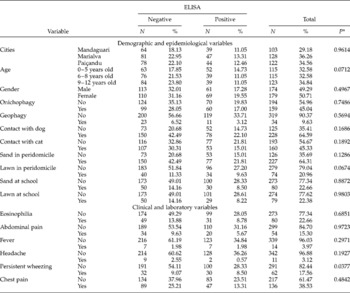
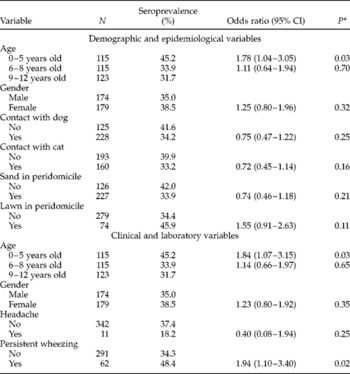
Of the 353 serum samples collected in the urban zones of all three municipalities, 130 (36.8%) were reactive to anti-Toxocara spp. antibodies. Seropositivity was slightly more prevalent in females (53.1%) than in males (46.9%), but the difference was not statistically significant (P>0.05). Of the variables tested in the survey, both demographic/epidemiological and clinical/laboratory variables showed P values ≤ 0.2 (table 1). However, only age and persistent wheezing were positively associated with seroprevalence of Toxocara (table 2). Children from 0 to 5 years old were 1.78 times more likely to be reactive to Toxocara than were children from 9 to 12 years old (P = 0.03), and the seropositive children were 1.94 times more likely to develop these clinical symptoms (P = 0.02) (table 2).
Seroprevalence (%) of IgG antibodies to Toxocara canis excreted-secreted antigens (TES), according to clinical signs and epidemiological factors in children resident in urban areas from three municipalities of Paraná State, Brazil.

N, number of children. *Chi-square value.
Seroprevalence (%) of IgG antibodies to T. canis excreted-secreted antigens (TES) and epidemiological and clinical laboratory variables in multiple logistic regression model.

N, number of children. *P < 0.05 considered statistically significant. 95% CI, 95% confidence interval.
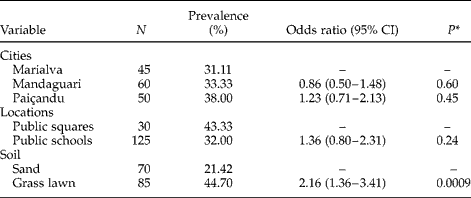
Eggs of Toxocara spp. were present in 21.4% (15/70) of the sand samples and in 44.7% (38/85) of the samples from grassed areas (P = 0.0009). The grass samples were 2.16 times more likely than the sand samples to be contaminated with eggs of Toxocara spp. (table 3). Of all the localities investigated, at least one in five samples was contaminated with Toxocara eggs, except the sandy areas in Marialva which did not show contamination. With respect to the quantities of Toxocara eggs in the different localities investigated, the distribution in the sandy areas of Paiçandu was uneven, ranging from 0 to 0.38 eggs/g of sand (P = 0.0087), as well as in the grassed areas in Mandaguari, where the numbers ranged from 0 to 52 eggs/m2 (P = 0.0112). Only small quantities of organic matter were found in the samples of sand from the three municipalities ( < 8 g/dm3) (Leite et al., Reference Leite, Bernardes and Oliveira2004).
Environmental contamination of public recreational sites by eggs of Toxocara spp., in urban areas from three municipalities of Paraná State, Brazil.
N, number of samples. 95% CI, 95% confidence interval. *P < 0.05 considered statistically significant.
Discussion
In the urban zones that have been studied in north-western Paraná, the seroprevalence of toxocariasis is inversely proportional to the number of inhabitants. The prevalence was highest (51.6%) in municipalities with 17,000–30,000 inhabitants (Colli et al., Reference Colli, Rubinsky-Elefant, Paludo, Falavigna, Guilherme, Mattia, Araujo, Ferreira, Previdelli and Falavigna-Guilherme2010), intermediate (36.8%) in the present study with populations estimated at 31,000–45,000, and lowest (28.8%) in Maringá, which has 350,000 inhabitants (Paludo et al., Reference Paludo, Falavigna, Elefant, Gomes, Baggio, Amadei and Falavigna-Guilherme2007). The smaller municipalities have few public recreation areas. This could have the effect of concentrating children together in the same localities, increasing the chance of infection. In addition, the presence of pet and stray dogs and cats, together with the ease of access of these animals to recreation areas, combine to contaminate the environment (Scaini et al., Reference Scaini, Toledo, Lovatel, Dionello, Gatti, Susin and Signorini2003; Avcioglu & Balkaya, Reference Avcioglu and Balkaya2011).
According to Campos Júnior et al. (Reference Campos Júnior, Elefant, Silva, Gandolfi, Jacob, Tofeti and Pratesi2003), the majority of users of public-health services are of more limited means, and have a higher seroprevalence of toxocariasis. Children between 0 and 5 years of age showed the highest seroprevalence of anti-Toxocara spp., in agreement with previous studies (Paludo et al., Reference Paludo, Falavigna, Elefant, Gomes, Baggio, Amadei and Falavigna-Guilherme2007; Colli et al., Reference Colli, Rubinsky-Elefant, Paludo, Falavigna, Guilherme, Mattia, Araujo, Ferreira, Previdelli and Falavigna-Guilherme2010) which also found a higher prevalence in children in this age group. The behaviour of young children may increase their exposure to contaminated sand and soil (Lopez et al., Reference Lopez, Martin, Chamorro and Alonso2005; Paludo et al., Reference Paludo, Falavigna, Elefant, Gomes, Baggio, Amadei and Falavigna-Guilherme2007).
An association was found between positive serology and persistent wheezing. Figueiredo et al. (Reference Figueiredo, Taddei, Menezes, Novo, Silva, Cristóvão and Cury2005) also reported an association between asthma and anti-Toxocara spp. IgG antibodies in children. However, in the majority of cases, toxocariasis is asymptomatic. Jacob et al. (Reference Jacob, Pastorino, Peres, Melo, Okay and Oselka1994), Rubinsky-Elefant et al. (Reference Rubinsky-Elefant, Shimizu, Sanches, Jacob and Ferreira2006) and Paludo et al. (Reference Paludo, Falavigna, Elefant, Gomes, Baggio, Amadei and Falavigna-Guilherme2007) did not find an association between the presence of clinical signs and symptoms, and positive serology. Although Roldán et al. (Reference Roldán, Cavero, Espinoza, Jiménez and Gutiérrez2010) found an association between toxocariasis and geophagy, and also an association with the use of public areas by seropositive people, interestingly, none of the epidemiological factors investigated in our study contributed to the seropositivity rate. It is possible that the cases of positivity found in this population resulted from accidental ingestion of Toxocara eggs in these public places, due to the contamination of various recreational spaces, squares and public schools by eggs of Toxocara spp. The youngest children were the group that best showed this association, which can be explained by their closer contact with soil (sand or grass), typical of the early years of life. In general, about 21.42% of the sandy and 44.7% of the grassed areas investigated in the present study were contaminated by eggs of Toxocara spp. Tiyo et al. (2008) found 100% contamination of grassed and sandy areas in the urban zone of Maringá. Colli et al. (Reference Colli, Rubinsky-Elefant, Paludo, Falavigna, Guilherme, Mattia, Araujo, Ferreira, Previdelli and Falavigna-Guilherme2010) also observed a high prevalence in grassed (40%) and sandy (41%) areas of smaller municipalities in the same region, with populations from 17,000 to 30,000.
The grassed areas showed a higher contamination rate than the sandy locales. The paucity of studies of grassed areas (Tiyo et al., 2008; Colli et al., Reference Colli, Rubinsky-Elefant, Paludo, Falavigna, Guilherme, Mattia, Araujo, Ferreira, Previdelli and Falavigna-Guilherme2010) reinforces the importance of these investigations, principally in tropical countries, because of the frequency with which these spaces are used. For example, in Marialva, although no Toxocara eggs were found in the sand, all the grassed areas were contaminated, placing the population at risk. In spite of the lack of homogeneity in the quantitative distribution of Toxocara eggs in the samples from sandy areas and grass lawns among the three urban areas, similar frequencies of seropositivity were observed among children in the three municipalities. The low amounts of organic matter found in the sand samples did not, apparently, contribute to reducing the number of Toxocara eggs, as also observed by Pierangeli et al. (Reference Pierangeli, Giayetto, Manacorda, Barbieri, Soriano, Veronesi, Pezzani, Minvielle and Basualdo2003).
The results indicate the existence of a risk of accidental Toxocara infection for the population of north-western Paraná, since the spaces investigated are used for school as well as recreational activities. The seroprevalence and the contamination of sand and, mainly, lawns of recreation areas by Toxocara eggs indicate the need to inform educators and families, in order to control animal waste and maintain hygienic conditions in recreation areas.