Introduction
Land use changes due to rapid urbanization have been considered as a major contributor to the degradation of urban soil especially in dry tropics (Pataki et al. Reference Pataki, Alberti, Cadenasso, Felson, McDonnell, Pincetl, Pouyat, Setälä and Whitlow2021). The integration of economically important tree species into urban planning for restoration of degraded soil may help in restoring various ecosystem services along with providing livelihood, thus fostering a more sustainable urban environment. These benefits are also aligned with Sustainable Development Goal No. 11 (sustainable cities and communities). Trees play a crucial role in restoring soil health and ecosystem functionality through litter dynamics (Morffi et al. Reference Morffi-Mestre, Ángeles-Pérez, Powers, Andrade, Feldman, May-Pat, Chi-May and Dupuy-Rada2023). Understanding and managing litter dynamics may serve as an efficient and sustainable approach to the restoration of degraded soils especially in urban ecosystem. The leaf acquisition traits (LATs), leaf morphological traits (LMTs), and production and decomposition rate of litter are considered as the major drivers of litter dynamics. LATs of litter determine their resource quality in terms of carbon (C), lignin, nitrogen (N), phosphorus, polyphenol content, C/N, lignin/N and polyphenol/N ratios (Patil et al. Reference Patil, Kumar, Kumar and Singh2020). Among LMTs, specific leaf area (SLA), leaf mass per area (LMA) and toughness have been suggested to be important factors that generally affect the rate of decomposition (Liu et al. Reference Liu, Wang, Jiang, Pan, Huang, Dong and Cornelissen2018). High resource quality litters having a rapid rate of decomposition are generally characterized by specific LATs and LMTs such as high nitrogen, low C/N ratio, low lignin/N ratio, high specific leaf area (SLA) and low leaf mass per area (LMA) (Ho et al. Reference Ho, Di Lonardo and Bodelier2017). On the other hand, low resource quality litters are characterized by several factors including low nitrogen, high C/N, high lignin/N ratios, low SLA and high LMA. These characteristics collectively contribute to a slower decomposition rate, as the limited nitrogen availability and the structural complexity of the litter hinder microbial activity and nutrient release (Cornwell et al. Reference Cornwell, Cornelissen, Amatangelo, Dorrepaal, Eviner, Godoy, Hobbie, Hoorens, Kurokawa, Pérez-Harguindeguy and Quested2008; Kumar and Garkoti Reference Kumar and Garkoti2021). The quantity of litter produced by trees directly affects soil moisture, temperature regulation, and organic matter accumulation which is considered to be vital for maintaining structure and fertility of the soil (Zhang et al. Reference Zhang, Yuan, Dong and Liu2014). The rate at which litter decomposes is a critical factor in determining the rate of release of nutrients into the soil. Fast-decomposing litter contributes to immediate nutrient availability, supporting plant growth and microbial activity. Conversely, slow-decomposing litter may lead to immobilization of nutrients leading to limited availability in soil (Isaac and Nair Reference Isaac and Nair2005). However, exceptions have also been reported by Loranger et al. (Reference Loranger, Ponge, Imbert and Lavelle2002) and Purahong et al. (Reference Purahong, Kapturska, Pecyna, Schulz, Schloter, Buscot, Hofrichter and Krüger2014).
Understanding the litter dynamics and its decomposition rate both in-situ (home soil) and ex-situ (away soil) is crucial for optimizing the use of plant litter in restoration strategies of urban ecosystem. In-situ decomposition refers to the breakdown of litter within its natural environment, directly influencing soil nutrient cycling and ecosystem processes. On the other hand, ex-situ decomposition involves the decomposition of litter outside of its original habitat, potentially for use in off-site restoration applications. The difference in the rate of decomposition, in home soil and away soil is often attributed to the presence of specialized decomposer communities that have adapted to the specific litter types and environmental conditions of their home soil (Austin et al. Reference Austin, Vivanco, González-Arzac and Pérez2014; Chomel et al. Reference Chomel, Guittonny-Larchevêque, DesRochers and Baldy2015). This effect has been referred to as home field advantage (HFA) (Hunt et al. Reference Hunt, Ingham, Coleman, Elliott and Reid1988). This advantage has been observed in various ecosystems, where home soils enhance decomposition rates, leading to increased nutrient cycling and ecosystem productivity (Austin et al. Reference Austin, Vivanco, González-Arzac and Pérez2014), however, the decomposition in home soil is controlled not only by the HFA. For instance, studies by de Alencar et al. (Reference de Alencar, Belo, Silva, Asato, Gomes, de Oliveira, Teixeira, Monte, Mota, Pereira and Dantas2022) and Van den Brink et al. (Reference Van den Brink, Canessa, Neidhardt, Knüver, Rios, Saldaña and Tielbörger2023) found home field disadvantage in their study highlighting the complexity of environmental factor and microbial interaction. For a better understanding of the factors influencing HFA of the litter decomposition, knowledge of the interaction among LATs, LMTs, microbial communities and environmental factors would be helpful.
Therefore, understanding the decomposition dynamics of different tree species in both home soil and away soil may help in the identification of suitable tree species which in turn may help in the restoration of degraded soil by manipulating the quantity and quality of the litters in addition to providing livelihood to the locals (Pitman Reference Pitman2013). Although the tree plantations have been advocated as an efficient strategy for the restoration of urban degraded land the significance of litter dynamics of the tree plantations in the restoration process is least studied in general and particularly in dry tropics. Moreover, very few studies are available on the litter dynamics under in-situ and ex-situ conditions, especially in urban ecosystem. This study was designed to examine major LATs, LMTs, production and decomposition rate of litter under in-situ and ex-situ conditions of four economically important tree species with the objective of identifying the better strategy for restoration of urban degraded land. The selected tree species involved Terminalia arjuna (Roxb.) DC (TA), Tectona grandis Linn. (TG), Eucalyptus citriodora Hooker (EC) and Psidium guajava Linn. (PG) having significant economic benefits. TA is well known for its medicinal properties, EC for its essential oil production, TG is renowned for its high-quality timber, and PG is cultivated primarily for the fruit production. We hypothesized that the decomposition rate of different tree leaf litter in urban ecosystem would be (i) regulated differentially by LATs and LMTs and, (ii) different under in-situ and ex-situ conditions.
The objectives of the present study were to evaluate in urban ecosystems of dry tropics (1) the LATs of leaf litter involving initial resource quality and LMTs involving SLA and LMA of four different trees, (2) the difference between in-situ and ex-situ decomposition rates of all the four types of litter, (3) seasonal changes in leaf litter decomposition rate, (4) the influence of abiotic variables on litter decomposition rate, and (5) variation in the quantity of litterfall.
Materials and methods
Study site
In the present study, the four different tree plantations selected were: TG, TA, EC, and PG. All plantation sites were more than 25 years old and situated within the campus of Banaras Hindu University, Varanasi, Uttar Pradesh, between 25°15’N latitude and 82°59’E longitude, at an altitude of 76 meters above mean sea level. This region experiences a dry tropical climate, characterized by strong seasonal variations in temperature and precipitation. The year is divided into a warm wet rainy season (July–September), a cool dry winter (November–February), and a hot dry summer (April–June), with October and March serving as transitional months between seasons. The rainy season accounts for approximately 80% of the long-term total mean precipitation of about 1100 mm. Mean monthly minimum and maximum temperatures varied from 14.2 to 32°C and 25.5 to 42.8°C, respectively (Figure 1a and b).
(a) Ombrothermic diagram showing total precipitation and temperature of the study area during the study period (May 2022–April 2023); (b) Monthly variations in soil moisture of four plantations (a) Terminalia arjuna, (b) Tectona grandis, (c) Eucalyptus citriodora and (d) Psidium guajava during the study period (May 2022–April 2023).

Measurement of litterfall and litter decomposition
To quantify leaf litter production, three litter traps (each with a 1 m2 area) covered with a perforated net sheet at the base were randomly positioned in the four permanent plots of each tree species in April 2022. Litter accumulated in the traps was collected at monthly intervals throughout the two-year period. These collected litter samples were transported to the laboratory, where they were separated into leaf and non-leaf components. The leaf litter component included the senescent leaves and the non-leaf litter component included flowers, fruits, twigs and small branches. Both the leaf litter and non-leaf litter components were thoroughly cleaned and subsequently oven-dried. Leaf area of the fresh leaf litter of each tree species was measured using a leaf area meter (211, Systronics) at the beginning of the experiment whereas leaf weight was measured and expressed on the basis of dry weight. SLA is the ratio between leaf area and dry mass (cm2/g) (Wolf et al. Reference Wolf, Carson and Brown1972) whereas, LMA is the inverse of SLA.
For the determination of the rate of decomposition of leaf litter of different tree species, leaf litters were collected during the months of February and March 2022, air dried and then cleaned thoroughly with the help of brush. Nylon net bags with a mesh size of 1 mm and dimensions of 20×15 cm2 were used following the litter bag technique described by Bocock and Gilbert (Reference Bocock and Gilbert1957). 10 grams of cleaned air-dried intact leaf litter were placed into a nylon litter bag which was securely sealed. A total of 96 bags were prepared for each tree species to retrieve 8 bags per month of the year. The litter bags were randomly placed just below the soil (0–8 cm) under the corresponding tree canopies for in-situ decomposition. Similar experiments were set up for the ex-situ decomposition in a nearby fallow land. The setups were implemented from April 2022 to March 2023 and were repeated from April 2023 to March 2024. At monthly intervals, five intact bags containing decomposing litter were randomly retrieved from each plantation site and the fallow land. The recovered bags were kept in polythene bags and transported to the laboratory. The recovered litter materials were initially air-dried, then cleaned thoroughly by using brushes of different thicknesses for removing adhering soil particles and finally dried at 80°C till the weight became constant.
Chemical analysis of litter
Oven-dried initial leaf litter of different tree species was powdered by using mortar and pestle and passed through a 1-mm mesh screen. Six replicates of each leaf litter were used for the initial chemical analyses. The carbon content of leaf litter was estimated by loss on ignition method (Mcbrayer and Cromack Reference McBrayer and Cromack1981), whereas the total N of the leaf litter was estimated by the micro-Kjeldahl method (Jackson Reference Jackson1973) by using Gerhardt digester and distillation unit. The ethanol-soluble substances were extracted by using ethanol from the litter. The residual solid substance obtained after filtration was oven-dried and thereafter weighed. The dry residue was then treated with 72% H2SO4 at 30°C for one hour followed by dilution with distilled water and then digested for two hours using reflux. The oven-dried weight of the residual solid substance was again taken after filtration and washing with distilled water. The difference in the weight before and after the acid digestion was reported as cellulose content. The difference between the cellulose content and the acid insoluble residue obtained by the loss on ignition was considered as lignin content (Klason lignin, Effland Reference Effland1977). Total phosphorus content was determined colorimetrically by the phosphomolybdic blue colour method, after digesting the litter in a triacid mixture of Perchloric, Nitric, and Sulfuric acids in a ratio of 1:5:1 (Murphy and Riley Reference Murphy and Riley1962). The total extractable polyphenols were extracted using Folin–Denis’s method, with tannic acid serving as the standard reference (Anderson and Ingram Reference Anderson and Ingram1994). This extraction was carried out in the 50% methanol (80°C).
Rate of litter decomposition
As described by Olson (Reference Olson1963), the mean relative decomposition rate (RDR) was calculated using the following formula:
 $${\rm{RDR}}\left( {{\rm{g }}{{\rm{g}}^{-1}}{\rm{da}}{{\rm{y}}^{-1}}} \right) = {\rm{ln }}\left( {{{\rm{W}}_1}-{{\rm{W}}_0}} \right)/\left( {{{\rm{t}}_1}-{{\rm{t}}_0}} \right)$$
where W0 = mass of litter present at time t0, W1 = mass of litter at time t1, and t1–t0 = sampling interval (days).
The decomposition rate (k) was estimated through the negative exponential decay model:
 $${{\rm{W}}_t}/{{\rm{W}}_0} = {\rm{ex}}{{\rm{p}}^{(-{\rm{kt}})}}$$
where W0 = initial mass of the litter, Wt = mass remaining after time t, and k = decomposition rate.
The time required for 50% mass loss was determined as:
t50 = 0.693/k, while for 95% mass loss, it was calculated as t95 = 3/k.
Statistical analysis
SPSS software (version 22) was used to perform the statistical analysis for this study. Tukey’s honest significant differences were used to compare the significance among group means. An independent t-test was employed to ascertain the significant differences between the ex-situ and in-situ mass loss rates of four plantations. A two-tailed Pearson correlation analysis was applied to investigate correlations among different variables. Principal component analysis (PCA) was applied to evaluate the relationships among various initial leaf litter quality parameters and decomposition rates for all the four plantations, using Origin software.
Results
Annual litterfall
In the present study, the quantity of annual leaf litterfall ranged from 512 to 1079 gm–2, while that of non-leaf components ranged from 132 to 221 gm–2 (Table 1). The highest amount of total litterfall was recorded in the TG plantation, followed in decreasing order by TA, EC, and lowest in PG (Figure 2, Table 1). In TG, the bulk of litterfall occurred between October to March, with the minimum recorded between June and July (Figure 2). For TA, peak litterfall occurred from February to April (Figure 2) whereas, in EC, it occurred throughout the year. PG had the lowest leaf litterfall as compared to other plantations, with comparatively highest litterfall from August to October (Figure 2). Leaf litterfall accounted for 79% to 85% of the total, while non-leaf litterfall comprised 15% to 22% of the total litterfall.
Variation in the annual leaf litter, non-leaf litter and the total litterfall production (gm–2) of different plantations. All the values are in mean ± SE. Different alphabetic lowercase letters represent the significant difference among the plantations (p < 0.05)

Monthly variation in the leaf litterfall of four plantations (a) Terminalia arjuna, (b) Tectona grandis, (c) Eucalyptus citriodora and (d) Psidium guajava.

Leaf morphological traits
The leaf litter area and weight varied significantly (p < 0.05) among the four plantations. Leaf area and leaf weight were highest in TG (105.54 cm2 and 2.86 g, respectively) followed in decreasing order by TA (39.81 cm2 and 1.35 g, respectively), PG (27.97 cm2 and 0.81 g, respectively) and lowest in EC (16.20 cm2 and 0.40 g) (Table 2). The SLA varied significantly (p < 0.05) among the four plantations. It was highest in TG (44.32 cm2/g) followed in decreasing order by TA (35.15 cm2/g), PG (29.59 cm2/g) and lowest in EC (22.72 cm2/g), whereas LMA followed the reverse trend (Table 2).
Leaf litter area (cm2), weight (g), SLA (cm2/g) and LMA (g/cm2) of different tree plantations All the values are in mean ± SE. Different alphabetic lowercase letters represent the significant difference among the plantations (p < 0.05)

Leaf acquisition traits
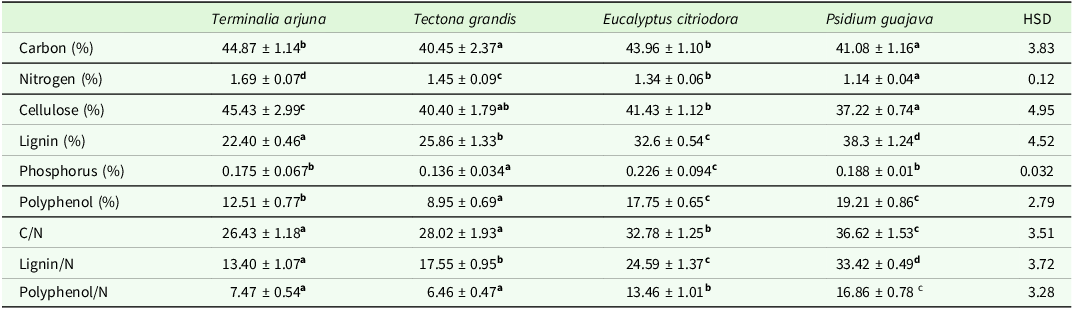
Significant differences were observed in the LATs of the litter, including carbon, nitrogen, phosphorus, lignin, cellulose, polyphenol, and ratios such as C/N, lignin/N, and polyphenol/N among different tree species (p < 0.05) (Table 3). TA had the highest contents of carbon, nitrogen, and cellulose (44.87%, 1.69%, and 45.43%, respectively), while TG had the lowest carbon content (40.45%), and PG had the lowest nitrogen and cellulose contents (1.14% and 37.22%, respectively) (Table 3). Lignin and polyphenol content were highest in PG (38.30% and 19.21%, respectively), while lignin was lowest in TA (22.4%) and polyphenol was lowest in TG (8.95%) (Table 3). The ratios of C/N, lignin/N, and polyphenol/N ranged from 26.43 to 36.62, 13.40 to 33.42, and 7.47 to 16.86, respectively, in the order of PG > EC > TG > TA except for polyphenol/N ratio which was lowest in TG.
Initial chemical composition in terms of carbon (%), nitrogen (%), cellulose (%), Lignin (%), phosphorus (%), polyphenol (%) and ratio of C/N, lignin/N and polyphenol/N of leaf litter of different plantations. All the values are in mean ± SE. Different alphabetic lowercase letters represent the significant difference among the plantations (p < 0.05)

Litter decomposition
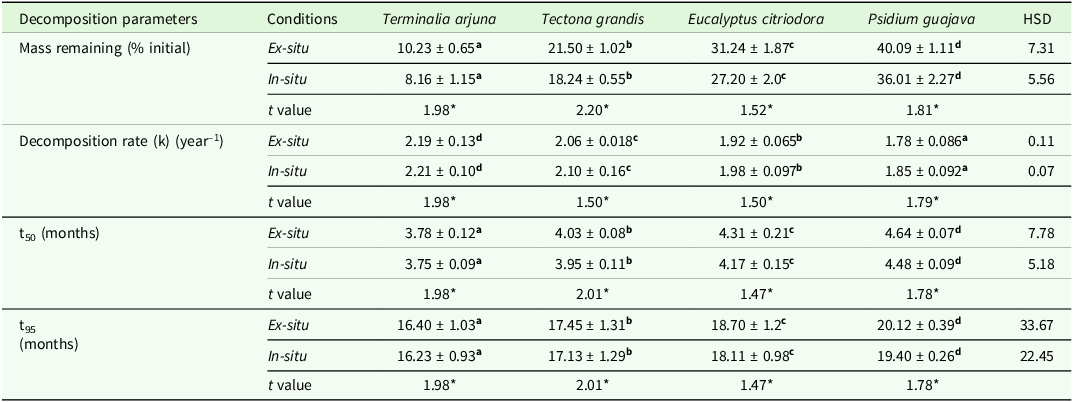
The mass loss of the leaf litter varied significantly (p < 0.05) among the four plantations but there was no significant difference between in-situ mass loss and ex-situ mass loss rate (Figure 3, Table 4). TA litter exhibited the highest mass loss, with only 10.23% of the initial mass remaining after the first year under ex-situ conditions and 8.16% remaining under in-situ conditions (Figure 3, Table 4). Conversely, PG showed the lowest mass loss, with 40.09% remaining undecomposed after one year under ex-situ conditions and 36.01% remaining undecomposed under in-situ conditions. The mass loss followed a three-phase decomposition pattern across all plantations, starting with a slow phase, followed by a faster decomposition phase, and ending with another relatively slow phase. The decomposition rate (k) was found highest in TA (2.19 year–1) for ex-situ and (2.21 year–1) for in-situ, respectively, whereas it was lowest in PG under both ex-situ (1.78 year–1) and in-situ (1.85 year–1) conditions (Table 4). The half-life period (t50) varied between 3.7 months for TA and 4.64 months for PG, while the t95 values ranged from 16.23 months to 20.12 months for the same species (Table 4).
Mass remaining and number of days after litter placement under (a) in-situ and (b) ex-situ conditions.

Decomposition parameters and time required for various levels of decay (t50 50% and t 95 95% mass loss) in-situ and ex-situ conditions across four plantations. Different alphabetic lowercase letters represent the significant difference among the plantations (p < 0.05) whereas * represent the not significant difference between ex-situ and in-situ conditions

Relationship of decomposition rate with LATs and LMTs
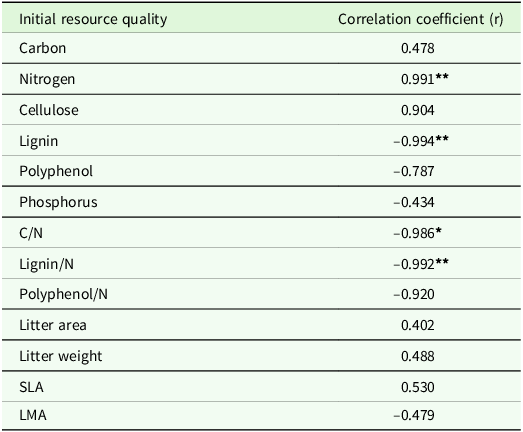
The correlation between the decomposition rate of various species and their respective litter quality parameters was examined to understand the impact of LATs on the decomposition rate. The correlation analysis revealed a significantly strong negative relationship between decomposition rate and lignin (r = –0.998, p < 0.01), as well as the ratios, that is, lignin/N (r = –0.992, p < 0.01), C/N (r = –0.986, p < 0.01), polyphenol/N (r = –0.937, p < 0.05) and polyphenol content (r = –0.920, p < 0.05), while phosphorus (r = –0.434, p < 0.05) showed a weak negative relationship with decomposition rate (Table 5). On the other hand, nitrogen (r = 0.991, p < 0.01) exhibited a strong positive relationship, while cellulose (r = 0.904, p < 0.05) and carbon (r = 0.478, p < 0.05), showed a positive but weak relationship with decomposition rate (Table 5). While the SLA (r = 0.530, p < 0.05) exhibited a weak positive correlation, the LMA (r = –0.479, p < 0.05) showed a weak negative correlation with the decomposition rate.
Relationship of decomposition rate (k) with initial resource quality parameters of litter across the four plantations. Significant at **p < 0.01; *p < 0.05

Principal component analysis (PCA) showed significant differences in litter types and tree species based on initial litter quality and decomposition rates. The first two principal components, PC1 and PC2, together accounted for 97.86% of the variance, with PC1 explaining 68.02% and PC2 explaining 29.84%. PC1 exhibited positive loadings for lignin content, C/N, lignin/N, polyphenol/N ratios, while PC2 showed positive loadings for carbon, nitrogen, and cellulose contents, and negative loadings for LA, LW, and SLA (Figure 4).
Scatter biplot of principal component analysis (PCA) across different plantations, involving TA (Terminalia arjuna), TG (Tectona grandis), EC (Eucalyptus citriodora) and PG (Psidium guajava) for carbon (C), nitrogen (N), cellulose, lignin, phosphorus, polyphenol, lignin/N (lig/N), C/N, polyphenol/N (poly/N), leaf area, leaf weight, specific leaf area (SLA), leaf mass area (LMA) and decomposition rate (k).

Relationship of decomposition rate with abiotic variables
The correlation analysis revealed significant relationships between the decomposition rate of leaf litter and several abiotic variables, such as soil moisture content, precipitation, relative humidity, and temperature. Examining different species individually, we found strong positive correlations between litter decomposition rate and the mean values of these variables. Specifically, soil moisture (ranging from r = 0.96 to r = 0.90, p < 0.01) and precipitation (ranging from r = 0.93 to r = 0.88, p < 0.01) showed higher correlation coefficients (Table 6). However, the correlation with temperature was notably weaker (r = 0.26 to r = 0.19, p < 0.05). Soil moisture content emerged as the most reliable predictor of decomposition rate across all the four leaf litters, explaining between ∼92% and ∼85% of the variability. Precipitation also demonstrated strong predictive capabilities, explaining significant portions of the variability in decomposition rate (ranging from ∼77% to 81%, respectively). In contrast, air temperature exhibited substantially weaker predictive capabilities, explaining only ∼4% to 7% of the variability (Table 6).
Relationship of decomposition rate with various abiotic variables across the four plantations. Significant at **p < 0.01; *p < 0.05

Discussion
Annual litterfall production
Litterfall is considered to be a complex system involving various biotic and abiotic factors. Besides the inherent characteristics of tree species, climatic factors such as precipitation, temperature, and edaphic factors also play a significant role in influencing litterfall (Pitman Reference Pitman2013). Seasonal dynamics, including changes in temperature and daylight hours, can trigger leaf shedding in deciduous species, while evergreen species may exhibit a more continuous but steady litterfall pattern throughout the year (Zhang et al. Reference Zhang, Yuan, Dong and Liu2014). In the present study highest annual litterfall exhibited by TG (Figure 2, Table 1) among the studied tree species probably was due to its deciduous nature and synchronized leaf-shedding events only once during the year (Purwanto and Tokuchi Reference Purwanto and Tokuchi2005). Additionally, TG exhibited larger leaf weight which was ∼6, ∼4 and ∼2 times higher than that of EC, PG and TA leaves, respectively (Table 2), including a notably heavier leaf midrib. These factors collectively contributed to the higher litterfall in this species. The bulk of litterfall in TG occurred from October to March (Figure 2), that is, concentrated in the cool dry period, which might be influenced by reduced soil moisture and lower temperatures occurred during this period (Singh et al. Reference Singh, Singh and Tripathi1999).
In contrast, TA exhibited its highest litterfall from February to April (Figure 2) and was considered to be semi-deciduous as there was partial shedding of leaves, rather than a complete litterfall. However, other studies described TA as either evergreen (Thakur et al. Reference Thakur, Chandrashekharaiah, Rathore, Lingappa, Singh, Sinha and Sahay2019) or deciduous (Keerthika et al. Reference Keerthika, Parthiban, Chavan, Shukla, Gupta and Venkatesh2024). During the dry season, leaf abscission occurred as a plant adaptation mechanism in response to water stress (Valentini et al. Reference Valentini, Sanches, de Paula, Vourlitis, de Souza Nogueira, Pinto and de Almeida Lobo2008). These observations were consistent with previous research highlighting the impact of environmental factors on litterfall dynamics (Kong et al. Reference Kong, Lin, Huang, Liu, He, Su, Li, Wang and Qiu2022).
EC and PG, being an evergreen tree, showed continuous shedding of litter throughout the year, contributing to a steady and continuous litterfall compared to the deciduous tree species. Despite having a lower leaf weight ∼1.5 times less than PG, EC exhibited higher annual litterfall which was equally distributed throughout the year. On the other hand, PG, in spite of being evergreen, litterfall was not regular throughout the year. Litterfall was higher during the fruiting period ranging from August to October and February to March (Figure 2). During these periods, trees shed older leaves and twigs to probably conserve resources or redirect them towards fruit production and growth. This shedding of older plant parts significantly increased litterfall. Our study showed that deciduous species had higher litter production compared to the evergreen species in the dry tropics. This observation aligned with previous research indicating that in tropical conditions, deciduous species tend to produce higher amounts of litter, whereas evergreen species exhibit lower litterfall or show no seasonal variations (Zhang et al. Reference Zhang, Yuan, Dong and Liu2014; Keerthika et al. Reference Keerthika, Parthiban, Chavan, Shukla, Gupta and Venkatesh2024).
Seasonal variation in the rate of decomposition
Seasonal variation in the decomposition rate across the four leaf litters were similar with highest during the rainy season and lowest during the summer. This trend of decomposition rate may be explained on the basis of the variability in the soil moisture and precipitation which was also evidenced from the strong and positive correlation found among decomposition rate, soil moisture and precipitation (Table 6). Similar observations were also reported by Naik et al. (Reference Naik, Maurya, Mukherjee, Singh and Bhatt2018) and Zhao et al. (Reference Zhao, Li, Xu and Lou2022), where soil moisture and precipitation were identified as influential factors in decomposition. In the present study, temperature had a minor role in regulating the rate of decomposition as observed by the weak relationship between decomposition rate and temperature in all the four leaf litters (Table 6). These results, however, contrast with observations in temperate regions, where temperature is recognized as the main regulating factor for litter decomposition (Rahman and Tsukamoto, Reference Rahman and Tsukamoto2013; Solly et al. Reference Solly, Schöning, Boch, Kandeler, Marhan, Michalzik, Müller, Zscheischler, Trumbore and Schrumpf2014). Thus, the relative importance of temperature, precipitation and soil moisture varied significantly across ecosystems, regulating decomposition dynamics. Variability in precipitation patterns has been predicted due to global climate change. Increased precipitation may enhance soil moisture content, promote microbial activity and accelerate decomposition rates, whereas decreased precipitation can lead to drier soil conditions and limit nutrient availability, thereby slowing down the decomposition rate (Sun et al. Reference Sun, Song, Wang, Lai, Tariq, Zeng, Zhong, Wang, Li and Peng2020).
Impact of tree species on litter decomposition rate
Importance of LATs have been recognized as important drivers of litter dynamics (Musvoto et al. Reference Musvoto, Campbell and Kirchmann2000). Major LATs such as lignin content, lignin/N, C/N, polyphenol and polyphenol/N were reported to regulate the decomposition rate globally (Zhao et al. Reference Zhao, Lin, Quan and Li2023).
The PCA revealed clear separation among the four plantations, indicating significant differences among them. The distinct clustering of initial litter quality around different plantations further emphasized notable variations in their LATs and LMTs. The LATs such as cellulose, nitrogen, and carbon contents were observed to be closely clustered in the PCA graph near the TA plantation, suggesting a strong influence of these traits on the litter decomposition rate (Figure 4). The variables SLA, leaf weight, and leaf area were closer to the TG plantation indicated that these traits were characteristic of this plantation and controlled the rate of decomposition. The key indicators of litter decomposition were found to be phosphorus content and LMA in EC plantation, whereas lignin content, lignin/N, C/N and polyphenol/N ratios in PG plantation (Figure 4).
A significant negative correlation among initial lignin content, lignin/N and C/N ratios with decomposition rates of leaf litter across all the species was also found in this study (Table 5). In the present study, however, polyphenol content and polyphenol/N ratio had little influence on the rate of decomposition as shown by a weak correlation among them (Table 5). While polyphenol content can be a significant indicator of decomposition rate in some contexts, its impact may vary significantly across different litter types and may not be applicable everywhere, particularly in the presence of stronger drivers such as lignin content and C/N ratio. TA exhibited the highest decomposition rate among tree species under both in-situ and ex-situ conditions, whereas PG showed the slowest rate (Table 5, Figure 3) probably, due to the variations in the LATs (Singh et al. Reference Singh, Singh and Tripathi1999; Rai et al. Reference Rai, Singh, Ghosal and Singh2016). Despite significant differences in initial nitrogen and lignin contents among all leaf litters, the C/N ratio was similar for TA and TG, but differed for EC and PG, possibly due to variation in carbon content (Table 3). Lignin, being a recalcitrant material, that is, structural barrier, interfered with the enzymatic degradation of carbohydrates, proteins, and other polyphenols, thereby influencing the decomposition rate (Rahman et al. Reference Rahman, Tsukamoto, Rahman, Yoneyama and Mostafa2013; Keerthika et al. Reference Keerthika, Parthiban, Chavan, Shukla, Gupta and Venkatesh2024).
The impact of LMTs including SLA and LMA on decomposition rate was widely studied and it was reported that the leaves with higher SLA as compared to lower SLA generally decompose at a faster rate due to the availability of more surface area to decomposers, facilitating microbial colonization and breakdown (Buchanan et al. Reference Buchanan, Sauvadet and Isaac2024). However, our study contradicts this observation as it was found that TA with lower SLA, decomposed faster than TG, despite the former having higher SLA. Similarly, while lower LMA is generally associated with faster decomposition, this study found that TA, with a higher LMA than TG, decomposed more rapidly than TG (Table 2). These observations were also supported by a weak positive correlation between SLA and decomposition rate, and a weak negative correlation between LMA and decomposition rate across all the studied leaf litters (Table 5). These observations indicated that the dynamics of litter decomposition could be better explained on the basis of LATs rather LMTs. Thus, this finding approved the first hypothesis of this study.
In-situ and ex-situ decomposition
No significant difference between in-situ and ex-situ decomposition rates was found in this study, suggesting that there might not be a prevalence of HFA (Table 4). This implies that the site of decomposition did not noticeably impact the rate of litter decomposition under our experimental conditions, probably due to the fact that the edaphic and climatic conditions were comparable in both the sites except the tree canopy, floor litter mass and root biomass. However, the tree canopy, floor litter mass and root biomass were reported to have synergistic or antagonistic, mixed or minor effects on the litter decomposition rate through their indirect effect on soil moisture, microbial population and activity (Çömez et al. Reference Çömez, Güner and Tolunay2021; Morffi-Mestre et al. Reference Morffi-Mestre, Ángeles-Pérez, Powers, Andrade, Feldman, May-Pat, Chi-May and Dupuy-Rada2023; Pugnaire et al. Reference Pugnaire, Aares, Alifriqui, Bråthen, Kindler, Schöb and Manrique2023). On the other hand, Van den Brink et al. (Reference Van den Brink, Canessa, Neidhardt, Knüver, Rios, Saldaña and Tielbörger2023) reported that HFA is not always evident. Ayres et al. (Reference Ayres, Steltzer, Simmons, Simpson, Steinweg, Wallenstein, Mellor, Parton, Moore and Wall2009) further observed that while vegetation type, tree canopy and floor litter mass are major drivers of decomposition rate these factors do not always explain the presence or absence of HFA. In our study, edaphic and climatic factors probably played a key role as compared to the tree canopy, floor litter mass and root biomass. Similar findings were also reported by Peña-Peña and Irmler (Reference Peña-Peña and Irmler2016) and Petraglia et al. (Reference Petraglia, Cacciatori, Chelli, Fenu, Calderisi, Gargano, Abeli, Orsenigo and Carbognani2019). However, Corrigan and Oelbermann (Reference Corrigan and Oelbermann2013) found differences in in-situ and ex-situ decomposition rates, which they explained on the basis of variations in soil moisture levels to which the leaf litter was exposed. Duan et al. (Reference Duan, Wang, Zhang, Fu, Tsang, Wu and Le2018) also found the difference between in-situ and ex-situ decomposition as they selected two different sites viz. salt marsh (wetland) and urban green belt soil. Our finding thus indicated that the site of decomposition may not always be a critical factor, as long as the broader environmental conditions are comparable. Thus, the second hypothesis of this study could not be accepted.
The leaf litter from different tree species could hence be used as an effective ex-situ decomposition source for restoring degraded land. The collection and utilization of excess litter from plantation sites which might otherwise go to waste, presents a promising strategy to enhance off-site restoration efforts in other degraded areas.
Conclusion
This study showed that the rate of decomposition was not solely influenced by either LATs and LMTs, instead considering both factors together might provide a more comprehensive understanding of litter decomposition dynamics. The absence of significant differences in decomposition rates between in-situ and ex-situ conditions of all the four leaf litter indicated that both in-situ and ex-situ decomposition are equally effective for the restoration of degraded urban land, allowing for the strategic collection and utilization of plant litter for off-site restoration strategies without significantly altering its decomposition patterns under comparable environmental conditions. TA leaf litter having a high rate of decomposition compared to other tree species, may be recommended for inclusion in the restoration strategies of degraded urban land. However, more studies are needed to explore the site-specific litter types and environmental factors influencing decomposition dynamics. Additionally, it is also important to consider the broader ecological and socioeconomic impacts of using diverse litter sources in long-term sustainable restoration strategies.
Data availability
Data will be available on request.
Acknowledgements
We thank the Head, Department of botany, BHU, for providing the required facilities. We acknowledged the Council of Scientific and Industrial Research (CSIR), New Delhi, India for providing financial support in the form Senior Research Fellowship to Mr. Rahul Kumar and Ms. Riya Gupta. University Grants Commission, New Delhi, in form of University research fellowship to Ms. Priyanka Soni, CAS Junior Research Fellowship to Ms. Fahami Zaya and Ms. Amrita Kumari and UGC Junior Research Fellowship to Ms. Nidhi Singh. Faculty Incentive Grant under the Institute of Eminence Scheme provided to Prof. Nandita Ghoshal is gratefully acknowledged.
Financial support
This research received no specific grant from any funding agency, commercial or not-for-profit sectors.
Competing interests
The authors declare that there is no conflict of interest to report in this paper.