INTRODUCTION
The family Gorgonocephalidae Ljungman, 1857 comprises over 20 genera, is distributed worldwide, and includes the so-called ‘basket stars’ because of their branched arms. Individuals can usually be found in colder or deep waters, compared to other ophiuroids (Hendler et al., Reference Hendler, Miller, Pawson and Kier1995). The complex ramifications of the arms allow these animals to hold on to gorgonians and other substrata (Turner & Boucher, Reference Turner and Boucher2010).
There are five representative species of the family in the eastern Pacific (Maluf, Reference Maluf1988), two of them are exclusively tropical: Gorgonocephalus diomedeae Lütken and Mortensen, 1899 from Panamá, and Astrodendrum galapagensis (Clark, 1916) an endemic of the Galápagos Islands, Ecuador. The other species is restricted to polar waters, like Gorgonocephalus eucnemis (Müller & Troschel, 1842), resident of the Bering Sea. In Mexico, only two gorgonocephalids have been reported: Astrocaneum spinosum (Lyman, 1875) and Astodictyum panamense Verrill, 1867. The first species is distributed along the Gulf of California, and its geographical range extends southward to Panamá (Maluf, Reference Maluf1988; Hendrickx et al., Reference Hendrickx, Brusca and Findley2005).
Comparatively, A. panamense is a relatively more abundant gorgonocephalid than the others referred to here (Herrero Pérezrul et al., Reference Herrero-Pérezrul, Reyes-Bonilla, González-Azcárraga, Cintra-Buenrostro, Rojas-Sierra, Danemann and Excurra2008), and is found from 3 to 64 m depth (Maluf, Reference Maluf1988; Caso-Muñoz et al., Reference Caso-Muñoz, Laguarda-Figueras, Solís-Marín, Ortega-Salas and Durán González1996) in coral and rocky reefs of Zorritos, Peru (5°S; Clark, Reference Clark1913), Panamá (Alvarado et al., Reference Alvarado, Solís-Marín and Ahearn2010), the oceanic Malpelo Island, Colombia (Birkeland et al., Reference Birkeland, Meyer, Stames and Buford1975; Neira & Cantera, Reference Neira and Cantera2005), and in several areas of the Gulf of California, including Sonora (north-eastern coast of the Gulf, no location mentioned; Solís Marín et al., Reference Solís-Marín, Laguarda-Figueras, Durán-González, Ahearn and Vega2005), La Paz (24°N; Hendrickx et al., Reference Hendrickx, Brusca and Findley2005) and Mazatlan (23°N; Caso-Muñoz et al., Reference Caso-Muñoz, Laguarda-Figueras, Solís-Marín, Ortega-Salas and Durán González1996). According to Brusca (Reference Brusca1980) and Caso-Muñoz et al. (Reference Caso-Muñoz, Laguarda-Figueras, Solís-Marín, Ortega-Salas and Durán González1996), this species is usually associated with octocorals (most commonly Muricea spp.) as well as with other ophiuroids such as Ophionereis annulata (Le Conte, 1851), Ophiocoma aethiops Lütken, 1859, Ophioderma sodipallaresi Caso, 1985, Ophiolepis pacifica Lütken, 1856 and Ophiactix simplex (Le Conte, 1851).
The objective of this paper is to report a number of new locations where A. panamense specimens have been sighted or collected in the Gulf of California and nearby areas.
MATERIALS AND METHODS
Visual censuses of conspicuous echinoderms were conducted with SCUBA diving in early April 2010 at Revillagigedo Archipelago (approximately 19°N and 111°W). Three islands were surveyed: Socorro, San Benedicto and Roca Partida (in order of size). Identity of the specimens of A. panamense was determined with the use of field guides (Brusca, Reference Brusca1980; Gotshall, Reference Gotshall1999; Kerstitch & Bertsch, Reference Kerstitch and Bertsch2007), and confirmed on the basis of photographs that highlighted their typical banding of the arms, a diagnostic character. To validate the taxonomic status of the species, various sources were consulted including the Global Biodiversity Information Facility (http://data.gbif.org), the World Register of Marine Species (http://www.marinespecies.org), the Ocean Biogeographic Information System (http://www.iobis.org/), the Integrated Taxonomic Information System (http://www.itis.gov), and the Comisión Nacional para el Conocimiento y Uso de la Biodiversidad (http://www.conabio.gob.mx/remib/), as well as a number of field logbooks of the authors. In addition, the Niche Model tool of the Global Biodiversity Information Facility (http://data.gbif.org/occurrence/setupModel.htm) was used to simulate the possible current distribution of the species. The idea was to locate information about specimens that is not available in scientific papers but is nevertheless taxonomically sound and provides new information on the distribution-range of this ophiuroid.
RESULTS
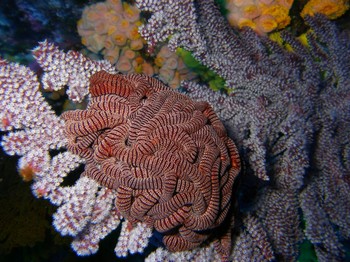
Two individuals of Astrodictyum panamense were found at Roca Partida (19°N and 112°05′W), in the Revillagigedo Archipelago. The individuals were located at 38 and 42 m deep (water temperature 24°C) clinging from octocorals of the genus Muricea. The specimens were not collected, but their identity was easily determined (Figure 1) due to the colour of the body (yellow to pink), and the characteristic banded arms (Brusca, Reference Brusca1980; Kerstitch & Bertsch, Reference Kerstitch and Bertsch2007).
Astrodictyum panamense observed at Roca Partida, Revillagigedo Archipelago (42 m deep). Scale bar: 5 cm. Photograph by Arturo Ayala-Bocos.

In addition, from field notes of the authors of this note we obtained several previously unpublished field records of A. panamense on the east coast of the Gulf of California, at Tiburón Island (29°N 112 W) and Puerto Peñasco (31°N 113° W), as well as in Loreto (25.6°N 110.8°W; 28 m depth) and Cabo San Lucas (22.8°N 109.8°W; 22 m depth), on the Baja California Peninsula. This species has been recorded at Adair Bay (31.3°N 113.8°W, eastern Gulf of California, USNM 39006, no depth information), which represents the northernmost record of this gorgonocephalid, and also at Tortugas Bay, on the Pacific coast of Baja California (27.5°N 114.8°W USNM 34452, no depth information). The latter is the only validated report of A. panamense in subtropical waters of the eastern Pacific Ocean.
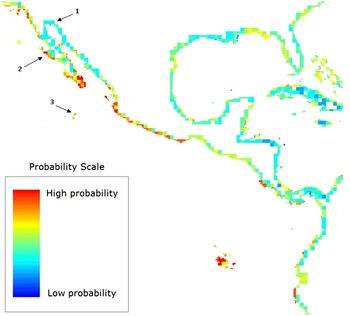
The results of niche model simulation indicate a high probability that A. panamense actually resides in reefs of south-western Baja California, and also along tropical west Mexico, in northern Costa Rica and in mainland Ecuador, regions where this species has not been reported to date (Figure 2).
Map of probability of occurrence of Astrodictyum panamense along the tropical eastern Pacific, generated online by the Niche Model tool of the Global Biodiversity Information Facility. It also shows the location of the northern and westernmost new records of the species. Key: (1) Adair Bay; (2) Tortugas Bay; (3) Roca Partida Island (http://data.gbif.org/occurrence/setupModel.htm?c[0].s=20&c[0].p=0&c[0].o=18737653&mask=prec_1&selectedLayers=marineLayers&template=biod_5_15&layer=depthmax&layer=depthmin&layer=iceconc&layer=landdist&layer=priprod&layer=salbottom&layer=salsurface&layer=tempsurface&layer=tempbottom&img=openModeller-12818108236111941892144352985954.png).

DISCUSSION
The new findings of A. panamense differ in relative importance. For example, the reports from Loreto and Cabo San Lucas (western Gulf of California) might be expected since this species is present in many areas of the southern gulf. Hendricks et al. (2005) and Solís Marín et al. (2005) indicated its occurrence at the State of Sonora, where its southernmost limit is at about the same latitude as Loreto. However, the records from Tiburón Island, Puerto Peñasco and Adair Bay (28°N to 31°N), represent the northernmost limits of the species in the eastern Pacific, and thus are more relevant.
On the other hand, the observation of A. panamense at Roca Partida Island, in the oceanic Revillagigedo Archipelago (Figure 1) demonstrated that larvae can be transported from mainland Mexico, or most likely considering the distance, from the Baja California Peninsula. The Revillagigedo Archipelago is a Biosphere Reserve, recognized by its high species richness and endemism, and for being an important stepping stone for colonization of marine species from the central Pacific (Reyes Bonilla, Reference Reyes Bonilla and Cortés2003). The emigration of marine faunal elements from the continent to the islands seems to be common (Reyes Bonilla, Reference Reyes Bonilla and Cortés2003; Robertson & Cramer, Reference Robertson and Cramer2009), and is facilitated by the confluence of the California and Costa Rica currents near the entrance of the gulf, which turn west and transform into the North Equatorial Countercurrent (NCC), with direction towards the Revillagigedo Archipelago (Fiedler and Talley, Reference Fiedler and Talley2006). The speed of the NCC is about 1.5 knots, and it may take very little time (about 5 to 7 days) for a larva to cover the distance of about 300 km from Baja California to Roca Partida. In addition, Barboza et al. (Reference Barboza, Mendes, Dalben and Tommasi2010) indicate that juvenile ophiuroids can travel across the ocean rafting in detached algae. The arrival of floating mats to the Revillagigedo Archipelago is common in winter (Reyes Bonilla, Reference Reyes Bonilla and Cortés2003) and may enhance the probability of success in long distance colonization.
The other significant new record of A. panamense comes from Tortugas Bay, west Baja California, and it draws attention because the nearest known population resides at Cabo San Lucas, about 400 km south-east. The presence of this ophiuroid so far away from its previously recognized geographical range limit may be another example of larval transportation of tropical species to the north during El Niño years (Sorte et al., Reference Sorte, Williams and Carlton2010), indicating a temporary situation and not the existence of a breeding population. Alternatively, the presence of A. panamense in regions with very contrasting oceanographic conditions like the Gulf of California underscores its tolerance to limiting factors, and may support the hypothesis that this species is already established at Tortugas Bay and probably in nearby areas.
To answer this question we need more detailed surveys of the reef areas along the west coast of Baja California, but some indications may be obtained from the use of new computational tools. We depicted the potential distribution of A. panamense along the tropical and subtropical eastern Pacific on the basis of the environmental conditions of the areas where it has been reported, using the Niche Model of the Global Biodiversity Information Facility. The model considered the following ecological constraints: minimum and maximum depth (m); mean distance to land (km); mean annual chlorophyll-a concentration (gC/m2); mean annual surface and bottom salinity (UPS); and mean annual surface and bottom temperature (C). The results of the simulation depicted a high probability for the species to occur at the west coast of Baja California and the Revillagigedos, although it failed to predict the presence of this species in the north-eastern Gulf of California. Considering all the evidence, we suggest that the Tortugas Bay report of A. panamense is indicative of the presence of a permanent population in the area.
In conclusion, the results of this paper extend the accepted distribution range of the ophiuroid Astrodictyum panamense over 400 km north, and points out its presence in western Baja California and the Revillagigedo Archipelago. This new information will be instrumental in future biogeographical analyses of this unusual echinoderm family.
ACKNOWLEDGEMENTS
We thank Francisco Solís-Marín (Instituto de Ciencias del Mar y Limnología, UNAM, Mexico), for confirming the identification of the species. The ‘Nautilus Explorer’ is gratefully acknowledged for their support in transportation to the Revillagigedo Islands and support dives during the trip. The study was funded by the Comisión Nacional para el Conocimiento y Uso de la Biodiversidad (Proyecto HJ017; to HRB).