On 4 September 1662, the directors of the Dutch West India Company (WIC) submitted a letter to the States General of the Dutch Republic regarding their protracted disputes on the Gold Coast (their main base of commercial activity in West Africa) with the Swedish African Company (SAC) and the Danish African Company (DAC).Footnote 1 While the Scandinavian companies urged the States General to speed up the ongoing negotiations in order to reach an amicable settlement, the much stronger WIC did not want a peaceful settlement and refused their offers for two main reasons.Footnote 2 First, they accused the Scandinavian companies, whom they called “evil disposed Netherlanders,” of being undercover Dutch enterprises and thus illegal. Second, they accused the Scandinavian companies of having sabotaged the peace negotiations by “inciting” the local inhabitants against them. Interestingly, the WIC asserted that, while the SAC was too weak to survive on the coast for long, they were more concerned about the mounting activity of the DAC, who challenged the Company’s hegemony by cooperating with local rulers and supplying them with arms and ammunition, which empowered “the Blacks” to consolidate their control over the coast.Footnote 3
This article aims to offer a fresh understanding of the local dynamics that influenced the evolution of the Dutch and Danish maritime empires by focusing on the on-the-spot interactions between the WIC, the DAC, and the African rulers on the Gold Coast from 1657 to 1662. The period under question saw the peak and subsequent decline of Dutch hegemony, the start of Danish activity, the downfall of the SAC, and the rise of English influence on the coast. While the activity and rivalry between the Dutch and English on the Gold Coast have been fairly well researched, the Scandinavian actors and their relationship with the Dutch in particular have been largely neglected.Footnote 4 A study that combines Dutch and Danish sources and focus on inter-imperial entanglements and Afro-European relations on the Gold Coast in the mid-seventeenth century can provide new and important insights into the debates of the nationalistic and Eurocentric perspectives as well as the company versus agency perspective in the historiography of early modern expansion.Footnote 5
The Gold Coast—so named because of the abundance of gold traded there—comprises the coastal territories of modern Ghana until the Volta River. For much of the period under discussion, this region was a scene of intense European commercial activity and rivalry. The Dutch, following their victory over the Portuguese in 1637–42, tried to maintain a trade monopoly over the entire Gold Coast.Footnote 6 Jan Valckenburgh, the WIC’s director general on the coast from 1656 to 1659, wrote a report that provided the legal justification for such a monopoly. He argued that the Dutch were legally entitled to the Gold Coast by virtue of their victory over the Portuguese and the treaties they had signed with various local rulers. These claims became the guiding principles of the WIC’s aggressive policy under Director General Jasper van Heussen in the early 1660s.Footnote 7 In this period, the Dutch were challenged by other northern European trading companies who wanted a stake in the lucrative gold trade. The English had frequented the coast since the late sixteenth century. Above all, the local African rulers and potentates—referred to as caboceers (headmen) by the Europeans—ignored Dutch territorial claims and treaties and wanted other European companies to settle and trade in their territories as well.Footnote 8 The conflicting arguments, assertions, and views of the WIC, their European rivals, and the caboceers occasioned numerous disputes and created an unstable, unpredictable, and constantly evolving political atmosphere.
By the mid-seventeenth century, the commercial rivalry among the Europeans set off a scramble for the Gold Coast that resulted in numerous trade posts (castles, forts, and lodges) being founded by both the major powers, the Dutch and the English, and the minor players, the Swedes and the Danes.Footnote 9 The Danish and Swedish companies were founded, financed, and operated by Dutch merchants who utilised the protection offered by the governments of Denmark–Norway and Sweden to circumvent the WIC’s trade monopoly on the Gold Coast.Footnote 10 Furthermore, the Dutch merchants often hired the services of rogue WIC employees in order to facilitate the establishment of their overseas trading organisations. A number of these employees were veterans who had formerly been influential in expanding the position of the WIC on the coast.Footnote 11 This policy gave the “Danish” company an apparent Dutch character, and it is not without a sense of truth that the WIC servants called them the “pretended,” “suborned,” or “simulated” Danes.Footnote 12 In their efforts to halt the activities of these pseudo-Dutch undertakings, the WIC encountered numerous dilemmas as they balanced between the interests of the Dutch Republic, the Scandinavian monarchies, and the African states.
The commercial threat posed by the small Danish company remained limited, but it did threaten the balance of Company’s policies on the Gold Coast. The WIC was incapable of excluding them from the coast due to the active support and protection given to them by their African allies. On the Gold Coast, the Europeans lacked the power to enforce political control over African polities, and as such, local rulers would determine their commercial role and capitalise on the weaknesses of the Europeans’ position.Footnote 13 The Europeans had to continuously demonstrate their respect for the rulers’ authority in order to maintain privileges such as access to trade and protection, and such policies were rooted in diplomacy, negotiation, and bargaining.Footnote 14 Due to their position as specialised merchants with access to Atlantic trade goods, the Europeans at times were able to exercise some political influence over the African polities on the coast who vied for their favours.Footnote 15 The Dutch possessed numerous trade outposts and enjoyed a significant advantage in numerical and financial strength over the Danes. Still, the Danes had an advantage over the Dutch in the polities where the caboceers sought to obtain a European trade partner based in their territory and/or curb the growing influence of the Dutch. While the Dutch made it an avowed policy to not be wholly dependent upon the caboceers but instead get control over local affairs, the Danes encouraged close cooperation. As a result, the caboceers, who seldom became tied to any particular company, gave legitimacy to the pseudo-Dutch Danish trade enterprise on the Gold Coast in the mid-seventeenth century.
Two overall questions to be addressed in this article are: How did the WIC respond to the arrival of the Danes on the Gold Coast? And how did the Danish expansion, which incorporated coastal societies, shape the policies of the local rulers?
The rivalry between the Dutch and the Danes was above all evident in the forgotten but nonetheless important coastal site of Akong (mentioned as Hill or Mount Cong, Congho or Congo in the Danish and Dutch sources, and as Queen Anne’s Point by the English).Footnote 16 The Dutch and Danish settlements at Akong have not received due historiographical attention because they have been viewed as commercially insignificant.Footnote 17 However, because of its strategic location between the contested Cape Coast in the Fetu kingdom in the west and the Dutch stronghold of Fort Nassau at Mouri in the Asebu kingdom in the east, it played a vital political role in the early Dutch efforts to halt European (English and Danish) expansion.Footnote 18 The Danish settlement on Akong Hill provided the Danes with a base to consolidate their position at Cape Coast (Amanfro and Oguaa), to gain a foothold in Accra (Osu), and in general, to survive on the coast during fierce WIC opposition.
The Historical Setting
In 1637, the Dutch West India Company conquered the Portuguese castle São Jorge da Mina (Elmina) on the Gold Coast and effectively ended 150 years of Portuguese trade hegemony in West Africa.Footnote 19 This success was made possible by two important factors. First, they maintained close cooperation and alliances with a number of local polities and rulers on the coast, in particular the Saboe (Asebu).Footnote 20 Already in 1612, the Dutch had signed a treaty with the Asebu king and erected a fort later named Nassau at Mouri, eighteen kilometres east of Elmina.Footnote 21 The second factor was the founding of the Dutch West India Company (WIC) in 1621. The WIC’s acquisition of Dutch possessions in the Atlantic provided the Dutch with a unified organisation that challenged the Portuguese trade hegemony.Footnote 22
The Dutch continued and developed the Portuguese feitoria system of trade posts (factorijen, i.e., factory castles, forts, and lodges) in West Africa.Footnote 23 In the 1630s to 1650s, the WIC signed treaties with numerous polities and established satellite lodges (small mud-and-thatch houses, both fortified and unfortified) on the coast. The English imitated this policy by signing treaties with local rulers and building trade posts in territories already inhabited or claimed by the Dutch, including a fort in Kormantin (Fante) and lodges in Komenda (Eguafo), Cape Coast, and Accra.Footnote 24 With the arrival of the Swedes and the Danes in the 1650s, trade posts became the preferred tactical arrangement among the Europeans. The main purpose of the forts and lodges was to protect the company’s position, control trade, and eliminate competition within specific economic spheres.Footnote 25 However, trade posts were negotiated, not imposed on the African polities. Nearly all of the European forts were built with the consent and sometimes on the urgent request of the local rulers and inhabitants. The rulers were able to extract a substantial income by imposing tributary fees, tolls, and duties on the Europeans.Footnote 26
Above all, the Dutch and even more so the Danes relied on the support and protection of various influential African actors in procuring footholds and trade on the coast. The Gold Coast was politically fragmented during the seventeenth century. The large number of states, some of which were competitors or even enemies at one time or another, complicated diplomatic relations.Footnote 27 However, with the rapid growth of Atlantic trade, seaside towns and social classes emerged that were closely associated with the European trade posts. This led to a gradual shift of power from the royal families based in the inland capitals to an emerging mercantile class of “big-men” (abirempon, singular obirempon) based in the coastal towns.Footnote 28 The abirempon functioned as a kind of mercantile bureaucracy that supervised the main function of the coastal polities as intermediaries between the gold-producing interior states and the European trade posts. For the Europeans, maintaining a good relationship with this mercantile class of big-men was paramount.Footnote 29
An obirempon of significant importance to the Dutch and the Danes on the coast was Acrosan, known to the Europeans as Jan or Johann Claessen. Acrosan was day (stadtholder and treasurer) of the Fetu kingdom and brother of the king Aduafo, but his personal wealth and large retinue of armed followers made him de facto ruler of Fetu and “the most powerful person” on the Guinean coast.Footnote 30 His greatest leverage over the European and African traders in the region came from his capacity to control the movement of the wealthy Akanni merchants, who brought down gold from the interior to the coast.Footnote 31 While the Dutch had initially been on good terms with him and founded a lodge in Fetu in the 1630s, their relationship soured in the 1640s when the Dutch started neglecting the trade of Fetu in favour of Elmina and Mouri. Acrosan therefore invited the English, Swedes (1650), and Danes (1657) to settle at Cape Coast in Fetu. These Europeans only succeeded because of Acrosan’s active support. The Dutch, however, refused to accept this, which initiated a phase of belligerent rivalry in the region.Footnote 32
Dutch Response to Early Danish Interloping
Following unsuccessful efforts to establish Danish African trading companies in the 1630s to 40s, a series of successful interloping expeditions to the West African coast were carried out by merchants of mostly Dutch origin, sailing under Danish commission and operating from the newly founded Danish town on the Elbe, Glückstadt, in the 1650s.Footnote 33 The increasing activity of interlopers caused much concern for the WIC, who ordered their agents on the spot in Africa “to cruise all the trading places; to invigilate (aandoen) the foreign and Netherland ships, and bring them up to Del Mina [=Elmina], regardless of what Commission they might have.”Footnote 34 The crew on three Glückstadt vessels—Fortuna (1651), Vliegende Hart (1656), and Noortse Leuw (1657)—attempted but failed to establish themselves in Akong on the Gold Coast due to having been chased away or captured by WIC ships.Footnote 35
The early Danish interloping activity at Akong occurred during a phase of mounting European rivalry in the territory that caused much concern for the WIC. In 1657, the Asebuhene (the title of the king of Asebu in the Akan Twi language), Abeedoe Intin, invited other Europeans to settle in his domains, to the great frustration of the Dutch, who claimed exclusive rights in the territory through past agreements with the rulers.Footnote 36 Director General Valckenburgh saw no other option than to negotiate a deal with the Asebu rulers for Akong Hill explicitly, located as it was a few kilometres to the west of their Fort Nassau. The Asebu rulers agreed to their proposals with a caveat that “the one or the other, who desired it, should also build there besides.”Footnote 37 Consequently, the Dutch began to build on the site in order to halt the advances of the “Danes” who had been frequenting the area and the English, who claimed that they had bought the hill on an earlier occasion.Footnote 38
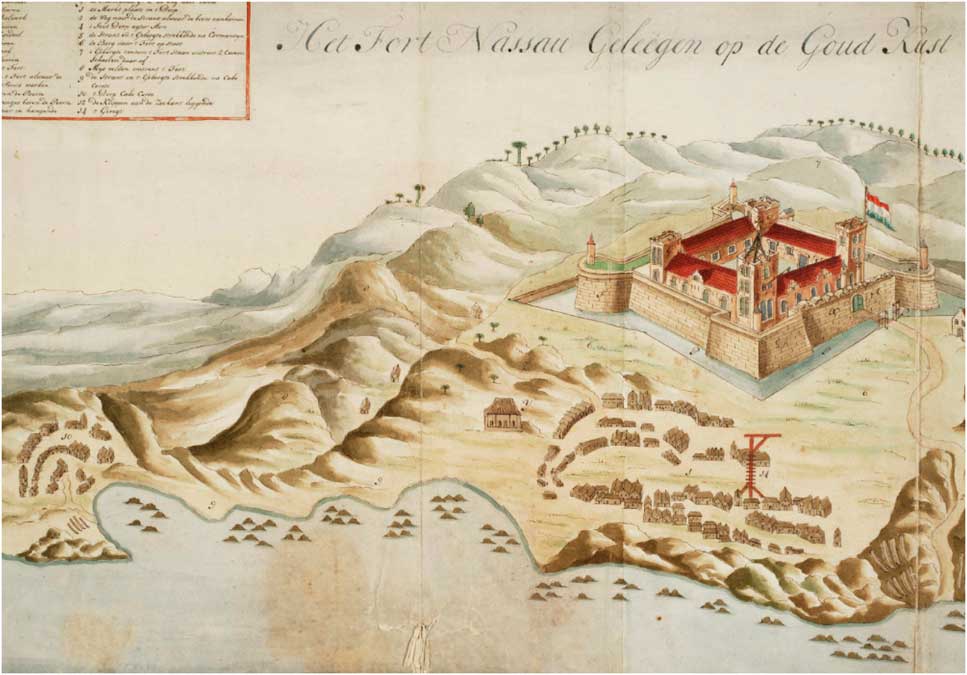
Ultimately, in May 1657, the Asebu rulers signed a new treaty with the WIC that granted the company control over the Asebu beach including the stretch at Akong. In reality, however, the Asebu rulers benefited the most from this treaty because the Dutch were obliged by it to build “a fortification suitable to use four field guns upon it” and pay fifteen bendas of gold to seal their commitment to Akong.Footnote 39 This was a setback for the Dutch, who did not have commercial interests in the area but were only interested in excluding other Europeans from settling it due to its proximity to their Fort Nassau.Footnote 40 (Figure 1)
Dutch drawing of Fort Nassau and the neighbouring African village Mouri in the seventeenth century. To the west is the African village Oguaa at Cape Coast, at this time uninhabited by Europeans. Although not depicted, Akong was situated roughly between Oguaa and Mouri (NL-HaNA, Aanw. Kaarten en Tekeningen, 4.AANW, inv.nr. 1570).

Carloff’s Danish Intermission
In 1657, Heinrich Carloff, a former WIC veteran who had established and run the Swedish venture on the Gold Coast since 1650, quarrelled with the directors of the SAC and thereafter transferred his allegiance to Sweden’s main rival Denmark. On 1 August, he obtained a commission from Danish King Frederik III (1648–70) to capture the possessions he himself had established for the SAC on the Gold Coast.Footnote 41 Upon his arrival on the coast in January 1658, Carloff achieved a rapid and easy success due to obtaining the consent and support of Acrosan. All of the Swedish trade posts, which included a fort at Cabo Corso (later corrupted to “Cape Coast” by the English) called Carolusborg, and lodges at Anomabu, Takoradi, and Osu (Accra) came under Danish control.Footnote 42 While the SAC attempted (without success) to recapture their former lodges, the WIC, who in fact had aided Carloff on his quest to capture the trade posts from the Swedes, remained quiet.Footnote 43 This was most likely because they viewed the Danes as a weaker and thus more controllable European competitor than the Swedes. In addition, the WIC might have had a secret agreement with Carloff that would grant them control over his Danish trade posts in the near future.Footnote 44
However, the WIC were more concerned about the willingness of some of the local rulers to ignore their treaties and trade with the Danes, and, because of this, made diplomatic efforts to oppose their policies. In January 1659, Valckenburgh dispatched the factor Harman Jansen Larens to Ayawaso, the capital of the Accra kingdom on the eastern Gold Coast, to inquire about King Okai Koi’s relationship with the Danes and the English, and urge him to respect his agreements with the WIC. The WIC had signed numerous treaties with the Accra over the years that had granted them the right to build a fort (called Crévecoeur) as well as exclusive access to trade in their realm.Footnote 45
Although a number of questions concerned the mounting activities of the English in the area and whether Okai Koi would continue to keep the agreement with WIC “in full vigour,” the main inquiries dealt with the Danes at Osu. Larens asked why the king allowed the trade at “Orsou [=Osu], contrary to the Agreement,” and whether he would resolve to renounce it. However, the king viewed the Danish-controlled Osu as more profitable than the Dutch settlement at Crévecoeur, and therefore discarded their demands for exclusive trade rights.Footnote 46 Clearly, Okai Koi did not respect the WIC’s treaty because he viewed the Dutch and Danes as equal subjects in his realm, and the treaty limited his own authority.
Despite the protection offered to the Danes by the local rulers, the WIC was able to circumvent their authority, take control of Carloff’s trade posts, and expel the Danes from the coast in April 1659. Jaspar van Heussen (Valckenburgh’s successor) convinced Samuel Smidt, a former WIC employee and the man Carloff had left in charge of Carolusborg, to transfer his allegiance, including the Danish trade posts, to the WIC.Footnote 47 Some accounts suggest that Smidt had been fooled into believing that Denmark–Norway had been defeated by Sweden in war and thus had lost its African possessions.Footnote 48 However, other accounts suggest that, as noted above, Carloff had from an early stage intended to sell the Danish possessions to the WIC and that Smidt had in fact carried out his orders. Moreover, Smidt was under pressure from Acrosan because no Danish ships had arrived on the coast since Carloff’s departure.Footnote 49 Nonetheless, neither the DAC nor the local rulers accepted this. While the Danish government initiated hectic diplomatic negotiations with the WIC and the States General in Europe, Acrosan prevented the Dutch from taking possession of Carolusborg by expelling them from Cape Coast in May and June.Footnote 50
Carloff’s Danish enterprise was a failure compared to his previous Swedish venture, and as such, has rightly been described by Henk den Heijer as a Danish intermezzo (intermission).Footnote 51 However, his ability to achieve quick successes and the WIC’s inability to strengthen its position in both Accra and Cape Coast clearly demonstrate the limits of that company’s authority and the local rulers’ strong influence on the Gold Coast. It also shows the capacity of the weak Danish contender to exploit this relationship for its own gain through negotiation and bargaining. In this case, the WIC’s success in expelling the Danes was more due to problems within the Danish group (Carloff’s opportunism and secret cooperation with the WIC) than the WIC’s ability to oppose the Danes and their African patrons. This explains why the Danes were able to return and settle on the coast again a few months later.
The DAC, Akong, and Dutch Opposition
The Danish enterprise was reestablished as a completely new venture on the Gold Coast following the founding of the Glückstadt-based Danish African Company (DAC) in May 1659.Footnote 52 In October, the appointed DAC governor, Joost Cramer, a former veteran of the SAC and possibly the WIC, arrived on the Gold Coast and found that Carolusborg was occupied by the Fetu and the remainder of Carloff’s trade posts had been lost to the WIC.Footnote 53 In an effort to recover the trade posts, Cramer initiated negotiations with the WIC and the Fetu rulers. He sent an envoy to Elmina to deliver a written protest to Van Heussen, claiming that Smidt had acted treacherously and that the transfer of Carloff’s trade posts to the WIC was illegal, urging him to restore the DAC’s “forts and places . . . within 14 days.”Footnote 54 Not surprisingly, however, Van Heussen rejected his demands and replied that the WIC had acted lawfully at the time and that it was the rightful owner of the places.Footnote 55 Cramer’s effort to convince Acrosan to return Carolusborg to the Danes also failed because Acrosan had decided to guard it for the Swedes, who were planning to re-establish themselves on the coast.Footnote 56
Consequently, Cramer turned his attention to the other coastal sites that had been frequented by Danish traders. Although he was unable to obtain Carloff’s former (at the time WIC occupied) lodges at Takoradi and Anomabu, he managed to re-establish ties that had existed between the Asebu rulers and the Glückstadt traders at Akong, situated some four kilometres to the east of Cape Coast.Footnote 57 Dutch had settled Akong in 1657 in order to keep other Europeans from the site. A small village had sprung up around the lodge during the Dutch presence, with inhabitants coming from Elmina, Mouri, and Akanni. However, Valckenburgh, who described it as “a beautiful airy place,” had considered but decided against erecting a stone building on the site.Footnote 58 The lack of fortified defences and its proximity to Fetu were most likely the reasons the Dutch abandoned the lodge during their retreat from Carolusborg in May-June 1659.
Shortly after the Dutch evacuated from the site, the Asebu rulers erected a new house that they offered to Cramer. Presumably they considered the Dutch withdrawal as a breach of the WIC–Asebu treaty of 1657 and took advantage of the situation by offering Akong to a more eager European power.Footnote 59 Initially, Cramer, still intent on regaining Carloff’s former trade posts, attempted to use the offer as a bargaining chip against the WIC. He exchanged letters with Van Heussen where he implied indirectly that he would not involve himself in Akong if Van Heussen handed over Carloff’s former lodges to the DAC. The Dutch director general rejected his proposals and warned him “not to do anything with the Sabouse about the Hill Cong.” However, Cramer, under pressure from the Asebu and without other options, accepted their offer and made it clear to Van Heussen that he intended “to purchase from the Sabou and Ampe and other Chiefs, the Hill Congh . . . and also to erect lodges and fortifications thereon.” The DAC signed an agreement with the Asebu for Akong in November and took possession of the lodge in December.Footnote 60
Because of Danish interference at Akong, the relationship between Cramer and Van Heussen deteriorated. Van Heussen warned that he “would try to pursue and destroy the Danish ships with fire and sword,” thereby ignoring recent orders sent by the States General to the WIC to maintain good relations with the DAC.Footnote 61 Indeed, in mid-December, the WIC attempted to seize the two Danish ships St. Marten and Liefde, but the Danes were able to ward them off after a three-hour battle.Footnote 62 Clearly, the WIC perceived Danish encroachment at Akong as trespassing on their sphere of influence in Asebu.
Danish Expansion and Dutch Powerlessness
In early 1660, the Danes acquired two lodges at Cape Coast and further consolidated their position at Akong, a progress that the WIC tried but was incapable of preventing due to the support given to the Danes by the local rulers. Beginning on 20 December 1659, the beleaguered Cramer signed a compromise agreement with the Fetu rulers that granted the DAC control over Amanfro Hill—which the Danes called Frederiksberg—for the sum of fifty benda gold. Amanfro was chosen by Cramer personally following a careful inspection of three sites offered by the Fetu rulers, whereas “one lay on a hill, the other two on low ground, on the seashore.”Footnote 63 Presumably, Cramer thought that Amanfro could provide the DAC with strategic advantages vis-à-vis the WIC as it offered immediate protection and, above all, proximity to both Akong Hill in the east and the former Danish stronghold Carolusborg located just nine hundred metres to the west, and thus within artillery range of both. In addition, the DAC was granted a mud-and-thatch lodge at Cape Coast (i.e., Oguaa), the African town adjacent to Carolusborg.
Importantly, the DAC–Fetu agreement also included a clause which specified that the Fetu leadership supported Danish claims in “Congho [=Akong] and Amboy Gruffa and their three seaports”—territories outside Fetu’s own authority but within its vicinity.Footnote 64 In order to establish a Danish base in the Amanfro-Akong area, Cramer considered the consent and support of his long-standing acquaintances in Fetu as essential in both places. On the other hand, the fact that Cramer and the DAC still showed considerable interest in regaining Carolusborg and that he chose the adjacent Amanfro Hill—offering immediate protection but with a difficult access to the sea—suggest that he considered the arrangement a temporary solution.Footnote 65 The details of the agreement also indicate that the Danes considered the return of the SAC unlikely, and had bought themselves more time in order to assess to situation.
While the Danes settled Oguaa and Amanfro, they strengthened their position at Akong with aid from several caboceers, at the expense of the WIC. According to a Dutch report, “a battery” was erected on the rocks below the lodge on the hill from which the Danes could observe and threaten the Dutch ships trafficking the harbour of Cape Coast, and presumably the seaports located next to Akong Hill mentioned in the treaty with Fetu.Footnote 66 Van Heussen also complained to the supreme board of the WIC, the Heeren XIX (the Nineteen Gentlemen) that the Danish lodge was located “underfoot our own lodge” that they would not allow the Dutch to resettle following their withdrawal in 1659.Footnote 67 In fact, Dutch sources related that Acrosan helped the Danes to remove the spiked-shut (vernagelt) cannons from the Dutch lodge,Footnote 68 and to establish a second lodge in its place called “Black Jan’s house” (i.e., Jan Claessen’s house) in March 1660.Footnote 69 Clearly, Acrosan played a pivotal role in the Danish undertaking at Akong, presumably in order to acquire a share in the Danish trade and expand his influence in the region.
The Danes were also supported at Akong by Ampe, the okyeame (spokesman) of the Asebu and brother of the Asebuhene. Ampe had grown powerful and gained authority in the state on account of having about a thousand people under his authority, compared to his brother, the king, who had only very few men under his command.Footnote 70 The Danes had made overtures directly to “Ampe and other Chiefs” of Asebu when they acquired Akong in November.Footnote 71 Subsequent events in 1661 also show that the Asebu leadership was divided into pro-Dutch and pro-Danish factions under the Asebuhene and Ampe respectively, which in turn may explain why Acrosan was allowed to actively support the Danes in the first place.Footnote 72 The Danes were not directly confronted or opposed by the Dutch and were allowed to stay at Akong because the Dutch were aware that the Danes were supported by both Acrosan and Ampe.
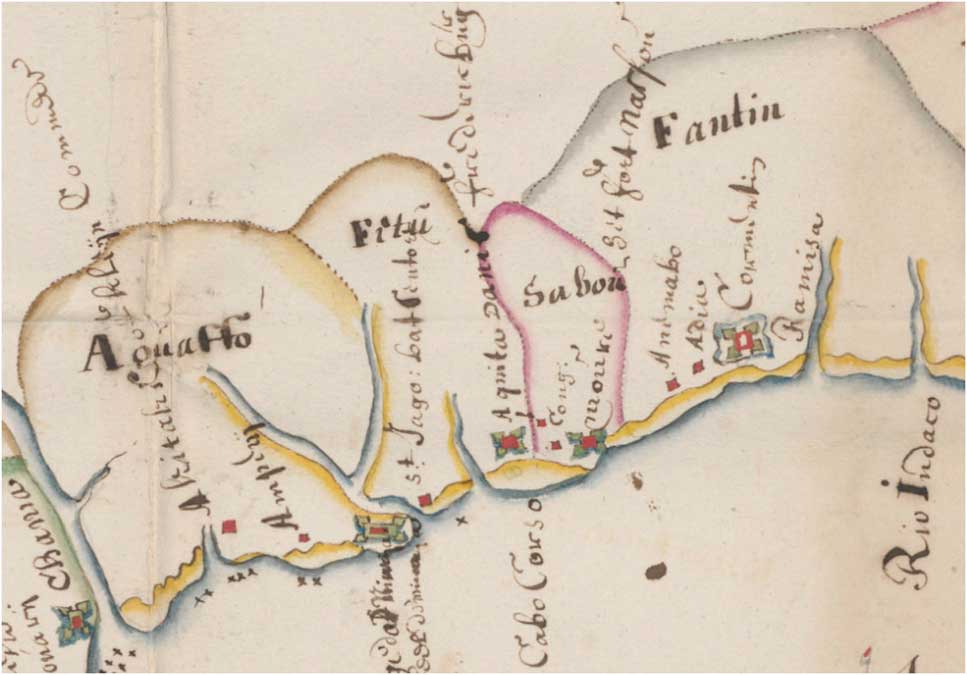
There was also some deliberate confusion within both Danish and Dutch circles regarding the precise location of Akong and whether it was under Fetu or Asebu suzerainty because of its proximity to Amanfro.Footnote 73 The Dutch actively attempted to manipulate this confusion in order to strengthen their own claims in both Akong and Cape Coast: a later Danish report noted that the Dutch disputed Fetu’s suzerainty over Amanfro by claiming that Amanfro “and Congo is one,” thus being under Asebu sovereignty.Footnote 74 This was in line with the Dutch policy of claiming exclusive rights through treaties, and, naturally, their position was more apparent in Asebu where they occupied a fort (Nassau), than in Fetu. (Figure 2)
Dutch map of the Gold Coast showing “Aquita Danis Fredericksburgh” in Fetu and neighbouring “Cong” in Asebu, 1662–63 (NL-HaNA, Staten-Generaal, 1.01.02, inv.nr. 12571.38.1).

Initiatives from Europe
By mid-1660, the conflicts between the WIC and the DAC in Africa had become a subject of fierce negotiation between the two companies and their respective states in Europe. In March, a Danish embassy was sent to The Hague to protest about the Smidt-Van Heussen agreement and to obtain promises of safe travel for two Danish (but de facto Dutch) vessels, the Frederik III and the Courier von Venetien, to Africa.Footnote 75 In October and November, perhaps in conjuncture with the sending of the two ships, Danish Ambassador Peder Charisius followed up on the complaints by pressing the matter in view of the later developments on the coast. The protests included the WIC’s attack on the ships St. Marten and Liefde, justification of Danish rights at Akong and Amanfro, and a denial of any Dutch involvement in the DAC.Footnote 76 However, the States General, no doubt already informed about Dutch involvement in the DAC, did not bring the matter forth to the WIC. In fact, in September and December, the Heeren XIX reaffirmed that Van Heussen was to take strong action against Dutch ships sailing under foreign commissions, and, especially, to hinder the trade at Cape Coast, as they considered the WIC the rightful possessor of that territory and fort, and furthermore, to recover possession of Akong Hill.Footnote 77
The directors of the DAC were aware of the Danish state’s limited ability to protect their overseas venture in Africa and instead took matters into their own hands by ordering their agents on the spot to enhance their cooperation with the local rulers. Gerhard van Tetz and Isaac Coymans, both former WIC officials and now leading men of the DAC, had been close associates of Acrosan during their Dutch service and wrote several letters to him and Cramer that were sent out with the aforementioned ships.Footnote 78 In one of the letters, Coymans warned Cramer about rumours that the WIC was equipping ships in order to take Carolusborg, and that they were planning to murder Acrosan, to which he recommended Cramer to warn Acrosan and, in case of a Dutch assault, to let him attack Fort Nassau as revenge.Footnote 79 The letters illustrate the delicacy of the DAC’s relationship with their African patron on the coast, as one of the letters referred to Acrosan as “father of all white men at Cabo Cors who are in service of the King of Denmark.”Footnote 80
The European element of the conflict shows the discrepancy between the desires of the European states and the political reality on the Gold Coast in Africa. Clearly, the Danish state had limited influence on the Dutch States General in asserting their rights on the coast, particularly when the latter had evidence of Dutch involvement in the DAC. However, in Africa it did not matter whether a company was considered illegal by one European state and legal by another as long as it enjoyed the protection of the local states. The DAC was fully aware of this fact and, combined with their intimate knowledge of the WIC, took advantage of it in order to strengthen their cooperation with Acrosan.
The Return of the Swedes and Its Implications for the Dutch and the Danes
In November 1660, the Swedish ship Coninck David arrived on the coast and the leader of the expedition, Tönnies Adrianson der Vos (a Dutch SAC veteran), was immediately given possession of Carolusborg by Acrosan.Footnote 81 With SAC back on the coast and in possession of their former stronghold, the WIC decided to exploit the confusing situation and take action against the now pressured DAC at both Akong and Cape Coast. In doing this, the director general in Elmina was following the orders of the Heeren XIX.Footnote 82 Roughly a week after Vos and his men had settled in the castle, a group of Dutch officials approached Cramer onboard the vessel Frederik III and read aloud a protest written by Van Heussen. The Dutch director general ordered Cramer to within forty-eight hours annul “the purchase of the Hill Congh, and take away from it the servants, goods, flag and flagstaff.” He further threatened that he would not tolerate “improprieties” and that he would take revenge for them in such manner as shall be judged “most proper and serviceable.” However, Cramer refuted their threats and answered that the matter of Akong, in addition to Carloff’s former lodges at Anomabu, Takoradi, and Osu, was to be settled in the upcoming negotiations in Europe. Interestingly, the Dutch officials replied that “Congh was quite another matter,” which shows how important they considered it to be for the WIC.Footnote 83
On 25 November, Van Heussen sent a letter to Vos and Michel Freymont, the captain of Coninck David, to inform them of his ongoing disputes with the DAC over Akong. He urged them not to “concern yourselves in that matter, nor to show any favour help or assistance either to the one side or the other,” and in return promised to not harass their ship.Footnote 84 Vos and Freymont were themselves in an awkward position with good reasons to fear the intentions of both the DAC and the WIC, and therefore accepted Van Heussen’s proposal to remain neutral.Footnote 85
However, no action was taken against the Danes at Akong at this time, apparently because of the involvement of Acrosan. In late November, Acrosan handed in two letters to Van Heussen in reply to his threats to Cramer over Akong where he stated that Cramer had “given himself into my hands and I have accepted him as an old friend and I know how to protect him; and he has never spoken of Congh.”Footnote 86 He also made it clear that it was Cramer who had been approached by the Asebu “by force” and that he had advised Cramer to fetch the goods from Akong “besides flag and flag staff,” but that they had been prevented from it by the Asebu. Importantly, Acrosan mentioned that the Asebu were greatly dissatisfied by this action and that they were blaming him for “taking the Whites away from them so that they are very evilly-disposed towards me.” Angered by the disturbances caused by the WIC, he ordered Van Heussen to notify the factor at Fort Nassau to call in Asebu to avoid disaster and to remove their ships from the area.Footnote 87 Clearly, neither Acrosan nor the Asebu would accede to Dutch demands.
Thus, in addition to explaining why the WIC refrained from taking action against the Danish lodges at Akong, these events once again underscore the authority and active role taken by Acrosan and the Asebu rulers (most likely Ampe) in guarding Danish (and therefore their own) interests. Importantly, in doing this the caboceers employed diplomatic means and negotiation rather than force to counter the WIC’s threats, and the latter was compelled to limit their opposition to threats and desist from using direct force against the Danes.
The Dutch Blockade of Cape Coast
The WIC’s failure to deal with the Danes at Akong and Cape Coast, and particularly the continuing of Dutch interloping in the name of the DAC, fuelled new high-handed measures by the WIC. From late 1660 to 1662 they concentrated their actions in the domain where they had the complete upper hand over Acrosan and their Danish rivals: the sea. The WIC seized numerous European vessels, including three Danish ships, effectively asserting their position on the coast and starving their Danish rivals of trade and provisions.Footnote 88
In February 1661, roughly two months after they failed to seize the Danish vessel Frederik III in the roadstead of Cape Coast, the WIC captured the Danish ship Courier von Venetien before it could reach the Gold Coast. The capture was very damaging to the Danes because it drained the DAC of essential supplies, harmed their reputation among their African allies, and revealed their tactics against the WIC when the WIC came into possession of some of the letters sent by the directors of the DAC that revealed Dutch involvement in the company and Danish plans to support Acrosan in a possible attack on Fort Nassau. The confiscation became a topic of intense diplomatic negotiations between Denmark–Norway and the Dutch Republic in Europe in the ensuing years, where the letters were used as incriminating evidence against the DAC.Footnote 89
The WIC’s capture of the Danish Courier in addition to the Swedish vessel Christina and a number of English vessels caused Acrosan to take strong action against the WIC.Footnote 90 In March 1661, he threatened war against the WIC if they would not release the captured vessels and used his influence in the region to prevent the influential Akanni traders from reaching a number of Dutch trade posts along the coast.Footnote 91 In response, the WIC intensified their blockade of Cape Coast and took advantage of their quarrels with Acrosan to do as much damage as possible to the Danes at Cape Coast and Akong. One of Van Heussen’s chief lieutenants later recounted that the Elmina Council had decided “to ruin all foreign ships, without respect.”Footnote 92 From April 1661 to late 1662, the WIC continuously stationed two or three ships outside Cape Coast and effectively hindered the vessels of the DAC as well as other European ships, and in some cases African boats, from exiting and entering the harbour.Footnote 93
Afro-European Opposition to Dutch Policies
The intensification of the conflict between the WIC and Acrosan had the effect of unifying the other Europeans against the Dutch, which in turn enabled the Danes to offer some resistance and expand their position on the coast. Between December 1660 and April 1661, the Danes expelled the Dutch from Carloff’s lodge in Osu with the support and consent of both Acrosan and the king of Accra, Okai Koi. They attempted the same actions without success at the Dutch fort Crévecoeur in Accra.Footnote 94 Moreover, the Danes at Akong and Amanfro fired on the blockading WIC ships lying in the roadstead of Cape Coast on 18 April, and on several occasions thereafter. They acted in unison with the Swedes at Carolusborg, who were also affected by the blockade and apparently also fired on the WIC ships from Carolusborg on the 19 April. By October, Van Heussen reported that the DAC and the SAC were “living with each other in good friendship, and are trying jointly, and each in particular, to stir up the Blacks against us.”Footnote 95
The Danes also secured the assistance of the English due to their shared frustration with the WIC’s aggressiveness. Already in 1660, Tetz had notified the Danes that “The King of England will trust [bouven aan] Denmark, and the English, so far as can be observed, will do no bad on the Coast, and if the WIC does anything against Denmark, it does it to England also.”Footnote 96 This explains why the Danes were supported by the English against the Dutch on several occasions in 1661, such as when the English at Fort Kormantin protected the Danish vessels St. Marten and Fortuyn from being chased by WIC ships, and the English government willingly detained the Dutch ship Graeff Enno in England for the Danes.Footnote 97 In 1662, this close cooperation led to the formation of a treaty of friendship between the DAC and the “English company trading in Africa and Guinea,” aimed at opposing the WIC.Footnote 98 Clearly, the WIC’s aggressive policy and blockade of Cape Coast had a profound impact on the political situation on the coast. For the Danes, the expenses involved in countering the WIC were substantial.Footnote 99
The Dutch Expel the Danes from Akong
It was inevitable that the actions of the Danes at Osu, Cape Coast, and Akong would add to the indignation of the Dutch. True, the Danes had shown their inclination to respond to WIC aggression on a large scale, and their actions were sanctioned by the local rulers. However, the Danish position was more ambiguous at Akong. Though the Dutch had threatened the Danes repeatedly, they had never taken action against them, presumably because they had been deterred by Acrosan. However, the situation changed when open hostilities broke out between Acrosan and the WIC, and due to the Danes’ actions in Accra (Osu) and bombardment of WIC ships from Akong and Amanfro in the first half of 1661. Furthermore, at this time Van Heussen probably received new instructions from the Heeren XIX that once again urged him to act more harshly against the simulated Danes on the coast, and particularly to recover the possession of Akong. Even more compelling were the intercepted letters from the Courier that revealed Danish plans to attack Fort Nassau.Footnote 100
All these factors were most likely decisive in the Dutch decision to instigate an attack and expel the Danes from Akong on the night of 24–25 April (4–5 May new style) 1661. A Danish report mentioned that the lodge was plundered and set on fire by a group of Africans hired by Van Heussen, with losses amounting to over 6,000 riksdalers. The Danes also claimed that a DAC assistant was arrested and brought to Fort Nassau, but the WIC “had to release him at the urgent request of the Fetus.”Footnote 101 The attack was also mentioned in English and Dutch sources, which both correspond with and contradict each other with regards to the role of the WIC. On the one hand, the English noted that “the flemins hired the King of Sabooe to fier a factory of the Danes, whoe lost to the vallue of two thousand pound Sterlling.”Footnote 102 Van Heussen’s account on the other hand put the blame solely on the Asebu and added that Cramer thereupon had the lodge and “all other houses” on Akong set on fire by the Fetu.Footnote 103 All three accounts show that the Danes lost a considerable amount of valuables and were not willing to let the Dutch take over their abandoned lodges. In opposing the Dutch, Cramer was once again supported by his patron Acrosan, who was able to pressure the WIC into releasing the imprisoned DAC (technically Dutch) assistant Johan Andriessen Hazel and, at least for the moment, to deter them from resettling Akong. This clearly underscores how far Acrosan’s influence extended into Asebu.
The expulsion of the Danes from Akong caused friction within the Asebu leadership. Clearly, Ampe had played a pivotal role in helping and protecting the Danish venture at Akong and therefore opposed the joint action taken against them by the WIC and the Asebuhene.Footnote 104 This explains why, in August, the Dutch were forced to restore the plundered goods to the Danes and the Asebu rulers continued to refuse the WIC possession of Akong, and were opting for the Danes to return to the site.Footnote 105 However, by 1664, the rulers had changed their minds and invited the Dutch back to Akong, where they resettled the site in order to avoid a possible English intrusion into the territory. Interestingly, the Dutch reported that the Asebuhene excused himself to them for what had “previously happened, with the authority of Jan Claasen, which would not now be so,” which highlights Acrosan’s role in supporting Danish activity in the territory.Footnote 106
However, the Danes maintained an interest in Akong and continued to receive political support from the Asebu (most likely Ampe) long after their expulsion from the territory. For instance, in early 1664, the Asebu threatened to intervene if the WIC attacked the DAC at Frederiksborg (Amanfro) in Fetu.Footnote 107 Akong remained a topic in the heated negotiations between Denmark-–Norway and the Dutch Republic in Europe in the late 1660s and early 1670s.Footnote 108 In 1670–71, the Danes tried to re-establish themselves in Akong and even opposed French efforts to settle there by claiming that the “jurisdiction and property of the Danish King” stretched “from Cabo Corse to Congo.”Footnote 109 Clearly, the Asebu, despite their long-standing ties with the Dutch, maintained an enduring and close relationship with the Danes as well.
Concluding Remarks: The WIC and the DAC after 1662
By 1662, the Dutch had become weary of opposing the activities of other European nations on the coast, particularly since their perennial efforts to expel the pseudo-Dutch Danes and Swedes had proven mostly ineffective. This hopeless struggle completely bogged down the WIC in the ensuing years, and the following year the director general and Council declared that the Company “is nothing but an exhausted body with a general scarcity of everything.”Footnote 110 Although the death of both Acrosan and Van Heussen in mid-1662 occasioned a power change in Fetu and the WIC that in turn led to a normalisation of their strained relationship, it was only temporary. In May 1663, the new Fetu leadership expelled the now inactive Swedes and gave the Dutch possession of Carolusborg, but they lost it again to the English (with Danish support and Fetu approval) a year later.Footnote 111 The English renamed it Cape Coast Castle and kept it as their headquarters. From that point on, the Dutch began to concentrate their main efforts on opposing the increasing activity and influence of the English on the coast. This allowed the Danes to continue to cultivate close ties with the rulers and consolidate and strengthen their position in their remaining possessions at Amanfro (Frederiksborg) and Osu (Christiansborg).
By focusing on the on-the-spot interactions between the WIC, the DAC, and local rulers on the Gold Coast from 1657 to 1662, this article has shown that the Dutch and Danish maritime empires developed as a result of inter-imperial entanglements and continuous processes of negotiation and bargaining. This process involved company officials, individuals operating the foreign outposts, and above all, local potentates in the overseas territories. The Danes took advantage of their intimate knowledge of the WIC and local affairs by seeking out African polities and potentates willing to welcome them as a buffer to the Dutch, and/or as an exclusive European trading company in their territory. By cultivating close ties and negotiating ad hoc agreements with the potentates for their own protection, the Danes mostly avoided direct conflict with the much stronger WIC. The Dutch, on the other hand, maintained an aggressive policy that sought to evade the authority of caboceers and instead get control over local affairs. In opposing the Danes and asserting their claims of trade hegemony, they were willing to use force if diplomacy proved insufficient. However, such actions were mostly opposed by the African potentates, who answered with vigorous countermeasures. This forced the Dutch to fall back on their claims and return to diplomacy, which allowed the Danes to continue their activity.