Introduction
Questionnaires used in surveys and health research most often consist of closed questions which offer participants a fixed number of response choices. In this way they are an efficient means for researchers to gather information from large numbers of people (Taylor & Bogdan, Reference Taylor and Bogdan1984). Many closed questionnaires will also offer participants the opportunity to add additional comments about the topic under investigation. There are a number of reasons for the inclusion of an ‘anything else you’d like to add’ section, ranging from affording participants the opportunity to clarify their answers to earlier questions to a view that this type of question is the appropriate way to close a questionnaire (O’Cathain & Thomas, Reference O’Cathain and Thomas2004). Some support has been found also for free-text comment sections increasing the response rate to questionnaires (McColl, Jacoby, Thomas, Soutter, & Bamford, Reference McColl, Jacoby, Thomas, Soutter and Bamford2002).
Despite the regularity with which participants are asked to include additional comments, it is rare for this data to be analysed by researchers (Pill et al., Reference Pill, Wood, Renold, Robling, Edwards and Wilkinson2003). This is largely due to the time and financial resources required to qualitatively analyse a large number of comments. By their nature closed questionnaires are aimed at gathering basic information from a wide sample and thus dealing with the large quantity of data in ‘any other comments’ sections can be beyond the scope of many research projects. While this is understandable, it has been suggested that it is ethically dubious to ask an open question without being prepared to analyse the responses provided (O’Cathain & Thomas, Reference O’Cathain and Thomas2004).
Another reason why the analysis of free-text comments is important has been evidenced by a number of studies which have reported the value of such analysis can lend to the understanding of complex research questions. For example, Phelps, Wood, Bennett, Brain, & Gray (Reference Phelps, Wood, Bennett, Brain and Gray2007) in their study of women undergoing cancer genetic risk assessment found that free-text comments contributed useful data concerning their participants’ expectations and knowledge of genetics services. Similar findings have been reported by Ong, Dunn and Croft (Reference Ong, Dunn and Croft2006) in their study of low back pain and by Pill et al. (Reference Pill, Wood, Renold, Robling, Edwards and Wilkinson2003) in their investigation of Welsh women's breast cancer and the care they received. It has been also suggested that free-text comments can be a useful way of obtaining feedback on the research being conducted and identifying new issues for future research (Garcia, Evans, & Reshaw, Reference Garcia, Evans and Reshaw2004).
Smokers Unmotivated to Quit
The aim of the current study was to utilise free-text comments to gain insight into a particular group, smokers unmotivated to quit smoking, through an analysis of free-text comments provided as part of a randomized controlled study of computer-tailored feedback for smoking cessation (Gilbert et al., Reference Gilbert, Leurent, Sutton, Alexis-Garsee, Morris and Nazareth2013). This group of smokers represent a large proportion of the smoking population. It has been reported by the Health and Social Care Information Centre that one third of smokers in the UK state that they do not want to quit and 75% of all smokers failed to make a quit attempt in a given year (2008–2009) (NHS, 2012). Established structured behavioural support programs such as that provided by the NHS Stop Smoking Service (SSS) are most effective in helping smokers to achieve successful cessation (Brose et al., Reference Brose, West, McDermott, Fidler, Croghan and McEwen2011) but these programs are aimed at smokers who are willing and ready to quit smoking. A better understanding of the beliefs and values of smokers unmotivated to quit could inform interventions to target this somewhat neglected group of smokers who make up the majority of the smoking population.
According to the Transtheoretical Model (Prochaska & DiClemente, Reference Prochaska and DiClemente1983) and the more recently proposed Perspectives on Change model (Borland, Balmford, & Hunt, Reference Borland, Balmford and Hunt2004) smokers who have no intention of quitting in the coming six months are ‘precontemplators’ or ‘disengaged’ with the process of quitting. This group encompasses both those who view their behaviour as problematic (who want to quit smoking but feel unable and thus have no intention of doing so, defined as ‘discouraged’ by Perspectives on Change model) and those who do not perceive there to be any problems associated with their behaviour (who enjoy smoking and have no desire to quit, defined as ‘immotive’ by Perspectives on Change model). It has been suggested that a focus on enhancing self-efficacy (Borland et al., Reference Borland, Balmford and Hunt2004) in the case of those smokers who feel unable to quit, and using motivational interviewing techniques (Catley et al., Reference Catley, Harris, Goggin, Richter, Williams and Patten2012) for those who lack the desire to quit, would be helpful. However, there is a shortage of information in this area as most research focuses on those who are prepared to make a quit attempt.
It is essential to better understand the beliefs and values of these smokers unmotivated to quit and thus improve the effectiveness of smoking cessation interventions aimed at this group. At the most basic level it seems essential to gain a better understanding of why these smokers are unmotivated to quit to begin with. Is it the case that they fail to appreciate the panoply of evidence that smoking is bad for their health? Do they feel alienated by the attitudes of the non-smoking majority? Or are they simply unaware of the support available to help them to quit?
This study aimed to explore these types of questions through the analysis of free-text comments provided at the end of a Smoking Behaviour Questionnaire(SBQ). Firstly, quantitative analysis was used to assess the possible differences between those who provided free-text comments and those who did not. Qualitative analysis was then conducted on a subset of commenters – those who indicated they had no intention to quit in the upcoming six months. In this manner, it was hoped that this research could explore the motivations of two types of smokers who are often neglected in smoking cessation research; smokers for whom quitting seems unimportant and those who feel unable to make a quit attempt.
Method
Data in the present research was collected as part of the effectiveness of computer-tailored smoking cessation advice in primary care (ESCAPE) study, a randomized controlled study to evaluate the effectiveness of adding tailored advice reports to a generic self-help booklet on smoking cessation six months later. Participants were recruited from geographically representative general practitioner surgeries throughout the UK.
ESCAPE Procedure
Current cigarette smokers aged 18–65 years were identified from their medical records using the computer system in 123 practices (n = 159,839) and a random sample of 58,660 were sent a SBQ and an invitation to participate. Eligible smokers returning the completed questionnaire and signed consent form (n = 6,911) were randomly assigned to the control group to receive standard, non-tailored information or to the intervention group, to receive the standard non-tailored information plus a computer-tailored advice report.
All participants were sent a follow-up questionnaire by post six months after randomization. Participants failing to respond after two weeks were sent a reminder with a duplicate questionnaire. Those failing to return the postal questionnaire were contacted by telephone to complete a shorter telephone interview.
Measures
The SBQ completed at baseline assessed demographic characteristics, intention and motivation to quit, dependence, previous quit attempts, perceived advantages and disadvantages of quitting, self-efficacy and social environment. This information was also used to generate the tailored reports. The final page of the SBQ at baseline provided a section entitled ‘Please use the space below for any other comments’.
The primary outcome measure of the ESCAPE trial was self-reported prolonged abstinence for at least three months at the six month follow-up. Secondary outcomes included self-reported prolonged abstinence for at least one month, point prevalent abstinence of seven days, point prevalent abstinence of twenty-four hours and quit attempts in the six months following randomization.
Participants
A total of 4,677 participants provided full data at the six month follow-up point either by postal questionnaire or telephone interview. Of these, 1,385 (29.6%) had provided a comment in the SBQ at baseline and 2,228 answered ‘not within the next six months’ to the question ‘when are you planning to quit?’ at baseline. A total of 631 provided both a free-text comment and indicated that they did not plan to quit ‘within the next six months’.
Analysis
The baseline characteristics and follow-up outcomes of those providing comments in the SBQ were compared to those who did not using t-tests for continuous data and chi-square tests for categorical data. Following these analyses, the baseline comments of those participants who had selected ‘not within the next six months’ to the question ‘Are you planning to quit?’ were isolated (n = 631).
The baseline comments for this group were entered into a spreadsheet. These comments were coded into thematic categories by the first author through an inductive analytic process (Thomas, Reference Thomas2006). Two additional authors (DK and AH) independently analysed half of the comments each and then all three met to discuss their findings where a consensus was reached about the key themes present in the data.
Results
Characteristics of Those Who Provided a Comment and Those Who Did Not
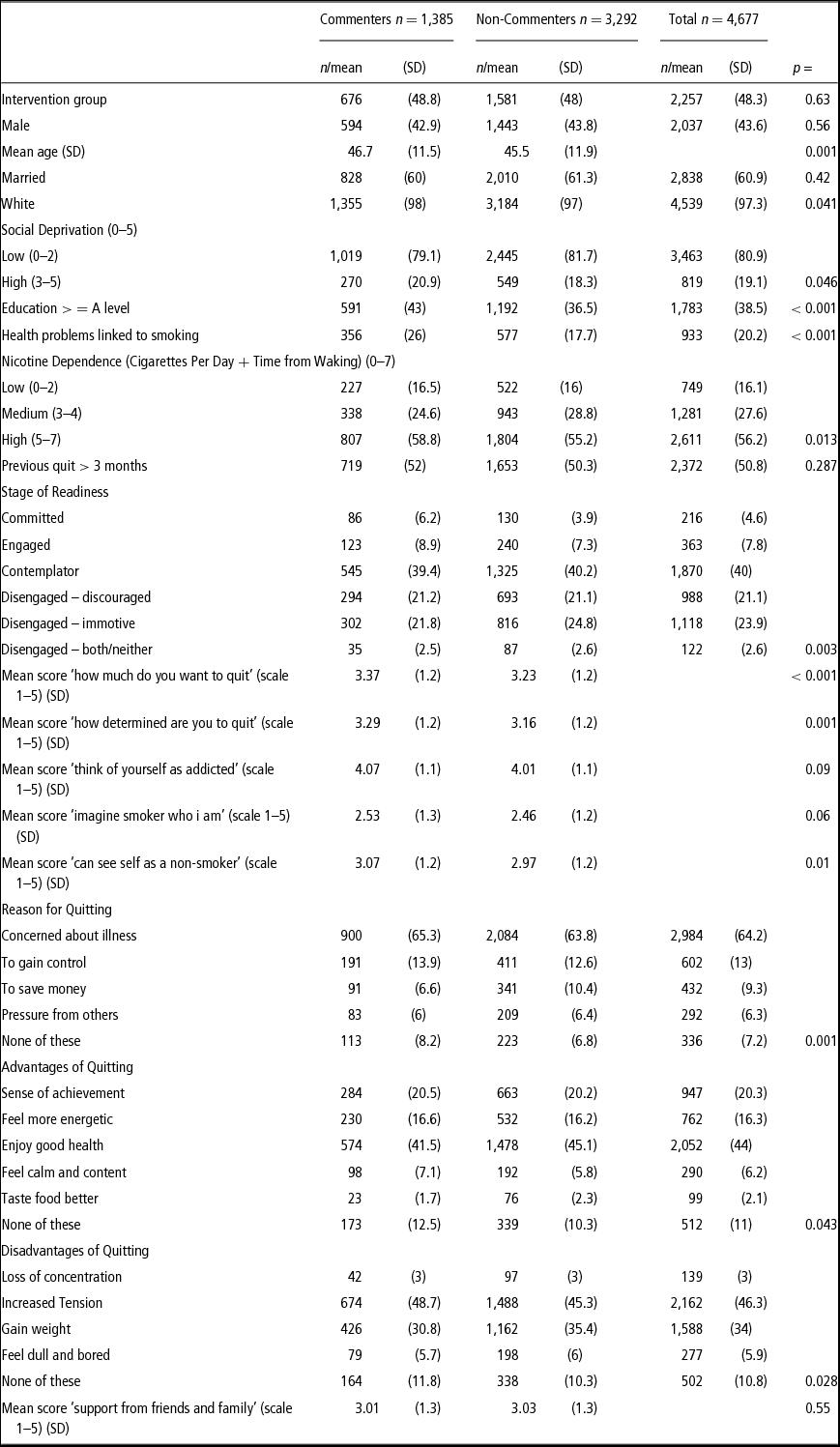
These groups differed significantly in age and education level, both of which were found to be greater in those who supplied comments (mean age 46.7 vs. 45.5 years, p = 0.001; education ≥ A level 43% vs. 36.5%, p < 0.001) (Table 1). In the measures related to smoking, those who commented were more likely to be of higher nicotine dependence (58.8% vs. 55.2%, p = 0.013), reported greater desire (mean score 3.37 vs. 3.23, p < 0.001) and determination (mean scale 3.29 vs. 3.16, p = 0.001) to quit smoking and were more likely to report that they could see themselves as a non-smoker (mean score 3.07 vs. 2.97, p = 0.01). The group who provided comments was also more likely to endorse intrinsic motivations for quitting smoking such as illness and self-control and less likely to choose extrinsic motivations such as social pressure and money concerns. Overall, those who made comments were more likely to be in the ‘committed’ or ‘engaged’ stage of quitting (6.2% vs. 3.9%; 8.9% vs. 7.3%, p = 0.003). Finally, those who provided comments were more likely to report suffering from a smoking related health problem (26% vs. 17.7%, p < 0.001).
Characteristics of commenters vs. non-commenters (n = 4,677)

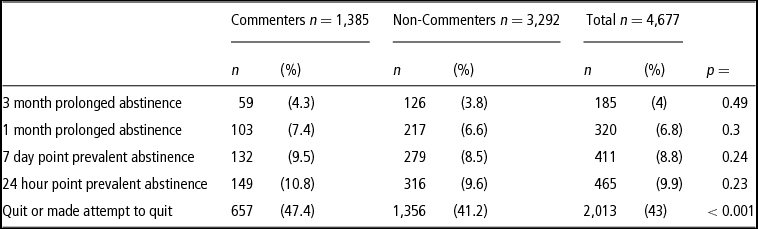
There was no difference between the two groups in the main outcomes of prolonged and point prevalent abstinence at the six months follow-up. However, those who provided a comment were significantly more likely to have made a quit attempt since joining the study (47.4% vs. 41.2%, p < 0.001) (Table 2). The primary outcome previously reported (Gilbert et al., Reference Gilbert, Leurent, Sutton, Alexis-Garsee, Morris and Nazareth2013) that there was a significant effect of the intervention on quit attempts in the following six months. Therefore, an analysis of the potential interaction effect of the study intervention and commenting or not commenting was conducted. No significant interaction was found.
Smoking status at six months follow-up by commenters versus non-commenters (n = 4,677)

Free-Text Comments
A number of themes were identified. However, as this research aimed to understand the motivations of both smokers who are uninterested in quitting smoking and those who feel unable to make a quit attempt, analysis focused on themes directly relating to these motivations; justification of smoking, restricting smoking instead of quitting, dissatisfaction with or lack of awareness of support available to quit, persecution, and freedom of choice. Other major themes that emerged were either not directly related to smoking (e.g. health in general) or were related to smoking but focussed on providing information (e.g. smoking habits).
In addition, due to the nature of free-text comments some themes which would appear related to these motivations were omitted as they consisted largely of statements that would lend little to the understanding of this group (e.g. ‘I do not wish to give up smoking’ within the theme of ‘No desire to quit’). The theme of questionnaire feedback is also discussed as it relates to the utility of including a space for free-text comments in questionnaires.
-
1. Justification of smoking.
A number of participants described their perception that quitting smoking was unnecessary due to the other healthy behaviours they engaged in.
I am not considering giving up smoking. . . . . . .I enjoy an active life, I walk some 30–40 miles a week with my dog, I regularly go skiing and I spend a lot of time outdoors. I have been a “real” vegetarian for over 20 years. (Male, 43)
This theme was extended by many participants to include negative health behaviours which they avoided and thus ‘deserved’ the indulgence of smoking.
. . . .Also, humans like drugs - I don't drink, do drugs, eat chocolate - much, so this (smoking) is my drug of choice. (Female, 50)
Other participants detailed their own good health and saw this as a justification for continuing to smoke.
. . . . . .I recently had a pulmonary examination and results were very good for a man of my age. (Male, 56)
-
2. Restricting smoking instead of quitting.
Participants who stated no intention of quitting within six months often justified their position by arguing that they had gained control of their smoking by cutting down to a specific number of cigarettes per day. Others seemed to consider cutting down a stepping stone to quitting completely in the long term.
Very little is ever said about cutting down smoking. I used to smoke 20+ cigarettes per day. Since being pregnant I cut back to 1–2 a week and I am fairly happy with 1–2 a day but will cut back more. (Female, 34)
I quit smoking recently and had not smoked for 4 months. Unfortunately I chose to start again and although I have cut back considerably (as I used to smoke 20 cigarettes a day) now I only smoke up to 5 per day. I have no plans in the near future to completely stop again, but in the long term I am very hopeful. (Female, 24)
Some participants mentioned that cutting down had given them a sense of control over their smoking.
I have drastically cut down since January this year (Jan’ 2007) and find it relatively easy to control and discipline myself to have between one and three a day, hence the average of 2 per day. (Male, 27)
Other participants suggested that by limiting the locations they allowed themselves to smoke they did not need to quit.
I only smoke in a social setting in a pub at a weekend. I do not smoke at work or at home during the week. (Female, 28)
-
3. Dissatisfaction with or lack of awareness of support available to quit.
Many participants included cries for help in their free-text comments, indicating a willingness to quit if given the appropriate support. The inclusion of such statements may suggest a lack of knowledge of the support which is freely available to all smokers in the UK from the NHS SSS.
I have suffered from chronic bronchitis and only weigh 7 stone. My mum, uncle and granddad all died of emphysema. I have tried several different products to help me to give up smoking but have never been successful for more than a week. Any help that you can give me to battle this addiction would be very much appreciated. (Female, 50)
Other participants seemed to have had experience of the support available to smokers but were critical of the ‘help’ they had received.
I tried to give up smoking early this year but I had one cigarette in two weeks and the nurse at my doctors just stopped the help, which was not very encouraging. She was not really paying much attention to my problem as she was too busy talking to the other practice nurse who kept on coming in and out all the time I was there, I felt let down by this and feel with a bit more help I would now be a non-smoker. I now have no faith in going back to my doctors for help. (Female, 46)
-
4. Persecution and freedom of choice
Many participants felt that smokers were unfairly targeted by legislation and public opinion over and above users of other health damaging substances.
I sat filling in the form while smoking and it was divine. Why are us smokers’ human rights being denied when smoking is LEGAL? Whereas drug taking is ILLEGAL (which I have never been one) are being applauded and vast amounts of money spent on them to very little or no success and not cost effective. . . . . . . . . . . . . .Get your priorities right. (Female, 50)
More specifically there was a feeling amongst many of those who provided comments that smokers were being persecuted by laws restricting smoking. There were many references to their freedom of choice being limited.
I despise society forcing me to do something like stopping smoking. I do not want motor racers, parachutists or mountaineers to stop trying to harm themselves. It is a question of choice. All my freedoms are being constantly eroded away by “big brother” mentality. I smoke though choice! I pay taxes to the National Health Service! I pay for choice! I know the facts! (Male, 52)
Other comments suggested alienation and ostracization due to their smoking status.
Sick of being frowned on and treated badly because I smoke, I am not a bad person. (Female, 55)
Process theme: Questionnaire feedback.
Finally, the free-text comments section was often used by participants to provide feedback on the questionnaire. Some were critical about the content of specific questions while others objected to being sent anything related to stopping smoking.
. . . . . . . . .When I know I really want to (quit) for all the right reasons for me, not because of some survey or literature being rammed down my throat. (Female, 39)
A particular issue which emerged was questions concerning socio-economic status and the relevance of these questions to research on smoking.
Although I have completed section 4, I cannot see its relevance to the questionnaire, unless it is to be utilised for “social grouping” of smokers, it reads very much of class distinction. (Female, 52)
A common usage for the free-text section was for clarification to earlier answers to closed questions.
Question 5 difficult to answer as I always think of quitting but don't really have plans. Question 8 - neither answer applies as I don't really know if it is too difficult and I really don't want to smoke. If I could answer honestly in my own words I would say I am afraid to stop but I don't know why I fear stopping other than the weight gain. . . . . . . . . . . . .(Female, 56)
Other comments were more positive, expressing gratitude that research was being done in this area.
At last! A high quality study concentrating on the behaviours/opinions of the “offenders” themselves! (Female, 45)
Discussion
This study aimed to gain insight into smokers with no intention to quit in the upcoming six months by qualitatively analysing free-text comments they provided at the end of a SBQ. The differences between those who provided a comment and those who did not (in the whole sample) were also examined. The results indicated that the groups differed in age and education level, both of which were greater in the group that supplied comments. The finding that those providing comments were more educated is in line with findings in other studies (Riiskjær, Ammentorp, & Kofoed, Reference Riiskjær, Ammentorp and Kofoed2012). Those who commented were also more dependent on cigarettes, more motivated and determined to quit smoking and more likely to report that they could imagine themselves as a non-smoker. These findings could be due to more ‘extreme’ participants being more likely to comment. Riiskjær Ammentorp and Kofoed (Reference Riiskjær, Ammentorp and Kofoed2012) reported a similar finding in their investigation of patient surveys which found that the least and most satisfied patients were those who were most likely to provide a comment.
An additional interesting finding that emerged from the quantitative comparison was the higher likelihood of those who commented to have made a quit attempt in the six months after joining the study. However, there was no difference in the groups in prolonged abstinence so these extra quit attempts did not lead to higher levels of smoking cessation in those who commented. These findings can be linked to other research which has reported that smokers who are motivated to quit are more likely to make a quit attempt but are not more likely to maintain abstinence from smoking (Hyland et al., Reference Hyland, Borland, Li, Yong, McNeill and Fong2006; Zhou et al., Reference Zhou, Nonnemaker, Sherrill, Gilsenan, Coste and West2009). This trend has been attributed to the tendency for smokers who are highly motivated to quit also being those who are most dependent on cigarettes and therefore likely to have the most difficulty in quitting. As previously mentioned, those who provided a comment were indeed more highly dependent on smoking.
A key theme to emerge from the qualitative analysis was the notion of justification of smoking whereby participants used their positive health behaviours and general perceived good health to rationalize their continuing to smoke. It may be that these smokers see their healthy behaviours such as exercising regularly and avoiding alcohol as counter balancing the negative impact of tobacco smoke on their bodies. Other researchers have reported this type of attitude elsewhere and have named these beliefs ‘Compensatory Health Beliefs’ (Knäuper, Rabiau, Cohen, & Patriciu, Reference Knäuper, Rabiau, Cohen and Patriciu2004). Rabiau and colleagues argue that the activation of these beliefs allow the individual to engage in the desired unhealthy behaviour without the associated guilt (Rabiau, Knäuper, & Miquelon, Reference Rabiau, Knäuper and Miquelon2006). In this way the individual can dismiss the necessity of quitting smoking based on the false belief that they are negating the impact of smoking on their body by engaging in a compensatory behaviour. This finding suggests that health messages to smokers should emphasize that the detrimental impact of smoking on health cannot be offset by engaging in other positive health behaviours.
This justification of smoking can also be understood in the context of the ‘considerate’ smoker as described by Poland (Reference Poland2000) who suggests that the increased awareness of the notions of health risks and the management of one's own health has placed more pressure on people to take responsibility for the risky behaviours in which they engage. People are expected to monitor themselves and carefully consider the risks that they take in everyday life (Poland, Reference Poland2000). It is perhaps in fulfilment of this new role that smokers try and explain their negative health behaviours in the context of the positive steps they take to maintain their health. In this way they can see themselves and be seen by others to be purposefully ensuring their own future good health.
Participants who provided comments also indicated that they felt persecuted by both government policy and non-smokers. They expressed anger at their perceived demonization and a number of comments suggested a perception that the public's attitude to them was worse than that to people addicted to illegal drugs or alcohol. This tendency of smokers to point to other behaviours which potentially jeopardise health has been reported elsewhere (Poland, Reference Poland2000). Other comments detailed the sense of smokers’ rights and freedom of choice being eroded. The distribution of the questionnaire coincided with the introduction of the UK smoking ban in 2007 and this could have affected or prompted some of these comments. A number of studies have identified an associated increase in perceived stigmatization among smokers following the introduction of smoke-free legislation (Ritchie, Amos, & Martin, Reference Ritchie, Amos and Martin2010; Stuber, Galea, & Link, Reference Stuber, Galea and Link2008).
There was also an overriding sense of smokers being marginalized by society in many of the comments. Again, this may be reflective of the timing of this survey as the smoking ban did have the effect of excluding smokers from the public realm, at least while they were smoking. Some research has suggested that smokers who perceive high levels of stigma are more likely to quit (Stuber et al., Reference Stuber, Galea and Link2008) but it is clear that strong feelings of stigma have not prompted these particular smokers to quit or even plan to quit in the next six months. This stigma can also represent an additional burden on those who are already struggling to cope (Bayer, Reference Bayer2008). While it is necessary to offer information about the dangers of smoking this theme suggests that it is also important to ensure support is available to people who experience stigma due to their smoking behaviour (Ritchie et al., Reference Ritchie, Amos and Martin2010).
In the related theme of restricting smoking instead of quitting completely many participants argued that they had gained control over their smoking by cutting down their cigarette consumption. Some participants were satisfied with the level they had reached but others saw it as a way of progressing towards complete abstinence. This is a particularly interesting theme as the idea of cutting down over abrupt cessation is a controversial one. The established practice in the NHS SSS is to recommend abrupt cessation and the notion that this is the most effective way to quit has been supported by a number of studies (Cheong, Yong, & Borland, Reference Cheong, Yong and Borland2007; West, McEwen, Bolling, & Owen, Reference West, McEwen, Bolling and Owen2001). However there is growing support for the idea that cutting down can be a potentially useful path to cessation, especially for smokers with little initial motivation to quit and particularly when combined with the use of NRT (Fagerström, Reference Fagerström2005; Fagerström, Tejding, Westin, & Lunell, Reference Fagerström, Tejding, Westin and Lunell1997; Moore et al., Reference Moore, Aveyard, Connock, Wang, Fry-Smith and Barton2009; Tønnesen, Reference Tønnesen2002). Bolliger et al. (Reference Bolliger, Zellweger, Danielsson, Biljon, Robidou and Westin2000) demonstrated in a randomized controlled trial that 9.5% of a small group of smokers with little motivation to quit had achieved point prevalent abstinence two years after the date of randomization following a program of cutting down and NRT as compared to 3% in a group cutting down and using a placebo. The fact that smokers in the current study were unmotivated to quit and many who commented highlighted the appeal of cutting down suggests that a program of this sort could potentially be effective in promoting eventual cessation to smokers with no immediate intention of quitting.
Some participants providing comments indicated a lack of awareness of support available while others described dissatisfaction with the support in quitting they had been offered in the past. The reasons for this dissatisfaction varied between participants with some feeling there was a lack of empathy from smoking cessation advisors. Considerable variability has been found in the training that NHS SSS advisors in the UK currently receive (McDermott, Beard, Brose, West, & McEwen, Reference McDermott, Beard, Brose, West and McEwen2013). This highlights the importance of training NHS SSS advisors to a high standard so they can effectively encourage behaviour change whilst maintaining an understanding and supportive stance. Other participants mentioned that they felt under pressure to quit at a faster rate due to the NHS SSS six week course structure. It should be noted, however, that this data was gathered in 2007–2008 and it is possible that since then services in the UK have become more flexible in the length of support and number of sessions they will offer a smoker.
Other comments related to the topic of support included many ‘cries for help’, with these participants beseeching the research team for assistance in quitting smoking. These comments suggest that participants were not aware of the free cessation support that is available in the UK. Greater advertisement and promotion of the support available is needed to ensure all smokers wanting help to quit are aware how to avail of assistance.
Free-text comment sections can be useful for garnering opinion on the tools used to address the research question (Garcia et al., Reference Garcia, Evans and Reshaw2004). The feedback on the questionnaire provided by some participants’ comments varied from emotive reactions to being sent an invitation to participate in smoking research to more detailed observations on individual questionnaire items. The anger expressed by some participants is perhaps evocative of the theme described above of the curtailment of smokers’ freedoms.
Those who provided feedback on individual questions in the free-text comment section fell into two groups. Firstly, some were critical of the inclusion of certain items which they felt were irrelevant to smoking. An example of this was participants who were particularly unhappy with questions which focused on socio-economic status. This may be reflective of the reluctance of people to acknowledge a causal link between socio-economic status and health behaviours (Blaxter, Reference Blaxter1997; Putland, Baum, & Ziersch, Reference Putland, Baum and Ziersch2011). It may also be linked to the previously mentioned stigma some smokers experience and the complex relationship between smoking and socio-economic status (Putland et al., Reference Putland, Baum and Ziersch2011). Perhaps a brief explanation of the necessity of these types of items in health surveys could both improve responses to these questions and the questionnaire in general. Secondly, some participants used the free-text comments’ section to explain and clarify their answers to particular questions. This use ties into the idea that free-text sections act as a ‘safety net’ to ensure researchers do not miss any relevant issues not covered by closed questions as discussed by O’Cathain and Thomas (Reference O’Cathain and Thomas2004). This section also affords participants the opportunity to present their own opinions without being forced to filter these views through closed questions which are representative of the researchers’ agenda.
Strengths and Limitations
A strength of this study is the large population based sample recruited. Unlike many smoking cessation studies which aim to recruit smokers who are ready to quit this study attracted a high proportion of smokers in earlier stages of readiness. This allowed for the gathering of views from a section of the smoking population which is normally quite difficult to reach. It is important to note that comments are unlikely to be fully representative of all participants who completed a questionnaire as only 29.6% of all participants and 28.3% of those who had no intention of quitting in the next six months made a comment. In addition, the exclusion of those who were lost to follow-up from this analysis does mean the views of a particular group of smokers, potentially the least motivated to quit, were missed.
While there were many similarities between those who commented and those who did not, the differences found mean that the findings from the comments section cannot be generalized to the study population. However this lack of generalizability does not negate the value of data from this subset of responders in providing insight into the minds of smokers who are not motivated to quit. The findings of the qualitative analysis suggest a number of areas on which future research should focus.
As this analysis was of responses to the statement ‘Please use the space below for any other comments’ the topics covered were determined by participants. An in-depth interview methodological approach would have allowed for further exploration of a wider variety of issues with each participant. However, it is possible that this particular group who had no intention to quit in the near future would have been unwilling to participate in such a time consuming procedure on a topic which ostensibly does not interest them. As such, free-text comments were a pragmatic way of capturing an insight into this group's beliefs and reasoning about smoking and smoking cessation.
Conclusion
The findings in this paper illustrate the value of free-text comments in identifying important issues to those responding to closed questionnaires. In particular this analysis demonstrates the usefulness of free-text comments in exploring issues common to a subset of respondents.
The identified themes highlight a number of areas which should be explored by future research such as the utility of cutting down smoking as a path to quitting among smokers unmotivated to quit and more explicit messages to smokers regarding the inability of positive health behaviours to balance out the negative impact of smoking on the body.
Acknowledgements
We are grateful to Dr Fiona Stevenson for providing feedback on the qualitative analysis and two anonymous reviewers for their comments and advice.
Financial Support
The original trial was supported by a grant from Cancer Research UK (C16265/A6907). This secondary analysis received no additional funding from any agency, commercial or not-for-profit sectors.
Conflict of Interest
None.
Ethical Standards
The authors assert that all procedures contributing to this work comply with the ethical standards of the relevant national and institutional committees on human experimentation and with the Helsinki Declaration of 1975, as revised in 2008.