INTRODUCTION
Canada’s 2015 federal election was an exiting and consequential contest. After nearly a decade in office, Prime Minister Stephen Harper and his Conservative Party of Canada suffered defeat at the hands of a resurgent Liberal Party led by Justin Trudeau. Trudeau is the son of Pierre Elliott Trudeau, one of Canada’s longest serving and most famous prime ministers. Like his father, Justin Trudeau had no executive experience in either the private or the public sectors prior to the election. But again, like his father, this did not matter to the electorate, despite attempts by the Conservatives to make it a defining issue in the 2015 campaign.
In this article, we use national survey data Footnote 1 to study the electoral forces that propelled Justin Trudeau and his party to power. We also employ data gathered in the 1968 Canadian Election Study Footnote 2 to demonstrate that these forces were similar to those that had done much to help his father win power nearly half a century ago. The factors that were crucial for Liberal success in both elections are key components in the valence politics model of electoral choice, a model that was strongly influenced by early research on Canadian voting behavior. Footnote 3 In the next section, we discuss key valence political forces at work in the 2015 federal election. Footnote 4
VALENCE VOTING IN 2015
Issues
In 2015, the economy—a quintessential valence issue—dwarfed all other concerns. Footnote 5 When asked about the most important issue facing the country, a full 47% of the Abacus survey respondents chose unemployment or the economy more generally, with an additional 7% referring to taxes or government debt. No other issue was cited by as many as one person in ten, with those two hardy perennials of contemporary Canadian political discourse—healthcare and the environment—mentioned by only 6% and 4%, respectively. Similarly, while the circumstances under which Muslim women could wear a veil (niqab) were hotly debated by the parties and press during the latter part of the campaign, only 4% of respondents mentioned this issue or other cultural concerns.
The emphasis on the economy is not surprising. Canada had escaped the worst effects of the 2008 financial crisis and ensuing economic meltdown, but growth had been sluggish and the economy had slipped into recession as the 2015 campaign began. Although the negative growth statistics were less than one-half of 1%, the matter of a recession was definitely not good news for Canadians or a federal government seeking a renewed mandate. Adding to the gloom, the price of oil on world markets had crashed, thereby sharply reducing the flow of petro-dollars that had bolstered Canada’s prosperity in recent decades. Also, the value of the Canadian dollar (the “Loonie”)—always closely watched as a sign of national economic well-being—had fallen sharply. When the campaign began in August 2015, the Loonie was trading at only 76 cents USD, down a whole 24 cents from its value at the time of the 2011 federal election.
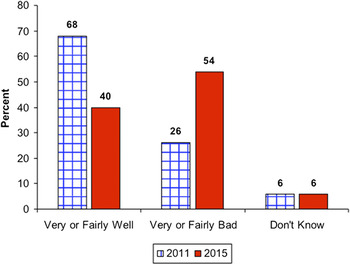
Public evaluations of the economy reflected the downturn. As figure 1 shows, 40% of those surveyed judged that the economy was doing “very” or “fairly” well, but a clear majority (54%) believed that it was doing “very” or “fairly” badly. Just before the 2011 election, the comparable figures had been very different— a full 68% thought that the economy was doing well and only 26% thought that it was doing poorly. The country’s economic mood had darkened considerably since Prime Minister Harper and the governing Conservative Party of Canada (CPC) had last faced reelection and escaping the attendant negative political consequences would not be easy.
The country’s economic mood had darkened considerably since Prime Minister Harper and the governing Conservative Party of Canada (CPC) had last faced reelection...
Evaluations of the Economy, 2011 and 2015
Source: 2011 Political Support in Canada pre-election survey, 2015 Abacus pre-election survey.

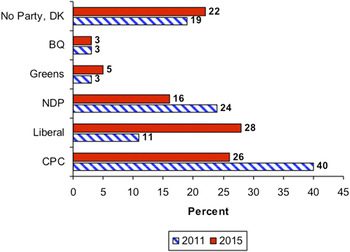
Decades of research on Canadian voting behavior testify that favorable party performance judgments on major valence issues such as the economy is a key to electoral success (e.g., Clarke et al. Reference Clarke, Jenson, Pammett and LeDuc1979; Reference Clarke, Jenson, LeDuc and Pammett1996; Clarke, Kornberg and Scotto 2009; 2012). In this regard, Canadian’s evaluations of the federal parties had changed markedly between 2011 and 2015. In 2011, the CPC dominated the performance sweepstakes, with fully 40% of those surveyed judging that it was best able to handle important issues confronting the country (see figure 2). No other party was judged favorably by as much as one-quarter of the electorate, with the New Democratic Party (NDP) endorsed by 24% and the Liberals by an abysmal 11%. Three percent chose the Greens, another 3% selected the Bloc Québécois (BQ), and 19% thought no party could do a good job, or said they “didn’t know.”
Party Best Able to Handle Most Important Issue, 2011 and 2015
Source: 2015 Abacus pre-election survey.

Four years later, much had changed, with the Conservatives’ 2015 “best able” number falling by 14 points, to 26%. Similarly, the NDP was down in 2011 by 8 points, to 26%. In sharp contrast, the Liberals now were seen as the most competent on important issues by 28%, fully a 17% increase. The Liberals’ 28% showing as best on most important issue was sufficient to put them slightly ahead of the governing Conservatives and well ahead of their main opposition rival, the NDP. Competitive again on the issues that mattered most to Canadians, the Liberals were positioned to make major gains on Election Day.
Partisanship
A sizable proportion of the Canadian electorate lacks the durable psychological attachments to political parties seen in the United States. Contradicting what had been hypothesized in the influential “Michigan model” (e.g., Campbell et al. Reference Campbell, Converse, Miller and Stokes1960), many voters identify only weakly with a party, sizable numbers identify with different parties in federal (national) and provincial politics, and large minorities have changed their party identifications at one or both levels of government over time. Weak, inconsistent, and unstable party identifications have long been a hallmark of Canadian political psychology (e.g., Meisel Reference Meisel1972; Clarke et al. Reference Clarke, Jenson, Pammett and LeDuc1979; Clarke and McCutcheon Reference Clarke and McCutcheon2009; Clarke, Kornberg, and Scotto 2009; 2012).
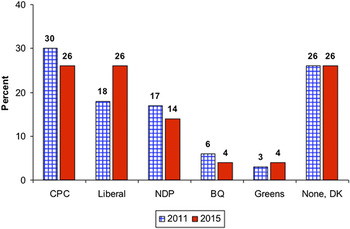
This is not to say that Canadians’ psychological attachments to political parties are inconsequential for the electoral choices they make at particular points in time. Indeed, as in other mature democracies, partisanship functions as a major heuristic that helps to guide political choice (e.g., Clarke, Kornberg and Scotto 2009; Gigendil et al. 2012). Similar to judgments about party performance, the pattern of aggregate partisan change from 2011 to 2015 favored the Liberals (see figure 3). In 2011, 30% reported that they were CPC identifiers and only 18% said that they were Liberal identifiers. Four years later, the share of Conservative partisans had dropped by four percentage points and the Liberal group had grown by a healthy eight percentage points. This meant that both parties had exactly the same percentage of partisans—26%. This figure is not especially large but it was substantially greater than that for the New Democrat Party. In 2011, 17% of the electorate reported NDP identification; by 2015, only 14% did so. The latter number is only slightly above the 11% NDP partisan share reported in the first Canadian national election study conducted in 1965, a half century earlier. The numbers of Conservative and Liberal partisans were much higher then—in 1965, 37% said they were Conservatives and an impressive 47% reported that they were Liberals. Other things being equal, the latter number certainly would be—and could be—sufficient to produce a majority government. By contrast, the 26% partisan shares the Liberals and Conservatives had in 2015 were clearly insufficient to do so.
Federal Party Identification, 2011 and 2015
Source: 2011 Political Support in Canada pre-election survey, 2015 Abacus pre-election survey.

Leader Images
Tied with their CPC rivals on partisanship and only marginally ahead on party performance judgments, the Liberals needed a strong boost from the third major valence politics variable—leader image—to deliver victory in 2015. The new Liberal Leader, Justin Trudeau, accomplished that task. Eldest son of former long-time Liberal Prime Minister Pierre Trudeau, Justin Trudeau was elected leader of the federal Liberals in April 2013. Although his famous surname might generate a nostalgic appeal to older segments of the electorate, commentators expressed doubts that he would be able to come anywhere close to matching the performance his father had delivered a half century earlier. Indeed, some critics opined that Justin Trudeau was an inexperienced, intellectual “lightweight.” Trudeau Sr. had suffered his share of criticisms, but a lack of brains was not a charge easily leveled against him. A prolific author, journal editor, and high profile public intellectual known for his incisive criticisms of Quebec’s provincial political establishment, Pierre Trudeau clearly had the cognitive wherewithal to be prime minister.
Preparing for the 2015 election, CPC strategists attempted to capitalize on the doubts voiced about Justin Trudeau’s capacity to be an effective prime minister. Following a game plan they had used successfully before the 2008 and 2011 federal elections, the Conservatives ran pre-campaign attack ads against him. In 2008, they had successfully characterized former Liberal Leader, Stéphane Dion, as “not a leader.” In 2011, they had charged that his successor, Michael Ignatieff, was “just visiting.” In 2015, they attempted to capitalize on Justin Trudeau’s lack of significant public or private sector experience and his youthful looks by framing him as “just not ready.” Using the setting of a purported committee meeting to evaluate job candidates, actors took turns explaining why Trudeau was manifestly unsuited for a major position, charging that his policy positions were unclear or non-existent and opining that “being prime minister is not an entry-level job.” After “just not ready” was scribbled in large red letters on Trudeau’s resume, a member of the committee quipped, “Nice hair, though!”
Using the setting of a purported committee meeting to evaluate job candidates, actors took turns explaining why Trudeau was manifestly unsuited for a major position, charging that his policy positions were unclear or non-existent and opining that “being prime minister is not an entry-level job.”
The ad did not work. Running neck-and-neck with their rivals in public opinion polls and wishing to give Trudeau ample opportunity to demonstrate his unsuitability to be prime minister, the Conservatives had scheduled a two-and-a-half month campaign (long by Canadian standards) and agreed to five leader debates. To their surprise, Trudeau used the debates and the long campaign to introduce himself to the electorate and advocate policies that appealed to many Canadians. Explicitly rejecting the CPC claim that he was not ready to govern, Trudeau argued that Canadians were not ready for four more years of Conservative mismanagement of the country’s economy. If elected, a Trudeau-led Liberal government would adopt a neo-Keynesian approach, running “modest” deficits to put unemployed Canadians to work, jump-start growth, and expand public infrastructure. With the Conservatives burdened by a stream of bad news about the economy Footnote 6 and the NDP desperate to demonstrate that they would be sound stewards of the nation’s business, who would eschew reckless “tax and spend” policies, Trudeau and the Liberals had the economic policy-innovation field to themselves. Trudeau seized the opportunity and his ability to articulate a reasoned plan to revitalize the Canadian economy did much to negate charges that he was not up to the job of leading the country. Trudeau was able to generate an image as a youthful and energetic leader of a party determined to bring “real change,” which resonated with large numbers of voters. Footnote 7
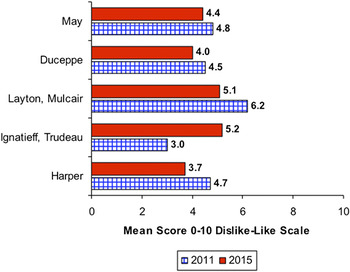
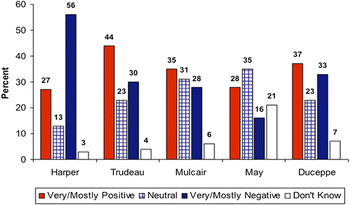
Figures 4 and 5 document the extent of his appeal. In 2011, his predecessor, erstwhile Harvard professor Michael Ignatieff, had recorded a dismal mean score of 3.0 on a 0–10 scale of likability. This was one of the lowest affect ratings ever recorded for any leader of any Canadian political party. Four years later, Trudeau’s mean score was a very healthy 5.2. This put him slightly ahead of NDP Leader Thomas Mulcair and well ahead of CPC Leader Stephen Harper. Harper’s 2015 mean like-dislike score was only 3.7, a full point below what he had recorded in 2011. The conclusion that Trudeau was more warmly received than his competitors is reinforced by the data in figure 5, which show that 44% of those surveyed had a positive impression of him, whereas 30% had a negative impression. While Mulcair’s numbers were also favorable on balance (35% positive versus 28% negative), those for Harper were massively unfavorable, with only 27% saying they had a positive impression of him and a clear majority (56%) indicating a negative impression.
Feelings About Party Leaders, 2011 and 2015
Source: 2011 Political Support in Canada post-election survey, 2015 Local Parliament Project pre-election survey.

Impressions of Party Leaders in 2015
Source: 2015 Abacus survey.

Harper’s image problem was not simply that voters did not like him. Never widely popular, he had relied heavily on perceptions that he was the most competent leader to manage the country’s economy. Whether impressed by the fact that Harper held a graduate degree in economics from the University of Calgary or sobered by his serious demeanor, many voters had accepted his claim. For example, in 2011, 37% of those surveyed said that Harper was best able to handle the economy, whereas only 21% and 11% chose his NDP or Liberal competitors, respectively. Four years later, Harper’s reputation for sound economic management had been seriously eroded—only 28% believed he was most capable on the issue. This was only slightly more than the 26% who favored Justin Trudeau, while Thomas Mulcair trailed badly at 14%. With the competence gap between himself and his Conservative rival closed, Trudeau had the public image needed to help his party attract large numbers of voters.
As the campaign progressed, with Conservative support stalled and the Liberals starting to surge, Prime Minister Harper and his advisers realized they were in trouble. Seizing on a Quebec Supreme Court decision that would allow Muslim women to wear the niqab (veil) during the Canadian citizenship ceremony, they tried to direct the narrative of the campaign away from the economy and towards cultural issues with potent potential to divide the Liberal vote. It was announced that a new Conservative government would take steps to make sure women did not wear a niqab during the citizen ceremony and, furthermore, the government would set up a hotline where tipsters could call in to report people perpetrating “barbaric cultural practices.” The strategy failed. Analyses of the Abacus survey data show that although over two-thirds of those concerned with the niqab and related cultural issues such as immigration and treatment of refugees favored the Conservatives, only 4% accorded high priority to these issues. Moreover, in Quebec, where the niqab controversy played most strongly, the chief effect seemed to be to move voters from the NDP to the Liberals, thus augmenting—rather than eroding—the latter party’s support in a key province and propelling its momentum in national polls.
With the niqab ploy failing in the closing days of the campaign, the Conservatives turned to Rob Ford, the former mayor of Toronto who had gained international notoriety for substance abuse. With Ford at his side, Prime Minister Harper tried desperately to rally Conservative support in hotly contested suburban Toronto ridings. It was to no avail. Burdened with a sputtering economy and an unpopular leader, the CPC campaign ground to a halt far short of Parliament Hill.
AT THE POLLS: 2015 AND 1968
As the election results rolled in on the evening of October 19, it quickly became obvious that the Liberals were in for a big night. Sweeping every seat in Atlantic Canada, the party also won the majority of seats in Quebec and Ontario, as well as pluralities in Manitoba and British Columbia. The result was a massive majority government, with the Liberals winning 184 of 338 seats in Parliament. It was a total turnaround for the Liberals, who four years earlier won only 34 of 308 seats—their worst performance in history. Footnote 8 In 2011, both the Conservatives and the NDP had celebrated, with the CPC winning a majority government and the NDP becoming the official opposition. However, both parties were big losers in 2015, with the Conservatives capturing only 99 seats and the NDP only 44. These totals were 67 and 59 seats fewer than the two parties had gained in 2011, respectively. Popular vote swings were massive as well, with the Liberals increasing their vote share from 18.9% to fully 39.5%. In contrast, the CPC and NDP vote totals fell sharply. The CPC was down nearly 8% (from 39.6% to 31.9%) and the NDP down nearly 11% (from 30.6% to 19.7%).
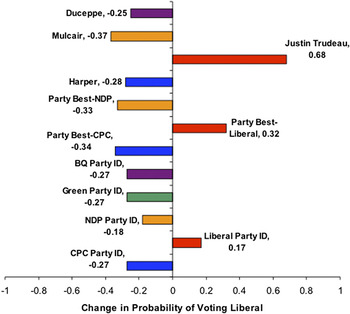
As in many previous elections, valence politics considerations did much to shape the choices votes made in 2015. The point can be illustrated by multivariate analyses of Liberal voting that employ party performance judgments, partisanship, and leader images as featured predictor variables. Footnote 9 To provide intuition, the results of these analyses are used to construct scenarios where the probability of voting Liberal is computed as predictor variables are moved from their minimum to maximum values, holding other predictors at their means. The results are summarized in figure 6.
Effects of Valence Politics Variables on Probability of Voting Liberal in 2015 Federal Election
Source: Calculations based on binomial logit analysis of Liberal voting in 2015 federal election.

As shown, party performance judgments, partisan identifications, and leader images all had substantial effects on Liberal voting in 2015. Regarding performance judgments, the probability of voting Liberal increased by .32 points if a voter went from thinking no party is best on an important issue to believing that the Liberals were best. If a voter moved from the Conservatives to the Liberals as best on most important issue, the probability of voting Liberal went up by an impressive .66 points. Partisan effects were large as well, with the likelihood of a Liberal vote moving upward by .35 points if someone changed from an NDP to a Liberal identification. Simply abandoning a CPC identification and becoming a non-identifier was enough to boost the probability of voting Liberal by .27 points. Partisan switching involving other parties had substantial effects as well. For example, if someone abandoned a Green identification in favor of a Liberal one, the probability of casting a Liberal ballot climbed by .44 points.
Leader images were very much in evidence. As feelings about Justin Trudeau increased from very negative to very positive, the probability of voting Liberal increased by .68 points. This impressive effect is consonant with evidence presented above regarding the favorable reception much of the electorate gave the new Liberal leader. Impressions of the other party leaders mattered for Liberal voting as well and, as expected, as feelings about them became more sanguine, the probability of a Liberal ballot decreased. These negative effects were not as large as the positive impact of feelings about Trudeau, but they were nonetheless sizable, averaging −.30 points. The strength of leader effects in 2015 is typical for Canadian federal elections, a point that can be appreciated by taking a brief trip back in time, to 1968, when Justin Trudeau’s father propelled the Liberals to a large majority in his first campaign as party leader.
Trudeaumania
As observed above, Justin was not the first Trudeau to lead the Liberal Party to victory over the Conservatives in a federal election. Nearly a half century earlier, in 1968, his father, Pierre Elliott Trudeau, had accomplished the same mission. At that time, the economy was in reasonably good health, with unemployment at a modest 4.5% and GDP growth at a healthy 5.3%. However, a major issue concerned growing nationalist sentiments in Quebec, accompanied by increasingly strident calls for the province to secede from the rest of Canada. Indeed, Pierre Trudeau had been recruited by the federal Liberals in 1965 as one of “three wise men” from Quebec Footnote 10 to address the separatist threat. Subsequently, perceptions that he could appeal to the restive Quebec electorate had helped him become Liberal Leader in April 1968.
With the Liberals in power as a minority government, Trudeau called an election shortly after winning his party’s leadership. Espousing a variety of progressive views and advantaged by a “cool” media-savvy presence (McLuhan Reference McLuhan1964), the youthful, fluently bilingual, and comfortably bicultural prime minister quickly became a popular figure throughout much of the country and “Trudeaumania” gripped press and public alike. Indicative of his appeal, his affect score in the 1968 Canadian Election Study survey was 6.9 on a 1–10 scale. Adjusted to 6.3 on a 0–10 scale, his rating remains the highest ever recorded for a leader of one of Canada’s federal parties. Although the rival party leaders—Robert Stanfield for the Conservatives and Tommy Douglas for the NDP—were also quite well regarded, they could not match the charisma of their Liberal counterpart. Campaigning with the strikingly simple (and very late 1960s) slogan “It’s Spring!” Trudeau engaged his competitors in the first-ever Canadian federal party leader debate. The election was held on June 25, 1968.
Espousing a variety of progressive views and advantaged by a “cool” media-savvy presence (McLuhan Reference McLuhan1964), the youthful, fluently bilingual, and comfortably bicultural prime minister quickly became a popular figure throughout much of the country and “Trudeaumania” gripped press and public alike.
To calibrate the impact of Trudeau’s image on voting in the 1968 federal election, we again perform a multivariate analysis of Liberal voting using a model that contains variables measuring feelings about party leaders, partisanship, and party preferences on various issues, Footnote 11 together with controls for economic evaluations and socio-demographic characteristics. The results resemble those for 2015, with leader images, partisanship, and party-issue preferences all having predictable and statistically significant effects on the likelihood of voting Liberal.
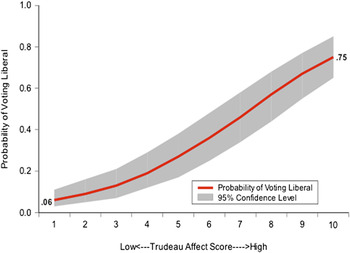
Particularly noteworthy is the impact of Pierre Trudeau’s image. With other predictor variables set at their means, the probability of voting Liberal in 1968 climbs from .06 to .75, as feelings about Trudeau become increasingly sanguine (see figure 7). The large increase is nearly identical in magnitude to that estimated for his son, Justin Trudeau, in 2015. Since many voters had been favorably disposed towards Pierre Trudeau in 1968, his powerful leader image effect helped the Liberals reap a bountiful harvest at the polls. When the votes were counted, the Liberals had won 45.4% as compared to only 31.4% for the Conservatives and 17.0% for the NDP. Those numbers were sufficient to give the Liberals a comfortable majority (154 of 264 seats) in Parliament. The first Trudeau era had begun.
Effects of Feelings About Pierre Trudeau on Probability of Voting Liberal in the 1968 Federal Election
Source: Calculations based on binomial logit analysis of Liberal voting in 1968 federal election.

CONCLUSION: LIKE FATHER, LIKE SON
For longtime followers of Canadian politics, the 2015 federal election had a number of familiar elements. Featuring sizable campaign dynamics, the contest resulted in large swings in both votes and seats, plus the installation of a Liberal government. And, conjuring abundant political nostalgia, the new prime minister was named Trudeau. As argued above, the Liberal victory in 2015 was the product of a number of factors: the economy was in the doldrums and the governing Conservatives were unpopular throughout much of the country. Although the CPC Leader, Prime Minister Harper, reiterated his familiar argument that he was most competent to manage the country’s affairs, many voters rejected the claim. With a slow-growing economy recently sliding into recession, the Canadian dollar at 76 cents USD, and unemployment at 7%, Harper’s assertion lacked prima facie credibility. Never particularly popular, the stern Harper had relied heavily on his image of managerial competence. In 2015, voter coolness towards him had turned to outright hostility across much of the electorate and his reputation as a “safe pair of hands” was badly tarnished.
In sharp contrast, the new Liberal Leader, Justin Trudeau, was warmly received throughout much of the country. Employing a strategy they had used successfully in previous elections, the Conservatives attempted to portray Trudeau as manifestly ill-prepared to lead the country. The strategy backfired; it set a very low bar for Trudeau and he proceeded to demonstrate that he could easily jump over it by articulating a variety of reasonable policies designed to advance the national interest. On the campaign trail, he proved to be an energetic, optimistic, and personable campaigner. Rejecting the “wedge issues” and negative campaigning of his opponents, Trudeau echoed 19th century Liberal Prime Minister Sir Wilfrid Laurier and attributed his political success to espousing “sunny ways.”
Multivariate analyses demonstrate that valence politics considerations—leader images, party performance judgments, and partisan identifications—were important for understanding the electoral choices Canadians made in 2015. Controlling for several other factors, leader images had statistically significant and substantively consequential effects on the likelihood of Liberal voting, with variations in feelings about Trudeau being particularly powerful. Performance judgments and partisanship had strong effects as well, with widespread perceptions of Conservative shortcomings on the dominant issue—the economy—doing much to erode the strength the Conservatives had enjoyed on that issue in earlier elections.
The power of these valence politics forces should not surprise. As shown above, voters’ favorable reactions to Justin Trudeau’s father, Pierre Trudeau did much to propel him to power in 1968. Strong leader image effects like these are not attributable to some sort of “Trudeau magic.” Rather, beginning with the very early national election studies, decades of research on voting behavior in Canada have repeatedly demonstrated that leader images are highly influential heuristics—cues that voters rely on when making their electoral decisions. Together with partisan identifications, judgments about party performance on the economy and other key valence issues, leader images work to shape political choice in Canada and elsewhere. Like his father before him, Justin Trudeau emphasized this point in the 2015 federal election.
SUPPLEMENTARY MATERIAL
To view supplementary material for this article, please visit https://doi.org/10.1017/S1049096517000452