INTRODUCTION
Between 21 January and 27 July 2008, there were unprecedented strandings of eighteen Cuvier's beaked whales (Ziphius cavirostris), four Sowerby's beaked whales (Mesoplodon bidens), five unidentified beaked whales and twenty-nine long-finned pilot whales (Globicephala melas) in Scotland, Ireland and Wales. Most were assumed to be dead upon stranding. In addition to those in the UK and Ireland, there was a mother and dependant calf pair of Sowerby's beaked whales stranded live at Calais, France on 19 January 2008: the mother died and the calf was lost alive back out to sea. Apart from two pilot whales that stranded dead on Eigg in the Western Isles of Scotland on 12 March, all other animals stranded individually.
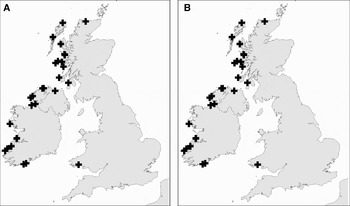
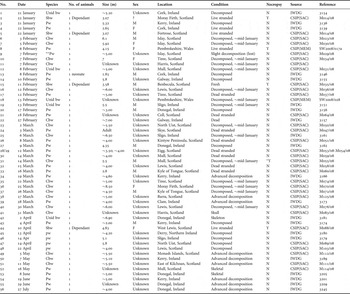
Concerns that an unusual mortality event had taken place were first raised following the strandings of five Cuvier's beaked whales (stranding numbers 6, 7, 10, 11 and 16 in Table 1) on Islay, Tiree, Harris and Lewis in western Scotland over a 9-day period. A further 51 strandings of deep-diving whales have since been recorded in Scotland, Ireland and Wales in this period (Table 1). The animals have been found in varying states of decomposition and as far apart as Cork, on the south coast of Ireland, and the Moray Firth, in north-east Scotland (Figure 1). Based on their states of decomposition, the suspected time of death of these animals was mid-January. The advanced states of decomposition meant that post-mortem was subsequently not possible for the majority of the stranded carcasses. However, samples have been collected from three live stranded Sowerby's beaked whales in Scotland (stranding numbers 2, 5 and 15 in Table 1) and the pilot whale carcass in Wales (stranding number 8 in Table 1). In two of the Sowerby's beaked whale cases (numbers 2 and 5), the cause of death was found to be maternal separation. No cause of death could be ascertained in the other Sowerby's beaked whale or for the pilot whale.
Stranding distribution of (A) long-finned pilot whales and (B) beaked whales (▴, Cuvier's beaked whale; □, Sowerby's beaked whale; ○, beaked whale species) along the UK and Irish coasts between January and July 2008.

Strandings of 57 deep diving species around the coastline of the UK and Ireland between January and July 2008. Pw, pilot whale; Sbw, Sowerby's beaked whale; Cbw, Cuvier's beaked whale; Unid. bw, unidentified beaked whale; IWDG, stranding recorded by the Irish Whale and Dolphin Group; CSIP, stranding recorded by Cetacean Stranding Investigation Programme; SAC, Scottish Agricultural College; MEM, Marine Environmental Monitoring; Dependant, classified as maternally dependant, assuming a mother–calf bond that lasts at least until the calf has stopped suckling and probably for a time afterwards until the youngster is able to feed independently. *samples taken but full necropsy not undertaken; **lost at sea, could have re-stranded elsewhere at later date. Natural mortalities undoubtedly overlay unusual event.

It should be noted that natural and/or unrelated mortalities undoubtedly occurred during this unusual period. As a result, some of these may have been included in Table 1, but strandings obviously not connected with this incident were excluded. For example, a pilot whale skull was found on 13 January in Clare, Ireland and was not considered to be related to this unusual mortality event.
Each of the species included in the stranding events discussed here are within their normal distribution ranges in the North Atlantic. However, the lack of population trend data for these species in the North Atlantic makes it difficult to place this mortality into a population context. The Cetacean Offshore Distribution and Abundance in the European Atlantic (CODA) survey undertaken in 2007 estimated the offshore abundance of long-finned pilot whales to be 25,100 (95% CI = 13,300–47,600) and provided the first abundance estimate for beaked whales of 7,000 (95% CI: 4,300–11,400) (Macleod et al., Reference Macleod, Burt, Cañadas, Rogan, Santos, Uriarte, Van Canneyt, Vázquez and Hammond2009). This latter figure includes Cuvier's, Sowerby's and unidentified beaked whales, as well as northern bottlenose whales.
RESULTS AND DISCUSSION
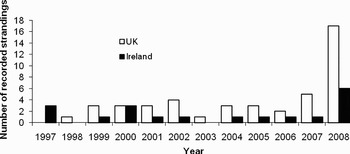
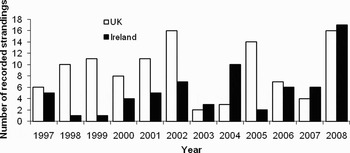
The number of beaked whales involved in the strandings in 2008 was unprecedented in both Ireland and the UK (Figure 2). In contrast, for pilot whales the number of strandings was unusual in Ireland but, although high, not unusual for the UK (Figure 3). For the UK, the annual average number of strandings between 1997 and 2007 for the period January to July was less than three beaked whales and six long-finned pilot whales, although strandings of this latter species ranged considerably on an annual basis from five to twenty-seven (Deaville & Jepson, Reference Deaville and Jepson2007). During the same 11 year period in Ireland, the annual number of recorded strandings from January to July was approximately one beaked whale and less than five pilot whales (O'Connell & Berrow, Reference O'Connell and Berrow2007; IWDG website).
Frequency distribution for number of Cuvier's and other beaked whales stranded between January and July each year in Ireland and the UK, 1997–2008.

Frequency distribution for number of pilot whales stranded between January and July each year in Ireland and the UK, 1997–2008.

Whilst the pattern of strandings reported here does not fit ‘atypical’ stranding events described previously, i.e. often involving more than two animals, of one or more species, stranding approximately simultaneously and alive but not in the same location (Frantzis, Reference Frantzis1998; Brownell et al., Reference Brownell, Yamada, Mead and van Helden2004; IWC, 2005), from the number of carcasses involved and combination of species this is considered to be an atypical event.
Consideration of possible causes of death
A number of possible causes of death were investigated with inconclusive results. Unusual stranding events may be associated with anthropogenic noise sources, fisheries interactions, disease, or natural phenomenon, such as earthquakes (see review by Geraci & Lounsbury, Reference Geraci and Lounsbury2005).
1. ANTHROPOGENIC NOISE SOURCES
Military activities
Some ‘atypical’ strandings of Cuvier's beaked whales in particular have been linked with mid-frequency active sonar (MFS) although it has not always been possible to fully investigate these events (Brownell et al., Reference Brownell, Yamada, Mead and van Helden2004; Freitas, Reference Freitas2004; Fernández et al., Reference Fernández, Arbelo, Deaville, Patterson, Castro, Baker, Degollada, Ross, Herráez, Pocknell, Rodríguez, Howie, Espinosa, Reid, Jaber, Martin, Cunningham and Jepson2004; Reference Fernández, Edwards, Rodriguez, Espinosa de los Morteros, Herraez, Casstro, Jaber, Martin and Arbelo2005a; Reference Fernández, Mendez, Sierra, Godhino, Herráez, Espinosa, Rodríguez and Arbelo2005b; Martin et al., Reference Martin, Servidio and Garciua2004; Espinosa et al., Reference Espinosa, Arbelo, Castro, Martín, Gallardo and Fernández2005; Fernández, Reference Fernández2006; Hohn et al., Reference Hohn, Rotstein, Harms and Southall2006). In many of these cases a definitive link could not be established, the features are described as ‘the “atypical” distribution of strandings involving one or more offshore species, all stranding alive, and without evidence of common infectious or other disease processes’ (Hohn et al., Reference Hohn, Rotstein, Harms and Southall2006). The mass stranding considered in this paper, however, differs in that the mortalities occurred offshore, the geographical range of the event was very wide and the strandings occurred over a prolonged period of several months.
In many of the locations where atypical mass strandings have occurred, and to which MFS use or believed to be used has been associated (e.g. Greece (Frantzis, Reference Frantzis1998); Bahamas (Balcomb & Claridge, Reference Balcomb and Claridge2001); Japan (Brownell et al., Reference Brownell, Yamada, Mead and van Helden2004), Canary Islands ((Espinosa et al., Reference Espinosa, Arbelo, Castro, Martín, Gallardo and Fernández2005; Fernández et al., Reference Fernández, Mendez, Sierra, Godhino, Herráez, Espinosa, Rodríguez and Arbelo2005b); Madeira (Freitas, Reference Freitas2004); Spain (Fernández, Reference Fernández2006)), the shelf edge is close inshore. Therefore if MFS had a lethal or sub-lethal effect on beaked whales and other offshore cetaceans, they are more likely to live in a mass strand. In the UK and Ireland, however, the shelf edge is generally further offshore, and any animals similarly affected would be more likely to die before reaching the coastline. However, correspondence between the Whale and Dolphin Conservation Society (WDCS) and the UK Ministry of Defence (MoD), under the strict legally binding Freedom of Information legislation, has confirmed that the Royal Navy ‘did not conduct any activities involving the use of sonar around these waters during the period of the strandings’. Information about the activities of other nations' naval activity is not available.
Modelling of the Atlantic Ocean currents at the calculated times of death was initiated by I. Boyd (Sea Mammal Research Unit, St Andrews University) to aid identification of possible locations of the original five Cuvier's beaked whale mortalities identified in the UK (stranding numbers 6, 7, 10, 11 and 16 in Table 1). It was intended that this information would then be used to run various scenarios to estimate where carcases from this ‘source’ region would be likely to strand, i.e. does the pattern fit that subsequently observed in the other strandings? Unfortunately, the initial modelling to identify a possible ‘source’ region proved inconclusive (I. Boyd, personal communication). Had this modelling indicated a specific area where the whales may have died, then the MoD had stated that they would revisit their records to determine if there was any military activity occurring in this location at that time (MoD email response dated 8 April 2008).
Seismic surveys
Behavioural responses have been detected in some species of cetacean in response to seismic activity including significant increases in fast swimming activity and directional changes, localized spatial avoidance, and subtle changes in foraging behaviour not detectable at the surface, whilst other species show no observable reaction (Stone & Tasker, Reference Stone and Tasker2006; Weir, Reference Weir2008; Miller et al., Reference Miller, Johnson, Madsen, Biassoni, Quero and Tyack2009).
Whilst seismic surveying utilizes lower frequencies than those used by beaked whales, Madsen et al. (Reference Madsen, Johnson, Miller, Aguilar Soto, Lynch and Tyack2006) demonstrated that considerable energy at higher frequencies is also produced. However, no seismic surveys were conducted in western UK waters between December 2007 and February 2008 inclusive (UK Oil Portal). Seismic surveys occurred close to shore off north-west Ireland (54º40′N 10º30′W) during 19–20, 30 December 2007 and 11–12 January 2008 (Tuffy, Reference Tuffy2008) coinciding with the likely times of death of these animals. Although these seismic surveys coincided with the stranding event, a lack of information prevents establishing a definitive causal link.
2. FISHERIES INTERACTIONS
Fishing activities have been associated with the deaths of pelagic cetaceans, including beaked whales in pelagic drift-net fisheries (Read & Wade, Reference Read and Wade2000; Moore et al., Reference Moore, Wallace, Lewison, Žydelis, Cox and Crowder2009). Large scale pelagic trawl fisheries exist in north-west European waters and have killed pilot whales at least (ASCOBANS, 2009). However, the deaths of the 56 long-finned pilot and beaked whales reported here are unlikely to be linked to fishing activities as the animals appear to have died at the same point in time rather than, for example, over the period of a fishing season for a particular fleet segment. There were a lack of distinctive scars and injuries on the stranded carcasses.
3. DISEASE
In recent decades a series of mass mortalities have been observed in marine mammal populations attributable to infection by various morbilliviruses (Kennedy, Reference Kennedy1997; Simmonds & Mayer, Reference Simmonds and Mayer1997; Van Bressem et al., Reference Van Bressem, Van Waerebeek, Jepson, Raga, Duignan, Nielsen, Di Beneditto, Siciliano, Ramos, Kant, Peddemors, Kinoshita, Ross, Lopez-Fernández, Evans, Crespo and Barrett2001; Fernández et al., Reference Fernández, Esperon, Espinosa de los Monteros, Lovel, Bernabé, Sandez-Vizcaino, Verborgh, De Stephenis, Coledano and Bayón2008).
Harmful algal blooms have been a cause of mass strandings in the US (HARRNESS, Reference Ramsdell, Anderson and Glibert2005). However, beaked whales would not be a candidate for this mortality source due to their deep-sea prey, more offshore habitat and the time of year that the strandings occurred.
In general, disease is a major cause of death in stranded species in the UK but there has been no recorded mass stranding event associated with disease. Where disease has been recorded as a cause of death, the species involved are generally smaller odontocetes, such as harbour porpoise (Phocoena phocoena) and common dolphin (Delphinus delphis), and are usually found as single animals (Deaville & Jepson, Reference Deaville and Jepson2007). Whilst there are records of mass strandings in long-finned pilot whales associated with disease (see Van Bressem et al., Reference Van Bressem, Van Waerebeek, Jepson, Raga, Duignan, Nielsen, Di Beneditto, Siciliano, Ramos, Kant, Peddemors, Kinoshita, Ross, Lopez-Fernández, Evans, Crespo and Barrett2001; Fernández et al., Reference Fernández, Esperon, Espinosa de los Monteros, Lovel, Bernabé, Sandez-Vizcaino, Verborgh, De Stephenis, Coledano and Bayón2008), disease in this case seems unlikely to be causal because of the mix of species that stranded; however, no analysis was available to support this.
4. NATURAL SEISMIC EVENTS (SEAQUAKES)
It is estimated that there are 500,000 detectable earthquakes in the world each year (USGS, 2009). In Western Europe, the majority of these occur on land but approximately 20% occur in the marine environment. Geraci & Lounsbury (Reference Geraci and Lounsbury2005) suggested that the effects of seaquakes on cetaceans are likely to be similar to those of military sonar.
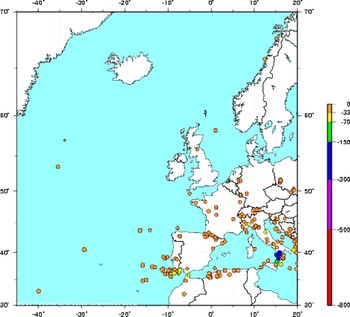
Between 1 December 2007 and 19 January 2008, there were 26 natural seaquakes between the Canary Islands and northern Norway and extending across to the North Atlantic Ridge (Figure 4; NEIC website). Owing to the decomposition of the animals and predicted time of death (mid-January) it is not possible to ascertain whether any of these events are linked to the mass stranding. Had a potential source location for the carcasses been identified from the modelling work undertaken by I. Boyd, it might have been possible to establish whether there was a link. However, there is a high density of beaked whales in the Bay of Biscay, yet the fact that stranding events were not reported along the Spanish/Portuguese coast might have been coincident with the earthquakes in that region.
Location of all earthquakes recorded from 1 December 2007 and 19 January 2008 from the Canary Islands to northern Norway (source: NEIC website). Scale represents depth (km) of earthquake. The depth of an earthquake relates to the strength of shaking. The same magnitude earthquake at 500 km depth will shake the ground less than one at 20 km depth due to the increasing distance from the source.

Stranding 36
Robinson & MacLeod (Reference Robinson and MacLeod2008) reported on a Cuvier's beaked whale stranded in the Moray Firth on the east coast of Scotland (stranding 36 in Table 1). These authors proposed that the recent increase in the number of Cuvier's beaked whale strandings was indicative of a ‘probable northern range expansion in our UK waters, perhaps as a result of increasing water temperature along the Atlantic frontier’. However, the range of species involved and the unprecedented nature of the 2008 event does not seem to fit with this hypothesis.
Subsequent strandings
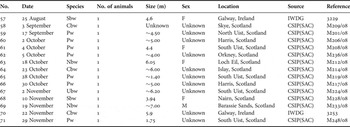
Following the 56 strandings outlined above, an additional 17 strandings of these species have been recorded through the remainder of 2008 (Table 2). Only two of these strandings occurred in Ireland, a Sowerby's beaked whale stranded on 25 August and a Cuvier's beaked whale on 22 November (Table 2). The remainder were recorded in Scotland. On 3 September the skeletal remains of a Cuvier's beaked whale were found in a remote site on Skye. Given that these remains were skeletal they could be associated with the earlier incident (B. Reid, personal observation). After this, a further seven pilot whales, three Cuvier's beaked whales, two northern bottlenose whales, one Sowerby's and one unidentified beaked whale stranded individually in the remaining four month period from September to December 2008 (Table 2). These animals obviously died later but it is still unusual to have more than one or two Cuvier's beaked whales stranding in Scotland in a single year. The pilot whale strandings could be described as within the normal range of numbers of strandings.
Strandings of deep diving species around the coastline of the UK and Ireland for the remainder of 2008, between August and December. Pw, pilot whale; Sbw, Sowerby's beaked whale; Cbw, Cuvier's beaked whale; Nbw, northern bottlenose whale; Unid bw, unidentified beaked whale.

CONCLUSION
Given the advanced state of decomposition of the majority of carcasses, no information was available to ascertain the cause(s) of death. However, the states of decomposition resulted in the suspected time of death of these animals being around mid-January and it remains a possibility that a currently unidentified anthropogenic or natural factor may have been contributory to these mortalities. During the first few days after a cetacean has died it is possible to identify the time of death to within 12–24 hours. After that it is less exact as other factors have to be considered, weather, location of carcase (below the high water mark, therefore getting cooled by water twice a day) and predator damage.
It should be noted that natural and/or unrelated mortalities undoubtedly occurred during this unusual period, although these have been excluded where possible. As regards observer effort the annual number of strandings reported in Scotland since the project started stabilized after an increase in the first few years, so this is not considered an issue. In addition, larger species are more difficult to ignore even as regards to the potential environmental health issues. Furthermore, care should be taken with the interpretation of strandings data as they may not be representative for determining events that happen at sea.
Clearly, whales that die at sea can sink, refloat, drift, be eaten by predators and may never strand. A further question remains about the number of animals that died, as additional carcasses may have sunk out at sea and not stranded.
There are general lessons that can be learnt from these stranding events including the high value of dedicated strandings networks and those staff and volunteers who contribute to them. While a properly funded and organized programme of post-mortem examination of strandings operates in the UK, a similar programme does not currently exist in the Republic of Ireland.
An online database such as that which exists in Ireland (www.iwdg.ie) should enable more efficient dissemination of information between strandings networks throughout Europe to improve the early identification of any unusual mortality events. The creation of a European strandings database is a long-standing aim of the Agreement for the Conservation of Small Cetaceans in the Baltic and North Sea (ASCOBANS). Such a database would greatly aid assessment of any future international event such as that described here. It may also help to identify any unusual historical stranding clusters across European waters.
ACKNOWLEDGEMENTS
The authors would like to thank Ian Boyd for undertaking to investigate drift modelling, also Thierry Jauniaux, Emer Rogan, IWDG and all volunteers who reported strandings to the UK and Irish stranding networks. Thanks to Paul Thompson and Caroline Weir for assistance with the figures. The first author is funded by the Whale & Dolphin Conservation Society (WDCS). The CRRU marine strandings outfit is funded by Care for the Wild International. In addition, we would like to thank Defra, the Scottish Government and the Welsh Assembly Government who co-fund the UK Cetacean Strandings Investigation Programme. The Irish stranding database is funded by the National Parks and Wildlife Service, Northern Ireland Environment Agency, Marine Institute and the Heritage Council through ISCOPE.