A Tip-Of-the-Tongue (TOT) state is a common and universal experience characterized by the incapability of retrieving a familiar word. In Psycholinguistics, TOT is considered a very interesting phenomenon to study, offering insights into the architecture and functioning of the human language production system. Even though the majority of studies on TOT states have been developed with monolinguals, the study of how bilinguals recover from a TOT state is particularly interesting because it might contribute to a better understanding of how the two languages interact cognitively during language production. In particular, the study of this phenomenon in bilinguals may ascertain if what is already known about TOT resolution in monolinguals can be generalized for bilinguals or if the fact of mastering two different languages can have a significant impact on it. Moreover, it might also shed a light on which variables play a role in bilingual word retrieval and whether they have a similar impact in the languages spoken by bilinguals.
Indeed, even though there is a growing number of studies in the literature on TOT states in bilinguals (e.g., Askari, Reference Askari1999; Gollan & Acenas, Reference Gollan and Acenas2004; Gollan & Silverberg, Reference Gollan and Silverberg2001; Gollan, Montoya & Bonanni, Reference Gollan, Montoya and Bonanni2005; Gollan, Ferreira, Cera & Flett, Reference Gollan, Ferreira, Cera and Flett2013; Pyers, Gollan & Emmorey, Reference Pyers, Gollan and Emmorey2009), these studies are mostly centred on the variables that can have an effect on its occurrence (i.e., TOT induction) neglecting the influence of these variables on TOT resolution. The present study focuses on the latter, exploring the role of the cognate status (cognate vs. noncognate), the syllable position (first, last or none) and the word length (two- vs. three-syllable long words) not only in TOT induction but mostly in TOT resolution for European Portuguese (EP)–English.
Recent research with TOT induction in bilinguals showed that bilinguals present more TOT states than monolinguals (Gollan & Acenas, Reference Gollan and Acenas2004; Gollan & Silverberg, Reference Gollan and Silverberg2001; Gollan et al., Reference Gollan, Montoya and Bonanni2005; Gollan et al., Reference Gollan, Ferreira, Cera and Flett2013; Pyers et al., Reference Pyers, Gollan and Emmorey2009). This result was firstly explained based on the dual-language activation hypothesis according to which, when producing a word in one language, bilinguals cannot avoid the activation of information about that word in the other language (Colomé, Reference Colomé2001; Ecke, Reference Ecke2004; Gollan et al., Reference Gollan, Ferreira, Cera and Flett2013; Kroll, Bobb, Misra & Guo, Reference Kroll, Bobb, Misra and Guo2008). Assuming that there is cross-language activation, the difference between bilinguals and monolinguals in TOT induction was explained based on the larger number of stored lexical nodes in bilinguals, increasing the competition for selection and hampering word retrieval. Nevertheless, Gollan and Acenas (Reference Gollan and Acenas2004) showed that the difference between bilinguals and monolinguals in TOT induction was modulated by the cognate status of the words in TOT. More precisely, the authors found that the difference between bilinguals and monolinguals was restricted to noncognate words. Noncognate words are translation equivalents that only share meaning (e.g., pepino in European Portuguese [EP] and cucumber in English), in contrast to cognate words that share not only meaning but also form (phonologic and/or orthographic) (e.g., papel [paper], in EP and English respectively). According to Gollan and Acenas (Reference Gollan and Acenas2004), the shared connections of cognate words make their phonological elements more available (i.e., more activated) than those of noncognate words because they are used more frequently and have higher levels of recency. Moreover, Gollan and colleagues stated in their weaker links hypothesis (Gollan & Acenas, Reference Gollan and Acenas2004), currently known as the frequency-lag hypothesis (Gollan, Slattery, Goldenberg, Van Assche, Duyck, & Rayner, Reference Gollan, Slattery, Goldenberg, Van Assche, Duyck and Rayner2011), that because bilinguals necessarily spend less time using words of each language (mainly noncognate words), the words may have weaker links between the levels of bilinguals’ speech production system (Gollan & Acenas, Reference Gollan and Acenas2004; Gollan et al., Reference Gollan, Slattery, Goldenberg, Van Assche, Duyck and Rayner2011; Kroll et al., Reference Kroll, Bobb, Misra and Guo2008). Additionally, research showed not only that bilinguals present more TOTs than monolinguals and more TOTs for noncognate than for cognate words, but also that they present more TOTs in the bilinguals’ non-dominant language (L2). In line with the frequency-lag hypothesis (Gollan et al., Reference Gollan, Slattery, Goldenberg, Van Assche, Duyck and Rayner2011), this result was explained based on the fact that the L2 is the bilinguals’ less frequently used language. This is also in line with Burke and colleagues’ suggestion (Burke, Mackay, Worthley & Wade, Reference Burke, Mackay, Worthley and Wade1991) about the strength of the semantic-to-phonological connections in TOT states in monolinguals. Specifically, the authors claimed that the strength of these connections varies as a function of frequency, recency of use and aging. If this is so, the co-activation of both languages is higher for the cognate than for the non-cognate words due to their shared semantic, phonological and orthographical connections facilitating their selection and naming (Costa, Caramazza & Sebastián-Gallés, Reference Costa, Caramazza and Sebastián-Gallés2000; Costa, Santesteban & Caño, Reference Costa, Santesteban and Caño2005; Kroll, Dijkstra, Janssen & Schriefers, Reference Kroll, Dijkstra, Janssen and Schriefers2000) and consequently reducing TOT induction. Therefore, TOT states would be a consequence of a lack of sufficient activation spread through the levels of word production system that can be increased, as we intend to verify in this paper, by providing additional phonological activation to the word in TOT.
In contrast to TOT induction, previous research showed no differences when comparing bilinguals and monolinguals in TOT resolution (Gollan & Acenas, Reference Gollan and Acenas2004; Gollan & Silverberg, Reference Gollan and Silverberg2001). According to the authors, similar mechanisms seem to underlie TOT resolution in bilinguals and monolinguals, both being equally susceptible to priming or cues that help them retrieve the word in TOT. However, these previous studies did not control for the variables explored in the present work (syllable position and target word length) which may in fact modulate TOT resolution, especially when noncognate words are considered.
Concerning the syllable position effect, research with monolinguals showed that the presentation of phonological segments of the word in TOT not only prevents TOT states induction (e.g., James & Burke, Reference James and Burke2000), but also facilitates their resolution (e.g., Abrams, White & Eitel, Reference Abrams, White and Eitel2003; James & Burke, Reference James and Burke2000; Meyer & Bock, Reference Meyer and Bock1992; Pureza, Soares & Comesaña, Reference Pureza, Soares and Comesaña2013; White & Abrams, Reference White and Abrams2002). Phonological priming seems to increase the amount of activation spread via feedback connections from the phonological to the semantic and syntactic levels, allowing for the retrieval and production of the target word (Bock, Reference Bock1996; Damian & Martin, Reference Damian and Martin1999). However, which segment is more relevant to prevent TOTs and/or enhance its resolution is still controversial. For instance, Abrams and colleagues (Reference Abrams, White and Eitel2003) showed that English monolinguals presented more TOT resolution after reading words phonologically related by the first syllable than when reading words related by the last or middle syllable of the word in TOT (e.g., for the target word contraband, the phonologically related words could be: connotation, extradite or headband, related with the target word by the first, the middle or the last syllable, respectively). However, Pureza and colleagues (Reference Pureza, Soares and Comesaña2013), in a study with EP monolinguals, found that TOT resolution was facilitated by the last rather than by the first phonological syllable of the TOT word, even though this result was restricted to four-syllable long words. The first and last syllable segments were embedded in pseudowords (i.e., syllabic pseudohomophones) presented in a lexical decision task (LDT) (e.g., for the target word pincel [paintbrush], the pseudowords pintro and pimpota functioned as primes related by the first syllable and crissel and tranecel as primes related by the last syllable). Thus, and irrespective to the methodological differences between the two studies, the study led by Pureza and colleagues (Reference Pureza, Soares and Comesaña2013) draws attention to the importance of exploring word length in TOT resolution, a variable that has been neglected in TOT literature (see Harley & Bown, Reference Harley and Bown1998).
The syllable position unexpected result obtained by Pureza and colleagues (Reference Pureza, Soares and Comesaña2013) was explained by the authors based on the characteristics of EP, a language with regular syllable structure and with well-defined syllable boundaries (see Frota, Vigário & Martins, Reference Frota, Vigário and Martins2002, for details), contrasting with the English language used in Abrams and colleagues’ (2003) study. Moreover, the result was also explained according to Pitt and Samuel (Reference Pitt and Samuel2006) and Jefferies, Frankish and Noble (Reference Jefferies, Frankish and Noble2011) studies, considering that longer words are more demanding in terms of encoding, recalling or production processes, generating a higher level of lexical activation and benefiting from stronger lexical support. Therefore, even though it could be more intuitive to think that shorter words would benefit more from phonological priming because the prime shares a larger proportion of the target's phonology than longer words, the higher level of resolution for longer words observed in the Pureza and colleagues (Reference Pureza, Soares and Comesaña2013) study may be a result of their higher level of activation. This, in turn, makes them benefit more from phonological priming provided by the syllabic pseudohomophones, in line with Pitt and Samuel (Reference Pitt and Samuel2006) and Jefferies et al.'s (Reference Jefferies, Frankish and Noble2011) proposals. This result was obtained even after ruling out possible alternative explanations such as the positional syllable frequency or the neighborhood density. Thus, longer words might present higher TOT resolution because, when in TOT, their baseline level of activation might be already higher than the shorter words which may also allow that the activation provided by the prime will be more effective forfaster word retrieval. Even though further studies should be developed in order to explore the mechanisms underlying this syllable position effect, there is the need to explore the role of word length on TOT resolution. In particular, it seems interesting to explore its effects in cross-linguistic studies considering languages with different definitions of syllable boundaries, such as English and EP, as in the present study. Moreover, in the present study we aimed to explore the role of syllable position (first vs. last), cognate status (cognate vs. noncognate) and word length (two- vs. three-syllable words) in EP (L1)–English (L2) bilinguals’ TOT states induction and resolution (and in a group of EP monolinguals as a control). Exploring all these variables in the same experiment, with bilinguals whose languages present different syllabic characteristics (mainly concerning the definition of syllable boundaries) may contribute to a better understanding of the role of these variables on bilingual lexical retrieval during language production and to the clarification of the inconsistencies found on previous studies.
Thus, in line with reviewed literature, on TOT induction we expected EP–English bilinguals to present more TOT states than EP monolinguals, especially for noncognate words. It was also expected that EP–English bilinguals and EP monolinguals would present more TOT states for longer (three-syllable long) than for shorter (two-syllable long) words. Following the claims of the frequency-lag hypothesis (Gollan et al., Reference Gollan, Slattery, Goldenberg, Van Assche, Duyck and Rayner2011), more TOTs were predicted when performing the task in English than in EP since English was the non-dominant language of these bilinguals. In this line, and concerning TOT resolution, it was expected that the syllabic features of the dominant language (EP) would modulate the word retrieval mechanisms in the less dominant language (English) (Altmann & Kabak, Reference Altmann and Kabak2011; Jarvis & Pavlenko, Reference Jarvis and Pavlenko2008; Marian, Reference Marian2009). Therefore, and in line with the previously obtained results for EP monolinguals (Pureza et al., Reference Pureza, Soares and Comesaña2013), we expected EP–English bilinguals and EPmonolinguals to present more TOT resolution for longer (three-syllable long) than for shorter (two-syllable long) words, revealing no interaction between word length and speaker group. Moreover, irrespective of the language, words primed by the last syllable were expected to have more TOT resolution than words primed by the first syllable, particularly for longer words, as in Pureza et al.’s (Reference Pureza, Soares and Comesaña2013) study. Concerning the cognate status, more TOT resolution was expected for cognate than for noncognate words. Additionally, since the cognate effect seems to be more robust from L1 to L2 than vice-versa (see Kroll et al., Reference Kroll, Dijkstra, Janssen and Schriefers2000, for more detail) we expected stronger cognate effects when bilinguals perform the task in L2 than when performing the task in L1.
Finally, although Gollan and Acenas (Reference Gollan and Acenas2004) and Gollan and Silverberg (Reference Gollan and Silverberg2001) did not obtain any differences between bilinguals and monolinguals in TOT resolution, we hypothesized an opposite effect in the present study. Since we are exploring variables that were not considered in these previous studies, their manipulation may reveal a different outcome for the two speaker groups. When compared to EP monolinguals, EP–English bilinguals were expected to show less TOT resolution particularly in smaller noncognate words due to the lower level of activation of these words when compared to longer and cognate words. Therefore, an interaction between word length and cognate status was expected on bilinguals’ performance, making the difference between bilinguals and monolinguals in TOT resolution.
Experiment
Method
Participants
One hundred and twenty proficient EP (L1) – English (L2) bilinguals (75 women; Mage = 24.7; SD = 8.45) recruited from international or bilingual institutions in Portugal with EP–English education volunteered for participation in the present study. All bilinguals were EP native speakers and highly proficient in their L2 as assessed by the Li, Sepanski and Zhao (Reference Li, Sepanski and Zhao2006) language history questionnaire (reading: M = 6.5, SD = .71; writing: M = 6.21, SD = .95; speaking: M = 6.18, SD = .91; listening: M = 6.53, SD = .71; evaluated in a 7-point Likert scale ranging from 1 (very poor proficiency) to 7 (native-like proficiency). Moreover, responses to this questionnaire revealed that all of them were first exposed to English before they were 10 years old (M = 5.49; SD = 3.67) and that the frequency of L1 use was, on average, 60% and 40% for the L2.
As a control, a group of 55 EP native monolinguals were age-matched with the bilingual group (50 women; Mage = 21.69, SD = 4.69).
Materials
Two types of materials were used in the present study: 80 pictures used in a picture naming task in order to induce TOT states, and eight words and eight pseudowords for each picture used in a lexical decision task (LDT) to manipulate the role of the syllable position in TOT resolution.
The 80 experimental pictures were selected from a pilot study. A total of 776 participants (640 EP native speakers and 125 English native speakers) evaluated 157 pictures taken from public picture databases such as Google Images (www.google.com/imghp) presenting values for name agreement (i.e., the number of different designations given to a particular picture across participants or the proportion of participants that assign the same name to a given object), subjective frequency (i.e., the estimation of the frequency with which subjects use a word – in written or spoken modality – to designate a certain picture), concept familiarity (i.e., the frequency with which the objects depicted are encountered or the frequency of its occurrence in daily life) and visual complexity (i.e., the number of lines, details and elements in the picture) for each picture. These variables have been shown to be critical on naming latencies and memory processes, particularly in name retrieval and lexical access (see for example Alario, Ferrand, Laganaro, New, Frauenfelder, & Segui, Reference Alario, Ferrand, Laganaro, New, Frauenfelder and Segui2004; Cycowicz, Friedman, Rothstein & Snodgrass, Reference Cycowicz, Friedman, Rothstein and Snodgrass1997; Rossion & Pourtois, Reference Rossion and Pourtois2004; Sanfeliu & Fernandez, Reference Sanfeliu and Fernandez1996). The pictures were colored on white background, with an approximate size of 580 pixels of length and a variable width. They had a 36.00 pixels/cm resolution. The 80 pictures selected out of the 157 for the present study were the ones that simultaneously in EP and English: (i) induced a high rate of “Don't remember” responses (indication of possible TOT answers; EP: M = 7.94, SD = 9.99; English: M = 3.36, SD = 5.97); (ii) had a high rate of name agreement (EP: M = 87.74, SD = 16.58; English: M = 88.28, SD = 12.63); and (iii) were designated by a word with the same number of syllables in English and EP (e.g., man.ga [man.go]; ci.lin.dro [cy.lin.der]). Half of the experimental pictures were designated by two-syllable words in EP and in English (40 experimental targets) and the other half were designated by three-syllable words in both languages (40 experimental targets). Within each word length, 20 were cognate words (e.g., two-syllable: manga [mango]; three-syllable: cilindro [cylinder]) and 20 were noncognate words (e.g., two-syllable: colchão [mattress]; three-syllable: pepino [cucumber]). Four pictures were added for practice trials.
The Name Agreement (NA) scores of the 80 experimental pictures did not differ statistically between languages, t(79) = −.30, p = .768. It is worth noting that a high NA rate is crucial in order to minimize the occurrence of negative TOTs. A TOT is called negative when the participant's TOT word (e.g., zucchini) is different from the target word manipulated in the experiment (e.g., cucumber), which means it has to be excluded from the analyses. Additionally, the words’ log10 lexical frequency in Portuguese and English (obtained from P-PAL – see Soares, Iriarte, de Almeida, Simões, Costa, França, Machado, & Comesaña, Reference Soares, Iriarte, de Almeida, Simões, Costa, França, Machado and Comesaña2014, available at http://p-pal.di.uminho.pt/tools; and N-Watch – Davis, Reference Davis2005, respectively), did not differ statistically across languages, F(1, 72) = 1.31, MSE = .064, p = .257, η 2 = .018; number of syllables [EP: F(1, 67) = .37, MSE = .029, p = .544, η 2 = .006; English: F(1, 75) = 2.32, MSE = .213, p = .132, η 2 = .030]; or cognate status [EP: F(1, 67) = 3.16, MSE = .244, p = .08, η 2 = .045; English: F(1, 75) = 3.52, MSE = .324, p = .07, η 2 = .045]. As expected, cognate and noncognate words differed statistically when considering the level of orthographic overlap as assessed by Van Orden's algorithm (Van Orden, Reference Van Orden1987), F(1, 76) = 168.72, MSE = 5.504, p < .001, η 2 = .689. Cognate words presented higher orthographic overlap (M = .72, SD = .19) than noncognate words (M = .20, SD = .17). Importantly, the level of orthographic overlap was not significantly different between two- and three-syllable words, F(1, 76) = 1.07, MSE = .035, p = .303, η 2 = .014. Also, the number of phonemes did not differ between cognate and noncognate words both in EP: F(1, 71) = .38, MSE = .303, p = .54, η 2 = .005; and English: F(1, 70) = 2.91, MSE = 2.25, p = .092, η 2 = .04, and, as expected, this number differed when comparing three- and two-syllable words in both languages, EP: F(1, 71) = 45.93, MSE = 36.68, p < .001, η 2 = .393; and English: F(1, 70) = 72.15, MSE = 55.77, p < .001, η 2 = .508. Six bisyllabic and 12 trisyllabic words of the English targets were compounds, words composed by two free morphemes (e.g., sunflower, tablecloth, lipstick). We decided not to remove them from the study due to the small amount of stimuli. However, it should be noted that there was a similar proportion of free morphemes constituents of the first and last syllable of the word (11 free morphemes manipulated as first syllable and 13 manipulated as the last syllable).
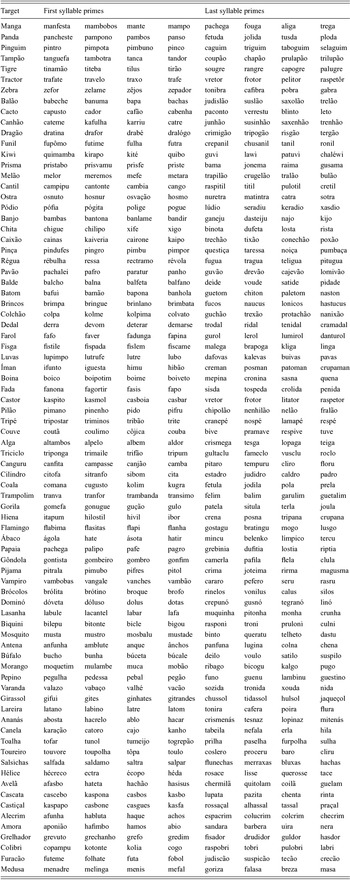
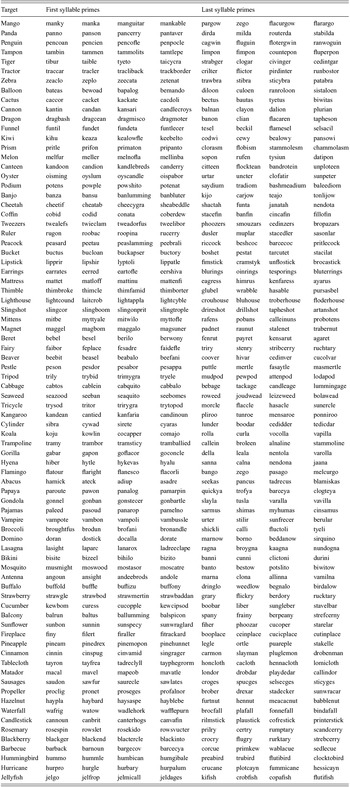
For each of the 80 target pictures, 16 verbal related stimuli (eight words and eight pseudowords) were created in each language in a total of 1,280 stimuli per language (640 words and 640 pseudowords). As in the Pureza et al. (Reference Pureza, Soares and Comesaña2013) study, these stimuli were used in an LDT presented after the naming of each picture. Each LDT comprised eight words and eight pseudowords. The purpose of the LDT was to manipulate the syllabic information of the word in TOT in order to test TOT resolution. Therefore, syllabic pseudohomophones were created and embedded in four of the eight pseudowords presented in the LDT. These syllabic pseudohomophones could be phonologically related with the word in TOT by the first or the last syllable. It is worth noting that the syllabic pseudohomophones created did not share anything with the target word other than the shared syllable. Furthermore, the syllabic pseudohomophones were created taking into consideration the phonological properties of the manipulated syllables, i.e., maintaining the phonotactic constraints of the target word, the syllable stress and the shwa both in EP and in English. Moreover, each syllabic pseudohomophone was created having as the starting point the syllable shared with the target word. Thus, they differed in orthography but maintained the original phonology of the syllable, assuring that the same amount of information (in number of letters) was given to the participants primed by the first or by the last syllable, F(1, 78) = .39, MSE = .253; p = .533, η 2 = .005. As an example, for the English word tiger (/’taɪ.gər/), the four pseudowords with syllabic pseudohomophones related by the first syllable were: tibur, taible, tyeto, taicycra; and the four pseudowords with syllabic pseudohomophones related by the last syllable: strabger, clogar, civinger, cedintgar. Therefore, the first syllable could be written ti, tai or ty because the three represent the sound [taɪ], and the last syllable could be written ger or gar because both represent the sound [gər] in English.
The words and pseudowords were distributed across three experimental conditions: one in which four of the eight pseudowords had syllabic pseudohomophones related by the first syllable (i.e., First Syllable Group – e.g., tibur, taible, tyeto, taicycra); another where four of the eight pseudowords had syllabic pseudohomophones related by the last syllable (i.e., Last Syllable Group – e.g., strabger, clogar, civinger, cedintgar ); and a control condition in which none of the pseudowords were related to the target word (i.e., Control Group – e.g., calleen, baxtus, kenvaria, qaale, vimpird, pungoun, clandmerry, lummingbact). The eight words presented for each experimental condition were selected guaranteeing that none of them was semantically, syntactically, orthographically or phonologically related with the target.
Every target word was presented in the three experimental syllable groups (i.e., Control, First and Last Syllable groups). Bilinguals performed half of the experiment in EP and the other half in English. For each experimental group, four lists of material were created to counterbalance language and order effects of the targets, making sure that every target word was presented in both languages but only in one of the languages for each participant. Participants were randomly assigned to each list. The group of monolinguals performed the task exclusively in EP and each participant was randomly assigned to one of the two lists created to counterbalance order effects of the targets within each experimental group.
Procedure
The experiment was run individually in a quiet room and lasted approximately 50 minutes per participant. Participants were asked to respond as quickly and accurately as possible, trying not to make mistakes. The instructions were given written and orally. Bilinguals were informed that the first half of the experiment (i.e., the first 40 pictures) was going to be performed in one language and the second half in the other language.
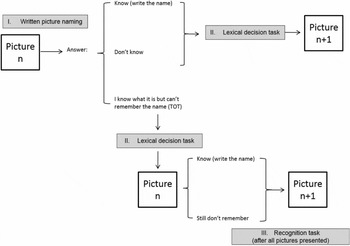
The three different interconnected experimental tasks used in this study are depicted in Figure 1. Firstly, in order to induce TOT states, a written picture naming task was used. Each picture was presented in the centre of the computer screen for a maximum of 5,500 ms with three possible answers: (i) Know, (ii) Don't Know or (iii) TOT state, all associated with three different keyboard keys. When participants answered Know, they had to write on the computer using the keyboard the name of the object depicted by the picture. It was explained to the participants that a TOT state happened when they “knew the name of the object depicted by the picture but could not remember it in that particular moment”. Secondly, irrespective of the participants’ answer, an LDT was performed after each picture. In this task participants were asked to decide as rapidly and accurately as possible whether the sequence of letters’ string presented in the centre of the computer screen was a word or a non-word in the language in use (EP or English). Each item was presented until a response was given or 2,500 ms had elapsed.
Experimental procedure used to induce TOT. The pictures represent sequential written picture naming tasks presented in the experiment in EP and English (in separate blocks). The recognition task was shown at the end of the experiment, after the presentation of all the pictures (80 experimental pictures + 4 for practice trials).

The rationale for the use of the LDT was to induce phonological priming by presenting the syllabic pseudohomophones embedded in pseudowords. The use of syllabic pseudohomophones allowed us to present phonological priming in a more implicit way than previous studies that explicitly presented phonological or semantic cues to help participants to resolve TOT states (i.e., by explaining that those words could be semantically or phonologically related with the word in TOT – see Askari, Reference Askari1999; or Meyer & Bock, Reference Meyer and Bock1992, for examples). Moreover, the use of the syllabic pseudohomophones embedded in pseudowords allowed for the strengthening of prime-target phonological links, attenuating simultaneously the potential effects of orthographic and semantic information presented in homophones or real words. In addition, the use of syllabic pseudohomophones made it possible to control for the part-of-speech effect found by Abrams and Rodriguez (Reference Abrams and Rodriguez2005). According to the authors, target production can be inhibited when prime and target share the same grammatical class. The use of pseudowords prevents this effect on TOT resolution.
After each LDT, participants who had initially answered Know or Don't Know continued to the following picture, whereas those who had answered TOT were presented with the previous picture once again. This way, participants had a second chance to write the name of the picture, i.e., to resolve the TOT state.
Finally, a recognition task was performed at the end of the procedure. For each picture three possible designations were presented. Participants were asked to decide which of them they had considered during the experiment. The provided designations were chosen from the most frequent answers given in the pilot study (e.g., for the target word propeller, the two possible alternatives apart from the correct word were: blade and fan). The recognition task allowed us for the distinction between positive and negative TOTs. Negative TOTs were excluded from the analyses.
Before the presentation of the experimental stimuli, four practice trails were performed in order to assure that the instructions had been understood and any doubts could be clarified. SuperLab 4.5 (Cedrus Corporation, 2006) software was used to present stimuli and for data collection.
Results
Results are presented in two different sections. First, we present the data concerning TOT induction on the first moment of picture naming. Secondly, we present results concerning TOT resolution, i.e., in the second moment of picture naming after the presentation of the syllabic pseudohomophones on the LDT. In each section we present the results obtained for bilinguals and the results of the comparison between bilinguals and monolinguals. In these comparisons, the group of monolinguals who performed the task exclusively in EP was compared with the group of bilinguals who named the first 40 pictures in EP (i.e., half of the bilingual sample).
TOT induction
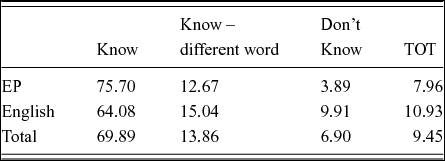
Bilinguals presented a total of 69.8% Know answers, 13.8% of Know-different answer (i.e., when the answer was different from the target name considered by the researchers), 6.9% of Don't Know answers, and a total of 9.5% of TOT answers. Considering the language in which the task was performed, in EP 75.7% were Know answers, 12.6% were Know – different answer, 3.8% were Don't Know answers, and 7.9% were TOT answers. In English, 64.1% were Know answers, 15.1% were Know – different answer, 9.9% were Don't Know answers, and 10.9% corresponded to TOT answers. Table 1 presents the percentages of answers (Know, Know – different answer, Don't Know, and TOT) given by the bilinguals in both languages (EP and English) taken together and separately.
Bilinguals’ Know, Know – different word, Don't Know and TOT answers in the first written picture naming task.

Note: Average percentage of answers in European Portuguese (EP), in English and considering both languages (Total).
An ANOVA for repeated measures was conducted for the percentage of TOT induction considering language (EP vs. English), word length (two- vs. three-syllable words), and cognate status (cognate vs. noncognate word) as within subjects factors in the analysis by subjects (F 1), and as between subjects factors in the analysis by items (F 2). The results showed a significant main effect of language, F 1(1, 120) = 8.66, MSE = 2093.74, p = .004, η 2 = .067; F 2(1, 152) = 8.23, MSE = 353.64, p = .005, η 2 = .051; with more TOT states induced for English (M = 10.93; SD = .81) than for EP (M = 7.96; SD = .88). In addition, a main effect of cognate status was also observed, F 1(1, 120) = 11.01, MSE = 964.53, p = .001, η 2 = .084; F 2(1, 152) = 4.38, MSE = 188.13, p = .038, η 2 = .028, in which more TOT states were induced by noncognates (M = 10.50; SD = .76) than by cognate words (M = 8.51; SD = .74), irrespective of the language.
Moreover, the language x word length interaction was marginally significant in the subjects analysis, F 1(1, 120) = 3.40, MSE = 254.52, p = .068, η 2 = .028; F 2(1, 152) = .89, MSE = 38.27, p = .347, η 2 = .006. This interaction revealed that when bilinguals performed the task in EP, they presented a higher number of TOTs for three-syllable words (M = 8.92, SD = 1.00) than for two-syllable words (M = 7.15, SD = .95) (p = .038). No significant difference was observed when performing the task in English (two-syllable words: M = 11.12, SD = .88; three-syllable words: M = 10.83, SD = .97). In addition, this interaction effect shows that even though bilinguals presented more TOTs in English (M = 11.12; SD = .88) than in EP (M = 7.15; SD = .95) for two-syllable words (p < .001), the same was not observed for three-syllable words. It should be noted that when we conducted the same analyses with the percentage of the Know and Don't Know answers as dependent variables the results also showed differences between languages. Bilinguals produced more Know answers in their dominant language (EP: M = 75.57, SD = .99) than in their non-dominant language (English: M = 64.00, SD = 1.43), F 1(1,119) = 62.74, MSE = 32393.69, p < .001, η 2 = .345; F 2(1,144) = 9.28, MSE = 5327.79, p = .003, η 2 = .061. In the same line, bilinguals produced more Don't Know answers in English than in EP (EP: M = 3.89, SD = .41; English: M = 9.94, SD = .94), F 1(1,119) = 39.63, MSE = 8879.90, p < .001, η 2 = .25; F 2(1,144) = 16.71, MSE = 1460.48, p < .001, η 2 = .104.
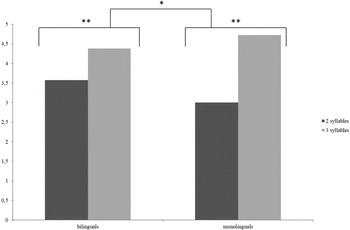
The group of EP monolinguals presented an average of 70.5% of Know answers, 13.3% of Know – different answer, and 8.5% of Don't Know answers. Considering the induced TOTs, the group of monolinguals presented 7.7% and the compared group of bilinguals (i.e., the sample of bilinguals who named the first 40 pictures in EP, half of the total number of bilinguals) presented 8.5% of induced TOTs. Figure 2 shows the percentages of induced TOTs in bilinguals and monolinguals by number of syllables.
Percentage of induced TOT states in bilinguals and monolinguals by number of syllables (two and three-syllable long words). The difference between bilinguals and monolinguals was statistically significant in the analysis by items (*) and the difference between two-syllable words and three-syllables words was statistically significant in both analyses, by subjects and by items (**).

In order to compare bilinguals and monolinguals in TOT induction we conducted an ANOVA for repeated measures in a mixed-design considering speaker group (bilinguals vs. monolinguals) as between subjects factor and word length (two- vs. three-syllable words), and cognate status (cognate vs. noncognate word) as within subjects factors in the analysis by subjects (F 1). In the analysis by items (F 2) the speaker group was considered as within-subjects factor, while the word length and the cognate status were considered as between-subjects factors. The ANOVA showed a main effect of word length, F 1(1, 113) = 18.91, MSE = 1104.38, p < .001, η 2 = .143; F 2(1, 36) = 9.29, MSE = 407.24, p = .004, η 2 = .205. Regardless of speaker group, participants presented more TOTs for three-syllable words (M = 9.43, SD = 1.05) than for two-syllable words (M = 4.90, SD = 1.05). Additionally, this analysis showed a main effect of speaker group, only statistically significant in the item analysis, F 1(1, 113) = .461, MSE = 76.05, p = .498, η 2 = .004; F 2(1, 36) = 6.53, MSE = 151.11, p = .015, η 2 = .154, in which the used pictures induced more TOTs when presented to bilinguals (M = 8.54, SD = .99) than when presented to monolinguals (M = 5.79, SD = .85). Neither the main effect of cognate status (cognate vs. noncognate words) nor the interaction between the two factors approached significance.
TOT resolution
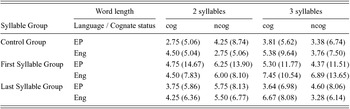
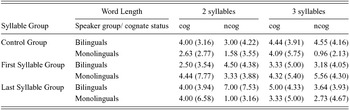
An ANOVA for repeated measures was conducted considering the percentage of TOTs positively resolved in the second moment of picture naming (i.e., when after the LDT participants who had previously answered TOT had a second opportunity to name the same picture). It is worth noting that from the total number of TOT states induced in bilinguals, 70.3% were positive TOTs (i.e., the word in TOT was the same word manipulated as target, as reported by the participants answers to the recognition task at the end of the experiment) and 71.1% of these were resolved in the second moment of picture naming. The ANOVA was based on a mixed design considering language (EP vs. English), word length (two- vs. three-syllable words), and cognate status (cognate vs. noncognate word) as within-subjects factors and syllable group (first, last, or control) as a between subjects factor in the analyses by subjects (F 1). In the analyses by items (F 2) the syllable group was considered as a within-subjects factor and language, word length, and cognate status as between-subjects factors. The percentage of TOT resolution obtained by syllable group, language, cognate status and word length are presented in Table 2.
TOT resolution (and Standard Deviation) in bilinguals by syllable position group (Control, First and Last Syllable Group), language (EP and English), cognate status (cognate and noncognate words) and word length (two and three syllable long words).

Note: EP = European Portuguese; Eng = English; cog = cognate words; ncog = non-cognate words.
The ANOVA showed a main effect of syllable group only statistically significant in the analysis by items, F 1(2, 117) = 1.435, MSE = 279.15, p = .242, η 2 = .024; F 2(2, 304) = 7.64, MSE = 157.24, p = .001, η 2 = .048. The TOT words primed by the first syllable showed significantly more TOT resolution (M = 5.78, SD = .42) than the TOT words that were not primed by either syllable (M = 3.81, SD = .34) (p < .001). Moreover, the words primed by the first syllable showed marginally significant differences in comparison with the words primed by the last syllable (M = 4.59, SD = .40) (p = .074). There were no statistically significant differences between TOT words primed by the last syllable and TOT words that were not primed.
The results of the ANOVA also showed a cognate status x word length interaction statistically significant by subjects, F 1(1, 117) = 4.04, MSE = 238.39, p = .047, η 2 = .033, and marginally significant by items, F 2(1, 152) = 3.39, MSE = 104.36, p = .068, η 2 = .022. This interaction revealed that bilinguals presented a higher percentage of TOT resolution for three- (M = 5.38, SD = .61) than for two-syllable cognate words (M = 4.08, SD = .57) (p = .036; p = .096, for subjects and items analyses, respectively). However, for noncognate words, no word length differences were observed. Additionally, a language x cognate status interaction, only marginally significant in the subjects analysis, F 1(1, 117) = 3.63, MSE = 139.58, p = .059, η 2 = .030; F 2(1, 152) = 1.532, MSE = 47.17, p = .218, η 2 = .010, was also observed. This interaction showed that bilinguals tended to present more TOT resolution for cognate words in English (M = 5.46, SD = .58) than in EP (M = 4.00, SD = .72) (p = .084).
As previously done in TOT induction, the group of monolinguals was compared with the group of bilinguals who firstly performed the task in EP. The group of monolinguals presented 64.8% of positive TOTs, and 66.1% of these were resolved in the second moment of picture naming. Table 3 presents the rates of TOT resolution for bilinguals and monolinguals according to syllable position, cognate status, and number of syllables.
TOT resolution (and Standard Deviation) in bilinguals and monolinguals according to syllable position group (Control, First and Last Syllable Group), cognate status (cognate and noncognate words) and word length (two and three syllable long words).

Note: cog = cognate word; ncog = noncognate word.
An ANOVA for repeated measures was conducted based on a mixed design considering the speaker group (bilinguals vs. monolinguals) and the syllable group (first, last, control) as between subjects factors and the word length (two- vs. three-syllable words) and cognate status (cognate vs. noncognate words) as within subjects factors in the analysis by subjects (F 1). In the analysis by items (F 2) the speaker group and syllable group were assumed as within-subjects factors and the word length and cognate status were between-subjects factors.
The ANOVA results failed to show any significant differences between bilinguals and monolinguals in TOT resolution, F 1(1, 111) = 1.81, MSE = 101.13, p = .18, η 2 = .016; F 2(1, 72) = 2.36, MSE = 51.68, p = .134, η 2 = .061, or any other effect on the manipulated variables (syllable position: F 1(2, 111) = .47, MSE = 26.29, p = .63, η 2 = .008; F 2(2, 72) = .77, MSE = 13.46, p = .47, η 2 = .021; word length: F 1(1, 111) = .23, MSE = 8.00, p = .63, η 2 = .002; F 2(1, 36) = .19, MSE = 4.09, p = .665, η 2 = .005; cognate status: F 1(1, 111) = .75, MSE = 20.98, p = .39, η 2 = .007; F 2(1, 36) = .50, MSE = 10.72, p = .48, η 2 = .014).
A posteriori analysis
Similarly to what was done in Pureza et al. (Reference Pureza, Soares and Comesaña2013), and in an attempt to explore the differences on the syllable position effect when comparing the current study with the previous one with EP monolinguals, we decided to conduct an a posteriori ANCOVA considering the first syllable frequency as a covariate. Syllable frequency seems to have an important role in modulating the effect of syllable position in TOT resolution, although it is rarely controlled due to the difficulties in stimuli selection.
In a first ANCOVA considering only the bilingual group, the syllable group (control, first, or last syllable) was considered as a within-subjects factor, the language (EP vs. English), word length (two- vs. three-syllable words), and cognate status (cognate vs. noncognate) as between-subjects factors, and the first syllable frequency in EP and English considered as covariate. As in Pureza et al. (Reference Pureza, Soares and Comesaña2013), we computed the positional (type) frequency of the first syllables of each experimental target for EP from the values available at the P-PAL database for EP (Soares et al., Reference Soares, Iriarte, de Almeida, Simões, Costa, França, Machado and Comesaña2014), and obtained the first syllable frequency values in English from the CELEX database (Baayen, Piepenbrock & Gulikers, Reference Baayen, Piepenbrock and Gulikers1995). The last syllable frequency computation was not possible to carry out for the English targets since CELEX does not provide such information. The covariate presented the following value: first syllable frequency = 435.96. The ANCOVA replicated the previously obtained effects in the ANOVA, showing a main effect of syllable group, F(2, 302) = 7.33, MSE = 151.80, p = .001, η 2 = .046. The First Syllable Group showed significantly more TOT resolution than the Control Group (p < .001) and marginally significant differences in comparison with the participants of the Last Syllable Group (p = .076). The Control and the Last Syllable Groups did not differ significantly (p = .352). Moreover, the cognate status x word length effect was marginally significant, F(1, 151) = 3.20, MSE = 96.67, p = .076, η 2 = .021. Once more, the interaction revealed that bilinguals tended to present more TOT resolution for three syllable cognate words than two-syllable cognate words (p = .10). No differences were observed for noncognate words as a function of word length. None of the interactions nor the covariate assumed statistical significance.
Finally, we also conducted a second ANCOVA comparing bilinguals and monolinguals, which considered the speaker group and syllable group (control, first and last syllable) as within subjects factors, the word length (two- vs. three-syllable words) and cognate status (cognate vs. noncognate) as between subjects factors, and the first and last syllable frequency in EP as a covariate. Similarly to the previously obtained results, there were no significant differences between bilinguals and monolinguals in TOT resolution nor any statistically significant results for the variables and covariates included.
General Discussion
The present study aimed to explore the role of cognate status (cognate vs. noncognate), syllable position (first vs. last) and word length (two- vs. three-syllable words) in TOT states induction and resolution in EP–English bilinguals (and in a group of EP monolinguals as a control). TOT was induced by a picture naming task in L1 and L2, after which a LDT was presented for each target picture. In this task, the syllable position was manipulated by considering syllabic pseudohomophones embedded in pseudowords that shared the first, the last, or none of the syllables with the target name depicted by each picture.
Results showed, as expected, a higher number of TOTs when bilinguals performed the task in their L2 than in their L1. In addition, more TOTs were induced for noncognate than for cognate words. Interestingly, bilinguals showed more TOTs for longer (three-) than for shorter (two-syllable) words when performing the task in EP, but no word length effect was observed when performing the task in English. When comparing bilinguals and monolinguals, bilinguals presented more TOTs than monolinguals even though this result was only statistically significant in the analysis by items. Moreover, a main effect of word length was also observed, in which and irrespective to the speaker group more TOTs were obtained for three- than two-syllable words.
The results on TOT resolution showed that word length and cognate status modulated the data. Bilinguals showed, as expected, more TOT resolution for three-syllable cognate words than two-syllable cognate words, and more TOT resolution for cognate words in their less frequently used language (English). However, bilinguals who were primed by the first syllable showed more TOT resolution than bilinguals who did not receive any phonological priming or who were primed by the last syllable, although this last difference was only marginally significant. Moreover, when bilinguals and monolinguals were compared, the results failed to show any differences between the two groups in the manipulated variables in TOT resolution.
Consistent with our hypotheses and in support of the frequency-lag theory (Gollan & Acenas, Reference Gollan and Acenas2004; Gollan et al., Reference Gollan, Slattery, Goldenberg, Van Assche, Duyck and Rayner2011), bilinguals presented more TOTs for L2 than for L1, and more TOTs for noncognates than for cognate words. According to this hypothesis, as bilinguals use each of their languages less frequently when compared to monolinguals, the inter-level connections between phonological and semantic levels of the lexical nodes will be weaker. Thus, the difference in the frequency of use of both languages revealed by our participants (40% vs. 60%, for L2 and L1, respectively) might explain the higher number of TOTs when performing the task in their L2 than in their L1. Additionally, bilinguals showed a lower number of TOTs for cognate than for noncognate words. This might occur not only because cognate words are more frequently used than noncognate words (due to cross-linguistic form similarities) but also because they receive greater semantic co-activation from the lexical representations of both languages. This, in turn, sends feedback activation to the phonological level, enhancing word retrieval (see Costa et al., Reference Costa, Caramazza and Sebastián-Gallés2000; Costa et al., Reference Costa, Santesteban and Caño2005; for consistent evidence on the advantage of cognate words in processing). In the same line, bilinguals showed a higher percentage of TOT states (8.5%) than monolinguals (5.8%), even though the difference between these groups was only statistically significant in the analysis by items.
It is worth noting that when bilinguals had to name the pictures exclusively in EP, they tended to reveal more TOTs for three- than for two-syllable long words, which is congruent with the Pureza and colleagues’ study (Reference Pureza, Soares and Comesaña2013) with EP monolinguals. However, when the task was performed in English the word length effect was not observed. Additionally, when bilinguals and monolinguals were compared, it was also shown that regardless of the speaker group, when performing the task in EP three-syllable long words were better retrieved than two-syllable long words. As mentioned in the Introduction, EP is a language with a regular syllable structure and clear-cut syllable boundaries (see Frota et al., Reference Frota, Vigário and Martins2002, for details) which may underlie the fact that the word length effect in TOT induction emerged when performing the task in EP but not in English. On the other hand, this result also suggests that bilinguals were able to attend to the specificities of each language. When performing the task in EP they were susceptible to the length of the EP words, in line with what was previously observed by Pureza and colleagues (Reference Pureza, Soares and Comesaña2013). However, when performing the task in English, the word length effects were no longer observable. Even though further research is necessary to analyse how language characteristics modulates word length effects, this result seems to suggest that the driving force of the word length effect might be the language in which the task is performed. Moreover, the syllable structure does not seem to be as informative in English as in EP. In fact, in EP the syllable structure seems to be affecting the mechanisms that underlie lexical access and word retrieval. Therefore, further investigation considering polysyllabic words in different languages is mandatory, particularly if we consider that the majority of the investigation in language production and comprehension has massively used monosyllables.
Interestingly and as hypothesized, in TOT resolution the word length effect was modulated by the cognate status of the target word but not by the language in use. Thus and irrespectively of the used language, cognate words with three-syllables had more TOT resolution than cognate words with two-syllables. This result extended the previous effect of word length observed by Pureza and colleagues (Reference Pureza, Soares and Comesaña2013) with EP monolinguals to the bilinguals, even though it was restricted to cognate words. As mentioned, cognate words share semantic, orthographic and phonological features between languages which may increase the lexical activation, allowing for a faster selection and naming (Costa et al., Reference Costa, Caramazza and Sebastián-Gallés2000; Kroll et al., Reference Kroll, Dijkstra, Janssen and Schriefers2000). Moreover, considering that longer words have a higher baseline level of activation – due to the higher number of nodes activated in comparison to shorter words – they might be more prone to phonological priming (see Pitt & Samuel, Reference Pitt and Samuel2006; Pureza et al., Reference Pureza, Soares and Comesaña2013 for details). This characteristic along with the higher activation that cognate words receive from shared connections between languages make these words (i.e., cognate longer words) particularly susceptible to TOT resolution.
Regarding syllable position, our results revealed that contrary to what was expected, bilinguals presented more TOT resolution when primed by the first syllable than by the last syllable or none, regardless of the language in which the task was performed (even though the difference between the first and the last syllable was only marginally significant in the analysis by items). This result, inconsistent with what was previously observed by Pureza et al. (Reference Pureza, Soares and Comesaña2013) with EP monolinguals, in which the last syllable was more relevant for TOT resolution, was consistent with Abrams et al.'s (Reference Abrams, White and Eitel2003) study with English monolinguals. Nevertheless, it is important to note that the syllable position effect observed by Pureza and colleagues was only observed in four-syllable long words. When comparing three- and two-syllable long words (as the words used in the current experiment) the syllable position effect was not obtained. Therefore, it seems that the advantage of the last syllable position might be obtained exclusively for longer words (more than three), which were not included in the present study with EP–English bilinguals.
Due to this unexpected result, similarly to what previously occurred in Pureza and colleagues’ (Reference Pureza, Soares and Comesaña2013) study, and in order to better understand it, an a posteriori analysis was conducted, aiming to control for the potential effect of the frequency of the syllables used to prime TOT words. Farrell and Abrams (Reference Farrell and Abrams2011) showed that targets beginning with low-frequency syllables had higher TOT resolution than targets with high-frequency first syllables. Farrell and Abrams interpreted these results based on the hypothesis of competition for selection, in which higher-frequency syllables would activate more lexical competitors, thereby inhibiting target retrieval. In line with Farrell and Abrams (Reference Farrell and Abrams2011), the a posteriori analyses conducted by Pureza and colleagues (Reference Pureza, Soares and Comesaña2013) showed that the last syllables were indeed less frequent than first syllables used in the experiment, which may have accounted for the last-syllable effect observed in four-syllable long words. In the current study, the a posteriori ANCOVA conducted on bilinguals’ TOT resolution replicated the previously obtained effect of syllable position. Words primed by the first syllable still showed significantly more TOT resolution than words that were not primed by either syllable, and marginally significant differences in comparison to the words primed by the last syllable. The same analysis was conducted for the comparison between bilinguals and monolinguals and once again, there were no differences between the two groups when considering TOT resolution. It is worth considering that there was not a main effect of the syllable frequency in either of the analyses, which indicates that this was kept constant along the experimental stimuli used. Takinginto consideration the findings of the aforementioned studies along with the results obtained in the present research, it seems that the first syllable has indeed a more relevant role in facilitating TOT resolution when compared with the last syllable of the word whenever the positional syllable frequency of the primes is controlled for. Nevertheless, in order to have a more accurate perspective on the syllable position effect (first vs. last) in TOT resolution in bilinguals (and monolinguals as well), future studies should include longer words as targets and control for the positional syllable frequency, preferablyby maintaining it constant at low-frequency values.
Finally, the present results showed that even though bilinguals and monolinguals present differences in TOT induction, when considering TOT resolution, and in opposition to our hypothesis, the two groups did not differ. This outcome is in line with previous studies (Gollan & Acenas, Reference Gollan and Acenas2004; Gollan & Silverberg, Reference Gollan and Silverberg2001). Thus, it seems that in TOT induction bilinguals and monolinguals differ in the mechanisms that enable lexical access. However, when in a TOT state, both bilinguals and monolinguals are equally able to retrieve the target word, being equally susceptible to effects of syllable position, word length and cognate status. Therefore and as suggested by Gollan et al. (Reference Gollan, Ferreira, Cera and Flett2013), the mechanisms that are involved in TOT resolution seem to be different from the ones operating in TOT induction, and similar for bilinguals and monolinguals. Nevertheless, it is also important to consider that the experimental procedure used here might be more suited to capture differences on lexical access between bilinguals and monolinguals but not so suited to capture differences between these groups on lexical retrieval. Further research using experimental procedures more sensible to TOT resolution are necessary in order to explore this hypothesis (e.g., electrophysiological measures). Finally, future studies should also try to consider a group of balanced EP–English bilinguals since the present results can be a consequence of having explored these particular variables in a group of proficient unbalanced bilinguals who have an L1 dominance.
Overall, the present study presents evidence for the existence of different mechanisms involved in TOT induction and in TOT resolution, particularly when comparing bilingual and monolingual speakers. The manipulation of variables that were not considered in TOT studies with bilinguals up to now, such as word length or syllable position, was explored and revealed its relevance. Results interestingly showed that word length is a key variable in lexical access in languages with well-defined syllable boundaries and that the syllabic features of the language used have an impact on bilinguals’ performance. Finally, evidence is presented that indicates the importance of controlling for syllable frequency whenever manipulating the syllable position effect in TOT resolution.
European Portuguese target words and syllabic pseudohomophones

English target words and syllabic pseudohomophones