Introduction
That learning and memory difficulties are an acute consequence of mild traumatic brain injury (mTBI) is well supported. That deficits persist years following injury, however, is a controversial issue. While the majority of individuals do not appear to experience persisting cognitive difficulties after mTBI, a subset of patients do demonstrate such difficulties (Benedictus, Spikman, & van der Naalt, Reference Benedictus, Spikman and van der Naalt2010; Ponsford et al., Reference Ponsford, Willmott, Rothwell, Cameron, Kelly, Nelms and Ng2000). For a myriad of complex reasons (e.g., psychological, motivational), this subset proves a challenge for clinicians. Prior work conducted in our laboratory using a non-clinical, non-litigating sample of mTBI patients attempted to address issues related to memory complaints often raised by clinical patients and their families (Geary, Kraus, Pliskin, & Little, Reference Geary, Kraus, Pliskin and Little2010). Our previous work focused on trial-by-trial performance on a measure of verbal learning in a sample of community-recruited mTBI participants. We reported that mTBI participants demonstrated diminished acquisition on the initial learning trial and evidenced an overall slower rate of learning across trials in the context of equivalent performance relative to controls on the total learning and memory indices (Geary et al., Reference Geary, Kraus, Pliskin and Little2010). Furthermore, performance on the verbal learning task was related to imaging measures showing a relationship between the effects of injury on cerebral white matter integrity and behavioral performance. One limitation of our previous work was that we were unable to comment on the specific mechanism that may underlie our behavioral findings. In this previous work, we proposed the hypothesis that meta-cognitive strategy use might underlie the verbal learning deficiency in mTBI.
Examining higher-order “meta-cognitive” learning and memory strategies has particular relevance in patient populations including mTBI where evidence of chronic primary temporal lobe/diencephalic memory dysfunction is not generally supported (Binder, Rohling, & Larrabee, Reference Binder, Rohling and Larrabee1997; Cicerone & Kalmar, Reference Cicerone and Kalmar1995; Dikmen et al., Reference Dikmen, Corrigan, Levin, Machamer, Stiers and Weisskopf2009; Ettenhofer & Abeles, Reference Ettenhofer and Abeles2009; Iverson, Reference Iverson2005; Schretlen & Shapiro, Reference Schretlen and Shapiro2003; West, Curtis, Greve, & Bianchini, Reference West, Curtis, Greve and Bianchini2010). Others have argued that memory deficiencies following mTBI could be influenced by dysfunction in frontal-subcortical networks which may support meta-cognitive functions (Alexander, Stuss, & Gillingham, Reference Alexander, Stuss and Gillingham2009; Bruce & Echemendia, Reference Bruce and Echemendia2003; Little et al., Reference Little, Kraus, Joseph, Geary, Susmaras, Zhou and Gorelick2010). In learning and memory, meta-cognitive functions such as restructuring information via the identification of shared relationships between items and/or other internally driven mnemonic devices increase one's ability to learn and recall information (Becker & Lim, Reference Becker and Lim2003; Schefft, Dulay, & Fargo, Reference Schefft, Dulay and Fargo2008). Studies in TBI and other neurologic populations provide evidence that successful recall of items on list-learning tasks is influenced by how well one consistently uses an efficient (i.e., semantic, subjective) recall strategy (Bruce & Echemendia, Reference Bruce and Echemendia2003; Chan et al., Reference Chan, Kwoka, Chiub, Lamb, Pangb and Chow2000; Gongvatana et al., Reference Gongvatana, Woods, Taylor, Vigil, Grant and Group2007; Gsottschneider et al., Reference Gsottschneider, Keller, Pitschel-Walz, Froböse, Bäuml and Jahn2010; Luek, Reference Luek1976; Ribeiro, Guerreiro, & De Mendonça, Reference Ribeiro, Guerreiro and De Mendonça2007).
When conceptualizing meta-cognitive strategies hierarchically in terms of degree of cognitive engagement, semantic clustering arguably constitutes a sophisticated strategy. Semantic clustering encompasses mentally grouping items from the same taxonomic category at greater than chance levels and is most often associated with improved learning and recall (Delis, Freeland, Kramer, & Kaplan, Reference Delis, Freeland, Kramer and Kaplan1988). In order for semantic clustering strategies to be used, an individual must first identify that semantic relationships exist, use the strategy by compartmentalizing words during list encoding, and then use the semantic groups during both initial and subsequent recall. In list-learning tasks such as the California Verbal Learning Test (CVLT-II), this process involves recognizing that the pseudo-random presentation of 16 target words consists of items from four semantic categories, regrouping words according to these categories, and organizing these words by category during recall.
In contrast to semantic clustering, subjective clustering may involve restructuring the list based on phonemic features of items or another personally derived mnemonic strategy. Because subjective clustering is internally derived, it is suspected when one recalls two or more words together from one trial to the next independent of semantic or serial clustering strategies.
Finally, serial clustering, or recalling words in the order of presentation, may partially reflect the tendency to recall the first words and last words presented (primacy/recency effects). Of all three strategies, serial clustering requires the least amount of cognitive engagement as the structure is externally facilitated by presentation order. If used at the exclusion of the other two strategies, serial clustering tends to be the least efficient as it often results in poorer performance (Delis et al., Reference Delis, Freeland, Kramer and Kaplan1988). Serial clustering is often most readily applied across trials in memory impaired populations (Gsottschneider et al., Reference Gsottschneider, Keller, Pitschel-Walz, Froböse, Bäuml and Jahn2010; Jefferies, Hoffman, Jones, & Ralph, Reference Jefferies, Hoffman, Jones and Ralph2008; Ranjith, Mathuranath, Sharma, & Alexander, Reference Ranjith, Mathuranath, Sharma and Alexander2010).
In our prior work, while there were no significant group differences on the traditional executive function measures in our analyses (Geary et al., Reference Geary, Kraus, Pliskin and Little2010; Kraus et al., Reference Kraus, Susmaras, Caughlin, Walker, Sweeney and Little2007), we speculated that differences in the rate of learning between groups could be related to less often analyzed executive functions including strategy use on the CVLT-II. Like others, we reasoned that these individualized measures of performance may be more sensitive to subtle diffuse effects following mTBI (Cicerone, Levin, Malec, Stuss, & Whyte, Reference Cicerone, Levin, Malec, Stuss and Whyte2006; Schweizer, Alexander, Gillingham, Cusimano, & Stuss, Reference Schweizer, Alexander, Gillingham, Cusimano and Stuss2010). The purpose of the present investigation is to test the hypothesis that semantic clustering will predict learning rate for control participants but not for our mTBI participants.
Methods
Participants
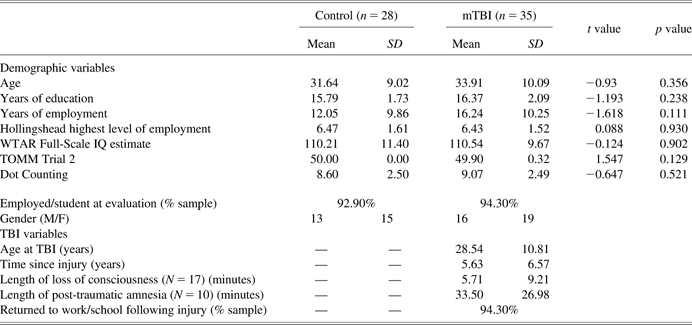
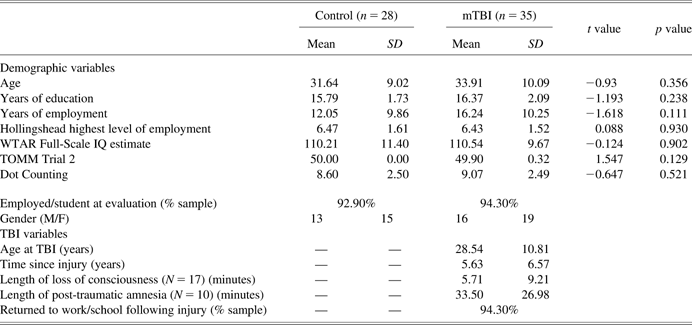
From a larger sample of participants described previously (Geary et al., Reference Geary, Kraus, Pliskin and Little2010), CVLT-II response data were available and analyzed for a total of 35 mTBI participants (19 females) and 28 healthy controls (15 females). Participants were recruited via advertisements in the community seeking individuals who had ever sustained a closed head injury, concussion, or traumatic brain injury. No participants were recruited from active clinical practices for treatment of TBI. All participants provided written informed consent and experimental procedures complied with the code of ethics of the World Medical Association, Declaration of Helsinki, and Institutional Review Board. Participants were excluded if they had a history of psychiatric disorder before the TBI, substance abuse/dependency, current or past litigation, failure on a formal measure of effort, or any other neurologic or medical condition that could result in cognitive changes (e.g., hypertension, severe chronic pain). For this study, participants were also excluded if there was positive radiologic finding of contusion or bleed, or, upon review of both T2- and T1-weighted magnetic resonance imaging, evidence of skull fracture suggesting significant trauma to the head. No mTBI participants had evidence of focal neurological symptom at the time of evaluation. Additionally, participants were not receiving any psychiatric medication or medications used for cognitive enhancement at the time of the study. The criteria used for defining mTBI follow the guidelines set forth by the American Congress of Rehabilitation Medicine (ACRM, 1993), including endorsement of at least one of the following: any period of loss of consciousness (LOC); any loss of memory for events immediately before or after the accident (PTA); any alteration in mental state at the time of the accident; focal neurological deficit (ACRM, 1993; Cassidy et al., Reference Cassidy, Carroll, Peloso, Borg, von Holst and Holm2004). These criteria help ensure that our sample were, in fact, mild severity (LOC less than 30 min; PTA less than 24 hr, and/or the Glasgow Coma Scale greater than or equal to 13) (ACRM, 1993; Cassidy et al., Reference Cassidy, Carroll, Peloso, Borg, von Holst and Holm2004; Levin, Reference Levin1992; Tagliaferri, Compagnone, Korsic, Servadei, & Kraus, Reference Tagliaferri, Compagnone, Korsic, Servadei and Kraus2006). For individuals who had witness-confirmed information on duration of LOC and/or PTA the average reported LOC was 5.7 minutes (N=17; range = 0–30 min) and average reported PTA was 33.5 min (N = 10; range = 0–60 min). For patients without specific information regarding LOC (N = 18) or PTA (N = 25), we relied upon estimates of self-report and witness report of duration of LOC or PTA. These criteria reduce the risk of Type I error as the reliance on self-report and inclusion of no minimum LOC raises the possibility that participants classified as mTBI may not have sustained a brain injury. We adopted this more conservative approach to ensure that we did not bias data in favor of the study hypothesis by including complicated mild or moderate TBI.
The mechanism of injury for the mTBI participants included motor vehicle accidents (MVA; N = 9), pedestrian versus MVA (N = 2), assault (N = 3), sports-related (N = 10), and falls or blows to the head (N = 11). Twelve patients reported experiencing more than one mTBI (range, 2–7 mTBI). Given that the purpose of this study was to elaborate on findings from the originally published work, and the original findings were supported regardless of the inclusion of multiple TBI patients, we did not exclude on the basis of history of multiple mTBI. Demographic data and injury related variables are presented in Table 1.
Demographics and brain injury variables
Materials and procedure
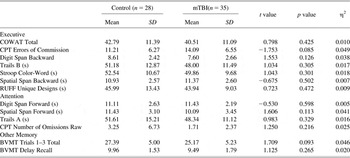
Neuropsychological Assessment
As detailed previously, participants completed an extensive neuropsychological test battery that was assembled to assess executive function, attention, and memory (Kraus et al., Reference Kraus, Susmaras, Caughlin, Walker, Sweeney and Little2007). Performance on individual measures from this battery for both groups are presented in Table 2. The CVLT-II was used to assess list-learning and memory. In addition to capturing the amount of verbal information an individual can learn and recall, the CVLT-II measures many individualized elements of precisely how information is learned (Delis, Kramer, Kaplan, & Obers, Reference Delis, Kramer, Kaplan and Obers2000a). We examined the following CVLT-II strategies.
Neuropsychological test performance

Note. (s) = standard score; CPT = Conners Continuous Performance Test; COWAT = Controlled Oral Word Association Test; RUFF = Ruff Figural Fluency Test; BVMT = Brief Visual Spatial Memory Test.
Calculation of Clustering Scores
Chance adjusted (CA) semantic category clustering individual trials
Semantic clustering involves recalling two or more words by virtue of shared semantic category. Recent theories of semantic clustering argue that organization processes occur during list-learning, presumably as semantic categories are identified. Semantic cluster scores were calculated based on the list-based measure of observed minus expected clustering offered by Stricker, Brown, Wixted, Baldo, and Delis (Reference Stricker, Brown, Wixted, Baldo and Delis2002), which was recently demonstrated to show improved classification rates when used with clinical samples (Delis et al., Reference Delis, Fine, Stricker, Houston, Wetter, Cobell and Bondi2010). For scoring observed semantic clusters, one point is given for each correct semantic cluster (i.e., each pair of words from the same semantic category), for a maximum of 12 points for each trial. For example, successive recall of the words cat/dog/fish would yield an observed semantic cluster score of two. The CA semantic clustering score used in analyses is the observed semantic clustering score minus the expected semantic clustering score. To calculate expected semantic clustering score, we adopted the method illustrated in Equation 1 (Delis, Kramer, Kaplan, & Obers, Reference Delis, Kramer, Kaplan and Obers2000b).

where, “i” represents a given trial, “r” the number of correct words recalled on trial i, “m” represents the number of members of each semantic category on the original list, and “NL” the total number of words on the original list. As such, the CA scores can range from a high of 9.0 (perfect semantic clustering with a total recall score of 16) to a low of −3.0 (no observed semantic clustering with a total recall score of 16) (Delis et al., Reference Delis, Kramer, Kaplan and Obers2000b).
Chance adjusted (CA) subjective clustering individual trials
Subjective clustering involves word pairs recalled together from one trial to the next, which do not adhere to semantic or serial clustering strategies. For example, subjective clusters may consist of seemingly unrelated words, which have been grouped using some mnemonic by the individual (e.g., car full of lettuce) or words that share phonemic qualities (e.g., sofa/soup). The observed directional subjective clustering score includes any target words recalled together (either in forward order or backward order) across two consecutive trials. The expected subjective clustering score is calculated using the method illustrated in Equation 2.

The expected value consists of “ii” which represents the subjective clustering score between two given trials, “c,” which is the number of common items recalled in Trials t and t + 1 (regardless if grouped together), “h,” which is the number of recalled items in Trial t, and “k,” which is the number of items recalled in Trial t + 1 (Sternberg & Tulving, Reference Sternberg and Tulving1977). The CA subjective clustering score used in analyses is the observed subjective clustering score minus the expected subjective clustering score. An example is if the word pair car/lettuce (subjective observed score of 1) is recalled together on trial one and trial two with 8 total words correctly recalled on trial one (t = 8) and 9 total words correctly recalled on the trial two (t + 1 = 9). If there were 4 words in common across both trials (but only one subjective cluster), the subjective clustering expected score would be calculated using: c = 4 (4 words recalled on both trial 1 & trial 2), h = 8 as trial 1 had 8 total correct words recalled, k = 9 as trial 2 had 9 total correct words recalled: 2(4)*(4−1)/(8*9) = 0.333. This result is then inserted into the CA subjective clustering formula of observed subjective clustering (car/lettuce, subjective observed score of 1) minus expected subjective clustering or [1–0.333] = 0.667, yielding a subjective clustering score of 0.667 for trial 1 to trial 2. A higher number demonstrates greater frequency of subjective clustering.
Chance adjusted (CA) serial clustering individual trials
Serial clustering encompasses recalling items in the order in which they were presented. The serial position effect (Young, Hakes, & Hicks, Reference Young, Hakes and Hicks1965) is demonstrated by a tendency to recall more items from the first (i.e., primacy) and last (i.e., recency) portions of a word list. On the CVLT-II, a serial recall strategy is an extension of the serial position effect as it involves grouping items in the order in which they were presented. For serial cluster scoring, one point was given each time two correct items from the list are recalled in the same order in which they were presented. For example, successive recall of the second and third words would yield a serial forward order score of one. We also scored serial clusters backward with one point given every time a correct target word immediately followed another correct target word in reverse order.
The bidirectional serial clustering observed score encompasses a summation of observed forward (F) serial clustering and observed backward (B) serial clustering. The CA serial clustering score is illustrated in Equation 3:
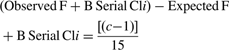
where “i” is represents a given trial and “c” is the number of correctly recalled items for the trial. The CA serial score thereby reflects observed bidirectional serial clustering minus expected bidirectional serial clustering.
Statistical Analysis
Consistent with previous work (Geary et al., Reference Geary, Kraus, Pliskin and Little2010), data from each individual were fitted to a power function (Eq. 4). The power function, which is commonly applied in the behavioral learning literature (Anderson, Reference Anderson1982; Logan, Reference Logan1998), was done by applying a two-parameter power function and calculating the best-fit line. The primary dependent measure for this analysis was total number of correctly recalled items per trial. This function was applied to data from each participant. We extracted the y-intercept (represented by y in Eq. 4), which equates to the location at which the best-fit line crosses the y-axis, and slope (represented by b in Eq. 4) which reflects how quickly learning is accomplished and/or the position at which the line becomes asymptotic. Unlike the CVLT-II learning trials 1–5 slope which reflects a least squares linear regression, the power function allows for characterization of the rate of change (exponential growth).

Correlations and regression analyses were used to evaluate the extent to which each of the clustering strategies predicted the rate of learning, the primary outcome measure, in patients and controls separately. First, Pearson's correlations were conducted to evaluate the unadjusted relationship between the three CA clustering strategies and overall rate of learning. Next, stepwise regression analyses were conducted to assess the extent to which each strategy contributed unique variance to overall learning rate.
Results
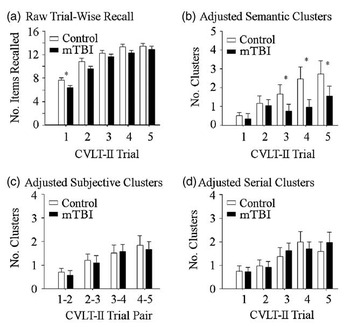
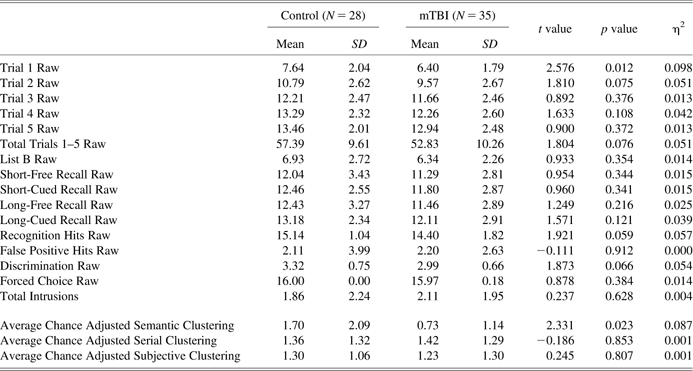
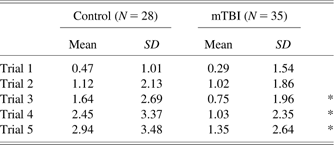
Consistent with our prior reported observations (Geary et al., Reference Geary, Kraus, Pliskin and Little2010), groups differed on performance on the initial learning trial of the CVLT-II (p < .05). This relationship is shown in Figure 1a. Table 3 details performance on CVLT-II variables. Groups did not differ significantly on total learning or delayed memory scores or ListB recall (all p's > .05). Groups did differ on average CA semantic clustering across five trials (p < .05).
a: CVLT-II raw recall findings across trials one through five for controls and patients with mTBI. Statistically significant difference between groups was only observed on the first learning trial. b: Chance adjusted semantic clusters across trials one through five for control and mTBI participants. Statistically significant differences between groups were observed on trials three through five. c: Chance adjusted subjective clusters scores across trials for control and mTBI participants. No statistically significant differences between groups were observed across trials. d: Chance adjusted serial clusters across trials one through five for control and mTBI participants. No statistically significant differences between groups were observed across trials.

Raw scores of CVLT-II performance
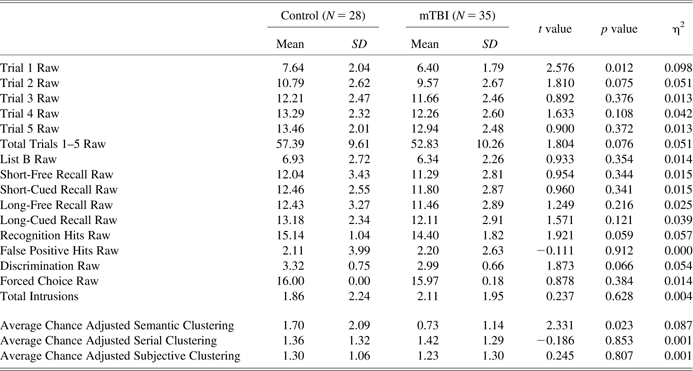
Pearson's correlations were conducted to evaluate the unadjusted relationship between the three CA clustering strategies and overall rate of learning. For control participants, average CA semantic (r = 0.566; p < .01) and average CA subjective (r = 0.565; p < .01) clustering was related to overall learning rate. For mTBI, only CA serial clustering was related to overall learning rate (r = 0.432; p < .01).
To test our primary hypothesis that clustering strategy could explain learning rate on the CVLT-II, a stepwise linear regression analysis was undertaken by group entering the average five-trial CA semantic clustering score, average five-trial bidirectional CA serial clustering score, and average four CA subjective clustering scores, as predictors of rate of overall learning. These analyses revealed that for the control participants, average CA semantic clustering score (β = 1.17; t(25) = 6.45; p < .001) and average CA serial clustering score (β = 0.82; t(25) = 4.53; p < .001) were significant predictors of overall rate of learning (R 2 = 0.63; F(2,25) = 20.980; p < .001) accounting for 32% and 31%, respectively, of the variance in overall learning rate. For mTBI participants, only the average CA serial clustering score (β = 0.43; t(33) = 2.75; p < .01) was a significant predictor of learning rate (F(1,33) = 7.58; p < .01) accounting for 19% of the variance.
To better understand differences in strategy use on the CVLT-II, we conducted three separate post hoc mixed factor analyses of variance (i.e., one per clustering strategy). We used the strategy score for each trial as the within-subject factor (e.g., (1)CA semantic clustering score on five trials, (2)CA serial clustering score on five trials; (3)four CA subjective clustering scores: trial 1 to trial 2; trial 2 to trial 3; trial 3 to trial 4; trial 4 to trial 5) and Group (control, mTBI) as the between-subject factor. As shown in Figure 1b–d, there was no significant group by trial interaction effect for any clustering strategy or significant trial by trial differences between groups on CA subjective (Figure 1c) or CA serial clustering (Figure 1d) variables. However, these analyses revealed a significant between group effect with control participants using more CA semantic clusters compared to mTBI participants F(1,61) = 5.994; p < .001; η2 = 0.091. Table 4 details CA semantic clustering by group for each learning trial.
CVLT-II semantic clustering chance adjusted
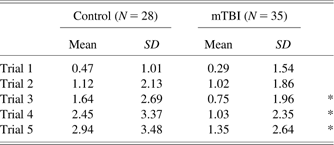
Note. *p < 0.05.
Although we did not include ListB in our primary learning analyses as it is difficult to reliably analyze strategy use in only one presentation and ListB shares semantic categories with ListA (i.e., proactive interference effects), we did examine transfer of strategy effects by comparison of Trial 1 of ListA and ListB. Consistent with our previous work, our groups did not differ on total raw recall on ListB (Geary et al., Reference Geary, Kraus, Pliskin and Little2010) and there were no between group differences or interaction effects. However, to examine potential transfer of strategy (DeRosa, Doane, & Russell, Reference DeRosa, Doane and Russell1970), we conducted post hoc stepwise regression analyses that demonstrated semantic clustering predicted 24% of the variance of ListB recall for controls only (β = 0.49; t(27) = 3.75; p < .001). For mTBI, only serial clustering was a significant predictor of ListB recall (β = 0.36; t(33) = 2.22; p < .05).
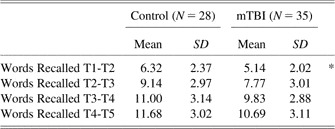
Recalling that our prior finding (Geary et al., Reference Geary, Kraus, Pliskin and Little2010) was of a relationship of diminished recall on the first recall trial, we also conducted a post hoc examination of recall consistency across trials. This analysis revealed less consistency in recall in mTBI relative to controls from trial 1 to trial 2, t(61) = 2.130, p = 0.037, but not on the remaining trials. Table 5 details these analyses.
Recall consistency of Recall Across Trials

Note. *p < 0.05
Discussion
The current study serves to characterize the mechanisms that underlie reductions in rate of verbal learning in mTBI (Geary et al., Reference Geary, Kraus, Pliskin and Little2010). To our knowledge, this is the first study to examine verbal learning strategy use within and across trials in a mTBI sample who achieved comparable total learning and memory scores relative to control participants. This approach is consistent with recent interest examining qualitative aspects of learning and memory performance, such as strategy use (Baldo, Delis, Kramer, & Shimamura, Reference Baldo, Delis, Kramer and Shimamura2002; Millis & Ricker, Reference Millis and Ricker1994; Nolin, Reference Nolin2006; Schefft et al., Reference Schefft, Dulay and Fargo2008). Semantic and subjective strategy formation and implementation are considered qualitative aspects of learning and memory performance. Such behaviors fall under the category of executive functions (Alexander & Stuss, Reference Alexander and Stuss2006; Matsui et al., Reference Matsui, Suzuki, Zhou, Takahashi, Kawasaki, Yuuki and Kurachi2008) reflective of active engagement of self-generated or internally driven reasoning skill. Semantic clustering arguably represents the most efficient and highest-order organization strategy to facilitate learning (Becker & Lim, Reference Becker and Lim2003). Given the evidence of frontal lobe dysfunction and reduced strategy use in TBI of greater severity (Levine et al., Reference Levine, Stuss, Milberg, Alexander, Schwartz and Macdonald1998; Millis & Ricker, Reference Millis and Ricker1994; Schefft et al., Reference Schefft, Dulay and Fargo2008; Strangman et al., Reference Strangman, O'Neil-Pirozzi, Goldstein, Kelkar, Katz, Burke and Glenn2008), we questioned if diminished internally derived meta-cognitive strategy use could explain decreased rate of learning across trials in a mTBI sample. Our present findings are supportive of the hypothesis that mTBI participants are under-utilizing semantic clustering relative to control participants. In the context of comparable total immediate recall and delayed memory scores, control participants use semantic clustering whereas the mTBI do not to a similar degree.
The frontal lobe's involvement in executive functions such as strategic processes of learning and memory is well supported (Alexander, Stuss, & Fansabedian, Reference Alexander, Stuss and Fansabedian2003; Alexander et al., Reference Alexander, Stuss and Gillingham2009; Baldo et al., Reference Baldo, Delis, Kramer and Shimamura2002; Cabeza & Nyberg, Reference Cabeza and Nyberg2000; Turner, Cipolotti, Yousry, & Shallice, Reference Turner, Cipolotti, Yousry and Shallice2007; Turriziani, Smirni, Oliveri, Semenza, & Cipolott, Reference Turriziani, Smirni, Oliveri, Semenza and Cipolott2010). We have previously reported no significant group differences between control and mTBI participants on administered measures of executive functioning (Geary et al., Reference Geary, Kraus, Pliskin and Little2010; Kraus et al., Reference Kraus, Susmaras, Caughlin, Walker, Sweeney and Little2007). In retrospect, these previous reports may not have been sufficient to conclude that subtle executive deficits do not persist following mTBI. We undertook the current analysis with the speculation that perhaps our executive function measures were not sensitive to detect subtle but diffuse deficits that may be experienced following mTBI (Cicerone et al., Reference Cicerone, Levin, Malec, Stuss and Whyte2006).
Traditionally, varied and overlapping skills believed dependent on prefrontal cortex are grouped under the executive function rubric (Stuss & Levine, Reference Stuss and Levine2002). Executive functions can be conceptualized as a hierarchy of cognitive processes with meta-cognitive processes such as those related to internally derived strategy use at the apex. In our larger battery, our executive function measures (set-shifting, response-inhibition, sustained attention) (Kraus et al., Reference Kraus, Susmaras, Caughlin, Walker, Sweeney and Little2007) share a common feature of an externally facilitated structure through the form of verbal instruction, visual stimulus, or visual feedback. In this way, these measures provide overt passive “structure” to the tasks. It may be that examining individualized aspects of performance in mTBI may increase the sensitivity of assessment (Cicerone et al., Reference Cicerone, Levin, Malec, Stuss and Whyte2006; Stuss & Levine, Reference Stuss and Levine2002) and capture internally derived executive functions that may be more diffusely represented such as strategy use (Cicerone et al., Reference Cicerone, Levin, Malec, Stuss and Whyte2006).
Meta-cognitive functions also includes the awareness that strategy use facilitates learning/recall on a word-list and then using that strategy in another word-list (Ellis, Reference Ellis1965). In the CVLT-II, transfer of learning strategy is likely evident when semantic clustering is used both during ListA learning trials and on the single presentation of ListB (DeRosa et al., Reference DeRosa, Doane and Russell1970). Our groups did not differ on total raw recall on ListB and there were no between group difference or interaction effect evident on repeated ANOVA comparing ListA trial 1 to ListB raw recall performance (Geary et al., Reference Geary, Kraus, Pliskin and Little2010). ListB consists of 16 items from four semantic categories, two categories overlap with categories on ListA. Despite proactive interference effects which are greatest among words from shared semantic categories (Delis et al., Reference Delis, Kramer, Kaplan and Obers2000b), post hoc stepwise regression found that semantic clustering predicted ListB recall for controls, but not for mTBI. This finding offers additional support that the mTBI participants exhibit deficient semantic strategy use as they under-use the semantic clustering strategy with a novel word list.
Unlike semantic clustering, serial clustering does not involve actively restructuring information as it is presented. Rather, serial clustering is externally facilitated as it embodies recalling items in the order in which they are presented. An over-reliance on serial clustering, at the expense of semantic clustering, in other neurological populations has been demonstrated to negatively correlate with overall recall (Delis et al., Reference Delis, Freeland, Kramer and Kaplan1988; Gsottschneider et al., Reference Gsottschneider, Keller, Pitschel-Walz, Froböse, Bäuml and Jahn2010; Jefferies et al., Reference Jefferies, Hoffman, Jones and Ralph2008; Ranjith et al., Reference Ranjith, Mathuranath, Sharma and Alexander2010). Our present findings are consistent with our hypothesis that mTBI participants use a less efficient serial strategy relative to controls. For mTBI participants, averaged CA serial clustering was the only significant predictor of learning rate.
As diffuse or traumatic axonal injury is the most frequent neuropathologic observation following mTBI of all etiologies, it has been speculated that disrupted connection between frontal-subcortical networks could explain deficiencies in cognitive performance (Becker & Lim, Reference Becker and Lim2003; Ghajar, Ivry, & The Cognitive Neurobiological Consortium, Reference Ghajar and Ivry2008; Hartikainen et al., Reference Hartikainen, Waljas, Isoviita, Dastidar, Liimatainen, Solbakk and Ohman2010; Zappalá & Trexler, Reference Zappalá and Trexler1992). This hypothesis was recently examined using functional magnetic resonance imaging in TBI participants (mild-severe) during performance of a list-learning paradigm (Strangman et al., Reference Strangman, O'Neil-Pirozzi, Goldstein, Kelkar, Katz, Burke and Glenn2008). Participants were imaged under three list-learning conditions, two of which involved semantically related word-lists. On the final “directed” condition, participants were instructed on the use of a semantic clustering strategy. Findings revealed that during the directed semantic clustering condition, both TBI and control groups displayed improvements in recall, but that controls demonstrated increased coupling with activation observed in dorsolateral prefrontal cortex (DLPFC) and angular gyrus (AG), while the TBI participants did not. These findings were interpreted as indications of variable disruptions along the superior longitudinal fasciculus (SLF) connecting angular gyrus and DLPFC. The authors speculated that while the TBI participants did not engage the more efficient DLPFC-AG network, they still experienced improvements in learning by a separate processing network. These findings have particular relevance given prior report of a relationship between integrity of the SLF assessed via diffusion tensor imaging and behavior (Bendlin et al., Reference Bendlin, Ries, Lazar, Alexander, Dempsey, Rowley and Johnson2008; Geary et al., Reference Geary, Kraus, Pliskin and Little2010; Kinnunen et al., Reference Kinnunen, Greenwood, Powell, Leech, Hawkins, Bonnelle and Sharp2011; Mayer et al., Reference Mayer, Mannell, Ling, Elgie, Gasparovic, Phillips and Yeo2009; Sidaros et al., Reference Sidaros, Skimminge, Liptrot, Sidaros, Engberg, Herning and Rostrup2009). From these works, the possibility is raised that dysfunction of the SLF in mTBI may underlie deficient meta-cognitive strategy use and explain over-reliance on more externally derived strategy use.
The use of more externally driven strategies or application of variable strategies may result in inconsistent patterns of recall. Indeed, list recall in moderate-severe TBI has been suggestive of a disorganized haphazard learning style coupled with an increased reliance on serial clustering (Deluca, Schultheis, Madigan, Christodoulou, & Averill, Reference Deluca, Schultheis, Madigan, Christodoulou and Averill2000; Millis & Ricker, Reference Millis and Ricker1994). Recalling that our prior work focused on early learning inefficiency (Geary et al., Reference Geary, Kraus, Pliskin and Little2010), our finding of less consistent recall from trial 1 to trial 2 may suggest that the mTBI participants are responding to the second trial as if it were a novel list versus a repeated presentation (Delis et al., Reference Delis, Kramer, Kaplan and Obers2000a) or possibly reflective of diminished attention (DeJong & Donders, Reference DeJong and Donders2010). This has also been offered as a theory to explain behavior in patients with frontal lobe dysexecutive syndrome (Roofeh et al., Reference Roofeh, Cottone, Burdick, Lencz, Gyato, Cervellione and Kumra2006; Stuss & Alexander, Reference Stuss and Alexander2007). We also considered that our mTBI participants might commit more intrusion errors reflective of reduced self-monitoring as has been offered by others (Busch, McBride, Curtiss, & Vanderploeg, Reference Busch, McBride, Curtiss and Vanderploeg2005), but this was not the case (p > .05), suggesting no source memory problems.
Study Limitations
In any TBI study, a primary concern is the inclusion of participants with a history of mTBI without witness confirmation of LOC or PTA. While our inclusion criteria was biased against inclusion of those with potentially greater severity of injury, given the reliance on retrospective self-report, it is possible that some of these individuals (N = 14 without witness-confirmed LOC or PTA) either did not sustain a TBI or sustained a TBI of greater than mild severity. Additionally, there is always concern with lifetime history and inclusion of participants with multiple TBIs. In fact, 12 of the TBI participants in this study reported a history of multiple mTBI. Primary CVLT-II trials 1–5, total learning, ListB and delayed memory analyses conducted with and without these participants demonstrated no change in the previously published findings (Geary et al., Reference Geary, Kraus, Pliskin and Little2010). However, while comparisons of single versus multiple mTBI participants detected no significant differences between the TBI groups on variables of interest, the inclusion of individuals with multiple injuries raises the possibility that findings could be driven, in part, by changes attributable to multiple mild injuries as has been suggested by others (Weber, Reference Weber2007). As such, future studies should be undertaken examining strategy use in a large group of patients with multiple mTBI so that number of TBIs can be examined directly. Furthermore, future studies would benefit by the collection of objective data on the duration of LOC and objective measurements of PTA for each injury. A prospective, longitudinal investigation of acute TBI course and recovery would achieve such aims.
We did not collect any data regarding the functional significance of the initial learning deficiency or ask any questions particularly relevant to meta-cognitive strategy use (e.g., “do you find it harder to organize information during your day-to-day?”). Future studies comparing strategy use and learning performance to more specific outcome variables would prove especially informative.
Despite these limitations, the clinical significance of reduced meta-cognitive strategy use in mTBI participants warrants further exploration. Notably, our groups did not differ on standard measures of executive function, which some suggest may not be sensitive to detect the subtle diffuse deficits following mTBI (Cicerone et al., Reference Cicerone, Levin, Malec, Stuss and Whyte2006; Stuss & Levine, Reference Stuss and Levine2002). Given the continued debate regarding persisting cognitive deficits following mTBI and the issues regarding the ecological validity and sensitivity of neuropsychological assessment to detect persisting cognitive changes in patients with a history of mTBI (Alexander, Reference Alexander1995; Iverson, Reference Iverson2010; Satz et al., Reference Satz, Alfano, Light, Morgenstern, Zaucha, Asarnow and Newton1999; Silver, Reference Silver2000), this study endeavored to elaborate on the individualized learning strategies of mTBI participants. Specifically, while chronic memory dysfunction is not supported in the mTBI literature, the issue may be one of what constitutes “memory” as standardly interpreted in neuropsychological evaluations. Perhaps the persisting learning and memory difficulties reported by some mTBI patients are related to reduced usage of internally driven strategies that facilitate learning and enhance recall. That mTBI participants use less semantic clusters relative to controls and use serial strategies is compelling especially given the comparable total learning (trials 1–5) score. Adopting a serial recall strategy versus a semantic strategy could require TBI participants to use other cognitive processes (Strangman et al., Reference Strangman, O'Neil-Pirozzi, Goldstein, Kelkar, Katz, Burke and Glenn2008) to achieve comparable total learning scores. Given that strategy training has demonstrated improvements in learning and memory (Basso, Lowery, Ghormley, Combs, & Johnson, Reference Basso, Lowery, Ghormley, Combs and Johnson2006; Fiszdon et al., Reference Fiszdon, McClough, Silverstein, Bell, Jaramillo and Smith2006; O'Brien, Chiaravalloti, Arango-Lasprilla, Lengenfelder, & DeLuca, Reference O'Brien, Chiaravalloti, Arango-Lasprilla, Lengenfelder and DeLuca2007; Schefft et al., Reference Schefft, Dulay and Fargo2008), these findings have translation value in offering that mTBI patients be given recommendations such as consideration of strategy use when learning information to potentially remediate learning inefficiencies.
Acknowledgments
This work is supported in part by NIH grant K23 MH068787 (MFK) and T32-MH067631 (EKG) from the National Institute of Mental Health, the Marshall Goldberg Traumatic Brain Injury Fund, NICHD/ORWH grant K12HD055892 (LHR), and a grant from the Department of Defense/Congressionally Directed Medical Research Program grant PT 075675. The contents of this study are solely the responsibility of the authors and do not necessarily represent the official views of the University of Illinois at Chicago, Department of Defense, Congressionally Directed Medical Research Program, Department of the Army, National Institute of Child Health and Human Development, the National Institutes of Health, or the National Institute of Mental Health. Special thanks to Sarung Kashyap for his contribution in the preparation of the raw data for these analyses. The authors have no financial and/or relationship conflicts of interest to disclose.