Introduction
Cognitive impairment is a common and important consequence of stroke, impacting upon functional independence and quality of life (Nys et al., Reference Nys2006; Barker-Collo et al., Reference Barker-Collo, Feigin, Parag, Lawes and Senior2010). Dementia is also prevalent, present in 10% of people before first stroke, newly developed in 10% of people after first stroke, and seen in more than a third of people after recurrent stroke (Pendlebury and Rothwell, Reference Pendlebury and Rothwell2009). Given these findings, it follows that stroke survivors should be routinely assessed for the presence of cognitive dysfunction. Unfortunately, this is often not the case in the clinic and is certainly not the case in research (Anderson et al., Reference Anderson, Arciniegas and Filley2005; Lees et al., Reference Lees, Fearon, Harrison, Broomfield and Quinn2012).
A Very Early Rehabilitation Trial (AVERT) is an ongoing randomized controlled trial testing the hypothesis that earlier and more frequent mobilization after stroke will lead to better long-term functional outcome (Bernhardt et al., Reference Bernhardt2007). AVERT includes evaluation of cognitive function at three-month follow-up, determined using the Montreal Cognitive Assessment (MoCA; Cumming et al., Reference Cumming, Bernhardt and Linden2011). The MoCA was chosen over the widely used Mini-Mental State Examination (MMSE (Folstein et al., Reference Folstein, Folstein and McHugh1975)) for a number of reasons: evidence of greater sensitivity to mild cognitive impairment (Nasreddine et al., Reference Nasreddine2005), findings that the MMSE lacks sensitivity to cognitive impairment after stroke (Blake et al., Reference Blake, McKinney, Treece, Lee and Lincoln2002; Nys et al., Reference Nys, van Zandvoort, de Kort, Jansen, Kappelle and de Haan2005; Srikanth et al., Reference Srikanth2006), and endorsement from leaders in the field (Hachinski et al., Reference Hachinski2006). Recent studies that have directly compared the MoCA and MMSE to extended neuropsychological testing in stroke have failed to identify marked MoCA superiority in predictive validity (Godefroy et al., Reference Godefroy2011; Cumming et al., Reference Cumming, Churilov, Linden and Bernhardt2013). Yet the MoCA still has certain advantages over the MMSE, being less susceptible to a ceiling effect (Pendlebury et al., Reference Pendlebury, Mariz, Bull, Mehta and Rothwell2012) and being available free of charge in many different languages.
One of the international centers participating in the AVERT trial is in Malaysia, a multiracial country where ethnic Malays, Chinese and Indians respectively make up approximately 67%, 25%, and 7% of the general population. While most Malaysians are able to understand basic conversational English, the degree of competency varies considerably, according to age, level of education, and region. When the Malaysian participants in AVERT were assessed using the MoCA in English, we found that many patients were unable to complete the testing.
Our objective was to translate the MoCA into the national language of Malaysia, Bahasa Malaysia (BM), and then conduct a study to determine the validity of the translated version in a bilingual Malaysian stroke population. While the MoCA has been translated into many different languages, there is currently no validated BM version of the MoCA. We hypothesized that the BM version of the MoCA would have strong agreement (>0.80) with the original English version of the MoCA. Previous work has shown good test-retest reliability of the English MoCA, with a correlation of 0.92 (Nasreddine et al., Reference Nasreddine2005). Among translated versions, test-retest agreement using intra-class correlation coefficients was 0.88 for the Japanese MoCA (Fujiwara et al., Reference Fujiwara2010) and 0.86 for the Chinese MoCA (Hu et al., Reference Hu2013). If successful, this will open the way for use of the BM MoCA in the Malaysian site of the AVERT trial, and will allow the MoCA to be more widely used across the Malay-speaking world.
Methods
MoCA translation
The MoCA is a screening tool for cognitive impairment that is scored out of 30 and takes approximately ten minutes to complete. It includes sections on visuospatial/executive function (alternating trail-making, cube copy, clock drawing), naming (lion, rhinoceros, camel), attention (forward and backward digit span, tapping to the letter A, subtracting 7s from 100), language (sentence repetition, letter fluency), abstraction (similarities between train–bicycle, watch–ruler), memory (delayed verbal recall of five words) and orientation to time and place (six questions). We obtained permission from the copyright holder to translate the MoCA to BM and conduct a validation study. The MoCA is administered based on a standardized guideline. Translations were carried out on both the test itself and this administration guideline. The MoCA was professionally translated to BM and then back-translated to English to establish the linguistic integrity and accuracy of the BM version. One of the researchers, who is bilingual in BM and English (RS), checked all documents for errors. Several minor corrections were made to the BM MoCA at this stage.
Ethics
The project was approved by the Human Research Ethics Committee of the Pusat Perubatan Universiti Kebangsaan Malaysia. All participants were provided with written and verbal information about the study and gave their informed consent before taking part.
Pilot phase
A pilot study was conducted to establish whether the new BM version of the MoCA could be understood and completed by stroke patients in Malaysia. Twenty patients with confirmed stroke who were attending the outpatient physiotherapy clinic of the Universiti Kebangsaan Malaysia Medical Centre (UKMMC) participated. The testing was delivered by one of two researchers, who were both trained in MoCA administration. After completion of the BM MoCA, participants were asked to comment on whether any parts of the assessment were difficult to comprehend or complete. None of the participants had difficulty understanding the test but several mentioned that the two sentences used in the item on sentence repetition were too long. We had attempted to match the translated version on the number of words in each sentence (sentence 1: English 11-BM 11, sentence 2: English 13-BM 15), but this resulted in the BM sentences having substantially more syllables (sentence 1: English 13-BM 22, sentence 2: English 15-BM 35). On the basis of the pilot feedback, we shortened the sentences in the BM version (without altering the meaning or complex sentence structure) so that they had slightly fewer words than the English version (sentence 1: English 11-BM 9, sentence 2: English 13-BM 11) but slightly more syllables (sentence 1: English 13-BM 18, sentence 2: English 15-BM 25). Given the different syllable structure in BM and in English, it was not possible to match the sentences on both syllables and words.
Validation phase
The finalized version of the BM MoCA (see Appendix, available as supplementary material attached to the electronic version of this paper at www.journals.cambridge.org/jid_IPG) and the standard English MoCA were administered to stroke patients attending the outpatient physiotherapy clinic of the UKMMC. The assessments were administered by the same two researchers who did the pilot phase testing. The two versions were completed with the same assessor during the same session, one at the beginning and one at the end, with the delay between them being approximately 45 minutes. Order of presentation was counter-balanced across participants – 20 patients received the English version first (Group 1) and the other 20 received the BM version first (Group 2). The bilingual assessors used the corresponding language instructions when administering the test in either BM or English. Total scores were calculated for each version, with a maximum of 31 (including the extra point for ≤12 years education). Scores on individual items were used to calculate “percentage correct” values; for example 5/6 on the orientation questions equaled 83%, 1/3 on clock drawing equaled 33%.
Statistical analysis
The primary outcome measure was agreement between the English and BM versions of the MoCA, quantified using intra-class (ICC) and concordance (CCC) correlation coefficients and reduced major axis regression. Absolute difference in scores between the English and BM versions (irrespective of order of presentation), and also between the versions presented 1st and 2nd (irrespective of language), was calculated. Quantile regression with bootstrapped standard errors was employed to analyze whether group (i.e. English version 1st or BM version 1st) was associated with absolute difference. Multivariate quantile regression with bootstrapped standard errors was used to determine whether the difference between the English and BM versions was associated with age or education.
Results
Forty stroke patients participated. All were at least three months post-stroke and most were within 12 months of stroke. Characteristics of the sample are outlined in Table 1.
Patient characteristics of the full sample, and also the two groups, with p values of independent t-tests comparing the groups shown (Group 1 received English version 1st, Group 2 received BM version 1st)

Shapiro-Wilk tests indicated that the total MoCA scores for both versions were non-normally distributed. Agreement between the two MoCA versions was strong (ICC = 0.81, 95% CI: 0.68 to 0.90; CCC = 0.81, 95% CI: 0.71 to 0.92). Mean absolute difference between the two scores (BM minus English) was 1.63 (SD = 3.54). Median absolute difference was 2.0, with IQR from 0 to 3.5 and a range from −10 to 10. There was very little evidence of proportional bias (reduced major axis regression slope = 0.97), but some evidence of fixed bias (reduced major axis regression intercept = −1.08). The relationship is depicted in Figure 1.
Scatterplot of total MoCA scores on the English and BM versions (Note: the line of perfect concordance with slope of 1 and intercept of 0 represents perfect agreement, with no evidence of either fixed or proportional bias).

The finding of higher scores on the BM version was consistent across the two groups. For Group 1, median absolute difference was 2.5 (IQR 0.5 to 4.0) and for Group 2, median absolute difference was 1.0 (IQR −1.0 to 3.0). Quantile regression indicated that group was not significantly associated with absolute difference in score between versions (median difference = −1.0, 95% CI: −3.5 to 1.5, p = 0.42).
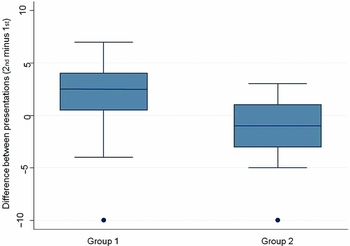
Absolute difference was also quantified according to order of presentation (2nd presentation minus 1st presentation), irrespective of language. Boxplots are presented in Figure 2. In Group 1 (English 1st), scores were higher on the 2nd presentation (BM). In Group 2 (BM 1st), scores were higher on the 1st presentation (BM). Quantile regression indicated that group was significantly associated with absolute difference in score between versions presented 1st and 2nd (median difference = −3.0, 95% CI: −5.8 to −0.2, p = 0.038).
Difference between total MoCA scores (version presented 2nd minus version presented 1st) in Group 1 (English version 1st) and Group 2 (BM version 1st).

Score was better on the English version in only 9/40 patients, and these patients were slightly older (59.6 vs. 56.5 years) and better educated (9.6 vs. 8.1 years). In the five cases where the difference in score was 3 points or greater, the difference in education was particularly pronounced (11.0 vs. 8.1 years). In multivariate quantile regression, however, absolute difference in MoCA score between the versions was not significantly associated with age (adjusted median difference = −0.07, 95% CI: −0.17 to 0.04, p = 0.23) or education (adjusted median difference = −0.26, 95% CI: −0.85 to 0.33, p = 0.38).
The two groups did appear to differ on agreement: agreement between the two versions was greater in Group 2 (ICC = 0.88, 95% CI 0.72–0.95; CCC = 0.87, 95% CI 0.77–0.98) than Group 1 (ICC = 0.70, 95% CI 0.39–0.87; CCC = 0.69, 95% CI 0.47–0.92), indicating higher agreement when the BM version was completed first.
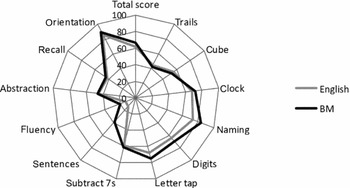
On individual items, the greatest differences between the versions were on sentence repetition (BM 39% vs. English 14%) and naming (BM 84% vs. English 73%); see Figure 3.
Percentage correct scores for individual MoCA items on the English and BM versions.

Discussion
The BM version of the MoCA exhibited strong agreement with the original English version of the MoCA (0.81) in a group of bilingual Malaysian stroke patients. This opens the way for more widespread cognitive screening after stroke in Malay-speaking populations. Future studies will also be able to establish whether this BM version of the MoCA can be applied in other populations, such as those with Alzheimer's disease or traumatic brain injury.
In our cohort, scores were slightly higher on the BM version than the English version, irrespective of which version was completed first. There are at least two possible explanations for this. The most plausible explanation is that the participants were not truly bilingual, and had a preference for BM over English. The first line of evidence for this is that the greatest differences between the BM and English versions were found on sentence repetition and naming, items that are both heavily language-based. This is consistent with the finding that non-native speakers perform worse on language-mediated neuropsychological tasks than native speakers (Kisser et al., Reference Kisser, Wendell, Spencer and Waldstein2012). The second line of evidence is that agreement was greater in Group 2 (BM first), consistent with the notion that initial presentation of the BM version primed better performance on the subsequent English version, bringing performance closer together. An alternative explanation is that our translation to BM made the items easier, reducing cognitive demand. This explanation, however, is unlikely to account for the difference between the two versions. Translation of the sentences for repetition resulted in an increased phonological load in the BM version due to a greater number of syllables, if anything increasing cognitive demand. Superior performance on the naming task in the BM version certainly cannot be attributed to the effects of translation, as there was no translation for this item.
While not the focus of this study, we were interested in whether age or education level would predict which language version was preferred. Our working hypothesis was that participants who were older and better educated would have had greater exposure to English language instruction, and score better on the English language version than the BM version. Of the 40 participants, there were only nine for whom the difference in MoCA score favored the English version. These nine participants were slightly older (59.6 vs. 56.5 years) and better educated (9.6 vs. 8.1 years), but neither age nor education emerged as a significant factor in regression.
Incidence of stroke in developing economies is increasing and is projected to continue to increase in coming decades (Feigin and Krishnamurthi, Reference Feigin and Krishnamurthi2011). As healthcare in these regions improves, the net effect will be increased numbers of stroke survivors. There is evidence that increased survival among stroke patients has resulted in increased incidence of vascular cognitive impairment in this population (Ukraintseva et al., Reference Ukraintseva, Sloan, Arbeev and Yashin2006). As a developing economy, Malaysia will have to deal with the consequences of improved survival among stroke patients. More physicians in Malaysia are now aware of the potential for cognitive impairment in stroke survivors but two problems hinder proper identification of these individuals. The first problem, not confined to Malaysia, is that there is a paucity of suitable screening tools. An exception is the MoCA, which has been shown to be a useful tool in the assessment of vascular cognitive impairment and has the advantage of being easily administered (taking approximately ten minutes to complete). While the MoCA may not be clearly superior to the MMSE in terms of predictive validity (Godefroy et al., Reference Godefroy2011; Cumming et al., Reference Cumming, Churilov, Linden and Bernhardt2013), it does include assessment of more cognitive domains and is less prone to a ceiling effect (Pendlebury et al., Reference Pendlebury, Mariz, Bull, Mehta and Rothwell2012). In a Malaysian context, one group has suggested that their ability to determine the prevalence of cognitive impairment among inpatients may have been improved if the MoCA had been used as a screening tool instead of the MMSE (Razali et al., Reference Razali2012). The second problem is the lack of validated translations of existing cognitive screening tools into BM. A search of current medical literature revealed that of the major cognitive screening or diagnostic tools, only the MMSE has a version in BM that has been validated (Ibrahim et al., Reference Ibrahim2009). To date, there are no published studies reporting validation of a BM version of the MoCA.
The current study did have several shortcomings. As we have mentioned, it is unlikely that the patients in the study sample possessed equal linguistic ability in English and BM. The penetrance of English usage in Malaysia has seen a marked reduction over the last two decades. In these circumstances, we cannot be certain whether any lack of agreement is due to relative language competency or to aspects of the test translation. Further validation of our BM MoCA version will require direct comparison with a BM-based criterion standard classification of cognitive impairment, derived from a neuropsychological battery. A preference for BM over English, while somewhat problematic for interpretation, does reinforce the need for validated translations of tools like the MoCA. It should be noted that our cohort was entirely made up of stroke survivors, and generalizability of our findings may be limited to this group.
We conclude that this BM version of the MoCA is a valid screen for post-stroke cognitive impairment, and can be used in the very large group of Bahasa Malaysia speakers who experience stroke. Further research will be required to establish the validity of the BM MoCA in other populations, and to build up a database of normative values.
Conflict of interest
None.
Description of authors’ roles
R. Sahathevan helped design the study, assisted with the translation, and helped write the paper. K. Mohd Ali and N. Mohd Ibrahim co-ordinated the study in Malaysia and supervised data collection. F. Ellery helped to set up the logistics of the study and had input into the content of the BM MoCA. N. Farhanis Mohamad and N. Hamdan collected the data. L. Churilov was responsible for statistical design and assisted with analysis. T. Cumming helped design the study, analyze the data, and write the paper.
Acknowledgments
The Florey Institute of Neuroscience and Mental Health acknowledges the strong support from the Victorian Government and in particular the funding from the Operational Infrastructure Support Grant.