Introduction
The cosmopolitan crustose genus Porpidia Körb. (Lecideaceae) is estimated to comprise c. 50 saxicolous species (Ruprecht et al. Reference Ruprecht, Søchting and Türk2016, Reference Ruprecht, Fernandez-Mendoza, Turk and Fryday2020; Zhao et al. Reference Zhao, Zhang, Miao and Zhao2016; Elix & McCarthy Reference Elix and McCarthy2018; Kondratyuk et al. Reference Kondratyuk, Halda, Lökös, Yamamoto, Popova and Hur2019; Spribille et al. Reference Spribille, Fryday, Pérez-Ortega, Svensson, Tønsberg, Ekman, Holien, Resl, Schneider and Stabentheiner2020; Fayyaz et al. Reference Fayyaz, Afshan, Niazi, Khalid and Orange2022). It is characterized by crustose, thick to inconspicuous, grey, white or occasionally orange thalli, dark brown to black lecideine apothecia, thick hymenia, darkly pigmented hypothecia, a usually moderately to heavily pigmented exciple, Porpidia-type, 8-spored asci, and simple, colourless, ellipsoid, halonate ascospores (Rambold Reference Rambold1989; Fryday Reference Fryday2005). Based on molecular systematics and anatomical characteristics, the genus Porpidia can be divided into three main infrageneric groups: the Porpidia albocaerulescens group, the Porpidia macrocarpa group and the Porpidia speirea group (Buschbom & Mueller Reference Buschbom and Mueller2004; Fryday Reference Fryday2005).
Although the genus is one of the most studied of the segregates of Lecidea, species delimitation in Porpidia has proved to be very difficult because of the problems in recognizing species-level characteristics (Hertel Reference Hertel1975; Hertel & Knoph Reference Hertel and Knoph1984; Schwab Reference Schwab1986; Gowan Reference Gowan1989a, Reference Gowanb; Gowan & Ahti Reference Gowan and Ahti1993; Buschbom & Mueller Reference Buschbom and Mueller2004, Reference Buschbom and Mueller2006; Fryday Reference Fryday2005; Coppins & Fryday Reference Coppins and Fryday2006; Jabłońska Reference Jabłońska2009; Osyczka & Olech Reference Osyczka and Olech2011; Wang et al. Reference Wang, Zhang, Joshi, Wang and Hur2012; Li et al. Reference Li, Feng and Xie2013; Fryday & Hertel Reference Fryday and Hertel2014; Hu et al. Reference Hu, Zhao, Sun, Zhao and Zhang2014; Lendemer & Harris Reference Lendemer and Harris2014; Orange Reference Orange2014; Zhang et al. Reference Zhang, Zhao and Hu2015; Ruprecht et al. Reference Ruprecht, Søchting and Türk2016; Zhao et al. Reference Zhao, Zhang, Miao and Zhao2016; Elix & McCarthy Reference Elix and McCarthy2018; Kondratyuk et al. Reference Kondratyuk, Halda, Lökös, Yamamoto, Popova and Hur2019; Spribille et al. Reference Spribille, Fryday, Pérez-Ortega, Svensson, Tønsberg, Ekman, Holien, Resl, Schneider and Stabentheiner2020; Fayyaz et al. Reference Fayyaz, Afshan, Niazi, Khalid and Orange2022). In recent years, molecular studies of the genus have greatly enhanced our understanding of the infrageneric relationships, but there are also many unidentified collections that probably represent undescribed taxa.
During our research into Porpidia in China, we identified one new species (P. crystallina Q. J. Zuo & Lu L. Zhang) and three species that have not previously been reported from China (P. umbonifera (Müll. Arg.) Rambold, P. seakensis Fryday and P. cf. contraponenda). All four species are described below, and a phylogenetic analysis based on the internal transcribed spacer region of the ribosomal DNA (nrITS) supports the placement of P. crystallina in Porpidia and its status as a new taxon within that genus. A key to all known Chinese Porpidia species is also provided.
Materials and Methods
Morphology and anatomy
The specimens studied are preserved in SDNU (Lichen Section of the Botanical Herbarium, Shandong Normal University) and KUN (Kunming Institute of Botany, Chinese Academy of Sciences). Morphological and anatomical characters were examined under a stereomicroscope (COIC XTL7045B2) and a polarizing microscope (Olympus CX41).
Spot tests were carried out on the thallus and medulla with K (a 10% aqueous solution of potassium hydroxide), C (a saturated solution of aqueous sodium hypochlorite), I (Lugol's iodine), N (a 50% aqueous solution of nitric acid) and P (a saturated solution of p-phenylenediamine in 95% ethyl alcohol). Lichen substances were identified using standardized thin-layer chromatography techniques (TLC) with systems A, C and G (Orange et al. Reference Orange, James and White2010). Nomenclature of apothecial pigments follows Meyer & Printzen (Reference Meyer and Printzen2000).
A minimum of 20 measurements from material mounted in water were made for each diagnostic feature from these samples. The dimensions of ascospores and the ascospore length/width ratio are presented as (minimum) mean ± SD (maximum); n = the number of measurements. Images were captured using a dissecting microscope (Olympus SZX16) and a compound light microscope (Olympus BX61), with a DP72 camera system. High-resolution images of type specimens were obtained from the Global Plants website (https://plants.jstor.org/).
DNA extraction, PCR amplification and sequencing
DNA was extracted from recently collected or frozen specimens. The Sigma-Aldrich REDExtract-N-Amp Plant PCR Kit (St Louis, Missouri, USA) was used to isolate DNA, following the manufacturer's instructions, except only 30 μl of extraction buffer and 30 μl dilution buffer were used. The internal transcribed spacer region of the ribosomal DNA (nrITS) was amplified using the primers ITS1F (Gardes & Bruns Reference Gardes and Bruns1993) and ITS4 (White et al. Reference White, Bruns, Lee, Taylor, Innis, Gelfand, Sninsky and White1990).
The 50 μl PCR mixture consisted of 2 μl DNA, 2 μl of each primer, 25 μl 2× Taq PCR MasterMix (Taq DNA Polymerase [0.1 unit], 3 mM MgCl2, 100 mM KCl, 0.5 mM dNTPs and 20 mM Tris-HCl [pH 8.3]) (Tiangen, Beijing, China) and 19 μl dd H2O. Conditions for PCR of nrITS were set for an initial denaturation at 94 °C for 10 min, followed by 34 cycles of denaturation at 95 °C for 45 s, annealing at 50 °C for 45 s, extension at 72 °C for 90 s, and a final extension at 72 °C for 10 min. Sequencing was performed by BioSune Biological Technology (Shanghai).
Sequence alignment and phylogenetic analysis
A BLAST search was carried out to identify similar sequences in GenBank. The raw sequences were assembled and edited using SeqMan v. 7.0 (DNASTAR packages). Sequences extracted from new material were aligned with the additional sequence data from GenBank, using MEGA v. 7.0 and an online version of MAFFT v. 7.0.26. The algorithm of MAFFT chose Auto (FFT-NS-1, FFT-NS-2, FFT-NS-i or L-INS-i; depending on data size). Farnoldia jurana was chosen as outgroup based on previous phylogenetic analyses (Ruprecht et al. Reference Ruprecht, Søchting and Türk2016).
Phylogenetic relationships were inferred using Bayesian inference (BI) and maximum likelihood (ML). ML and BI were performed using the CIPRES Science Gateway (http://www.phylo.org/portal2/) (Miller et al. Reference Miller, Pfeiffer and Schwartz2010). ML analyses were performed with RaxML-HPC v. 8.2.6 (Stamatakis Reference Stamatakis2014), using the default parameters as implemented on CIPRES, and support values were based on 1000 non-parametric bootstrap pseudoreplicates. For the Bayesian analysis, the best substitution models were estimated using jModelTest v. 2.1.7 (Darriba et al. Reference Darriba, Taboada, Doallo and Posada2012). Based on the results, we used the GTR + I + G model for nrITS. Four Markov chains were run with 2 million generations for this dataset. Trees were sampled every 100 generations, with the first 25% of trees discarded as burn-in. Stationarity of analysis was determined by examining the standard deviation of split frequencies (< 0.01). Bootstrap support (BS) ≥ 70% and posterior probabilities (PP) ≥ 0.9 were considered significant supporting values. The phylogenetic trees generated were visualized with FigTree v. 1.4.2 (Rambaut Reference Rambaut2012).
Results and Discussion
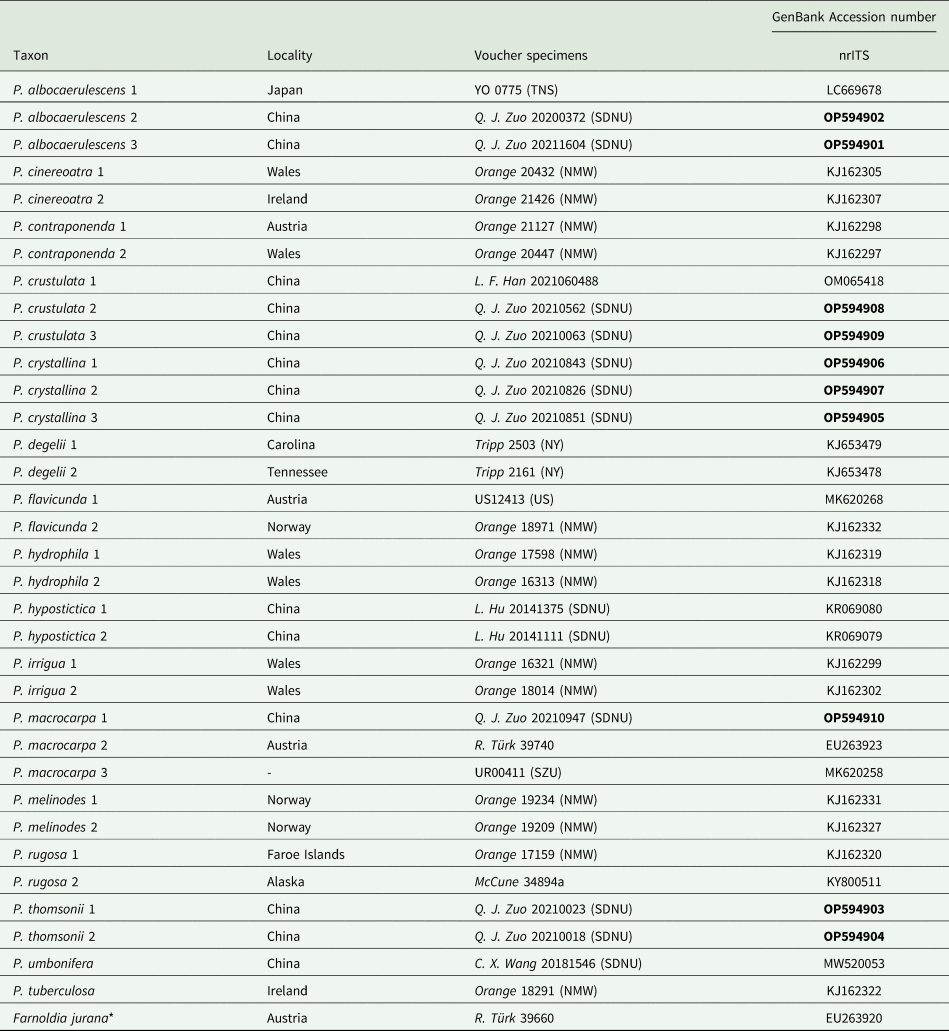
A total of 10 sequences of nrITS were newly generated from 10 specimens, and 25 sequences were downloaded from GenBank (Table 1). The aligned ITS1-5.8S-ITS2 region comprised 640 sites.
Voucher information and GenBank Accession numbers of Porpidia specimens used in the phylogenetic analyses in this study. Newly generated sequences are in bold. * = outgroup.

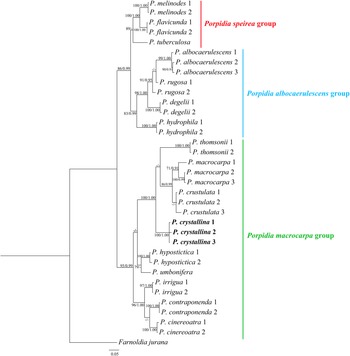
The phylogenetic trees obtained from maximum likelihood (ML) and Bayesian inference (BI) analysis exhibited the same topology; we therefore present only the ML tree, with BS ≥ 70% for the ML analysis and PP ≥ 0.9 for the Bayesian analysis (Figure 1).
Phylogenetic tree constructed from a maximum likelihood (ML) analysis of species in the genus Porpidia, based on the nrITS dataset. Bootstrap support (BS) ≥ 70 for ML and posterior probabilities (PP) ≥ 0.9 for Bayesian methods are indicated above or below the branches (BS/PP). ‘-/-’ indicates low support. The newly described species is marked in bold. Scale = 0.05 substitutions per site. In colour online.

Although it would be unwise to draw any phylogenetic conclusions from our single-gene phylogeny, our results are consistent with the hypothesis that there are three main groups in Porpidia: the Porpidia albocaerulescens group, the P. macrocarpa group and the P. speirea group (Buschbom & Mueller Reference Buschbom and Mueller2004; Fryday Reference Fryday2005). Through evolutionary distance and support, it is not difficult to see that the new species belongs to Porpidia and exists on the branch of the P. macrocarpa group. The new species P. crystallina, described and discussed below, is supported (BS = 100, PP = 1.00) as sister to P. macrocarpa, P. crustulata and P. thomsonii.
Taxonomy
Porpidia crystallina Q. J. Zuo & Lu L. Zhang sp. nov.
MycoBank No.: MB 845976
The species is characterized by having a macrocarpa-type exciple containing crystals, a Cinereorufa-green epihymenium, large ascospores ((16–)18.8 ± 1.6(–22) × (7–)8.6 ± 0.9(–10) μm) and a thallus lacking secondary metabolites.
Type: China, Sichuan Province, Huili Co., Mt Longzhou, 26°47ʹ22.89ʺN, 102°12ʹ18.58ʺE, 3548 m alt., on rock, 23 April 2021, Q. J. Zuo 20210851 (SDNU—holotype).
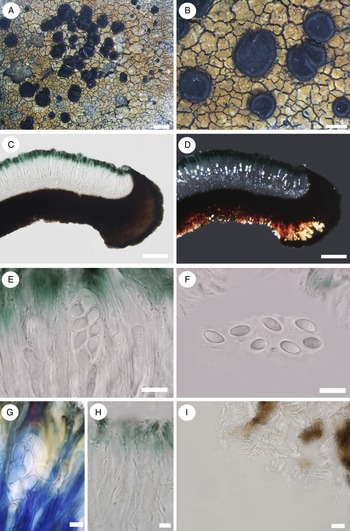
(Fig. 2)
Porpidia crystallina (holotype! Q. J. Zuo 20210851, SDNU). A, thallus. B, apothecia. C, apothecium section. D, crystals. E, ascus. F, ascospores. G, amyloid reaction of ascus. H, paraphyses. I, conidia. Scales: A = 1 mm; B = 200 μm; C & D = 100 μm; E & F = 20 μm; G–I = 10 μm. In colour online.

Thallus crustose, epilithic, continuous to irregularly rimose, sometimes areolate, thin to moderately thick, grey-white to pale greyish orange-yellow, with crystals in the medulla, surface wrinkled, occasionally shallowly papillate, margin usually distinct; prothallus sometimes present, especially between contiguous thalli, thin, black; medulla I−; soredia and isidia absent; photobiont with globose green cells, 9–14 μm.
Apothecia scattered or clustered in small groups, sessile, 0.5–0.7 mm diam., round to irregular; disc black, shallowly concave, margin 0.1–0.17 mm wide, occasionally weakly pruinose; pruina whitish. Exciple with brown pigment, at margin with dense pigment which is dark green to blackish, dilute to moderately dense within, 85–100(–125) μm wide, containing crystals partly dissolving in K, hyphae 3–5(–6) μm wide; hymenium hyaline, (80–)90–100–125 μm tall; paraphyses richly anastomosing and branched in upper part, conglutinate; epihymenium aeruginose (Cinereorufa-green); subhymenium 25–35 μm tall, colourless; hypothecium brown to dark brown, without crystals. Asci clavate, 8-spored, Porpidia-type; ascospores simple, colourless, ellipsoid, halonate, (16–)18.8 ± 1.6(–22) × (7–)8.6 ± 0.9(–10) μm, length/width ratio (1.8–)2.2 ± 0.3(–2.6); n = 24.
Conidiomata usually present, sometimes frequent, black, immersed or slightly raised, orbicular to somewhat elongate, with raised and white margin; conidia simple, colourless, bacilliform, 7–11 × 0.8–1.2 μm.
Chemistry
Spot test: cortex and medulla K−, C−, KC−. TLC: no substance detected.
Etymology
The specific epithet refers to the crystals in the exciple and thallus.
Ecology and distribution
The species is found in southern China; on siliceous rocks (HCl−), exposed, in an upland region.
Notes
The new species, characterized by its exciple with a dark cortex and paler medulla, thick excipular hyphae (3–5(–6) μm wide) and lack of secondary metabolites, clearly belongs to the Porpidia macrocarpa group. This is consistent with the results of our phylogenetic analysis. It can be separated from other species of the macrocarpa-group by the Cinereorufa-green epihymenium, and the thallus and exciple containing crystals. Porpidia hydrophila (Fr.) Hertel & A. J. Schwab also has a Cinereorufa-green epihymenium and lacks secondary metabolites but the exciple of that species has a hyaline medulla with thinner hyphae, placing it in the P. albocaerulescens group. In addition, P. hydrophila lacks crystals in the exciple medulla and thallus, and occurs on damp rocks. In our phylogenetic tree, Porpidia crystallina clustered into a different monophyletic clade to other species, demonstrating that it is a distinct species. We also conducted a comprehensive comparative analysis of the main morphological characters of the species that have been reported in China that have a Cinereorufa-green epihymenium and no substances found by TLC (Table 2) in the thallus. Through the course of our research, we collected multiple specimens of the new species. These specimens vary greatly in colour and thickness of the thallus but are similar in anatomical characters, belong to the same branch in the phylogenetic analyses and have a relatively close evolutionary distance with high support (BS = 100, PP = 1.00) in our phylogenetic analysis. However, there are also differences in morphology and the location of the crystals is slightly different between specimens collected in the same place. We suggest that this may be caused by differences in the growing environment, such as aspect and composition of rocks.
Comparison of the morphological characters of Porpidia species in China that have a Cinereorufa-green epihymenium and no substances found by thin-layer chromatography (TLC) in the thallus (P. crystallina, P. hydrophila, P. shangrila) (Fryday Reference Fryday2005; Wang et al. Reference Wang, Zhang, Joshi, Wang and Hur2012).

Additional specimens examined
China: Sichuan Province: Huili Co., Mt Longzhou, 26°47ʹ22.89ʺN, 102°12ʹ18.58ʺE, 3548 m alt., on rock, 2021, Q. J. Zuo et al. 20210843, 20210826 (SDNU).
Porpidia seakensis Fryday
Lichenologist 52, 116 (2020).
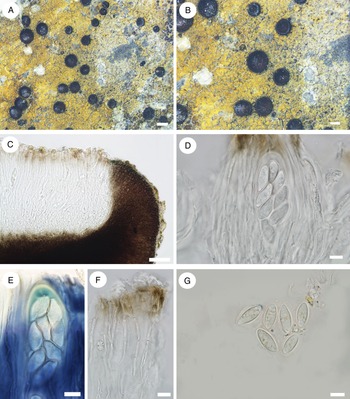
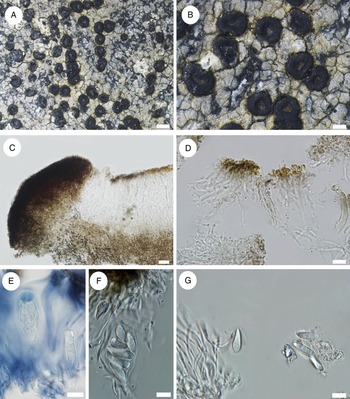
(Fig. 3)
Porpidia seakensis (L. S. Wang & X. Y. Wang 15-49296, KUN). A, thallus. B, apothecia. C, apothecium section. D, ascus. E, amyloid reaction of ascus. F, paraphyses. G, ascospores. Scales: A = 1 mm; B = 500 μm C = 40 μm; D–G = 10 μm. In colour online.

Thallus crustose, pale rusty yellowish to greyish white, epilithic to mostly endolithic, usually thin; prothallus absent; soredia absent; medulla I−.
Apothecia scattered, broadly sessile, 0.5–0.9(–1.1) mm diam. when mature; disc red-brown to brownish black, plane to shallowly concave, margin moderately thick, 0.06–0.08 mm wide, rarely very weakly pruinose; pruina whitish. Exciple dark brown to brownish black at exciple cortex, pale brown to red-brown within, 67.5–92.5 μm wide, without crystals, composed of radiating hyphae (4–)5–6–7(–8) μm wide; hymenium hyaline, 87.5–100–125 μm tall, I+ blue; paraphyses strongly branched and anastomosing, slightly enlarged at the apical part; epihymenium dilute brown, (12.5–)17.5–22.5 μm thick; subhymenium 20–32.5 μm thick; hypothecium brown to dark brown. Asci clavate, 8-spored, Porpidia-type; ascospores simple, colourless, ellipsoid, halonate, (17–)20.8 ± 2.8(–25) × (7–)9.3 ± 1.3(–11) μm, length/width ratio (1.8–)2.2 ± 0.2(–2.5); n = 18.
Conidiomata not observed.
Chemistry
Spot test: cortex and medulla K+ yellow, C−, KC−. Stictic acid was detected by TLC.
Ecology and distribution
Porpidia seakensis has previously been reported only from Alaska, USA (Spribille et al. Reference Spribille, Fryday, Pérez-Ortega, Svensson, Tønsberg, Ekman, Holien, Resl, Schneider and Stabentheiner2020) and is new to China; on siliceous rocks (HCl−), exposed, in upland regions.
Notes
Porpidia seakensis is characterized by a thin to endolithic thallus, strongly constricted apothecia with a brown pruinose disc, large ascospores and a macrocarpa-type exciple. The Chinese material closely matches the description in Spribille et al. (Reference Spribille, Fryday, Pérez-Ortega, Svensson, Tønsberg, Ekman, Holien, Resl, Schneider and Stabentheiner2020), except that the thallus is tinged with a yellowish pigment, which may be due to the extreme environment. As a member of the P. macrocarpa group, it has similar ascospores to P. superba (Körb.) Hertel & Knoph, but that species has a thallus composed of thick, bullate areoles and an orange-brown exciple (Superba-brown), and usually occurs on slightly basic rocks.
Specimen examined
China: Taiwan Province: Nantou Co., Mt Hehuanshan, Wuling, 24°08.365ʹN, 121°17.253ʹE, 3139 m alt., on rock, 2015, L. S. Wang & X. Y. Wang 15–49296 (KUN).
Porpidia umbonifera (Müll. Arg.) Rambold
Biblioth. Lichenol. 34, 296 (1989)
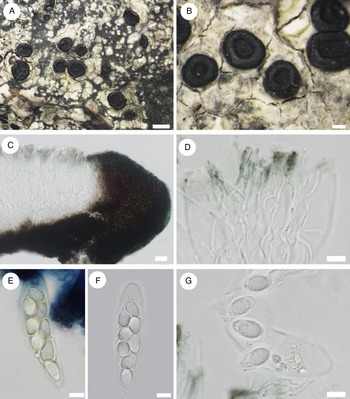
(Fig. 4)
Porpidia umbonifera (C. X. Wang et al. 20181546, SDNU). A, thallus. B, apothecia. C, apothecium section. D, paraphyses. E, amyloid reaction of ascus. F, ascus. G, ascospores. Scales: A = 500 μm; B = 200 μm; C = 20 μm; D–G = 10 μm. In colour online.

Thallus crustose, irregularly rimose to rimose-areolate, even to weakly verruculose, thin to moderately thick, areoles angular to irregularly shaped, medium grey to greyish white; prothallus between areas of the thallus, black, thin; soredia absent; medulla I+ pale violet-black.
Apothecia clustered, soon becoming sessile, 0.4–0.8 mm diam.; disc black, flat to shallowly concave, even umbonate, margin distinct, 0.07–0.1 mm wide, epruinose. Exciple at surface with dense pigment, black to carbonaceous, pale brown to red-brown within, 100–120(–130) μm wide, without crystals, hyphae 4–5–6 μm wide; hymenium (75–)85–100 μm tall, colourless, I+ blue; paraphyses strongly anastomosed and apically branched, slightly enlarged at the apex; epihymenium brown to olive-brown, 10–15 μm thick; subhymenium 15–25(–30) μm; hypothecium brown to dark brown. Asci clavate, 8-spored, Porpidia-type; ascospores simple, colourless, ellipsoid, halonate, (12–)16.5 ± 2.2(–20) × (5–)7.3 ± 1.4(–9) μm, length/width ratio (1.8–)2.2 ± 0.2(–2.8); n = 18.
Conidiomata not observed.
Chemistry
Spot test: cortex and medulla K−, C−, KC−. No substances detected by TLC.
Ecology and distribution
Porpidia umbonifera has previously been reported only from Australia (Rambold Reference Rambold1989) and is new to China; on siliceous rocks (HCl−), exposed.
Notes
According to Rambold (Reference Rambold1989), Porpidia umbonifera is characterized by sessile apothecia that are constricted at the base, an exciple with a black-brown (ectal zone) to pale brown (inner zone) pigment, no substances detected by TLC and a medulla that reacts I+ violet. The Chinese material closely matches this description except that the medulla is only I+ light violet and finally fades away. Porpidia umbonifera resembles P. speirea (Ach.) Kremp. and P. grisea Gowan in having an I+ medulla and similar ecological requirements. However, both P. grisea and P. speirea contain confluentic acid as the major substance and have a very dark exciple, even in thin sections. In addition, the thick excipular hyphae and lack of secondary metabolites of Porpidia umbonifera indicate that it belongs to the P. macrocarpa group, whereas P. grisea and P. speirea belong to the P. speirea group.
Specimens examined
China: Yunnan Province: Shangri-La County, Mt Hongshan, 28°07ʹ55.99ʺN, 99°54ʹ06.68ʺE, 4361.9 m alt., on rock, 2018, C. X. Wang et al. 20181546 (SDNU); 28°07ʹ54.66ʺN, 99°54ʹ09.08ʺE, 4459.4 m alt., on rock, 2018, C. X. Wang et al. 20181672 (SDNU); 28°07ʹ55.66ʺN, 99°54ʹ13.58ʺE, 4503.1 m alt., on rock, 2018, C. X. Wang et al. 20181734 (SDNU).
Porpidia cf. contraponenda
(Fig. 5)
Porpidia cf. contraponenda (Q. J. Zuo et al. 20210986, SDNU). A, thallus. B, apothecia. C, apothecium section. D, paraphyses. E, amyloid reaction of ascus. F, ascus. G, ascospores. Scales: A = 500 μm; B = 100 μm; C = 20 μm; D–G = 10 μm. In colour online.

Thallus crustose, continuous to irregularly rimose, pale cream-white to greyish white, occasionally tinged rusty orange, surface occasionally shallowly papillate, thick, tartareous, margin thinner than thallus centre; prothallus between areoles, black, thin; soredia absent; medulla I−.
Apothecia clustered, half-immersed when young, occasionally more or less sessile or remaining sunken when mature, (0.3–)0.5–1 mm diam.; disc shallowly concave at first then flat to subconvex, black or less commonly dark brown, margin smooth, moderately thick to thin, usually thinning in old or convex apothecia, 0.07–0.11 mm, epruinose or rarely very weakly pruinose; pruina greyish white. Exciple at surface with dense pigment that is dark bluish green to olive-brown, moderately to heavily dark brown within, (65–)80–90–110(–125) μm wide, without crystals, hyphae 3.5–4.5 μm wide; hymenium (75–)85–97.5–110 μm tall, colourless, I+ blue; paraphyses richly anastomosing and branched in upper section, conglutinate; epihymenium dull olive green to dull greenish brown, without crystals; subhymenium 12.5–20 μm; hypothecium brown to reddish brown, pale aeruginose pigment occasionally present in medullary region around apothecial base. Asci clavate, 8-spored, Porpidia-type; ascospores simple, colourless, ellipsoid, halonate, (15–)17.6 ± 1.7(–21) × (7–)8.9 ± 1.5(–11.5) μm, length/width ratio (1.6–)2.1 ± 0.3(–2.5); n = 18.
Conidiomata not observed.
Chemistry
Spot test: cortex and medulla K−, C−, KC−. Methyl 2ʹ-O-methylmicrophyllinate and 2ʹ-O-methylmicrophyllinic acid (trace) were detected by TLC.
Ecology and distribution
Porpidia contraponenda has been reported from North America and Europe (Hertel & Knoph Reference Hertel and Knoph1984; Fryday Reference Fryday2005; Orange Reference Orange2014), and is new to China; on siliceous rocks (HCl−), exposed, in upland regions.
Notes
Porpidia contraponenda is characterized by having an epilithic thallus, apothecia at least partly sunken in the thallus, an olive green to dull greenish brown epihymenium, and a thallus containing a second unidentified depside as a major compound in addition to methyl 2ʹ-O-methylmicrophyllinate. The specimens found in China are very similar to those described previously in the literature (Gowan Reference Gowan1989a; Fryday Reference Fryday2005; Orange Reference Orange2014), but they have a shorter hymenium (75–110 μm vs 100–170 μm high) and methyl 2ʹ-O-methylmicrophyllinate as the only major constituent. Through standardized thin-layer chromatography techniques (with systems A, C and G), we did not find a second unidentified depside as a major compound, as described by Orange (Reference Orange2014), only methyl 2ʹ-O-methylmicrophyllinate. These specimens are also similar to Porpidia irrigua Orange in secondary metabolite content, but the latter has apothecia which are sessile from a very early stage and wider hyphae in the exciple (3.5–8.0(–12) μm). Our specimens might represent a new species, but we do not have enough material and molecular data to support this. Therefore, they are identified here as Porpidia cf. contraponenda and further research will be carried out in the future.
Specimens examined
China: Taiwan Province: Nantou Co., Mt Hehuanshan, Wuling, 24°08.182ʹN, 121°17.366ʹE, 3174 m alt., on rock, 2015, L. S. Wang & X. Y. Wang 15-49210 (KUN). Sichuan Province: Puge Co., Mt Luoji, Dahaizi, 27°34ʹ44.07ʺN, 102°22ʹ28.52ʺE, 3554 m alt., on rock, 2021, Q. J. Zuo et al. 20210986 (SDNU).
Key to the species of Porpidia occurring in China
1 Thallus subsquamulose, brownish yellow, lacking secondary products; epihymenium blue-green (Cinereorufa-green) P. squamosa
Thallus crustose; thallus upper surface, chemistry and epihymenium colour various 2
2(1) Thallus with soredia; apothecia present or absent 3
Thallus without soredia; apothecia present 4
3(2) Medulla I+ blue, confluentic acid present P. tuberculosa
Medulla I−, stictic acid present P. soredizoides
4(2) Exciple of apothecia in section with ±hyaline medulla, usually composed of thin filamentous hyphae 2–4 μm wide (albocaerulescens-type) 5
Exciple of apothecia with pigmented medulla, usually composed of thicker pseudoparenchymatous hyphae 3–8 μm wide; if hyphae thinner then medulla pigmented 9
5(4) Epihymenium vivid aeruginose (Cinereorufa-green) P. hydrophila
Epihymenium brown or olivaceous (Macrocarpa-green) 6
6(5) 2ʹ-O-methylperlatolic acid and confluentic acid present; apothecia epruinose; hypothecium K+ red P. chungii
2ʹ-O-methylsuperphyllinic acid, stictic acid, or norstictic acid present; apothecia often pruinose 7
7(6) 2ʹ-O-methylsuperphyllinic acid present P. carlottiana
2ʹ-O-methylsuperphyllinic acid absent, stictic acid (K+ yellow, Pd+ orange) or norstictic acid (K+ red) present 8
8(7) Thallus and apothecium exciple containing stictic acid (K+ yellow); apothecia usually innate, and often heavily pruinose P. albocaerulescens var. albocaerulescens
Thallus and apothecium exciple containing norstictic acid (K+ red); apothecia usually innate, and often slightly pruinose P. albocaerulescens var. polycarpiza
9(4) Medulla I+ blue 10
Medulla I− 12
10(9) No substances detected by TLC P. umbonifera
Confluentic acid present 11
11(10) On ±basic rocks; thallus white; apothecia innate P. speirea
On siliceous rocks; thallus grey; apothecia usually sessile P. grisea
12(9) Thallus orange, orange-brown or yellowish brown, usually containing confluentic acid P. flavicunda
Thallus grey or endolithic, sometimes partly oxidized, chemistry various 13
13(12) Epihymenium and exciple with only orange-brown pigment (Superba-brown); thallus white, usually bullate, but occasionally smoother; usually on basic rocks; ascospores usually > 20 μm long P. superba
Epihymenium and/or exciple cortex with olivaceous (Macrocarpa-green), dark bluish green (Cinereorufa-green) or brown (Arnoldiana-brown) pigments (N+ reddish) 14
14(13) On basic rocks; thallus endolithic; epihymenium dark bluish green (Cinereorufa-green, K−, N+ rose pink), containing traces of norstictic acid P. shangrila
On siliceous rocks 15
15(14) Exciple dark, with paler medulla apparent only in thin section; thallus epilithic, containing confluentic acid, methyl 2ʹ-O-methylmicrophyllinate or unidentified triterpenes 16
Exciple not uniformly dark in section; thallus often endolithic, containing stictic acid, norstictic acid, or no substances (K+ red or yellow or K−) 18
16(15) Apothecia usually innate, becoming convex, with thin (c. 0.05 mm) barely raised margin; thallus thick, cracked-areolate, usually continuous, containing confluentic acid (K+ numerous ‘oil droplets’ in section) P. cinereoatra
Apothecia sessile with thick (c. 0.1 mm) raised, persistent margin; thallus thinner, often composed of ±dispersed areoles, containing methyl 2ʹ-O-methylmicrophyllinate or confluentic acid 17
17(16) Thallus containing confluentic acid (K+ numerous ‘oil droplets’ in section); apothecia often pruinose P. lowiana
Thallus containing methyl 2ʹ-O-methylmicrophyllinate (K−); apothecia epruinose or rarely pruinose P. cf. contraponenda
18(15) Proper margin thin and barely raised, < 0.08 mm wide; thallus thin, usually containing stictic acid (K+ yellow, Pd+ orange) 19
Proper margin thick and raised, > 0.1 mm wide 21
19(18) Epihymenium dilute brown, hymenium 90–125 μm high; ascospores 17–25 μm long P. seakensis
Epihymenium light to dark brown to olive-brown, or olive-ochre, hymenium 60–90 μm high; ascospores 12–16(–19) μm long 20
20(19) Hypothecium brown to dark brown, K+ yellow or K− P. crustulata
Hypothecium light brown to medium brown, K+ carmine-violet P. cervinopungens
21(18) Hypostictic acid present; thallus white to grey-white, with yellow, oxidized patches near the margin; apothecia sessile, up to 2–3 mm diam.; ascospores 17.5–25.0 μm longP. hypostictica
Hypostictic acid absent 22
22(21) Thallus grey-white to pale greyish orange-yellow; epihymenium aeruginose, exciple with crystals, no substances; ascospores (16–)19(–22) μm long P. crystallina
Exciple without crystals 23
23(22) Thallus white, containing norstictic acid (K+ red), rarely with stictic acid (K+ yellow); apothecia densely pruinose; medulla of exciple very pale P. platycarpoides
Thallus grey to whitish, sometimes rust coloured, containing stictic acid or no substance present (K+ yellow or K−); apothecia not or only slightly pruinose; medulla of exciple pale brown 24
24(23) Apothecia < 1.5 mm diam. (usually < 1.1 mm), proper margin c. 0.1 mm wide; exciple composed of swollen elongate cells 5–8(–10) μm wide P. thomsonii
Apothecia up to 3.0 mm diam., margin up to 0.2 mm wide; exciple composed of cells 4–6(–8) μm wide 25
25(24) Exciple reacting K+ crimson P. macrocarpa f. nigrocruenta
Exciple not reacting K+ crimson P. macrocarpa f. macrocarpa
Acknowledgements
We are grateful to Dr Majda Valjavec-Gratian for help with uploading genetic data. We also thank Dr. Li-Song Wang and Dr. Xin-Yu Wang (Kunming Institute of Botany, China Academy of Sciences) for help with sending specimens. This study was supported by the Emergency Management Project of the National Natural Science Foundation of China (32170002, 31750001).
Author ORCIDs
Qi-Jia Zuo, 0000-0001-8910-1809; Lei Wang, 0000-0001-9111-5206; Lu-Lu Zhang, 0000-0001-8011-4451.
Competing Interests
The authors declare none.