Implications
Research has indicated that a low intake of long chain n-3 and a possible imbalance between the n-6 : n-3 polyunsaturated fatty acids ratio in human diets increases chronic disease risk. The current study examined the potential to enhance milk n-3 content by replacing a commercially available fat supplement in the diet with extruded linseeds in Jersey and Holstein cows. The implications of this study are important, highlighting the requirement for more detailed research into the effects of oilseeds on nutrient metabolism in the lactating cow, and emphasizing the importance of diet–genotype interactions on milk fatty acid composition responses to lipid in the diet.
Introduction
Clinical and biomedical studies indicate that low intakes of long chain n-3 polyunsaturated fatty acids (PUFA) in human diets are associated with increased chronic disease risk (Scientific Advisory Committee on Nutrition and Committee on Toxicity, 2004). Within many parts of the European Union (EU), dietary intake of long-chain n-3 PUFA is sub-optimal (Givens and Gibbs, Reference Givens and Gibbs2008). Due to the relatively high contribution of milk and dairy products to total fat consumption in typical Western diets (Hulshof et al., Reference Hulshof, van Erp-Baart, Anttolainen, Becker, Church, Couet, Hermann-Kunz, Kesteloot, Leth, Martins, Moreiras, Moschandreas, Pizzoferato, Rimestad, Thorgeirsdottir, van Amelsvoort, Aro, Kafatos, Lanzmann-Petitory and van Poppel1999), enriching the n-3 content of milk represents a nutritional strategy to enhance the n-3 fatty acid status of human populations. However, the transfer efficiency of n-3 fatty acids from the diet into milk in lactating cows is relatively low due to extensive rumen biohydrogenation, and preferential incorporation of n-3 fatty acids into plasma lipid fractions that are poor substrates for mammary lipoprotein lipase (Givens and Shingfield, Reference Givens and Shingfield2006; Chilliard et al., Reference Chilliard, Glasser, Ferlay, Bernard, Rouel and Doreau2007).
Despite the relatively low efficiency of conversion in human tissues (Burdge and Calder, Reference Burdge and Calder2005), enhancing milk fat 18:3n-3 content to increase substrate supply for endogenous 20:5n-3 and 22:6n-3 synthesis is a means of improving long chain n-3 PUFA status. Several studies have examined the potential of linseeds or linseed oil (Chilliard and Ferlay, Reference Chilliard and Ferlay2004), and more recently, extruded linseeds (Gonthier et al., Reference Gonthier, Mustafa, Ouellet, Chouinard, Berthiaume and Petit2005; Akraim et al., Reference Akraim, Nicot, Juaneda and Enjalbert2007) in the diet of lactating cows to increase milk fat 18:3n-3 concentration, with varying results. Differences in the efficacy of linseed feeds may, at least in part, reflect differences in the extent of metabolism of constituent PUFA in the rumen. Incomplete biohydrogenation of 18:3n-3 results in the formation of trans fatty acid intermediates that are incorporated into milk fat (Givens and Shingfield, Reference Givens and Shingfield2006; Chilliard et al., Reference Chilliard, Glasser, Ferlay, Bernard, Rouel and Doreau2007). Although human consumption of trans fatty acids is associated with increased cardiovascular disease risk, evidence suggests that ruminant-derived trans fatty acids in the human diet elicit rather innocuous effects at current intakes (Jakobsen et al., Reference Jakobsen, Bysted, Andersen, Heitmann, Hartkopp, Leth, Overvad and Dyerberg2006; Chardigny et al., Reference Chardigny, Destaillats, Malpuech-Brugère, Moulin, Bauman, Lock, Barbano, Mensink, Bezelgues, Chaumont, Combe, Cristiani, Joffre, German, Dionisi, Boirie and Sébédio2008).
The present experiment examined the effect of replacing calcium salts of palm oil distillate (CPO) with extruded linseeds in a grass and maize silage-based dairy cow diet on milk production and milk fatty acid composition. Furthermore, the responses of Holstein and Jersey cows (each breed exhibiting inherent differences in lipogenesis, fatty acid synthesis and mammary Δ9-desaturase activity; Beaulieu and Palmquist, Reference Beaulieu and Palmquist1995; Drackley et al., Reference Drackley, Beaulieu and Elliott2001) were examined, allowing a preliminary insight into diet–genotype interactions, and the potential to alter milk fatty acid composition beyond the realms of dietary influence alone.
Material and methods
Experimental design, animals and management
All experimental procedures used were licensed, regulated and inspected by the UK Home Office under the Animals (Scientific Procedures) Act, 1986. Six late-lactation (mean 258 days in milk) multiparous dairy cows (three Holstein-Friesian, mean live weight 677 ± 29 kg; three Jersey, mean bodyweight 427 ± 17 kg) were used in a three-period switchback design with two dietary treatments (Table 1). Experimental periods were 21 days in duration and comprised an 18-day adaptation to diets and a 3-day interval for sample collection. Cows were maintained in individual tie-stalls with rubber mattresses and bedded with wood shavings. Fresh water was available ad libitum. Cows were milked in situ at 0500 h and 1500 h.
Allocation of treatments to experimental animals according to the switchback design

‘A’ refers to the control diet containing calcium salts of palm oil distillate and ‘B’ refers to the diet containing extruded linseeds.
Experimental diets
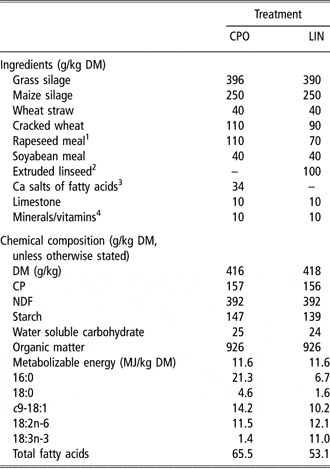
Diets were offered as total mixed rations (TMR; forage : concentrate ratio of 68 : 32 on a dry matter (DM) basis) with the forage component comprising grass silage and maize silage. Treatments consisted of a control diet containing 34 g/kg DM of CPO (Nutrilac; Banks Cargill Agriculture Ltd, Lincoln, UK) or the same basal diet with CPO being replaced with 100 g/kg DM of extruded linseed (LIN) (Valomega; Valorex®, Combourtillé, France). Diets were formulated using the Feed into Milk model (Thomas, Reference Thomas2004) to contain similar concentrations of total lipid, crude protein (CP), neutral detergent fibre (NDF), starch and metabolizable energy (Table 2). Diets were offered in restricted amounts according to live weight (30 g/kg live weight), with two-thirds of the daily ration offered at 0800 h and one-third offered at 1600 h. DM concentrations of forages and concentrates were determined daily and weekly, respectively, by drying for 18 h at 100°C, and were used to adjust ration mixes to account for changes in component DM content.
Formulation and chemical composition of experimental diets

CPO = calcium salts of palm oil-based diet; LIN = extruded linseed-based diet; DM = dry matter.
1Solvent-extracted rapeseed meal of low glucosinolate content.
2Valomega®; Valorex®, La Messayais, 35210 Combourtillé, France.
3Nutrilac, Banks Cargill Agriculture Ltd, Lincoln, UK.
4Proprietary mineral and vitamin supplement (Rockies (Red), Tithebarn Ltd, Cheshire, UK) declared as containing 380 g/kg sodium, and (mg/kg) magnesium (5000), iron (1500), cobalt (50), copper (300), iodine (150), manganese (200), zinc (300) and selenium (10).
Experimental measurements, sample collection and chemical analysis
Individual animal intakes were recorded daily. Samples of fresh TMR, subsamples of TMR components and refused feeds were collected daily during each sampling week, and pooled to provide weekly composite samples. Composite feed samples were stored at −18°C until submitted for chemical composition determinations. Oven dried (60°C), milled (1 mm screen) samples of forages and concentrates were analysed for NDF, organic matter, CP, water soluble carbohydrates, ether extract, starch, metabolizable energy and fatty acid concentrations according to reference procedures, as outlined elsewhere (Kliem et al., Reference Kliem, Morgan, Humphries, Shingfield and Givens2008).
Milk yields were recorded twice daily for individual animals throughout the experiment. Milk samples (3% of the yield) for the measurement of fat, CP and lactose were collected from each cow over six consecutive milkings between days 19 and 21 of each period. Milk fat, CP and lactose were determined in samples treated with potassium dichromate preservative (1 mg/ml, Lactabs; Thomson and Capper, Runcorn, UK) by infrared spectroscopy (Foss Electric Ltd, York, UK). Additional samples of unpreserved milk were collected during the last 24 h of each experimental period, stored at −20°C until composited according to milk yield and submitted for fatty acid analysis.
Lipid in 1 ml milk and appropriate sample weights of forage, concentrate and lipid supplements were extracted and transesterified to fatty acid methyl esters (FAME; Kliem et al., Reference Kliem, Morgan, Humphries, Shingfield and Givens2008). The distribution of conjugated linoleic acid (CLA) isomers in milk FAME was determined by HPLC using four silver impregnated silica columns (ChromSpher 5 Lipids, 250 × 4.6 mm, 5 μm particle size; Varian Ltd, Oxford, UK) coupled in series using 0.1% (v/v) of acetonitrile in heptane as the mobile phase (Shingfield et al., Reference Shingfield, Ahvenjärvi, Toivonen, Ärölä, Nurmela, Huhtanen and Griinari2003 and Reference Shingfield, Reynolds, Lupoli, Toivonen, Yurawecz, Delmonte, Griinari, Grandison and Beever2005). Isomers were identified using an authentic CLA methyl ester standard (O-5632; Sigma-Aldrich, YA-Kemia Limited, Helsinki, Finland) and chemically synthesized t9, c11-CLA (Shingfield et al., Reference Shingfield, Reynolds, Lupoli, Toivonen, Yurawecz, Delmonte, Griinari, Grandison and Beever2005). Identification was verified by cross-referencing with the elution order reported in the literature using c9, t11-CLA as a landmark isomer.
Milk fatty acid composition was expressed as a weight percentage of total fatty acids using response factors derived from the analysis of a butter oil reference standard (CRM 164; Community Bureau of Reference, Brussels, Belgium). Concentrations of specific conjugated isomers in CLA supplements were calculated based on proportionate peak area responses determined by HPLC and the sum of t7, c9-CLA, t8, c10-CLA and c9, t11-CLA weight percentage determined by Gas Chromatography.
Statistical analysis
Measurements of DM intake (DMI), milk yield and milk composition during days 19 to 21 were averaged and subjected to Analysis of Variance for repeated measures, within cow, using the Mixed procedure of Statistical Analysis System (2001). The statistical model included the fixed effects of diet, breed and their interaction and random effects of cow. Compound symmetry, heterogeneous compound symmetry, autoregressive order one, heterogeneous autoregressive order one and unstructured covariance structures were tested, and Akaike’s information criterion was used to select the most appropriate structure for each variable.
Results
By design, the chemical composition of experimental diets was comparable (Table 2). Extruded linseed contributed to 49% of total lipid in the LIN diet, equivalent to 30.4 g linseed oil/kg DM of diet. For the CPO diet, 16:0 predominated, reflecting the composition of the CPO supplement. The LIN diet contained almost ten times more 18:3n-3 than the CPO diet, whilst the amounts of c9-18:1 and 18:2n-6 were similar across treatments.
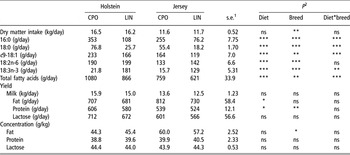
Replacing CPO with extruded linseed in the diet reduced (P < 0.001) 16:0, 18:0 and c9-18:1 intake to a greater extent for the Holstein relative to the Jersey. Increases in 18:3n-3 and total fatty acid intakes were also greater (P < 0.01) in the Holstein compared with the Jersey (Table 3). Including extruded linseed in the diet at the expense of CPO had no effect (P > 0.05) on DMI or milk fat, protein and lactose concentration, but decreased (P < 0.05) milk fat and protein yields for both breeds (Table 3). Replacing CPO with extruded linseed resulted in a numerical but non-significant reduction in milk yield. DM and 18:2n-6 intake and milk protein yield were lower (P < 0.01) for Jersey cows, but milk fat content was higher (P < 0.05). Respective intakes of linseed oil by Holstein and Jersey cows fed the LIN diet were calculated to be 492 and 356 g/day, respectively.
Effect of replacing calcium salts of palm oil distillate (CPO) with extruded linseed (LIN) in the diet on dry matter and selected fatty acid intake, milk yield and composition in Holstein and Jersey cows

1Standard error of the mean for n = 18 measurements, error degrees of freedom = 7.
2Significance: *P < 0.05, **P < 0.01 and ***P < 0.001; ns = non-significant (P > 0.05).
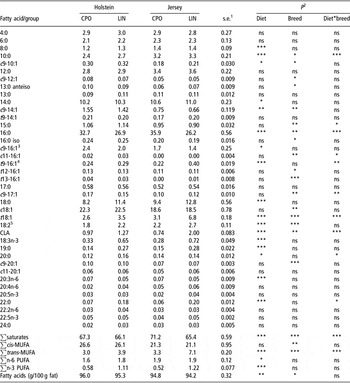
Including LIN in the diet at the expense of CPO resulted in diet by breed interactions for certain milk fatty acid concentrations – enhanced (P < 0.05) milk fat 10:0 and c11-16:1 contents were observed for the Holstein but treatment effects were not significant in the Jersey (Table 4). In contrast, the LIN diet decreased (P < 0.05) milk fat 15:0 concentrations in the Jersey but no such effects were observed for the Holstein (Table 4). Furthermore, increases in milk fat t9-16:1 concentrations observed in cows consuming the LIN diet were larger (P < 0.01) in the Jersey than the Holstein, while the decrease in 16:0 content following extruded linseed consumption was greater (P < 0.01) in the Jersey relative to the Holstein (mean responses 9.7% and 5.8%, respectively). Overall, the reduction in total saturated fatty acid concentration due to replacing CPO with LIN was significant (P < 0.05) in the Jersey but not in Holstein cows (mean reduction 5.8% v. 1.2%).
Effect of replacing calcium salts of palm oil distillate (CPO) with extruded linseed (LIN) diets on milk fatty acid composition (g/100 g fatty acids)

CLA = conjugated linoleic acid; MUFA = monounsaturated fatty acids; PUFA = polyunsaturated fatty acids.
1Standard error of the mean for n = 18 measurements, error degrees of freedom = 7.
2Significance: *P < 0.05, **P < 0.01 and ***P < 0.001; ns = non-significant (P > 0.05).
3Co-eluted with 17:0 anteiso.
4Co-eluted with 17:0 iso.
5Sum of 18:2 excluding isomers of CLA.
Breed differences were observed for several fatty acids, with milk from Holsteins containing higher (P < 0.05) concentrations of c9-10:1, c9-12:1, 13:0 anteiso, c9-14:1, 16:0 iso, and several 16:1 isomers (t12, t13) compared with the Jersey (Table 4). For both breeds, inclusion of LIN at the expense of CPO enhanced (P < 0.05) the concentration of several milk-fat short–medium chain (8:0 to 14:0) saturated fatty acids and c9-10:1 and decreased (P < 0.05) milk c9-14:1 and c9-16:1 content.
Interactions between diet and breed were significant (P < 0.001) for total t18:1, total trans-monounsaturated fatty acids (MUFA) and total CLA concentrations, with the magnitude of increase in these groups of fatty acids being larger for the Jersey than Holstein (mean responses 3.7%, 3.8% and 1.3% v. 0.9%, 0.9% and 0.3%; Table 4). Milk fat concentration of 20:0 was enhanced (P < 0.05) for Holstein cows fed the LIN diet but there was no difference between treatments for Jersey cows. For both breeds, replacing CPO with LIN increased (P < 0.001) milk fat 18:0, 18:3n-3 and 19:0 concentrations (Table 4). Intakes of 18:3n-3 derived from LIN were transferred into milk with a mean marginal efficiency of 1.8%, with evidence of a more efficient transfer in the Jersey compared with the Holstein (2.7% v. 1.0%). Relative to the CPO diet, the LIN diet tended (P = 0.086) to increase milk 20:5n-3 content and enhanced (P < 0.05) the secretion of 20:5n-3 in milk from 0.11 to 0.19 and 0.19 to 0.31 g/day in Holstein and Jersey cows, respectively. Total n-6 and n-3 PUFA concentrations were higher (P < 0.05) following the replacement of CPO with LIN, but proportionate increases in n-3 PUFA were greater, resulting in an overall reduction in the n-6 : n-3 ratio from 2.8 to 1.6 and from 3.7 to 1.6 in Holstein and Jersey cows, respectively.
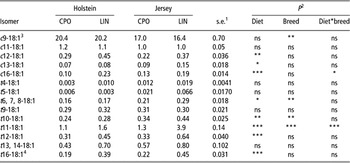
Breed by diet interactions were significant for t11-18:1 and c16-18:1, with the increases in t11-18:1 concentration following the replacement of CPO with extruded linseed being greater (P < 0.001) in the Jersey than Holstein, whilst the converse was true for the enrichment (P < 0.05) of milk c16-18:1 content (Table 5). Concentrations of c9-18:1 were higher (P < 0.01) in milk from Holstein cows than from Jersey cows, which contributed to an overall differences in total c18:1 and cis-MUFA content between breeds. Irrespective of diet, milk t6–8-18:1, t10-18:1, t11-18:1 and total trans-MUFA concentrations were lower (P < 0.01) in milk from the Holstein compared with the Jersey (Table 5). Relative to the CPO diet, the LIN diet increased (P < 0.05) milk t6–8-18:1, t10-18:1, t12-18:1 and t16-18:1 concentrations (Table 5). Replacing CPO with LIN was also associated with milk fat c12-18:1 and c13-18:1 enrichment (P < 0.05; Table 5), but total c18:1 content was independent of diet (Table 4).
Effect of replacing calcium salts of palm oil distillate (CPO) with extruded linseed (LIN) diets on milk 18:1 isomer composition (g/100 g fatty acids)

1Standard error of the mean for n = 18 measurements, error degrees of freedom = 7.
2Significance: *P < 0.05, **P < 0.01 and ***P < 0.001; ns=non-significant (P > 0.05).
3Co-eluted with c10-18:1 and t15-18:1 as minor components.
4Co-eluted with c14-18:1 as a minor component.
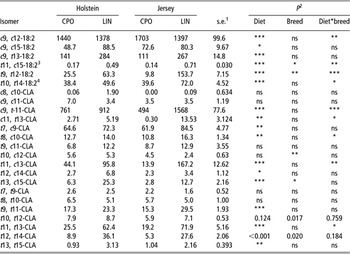
Breed by diet interactions were significant (P < 0.05) for certain CLA isomers, c9, c12-18:2, t11, c15-18:2, t9, t12-18:2 and t10, t14-18:2 concentrations (Table 6). The extent of change was greater for Jersey cows; for example, compared with CPO the LIN diet caused a significant increase (1.07%) in c9, t11-CLA content in only Jersey cows. Similarly, replacing CPO with LIN caused a reduction (P < 0.05) in c9, c12-18:2 in Jerseys but not Holsteins (mean reductions of 0.06% and 0.3%, respectively). Concentrations of total non-conjugated 18:2 isomers were higher (P < 0.01) in milk from the Jersey compared with the Holstein (Table 4). For both breeds, inclusion of LIN at the expense of CPO enhanced (P<0.05) milk fat t7, c9-CLA, t9, t11-CLA, c9, c15-18:2 and c9, t13-18:2 concentrations (Table 6).
Effects of replacing calcium salts of palm oil distillate (CPO) with extruded linseed (LIN) diets on milk 18:2 isomer composition (mg/100 g fatty acids)

CLA = conjugated linoleic acid.
1Standard error of the mean for n = 18 measurements, error degrees of freedom = 7.
2Significance: *P < 0.05, **P < 0.01 and ***P < 0.001; ns = non-significant (P > 0.05).
3Co-eluted with c9-19:1 as a minor component.
4Co-eluted with t11, t15-18:2.
Discussion
Nutrition has a major influence on milk fatty acid composition (Givens and Shingfield, Reference Givens and Shingfield2006; Chilliard et al., Reference Chilliard, Glasser, Ferlay, Bernard, Rouel and Doreau2007) and genotype is also known to be important (Soyeurt et al., Reference Soyeurt, Dardenne, Gillon, Croquet, Vanderick, Mayeres, Bertozzi and Gengler2006), with evidence of significant variations in milk fat composition within-breed (Lawless et al., Reference Lawless, Stanton, L’Escop, Devery, Dillon and Murphy1999) that may arise due to inherent differences in Δ9-desaturase activity (Kelsey et al., Reference Kelsey, Corl, Collier and Bauman2003). Several studies have shown that dietary linseed oil enhances milk n-3 PUFA content; increases that are also accompanied by increases in trans fatty acid concentrations (Loor et al., Reference Loor, Ferlay, Ollier, Doreau and Chilliard2005; Roy et al., Reference Roy, Ferlay, Shingfield and Chilliard2006). The current study examined the potential of replacing CPO in the diet with LIN to increase 18:3n-3 concentrations and minimize changes in milk trans fatty acid content in two breeds that differ with regard to mammary lipogenesis. Despite the limited number of experimental animals, comprehensive milk fatty acid analysis offered a unique insight into the importance of genotype–diet interactions for enhancing the nutritional value of milk for improved human health.
Late-lactation cows were recruited to the experiment to minimize the supply of preformed fatty acids from adipose tissue to the mammary gland. The use of late-lactation cows fed at a restricted level of intake, in addition to the formulation of iso-energetic experimental treatments may explain the lack of effect of replacing CPO with LIN on milk yield. Breed by diet interactions were apparent for the intake of specific dietary fatty acids, reflecting the higher DMI of Holstein than Jersey cows on the CPO and LIN diets to meet the higher energetic requirements for milk production. However, total fatty acid intake was comparable between breeds (P = 0.080) after accounting for differences in live weight (mean 1.62 and 1.44 g/kg for Jersey and Holstein, respectively).
Substituting CPO with LIN was associated with a reduction in milk fat and protein yield across both breeds, that can mainly be explained by the numerical but non-significant decreases in milk yield. Earlier studies have demonstrated that whole or processed linseeds in the diet reduce milk protein output (Deaville et al., Reference Deaville, Givens and Blake2004; Akraim et al., Reference Akraim, Nicot, Juaneda and Enjalbert2007) because of reductions in both milk yield and milk protein content. In the present study, there was no change in milk protein concentration possibly owing to the relatively low linseed oil intake as compared with the earlier studies.
Dietary long-chain PUFA inhibit de novo fatty acid synthesis in the mammary gland (Chilliard et al., Reference Chilliard, Ferlay, Mansbridge and Doreau2000), and earlier studies have shown that linseed oil in the diet reduces milk fat medium-chain saturated fatty acid concentrations (Roy et al., Reference Roy, Ferlay, Shingfield and Chilliard2006). However, in the present experiment, replacing CPO with LIN enhanced milk fat 8:0 and 14:0 concentrations, possibly owing to the relatively large reduction in 16:0 concentration. Significant breed by diet interactions for milk fat 16:0 concentrations may be related to a number of factors that act in an additive and synergistic manner. First, despite the lower (P < 0.001) intake of 16:0 (244 v. 348 g/day) on the CPO diet, milk fat 16:0 concentrations were higher for the Jersey, implying breed specific differences in fatty acid synthesis de novo, in the mammary gland. A higher rate of lipogenesis in the Jersey may reflect an increased supply of precursors (i.e. acetate and butyrate from rumen fermentation) or greater activity and/or abundance of fatty acid synthase in mammary tissue. Second, mammary Δ9-desaturase activity is thought to be lower in the Jersey compared with Holstein cows (Beaulieu and Palmquist, Reference Beaulieu and Palmquist1995; Drackley et al., Reference Drackley, Beaulieu and Elliott2001), which would contribute to a greater proportion of saturated fatty acids in milk from Jerseys. Differences in Δ9-desaturase activities also offer a plausible explanation for the lower concentration of certain cis-MUFA in Jersey milk. Significant breed by diet interactions observed for the fatty acids present in milk at much lower concentrations are difficult to explain in the absence of direct measurements of fatty acids available for absorption and extracted across the mammary gland. However, 15:0 and c9-17:1 are known to be synthesized de novo by rumen bacteria (Vlaeminck et al., Reference Vlaeminck, Fievez, Cabrita, Fonseca and Dewhurst2006), suggesting that part of the variance in breed response to dietary treatment may originate from the effects of dietary lipids on rumen microbial populations and fermentation patterns.
Concentrations of total saturated fatty acids were higher in milk on the CPO diet from Jersey as compared with Holstein cows, consistent with earlier studies (White et al., Reference White, Bertrand, Wade, Washburn, Green and Jenkins2001; Beaulieu and Palmquist, Reference Beaulieu and Palmquist1995).
Milk fat contained higher amounts of 18:0 when cows were fed the LIN diet compared with the CPO diet. Even when numerical differences in milk yield were taken into account, secretion of 18:0 in milk was higher on the LIN than CPO diet (78 v. 65 g/day). Rumen biohydrogenation of C18 PUFA results in the formation of 18:0 (Harfoot and Hazlewood, Reference Harfoot and Hazlewood1997), with between 85% and 100% of 18:3n-3 being metabolized (Doreau and Ferlay, Reference Doreau and Ferlay1994). Reduction of biohydrogenation intermediates is considered rate-limiting (Palmquist et al., Reference Palmquist, Lock, Shingfield and Bauman2005), and therefore 18:1 and 18:2 metabolites accumulate and are thus available for incorporation into milk fat.
Proportionate increases in milk fat total t18:1, total trans-MUFA, t11-18:1 and c9, t11-CLA concentrations, in response to replacement of CPO with LIN in the diet, were higher for Jersey than Holstein cows, which may be attributable to differences in rumen lipid metabolism arising from higher rumen passage rates (Aikman et al., Reference Aikman, Reynolds and Beever2008) and lower mammary Δ9-desaturase activity. Jersey cows produced milk with higher t18:1 and total trans-MUFA concentrations compared with Holstein cows. In contrast, earlier reports indicated that milk from Jersey cows contains lower trans-18:1 concentrations compared with Holstein cows fed the same diet (Sol Morales et al., Reference Sol Morales, Palmquist and Weiss2000). The reasons for the discrepancies between experiments are not clear, but both used different forage sources (predominantly grass silage in the current study v. predominantly maize silage in the study of Sol Morales et al., Reference Sol Morales, Palmquist and Weiss2000), which may have a role on the impact of differences in milk fatty acid composition responses between breeds. Owing to the small number of animals used in this experiment, no definitive conclusions on the effect of breed can be made, but current findings highlight potentially greater milk fatty acid responses to linseed supplements in Jersey cows.
Substitution of LIN for CPO increased the concentration of specific t18:1 isomers in milk, consistent with earlier studies reporting the effects of linseed oil (Loor et al., Reference Loor, Ferlay, Ollier, Doreau and Chilliard2005; Roy et al., Reference Roy, Ferlay, Shingfield and Chilliard2006) or linseeds (Collomb et al., Reference Collomb, Sieber and Bütikofer2004) on milk fatty acid composition. The enhanced milk content of t16 and c12-18:1 was observed in earlier studies involving linseed products (Loor et al., Reference Loor, Ferlay, Ollier, Doreau and Chilliard2005; Bell et al., Reference Bell, Griinari and Kennelly2006).
Replacing CPO with LIN decreased milk c9, c12-18:2 content, but the magnitude of reductions were larger in the Jersey than Holstein, due, at least in part, to the higher concentration of c9, c12-18:2 in milk of Jersey cows on the CPO diet. Earlier studies have attributed a decrease in milk fat c9, c12-18:2 concentration in response to extruded linseed in the diet as a result of lower mammary uptake of c9, c12-18:2, or competition between 18:3n-3 and c9, c12-18:2 for incorporation into plasma triacylglycerides available to the mammary gland (Akraim et al., Reference Akraim, Nicot, Juaneda and Enjalbert2007). Current data provide some initial indications that partitioning of absorbed PUFA into plasma lipid fractions may differ between breeds, but further studies are required to substantiate this finding.
Interactions between breed and diet were also significant for other non-methylene interrupted 18:2 isomers. Concentrations of t11, c15-18:2 and t9, t12-18:2 were increased to a greater extent in milk from Jersey cows when substituting CPO with LIN. Both of these isomers are intermediates of 18:3n-3 biohydrogenation (Jouany et al., Reference Jouany, Lassalas, Doreau and Glasser2007), suggesting that complete metabolism of 18:3n-3 to 18:0 was possibly less extensive in Jersey than Holstein cows under the specified conditions of this experiment. Replacing CPO with LIN enhanced the concentration of c9, c15-18:2 and c9, t13-18:2, which are also formed during in vitro fermentation of 18:3n-3 (Jouany et al., Reference Jouany, Lassalas, Doreau and Glasser2007), whereas increases in milk c9, t13-18:2 content (Collomb et al., Reference Collomb, Sieber and Bütikofer2004; Roy et al., Reference Roy, Ferlay, Shingfield and Chilliard2006) have been reported in response to diets containing linseeds or linseed oil.
The majority of c9, t11-CLA (the main CLA isomer in milk fat) is synthesized endogeneously in the mammary gland via the action of Δ9-desaturase, using rumen-derived t11-18:1 as a substrate (Palmquist et al., Reference Palmquist, Lock, Shingfield and Bauman2005). Replacing CPO with LIN enhanced milk fat t11-18:1 and c9, t11-CLA content, but the increases were higher in the Jersey than Holstein, suggesting breed differences in the extent of complete biohydrogenation of 18:3n-3 to 18:0 in the rumen. Replacing CPO with LIN also increased t12, t14-CLA concentrations, which is thought to be produced during ruminal 18:3n-3 metabolism (Roy et al., Reference Roy, Ferlay, Shingfield and Chilliard2006).
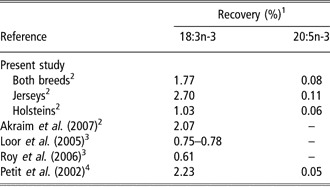
In the UK, milk typically contains 18:3n-3 at a concentration of 0.5 g/100 g total fatty acids (McCance and Widdowson, Reference McCance and Widdowson1998). Replacing CPO with LIN resulted in the production of milk containing approximately 0.7 g/100 g total fatty acids of 18:3n-3. However, milk fat 18:3n-3 enrichment was not proportional to the marginal increases in 18:3n-3 intake between breeds, with evidence that the efficiency of transfer into milk was higher in the Jersey than Holstein. Earlier studies demonstrate that the efficiency of transfer of marginal increases in 18:3n-3 intake into milk varies depending on the form of linseed lipid in the diet, with linseed oil resulting in the lowest apparent transfer (Table 7). The relatively low incorporation of dietary 18:3n-3 from linseed oil into milk has been attributed to extensive biohydrogenation of 18:3n-3 in the rumen (Petit et al., Reference Petit, Dewhurst, Scollan, Proulx, Khalid, Haresign, Twagiramungu and Mann2002). It is possible that the more efficient transfer of 18:3n-3 from the diet into milk in the Jersey compared with the Holstein is related to a higher diet digestibility rather than due to breed differences in the partitioning of absorbed 18:3n-3. Expressing milk yield as a function of DMI (1.14 and 0.90 for Jersey and Holstein cows, respectively; P = 0.116) indicates that whole-tract digestibility coefficients of experimental diets were higher for the Jersey. This may also explain differences in the concentration and secretion of 20:5n-3 in milk following the LIN diet between breeds, since 18:3n-3 can also be elongated and desaturated to 20:5n-3 in ruminant tissues.
Marginal increase in daily yield of 18:3n-3 and 20:5n-3 as a proportion (%) of the marginal increase in daily 18:3n-3 intake, in selected studies using linseed products.

1Calculated as (marginal increase in the secretion in milk/marginal increase in 18:3n-3 intake) × 100.
2Used extruded linseed.
3Used linseed oil.
4Used formaldehyde treated whole linseeds.
The late-lactation cows in this study showed moderate responses to a fairly low level of linseed supplementation. Overall, the results suggest that lipid contained in LIN is not highly protected from rumen biohydrogenation. Replacing CPO in the diet with LIN decreased milk total saturated fatty acid concentration and increased milk fat 18:3n-3, trans fatty acid and CLA content. Such alterations in milk fat composition could be considered beneficial for human health, but it remains uncertain if the magnitude of changes would result in a biologically significant impact at a population level. The significant breed by diet interactions indicated variations in response to LIN between breeds, which would merit further investigation. Whilst high dietary intake of trans fatty acids from ruminant-derived foods may impair cholesterol homeostasis, moderate intakes of ruminant trans fatty acids (even well above the upper limit of current human consumption) do not exert detrimental effects on plasma lipids or other CVD risk factors (Motard-Bélanger et al., Reference Motard-Bélanger, Charest, Grenier, Paquin, Chouinard, Lemieux, Couture and Lamarche2008). However, it remains questionable whether the increases in milk trans fatty acid concentrations would be widely accepted if labelling of trans fatty acids in foods became more widespread.
Acknowledgements
This work was jointly supported by LIPGENE, a EU Sixth Framework Programme Integrated Project (2004–2009) (http://www.lipgene.tcd.ie) and The States of Jersey Milk Marketing Board. The authors would like to thank Valorex® (La Messayais, 35210 Combourtillé, France) for supplying the linseed supplement. The authors gratefully acknowledge and appreciate the assistance of the late Colin Grayer for statistical support and staff at the Centre for Dairy Research for care of the experimental animals.