Academic studies and the evaluation reports of international organizations regularly raise doubts about the effectiveness of the institutions, programmes and instruments that shape the Chinese national innovation system (NIS). According to these studies, Chinese innovation policy is characterized by central state dirigisme, a one-sided focus on centrally sponsored mega-projects, a concentration of subsidies on large state-owned enterprises with their R&D departments, and a neglect of private-sector small and medium-sized enterprises in major programmes of technology policy.Footnote 1
Most of these critical accounts draw on evaluations of fiscally expensive national programmes such as the 863 Programme for high-technology R&D (since 1986), the 973 Programme for basic research (since 1997) or the mega-projects contained in the Medium- and Long-Term Plan for the Development of Science and Technology in the 2006–2020 period. Yet, less prominent and more decentralized programmes remain understudied in the international research on China's technology policy (and also in Chinese research itself). This applies in particular to the national Torch Programme (huoju jihua/guihua火炬计划/规划), which was launched as early as 1988 to promote the commercialization of Chinese R&D, i.e. the diffusion of new technologies to production and markets.Footnote 2 As its most visible component, the Torch Programme governs a group of presently 83 high-technology zones (HTZs) that have made a disproportionately strong contribution to Chinese exports of higher-value, technology-intensive products.Footnote 3
To understand the dynamics and effectiveness of China's innovation policies, this study will focus on mechanisms of governance that challenge widely held assumptions about the dirigiste and hierarchical character of Chinese innovation policy. The Torch Programme manifests strong elements of decentralized institutional and policy experimentation, an enterprise-dominated financing scheme, as well as a long-standing inclusion of non-state small and medium-sized enterprises (SMEs) in its incubator activities. HTZ administration has been left to local governments, and central funding has been extremely limited.Footnote 4 Moreover, a significant mission drift (from promoting domestic R&D and linking it to industrial production towards FDI acquisition and export business) is attributed to the Torch Programme's zones by Chinese and Western studies alike.Footnote 5 This functional reorientation has been forcefully propelled by local initiatives and interests in the diverse zones. National technology planners responded to bottom-up policy shifts through major programme adjustments. The actions and interactions that have shaped local experimentation and national adaptation provide insights into the rather unconventional mechanisms that are at work in technology planning and policy in China.
This article opens with a qualitative examination of the procedural patterns and modes of action inherent in the Torch Programme. We show that the Torch Programme rests on the exploration of promotional measures in competing HTZs and provides considerable leeway for local policy adaptation and national programme review at an early stage. This practice of adaptive governance is based on planning and feedback mechanisms that, due to historical institutional reasons, have differed markedly from other major technology programmes during the past two decades.
The specific dynamics of interaction (processes of prioritization, experimentation, feedback and adjustment) between central and local policy formulation and implementation, as well as their contribution to innovation in technology planning, are then examined through an explicitly open-ended, evolutionary analytical perspective. This perspective differs from the assumptions and assessments that research on innovation policy conventionally derives from pre-defined “best practice” and statistical benchmarking.
The next section of this paper introduces the analytical framework that guides our analysis. The ensuing two sections trace the striking mission shifts and particular governance mechanisms to be found in the Torch Programme. In our case studies, we then scrutinize recent innovations in national technology policy that were brought about by locally launched, yet nationally generalized, HTZ programmes in the realms of human resources (attracting international high-tech researchers and entrepreneurs), home-grown R&D (aiming at “indigenous” breakthrough innovation), and novel funding schemes (the “new third board” stock transfer agent system). Based on the case studies, we discuss the general significance of the Torch Programme for Chinese innovation policy. The concluding section sums up our central hypothesis.
Regarding data and information, this article draws on central and local evaluation reports, official statistics and documents mainly provided by MOST, Chinese and Western academic research literature and a series of interviews that were conducted in 2010 and 2011 with officials of central and local-level organs in charge of technology policy.
The ESH Framework: Local Experiments as a Corrective to National Policy
In order to grasp the innovative capacity of a given country, conventional evaluations rely on quantitative indicators, such as expenditure for R&D, the number of research staff, the number of patents registered or SCI-articles published.Footnote 6 All these indicators focus on NIS output data that can be compared to benchmarks obtained from other economies. And there has indeed been a tendency in many countries to bring their own technological development strategies in line with uniform benchmark indicators.Footnote 7
While international benchmarks may serve to mobilize national R&D efforts, it is the absorptive and learning capacities among NIS protagonists (including the continuous adjustment of government programmes) that determine the effectiveness of innovation policies.Footnote 8 Thus, instead of mechanically following international “best practice,” it must be a primary task of innovation policy to unleash the specific potential of key protagonists in the particular NIS context.
This study therefore focuses on the discovery and activation of context-specific potential as a central yardstick for innovation policy. It is not standardized benchmarks, but the corrective mechanisms built into the making and re-making of innovation policy that are at the centre of our analysis. All too often, technology planners pretend to know which innovation potential is available and how it can be activated through public policy. However, it is the search for potential in an extremely heterogeneous and perpetually shifting global and domestic market environment that is the fundamental challenge for technology policy. Such a fluid context requires broad-based decentralized tinkering and regular feedback into policy-making to generate a diversity of options and allow timely adjustment of objectives and instruments. If the most effective economic, industrial and technology policy is seen as an open-ended discovery process,Footnote 9 inconsistent policy implementation is not only inevitable in a rapidly changing economic environment, but may actually direct resources to more productive uses than those defined in the original policy designs. If local policy drift triggers recurrent adjustments of national programmes, it must not be seen as policy failure but rather as a productive policy corrective.
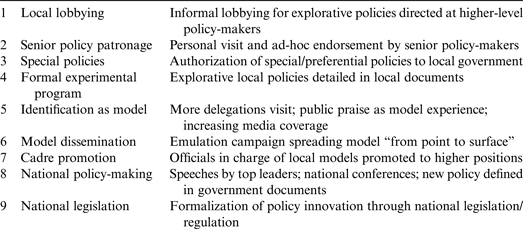
In order to map the dynamics of such a discovery process, we will resort to the analytical framework of “experimentation under the shadow of hierarchy” (ESH). This framework was originally derived from analysing common processual patterns across different domains of economic policy.Footnote 10 It has recently been refined through a broader conceptual debate and a series of instructive case studies.Footnote 11 The ESH framework captures an interactive process that is based on administrative tinkering on the local level and selective integration of locally generated policy options into national regulation. If certain local experiences are judged by individual top-level policy-makers to be conducive to their political goals and interests, they may be extended and explored on a larger scale. If broad support among senior policy-makers can be built, local policy initiatives may be generalized through national regulation. Some stages are decentralized (the initiation and execution of local experiments) whereas others are centralized (the identification of model experiences and the initiative to expand these “from point to surface,” you dian dao mian 由点到面). The experimental cycle captured by the ESH framework can be disaggregated in nine steps that range from the initiation of local experiments to the formalization of national policies (see Table 1).
Patterns of Central–Local Interaction according to the ESH Framework

Source: Based on Heilmann Reference Heilmann2008 and Reference Li2009.
By emphasizing a perpetually oscillating, tense and patchy, yet often evidently productive multi-level interplay, the ESH framework differs from popular research focuses, which tend to emphasize the disconnection between top-level policy specification (the realm of the “central state” that issues innumerable and often hollow policy programmes) and bottom-up local policy-making (the realm of the “local state” that dilutes or ignores central policies and pursues an independent policy calculus). In contrast, the ESH framework is designed to capture formal and informal, selective and ad-hoc interaction among local and national policy-makers; it assumes that policy shifts are driven by vertical and horizontal diffusion and adaptation across administrative jurisdictions and hierarchy levels.
Regarding the concrete mechanisms of governance that are addressed by ESH, experimental zones (shiyanqu 试验区), such as the technology parks under the Torch Programme, differ from more limited pilot schemes (shidian 试点, “experimental points”) that deal with a single policy domain in important ways. In the zones, an entire jurisdiction is authorized by the central government to conduct reorganization measures and promotional programmes that may cut across diverse policy domains. Experimental zones are established with the explicit mission to bring about novel policy options and contribute to readjusting national programmes. The efforts of local protagonists to utilize these zones – first, to boost local manufacturing, services and real estate, and second, to impress their superiors and thereby further their career prospects – has served to give technology parks a prominent role in central–local policy interaction.
As “experimental and demonstration zones,” the HTZs under the Torch Programme encompass a wide array of promotional tools and organizational patterns. They provide planners in the central bureaucracy with a plethora of locally tested options for potential inclusion in national technology programmes.Footnote 12 As our case studies will demonstrate, this approach generates considerable flexibility and adaptivity in a constantly changing economic environment. Analysing the emergence and spread of experimental programmes in the technology zones through the ESH framework produces striking evidence of the Torch Programme's capacity to propel continual policy adaptation. It is the specific dynamics of interaction – not pre-defined technological or institutional standards – that should be seen as the foundation of the Torch Programme's innovation potential.
Mission Drift in the Torch Programme since 1988
When the Torch Programme was launched, command economy practices were still dominant in China, and nationwide R&D priorities were controlled by the planning bureaucracies. During the mid- to late 1980s, the State Science and Technology Commission (SSTC, in 1998 renamed the Ministry of Science and Technology, MOST) was involved in an intense rivalry with the State Planning Commission over defining the agenda for China's technological modernization. SSTC had to search for novel targets and methods of technology promotion that were out of the direct reach of the Planning Commission. Through the Torch Programme, the SSTC aimed to promote the commercialization, industrialization and internationalization of domestic R&D. From a broader programmatic perspective, the Torch initiative was launched by a demand-oriented, foreign-inspired policy camp that gained the upper hand in the SSTC and in several economic policy think tanks during the late 1980s, with the backing of individual top-level reformist politicians. Yet these reformists were caught in increasing tensions with the entrenched top-down, supply-oriented planning and academic “policy cultures” within the industrial and research establishment.Footnote 13 Originally, SSTC leaders planned to launch the Torch Programme as early as 1986. Yet these plans met with resistance from industrial planners who regarded technological innovation as their turf.Footnote 14
Entailing important consequences to the present day, the genesis of the Torch Programme can be interpreted as an evasive manoeuvre. When industrial planning bodies directly challenged the SSTC's core powers in technology policy-making in the second half of the 1980s (the State Planning Commission was put in charge of drafting national technology plans while the SSTC was continuously curtailed in its planning powers), the strong-willed head of the SSTC, Song Jian 宋健, decided to protect his turf by launching novel types of R&D-oriented HTZs and SMEs that were outside of the control of traditional industrial administration.Footnote 15 The promotion of industrial applications through start-ups, incubators and parks was inspired by exposure to foreign innovation systems, intense domestic debate about strategies for technological catch-up, and pioneering informal experiments with new-style technology firms and zones during the 1980s.Footnote 16
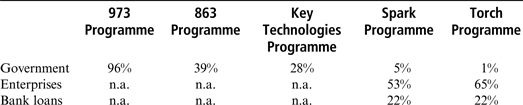
In contrast to most other national technology plans, the central government has exercised utmost restraint in directly subsidizing the Torch Programme. Between 1988 and 2005, only about 1 per cent of total Torch Programme finances stemmed from the national budget since a disproportionately large part of funding was, and continues to be, provided by local enterprises and banks (see Table 2). This was an intentional move by the Torch Programme's policy entrepreneurs in the late 1980s, who had few funds to disburse and therefore stressed that technological progress would be much more dynamic if geared to marketable commercial products (instead of research projects aloof from markets). A fast move from small-scale R&D towards commercial production was already on the minds of the Torch Programme's leaders in the programme's early stages.Footnote 17
The commercial success of several newly founded technology companies in the pioneering Zhongguancun 中关村 and Donghu 东湖 zones paved the way for further promotional policies aimed at start-up firms with a mixture of ownership arrangements, including privately owned SMEs (starting in the late 1980s, when non-state enterprises were still in an infant stage). In a manner that is typical of China's administrative political economy, many of the early start-up companies founded in the HTZs under the Torch Programme were set up by scientists and researchers who came from the SSTC-affiliated bureaucratic and research complex (xitong 系统). By opening additional domains of activity and sources of income, those affiliated to the SSTC complex benefited significantly from the new commercial opportunities offered by the Torch Programme. As organizational and fiscal reforms increasingly triggered staff cuts in state research institutes and universities, entrepreneurial scientists often responded favourably to the Torch Programme's incentives to set up their own firms. Since 1999, technology-based SMEs have been supported through a special innovation fund under the Torch Programme that has financed industrial applications of selected R&D results through interest free loans, subsidies and direct capital investments. In addition, the fund provides start-up capital for companies holding their own patents.Footnote 18
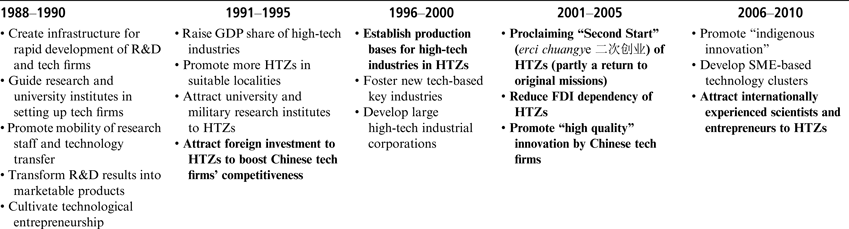
While the entrepreneurial funding approach has been sustained to the present day, the top priorities defined in the national Torch Programme have undergone several waves of substantial adjustments. The spectacular economic success of the zones in higher-value industrial production for export triggered a series of reprioritizations in the national Torch Programme. The programme revisions that were undertaken as a direct response to policy exploration in the HTZs are presented in bold print in Table 3.
Shifting Priorities in the National Torch Program, 1988–2010
Note: Bold print shows national programme adjustments in response to local policy explorations in HTZs.
Source: Song Jian Reference Song1988; Li Xu'e Reference Li1989, Reference Li1991a, Reference Li1991b; Mu Gongqian Reference Mu1989; State Council 1991; Keji ribao 1995; Torch Center/MOST 2001 and 2007.
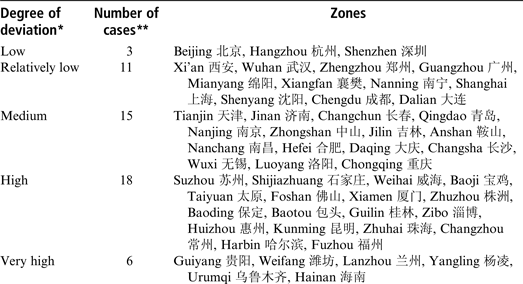
HTZs were originally designed to activate and upgrade domestic R&D capacities for commercial uses. However, more than two thirds of Chinese HTZs under the Torch Programme (39 zones out of a sample of 53) are found to deviate significantly from this core mission (see Table 4). For most local governments, the zones serve as very useful vehicles for boosting economic activity in their jurisdiction, “taking whichever route provides the fastest growth.”Footnote 19 We can witness sophisticated R&D efforts, heavy transnational investment and substantial technology exchanges, as well as major industrial and commercial success stories and massive export contributions in the more advanced HTZs. In contrast, among the functionally most deviant and technologically laggard HTZs, we find low-tech enterprises, mass production or even mere facades for pursuing property deals and tax evasion through government-linked shell firms.Footnote 20
Functional Deviation (Mission Drift) in HTZs under the Torch Program
Note: *The degree of deviation is based on bundles of indicators for the funding structure, capacity of incubators, capacity for R&D and efficiency of R&D.
**Total sample: 53.
Source: Chen Reference Chen2009, 91–92.
Beyond the Chinese government's expectations, many HTZs turned into export bases for higher-value products and attracted massive foreign investment and technology. In 2009, Chinese-controlled enterprises contributed just 46.4 per cent to the HTZ's total export volume, whereas foreign-invested companies contributed 35.5 per cent and firms established through investors from Hong Kong, Macao or Taiwan contributed 18.1 per cent (MOST 2010b). In effect, the HTZs' contribution to “indigenous innovation” in a narrow sense (that is, home-grown breakthrough innovations that do not rely on technology transfer from abroad) has so far been very limited. The focus of many HTZs on canvassing foreign investment and technology is often interpreted as demonstrating the central government's limitations in promoting “indigenous” technological progress through hierarchically administered programmes.Footnote 21 Yet, while many top-down efforts at boosting domestic technology got stuck on the ground, our case studies will show how decentralized organizational tinkering in the HTZs generated many new policy options that central policy-makers were quick to disseminate “from point to surface,” as soon as bottom-up initiatives were seen as conducive to central agendas and interests.
Governance Mechanisms in the Torch Programme
In marked contrast to other national technology plans (especially the 863 Programme that was launched almost at the same time), the Torch Programme from the very beginning relied on explicitly indicative, non-imperative target definitions. The first Torch documents were confined to a few aggregated, quantitative and qualitative targets. Planners referred to experiences obtained from the Zhongguancun zone and a pioneering incubator facility in the Donghu zone (located in Wuhan) to promote the commercialization of high-tech R&D.Footnote 22 Bolstered by favourable tax, investment and trade-related policies, programme targets were aimed at stimulating and legitimating local initiatives, redirecting local efforts in technology promotion to market demand and improving the infrastructure and environment for high-tech R&D. The concrete modes of funding and implementation of most projects were left to local governments and technology zones.Footnote 23
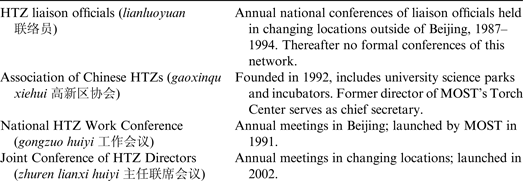
The basic pattern of utilizing local policy practice as a constant input into national planning has remained an unchanged feature of the Torch Programme since 1988. The SSTC/MOST has acted as a central policy patron for the HTZs in experimenting with the Torch Programme's promotional schemes, including frequent inspection tours by cadres from the national technology bureaucracy as well as regular personnel exchanges between SSTC/MOST and the zones. Frequent central–local communication has facilitated constant feedback for adjusting the Torch Programme's objectives and instruments. In addition, regional technology departments, institutes and HTZs have engaged in regular exchanges, intervisitation programmes and liaison networks on a horizontal level (see Table 5).
Horizontal Policy Networks Attached to the Torch Program and its HTZs
Source: SSRC/SPC 1992; Keji jinbu 1994; Keji ribao 2002; Gong Reference Gong2008.
A continual characteristic of the Torch Programme has been its orientation towards SMEs. Contrary to many national technology plans that are aimed at state-owned enterprises (SOEs) or government-linked research institutes, the Torch Programme strives to support excellent individual researchers or small-scale research groups to bring the results of their R&D to the market through their own, usually small-scale, firms. One of the founding fathers of the Torch Programme defined it as a key function of the HTZs to provide a protective “umbrella” for technology researchers and entrepreneurs since they often had no experience with business management or product marketing and in addition had to face pressures from large state-owned companies and traditional industrial bureaucracies.Footnote 24 Overall, the Torch Programme has been less attractive to large SOEs that belong to industrial branches outside of the SSTC's bureaucratic turf and enjoy preferential access to state banks or equity markets in funding their R&D activities.
Another continuous feature of the Torch Programme lies in the experimentation function of the HTZs that are administered under the programme. Since 1988 the number of HTZs had been raised through several wave-like additions to 83 by 2011. In 1991, the SSTC called on regional and local governments to consider launching new HTZs and experiment with technology promotion on the local level. These zones were supposed to act as “experimental and demonstration zones” for the commercialization of scientific and technological advances through “optimizing soft and hard framework conditions.” Local administrations were urged not to follow a standard blueprint but to develop “diverse effective models.”Footnote 25 This type of purposely non-uniform national regulation and lack of standardization has had far-reaching consequences. All zones under the Torch Programme have to be formally recognized by the central government. However, we find stark variation amongst their organizational patterns, incentive policies and technological or qualification levels for firms and personnel.Footnote 26
In sum, the Torch Programme exhibits a striking combination of central coordination (including national definition of programme objectives and legitimation of local policy trials) with local experimentation during implementation that is in turn fed back into national programme adjustments as well as into horizontal policy diffusion. These major distinctive procedural features of the Torch Programme are summarized below:
• indicative: minimal quantitative targets for local governments;
• decentralized: primacy of local initiatives; decentralized funding; minimal resource allocation by central government;
• SME-oriented: promotional measures predominantly target start-up firms and SMEs;
• non-standardized: open-ended search for appropriate instruments to improve conditions for high-tech firms;
• feedback-driven: strong policy diffusion across jurisdictions; “rolling” (gundong滚动) adjustments of national programmes driven by local experimentation.
Case studies: HTZ-Driven Innovations in Chinese Technology Policy
The following case studies scrutinize specific processual patterns of central–local interaction under the Torch Programme with regard to three crucial areas of technology policy: human resources, corporate finance and R&D organization.
Case Study A – Human resources: Local Model Programmes for the International Recruitment of Senior High-Technology Experts and Entrepreneurs
China's pioneering programme to recruit international high-technology personnel, the 530 Plan, originated in Wuxi (Jiangsu province) in spring 2006. It sought out high potential in cutting-edge technology research and entrepreneurship among overseas Chinese (in particular patent holders) willing to found enterprises in China. The Wuxi municipal government could afford to arrange generous start-up capital as well as free office and living space. The initial aim of the municipal government was to attract 30 leading executives from abroad to Wuxi within five years (that is where the abbreviated name “530” stems from).
The ambitions of Wuxi's policy-makers were nourished by the rapid ascent of Suntech Power, a major producer of photovoltaic products founded in 2000 with the support of the municipal government. Suntech became one of the world's leading producers of solar cells within a few years and its founder, an Australian-trained Chinese who had been attracted by favourable conditions extended in the Wuxi HTZ, became one of China's wealthiest people after Suntech's Nasdaq IPO in December 2005. Wuxi's leaders were determined to extend Suntech's success to other start-up firms.Footnote 27
In March 2006, on the occasion of an exploratory trip by the then provincial Party secretary Li Yuanchao 李源潮, Wuxi's government secured the support of provincial superiors for their pilot scheme (the 530 Plan) aimed at attracting international technology entrepreneurs through extremely generous investment and living conditions.Footnote 28 Since the “30 high potentials” target of the original 530 Plan was surpassed in 2009, Wuxi's government has expanded the recruitment programme and further enhanced the preferential conditions for attracting high-tech personnel from abroad.Footnote 29
In January 2007, the provincial Party secretary proclaimed the 530 Plan a model for the entire province of Jiangsu. The “Wuxi model” was rapidly extended to other technological strongholds within the province, in particular to the HTZs in Nanjing, Suzhou and Changzhou. Jiangsu's pioneering approach to high-tech personnel recruitment gained the attention of national policy-makers and received a national boost when Li was promoted to become China's top personnel manager as director of the Communist Party's Central Organization Department (COD) in July 2007. The “Wuxi model” became precious political capital for the department's new director. As a result, in 2008–2009, the COD designed a national programme for recruiting international technology experts (the so-called “1000 Talents” programme) who were expected either to found new high-tech enterprises or to manage state-owned key research projects or key technology enterprises for a contractually fixed minimum period of time. In effect, the “1000 Talents” programme has provided broad authorization for Chinese HTZs to experiment with new methods of personnel recruitment and promote the inbound mobility of senior technology experts (“reverse brain drain”) through “unbureaucractic” means.Footnote 30
In June 2010, the COD convened a national conference to exchange views on the diverse local experiences with the new recruitment schemes. Eight HTZs presented the results of their efforts in an atmosphere of mutual competition.Footnote 31 After the conference, several zones sent study groups to other HTZs for policy learning. An internal publication of the Ministry of Personnel carried comparative studies of diverse local human resources programmes. In addition, international HR experts and high-profile scientists were invited to public discussions to make proposals for improving the national recruitment programme.Footnote 32
All these activities were part of a stream of information exchanges serving horizontal (local) policy learning and vertical (national) policy adaptation. Between 2006 and 2010, many local and national human resources programmes were directly derived from, or at least inspired by, Wuxi's 530 Plan. Yet, except for Wuxi's experimental programme, no other local experience was awarded national model status. There is a straightforward political explanation for this. The “Wuxi model” was intimately connected to the career of its policy patron, the newly installed COD director Li Yuanchao, who exploited “his” local model as political capital on the national level with great determination.
Case study B – Corporate Finance: The “New Third Board” Experimental Scheme
The initiative for the “new third board” (xinsanban 新三板) funding scheme dates back to an on-site investigation tour by Beijing municipal government leaders to the Zhongguancun zone in 2004. On the occasion of this trip, several smaller tech firms whose track record was not yet sufficient for raising money in the stock market drew attention to their financial difficulties. In response, Beijing's municipal government, MOST's Torch CenterFootnote 33 and the Securities Association of China (SAC) designed and launched an experimental platform for Zhongguancun firms to trade shares outside of the formal stock exchange through a so-called “stock transfer agent system.”Footnote 34 The new funding platform was approved by the State Council already in January 2006. Since then, a supervisory group for the pilot programme (shidian dudao xiaozu 试点督导小组, in which representatives from the China Securities Regulatory Commission [CSRC], Shenzhen Stock Exchange, SAC, Torch Center and Zhongguancun administrative committee take part) has convened monthly meetings to deal with the frequent problems that arise in the inter-enterprise transactions conducted through the “new third board.”
By the end of 2010, due to the attractiveness of this new channel for raising capital, more than 30 HTZs had lobbied the CSRC and MOST's Torch Center to extend the Zhongguancun-focused pilot scheme to other zones. Official approval, however, had to be issued by the CSRC, which still saw a number of risks or unclarified issues in an early generalization of the programme. Nevertheless, lobbying efforts continued, and the Torch Center and SAC actively tried to generate a positive climate in public opinion for the expansion of the experiment by launching reports in the mass media.
From 2009, CSRC officials conducted on-site investigations in several HTZs to check on local conditions for making the new funding scheme work.Footnote 35 Competition among HTZs for being included in the expanded stage of the experimental programme was fierce.Footnote 36 Officials from a number of zones (namely Shenzhen, Guangzhou, Qingdao, Chengdu, Suzhou and Hangzhou) advertised their zones through the mass media as promising candidates for the “new third board” and, addressing firms in their zones, promised substantial financial support for those enterprises that might become involved in the transactions.Footnote 37 There also was a lot of talk about intense lobbying in the guise of kickback offers to regulators. Clearly, the “new third board” was seen by officials and firms in many HTZs as an extremely attractive scheme that they had to become part of as early as possible.
Case study C – R&D Organization: “Demonstration Zones for Indigenous Innovation”
At the end of the 1990s, a decade after the inauguration of the Torch Programme, the industrialization of China's HTZs had reached an advanced stage not foreseen by the technology policy-makers of the late 1980s. Yet, as most Chinese and foreign analyses stated, the HTZs' industrial and export successes were due to the powerful engagement of foreign-invested rather than Chinese companies. In practice, the HTZs had become “platforms for export-oriented manufacturing by affiliates of international corporations.”Footnote 38 They thus substantially deviated from the Torch Programme's original goal of promoting domestic R&D and technology firms. Faced with obvious “functional deviations” and starkly different innovation capacities, the updated 2001 Torch Programme called on the zones to launch a “second start” (erci chuangye 二次创业), subdivided the HTZs into three categories and defined different policy targets and promotional measures for each category. MOST planners called for making the transition “from the foundation phase to the innovation phase” and defined “indigenous innovation” (zizhu chuangxin 自主创新) as the key task for China's technology policy in the new century.Footnote 39
Zhongguancun was the first zone to respond to this call. In 2003, Beijing's municipal government invited representatives from several central ministerial bodies (among them the NDRC, MOST, CSRC, MOF, MofCOM) to take part in policy deliberations about how the zone could contribute to meeting the demands of “indigenous innovation” and become more independent from foreign technology.Footnote 40 The Zhongguancun zone was identified as having the potential to pioneer new ways and means in “indigenous innovation” due to its outstanding concentration of Chinese research facilities and scientists. Zhongguancun thus tried to boost domestic R&D efforts in high technology three years before the national Medium- and Long-term Programme for the Development of Science and Technology, 2006–2020 (MLP) was issued.
As a comprehensive programme, the MLP upgraded “indigenous innovation” to a national strategy and a key slogan of the Hu–Wen administration. Yet, this reorientation of national technology policy was not the product of a top-down directive. It rather resulted from an extended effort by MOST (which was in charge of drafting the MLP) to direct China's innovation system away from what MOST officials saw as over-reliance on foreign investment and technology. From the mid-2000s, the drive towards “indigenous innovation” was taken up by Hu and Wen who defined technology policy as a top priority for the government.
In this macro-context, Zhongguancun was formally renamed a national “demonstration zone for indigenous innovation” (zizhu chuangxin shifanqu 自主创新示范区) in March 2009, following a personal initiative by the Beijing mayor that obtained swift approval from the premier. A series of pilot programmes that had been tested in Zhongguancun from 2003 (e.g. new incentive mechanisms for research staff, better access to venture capital for start-ups, government procurement of high-tech products, protection of intellectual property rights and human resources management) were confirmed as viable and generalizable by central government bodies.Footnote 41
Other HTZs strove to follow this example. When the premier visited Hubei province and the Donghu HTZ (located in Wuhan) a little later, provincial leaders seized the occasion and declared their determination to follow the direction of the Zhongguancuan zone and raise the R&D capacity of local Chinese industries.Footnote 42 In spring 2010, the Donghu zone was officially also granted the status of “demonstration zone for indigenous innovation” by the State Council and charged with exploring new approaches to boost the innovation capacity in local R&D clusters.Footnote 43
In the background, MOST had consistently supported the efforts of Hubei's provincial government to upgrade the status of the Donghu zone. In April 2010, the head of MOST's Division for High and New Technology Development and Industrialization was posted to Wuhan and appointed vice-mayor for three years.Footnote 44 This appointment was intended to strengthen communication with the central government (MOST) about local explorative efforts in innovation policy. Thereafter, a media campaign on popularizing the Zhonguancun zone's experiences was started in Wuhan and high-ranking Wuhan officials went on an extended inspection tour of Zhongguancun.Footnote 45 In addition to Zhonguancun and Donghu, the Zhangjiang zone (located in Shanghai) also obtained the status of national “demonstration zone” in March 2011,Footnote 46 as a manifestation of an on-going process of policy dissemination and diffusion “from point to surface” coordinated by MOST.
Synthesis of Case Study Findings
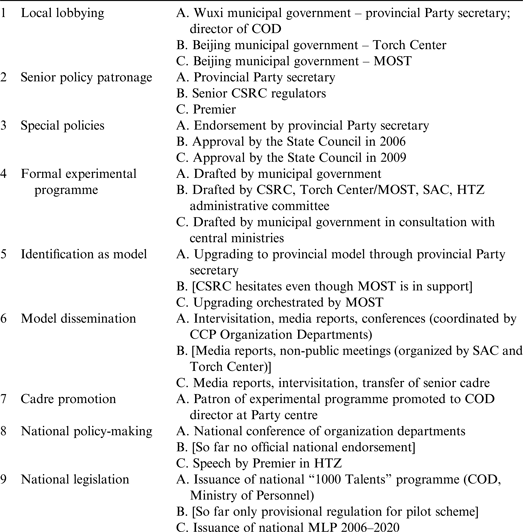
To what extent can the procedural steps of the ESH framework be found in the case studies presented above? In all three cases, the local governments' ambitions and efforts were the driving force behind the initiation of experimental projects (see Table 6). In this respect, the Torch Programme and MOST succeeded in creating strong interests among local jurisdictions (provinces and municipalities in which HTZs are located) in boosting the status and policy role of local HTZs. Following the official (vertical, top-down) recognition of local experimental sites and programmes, a process of both horizontal policy diffusion and intense locational competition about status and preferential conditions was triggered in cases A and C.
Procedural Features Found in Case Studies
Source: Compiled from the three case studies by the authors.
In the course of policy diffusion, central government actors played a coordinating role. They organized national conferences to further the exchange of experiences between local actors (case A) or started emulation campaigns in the national media (all cases). In order to justify the granting of special experimental status to individual jurisdictions, protagonists of the central government acted as policy patrons by contributing to the formulation of local experimental programmes (case B and C) or advertising regional experiments publicly (case B).
Intense interaction with local actors enhanced the information base for national policy-making, furthered an adjustment of national programmes in response to local experiences or even resulted in the transformation of innovative local policies into national programmes as in the realm of human resources (case A) and innovation policy (case C). Very strong reciprocal effects between local experimentation and national policy-making became manifest in all three case studies.
The Torch Programme as a Discovery Process for Technology Policy
Due to intense conflicts between the planning and technology bureaucracies in the 1980s and 1990s, China's Torch Programme was launched as an antithesis to dirigiste industrial planning. As opposed to the central planning tradition, key policy concepts, standards and definitions of high-technology zones, firms and policies were left “purposely ambiguous.”Footnote 47 They were not regulated in a uniform, closed and stable way and therefore positively allowed the Torch Programme to evolve along with the rapid run of China's increasingly globalized economy.
As the case studies demonstrate, the Torch Programme is characterized by a pronouncedly experimentalist approach. HTZs fulfil a critical policy function, officially defined already in the early phase of the Torch Programme as “experimental and demonstration zones” for technological development.Footnote 48 The central technology bureaucracy defines indicative targets, yet provides only scarce funds and delegates implementation to local governments and HTZs.
By initiating experimental programmes, local actors strive to expand their administrative autonomy, open new channels of growth and income (fiscal and personal) and obtain political capital (securing support by both their local constituencies and their superiors at higher administrative levels) through outdoing other HTZs. The array of policy instruments and organizational patterns that emerges from such competitive experimentation goes way beyond what could have been initiated from top down.Footnote 49
Central bodies, such as MOST's Torch Center, serve as policy patrons for the local efforts. Through frequent on-site visits, central officials try to understand, and benefit from, what works on the ground. Local experiences are regularly fed back into national programme adjustments. The Torch Programme thus comes close to being the only major national example of a regularly adjusted “rolling plan” (gundong jihua 滚动计划) that was once the goal of national planning reformers in the early 1990s.Footnote 50
What sets Chinese HTZs apart from zones in other countries is that their active contribution to policy-making through administrative exploration has been built into the national Torch Programme from the very beginning. Seen from its policy role, Zhongguancun has nothing in common with Silicon Valley or most other major technology clusters abroad, since it serves a pivotal explorative function for national and local innovation policies in China and does not at all constitute a free-wheeling, market-driven technology zone.Footnote 51
The mission drift that was observed in many HTZs resulted from the discovery of tangible economic potential (ranging from creative promotional schemes for start-up firms to opaque property deals) that had not been recognized by national policy-makers beforehand. For MOST's technology bureaucrats, the zones provide valuable information about what novel policies may work and what existing policies may have to be adjusted. Beyond their economic function of attracting foreign and domestic investment and firms, HTZs thus have been a means to deal with pervasive uncertainty regarding the unknown potential, appropriate priorities and effective instruments of innovation policy. This uncertainty can be reduced if policy-making is designed as a search and discovery process and includes corrective mechanisms such as decentralized experimentation, continual central-local feedback, regular review and adjustments of national programmes.
Conclusion: The Potential of Experimental Governance in Innovation Policy
The local and central agility displayed in the management of the Torch Programme points to a type of open-ended policy generation and adaptation that is often advocated as a core element of “third generation innovation policy” for the 21st century.Footnote 52 Conventional approaches to technology policy tend to be rooted in the belief of many planners, researchers and policy advisors that they can recognize the innovative potential of an economy ex ante, activate it through known procedures and institutions and measure its performance through well-established statistical benchmarks.Footnote 53
Yet, in a context of accelerated technological change and macroeconomic uncertainty, a policy process that relies on continuous searching, feedback, correction and adaptation will provide much more agility than pursuance of “known best practice” that is often derived from very different times and contexts. Standardized indicators of innovative performance that stem from past experiences of the most advanced OECD economies may fail to detect the particular requirements and opportunities posed by the extremely diverse and rapidly shifting demands in the technology markets of emerging economies.Footnote 54
Procedural patterns give us better clues than output benchmarks about how responsive and forceful a nation's innovation policies can and will be in the face of unforeseen opportunities and challenges. The essential fluidity and unpredictability of the policy environment must be taken seriously as a universal constraint for any attempt at designing comprehensive and coherent packages of innovation policies. If innovation policy is best designed as an open-ended discovery process, local deviations from central targets can be judged as desirable and productive, for they produce valuable information and necessary adjustments to national policy. The core strength of experimental governance, as displayed in China's Torch Programme, lies in not pursuing coherence and standardization but promoting openness to unexpected and tentative policy options when they arise.