INTRODUCTION
Recent research on the validity of the DSM-IV criteria for eating disorders (EDs; APA, 2000) has raised many questions. For example, in both population-based and clinical samples the amenorrhea criterion has not been found to differentiate between women with full syndrome anorexia nervosa (AN) and those with all AN symptoms except amenorrhea in terms of risk factors and correlates of AN (Garfinkel et al. Reference Garfinkel, Lin, Goering, Spegg, Goldbloom, Kennedy, Kaplan and Woodside1996; Cachelin & Maher, Reference Cachelin and Maher1998; Mitchell et al. Reference Mitchell, Cook-Myers and Wonderlich2005). Similarly, researchers have not found evidence to support the frequency criterion of two or more times a week for binging and inappropriate compensatory behavior (e.g. vomiting, laxative use) in bulimia nervosa (BN) as being preferable to a threshold of one or more times per week (Kendler et al. Reference Kendler, MacLean, Neale, Kessler, Heath and Eaves1991; Sullivan et al. Reference Sullivan, Bulik and Kendler1998). Furthermore, many women with EDs fall into the ‘eating disorder not otherwise specified’ (EDNOS) category (e.g. Gotestam & Agras, Reference Gotestam and Agras1995) because they do not meet these questionable criteria. In two studies based on data from the Virginia Twin Registry, the prevalence of BN and AN was shown to more than double when the frequency criterion for binge eating in BN (Sullivan et al. Reference Sullivan, Bulik and Kendler1998) and the amenorrhea criterion in AN (Walters & Kendler, Reference Walters and Kendler1995) were eliminated. As individuals meeting all criteria for BN except binge/purge frequency or all criteria for AN but amenorrhea are categorized as EDNOS under the DSM-IV diagnostic system, these findings suggest that ED types are currently not adequately defined.
Several studies have used latent class analysis (LCA) to determine whether ED symptoms and behaviors cluster according to DSM-III-R and DSM-IV ED types and to suggest new ways of defining EDs. Two of these studies have examined symptoms relating only to BN (Sullivan et al. Reference Sullivan, Bulik and Kendler1998; Striegel-Moore et al. Reference Striegel-Moore, Franko, Thompson, Barton, Schreiber and Daniels2005) and two used items relating to both AN and BN (Bulik et al. Reference Bulik, Sullivan and Kendler2000; Keel et al. Reference Keel, Fichter, Quadflieg, Bulik, Baxter, Thornton, Halmi, Kaplan, Strober, Woodside, Crow, Mitchell, Rotondo, Mauri, Cassano, Treasure, Goldman, Berrettini and Kaye2004). Keel et al. (Reference Keel, Fichter, Quadflieg, Bulik, Baxter, Thornton, Halmi, Kaplan, Strober, Woodside, Crow, Mitchell, Rotondo, Mauri, Cassano, Treasure, Goldman, Berrettini and Kaye2004) identified four latent classes in a sample of affected relative pairs with clinically significant EDs (including some forms of ENDOS), characterized as restricting AN, AN and BN with multiple purging methods, AN without obsessive compulsive symptoms and BN with vomiting as the only method of purging. These results do not provide insight into the natural clustering of ED symptoms among women in the general population, however, because many women have some ED symptoms without meeting full ED diagnostic criteria. Bulik et al. (Reference Bulik, Sullivan and Kendler2000) applied LCA to ED symptoms in a general population sample of female twins who endorsed at least one of two ED screening questions. Six classes were identified, characterized as AN, BN, binge eating, shape/weight preoccupied, low weight with binging, and low weight without binging. However, because of skips built into the interview, all individuals in the sample were not asked questions regarding compensatory behavior. As some women do engage in inappropriate compensatory behavior in the absence of binge eating (Keel et al. Reference Keel, Haedt and Edler2005), it is possible that the results presented may not be a true depiction of the clustering of ED symptoms in the general population. Finally, Wade et al. (Reference Wade, Crosby and Martin2006) identified latent profiles in a latent profile analysis that included behavioral ED symptoms and highest and lowest BMI in a community sample of Australian female twins using all subjects in the sample, regardless of whether they endorsed any ED symptoms, and an assessment that was free of skips. Unlike the results of previous studies, these latent profiles were differentiated on the severity of symptoms rather than specific ED behaviors.
Of the above-mentioned studies, only one used a multi-ethnic sample and included ethnicity as a validator (Streigel-Moore et al. Reference Striegel-Moore, Franko, Thompson, Barton, Schreiber and Daniels2005); however, only BN symptoms were used in the LCA. To our knowledge, no studies have examined the clustering of both AN and BN related to symptoms in a sample that includes a substantial portion of women of African-American (AA) descent. The objective of the current study was to examine the clustering of ED symptoms using LCA in a multi-ethnic general population sample of young adult female twins (median age 22 years). Latent classes were validated by comparing rates of demographic and psychiatric variables that have been found in the literature to differentiate between women with and without EDs as well as between women with BN and AN.
METHOD
The Missouri Adolescent Female Twin Study (MOAFTS)
The MOAFTS is a study of female twin pairs identified from state birth records as being born between 1975 and 1985 in the state of Missouri (Heath et al. Reference Heath, Madden, Grant, McLaughlin, Todorov and Bucholz1999, Reference Heath, Howells, Bucholz, Glowinski, Nelson and Madden2002). Participants reflect statewide demographics, coming from both rural and urban areas, and include individuals of both AA and European-American (EA) ancestry. Data collection began with the baseline interview in 1995, when twins were of median age 15. Four waves of data collection have been completed; however, all participants do not have data at all time points. Women were recruited for subsequent waves even if they had not participated at baseline. Data used in this study come primarily from the most recent wave of data collection, Wave 4, which was conducted between 2000 and 2005. There were 3785 participants aged 18–29 years (median age 22) in the Wave 4 assessment, representing 80% of all twins from live-born pairs identified from birth records. In addition, a telephone interview was conducted with the twins' mother for 79·5% of the sample (n=2960). All protocols were approved by the Institutional Review Board at Washington University School of Medicine. Additional details regarding the sample are available elsewhere (Heath et al. Reference Heath, Madden, Grant, McLaughlin, Todorov and Bucholz1999, Reference Heath, Howells, Bucholz, Glowinski, Nelson and Madden2002).
Assessment
Study participants were interviewed with a telephone adaptation of the Semi-Structured Assessment for the Genetics of Alcoholism (SSAGA), a comprehensive structured psychiatric diagnostic instrument (Bucholz et al. Reference Bucholz, Cadoret, Cloninger, Dinwiddie, Hesselbrock, Nurnberger, Reich, Schmidt and Schuckit1994). Lifetime diagnoses covered in the interview and included in the present analyses included DSM-IV EDs, major depression, alcohol abuse and dependence, illicit drug abuse and dependence, social phobia, conduct disorder, panic disorder and nicotine dependence (items in this section were derived from the Composite International Diagnostic Interview rather than the SSAGA; Cottler et al. Reference Cottler, Robins, Grant, Blaine, Towle, Wittchen and Sartorius1991). Suicidality (suicidal ideation, suicidal ideation for 7+ days, suicide plan, and suicide attempt) was a separate section of the interview, independent of the depression assessment. Self-reported height and weight at the time of the Wave 4 interview were used to compute current BMI (weight in kg/height in m2). Self-reported height and weight have been found to correspond highly with actual height and weight in young women (Brunner Huber, Reference Brunner2007). Maternal and paternal education variables were taken from the maternal interview.
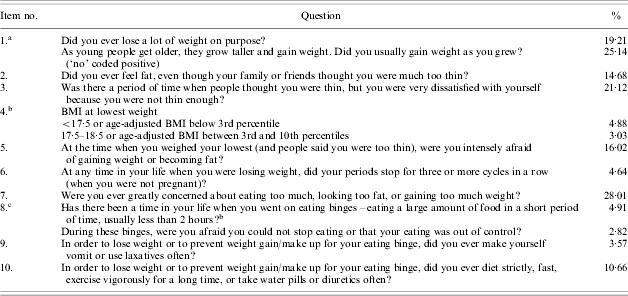
The ED diagnostic section of the interview was based on the DSM-IV classification system (APA, 2000). Questions were adapted from the ED section of the Diagnostic Interview Schedule – version 4 (Robins et al. Reference Robins, Cottler, Bucholz, Compton, North and Rourke1999), and diagnoses were derived using a computer algorithm. There were deviations from the DSM-IV in some interview questions. First, for AN, BMI below 17·5 at lowest weight was used to indicate ‘a minimally normal weight for age and height’ as in the ICD-10 AN criteria (WHO, 1993; APA, 2000). For women reporting an age at lowest weight ⩽19 years, a cut-off of BMI below the 3rd percentile for age (i.e. equal to BMI <17·5 in women >19 years) according to the Centers for Disease Control and Prevention (CDC) age for BMI growth chart for females age 2 to 20 was used instead (National Center for Health Statistics, 2000). Respondents were asked about their lowest weight if they indicated that they had lost a lot of weight on purpose, had not gained weight as they grew taller, or felt that they were fat or not thin enough when others thought that they were thin (see Table 1, items 1–3 for specific wording of questions). Second, for BN, frequencies of compensatory behavior were qualitative rather than quantitative. Respondents were asked if the behavior occurred ‘rarely’, ‘sometimes’ or ‘often’, with ‘often’ counting towards a strict BN diagnosis. For the broad definition of BN, frequency criteria were relaxed to one or more binges per week and inappropriate compensatory behavior ‘sometimes’ or ‘often’, and for the broad definition of AN the amenorrhea criterion was eliminated. ED treatment was assessed by the question, ‘Have you ever been treated for an eating disorder?’ Unfortunately, no data are available on the reliability of the ED assessment.
Eating disorder questions asked of participants in the Missouri Adolescent Female Twin Study and entered into a latent class analysis (n=3723)

a Collapsed into three mutually exclusive levels: lost weight on purpose, did not gain as grew, and neither.
b Only asked of women who answered yes to previous questions, others were assumed to have normal or greater than normal body mass index (BMI).
c Collapsed into three mutually exclusive levels: binge eating with loss of control, binge eating without loss of control, and no binge eating.
Data analysis
Latent class analysis (LCA)
LCA is a statistical method that has been widely used in psychiatric nosology (e.g. Kendler et al. Reference Kendler, Karkowski, Prescott and Pedersen1998; Neuman et al. Reference Neuman, Heath, Reich, Bucholz, Madden, Sun, Todd and Hudziak2001). The underlying premise of the latent class model is that the responses to a set of observed variables are indicative of an underlying latent variable with a finite number of mutually exclusive classes or subtypes. Furthermore, when the latent variable is introduced into the model, the observed variables will be mutually independent within each subtype. This latter assumption is known as ‘local independence’ in the latent class literature (Clogg, Reference Clogg, Arminger, Clogg and Sobel1995) and implies that the subject's response to any item is dependent only on their latent class assignment. The parameters to be estimated in a latent class model are (1) the proportion of the sample composing each class and (2) the class-specific symptom endorsement probabilities (SEPs). The posterior probability of a subject's membership in each class can be computed, and each subject is traditionally assigned to the group with the largest probability.
LCA models with two to nine classes were fit to the data. Assignment of individuals to classes was based on maximum likelihood methods using Mplus version 3.0, and clustering of twin data was taken into account using a sandwich estimator (Muthén & Muthén, Reference Muthén and Muthén2004). Since the likelihood ratio χ2 test is not appropriate for LCA model selection, as a j-class solution is not nested within a j+1 class solution, instead the model with the lowest Bayesian Information Criteria (BIC) was chosen as the best-fitting model (Schwarz, Reference Schwarz1978). To test whether the LCA results were affected by the twin nature of our sample, a separate LCA was performed using only one twin from each pair, and the resulting latent class assignments were compared to those obtained from the analyses using both members of the pair. Ninety-one per cent of the selected twins were assigned to the same class in both analyses.
Ten items from the ED diagnostic section were included in the LCA (displayed in Table 1, see Results). Two questions assessed binge eating, reflecting the two parts of BN criterion A (eating an abnormally large amount of food in a discrete period of time, and a sense of a lack of control during the episode). Respondents were only asked about loss of control if they had endorsed the previous question: ‘Has there been a time in your life when you went on eating binges – eating a large amount of food in a short period of time, usually less than 2 hours?’ These items were collapsed into a three-level variable (no binging, binging without loss of control, and binging with loss of control). Likewise, the two mutually exclusive items regarding the reason for low weight were also collapsed into a three-level variable (no low weight, did not gain weight while growing, and lost a lot of weight on purpose). Lowest BMI was also included as a three-level variable indicating normal weight or greater (BMI ⩾18·50), moderate underweight (BMI 17·50–18·49), and severe underweight (BMI <17·50). For women reporting an age at lowest weight ⩽19 years, those with a BMI between the 3rd and 10th percentiles for age were considered moderately underweight and those with a BMI below the 3rd percentile for age were considered severely underweight, as described in the assessment section above. Finally, inappropriate compensatory behavior was captured in two variables indicating purging and non-purging with reported frequency of ‘often’.
External validators
We used ED-related variables, other psychiatric diagnoses, substance use disorders (SUDs), suicidality variables, and demographic variables to further examine the characteristics of the latent subtypes. Comparisons of categorical and quantitative variables across the subtypes were performed using χ2 and multinomial logistic regression. stata version 8 (Stata Corp., College Station, TX, USA) was used for all analyses, and confidence intervals were adjusted for non-independence of observations. When omnibus tests proved statistically significant, post-hoc tests were performed to determine which of the five groups differed from one another. Because the presence of maternal interview data differed by class, variables taken from the maternal interview (maternal and paternal high school education) were included as three-level variables (education ⩽high school, >high school, and maternal interview data missing).
Familial resemblance
Familial resemblance modeling was conducted on the 1712 complete twin pairs [927 monozygotic (MZ) and 785 dizygotic (DZ)] in the study sample. The influence of genetic factors on twin concordance for assignment was assessed using multinomial logistic regression. The respondent's class assignment was the outcome variable, with the Unaffected Class serving as the referent category, and predictor variables consisted of a set of design variables indicating the co-twin's latent class assignment and zygosity. Zygosity was also included in the model as a main effect. Data were double entered such that each individual appeared in the analysis twice: once as the respondent and once as the co-twin. Standard errors were adjusted for clustering by family identification number.
RESULTS
Sample characteristics
Analyses were conducted on the 3723 women (98·36% of the total sample of 3785 participants) with complete data for all items included in the LCA. The age of the women ranged from 18 to 29 years, with a mean of 21·69 (s.d.=2·76). Fourteen per cent (14·45%) were from AA families, while the remaining women were mostly from EA families (85·55%). EA women had a higher rate of lifetime broadly defined AN than AA women (1·38% v. 0·19%, p=0·019), but there were no significant differences between EA and AA women for broadly defined BN (0·94% v. 0·74%, p=0·654).
Lifetime prevalences of items used in the LCA (see Table 1) ranged from 2·47% (‘In order to lose weight or to prevent weight gain/make up for your eating binge, did you ever make yourself vomit or use laxatives?’) to 28·01% (‘Were you ever greatly concerned about eating too much, looking too fat, or gaining too much weight?’).
Latent class analysis
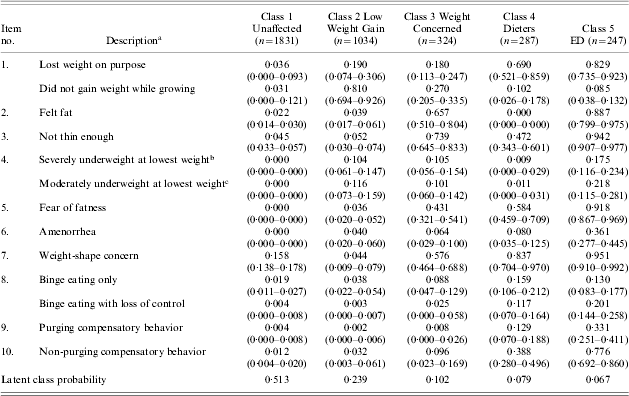
One- to nine-class solutions were investigated. The five-class solution had the lowest BIC and was thus chosen as the best model. The model provided a good fit to the data (χ2=1192·671, p=1·00). Table 2 displays the SEPs and overall class membership probabilities for each of the five classes. Individuals in the sample had the highest probability of being assigned to Class 1 (‘Unaffected’: 0·513), which had SEPs <0·100 for all symptoms except weight/shape concern, which was mildly elevated (0·158). Twenty-four per cent of the sample was assigned to Class 2 (‘Low Weight Gain’), which consisted entirely of women who reported that they either had not gained weight as they grew (81%) or had lost a lot of weight on purpose (19%), although only a minority had been underweight at their lowest weight. SEPs for all other symptoms were very low. Ten per cent of the women in the sample were assigned to Class 3 (‘Weight Concerned’). Approximately one-fifth of this class was underweight at lowest weight and almost half indicated that they had either lost weight on purpose or failed to gain weight as they grew. SEPs for eating disordered cognitions were moderate; however, binge eating and compensatory items were seldom endorsed. Eight per cent of the women in the sample were assigned to Class 4 (‘Dieters’), 69% of whom had lost a lot of weight on purpose. More than half of the women in this class endorsed the items for weight-shape concern and fear of fatness, almost half thought they were not thin enough, and over a third engaged in non-purging compensatory behavior. The remaining 6·0% of the sample was assigned to Class 5 (‘ED’), which had the highest SEPs for all symptoms in the LCA. In particular, SEPs for cognitive ED symptoms were extremely high. A third of ED class members engaged in purging and 77·6% engaged in non-purging compensatory behavior. While ED class members had the highest probability of having had amenorrhea of any class, the SEP for this criterion was still relatively low.
Class membership and class-specific symptom endorsement probabilities (and 95% confidence intervals) of psychiatric co-morbidity in women from the Missouri Adolescent Female Twin Study

a Refer to Table 1 for specific wording of questions.
b Body mass index (BMI) <17·5 or weight <3rd percentile for age.
c BMI 17·5–18·49 or weight 3rd–9th percentile for age.
External validators
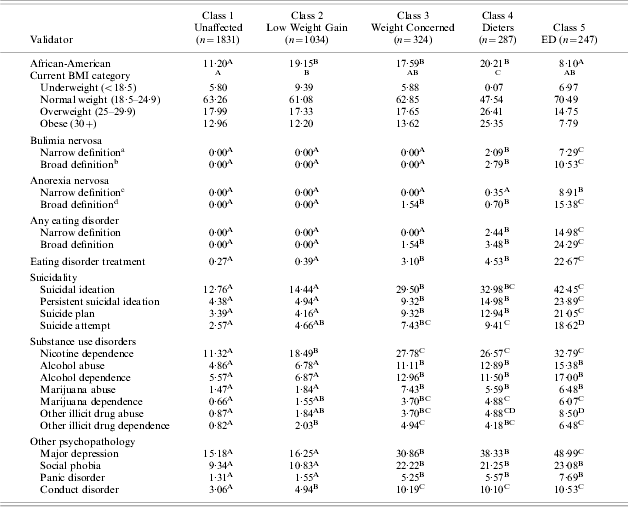
Low Weight Gain class members were slightly but significantly older than members of the Unaffected class (21·92 v. 21·52 years), but there were no other significant age differences between classes. Low Weight Gain, Weight Concerned and Dieter classes had higher (p>0·001) proportions of AA women (19·15, 17·59 and 20·21% respectively) than the Unaffected and ED classes (11·20% and 8·10% respectively). Weight Concerned class members were more likely (p>0·02) to have fathers with ⩽high school education than those in the Unaffected class, although the Weight Concerned and Low Weight Gain classes did not differ from one another. Interactions between race and maternal and paternal education were not significant.
ED variables by latent class are displayed in Table 3. Dieter Class members were more likely to be currently overweight and obese than members of the other classes, and the Low Weight Gain class had a higher proportion of underweight women than the Unaffected class. No members of the Unaffected or Low Weight Gain classes had a DSM-IV ED diagnosis. While some members of the Weight Concerned and Dieter classes had ED diagnoses, the majority of women with ED diagnoses were assigned to the ED class (80·00% of broad ED and 84·09% of narrow ED diagnoses). ED class members were significantly more likely to report ED treatment than members of any other class, and Weight concerned and Dieter class members were significantly more likely to have been treated for EDs than members of the Unaffected and Low Weight Gain classes.
External validators by latent class in women from the Missouri Adolescent Female Twin Study

BMI, Body mass index; ED, eating disorder.
All values are proportions unless otherwise indicated. Numbers with different superscripts differ significantly p⩽0·01.
a Strictly defined DSM-IV bulimia nervosa, frequency described as ‘often’.
b All criteria for DSM-IV bulimia nervosa met but self-reported binge/purge frequency defined as ‘often’ or ‘sometimes’.
c Strictly defined DSM-IV anorexia nervosa.
d All criteria for DSM-IV anorexia nervosa but amenorrhea (criterion D) met.
Other external validators by latent class are also shown in Table 3. Omnibus tests of statistical significance indicated between class differences (p<0·001) for all variables assessed. Post-hoc comparisons demonstrated that the Low Weight Gain class was differentiated from the Unaffected class only by higher rates of nicotine dependence, other illicit drug dependence, and conduct disorder. The ED class had a significantly higher prevalence of every diagnosis and behavior assessed compared to the Unaffected and Low Weight Gain classes. The ED class was differentiated from both the Weight Concerned and Dieter classes by higher rates of persistent suicidal ideation, suicide plan and attempt and major depression and from the Weight Concerned class alone by higher rates of suicidal ideation and other illicit drug abuse. There were no significant differences between the Weight Concerned and Dieter classes on any non-ED validators, and both classes tended to have higher rates of suicidality, SUDs, and other psychopathology than the Low Weight Gain class.
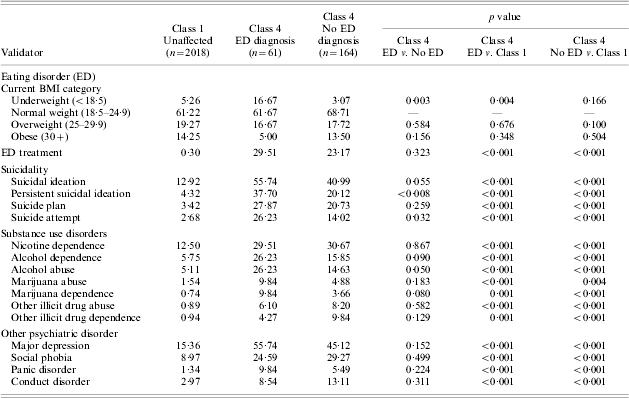
Because nearly all ED cases were found in the Severe ED class, we divided this class by presence or absence of a broad AN or BN diagnosis (Severe ED with diagnosis and Severe ED without diagnosis) and further statistical comparisons were made using a series of logistic regressions with the external validators as dependent variables. Design variables for the latent classes, with the Severe ED class divided by presence or absence of a broad ED diagnosis, were used as independent variables with the Unaffected class serving as the referent group. Post-hoc tests indicated whether the coefficients for Severe ED with and without ED diagnosis differed significantly. Results from these analyses are shown in Table 4. The only significant differences between Severe ED class members with and without an ED diagnosis (p⩽0·01) were that women without a diagnosis were less likely to be underweight and to have persistent suicidal ideation. With the exception of underweight, which was more prevalent in ED class members with a diagnosis but was not significantly elevated among those ED without diagnosis when compared to the Unaffected Class, ED class members both with and without ED diagnosis differed significantly from Unaffected class on every variable.
External validators by latent class with Class 4 divided by presence (n=61) or absence (n=164) of a broadly defined eating disorder diagnosisFootnote a in women from the Missouri Adolescent Female Twin Study

BMI, Body mass index.
All values are percentages unless otherwise indicated.
a All criteria for DSM-IV bulimia nervosa met but self-reported binge/purge frequency defined as ‘often’ or ‘sometimes’ or all criteria for DSM-IV anorexia nervosa but amenorrhea (criterion D) met.
Familial resemblance
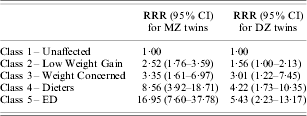
As shown in Table 5, relative risk ratios (RRRs) indicating the probability of assignment to a particular class, given co-twin membership in the same class, were higher for MZ twins than DZ twins for all classes compared to the Unaffected class. Post-hoc tests, however, did not reveal significant differences between RRRs for MZ and DZ twins (p<0·01), although there was a trend towards statistical significance for the Low Weight Gain (p=0·04) and ED (p=0·06) classes. Given the dramatic differences in point estimates and wide confidence intervals for both the Dieter and ED classes, the lack of evidence for a genetic basis for class assignment is likely to be a function of lack of statistical power rather than the absence of a true difference.
Relative risk ratios for MZ and DZ twins from a multinomial logistic regression predicting class assignment of respondent given class assignment of co-twin

RRR, Relative risk ratio; MZ, monozygotic; DZ, dizygotic; CI, confidence interval, ED, eating disorder.
DISCUSSION
In this LCA of ED interview items in a general population sample of adolescent female twins, we found five classes: Unaffected, Low Weight Gain, Weight Concerned, Dieter, and ED. The Low Weight Gain class, composed primarily of women who indicated that they had failed to gain weight as they grew, had the highest proportion of women who were underweight out of all classes, as well as significantly higher rates of conduct disorder and nicotine dependence compared to Unaffected class members. The ED class had significantly higher prevalence of suicidality and major depression than any other class and had significantly higher rates of SUDs and other psychopathology than the Unaffected and Low Weight Gain classes, which is consistent with other studies that found that women with EDs have significantly elevated rates of co-morbid psychopathology (e.g. Kaye et al. Reference Kaye, Bulik, Thornton, Barbarich and Masters2004), SUDs (e.g. Bulik et al. Reference Bulik, Klump, Thornton, Kaplan, Devlin, Fichter, Halmi, Strober, Woodside, Crow, Mitchell, Rotondo, Mauri, Cassano, Keel, Berrettini and Kaye2004) and suicidality (e.g. Corcos et al. Reference Corcos, Taieb, Benoit-Lamy, Paterniti, Jeammet and Flament2002). Separation of women in the ED class by presence or absence of broad DSM-IV ED diagnosis revealed no significant differences for SUDs, other psychopathology, most suicidality variables, and ED treatment. The other two classes, Weight Concerned and Dieter, did not differ significantly from one another on any non-ED diagnostic variables; however, Dieter class members were more likely to have BN and were currently heavier than women in the Weight Concerned class. Both classes were statistically similar to the ED class in the prevalence of SUDs, social phobia, panic disorder and conduct disorder, indicating that members of these classes, while less severely affected than those in the ED class, still suffer from a significant burden of psychopathology. Taken together, our findings suggest that the DSM-IV classification of eating disorder types is too narrow, misclassifying individuals with significant problems as unaffected.
The differentiation of groups of women with ED pathology by co-morbidity rather than by ED symptomatology has been reported elsewhere (Keel et al. Reference Keel, Fichter, Quadflieg, Bulik, Baxter, Thornton, Halmi, Kaplan, Strober, Woodside, Crow, Mitchell, Rotondo, Mauri, Cassano, Treasure, Goldman, Berrettini and Kaye2004; Duncan et al. Reference Duncan, Neuman, Hesselbrock, Kramer, Kuperman, Reich and Bucholz2005). Our results are similar to those reported by Wade et al. (Reference Wade, Crosby and Martin2006), who conducted a latent profile analysis of behavioral ED symptoms and BMI in a sample of Caucasian female twins with and without ED symptomatology. They identified five latent profiles that reflected severity of symptoms rather than types of EDs, several of which were comparable to classes identified in the current study. Notably, members of the most severely affected latent profile were also more likely to have major depressive symptoms and had higher rates of suicidality.
An important feature of our study is the ethnically heterogeneous sample. To our knowledge, this is the only study of the clustering of AN and BN symptoms in a general population sample with a substantial portion of AA women (14·5%). AA women were more likely to be assigned to the Low Weight Gain, Weight Concerned, and Dieter classes than to the Unaffected and ED classes. These differences did not appear to be a function of socio-economic status, as interactions between race and parental education were not significant. In an LCA of BN symptomatology, Streigel-Moore et al. (Reference Striegel-Moore, Franko, Thompson, Barton, Schreiber and Daniels2005) also found differences in latent class by ethnicity. The current findings contribute to the evidence that the type of eating pathology exhibited by AA women differs from that of EA women.
Our results differ from those of some previous studies, which found classes approximating DSM-IV ED types. There are several possible reasons for this discrepancy. First, we used the entire sample in the LCA, not just women with any ED symptoms (Bulik et al. Reference Bulik, Sullivan and Kendler2000) or diagnoses (Keel et al. Reference Keel, Fichter, Quadflieg, Bulik, Baxter, Thornton, Halmi, Kaplan, Strober, Woodside, Crow, Mitchell, Rotondo, Mauri, Cassano, Treasure, Goldman, Berrettini and Kaye2004). Using the entire sample is preferable because it allows for the possibility of false positive responses on individual items, which are seen as non-zero endorsement probability in the Unaffected class. Second, our sample of women aged 18–29 (mean age 21·7) is considerably younger than the samples used in other studies (Bulik et al. Reference Bulik, Sullivan and Kendler2000; Keel et al. Reference Keel, Fichter, Quadflieg, Bulik, Baxter, Thornton, Halmi, Kaplan, Strober, Woodside, Crow, Mitchell, Rotondo, Mauri, Cassano, Treasure, Goldman, Berrettini and Kaye2004; Wade et al. Reference Wade, Crosby and Martin2006). While younger women might be better informants regarding AN symptoms, which tend to onset early, a large portion of our sample had not passed through the age of risk for onset of binge eating and BN, which tends to onset later than AN (Hudson et al. (Reference Hudson, Hiripi, Pope and Kessler2007). This could explain the high rate of BN compared to AN as well as the relatively low rate of binge eating in our sample (7·8%). The low prevalence of binge eating in this sample could be the reason that the LCA did not detect a separate class of binge-eating women, and the results could rather reflect the continuous nature of anorexic behaviors (Williamson et al. Reference Williamson, Gleaves and Stewart2005). Another potential limitation of our study is the subjective assessment of the frequency of compensatory behavior (‘rarely’, ‘sometimes’ or ‘often’). Similarly, participants were allowed to define the ‘large amount’ of food eaten during a binge themselves, and it is possible that the binge eating endorsed by some of the women in this study was subjective rather than the objective binge eating required by the DSM-IV. Finally, because of the large number of statistical tests performed, it is possible that some of the statistically significant associations may be spurious due to type I error (erroneously rejecting the null hypothesis). Wherever possible, specific p values are given so that the reader may adopt a more stringent p value when evaluating these results.
CONCLUSIONS
Our results indicate that there exists in the general population a group of women larger than that of those who meet broad criteria for AN or BN who appear to be as severely affected in terms of psychiatric co-morbidity, suicidality, and substance use as those with broadly defined AN and BN. These women are as likely to have received treatment for EDs, suggesting that they and their clinicians perceive themselves to have had EDs. Furthermore, we identified two additional groups of women with ED symptoms who, although they were less likely to have suicidality, and major depression compared to those in the ED group, had similar levels of SUDs and other psychopathology to those in the ED group and elevated prevalences compared to women in the Unaffected and Low Weight Gain groups. These results add to the evidence that the DSM-IV criteria for EDs are not capturing a large portion of women with significant eating-related psychopathology. Future research focusing on the characterization of women with ED symptoms who do not meet criteria for AN or BN is needed to inform revisions of the current diagnostic system.
ACKNOWLEDGMENTS
This work was supported by grants AA09022, AA07728, AA11998 and by T32 DA07313-08 and T32 AA07580-06. This work was carried out in partial fulfillment of the dissertation requirements for a Ph.D. in Public Health Studies from the Saint Louis University School of Public Health (A. Duncan).
DECLARATION OF INTEREST
None.