Introduction
Despite the growing interest in anxiety among elderly people, several questions require clarification. Contrasting results have been reported regarding its frequency, with some studies reporting that anxiety disorders decrease with age (e.g. Henderson et al., Reference Henderson, Jorm, Korten, Jacomb, Christensen and Rodgers1998) and others showing the opposite (e.g. Lauderdale and Sheikh., Reference Lauderdale and Sheikh2003). Nevertheless, anxiety remains one of the most common psychiatric problems experienced by older people, with prevalence rates ranging from 15% to 52% for anxiety symptoms and from 3% to 15% for anxiety disorders (Bryant et al., Reference Bryant, Jackson and Ames2008). A recent study also revealed the importance of considering subthreshold manifestations of anxiety which may cause significant disabilities in social functioning (Grenier et al., Reference Grenier2011). Moreover, anxiety disorders are more frequent in the elderly with chronic medical conditions, depression (Beekman et al., Reference Beekman, Beurs, van Balkom, Deeg, van Duck and van Tilberg2000; Lenze et al., Reference Lenze, Mulsant, Shear, Alexopoulos, Frank and Reynolds2001), and cognitive disorders (Krasucki et al., Reference Krasucki, Howard and Mann1998). They contribute also to significant morbidity, loss of functional abilities, poorer quality of life, and increased use of medical care services (Lauderdale et al., Reference Lauderdale and Sheikh2003). Various biological, psychological, and social risk factors have been identified such as cognitive and functional impairments, hearing or vision loss, low self-perceived health, neuroticism, worrying about being a burden for others, and negative life events (Kogan et al., Reference Kogan, Edelstein and McKee2000; see Vink et al., Reference Vink, Aartsen and Schoevers2008 and Wolitsky-Taylor et al., Reference Wolitsky-Taylor, Castriotta, Lenze, Stanley and Craske2010 for a review).
The underlying mechanisms of psychological distress in the elderly may be quite different to that in the young people. Some studies (e.g. Kogan et al., Reference Kogan, Edelstein and McKee2000) have pointed to an underlying difficulty in evaluating anxiety symptoms in the elderly due to confounding effects of memory and other cognitive deficits, fatigue, and medication use. The question has also been raised as to whether symptom patterns alter with age independently of these factors due to aging-related modifications in the biological regulation of stressors. The validity of current diagnostic criteria for generalized anxiety in relation to elderly populations is currently uncertain due to the non-availability of adequate normative data, the majority of instruments having been developed and validated in younger populations (Fuentes and Cox, Reference Fuentes and Cox2000). Within the current context of revision of the major classification systems for psychiatric disorders, the provision of general population-based observations on elderly populations is timely.
The Spielberger State-Trait Anxiety Inventory (STAI; Spielberger et al., Reference Spielberger, Gorshu and Lushene1970) is probably the most widely used self-reported measure of anxiety. The scale differentiates “state anxiety,” defined as a transitory emotional state, and “trait anxiety” defined as a personality trait considered as being a relatively stable “tendency to perceive stressful situations as dangerous or threatening, and to respond to such situations with elevations in the intensity of state anxiety reactions” (Spielberger, Reference Spielberger1983). Previous studies have shown the utility and validity of this scale in the elderly (Stanley et al., Reference Stanley, Novy, Bourland, Beck and Averill2001; Dennis et al., Reference Dennis, Boddington and Funnell2007) although the impact of depression and somatic comorbidity on the score remains unclear and could limit STAI-Y validity (Dennis et al., Reference Dennis, Boddington and Funnell2007; Kvaal et al., Reference Kvaal, McDougall, Brayne, Matthews and Dewey2008). Significant positive correlations between the STAI-Y trait scale and depression scales have been reported in community-dwelling elderly people (Fuentes and Cox, Reference Fuentes and Cox2000) and with generalized anxiety (Hopko et al., Reference Hopko2000). Moreover, a number of small-scale studies have indicated that the STAI-Y has adequate internal consistency in the elderly with and without generalized anxiety disorder (Fuentes and Cox, Reference Fuentes and Cox2000; Stanley et al., Reference Stanley, Novy, Bourland, Beck and Averill2001), as well as within more heterogeneous groups of mixed psychiatric conditions (Himmelfarb and Murrell, Reference Himmelfarb and Murrell1984; Kabacoff et al., Reference Kabacoff, Segal, Hersen and Hasselt1997). Whereas norms of the STAI-Y state scale have been published recently by Potvin et al. (Reference Potvin2011), the currently available norms of the original STAI-Y trait scale specifically for the general elderly population remain restricted to the ones published by Himmelfarb and Murrell (Reference Himmelfarb and Murrell1984) based on the initial version of the trait scale (STAI-X). For French subjects, the norms by Bruchon-Schweitzer and Paulhan (Reference Bruchon-Schweitzer and Paulhan1993) are also avalaible, but they refer only to the young adult population. So, the lack of norms in the elderly for the STAI-Y trait appears to be important in both a clinical and research context. One objective of these norms is to propose a more accurate detection of anxiety symptoms in the elderly than the published clinical cutoffs which do not result in a consensus (e.g. Himmelfarb and Murrell, Reference Himmelfarb and Murrell1984; Dennis et al., Reference Dennis, Boddington and Funnell2007).
The purpose of the present study is hence to provide normative data for the STAI-Y trait scale from a large elderly cohort drawn at random from the general population and to identify some of the principal sociodemographic and health correlates that appear important when evaluating anxiety in the elderly.
Methods
Study population
The participants of the present study are those included in the “Three-City” (3C) Study, a prospective multicenter cohort study of cerebral aging. The methodology and baseline characteristics of the participants have been previously described (Alpérovitch et al., Reference Alpérovitch2003). Briefly, it is a prospective cohort study of 9,294 subjects (3,650 men and 5,644 women) aged 65 years and older, non-institutionalized at baseline. The sample was drawn from a random sample obtained from the electoral rolls of three French cities (Bordeaux (southwest), Dijon (central east), and Montpellier (southeast)). Baseline data were collected between March 1999 and March 2001 and participants were followed up every two years. All of the participants gave informed consent. Trained nurses and psychologists collected information during a face-to-face interview relating to sociodemographic characteristics, educational level, and lifestyle. Additionally, a clinical examination included blood pressure, anthropometric measurements and biological parameters, self-report of chronic diseases, medication use, anxiety, depressive symptoms, and functional status. Cognitive testing was also undertaken with a provisional diagnosis of probable dementia being made with reference to standard international diagnostic criteria (DSM-III-R; American Psychiatric Association, 1987). In Montpellier, all subjects were examined by a neurologist and in the other two centers neurologists examined screen-positive subjects. All cases were validated by an independent panel of specialized neurologists who reviewed all available information to apply criteria commonly used for each etiology. The ethical committee of the University Hospital of Kremlin-Bicêtre approved the 3C Study.
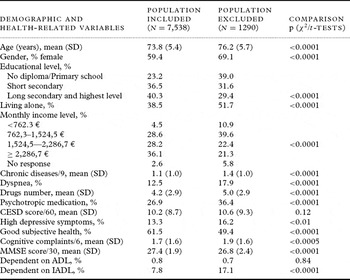
For the present study, participants were excluded if they had dementia (n = 215), were confined to bed (n = 47), or did not fully complete the depression questionnaire (n = 241). The present study is thus based on 8,828 eligible participants interviewed at baseline. The descriptive analyses (see Table 1) indicated that individuals who declined to participate were older (p < 0.0001), more often female (p < 0.0001), and with lower education (p < 0.0001).
General characteristics of the study population (N = 8,828)

SD = Standard Deviation; € = Euro (European devise); CESD = Center for Epidemiologic Studies of Depression Scale; High depressive symptoms is based on validated CES-D French cutoff scores (16 for men, 22 for women); MMSE = Mini-Mental State Examination; ADL = Activities of Daily Living (1: subject is dependent for at least one activity, else, 0); IADL = Instrumental Activities of Daily Living (1: subject is dependent for at least one activity, else, 0).
Sociodemographic variables
Sociodemographic variables assessed were age, sex, educational level, living alone, and income level. Three categories of education (at least primary school level validated by a diploma, short secondary school level validated by a diploma, long secondary school level validated by a diploma, and highest school level) were used. The monthly income level was coded into five categories: less than 762.3 €, between 762.3 € and 1,524.5 €, between 1,524.5 € and 2,286.7 €, more than 2,286.7 €, and no answer).
Clinical variables
The French version of the STAI-Y trait scale (Bruchon-Schweitzer and Paulhan, Reference Bruchon-Schweitzer and Paulhan1993) was completed as a self-reported questionnaire during the interview with the psychologist. Respondents were asked to indicate how they “generally feel” on a four-point scale with respect to 20 different anxiety-related items. The psychologist read aloud instructions on how to fill in the questionnaire.
Depressive symptoms were assessed using the Center for Epidemiological Studies Depression Scale (CES-D). This 20-item self-report questionnaire asks participants to indicate their experience of different depressive symptoms on a four-point scale over the previous week. Cutoff scores for significant depressive symptoms were those having previously been established for a French population (>16 for men; >22 for women; Fuhrer and Rouillon, Reference Fuhrer and Rouillon1989).
Subjective health status was evaluated by asking the participants to rate their health (very good/good/average vs. poor/very poor).
A questionnaire regarding subjective cognitive complaints required participants to rate current cognitive difficulties relating to forgetfulness for recent and past events, language, calculation, and orientation, and to specify whether they had spoken of these problems with their general practitioners. The total number of cognitive complaints was then calculated leading to a score ranging from 0 to 6.
Global cognitive functioning was assessed by the French version of the Mini-Mental State Examination (MMSE), with the scores ranging from 0 to 30.
Functional status was assessed by two instruments: the French translations of Katz's scale of basic Activities of Daily Living (ADL) and Lawton's scale of Instrumental Activities of Daily Living (IADL). Dependency for ADL and IADL (coded 1) was attributed to participants who could not perform one or more activities listed in these scales at the highest level of performance, without help (otherwise coded 0). IADL referring to laundry, food preparation, and housekeeping were not considered for functional status in men.
Information regarding the number of current medications and psychotropic medication use was obtained during the interview and requests were made to see medications used regularly during the preceding month. Dyspnea was assessed by asking the subject whether he felt out of breath in circumstances requiring minor effort (e.g. walking with other people of their own age). The number of chronic diseases was also recorded with a score ranging from 0 to 9. Participants were asked whether they had a physician's diagnosis of cardiac failure, myocardial infarction, angina pectoris, chronic obstructive pulmonary disease, fractures during the two preceding years (femoral or vertebral), cancer diagnosis, diabetes, hypertension, or arthrosis. Participants were considered as hypertensive if self-reported or systolic blood pressure was ≥160 mmHg or diastolic blood pressure was ≥95 mmHg or if they were on antihypertensive medications.
Statistical analyses
Frequencies, means, and standard deviations were calculated for sociodemographic and health-related variables. t-tests and χ2 comparisons assessed the significance of the differences observed between the participants who were included in the study (n = 7,538) and those who were excluded because of missing data on the STAI-Y trait scale (n = 1,290).
Second, to produce the STAI-Y trait norms, we examined associations between the STAI-Y trait score and common associated factors such as age, gender, educational level, and depression score, using t-tests and ANOVAs.
Finally, to identify the various sociodemographic and health-related variables associated with the STAI-Y trait score, we performed a first set of univariate linear regressions, followed by multiple linear regressions with a backward stepwise procedure to identify the main explanatory variables. All interactions were tested among the significant associated factors.
Statistical analyses were carried out using SAS software (version 9.1). The significance level of p < 0.05 was considered for all statistical analyses.
Results
Demographic and health-related characteristics of our study sample are described in Table 1.
Briefly, the 7,538 participants of study sample had a mean age of 73.8 years (SD = 5.4) and 59% were women. Most participants completed short secondary school (76.8%), were married (61.5%), and 64.3% had a monthly income level higher than 1,524.5 Euros. A small proportion of the subjects had functional restrictions (7.8% and 0.8% individuals dependent for one or more IADL and ADL, respectively), 12.5% had dyspnea, and the mean number of chronic diseases was 1.1 (SD = 1.0). Regarding mental health variables, 13.3% had high depressive symptoms, 26.9% used psychotropic medication, and 61.5% reported good subjective health. The mean score on the MMSE was 27.4 (SD = 1.9).
STAI-Y trait norms
The α coefficient for internal consistency was 0.89.
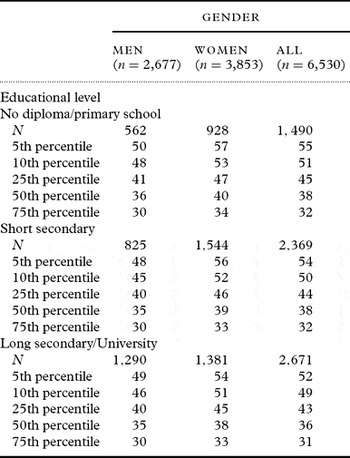
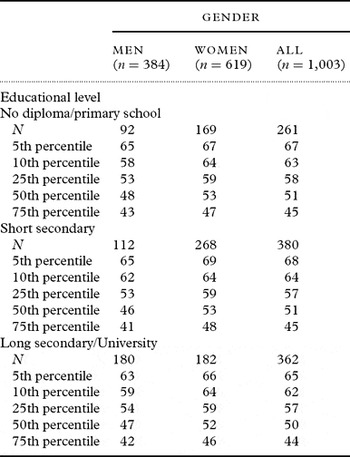
To produce the STAI-Y trait norms, we assessed associations between the STAI-Y trait score and common associated factors such as age, gender, educational level, and depression score. The results showed that STAI-Y trait scores differed according to gender (p < 0.0001), educational level (<0.0001), and depressive symptoms (p < 0.0001), but not with age (p = 0.45). Therefore, norms were stratified by gender and educational level and were presented separately for non-depressed (Table 2) and depressed (Table 3) elders.
STAI-Y trait scores of non-depressive elderly adults as a function of educational level and gender

STAI-Y trait scores of depressive elderly adults as a function of educational level and gender

Health-related factors of trait scores STAI-Y
As shown partially in the previous section, the univariate analyses revealed significant associations between the STAI-Y trait score and all sociodemographic variables (gender, living alone, educational level, income level, at p < 0.0001) except age (p = 0.45). All clinical variables (hypertension, p < 0.05; chronic diseases, p < 0.0001; dyspnea, p < 0.0001; drugs number, p < 0.0001; psychotropic medication, p < 0.0001; depressive symptoms, p < 0.0001; subjective health, p < 0.0001; cognitive complaints, p < 0.0001; cognitive functioning, p < 0.0001; dependency on ADL, p < 0.0005; and IADL, p < 0.0001) were also significantly associated with the STAI-Y trait score.
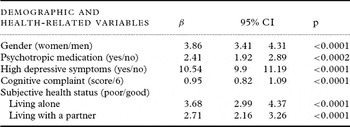
The multivariate model is presented in Table 4. The variables which are most highly associated with STAI-Y trait scores were gender (with women having higher anxiety scores), psychotropic medication use (among the participants under psychotropic, the score of anxiety is increased by 2.41 on average compared to the participants not taking any), high depressive symptoms (increasing the score of trait anxiety by 10.54 on average), cognitive complaints (increasing the score of trait anxiety by 0.95 on average), and the interaction between subjective health and marital status (i.e. in participants living alone those assessing their subjective health as poor had 3.68 higher trait anxiety scores than those with good subjective health). R 2 for this model is 0.3.
Multiple regression model of sociodemographic and clinical variables associated with STAI-Y trait score

R 2 adjusted = 0.3008.
Discussion
Anxiety is an important public health consideration given its impact on other aspects of health and daily functioning (Teachman, Reference Teachman2006). Consistent with previous studies (Fuentes and Cox, Reference Fuentes and Cox2000; Stanley et al., Reference Stanley, Novy, Bourland, Beck and Averill2001), our results confirm good internal consistency of the STAI-Y trait scale in this large elderly cohort; high α coefficients are considered to indicate item redundancy so that correlations of around 0.8 are considered ideal for scales measuring single traits.
STAI-Y trait norms
The aim of the present study was to produce norms for the STAI-Y trait anxiety scale with a large sample of elderly people selected from the general population. The selected participants were without dementia, not institutionalized, not confined to bed, and did not have any major hearing deficits. Globally, women with a lower educational level (median = 40) had higher STAI-Y trait scores compared to men with at least a short secondary educational level (median = 35). Moreover, as expected, depressed participants also had higher trait anxiety levels; separate norms are therefore provided to distinguish anxiety from mixed anxiodepressive states. In the non-depressed elderly sample, the STAI-Y trait median scores were higher for women than for men. This effect was especially obvious in women with the lowest educational level compared with men with the highest educational level.
Compared with normative data previously obtained from younger French adults (Bruchon-Schweitzer and Paulhan, Reference Bruchon-Schweitzer and Paulhan1993) of the STAI-Y trait, non-depressed elderly persons had lower trait median scores, although age was not found to be a significant determinant of anxiety level within the elderly cohort. On the other hand, depressed elderly persons had higher trait anxiety median scores compared to younger adults suggesting perhaps that comorbid depression may be associated with trait anxiety in the elderly. This difference will of course be partly due to differences in sampling methods and, perhaps more importantly, to cohort differences; the elderly group is a war cohort and more likely to have experienced trauma which may have down- or upregulated biological stress reactivity systems.
Health-related factors of the STAI-Y trait
Another objective of the present study was to identify the sociodemographic and health-related variables associated with the trait anxiety measured by STAI-Y trait score. Univariate analyses confirm previous work indicating significant associations of trait anxiety with sociodemographic variables: female gender, living alone, lower educational level, and lower income level (Himmelfarb and Murrell, Reference Himmelfarb and Murrell1984; Fuentes and Cox, Reference Fuentes and Cox2000). In particular, the association with gender is consistent with previous work indicating that elderly women have higher trait anxiety levels compared to elderly men. Nevertheless, the present study does not reveal significant association with age. This finding is consistent with past studies (Henderson et al., Reference Henderson, Jorm, Korten, Jacomb, Christensen and Rodgers1998) and is further confirmed by a study of hypothalamus–pituitary–adrenal axis functioning carried out in one of the Three City study centers at the time of interview, which noted greater increases in cortisol secretion in relation to both state and trait anxiety, with slower recovery in women and no age effect (Chaudieu et al., Reference Chaudieu, Beluche, Norton, Boulenger, Ritchie and Ancelin2008). Although some previous studies have shown trait anxiety scores to increase with age in elderly cohorts (Himmelfarb and Murrell, Reference Himmelfarb and Murrell1984; Teachman, Reference Teachman2006), this large-scale study does not confirm these findings and challenges the hypothesis of Teachman suggesting a curvilinear relationship of negative affect symptoms with age. On the other hand, our sample may have lacked sufficient age variability, especially given lower numbers in the oldest age category (i.e. over 85 years). Previous clinical studies have underlined the role of rumination in anxiety symptoms, with elderly persons, in particular women, more likely to ruminate longer over stressors (Chaudieu et al., Reference Chaudieu, Beluche, Norton, Boulenger, Ritchie and Ancelin2008). Exposure to recent adverse life events, more common in the elderly, may thus be an important confounding variable. Future research using longitudinal design is needed to better understand the evolution of anxiety symptoms.
Furthermore, after adjustment, variables such as dependency, cognitive functioning, and educational level were not associated with anxiety. This result may be explained in part by the exclusion of participants with dementia and those confined to bed. We can hypothesize anxiety would be more associated with these vulnerability factors in elderly persons having more severe cognitive deficits or dementia (see review of Seignourel et al., Reference Seignourel, Kunik, Snow, Wilson and Stanley2008 about anxiety in dementia). So, in the present study, medication, depressive symptoms, subjective cognitive complaints, subjective health status, and marital status were major predictors of STAI-Y trait score. The finding that psychotropic medication was associated with higher trait anxiety score is not surprising as this may have been given in some cases for anxiety or anxiety-related symptoms such as sleep disturbance. Previous work has indicated that the prevalence of psychotropic medication increases according to the STAI-X trait score (Paterniti et al., Reference Paterniti, Bisserbe and Alperovitch1998). The fact that high depressive symptoms strongly predicted STAI-Y trait score further supports previous observations of high depression and anxiety comorbidity (Beekman et al., Reference Beekman, Beurs, van Balkom, Deeg, van Duck and van Tilberg2000; Lenze et al., Reference Lenze, Mulsant, Shear, Alexopoulos, Frank and Reynolds2001). Moreover, it has recently been shown that STAI trait scores are more strongly correlated with depression than other measures of anxiety (Bados et al., Reference Bados, Gomez-Benito and Balaguer2010). Due to the limits of current measures and to the different characteristics and risk factors between anxiety and anxiety with comorbid depression, separate normative data appeared necessary.
The present results also corroborate previous findings showing an association between subjective cognitive complaints and trait anxiety symptoms (Jorm et al., Reference Jorm, Christensen, Henderson, Korten, Mackinnon and Scott1994). Finally, among the participants living alone, those assessing their subjective health as poor had higher trait anxiety scores than those with good subjective health. Among the participants assessing their subjective health as poor, those living alone had lower trait anxiety scores than those with poor subjective health. This effect was also observed in participants living with a partner, with a lower magnitude. Previous results indicate that having a partner is associated with a more optimistic perception of life and has a positive impact on subjective health, in comparison with persons living alone (Barberger-Gateau and Fabrigoule, Reference Barberger-Gateau and Fabrigoule1997). Previous studies have also indicated that general health perception was associated with the STAI-Y State (Dennis et al., Reference Dennis, Boddington and Funnell2007, Byrne et al., Reference Byrne, Pachana, Goncalves, Arnold, King and Khoo2010; Potvin et al., Reference Potvin2011).
While the covariates examined in this study were only able to explain a small proportion of the total variance in STAI scores (R 2 = 0.3), this is not unusual for psychiatric syndromes of highly complex etiology in the elderly. It is not, however, the place of this study to explore the causes of anxiety disorder in the elderly, but rather to indicate expected levels of normal functioning for this age group and to indicate primary adjustment variables which should be taken into account when clinically evaluating STAI scores. Adequate consideration of these variables could improve interpretation of the STAI and subsequent decision for a more complete evaluation of anxiety. Nevertheless, further research using a longitudinal design is necessary to identify the risk factors of anxiety such as race or ethnicity (see Wolitsky-Taylor et al., Reference Wolitsky-Taylor, Castriotta, Lenze, Stanley and Craske2010, for a review).
Conclusion
While this study has not been able to provide validation data based on a gold-standard measure of clinical anxiety and may have introduced some bias due to exclusion of persons with dementia or those who are bed-ridden, it has provided normative data on a very large elderly cohort which is not only age- and education-adjusted but also provides separate norms for anxiety disorders alone and mixed anxiety and depression. These norms obtained with the French version of the STAI-Y should be consistent with the English STAI-Y version, although further studies would be needed to confirm this. Moreover, it could be important to develop norms taking into account health and medical problems due to their potential associations with the trait anxiety.
Confirmation of previously identified risk factors suggests that despite the low response rate in the study, data are consistent with previous observations, except for age. Whether or not anxiety levels are modified by age remains a strongly debated question. The results of a previous study, corroborated by biological measures of stress, suggest they do not (Chaudieu et al., Reference Chaudieu, Beluche, Norton, Boulenger, Ritchie and Ancelin2008).
Conflict of interest
None.
Description of authors' roles
Valérie Bergua wrote the paper. Céline Meillon and Mélanie Le Goff performed the statistical analyses. Olivier Potvin, Jean Bouisson, Olivier Rouaud, Karen Ritchie, and Jean-François Dartigues revised the paper and contributed to its content and to interpretation of data. Hélène Amieva supervised data interpretation and preparation of the paper. Jean-François Dartigues developed the paper further and was responsible for the research design.
Acknowledgments
The Three-City study is conducted under a partnership agreement among the “Institut National de la Santé et de la Recherche Médicale” (INSERM), the Segalen-Bordeaux University, and Sanofi-Aventis. The “Fondation pour la Recherche Médicale” funded the preparation and initiation of the study. The Three-City study is also supported by the Caisse Nationale Maladie des Travailleurs Salariés, Direction Générale de la Santé, MGEN, Institut de la Longévité, Conseils régionaux d'Aquitaine et de Bourgogne, Fondation de France, and Ministry of Research-INSERM Program Cohortes et Collections de données biologiques.