Introduction
Breeding programmes rely mainly on the genetic diversity available in crop collections. It is therefore important to evaluate the phenotypic and genotypic diversity they encompass.
Most agronomic traits are controlled by multiple loci with a quantitative effect. Compared with the analysis of biparental crosses, which is the most common method used to identify such quantitative trait loci, the exploitation of crop collections by association mapping has two major advantages: (1) polymorphisms of interest are detected in a large range of genetic backgrounds, including allelic diversity relevant to plant breeders (Simko, Reference Simko2004) and (2) resolution for detecting quantitative effects is improved because these collections represent a higher number of recombination events (Flint-Garcia et al., Reference Flint-Garcia, Thornsberry and Buckler2003). Nevertheless, the presence of population structure can result in false associations between markers and phenotypes (Lander and Schork, Reference Lander and Schork1994). It is therefore important to first examine the genetic structure of the studied collection and take it into consideration in the association mapping model (Yu et al., Reference Yu, Pressoir, Briggs, Vroh Bi, Yamasaki, Doebley, McMullen, Gaut, Nielsen, Holland, Kresovich and Buckler2006).
The tetraploid cultivated potato (Solanum tuberosum L.) is a very important staple crop, which is cultivated worldwide. Landrace populations of S. tuberosum grow from western Venezuela to northern Argentina (Andean populations) and then, from lowland Chile in Chiloé Island and the Chonos Archipelago Islands to the south (Chilean populations) (Ovchinnikova et al., Reference Ovchinnikova, Krylova, Gavrilenko, Smekalova, Zhuk, Knapp and Spooner2011). There has been much controversy over the taxonomic classification of these landraces, as well as over the origin of ‘modern’ potato cultivars (the cultivated potato which first appeared in Europe and then spread worldwide). However, recent studies have shown that European potato germplasm was derived from Chilean forms of S. tuberosum (Rios et al., Reference Rios, Ghislain, Rodriguez and Spooner2007; Ames and Spooner, Reference Ames and Spooner2008).
The genetic diversity of the cultivated S. tuberosum L. gene pool has been investigated previously. Some studies have focused on genotypes cultivated in specific regions (Veteläinen et al., Reference Veteläinen, Gammelgard and Valkonen2005; Sukhotu and Hosaka, Reference Sukhotu and Hosaka2006; Ispizua et al., Reference Ispizua, Guma, Feingold and Clausen2007; Solano et al., Reference Solano, Morales and Anabalon2007; Fu et al., Reference Fu, Peterson, Richards, Tarn and Percy2009; Zhang et al., Reference Zhang, Brown, Culley, Baker, Kunibe, Denney, Smith, Ward, Beavert, Coburn, Pavek, Dauenhauer and Dauenhauer2010). Other studies have analysed the genetic diversity of collections of worldwide ‘modern’ cultivars and advanced breeders' clones (Gebhardt et al., Reference Gebhardt, Ballvora, Walkemeier, Oberhagemann and Schüler2004; Simko et al., 2004a, Reference Simko, Haynes, Ewing, Costanzo, Christ and Jonesb; Li et al., Reference Li, Strahwald, Hofferbert, Lübeck, Tacke, Junghans, Wunder and Gebhardt2005; Malosetti et al., Reference Malosetti, van der Linden, Vosman and van Eeuwijk2007; D'Hoop et al., Reference D'Hoop, Paulo, Mank, van Eck and van Eeuwijk2008, Reference D'Hoop, Paulo, Kowitwanich, Sengers, Visser, van Eck and van Eeuwijk2010; Pajerowska-Mukhtar et al., Reference Pajerowska-Mukhtar, Stich, Achenbach, Ballvora, Lubeck, Strahwald, Tacke, Hofferbert, Ilarionova, Bellin, Walkemeier, Basekow, Kersten and Gebhardt2009; Urbany et al., Reference Urbany, Stich, Schmidt, Simon, Berding, Junghans, Niehoff, Braun, Tacke, Hofferbert, Lubeck, Strahwald and Gebhardt2011). Ghislain et al. (Reference Ghislain, Nunez, Herrera and Spooner2009) carried out a more comprehensive study in which the genetic diversity of Chilean accessions, Andean accessions and ‘modern’ cultivars was assessed. This study showed that ‘modern’ cultivars cluster with Chilean landraces rather than with Andean landraces, and that they all present a high genotypic diversity. Moreover, Chilean accessions proved to present favourable traits such as resistance to virus diseases and Erwinia soft rot (Spooner et al., Reference Spooner, Contreras and Bamberg1991) or partial resistance to late blight (Solano, 2011).
The purpose of the study was to examine the genetic diversity of a collection of Chiloé Island landraces relative to a large collection of ‘modern’ genotypes, in order to investigate further the interest of using the Chilean gene pool in potato breeding programmes.
Materials and methods
Plant material
With the aim of collecting a representative subset of the genetic diversity available in our collection of modern germplasm of the cultivated tetraploid potato, we selected 350 potato varieties or breeders' lines. The genotypes are listed in Supplementary Table S1 (available online). In this paper, this subset will be referred to as the modern group. It was formed by selecting genotypes showing extreme phenotypes for 21 morphological or agronomic traits. The country of origin was also considered. This selection was based on the data available in the European Cultivated Potato Database (http://www.europotato.org). All these genotypes are maintained in the field at the INRA BrACySol Biological Resource Center (UMR IGEPP, Ploudaniel, France).
A total of 30 tetraploid accessions of native potato collected between 2000 and 2007 on Chiloé Island were chosen to represent the phenotypic diversity of S. tuberosum L., which is still being cultivated on this island. These accessions are maintained in the field at the experimental station of the Catholic University of Temuco (Chile). DNA from these genotypes was provided by J. Solano.
We also examined 14 tetraploid Andean accessions of S. tuberosum L. and four diploid accessions of Solanum stenotomum Juz. & Bukasov, both species being Andean cultivated species. We included four accessions of the diploid species Solanum sparsipilum Juz. & Bukasov, which belong to the southern Brevicaule group (Spooner et al., Reference Spooner, McLean, Ramsay, Waugh and Bryan2005). These accessions were obtained in 1974, 1978 or 1988 as seeds from the Inter-Regional Potato Collection, Sturgeon Bay (WI, USA) or the German–Dutch Collection, Braunschweig (Germany). They are maintained by vegetative propagation in the greenhouse at the INRA BrACySol Biological Resource Center. One clone of each accession was chosen for this study.
For all the genotypes except Chiloé Island landraces, leaf material was harvested from greenhouse-grown plants, frozen in liquid nitrogen and stored at − 80°C until DNA extraction. For the Chiloé Island landraces, DNA was extracted from young fresh leaves.
Simple sequence repeat (SSR) genotyping
DNA extraction was performed using a protocol derived from Doyle and Doyle (Reference Doyle and Doyle1990). The quality and concentration of the DNA was verified using ethidium bromide-stained 1.5% agarose gels. Concerning the Chiloé Island landraces, DNA was isolated as described by Solano et al. (Reference Solano, Morales and Anabalon2007).
A total of 19 microsatellite markers developed by Milbourne et al. (Reference Milbourne, Meyer, Collins, Ramsay, Gebhardt and Waugh1998), Ghislain et al. (Reference Ghislain, Spooner, Rodriguez, Villamon, Nunez, Vasquez, Waugh and Bonierbale2004) and Feingold et al. (Reference Feingold, Lloyd, Norero, Bonierbale and Lorenzen2005) were selected for their high level of polymorphism and their map position (in order to represent each chromosome). These SSR markers were Sti006, Sti012, Sti023, Sti024, Sti028, Sti029, Sti043, Sti044, Sti050, Sti051, Sti057, Sti060, STM0028, STM1016, STM1021, STM1040, STM2005, STM2030 and STM3011 (their map position is shown in Supplementary Table S2, available online). For all the genotypes except the Chiloé Island landraces, the genotyping work was performed at the high-throughput genotyping platform GENTYANE at INRA Clermont-Ferrand. Microsatellites were amplified by a separate PCR in a 6.5 μl reaction volume containing 25 ng of genomic DNA, 0.2 mM of each dNTP, 0.25 U of Taq (Qiagen), 1 μM of the labelled M13 primer, 0.327 pM of the forward primer and 3.27 pM of the reverse primer. The PCR conditions were one cycle of 94°C for 4 min, then seven touchdown cycles with a decreasing annealing temperature, followed by 25 cycles at the minimum of the slope. Thereafter, seven cycles of 94°C for 30 s, 56°C for 1 min and 72°C for 30 s were used for labelled M13 primer extension followed by a final extension at 72°C for 5 min. For the Chiloé Island landraces and 17 modern cultivars selected from the list of genotypes tested in the GENTYANE platform, the genotyping work was performed at the high-throughput genotyping platform Biogenouest® at INRA Le Rheu. The 17 common genotypes allowed us to check the equivalence of the experiments performed at both platforms. Microsatellites were amplified by a separate PCR in a 8 μl reaction volume containing 20 ng of genomic DNA, 4 μl of AmpliTaqGold® 360 Master Mix (Applied Biosystems, Foster City, USA), 0.5 μM of each reverse and labelled M13 primer and 0.05 μM of the forward primer. The PCR conditions were one cycle of 94°C for 4 min, followed by 12 cycles of 94°C for 30 s, 65°C for 1 min with a 1°C decrease per cycle, 72°C for 30 s, then 25 cycles of 94°C for 30 s, 53°C for 1 min, 72°C for 30 s and a final extension at 72°C for 10 min. The fluorescence dyes used at both platforms were 6-FAM™, VIC®, NED™, PET® and LIZ®.
PCR products were separated by capillary electrophoresis using an ABI PRISM® 3100 Genetic Analyzer (Platform GENTYANE) or an ABI PRISM® 3130xl Genetic Analyzer (Platform Biogenouest®). SSR alleles were detected and scored using GeneMapper 3.7 software (Applied Biosystems). The SSR alleles were identified by their size and scored as present (1) or absent (0).
Diversity and population structure analyses
The total number of identified alleles and the number of specific alleles were determined for each species or taxonomic group.
Using the program DARwin 5.0 (Perrier and Jacquemoud-Collet, 2006), the genetic distance between each pair of genotypes was calculated using the Dice dissimilarity index with the minimal proportion of valid data required for each unit pair set at 50%. The mean genetic distances within each species or taxonomic group and between each pair of species or taxonomic groups were then calculated.
Different population structure analyses were performed. First, we carried out a principal coordinate (PCO) analysis with the program DARwin 5.0 (Perrier and Jacquemoud-Collet, 2006) using the Dice dissimilarity index on the complete dataset. Next, three different methods were used considering only the modern group and the Chiloé Island landraces, in order to investigate the relationships between these two groups more precisely. We again used the program DARwin 5.0 (Perrier and Jacquemoud-Collet, 2006) to carry out a PCO analysis as well as a hierarchical clustering analysis. To calculate genetic distances, 100 bootstraps were performed. The dendrogram was built using the Ward minimal variance methodology. Finally, we used the Bayesian model-based clustering method of Pritchard et al. (Reference Pritchard, Stephens and Donnelly2000) implemented in STRUCTURE 2.2 software (http://pritch.bsd.uchicago.edu/software). STRUCTURE was run under the assumption of admixture with independent allele frequencies. No a priori population information was used. Analyses were performed for the number of subgroups (K) ranging from 1 to 15 with five independent repeats for each K. For each run, we used a burn-in period of 100,000 iterations and then 200,000 iterations for estimating the parameters. The estimated log probability of data Pr(X/K) and the associated standard deviation were computed for each tested K, and the optimal number of clusters was inferred from the formula established by Evanno et al. (Reference Evanno, Regnaut and Goudet2005). When the optimal number of subgroups was determined, each genotype was assigned into a cluster according to its proportion of membership in this subgroup. The reproducibility of genotype assignment into the subgroups was checked between the five replicates.
Using the program Arlequin 3.1 (Excoffier et al., Reference Excoffier, Laval and Schneider2005), two analyses of molecular variance (AMOVA) were performed: first to evaluate the variation explained by the clusters identified using STRUCTURE; second to evaluate the variation explained by considering the Chiloé Island landraces and the modern genotypes as two separate groups. The distance matrix built using the program DARwin was used as input data and the number of permutations was set at 1000.
Results
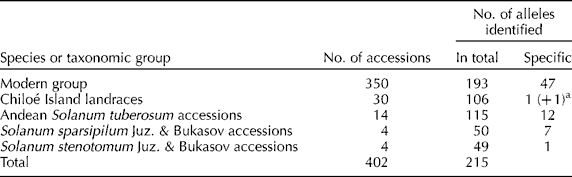
In total, 215 alleles were identified, of which 193 were observed in the modern group, 106 in the Chiloé Island landraces, 115 in the Andean S. tuberosum accessions, 50 in the S. sparsipilum Juz. & Bukasov accessions and 49 in the S. stenotomum Juz. & Bukasov accessions (Table 1). The number of alleles identified for each SSR marker is presented in Supplementary Table S2 (available online). Regarding the specificity of these alleles, 47 alleles were specific to the modern group, one allele was specific to the Chiloé Island landraces, 12 alleles were specific to the Andean S. tuberosum accessions, seven alleles were specific to the S. sparsipilum Juz. & Bukasov accessions and one allele was specific to the S. stenotomum Juz. & Bukasov accessions (Table 1). Of the 106 alleles identified in the Chiloé Island landraces, two alleles were not found in the modern group.
Number of accessions, total number of alleles identified and number of specific alleles for each species or taxonomic group

a Another allele present in the Chiloé Island landraces was not found in the modern group (it was present in one S. sparsipilum Juz. & Bukasov accession).
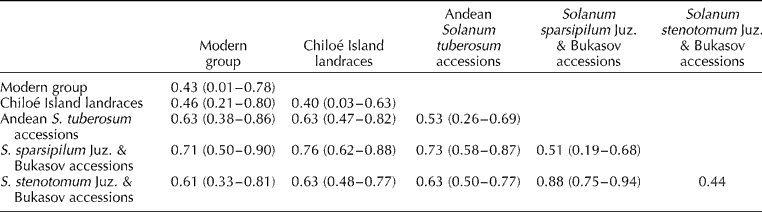
The average genetic distance between each pair of genotypes was 0.45. The mean genetic distances within each species or taxonomic group and between each pair of species or taxonomic groups are presented in Table 2. These mean genetic distances ranged from 0.40 (within the Chiloé Island landraces) to 0.88 (between the two diploid species). The S. sparsipilum Juz. & Bukasov accessions appeared to be the most distant group from the others (from 0.71 to 0.88). The modern group appeared to be more distant from the Andean S. tuberosum accessions (0.63) than from the Chiloé Island landraces (0.46). The average genetic distances within the modern group and within the Chiloé Island landraces were similar (0.43 and 0.40, respectively).
Mean genetic distances within each species or taxonomic group and between each pair of species or taxonomic groupsa

a The smallest and largest genetic distances are shown in parentheses.
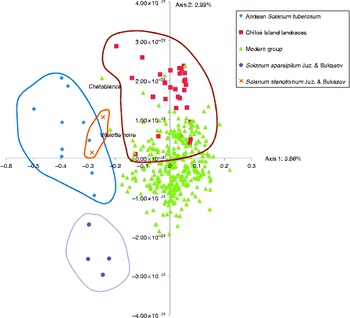
The PCO analysis performed with the complete dataset showed the clustering of each taxonomic group (Fig. 1). However, the first two PCOs represented only 6.85% of the total variation. A separation of the two diploid species and the Andean S. tuberosum accessions from the modern group and the Chiloé Island landraces was observed along the first PCO. A partial separation of the Chiloé Island landraces from the modern group was observed along the second PCO. However, these two groups largely overlapped. When the PCO analysis was carried out considering only the modern group and the Chiloé Island landraces, an overlapping of these two groups was also obtained, the first two principal axis representing 6.07% of the total variation (results not shown).
(colour online) Principal coordinate analysis performed with the complete dataset.

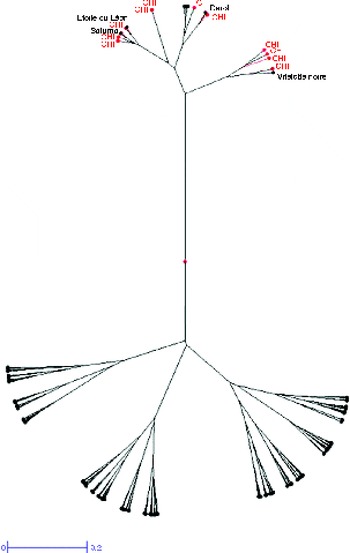
The hierarchical clustering analysis demonstrated a best separation of the Chiloé Island landraces from the modern group (Fig. 2). However, some modern genotypes clustered with the Chiloé Island landraces, also indicating the overlapping of these two groups.
(colour online) Ward tree considering the modern group and the Chiloé Island landraces. Black, genotypes of the modern group (some variety names are indicated); red, Chiloé Island landraces (CHI).

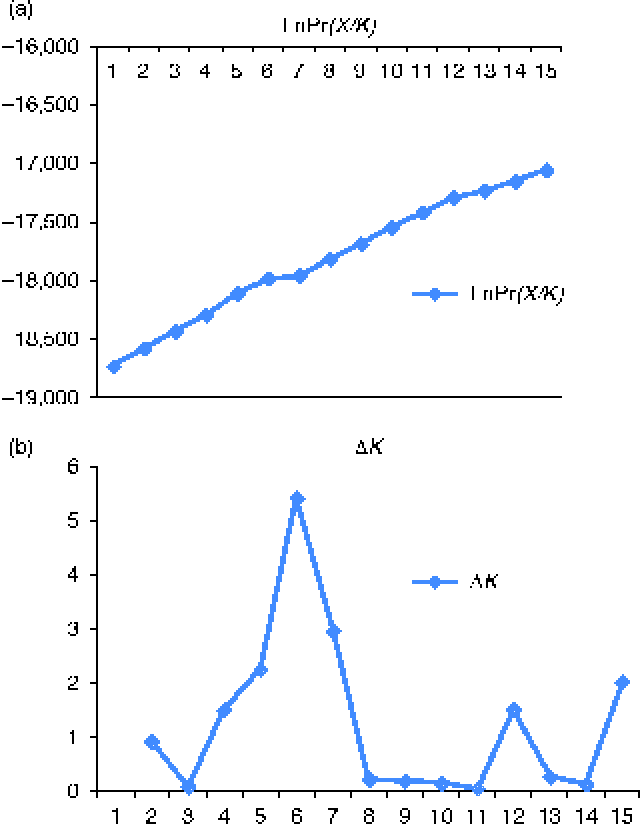
The results obtained using STRUCTURE, assuming admixture and independent allele frequencies, showed a continuous increase in the estimated log probability of data Pr(X/K) with the number of groups K (Fig. 3(a)). However, the graphical representation of ΔK calculated according to the formula established by Evanno et al. (Reference Evanno, Regnaut and Goudet2005) with respect to K showed a clear peak for K= 6 (Fig. 3(b)). Each genotype was then allocated to one of these six groups (Fig. 4). The number of individuals assigned to each group was 56, 88, 60, 56, 53 and 67, respectively. The assignment of the genotypes into the subgroups was highly reproducible between the five replicates. Two to seven genotypes only changed subgroup depending on the repeat. These changes can be explained by quite similar membership proportions to two different subgroups. The maximum proportion of assignment of one genotype to one population was 77.2%. For each group, the percentages of genotypes with a proportion of group membership higher than 50% were 12.5, 18, 5, 37.5, 26.4 and 15%, respectively. Of the 30 Chiloé Island landraces, 28 were allocated to group 4, with an allocation percentage ranging from 26.8 to 77.2%. They constituted half of this group. Group 5 was mainly composed of genotypes selected by the International Potato Center (Peru) or in the USA.
(colour online) (a) Graphical representation of the estimated log probability of data Pr(X/K) with the number of groups K. (b) Determination of the optimal number of clusters following the method of Evanno et al. (Reference Evanno, Regnaut and Goudet2005).

(colour online) Bar plot of individual genotypes generated by the STRUCTURE analysis with K= 6. The subgroups identified by the STRUCTURE analysis are represented by different colours. Each column (380 in total) represents a genotype and its proportion of membership in each subgroup. The analysis was carried out considering the modern group and the Chiloé Island landraces.

The AMOVA, performed to evaluate the part of variation explained by the groups identified using STRUCTURE, showed that only 9.20% of the variance could be attributed to this population structure (Supplementary Table S3, available online). Similarly, the separation of the Chiloé Island landraces from the modern group explained only 10.06% of the variation (Supplementary Table S3, available online).
Discussion
In the prospect of developing an association mapping strategy, we examined, using SSR markers, the genetic diversity and population structure of a collection of S. tuberosum L. genotypes, which included 30 Chiloé Island landraces and 350 worldwide varieties or breeders' lines.
The first aim of the study was to evaluate and compare the genetic diversity of these two groups. We observed that the average genetic distances within the Chiloé Island landraces and within the modern group are similar. The genotypes included in the modern group were chosen in order to represent the genetic diversity available in our worldwide cultivated potato collection, which shows that a great diversity has been preserved within the landraces that are still cultivated in the Chiloé Island. This is in agreement with the study conducted by Solano (2011), which evaluated their morphological diversity.
The second aim of the study was to examine the genetic distance between these two groups. In order to check that the genetic distances were in agreement with taxonomic classification, Andean S. tuberosum, S. stenotomum Juz. & Bukasov and S. sparsipilum Juz. & Bukasov accessions were included in the study. The mean genetic distances between each pair of species or taxonomic groups were calculated. As expected, the larger genetic distances were observed between the S. sparsipilum Juz. & Bukasov accessions and the different cultivated groups. Indeed, Spooner et al. (Reference Spooner, McLean, Ramsay, Waugh and Bryan2005) showed that the origin of cultivated potato is confined to the northern component of the Solanum brevicaule complex and that S. sparsipilum Juz. & Bukasov belongs to the southern Brevicaule group. The S. stenotomum Juz. & Bukasov accessions and the Andean S. tuberosum accessions showed similar genetic distances to the modern group and the Chiloé Island landraces. In the new taxonomy published by Ovchinnikova et al. (Reference Ovchinnikova, Krylova, Gavrilenko, Smekalova, Zhuk, Knapp and Spooner2011), S. stenotomum Juz. & Bukasov is considered to be a synonym of the S. tuberosum L. Andigenum group. Our results did not show smaller genetic distances between these two groups. However, the number of accessions that were included in this study is too limited to confirm or contradict this statement.
The modern group appears to be less distant from the Chiloé Island landraces than from the Andean S. tuberosum accessions. Although the axes explained a small percentage of variation, the PCO analysis separated the Andean S. tuberosum accessions from the other two tetraploid groups. The PCO analysis also revealed a partial separation of the Chiloé Island landraces from the modern group. However, these two groups did overlap considerably. Therefore, these data appear to be consistent with the classification proposed by Dodds (Reference Dodds and Correll1962), who placed the modern cultivars and the Andean S. tuberosum accessions in two different taxonomic groups belonging to the S. tuberosum species. These results are also in agreement with the Chilean origin of modern potato (Ames and Spooner, Reference Ames and Spooner2008) and support the conclusions of Ghislain et al. (Reference Ghislain, Nunez, Herrera and Spooner2009): the modern group is genetically closer to the Chilean S. tuberosum accessions (originating from the Chonos Archipelago Islands or from the Chiloé Island) than to the Andean S. tuberosum accessions. Traits conferring the ‘day-length syndrome’ are likely to contribute to the separation of the Andean S. tuberosum accessions from the Chiloé Island landraces and the modern group observed in the PCO analysis. Therefore, it would be interesting to study the genes that have been subjected to selective pressure in order to investigate their influence on the genetic structure.
In the PCO analysis, the two genotypes ‘Chatablanca’ and ‘Vitelotte noire’ present an intermediate position between the Andean S. tuberosum cluster and the modern group cluster. ‘Chatablanca’ is actually an Andean S. tuberosum accession that can tuberize under long-day conditions but with difficulty. It therefore presents traits that are intermediate between these two groups. ‘Vitelotte noire’ is an old potato variety that produces tubers with a primitive morphology. This can explain its intermediate position in the PCO analysis. Moreover, it is also one of the varieties that cluster with the Chiloé Island landraces in the Ward tree. All these varieties, including ‘Arran Banner’, ‘Daroli’, ‘Etoile du Léon’, ‘Markant’ or ‘Saturna’, are old varieties whose tubers have a more or less primitive morphology. This can therefore explain their genetic proximity to the Chiloé Island landraces.
The fact that all the alleles identified in the Chiloé Island landraces, except two, were observed in the modern group also demonstrates the genetic proximity of these two groups. Hence, their use in breeding programmes will probably need few sexual generations to create varieties adapted to our agronomic conditions. Therefore, it should be interesting to characterize them for different agronomic traits. Solano (2011) has already evaluated these 30 Chiloé Island landraces for their resistance to Phytophthora infestans in field experiments and leaf tests. Several landraces showed a high level of partial resistance. It would be worth assessing the resistance of these landraces to P. infestans isolates present in our natural conditions.
Finally, considering the Chiloé Island landraces and the modern group, a population structure analysis was performed using a Bayesian approach implemented in STRUCTURE. As the allele dosage in an autotetraploid species cannot be determined with certainty due to the preferential amplification of specific alleles and the presence of null alleles, SSR alleles were coded as binary data (presence/absence) and the ploidy level was set at 1 in the STRUCTURE analysis. D'Hoop et al. (Reference D'Hoop, Paulo, Kowitwanich, Sengers, Visser, van Eck and van Eeuwijk2010) used STRUCTURE in the same way using their amplified fragment length polymorphism data. In such conditions, the STRUCTURE analysis focuses on between-locus disequilibrium (LD) and cannot consider intra-LD (absence of Hardy–Weinberg equilibrium). Nevertheless, the population structure identified in this way was highly reproducible and consistent with DARwin analyses. A six-group subdivision was revealed. However, the allocation percentage for the majority of individuals was less than 50% and intermixing between the groups was evident. D'Hoop et al. (Reference D'Hoop, Paulo, Kowitwanich, Sengers, Visser, van Eck and van Eeuwijk2010) suggested that STRUCTURE grouping is meaningful when membership probabilities are over 70%. Therefore, the relevance of the six groups that we detected could not be confirmed, indicating that this potato collection does not present a clear population structure. The AMOVA analysis supported this conclusion because only 9.2% of the genetic variation could be assigned to the six STRUCTURE groups. The lack of a clear population structure in modern potato collections has already been observed in other studies (Li et al., Reference Li, Strahwald, Hofferbert, Lübeck, Tacke, Junghans, Wunder and Gebhardt2005; Malosetti et al., Reference Malosetti, van der Linden, Vosman and van Eeuwijk2007; D'Hoop et al., Reference D'Hoop, Paulo, Mank, van Eck and van Eeuwijk2008; Achenbach et al., Reference Achenbach, Paulo, Ilarionova, Lubeck, Strahwald, Tacke, Hofferbert and Gebhardt2009). We observed here the same result with such collections which would also include Chiloé Island landraces. All Chiloé Island landraces, except two, clustered in group 4. However, this group contains also modern cultivars, and the AMOVA analysis found that only 10.06% of the genetic variation could be attributed to the separation of the Chiloé Island landraces from the modern group, demonstrating, once again, the genetic proximity of this germplasm to modern genotypes. Half of group 5 consisted of genotypes selected by the International Potato Center (Peru) or in the USA. No common characteristics could be found to explain the other groups. By studying a representative of worldwide potato cultivars and Dutch advanced breeders' clones, D'Hoop et al. (Reference D'Hoop, Paulo, Kowitwanich, Sengers, Visser, van Eck and van Eeuwijk2010) observed only two consistent groups: one group comprising old cultivars and one group containing cultivars bred for the starch industry. This type of subdivision was not observed here. As the pedigree analysis showed that the ‘modern’ potato germplasm has a narrow genetic base and a high level of co-ancestry (Love, Reference Love1999; Gebhardt et al., Reference Gebhardt, Ballvora, Walkemeier, Oberhagemann and Schüler2004), it may explain this lack of a clear population structure. D'Hoop et al. (Reference D'Hoop, Paulo, Kowitwanich, Sengers, Visser, van Eck and van Eeuwijk2010) suggested that a meaningful group structure could rely on specific regions in the genome, which could be introgressions of resistance genes from wild species. Therefore, to avoid spurious associations, it is important to include, in association mapping models, a genetic relationship structure to fully account for obvious and subtle genotypic relationships.
In conclusion, this study confirms the genetic proximity of modern potatoes and Chiloé Island landraces. It demonstrated that a cultivated potato collection which includes a large array of worldwide cultivars and Chiloé Island landraces did not show a clear genetic structure. As the studied landraces proved to present interesting genetic factors, it would be worth exploring further the genetic diversity of this germplasm that can be analysed together with modern cultivars using an association mapping approach.
Supplementary material
To view supplementary material for this article, please visit http://dx.doi.org/10.1017/S1479262113000300
Acknowledgements
This study was funded by the INRA Plant Breeding and Genetics Research Division. We thank Anne-Marie Chèvre, Marie-Claire Kerlan and Sylvie Marhadour for their valuable comments.