Introduction
The restoration and improvement of walking and balance are highly relevant in the daily life of stroke survivors (Saposnik & Levin, Reference Saposnik and Levin2011; Tyson, Hanley, Chillala, Selley, & Tallis, Reference Tyson, Hanley, Chillala, Selley and Tallis2006). Walking performance, such as heel strike, requires the ankle flexors to make co-ordinated movements. Stroke patients have to practice the movements repeatedly to promote the motor control of their lower limbs, especially ankle mobility affected by foot drop problems (Cho, Kim, & Lee, Reference Cho, Kim and Lee2013; van Meulen et al., Reference van Meulen, Weenk, van Asseldonk, Schepers, Veltink and Buurke2016). Increased tibialis anterior activation can overcome the plantar flexors spasticity and stiffness during gait training after stroke (Lamontagne, Malouin, Richards, & Dumas, Reference Lamontagne, Malouin, Richards and Dumas2002). Ankle dorsiflexion exercises include muscle strengthening and improving flexibility of the ankle joints to prevent plantar flexor contractures, which are important for gait and balancing abilities (Harris, Eng, Marigold, Tokuno, & Louis, Reference Harris, Eng, Marigold, Tokuno and Louis2005; Rocchi, Chiari, Cappello, & Horak, Reference Rocchi, Chiari, Cappello and Horak2006).
As postulated by the motor learning theory, repetition, feedback and motivation are regarded as key factors for improving movement (Carr & Shepherd, Reference Carr and Shepherd1989; Olivetti et al., Reference Olivetti, Schurr, Sherrington, Wallbank, Pamphlett and Mun-San Kwan2007; Peterka, Reference Peterka2002). Virtual reality interventions may promote these key principles of motor learning and have been found to be effective for improving balance and mobility in the patients after stroke (Corbetta, Imeri, & Gatti, Reference Corbetta, Imeri and Gatti2015). For example, a systematic review of 15 trials involving a total of 341 participants has reported that when the virtual reality replaced some or all of the regular rehabilitation activities (Corbetta et al., Reference Corbetta, Imeri and Gatti2015), there were statistically significant improvements in the walking speed (minimal clinically important difference, MCID: 0.16 m/s, 95% CI: 0.10–0.19) and balancing abilities of the participants (MCID: 2.1 points on the Berg Balance Scale, 95% CI: 1.8–2.5). More broadly, a Laver systematic review (based on 8 studies involving 253 participants) has reported that interventions with virtual reality in stroke rehabilitation activities were also effective in improving the outcomes of the activities of daily living (Laver, George, Thomas, Deutsch, & Crotty, Reference Laver, George, Thomas, Deutsch and Crotty2015). The virtual rehabilitation studies highlighted the role of ankle muscles in gait training, and these training programmes included a promising task-specific repetitive treatment concept, such as standing up and walking (Corbetta et al., Reference Corbetta, Imeri and Gatti2015; Katz et al., Reference Katz, Ring, Naveh, Kizony, Feintuch and Weiss2005; Laver et al., Reference Laver, George, Thomas, Deutsch and Crotty2015).
Computer-based training has become more popular due to its low cost, potential for independent practice and convenience to use at home (Bateni, Reference Bateni2012; Hsieh, Lin, Chiu, Meng, & Liu, Reference Hsieh, Lin, Chiu, Meng and Liu2015). The positive attributes of video game (VG) technology incorporate interactive sensory information for physical therapy, such as balance training for the stroke patients (Girone, Burdea, & Bouzit, Reference Girone, Burdea and Bouzit2001; Viñas-Diz & Sobrido-Prieto, Reference Viñas-Diz and Sobrido-Prieto2016). Instead of using complex and expensive equipment, this study considered VG rehabilitation by using a foot switch to improve participation, and to increase ankle movements by changing the interface for playing on-line games and by requesting to perform specific movements. However, there is limited evidence showing the relationships between adaptive VG rehabilitation, balance control and walking performance in the stroke patients. Therefore, the research question is as follows: ‘Do balance control and walking performance improve more with additional adaptive VG rehabilitation by using a foot switch as compared to that with standard therapy alone following stroke?’
Methods
Design
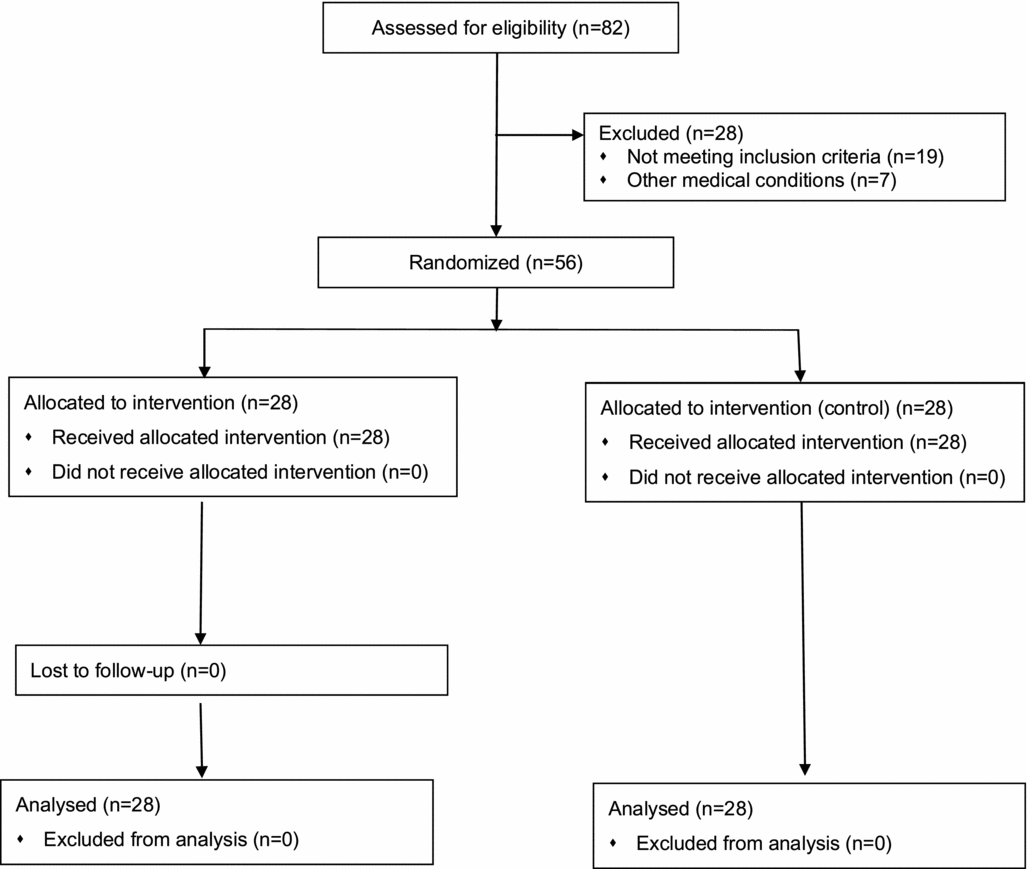
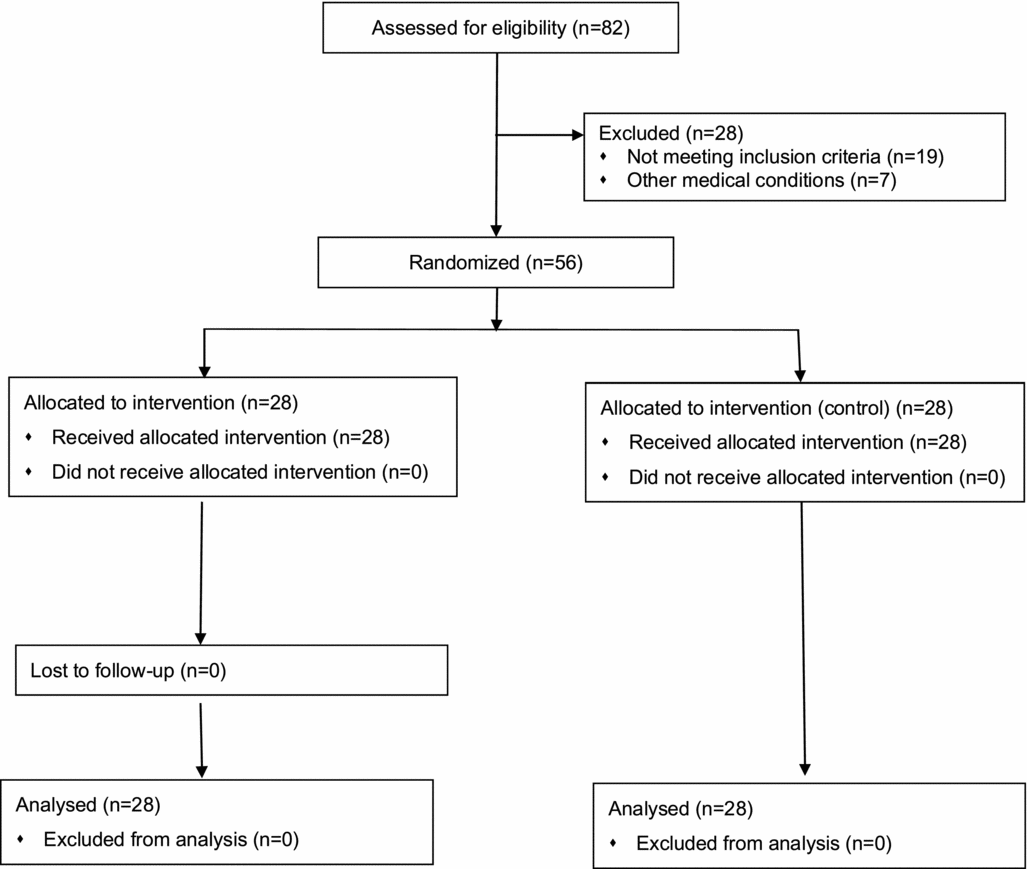
The intervention was evaluated by means of a randomised controlled trial, and the participants were allocated to the VG rehabilitation or standard care conditions in a 1:1 ratio. The protocol for this trial followed the CONSORT 2010 guidelines (Schulz et al., Reference Schulz, Altman and Moher2010), and no adverse harm was caused to the participants of the intervention group. The flow of participants through the study is shown in Figure 1.
Participant flow in the trial.
Participants
A total of 82 patients from the rehabilitation, outpatient clinics in Taiwan were screened by the research assistants, and 26 stroke patients were excluded as they did not meet the inclusion criteria (n = 19) and presented with other medical conditions (n = 7) (see Figure 1). The inclusion criteria for the stroke patients were as follows: a clinical diagnosis of ischaemic stroke, time since stroke onset over 3 months, slightly active ankle dorsiflexion (>10°) and ability to walk with or without an assistive device. Patients with severe walking problems or suspected to have additional significant medical condition were excluded. A total of 56 patients were randomly assigned either to the intervention group or to the control group (28 patients in each group). Randomisation was undertaken using computer-generated random numbers from a random number generator.
Procedures
The VG intervention was delivered by a qualified physiotherapist with 5 years of experience in stroke rehabilitation. All the testing sessions were conducted by one occupational therapist and one research assistant, who was also in charge of the randomisation and recruitment processes. Both raters were blinded to the treatment. The patients of the intervention group underwent 30 minutes of VG rehabilitation with an adaptive foot switch at the clinics once a week, and performed the same exercises at home once a day. For the intervention group, the researcher set up the VG rehabilitation equipment with the adaptive foot switch at the participants’ homes. In contrast, the patients in the control group received only regular physiotherapy once a week, and performed regular walking as their daily homework for 10 weeks. Regular physiotherapy for both the groups included gait, posture and strength training.
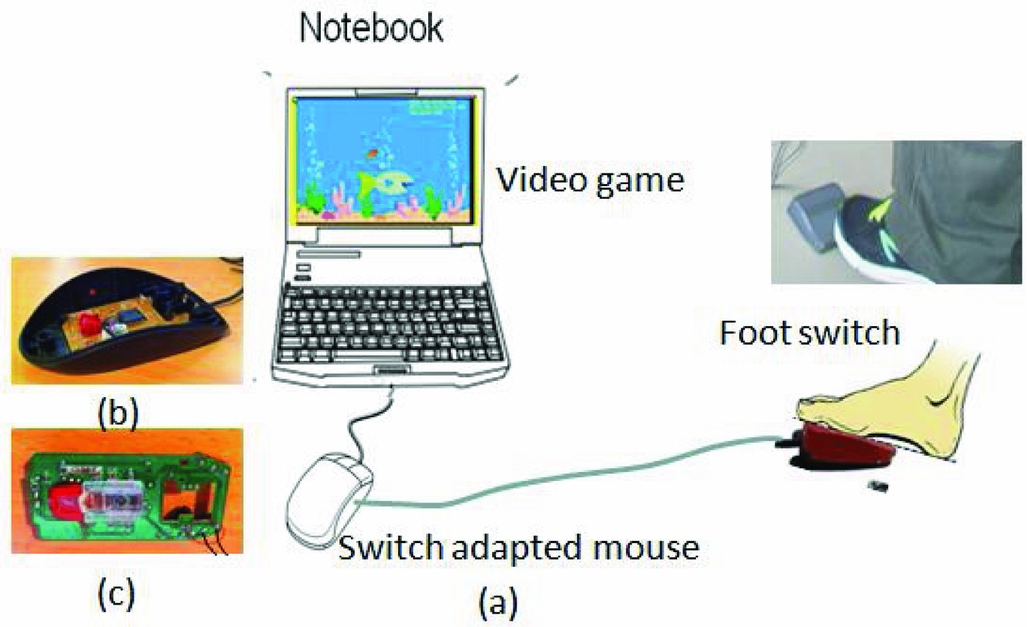
The participants had to use their feet to control the computer instead of using a computer mouse to play the on-line games (Figure 2). In the intervention group, ankle plantar flexion was performed by pressing the foot switch (the mouse), and ankle dorsiflexion occurred by releasing the foot switch. The on-line games chosen for this study required participants to use the left button of the mouse to operate the games; the free on-line games used in this study were selected from the following address: http://www.gamesmomo.com
(a) Schematic diagram of switch adapted mouse, foot switch and video game. (b) Top side of printed circuit board inside the mouse. In this procedure, fastening screws on the mouse are removed using a screw driver, and the solder points on the circuit board for the left click buttons on the mouse are identified. (c) Two wires are soldered to prongs of the micro-switch on bottom side of the printed circuit board. Each wire is attached to the single-core shielded wire, and after the wire is attached, the circuit board is placed back into the mouse.
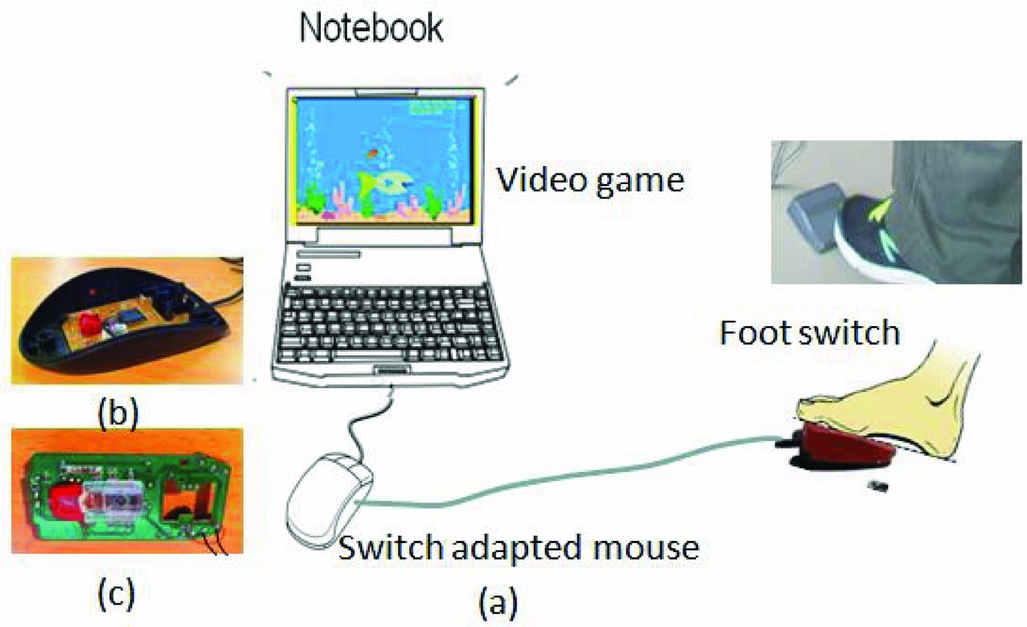
An adaptive foot switch: The researcher (Hsieh, Hsieh-Chun) connected the left button of the mouse to the foot switch as the proposed device to modify computer access, as shown in Figure 2. Twenty-eight modified foot switches were developed for the intervention group. The cost of an adaptive foot switch was 380 New Taiwan dollars (TWD), which was equal to 12.5 USD (a computer mouse: 175 TWD; a foot switch pedal: 185 TWD; lines and other materials: 20 TWD). The goal of using an adaptive foot switch and internet games was to provide inexpensive rehabilitation. This foot switch was operated by applying pressure with ankle plantarflexion and releasing the pressure with ankle dorsiflexion (>10°). Literatures have shown that the normal range of motion in the ankle is between 13° and 33° dorsiflexion, and 10° dorsiflexion is used during walking (Asbjørn & Gunnar, Reference Asbjørn and Gunnar1982; Hintermann, Reference Hintermann2005). After the clinical training, the patients in the intervention group operated the foot switch to play the games by performing ankle dorsiflexion and plantarflexion at home to improve walking abilities, as shown in Figure 2.
Outcome assessment: There were four primary outcome variables to measure the walking performance and standing balance, namely, the 10-Metre Test of Walking (10MWT) score, Centre of Pressure (CoP) sway kinematics in the anterior–posterior (AP) sway, the medal–lateral (ML) sway and sway area. The 10MWT score was a performance measure used to evaluate temporal attributes of gait, and the length of the test was 5 minutes. All the participants performed their individual walks without assistance for 10 metres, and the time was measured in the intermediate 6 metres (from 2-metre to 8-metre mark) to allow the acceleration and deceleration of the walking speeds. Subjects were instructed to walk at a self-selected pace, and each patient's gait was recorded with a stopwatch for calculating the velocity. The 10MWT had a predictive validity with ADL (r = 0.76) for the stroke patients (Tyson & Connell, Reference Tyson and Connell2009).
Standing balance was evaluated by using three variables, which measured different aspects of sway by means of a Midot™ Posture Scale Analyzer (MPSA). The MPSA is a portable force platform. Its analogue signals were transferred to a laptop or a computer, which were used to measure the CoP kinematics, including (1) the maximum CoP sway in the anterior–posterior direction (AP sway); (2) the maximum CoP sway in the medial–lateral direction (ML sway) and (3) the sway area: the area of an ellipse enclosing 95% of the CoP sway (Mochizuki, Duarte, Amadio, Zatsiorsky, & Latash, Reference Mochizuki, Duarte, Amadio, Zatsiorsky and Latash2006; Rocchi et al., Reference Rocchi, Chiari, Cappello and Horak2006; Rugelj & Sevsek, Reference Rugelj and Sevsek2007). All the subjects were asked to stand still on the force platform for 1 minute (three repeated trials; Goljar, Burger, Rudolf, & Stanonik Reference Goljar, Burger, Rudolf and Stanonik2010; Tyson & Connell, Reference Tyson and Connell2009). The CoP trajectory of the quiet stand trial was computed and delineated onto rambling and trembling trajectories. Sway components were quantified by using average CoP sway and sway area. The CoP sway area was calculated with π × (AP sway) × (ML sway), and the exact method of calculation has been described in a study by Rugelj and Sevsek (Reference Rugelj and Sevsek2007).
The software program SPSS for Windows and a repeated measures MANOVA for the two-way mixed design data were used to investigate the relationship between the Patient Group (intervention group or control group) and Time-type (pre-test or post-test) variables. The Patient Group was the independent variable for between-subject changes. Time type was the independent variable for within-subject changes. The four dependent variables were 10MWT, CoP AP sway, CoP ML sway and sway area, which were conceptually related, and this was one of the underlying assumptions for the MANOVA. Increased CoP sway during quiet standing was indicative of restricted velocity performance during walking (Titianova & Tarkka, Reference Titianova and Tarkka1995). After checking that all the dependent variables were approximately normally distributed for each category of the independent variables (Patient Group) during the pre-test and the post-test, a multivariate test was performed. When the multivariate interaction effects (Patient Group × Time) were significant, follow-up tests to determine univariate effects were carried out. In the MANOVA, Wilks’ Lambda (Λ) was used as a multivariate statistical value, and partial eta-squared (η²) values were used for the effect size of significant findings. Statistical significance was assumed for p < .05.
Results
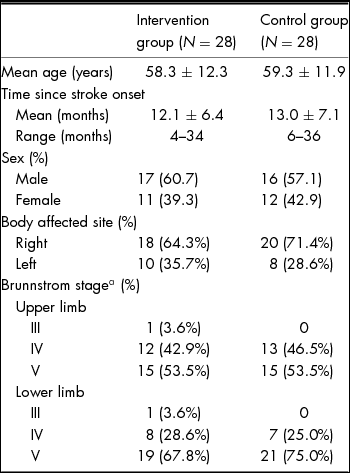
Twenty-eight patients in the intervention group were trained for intensive active dorsiflexion to play on-line games for a 10-week period. The background information and the recovery stages for the 56 participants are listed in Table 1. The Brunnstrom stage of each patient was determined through an interview with an occupational therapist, and six stages were used to evaluate and track the progress of the patients recovering from the stroke (Brunnstrom, Reference Brunnstrom1970).
Demographic of Patients with Stroke (N = 56)
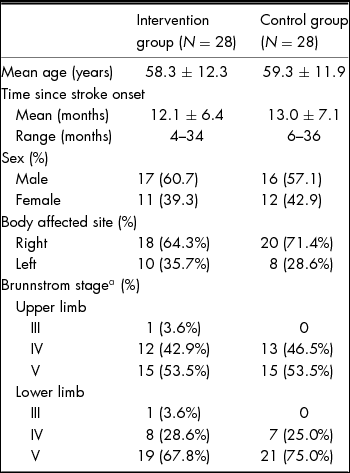
aBrunnstrom stage: within stage III, obligatory synergic movement patterns; within Stage IV, spasticity and the influence of synergy decrease, leading the patients to be able to move with less restrictions; and within Stage V, spasticity continues to decline, and there is a greater ability for the patient to move freely.
Performance on MPSA and during 10MWT
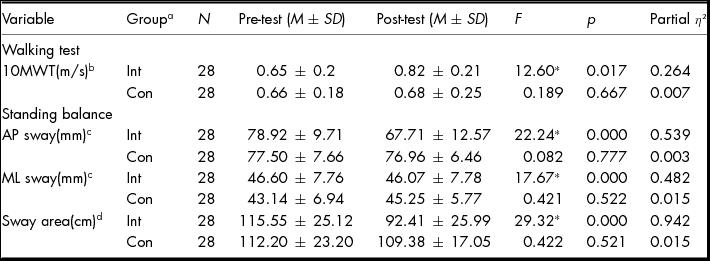
The descriptive statistics about the performance on MPSA (CoP sway kinematics) and during 10MWT are listed in Table 2. The repeated measures MANOVA results indicated a significant interaction between the Patient Group × Time (F = 4.373, p < .05, Λ = 0.745) in the dependent variables. Therefore, a simple analysis of the main effects of the interaction for each dependent variable was performed (Table 2).
Mean Scores and Simple Main Effects ANOVA Results
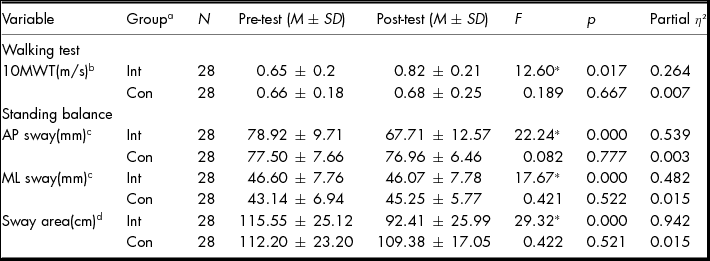
Note: *p < .05;
aInt: Intervention group; Con: Control group.
b10MWT score: .4–.8 m/s limited community ambulators; >.8 m/s were community ambulators.
cMidot Posture Scale Analyzer: CoP maximum sway in anterior–posterior direction (AP sway); in medial-lateral direction (ML sway).
dSway area = π × (AP sway) × (ML sway).
Differences between Patients of the Intervention and Control Groups
In the pre-test results, the multivariate main effects of the Patient Group were not significant (10MWT: F = .088, p = .768, η² = .002; AP sway: F = .373, p = .544, η² = .007; ML sway: F = .066, p = .798, η² = .001; sway area: F = .271, p = .605, η² = .005). In the post-test results of the adaptive VG rehabilitation, the results showed that the patients in the intervention group showed significantly better 10MWT (F = 4.98, p = .033, η² = .082), the CoP AP sway (F = 11.98, p = .001, η² = .182) and the sway area (F = 8.33, p = .006, η² = .134) than the control group. However, the post-test results of the CoP ML sway (F = 1.52, p = .223, η² = .027) did not show significant difference.
Difference between Pre-test and Post-test Results
The analyses illustrated that the VG rehabilitation sessions appeared to influence the walking performance and the ankle control in the patients of the intervention group. Changes in the 10MWT (F = 12.60, p = .017, η² = .264), the CoP AP sway (F = 22.24, p = .000, η² = .539) and the CoP ML sway (F = 17.67, p = .000, η² = .482) revealed that the patients of intervention group showed significant improvement in the ankle control following the adaptive mouse rehabilitation. They also reported significant changes in the CoP sway area after adapting to VG rehabilitation (F = 29.32, p = .000, η² = .942). However, the patients in the control group exhibited no statistically significant differences between their pre-test and post-test results (10MWT: F = .189, p = .667, η² = .007; AP sway: F = .082, p = .777, η² = .003; ML sway: F = .421, p = .522, η² = .015; sway area: F = .422, p = .521, η² = .015).
Discussion
This study identified the effects of training with an adaptive VG rehabilitation on walking speed and balance control in the stroke patients. The foot switch intervention was effective in improving the walking and balance as compared to the standard care condition. The improvement in gait speed may be due to increased ankle strength and range of movement and therefore reduced compensatory movements. The intervention may have improved the ankle plantarflexion as much as the ankle dorsiflexion. Therefore, the gait improvements may also be due to better push-off. When performing the VG rehabilitation, the patients had to maintain ankle dorsiflexion (>10°) at the maximal position in order to generate the next action.
The standardised MCID of 10MWT was 0.16 m/s in the study by Tilson et al. (Reference Tilson, Sullivan, Cen, Rose, Koradia, Azen and Duncan2010); n = 283; mean age = 63.5 ± 12.5 years; assessed approximately on day 20 and day 60 post stroke). The change in the mean scores between the pre-test and post-test in the intervention group was 0.17 m/s, which was higher than 0.16 m/s of Tilson et al.’s study, and the change in the control group was 0.02 m/s, which was lower than 0.16 m/s of Tilson et al.’s study. This indicated that improvement in the intervention group after VG rehabilitation was clinically significant during the 10MWT. The mean 10MWT score improved from 0.65 m/s to 0.82 m/s, which showed improved ambulation ability. Ambulation ability, which is predicted by gait speed, is a reliable method of classifying the patients (Lum, Reinkensmeyer, Mahoney, Rymer, & Burgar, Reference Lum, Reinkensmeyer, Mahoney, Rymer and Burgar2002), with the cut-off scores for the 10MWT listed as follows: household ambulation (<0.4 m/s), limited community ambulation (0.4–0.8 m/s) and full community ambulation (> 0.8 m/s).
The finding was also in agreement with that of the previous studies and indicated that exercise therapy had an effect on motor control in the stroke patients (Deng, Durfee, & Nuckley, Reference Deng, Durfee and Nuckley2010; van Duijnhoven et al., Reference van Duijnhoven, Heeren, Peters, Veerbeek, Kwakkel, Geurts and Weerdesteyn2016). The patients had a goal to attain (i.e., scoring the greatest number of points) while participating in the VG exercises, whereas with the traditional exercises, the patients received no feedback on the ankle range of motion. As suggested by the earlier studies, interactive games could improve the motor abilities of the stroke patients in the VG rehabilitation (Kizony, Katz, & Weiss, Reference Kizony, Katz and Weiss2004; Laver et al., Reference Laver, George, Thomas, Deutsch and Crotty2015; Proffitt, Alankus, Kelleher, & Engsberg, Reference Proffitt, Alankus, Kelleher and Engsberg2011).
Future studies regarding VG rehabilitation should focus on establishing movement training through the adaptive foot switch in lager clinical populations, and use of various outcome measures that are associated with optimal transfers to real-world functions. Future studies may also focus on the systems that can target multiple joints in the stroke population, and investigate their training effects. This study focused only on 28 people with hemiplegic stroke who were able to control environmental stimulation through the adaptive foot switch by performing ankle dorsiflexion/plantarflexion.
The foot switch controlled VG system may provide an effective means of training of ankle movements, namely, dorsiflexion/plantarflexion in the home-based environments. The stroke patients demonstrate better control of balance and mobility following the stroke, and also show greater interest in performing the same exercise (ankle dorsiflexion and plantarflexion) through the VG system than performing it as a traditional daily exercise.
Financial Support
This research received no specific grant from any funding agency, commercial or not-for-profit sectors.
Conflict of Interest
None.
Ethical Standards
The author asserts that all procedures contributing to this work comply with the ethical standards of the Research Ethics Contact (REC), National Tsing Hua University on human experimentation and with the Helsinki Declaration of 1975, as revised in 2008.