

What do we do with our words as philosophers? What kinds of speech acts do we perform? Our answer to this question will depend on our view of what philosophy is, and philosophers tend to be just as divided on this question as they are on any other philosophical question. But let's start with what at least seems to be the prevailing and, on the face of it, rather innocuous view – that philosophers, like any serious inquirer, aim to say something true about the world. Alice Ambrose labels this ‘the orthodox position’, which ‘describes philosophy as a pursuit of truth, where “pursuit of truth” is interpreted in conformity with common usage as the attempt to acquire knowledge about our world’ (Ambrose, Reference Ambrose1952, p. 289).Footnote 1 This reading of philosophy seems to capture how philosophers typically package their utterances. Ambrose continues: ‘Philosophical views quite clearly…appear to state matters of fact. To take some sample illustrations: a physical object is a bundle of properties…it is impossible to know other people exist, motion is impossible, etc.’ (Reference Ambrose1952, p. 290). Philosophy is therefore typically ‘carried on in the language of assertion, i.e., of truth and falsity’ (Ambrose, Reference Ambrose1966, p. 84).
Ambrose is hardly alone in this assessment. Assertion, Sanford Goldberg contends, is ‘the sort of speech act by which we state, report, contend, or claim that such-and-such is the case’ (Goldberg, Reference Goldberg2015, p. 3). Goldberg argues that philosophers not only issue assertions, but also that philosophy is the paradigm case of a specific type of assertoric practice: philosophy is ‘the best example of a more general phenomenon, whereby assertoric practice continues unabated even under conditions of systematic disagreement’ (Reference Goldberg2015, p. 245, fn 35). Not only, then, do we primarily issue assertions as philosophers, but we even persist in performing this speech act in the very circumstances where we might expect speakers to avoid assertions altogether.
But some philosophers have argued that, despite the prevalence of assertion in philosophical discourse, this speech act should not play such a central role. Rudolf Carnap, for example, argues that philosophers make a fundamental mistake when they formulate their views in exclusively assertoric terms. Assertions, on Carnap's view, are meaningful and felicitous only when they are articulated from within a particular ‘linguistic framework’ where the key terms and concepts of that language are defined. Philosophers, however, often make assertions without first identifying and articulating the linguistic framework they are utilizing. Their utterances, in turn, risk being meaningless. The proper role for philosophical language is, in Carnap's view, primarily non-assertoric. Rather than produce infelicitous and meaningless assertions that attempt, in a framework-independent way, to represent what is the case in the world, philosophers should focus on ‘introducing’ novel and useful ways of speaking and thinking:
[T]he introduction of the new ways of speaking does not need any theoretical justification because it does not imply any assertion of reality…To be sure, we have to face at this point an important question; but it is a practical, not a theoretical question; it is the question of whether or not to accept the new linguistic forms. The acceptance cannot be judged as being either true or false because it is not an assertion. It can only be judged as being more or less expedient, fruitful, conducive to the aim for which the language is intended (Carnap, Reference Carnap1950, p. 31).
Now Carnap is not working in the tradition of speech act theory, but his comments are striking for anyone trying to understand what philosophers are or should be doing with their words. If he is right, there seems to be a kind of speech act philosophers sometimes do and, moreover, ought to perform that is not an assertion and so ‘cannot be judged as being either true or false’, but instead involves the ‘introduction’ of terms and concepts in a way that is crucially tied to questions of utility. Carnap seems to suggest elsewhere that it is the act of ‘stipulation’ that plays this introductory role (Carnap, Reference Carnap and Ayer1959, pp. 62–64).
In recent years, contemporary philosophers interested in the methodology of conceptual engineering have turned to Carnap's metaphilosophical observations.Footnote 2 Sally Haslanger, whose work is the catalyst for this contemporary interest in conceptual engineering, notes both the Carnapian heritage of her view and the connection between the kinds of philosophical projects she advocates for and the act of stipulation.Footnote 3 Haslanger calls ‘ameliorative’ those projects where philosophers do not simply represent existing usage and understanding of certain terms or concepts, but argue for how they ought to be used and understood. She explains that these ameliorative projects depend on a key ‘stipulative element’: we are not asking how the world currently is, but ‘what work we want these concepts to do for us; why do we need them at all? The responsibility is ours to define them for our purposes’ (Haslanger, Reference Haslanger2012, p. 224).
What these alternative views of philosophical language hint at is a type of non-assertoric speech act that is importantly bound up with questions of utility and that seems to be crucial for philosophical inquiry. In this paper, I give a detailed account of this speech act. Following the clues from Carnap and Haslanger, I call this speech act ‘stipulation’. In the first section, I situate my discussion within the landscape of contemporary speech act theory. In the second section, I introduce a novel taxonomy for making sense of criticisms of speech act performances generally in order to help individuate the unique features of speech acts of stipulation. I then introduce my account of stipulation. In the third section, I apply my account to examples from different areas of philosophy – to cases drawn from political philosophy and philosophy of language. I show that applying my account of stipulation to specific philosophical disputes helps to clarify key questions and assumptions at stake and offers us novel ways of advancing these discussions.
1. Methodological Clarifications
The goal of this paper is to individuate a type of non-assertoric speech act that may be crucial to philosophical inquiry, and to do so, we will need a clear methodology for distinguishing among speech act kinds. But this is a difficult task because there is little consensus over key questions – for example, how to determine when a speech act counts as ‘successfully’ performed and what it is to give a particular performance ‘uptake’. In this section, I clarify my position on these questions.
Marina Sbisà has recently defended a tripartite classification of speech act norms that brings some much needed clarity to these discussions. Sbisà first distinguishes what she calls ‘constitutive’ norms, which refer to those rules or norms that ‘establish how one can do something and thus, in the case of speech acts, when a certain utterance amounts to the performance’ of a specific act (Sbisà, Reference Sbisà, Witek and Witczak-Plisiecka2018, p. 25). The ‘constitutive’ norms for a speech act are therefore the norms that enable the performance of a specific speech act and thereby distinguish it from other speech acts. Violation of constitutive norms or rules for a speech act means that ‘its alleged effect may be null and void’ (Reference Sbisà, Witek and Witczak-Plisiecka2018, p. 45). For example, plausibly, a constitutive norm for the speech act of ordering is that I occupy a position of authority over my addressee. If, then, I attempt to issue an order to an addressee over whom I do not have any relevant authority (for example, if I am a private attempting to issue an order to a general), I will not have performed this speech act: I will have attempted to issue an order, but I will not have done so.
There are then two further types of norms relevant to speech act performances. Maxims, Sbisà explains, ‘encode advice for optimal communicative behavior from the point of view of the subjects involved’ (Reference Sbisà, Witek and Witczak-Plisiecka2018, p. 29). Consider, for example, Grice's conversational maxims, such as the maxim of manner that a speaker should ‘make it clear what contribution he is making’ (Grice Reference Grice1989, p. 28). This is a way for a speaker to maximize the possibility of their speech act performance being interpreted in the way the speaker intends. For example, it is not necessary for me to perform the speech act of ordering that I make the order clear and easy-to-follow, but following this maxim will increase the likelihood that my utterance affects the linguistic context in the way I intend.
There is also the further question of whether ‘the speaker was right in performing that speech act for those aims in that context, given how things are in the world’ (Sbisà Reference Sbisà, Witek and Witczak-Plisiecka2018, p. 34). Sbisà calls this third set of norms ‘objective requirements’. For Austinian verdictives, such as estimates and assessments (examples of which include the decisions of umpires and juries), we treat speech act performances belonging to this class as ‘right or wrong, fair or unfair, [where] we have at least to consider: the speech situation, the situation in the world to which the speech act refers, the pertinent criteria of judgment and their application, possible application precedents and, finally, the aims for which the estimate or assessment was contributed’ (Sbisà, Reference Sbisà, Witek and Witczak-Plisiecka2018, p. 33). Similarly, when we distinguish between ‘“good” and “bad” advice, “merited” and “unmerited” blame and…“just” or “unjust” orders’, we are invoking the objective requirements relevant to the speech act (Sbisà, Reference Sbisà, Witek and Witczak-Plisiecka2018, p. 33).
We can use Sbisà's taxonomy to help formulate clearer notions of a speech act being successfully performed and of uptake.Footnote 4 A ‘successful’ performance of a speech act should be taken to occur when the speakers in a context are assessing the utterance exclusively via non-constitutive norms, that is, when speakers are assessing the act exclusively in terms of the maxims and objective requirements relevant to the act. In such cases, the question of whether the speech act has been performed is treated as settled, and we are now deciding whether the act was performed well or efficiently (or badly or inefficiently), rather than considering whether the act has been performed at all.
Why opt for this characterization? By viewing successful speech act performances as those where speakers treat the performance of the speech act as settled (as indicated by speakers assessing the performance exclusively via non-constitutive norms), we can more easily identify the characteristic or constitutive features of different speech act kinds. Were we to include the fulfillment of non-constitutive norms as a necessary dimension of successful speech act performances, then we would risk obscuring these distinguishing features of different speech acts because many non-constitutive norms are equally relevant to a range of acts and so do not differentiate among them. For example, for most speech acts, maxims encouraging clarity and sincerity for the speaker's performance will be relevant. Similarly, the objective requirement of fairness is plausibly applicable to various acts – rendering verdicts, rankings, orders, etc. To identify the characteristic, constitutive features of a particular speech act, we should therefore center cases where it is taken as settled among speakers that the speech has been performed but where it remains an open question among these speakers how the act should be assessed via maxims and objective requirements.
Consider successful orders and requests in this sense. If a general says they are issuing an order to their troops (to play specific music for an attack, say, à la the famous chilling sequence in Apocalypse Now), and it is taken to be settled in the linguistic context that the general has in fact issued this order, then the general's speech act has given rise to an obligation for those troops: if they do not act in accordance with the order, they can be appropriately held accountable for this failure to act. Why? Because they have failed to meet an obligation that the speech act of ordering institutes. It may be that the order could have been issued more clearly or that it was ill-advised given the circumstances, etc. But insofar as the order has been successfully issued, an obligation for the addressee is generated.
Compare this to an instance of a successful request. My friend is playing music and asks if there is anything I would like to hear. I say that I have a request for a specific song, one I know they can easily access. Suppose, then, it is taken to be settled in this linguistic context that I have in fact made this request. What kind of pragmatic structure does this speech act of requesting have? Does it, for example, generate an obligation for the addressee in the same way an order does? This does not seem to be the case. If my friend says that they will not play the song – because, they say, they are just not in the mood to listen to it – I am not entitled to hold them accountable in the way the general is entitled to hold their troops accountable for disobeying an order. That is, my friend has not violated an obligation that my speech act of requesting institutes. Because I am making a request, my friend instead has the option of appropriately accepting or declining. If they decline, I may be disappointed or think their behavior was rude, but I cannot appropriately say that my friend has violated an obligation my request somehow generates.
By comparing instances of successful orders and requests in this sense, what emerges is that requests – as opposed to orders – generate for the addressees a non-obligatory, ‘petitionary’ reason to carry out a certain action, that is, a reason for acting but one the addressee need not act on (Lance and Kukla, Reference Lance and Kukla2013, p. 462). An imperative, however, ‘is structurally incapable of giving its target a petitionary reason to act’ because they generate obligations for their addressees (Lance and Kukla, Reference Lance and Kukla2013, p. 462).
If, however, we analyze the pragmatic structure of speech acts by considering failed instances or cases where the success of the performance is ambiguous, these differences will likely be obscured. For example, suppose I say to a group of people that I congratulate them or that I am advising them. This audience assumes, however, that I am always surreptitiously condescending towards others and take my utterances to be insults. Whatever distinguishing features there may be to the speech acts of congratulating or advising are obscured in such contexts – features that are brought to the fore when it is taken to be settled that the speech act in question has been performed.
Against this backdrop, ‘uptake’ should be understood as reactions and behaviors – linguistic or otherwise – on the part of the audience that ensure that the speech act's characteristic effects are instituted in the relevant linguistic context. In this sense, I give uptake to an order both when I act on it and when I disobey it. In disobeying the order, I nonetheless treat the order as successful, i.e., as generating an obligation for me that I then do not act on. Similar to the above account of success, ‘uptake’ in this sense does not necessarily involve acting on the relevant maxims and objective requirements for the speech act in question. For example, my friend may make a bet with me that I think is extremely risky and so misguided, but I can give it uptake as a bet nevertheless – acknowledging the legitimacy of the demand, for example, that I pay up if I lose.Footnote 5
Now it is worth emphasizing that when we take a speech act to be successfully performed in this sense, a clear role emerges for other speakers in guaranteeing the performance of particular speech act kinds. An order, for example, is successfully performed when it gives rise to an obligation for the addressee and therefore fails when a speaker attempts to issue an order but does not institute this obligation for reasons that may well involve the audience's reception of the utterance.Footnote 6 Similarly, a request is successfully performed when it generates a petitionary reason for the addressee and fails when it does not – again, for reasons that may well involve the audience's reception of the utterance.
This way of construing speech act success and audience role cuts against the standard way of construing the illocutionary-perlocutionary distinction, where addressees are typically barred from playing a constitutive role.Footnote 7 I cannot delve into a full discussion of the relationship between this distinction and my approach here, but my view is that rather than shoehorning our analysis of speech act kinds into this distinction, we should instead, in good Wittgensteinian fashion, look and see. That is, we should consider what successful performances of the speech act in question look like in order to determine what role, if any, is played by the audience in constituting this speech act kind, rather than antecedently ruling out such possibilities as a result of fidelity to this distinction.Footnote 8
2. How to Object to a Speech Act
With this taxonomy in hand, let's now take a closer look at the distinction between constitutive and non-constitutive norms that attach to speech acts. We need to explore this border more carefully because stipulation – the speech act at the center of this discussion – seems not just incidentally, but in a more fundamental way to aim at promoting the ends of speaker and audience, rather than at truth. But is this best construed as a constitutive or a non-constitutive norm for the speech act? Is the relevant speech act, in other words, simply an assertion but an assertion subject to specific maxims or objective requirements, or is it an altogether different, non-assertoric speech act? To answer these questions, and to begin to more clearly pin down the speech act at stake, we will need to look more closely at the constitutive vs. non-constitutive distinction.
Consider cases from Austin's ‘Performative Utterances’. Austin begins by analyzing cases where ‘certain rules, transparently simple rules, are broken’ in the attempted speech act performance – cases where, in Sbisà's terminology, the constitutive norms are violated – and the attempted performance therefore fails; it does not bring about its characteristic effects in this linguistic context (Austin, Reference Austin, Urmon and Warnock1970, p. 237). For example, if we tried to divorce our spouse by standing them ‘in front of us squarely in the room and saying, in a voice loud enough for all to hear, “I divorce you”… [w]e shall not thereby have succeeded in divorcing’ our spouse because carrying out this act requires that we be in the appropriate legal, institutional context (Austin Reference Austin, Urmon and Warnock1970, p. 238).
Austin then discusses a more complex case: ‘Suppose that you are just about to name the ship, you have been appointed to name it, and you are just about to bang the bottle against the stem; but at that very moment some low type comes up, snatches the bottle out of your hand, breaks it on the stem, shouts out “I name this ship the Generalissimo Stalin”, and then for good measure kicks away the chocks’ (Reference Austin, Urmon and Warnock1970, pp. 239–240). While Austin thinks we will ‘agree that the ship certainly isn't now named the Generalissimo Stalin…we may not agree as to how we should classify the particular infelicity in this case’ (Reference Austin, Urmon and Warnock1970, p. 240). Now as Austin himself says, the naming clearly does not succeed because the person who attempts the naming does not have the necessary authority. But what partly seems to trouble Austin about this example is that there is something about the name itself that may be related to the misfire – which would be a surprising result.
To draw this out, imagine a different version of this case where someone is having a naming ceremony for their boat and thinks it would be provocative and amusing to name it ‘Generalissimo Stalin’. Unknown to the owner, however, the community where the boat is docked is one where many people were wiped out in Stalin's Purges. Someone says to the owner:
(1) You can name your ship ‘Generalissimo Stalin’ if you want, but I don't think you should. You may not know this, but many people in this community were killed during Stalin's Purges, and those wounds have not healed.
The objection raised in (1) fundamentally differs from Austin's objection that a non-owner does not have an entitlement to name the boat. The latter objection points to a violation of the rules that Sbisà would call constitutive of the act of naming (namely, that one must have the right authority to carry out the naming in order for that naming to occur). This violation, in turn, generates a straightforward misfire, where the attempted speech act performance fails: the ship does not now have this name. But in (1), the objector accepts that the act can or will come off (‘You can name your ship that if you want…’), but is nonetheless trying to raise considerations against the owner carrying out the naming. The considerations raised in the objection are external to the rules constitutive of the speech act; they concern the objective requirements for a speech act of naming and therefore represent non-constitutive considerations.
Now consider a different case. Two faculty members are in the audience for a philosophy conference designed to encourage undergraduates to pursue graduate work in the discipline. The talk finishes, and one of the professors, Lisa, turns to the other professor, Paula, and whispers that there is a gaping flaw in the paper that she plans to mention during q&a. Paula says:
(2) I'm not sure that's a great idea. We're trying to encourage the students to consider pursuing philosophy professionally. That criticism is pretty devastating, and I worry it will discourage this student and the other students in the audience as well.
How should we characterize the objection in (2), assuming Lisa makes an assertion or series of assertions explaining the flaw in the paper? Suppose, for now, that the following view of the norms constitutive of assertion is right – a view according to which ‘one who asserts that p undertakes a commitment to the truth of [p], which involves inheriting the obligation to vindicate one's entitlement to [p] if queried’ (Goldberg, Reference Goldberg2015, p. 11).Footnote 9 Now it is not the case that Lisa will be asserting that there is a flaw in the paper when she does not want or intend to undertake a commitment to the truth of this proposition. Paula is rather invoking a separate consideration that she thinks ought to outweigh Lisa's desire to carry out the assertion, i.e., Lisa's commitment to encouraging students to pursue further work in philosophy. This exchange therefore represents another example of a non-constitutive objection.
But the kinds of considerations raised by (1) and (2) differ, despite both being examples of non-constitutive objections. In (1), the objection invokes deontological considerations in favor of the idea that I ought not perform (or ought retract) this act of naming. It is not that, or not just that, things will go badly if I carry out this act of naming; the problem is mainly that I will violate basic ethical principles that I ought to abide by (to be kind to one's neighbors, for example). In (2), however, the considerations Paula raises are not primarily deontological, but consequentialist: the event will not go well if Lisa issues her assertion, and therefore she ought not issue it.
This difference between the two examples suggests a way of schematizing the objections that can be made in response to a speech act:
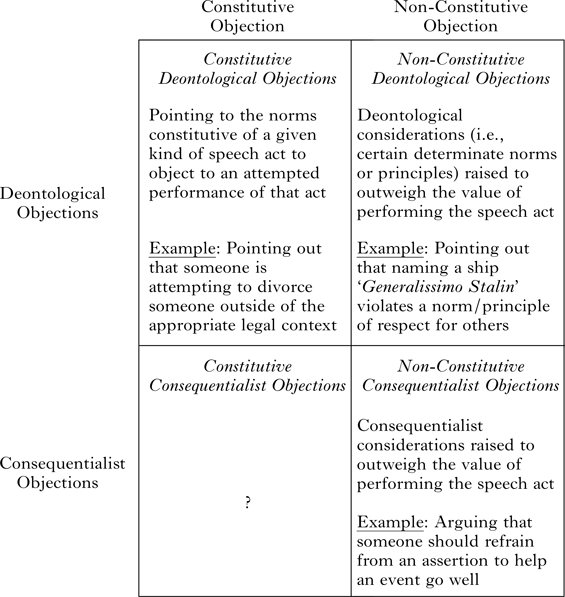
What we find in this schema is a square here that cannot be easily filled – the possibility of a constitutive consequentialist objection. Why? Because a ‘constitutive consequentialist’ objection seems to be a contradiction in terms. If constitutive objections work by pointing to a failure of a performance to adhere to the norms constitutive of the relevant speech act, then they seem to be deontological by their very nature. Whether such a performance would nonetheless promote the speaker's and audience's ends would not suddenly transform the act into a successful one: the norms that constitute the act are the relevant norms regardless of whether an infelicitous performance would bring about a maximally good set of consequences. Even if, for example, someone's attempt to divorce their spouse by saying outside of the appropriate legal context, ‘I divorce you!’, is an utterance that somehow – through a very peculiar causal chain – brings about world peace, this would not make it the case that they had thereby, via their utterance, divorced their spouse.
But I want to argue that there is at least one type of objection that belongs here: objections to speech acts where speakers put linguistic or conceptual content forward in a way that aims to be useful for both speaker and audience. Consider, for example, Mitchell Green's account of the speech act of supposition, which he glosses this way: ‘the acceptance of a proposition for the sake of argument’ (Reference Green2000, p. 376). Suppositions are key tools for inquiry. They help interlocutors entertain possibilities they may not be ready to commit to or possibilities that will help reveal conclusions they may not otherwise accept. Green continues:
[O]ne may invoke a practice permitting a proposition P to be put forth as a supposition rather than as an assertion. Doing so entitles the reasoner to draw inferences from P, together with other propositions already established or accepted, in order to infer a proposition Q still under the scope of the supposition P. (That she is entitled to do so is shown by the impropriety of objecting to the soundness of her reasoning as against the validity thereof.) Having reached Q, the reasoner is entitled to put forth “If P, then Q” no longer under the scope of P, and if no other suppositions are in force she is entitled to put forth that conditional assertorically. Ideally, with the aid of other propositions established or accepted the assertion justified by this procedure will settle the question at issue (Reference Green2000, p. 378).
To suppose a proposition P, then, on this view, is to generate an entitlement to draw inferences on the basis of P that, along with ‘other propositions already established or accepted’, will help us arrive at a salient conclusion. Conversely, once we give uptake to the supposition (i.e., treating it as in effect for our linguistic context), it is no longer appropriate to deny an entitlement to P. The latter is precisely what the supposition generates for speaker and audience (an entitlement that disappears when the supposition is no longer taken to be in effect).
I want to extend Green's account and subsume it under a larger class of speech act. Two notes are important. First, the justification Green links to suppositions is that of conversational or argumentative utility: the supposition is taken to be justified or accepted because it will help the conversation or argument go better. But what if the end appealed to by the speaker and shared by the audience were different? Consider, in this light, the following example. I am playing a game of soccer with friends in a field, and we need to pick something to count as goal posts. So I say:
(3) Let's have those trees count as goal posts.
Suppose my friends agree. What have I done via the speech act I perform in (3)? In part, I have generated a certain inferential entitlement: I and my friends are now all entitled to treat the relevant trees as goal posts. In turn, this entitlement gives rise to all sorts of novel linguistic moves and behavior. For example, we can now determine when someone has scored, we can assert who is winning or losing the game, players can demand the ball from one another, etc. But not only does uptake for (3) generate this inferential entitlement, it is now the case that no one who is a party to the game can appropriately act as though the trees are not goal posts. If someone tries to do so, they will be appropriately subject to censure – criticized for failing to abide by what is now the case. (3) is also justified – even though I do not make this justification explicit – on the basis of its usefulness for promoting what I take to be my shared ends with my audience. Given the context for this case, this shared end is not one of conversational or argumentative utility; the shared end is our having a good, fun, challenging, etc., game.
The speech act I carry out in (3) is therefore a close cousin of Green's supposition: it generates an inferential entitlement, a license to censure those who give uptake to the act but refuse to grant the entitlement, and it is taken to be justified on the basis of whether it serves the shared ends of speaker and audience. My view is that it is this general structure that characterizes the speech act of stipulation, of which both Green's supposition and (3) represent subsets. Consider, in this light, that we could easily re-phrase (3) as follows:
(3’) Let's stipulate that those trees count as goal posts.
Now, following many other speech act theorists, I take surface grammar and ordinary language to be a highly defeasible guide to determining what kind of speech act is at stake in a given context. Whether or not the word ‘stipulate’ appears in an utterance, then, is hardly a dispositive indication of its status as a stipulative speech act. But I include this language in (3’) to help make the connections I am interested in more vivid.
Green's suppositions, (3), and (3’) are therefore all examples of the class of speech act I call ‘stipulations’ or ‘stipulative acts’. Stipulations in my sense allow for variability in both the content stipulated and the end speakers appeal to in order to justify their act, but share the following general pragmatic structure:
S1: Successful stipulations give both speaker and audience a shared inferential entitlement, while also precluding speaker and audience from denying this entitlement.
S2: Even if not explicitly, the speaker justifies their stipulation on the basis of whether it serves the shared ends of speaker and audience, and the act is always subject to the felicitous criticism from the audience that it fails to serve these shared ends.
→ Corollary: Assertoric negations of stipulations are infelicitous.Footnote 10
Let's now return to the question that launched us down this path. We wanted to know whether there was any speech act felicitously subject to what I have called a constitutive consequentialist objection – that is, whether we can prompt a misfire of a speech act, rendering its characteristic effects null and void, by pointing to the failure of the attempted speech act performance to be useful. While it is clear that we can felicitously criticize speech act performances for failing to be useful in a non-constitutive sense (i.e., once the speech act has been performed), the puzzle is whether such a criticism can be felicitously deployed in a constitutive sense. Initially, it was unclear what kind of speech act could possibly play this role. But we have now found that it is stipulative speech acts, as I understand them, that can be felicitously criticized in a constitutive sense for failing to be useful.
To make this point explicit, consider the following criticism of (3) or (3’):
(4) Having those trees be the goal posts isn't a good idea because those trees are too close together, so no one will ever manage to score.
What makes (4) an example of a felicitous objection is that it shows that the attempted stipulation does not promote the speaker and audience's joint ends (e.g., of playing a good game). It might seem that this example is very similar to the case of the two professors, where Lisa's assertion is objected to by Paula who thinks the value of making the assertion is outweighed by the negative consequences of carrying out the act. But the latter was taken to be a paradigmatic example of a non-constitutive consequentialist objection.
The crucial difference between these two cases, however, lies in how the consequences are relevant in assessing the speech act. When Paula raises her consequentialist objections to Lisa's assertion, these consequences, no matter how devastating, do not prevent Lisa from successfully carrying out an assertion; they may well give her an all-things-considered reason not to make this assertion, but the assertion can itself succeed qua assertion regardless. This is not the case for (4) as an objection to (3) or (3’). The raising of the objection in (4) – all else being equal – prevents my stipulation from going into effect. After the other player raises the objection in (4), were I to begin trying to play with the rule in place, the other players would be rightly confused by what I was doing. No entitlement has been generated to act in this way without the other players’ endorsement.Footnote 11
Note that, by contrast, the following attempts to object to my stipulations in (3) or (3’) would be infelicitous:
# (5) It is not the case that the trees count as goal posts.
# (6) It is not true that the trees count as goal posts.
# (7) It is false that the trees count as goal posts.
(5)-(7) are all infelicitous objections to my stipulative speech acts because I am not saying in (3) or (3’) that it is true or it is the case that the trees count as goal posts. Rather, I am saying that it will be useful to take the trees to be goal posts, not that they already somehow are. After a successful performance for (3) or (3’), my friend and I can then make felicitous assertions about the trees counting or not counting as goal posts, but (3) or (3’) – as the inappropriateness of these assertoric objections demonstrate – are not helpfully construed as assertions.
What this discussion has revealed is that there is a class of speech act that is not an assertion and that constitutively aims at promoting the ends of speaker and audience (and is therefore always subject to the felicitous constitutive objection that it fails to do so). We therefore seem to have a good candidate for the kind of speech act we have been searching for – one that will allow us to introduce a novel way of talking and thinking about a particular linguistic context on the basis of its utility.
So far, however, the examples of stipulation discussed have not involved the question of how a particular term or concept is to be understood. But recall my claim that stipulations do not have a determinate content they must take as input. There is no reason, then, that a stipulative speech act cannot be performed that concerns how a particular term or concept is to be understood, and I turn to these cases now.
3. Stipulation, Concepts, and Philosophy
In a discussion in political philosophy, I say:
(8) I stipulate that ‘oppression’ means institutional constraints on a social group's self-development.
As phrased, (8) may sound as though it is addressing a marginal issue, rather than giving an account of how the term ‘oppression’ (or the concept of oppression) should be understood, but it is the latter (it may be objected) that philosophers are concerned to give. Note, however, that my account of stipulation covers both cases. Suppose (8) is addressing a marginal issue that I want to quickly settle and not have us get sidetracked by. Then the end I will either implicitly or explicitly appeal to in justifying (8) is that my stipulation will help us get right to the questions of primary interest.
But perhaps in (8) I am aiming to give a more robust account. Indeed, the view in (8) is taken from the work of Iris Marion Young, and I turn now to details of her account of this concept for the first of two applications of my account of stipulation. These applications should help to further clarify the details of the account and demonstrate its utility as a view of philosophical language.
In Justice and the Politics of Difference, Young explains that she will apply the term ‘oppression’ to the context of late twentieth-century American society. She acknowledges that this use of the term will be surprising to many: ‘One reason that many people would not use the term oppression to describe injustice in our society is that they do not understand the term in the same way as do new social movements. In its traditional usage, oppression means the exercise of tyranny by a ruling group’ (Young, Reference Young1990, p. 40). When understood as fundamentally tied to ‘the exercise of tyranny by a ruling group’, the concept of oppression is therefore assumed to apply ‘societies other than our own’, that is, those governed by explicitly authoritarian regimes and those enforcing de jure discrimination, such as apartheid South Africa (Young, Reference Young1990, p. 41). Young, by contrast, takes up the usage and understanding of the concept of oppression by ‘[n]ew left social movements of the 1960s and 1970s’ that severs any fundamental link between the concept of oppression and a determinate figure or group of authoritarian leaders (Reference Young1990, p. 41). We are told: ‘Oppression refers to structural phenomena that immobilize or diminish a group’, specifically in terms of its self-development (Young, Reference Young1990, p. 42). The ‘structural phenomena’ constraining a social group's self-development need not ‘be understood as perpetrated by particular oppressing agents’, otherwise ‘one misses the mundane and systematic character of oppression’ (Young, Reference Young1990, p. 196). That is, we end up missing ‘the disadvantage and injustice some people suffer not because a tyrannical power coerces them, but because of the everyday practices of a well-intentioned liberal society’ (Young, Reference Young1990, p. 41).
What sort of speech act should we say Young is performing in articulating this understanding of the concept of oppression? Many of her formulations are assertoric. They appear to state what is the case with respect to the concept of oppression: ‘Oppression consists in…’ (Reference Young1990, p. 38); ‘Oppression refers to…’; the traditional understanding of the concept of oppression ‘misses [its] mundane and systematic character’. But Young explicitly acknowledges that her account of this concept will be surprising to many precisely because it does not represent how this concept is currently used and understood by the vast majority of speakers: it is a ‘new’ and ‘extended’ usage that therefore does not seem to state what is the case with respect to the concept of oppression (Young, Reference Young1990, p. .41). But Young is also not simply saying that we should adopt this usage on the basis of her speaker authority or the authority of these social movements.
My preferred interpretation is that Young is engaging in an act of stipulation: she is attempting to impart an inferential entitlement to both herself and her readers that they understand the concept of oppression in a specific way because doing so has a host of advantages. That is, Young is saying that whenever the concept OPPRESSION is invoked, speaker and audience are entitled to make the following inference: it involves ‘institutional constraint on self-development’ in a way that does not require specific, individual agents having the conscious intent to impose these constraints (Young, Reference Young1990, p. 37). Speaker and audience should be entitled to this inference on the basis of what Young takes to be ends shared with her readers. What are these ends? It seems that she takes views of political concepts such as oppression to be accountable to how they are understood by a broad range of political actors, not just those with existing institutional power. Young also seems to believe that any view of the concept of oppression is one that should help to explain the presence of pervasive and grave injustices and inequalities generally, regardless of whether the society's dominant political institutions are typically viewed as democratic or liberal.
If Young's audience gives uptake to her attempted stipulative act – treating this inferential entitlement as shared – then neither she nor her audience will be able to appropriately deny this inference and will be appropriately subject to censure if they attempt to do so. For example, someone cannot appropriately claim, after granting Young's stipulative act uptake, that a certain policy is not oppressive because it was not formulated by specific, individual agents consciously intending to subordinate a social group. Such a move would ignore the inferential entitlement that is now shared in this context. A critic can, however, migrate to a constitutive consequentialist objection that Young's understanding of the concept of oppression is not useful and therefore should not be given uptake. But assertoric objections that the concept of oppression is not or does not consist in what Young says it does after granting uptake to this stipulative act are no longer felicitous.
Why would such a reading of Young's account be helpful? To begin, it makes the contours of subsequent debate about this understanding of the concept of oppression clearer. It is easy to imagine the following genre of response to Young's account:
Young simply gets the concept of oppression wrong. What she is talking and thinking about when she discusses this concept has nothing to with what the vast majority of us are talking and thinking about when we discuss this concept. Whatever injustices and inequalities certain social groups face in contemporary liberal societies, they simply are not forms of oppression. She and sympathetic readers are of course welcome to talk however they wish, but there is no reason anyone else needs to take their concept seriously.
Though typical, such a response on my re-reading of Young represents a non-sequitur.Footnote 12 If Young is not making an assertion regarding this concept, then she is not primarily aiming to state what is the case regarding this concept. If Young is, as I have argued, stipulating an understanding of this concept, then she is not saying that we already understand it in this way or that this represents the ‘true’ nature of the concept, but that we should understand the concept in this way. Now we might not want to accept this usage and understanding. But our objection cannot be that it falsely represents what is the case regarding this concept. The latter misunderstands what Young is doing.
At the same time, a version of this objection with genuine bite for Young's account can now be formulated. Here the critic could be read as defending the importance of preserving continuity with existing usage and understanding in articulating our understandings of certain concepts. Perhaps the critic would further argue that any utility to Young's account is outweighed by how it will confuse researchers and other speakers not familiar with Young's work. The critic would then be arguing that Young's attempted act of stipulation fails to be useful and so should not be taken as binding on other speakers (as it aims to be). Or the critic may argue that Young's view fails to clearly delineate instances of oppression in ways that are important, say, for social and political science or for political action. These are debates well worth having: the degree to which ends such as preserving continuity with existing usage and understanding as well as fruitfulness for forms of empirical inquiry or specific political projects should factor into our articulation of certain concepts.Footnote 13 These are also difficult questions. Trying to pin down what we care about when it comes to our concepts and conceptual schemes is no easy task. But the importance of these issues and the need for positive arguments concerning them risk being obscured by standard assertoric formulations, such as the above imagined objection.
A final note on this case. The ends Young appeals to here – accounting for a range of injustices and accounting for usage among various political actors – are very different from those at stake in (8). They are not the ends of overcoming a conversational impasse or facilitating easier discussion. The ends Young appeals to – because they are not indexed to a single conversation – entail that the applicability of this stipulative act is not constrained to only one linguistic context. Unless otherwise specified, the act aims to apply whenever the term ‘oppression’ or concept of oppression is invoked.Footnote 14 And this is exactly what my general account of stipulation predicts: differences in both the content stipulated and the ends speakers appeal to (neither of which my account restricts) will lead to stipulations whose effects will often be very different for the subsequent linguistic context. The same fundamental pragmatic structure will nonetheless be at play: a shared inferential entitlement for speaker and audience justified on the basis of the shared ends of speaker and audience, not on the basis of its truth.
The second example is from a very different area of philosophy – debates over the nature of linguistic reference. The tradition of semantic externalism claims that linguistic meaning is not importantly determined by the mental states of speakers, but instead by the references of words to extra-linguistic objects in the world. I will return to specific arguments for this view shortly, but first consider how proponents themselves articulate their position:
Saul Kripke: ‘It is in general not the case that the reference of a name is determined by some uniquely identifying marks, some unique properties satisfied by the referent and known or believed to be true of that referent by the speaker’ because such a description ‘is not giving a synonym, giving something for which the name is an abbreviation; it is, rather, fixing a reference’ (Reference Kripke1980, p. 106).
Hilary Putnam: ‘[T]he psychological state of the speaker does not determine the extension (or the ‘meaning’, speaking preanalytically) of the word’ (Reference Putnam1986, p. 226). He famously continues: ‘Cut the pie any way you like, ‘meanings’ just ain't in the head!’ (Reference Putnam1986, p. 227).
Note here that both Kripke and Putnam frame what they say about linguistic meaning and reference assertorically. Reference, Kripke argues, is not determined by an object satisfying a particular description, but by a reference-fixing event. For Putnam, linguistic meaning is not determined by the psychological state of the speaker, but primarily by the extra-linguistic reference of their words. They present themselves as representing what is the case with respect to the nature of linguistic meaning and reference.
But despite the assertoric surface grammar of these accounts, is this the best way to interpret them? Two sets of considerations suggest not. First, while Putnam, for example, does say that his view of linguistic meaning ‘recovers as much of ordinary usage in common sense talk and in linguistics as one is likely to be able to conveniently preserve’, he also concedes that ‘no reconstruction is going to be without some counter-intuitive consequences’, and his view is no exception (Reference Putnam1986, pp. 268–269). Second, despite Putnam's claim to be aiming to capture our common sense notion of linguistic meaning – and Kripke's similar claim that ‘having intuitive content…is very heavy evidence in favor of’ his views – neither carries out any kind of systematic empirical study to show that their usage and understanding of ‘reference’ and ‘meaning’ track intuitive, ordinary usage and understanding (Kripke, Reference Kripke1980, p. 42). Furthermore, as Noam Chomsky points out, it is not even clear that such a study could be designed because while we may have ‘intuitive judgments about the notion used in such expressions as Mary often refers to the young man as a friend (to the average man as John Doe, to good health as life's highest goal)’, we do not seem to have any intuitions about a term of ‘technical discourse’ such as ‘reference’ as Kripke and Putnam are articulating it, i.e., we have no intuitions about a term as it appears outside of natural language contexts (Chomsky, Reference Chomsky2000, p. 40).
Consider, then, an interpretation of what Kripke and Putnam are doing using my account of stipulation. Rather than saddling them with the implausible claim that they are simply trying to represent common usage and understanding regarding ‘meaning’ and ‘reference’ (even if some of their own formulations suggest this) or trying to represent their ‘true’ nature, we can instead take them to be saying that we should use and understand these terms and underlying concepts in a specific way in order to advance certain ends that are assumed to be shared with their audience. But what kinds of ends? Here we can re-visit some of Putnam's and Kripke's arguments. Putnam, for example, explains that his account of reference can help avoid what he takes to be the disastrous views of philosophers such as Paul Feyerabend, where linguistic meaning is taken to be inextricably linked to the scientific theory and beliefs in which terms are situated. On such views, differences in theory entail differences in the meanings of terms, so apparent advances in our understanding of a phenomenon are not advances, but simply changes in subject. If, however, we opt for an understanding of the concept of linguistic meaning where it is taken to be ‘largely determined by reference’ to extra-linguistic objects or kinds and not speakers’ beliefs, then we can avoid these unacceptable relativist consequences (Putnam, Reference Putnam1986, p. x). On my re-reading and despite his own assertoric formulations, Putnam is therefore helpfully read as stipulating that when the term ‘meaning’ or concept MEANING is invoked, speakers should be entitled to infer that it is largely determined by reference to extra-linguistic objects or kinds, and they are entitled because of the advantages of such an understanding – for example, in how it allows us to avoid relativist views in the history and philosophy of science.
For Kripke, a major consideration in favor of his kindred view of linguistic meaning is that it seems to capture the modal dimensions of our ordinary talk surrounding proper names. For example, we typically say of someone that they might not have done thus and such – that, say, Nixon might not have won the election in 1968 (Kripke, Reference Kripke1980, pp. 40–49). For such utterances to make sense, it seems that it must be the case that the meaning of proper names is not reducible to beliefs we have about that individual since we can always imagine that any of these beliefs might not be true of the individual in question, and we would nonetheless, in imagining such scenarios, still be referring to the same individual. Kripke says that he is capturing our intuitions about such cases while different views are simply ‘wrong’ or ‘false’. On my re-reading, however, this language is misleading. Kripke (like Putnam) is stipulating that when the concept of meaning is invoked, we are entitled to infer that it is determined primarily by reference to extra-linguistic objects. This is not because Kripke has represented the concept of meaning correctly, as his own wording suggests; it is because this view of the concept of meaning has the advantage of preserving certain everyday linguistic practices we have surrounding proper names, for example.Footnote 15
As I did for Young's account, let me suggest how this re-reading of the debate over linguistic meaning and reference can be helpful. It moves the debate away from seemingly unproductive exchanges about the precise ontological status of a relation of reference – whether there really is such a relation in the world. Rather, the question now becomes whether it is useful to think and talk about linguistic meaning in this way, i.e., as determined by a term's extra-linguistic referent(s). Read in this light, participants in the debate will not just be able to leave in the background the ends to which a view of linguistic meaning should be accountable; they will have to move this discussion of (otherwise simply assumed) shared ends to the fore. Do we want, for example, our view of linguistic meaning to account for ordinary language practices involving talk of proper names and natural kind terms? Why should this matter, and, if we decide it does, then to what degree should it matter? Do we want our view of linguistic meaning to be directly accountable to questions surrounding the rationality of conceptual change? Why or why not?Footnote 16 Note that neither Putnam nor Kripke provides us with any extensive discussion of such questions. Furthermore, interpreted in this light, assertions that meaning just is or is not a matter of reference – that this is how things are in the world – will prove not only unhelpful, but even infelicitous. The question posed by such discussions will not be what the concept of reference is or consists in; the question will be how we should choose to talk and think about this concept in light of what we take to be our shared ends.
Second, consider one of Chomsky's criticisms of Putnam and Kripke-style views that there is no concept of reference as Putnam and Kripke understand it that plays a role in ‘the best-grounded naturalistic theories of language [that are] C-R [computational-representational] theories’ (Chomsky, Reference Chomsky2000, p. 25). One way of construing this objection is to frame it as an objection on ontological grounds – i.e., that there just is no reference relation in the way Putnam and Kripke construe it from a naturalist's perspective. But the application of my account allows for a different reading. We can instead view the objection as arguing that any understanding of the concepts of linguistic meaning and reference should be directly answerable to our best scientific theories of language, rather than aspects of our ordinary talk surrounding proper names and natural kind terms. Indeed, this also helps us make sense of Chomsky's initially surprising observation that a suitably revised view of reference (that divorces it from a fundamental relationship to extra-linguistic objects and ties it to ‘an internalist syntactic’ framework) is often useful for contemporary linguistics (Chomsky, Reference Chomsky2000, p. 132).
Here in this final section, I have provided a sense of how my account of stipulation can be applied to discussions where philosophers are articulating a particular view of a term or concept. Even if philosophers do so in assertoric terms, my account gives us the ability to re-read their views in a novel and productive light. My hope is that the ground will also now be cleared for new metaphilosophical debates concerning the precise role of assertions in philosophy and the much wider range of things we may well do with our words as philosophers.Footnote 17


