Introduction
Schizophrenia is a severe mental illness that affects 1% of the population worldwide. Among the major psychiatric disorders, schizophrenia shows one of the highest estimates of heritability, ranging between 60% and 90% (Nöthen et al. Reference Nöthen, Nieratschker, Cichon and Rietschel2010). However, the neurobiological abnormalities determined by this genetic risk are poorly understood. In a recent genome-wide association study (GWAS) and in a follow-up study (Cichon et al. Reference Cichon, Mühleisen, Degenhardt, Mattheisen, Miró, Strohmaier, Steffens, Meesters, Herms, Weingarten, Priebe, Haenisch, Alexander, Vollmer, Breuer, Schmäl, Tessmann, Moebus, Wichmann, Schreiber, Müller-Myhsok, Lucae, Jamain, Leboyer, Bellivier, Etain, Henry, Kahn, Heath, Hamshere, O'Donovan, Owen, Craddock, Schwarz, Vedder, Kammerer-Ciernioch, Reif, Sasse, Bauer, Hautzinger, Wright, Mitchell, Schofield, Montgomery, Medland, Gordon, Martin, Gustafsson, Andreassen, Djurovic, Sigurdsson, Steinberg, Stefansson, Stefansson, Kapur-Pojskic, Oruc, Rivas, Mayoral, Chuchalin, Babadjanova, Tiganov, Pantelejeva, Abramova, Grigoroiu-Serbanescu, Diaconu, Czerski, Hauser, Zimmer, Lathrop, Schulze, Wienker, Schumacher, Maier, Propping, Rietschel and Nöthen2011), we found strong statistical evidence that the single nucleotide polymorphism (SNP) rs1064395 in the 3′ untranslated region of the neurocan (NCAN) gene on chromosome 19p13.11 is a risk factor for bipolar disorder (BD). In view of formal genetic and molecular genetic evidence that BD and schizophrenia share some of their risk factors, we performed a subsequent association study and identified that this common variation is also a risk factor for schizophrenia (Mühleisen et al. Reference Mühleisen, Mattheisen, Strohmaier, Degenhardt, Priebe, Schultz, Breuer, Meier, Hoffmann, Rivandeneira, Hofman, Uitterlinden, Moebus, Gieger, Emeny, Ladwig, Wichmann, Schwarz, Kammerer-Ciernioch, Schlösser, Nenadic, Sauer, Mössner, Maier, Rujescu, Lange, Ophoff, Schulze, Rietschel, Nöthen and Cichon2012). Both studies found that the A allele of rs1064395 is the risk-mediating allele. These results suggest that the SNP rs1064395 influences risk to a broader psychosis phenotype. In the next step, imaging studies are necessary to test the hypothesis that the NCAN risk allele mediates pathophysiologically relevant changes in the brain.
NCAN, formerly termed CSPG3, encodes neurocan, a brain-specific chondroitin sulfate proteoglycan (CSPG) of the lectican family (Prange et al. Reference Prange, Pennacchio, Lieuallen, Fan and Lennon1998). Recent analyses of mRNA expression patterns in mice and humans suggest an important role for NCAN in the developing mammalian brain (Cichon et al. Reference Cichon, Mühleisen, Degenhardt, Mattheisen, Miró, Strohmaier, Steffens, Meesters, Herms, Weingarten, Priebe, Haenisch, Alexander, Vollmer, Breuer, Schmäl, Tessmann, Moebus, Wichmann, Schreiber, Müller-Myhsok, Lucae, Jamain, Leboyer, Bellivier, Etain, Henry, Kahn, Heath, Hamshere, O'Donovan, Owen, Craddock, Schwarz, Vedder, Kammerer-Ciernioch, Reif, Sasse, Bauer, Hautzinger, Wright, Mitchell, Schofield, Montgomery, Medland, Gordon, Martin, Gustafsson, Andreassen, Djurovic, Sigurdsson, Steinberg, Stefansson, Stefansson, Kapur-Pojskic, Oruc, Rivas, Mayoral, Chuchalin, Babadjanova, Tiganov, Pantelejeva, Abramova, Grigoroiu-Serbanescu, Diaconu, Czerski, Hauser, Zimmer, Lathrop, Schulze, Wienker, Schumacher, Maier, Propping, Rietschel and Nöthen2011; see also BrainSpan: Atlas of the Developing Human Brain; www.brainspan.org). Neurocan molecules are mainly expressed by reactive astrocytes, but also by neurons (Karetko & Skangiel-Kramska, Reference Karetko and Skangiel-Kramska2009). Neurocan interacts with cell surface molecules, such as neural cell adhesion molecule (NCAM), L1/neuron-glia (L1/Ng)-CAM, transient axonal glycoprotein-1 (TAG-1)/axonin-1 and an N-cadherin-binding N-acetylgalactosaminyl phosphoryltransferase (GalNAcPTase) (Rauch et al. Reference Rauch, Feng and Zhou2001). These features enable neurocan to participate in the modulation of cell adhesion and migration. Furthermore, neurocan and other lecticans are thought of as ‘organizers’ of the extracellular matrix (ECM) in the central nervous system (Yamaguchi, Reference Yamaguchi2000). From embryogenesis to early postnatal stages, neurocan is one of the predominant lecticans in the brain ECM whereas, later in life, other members of this protein family prevail (Frischknecht & Seidenbecher, Reference Frischknecht and Seidenbecher2008; Karetko & Skangiel-Kramska, Reference Karetko and Skangiel-Kramska2009). Characterization of NCAN double-knockout mice demonstrated impaired pre-pulse inhibition (Miró et al. Reference Miró, Meier, Dreisow, Frank, Strohmaier, Breuer, Schmäl, Albayram, Pardo-Olmedilla, Mühleisen, Degenhardt, Mattheisen, Reinhard, Bilkei-Gorzo, Cichon, Seidenbecher, Rietschel, Nöthen and Zimmer2012), an intermediate phenotype for schizophrenia and also for BD (Thaker, Reference Thaker2008). The affected mice also showed higher exploratory and overall locomotor activity. Accordingly, in patients with schizophrenia and BD, the risk allele was strongly associated with the symptom dimension overactivity, providing further support for an association between NCAN and psychosis pathophysiology (Miró et al. Reference Miró, Meier, Dreisow, Frank, Strohmaier, Breuer, Schmäl, Albayram, Pardo-Olmedilla, Mühleisen, Degenhardt, Mattheisen, Reinhard, Bilkei-Gorzo, Cichon, Seidenbecher, Rietschel, Nöthen and Zimmer2012). Despite these strong molecular and behavioural data, the possible relevance of NCAN variation for disease mechanisms in the human brain has not yet been explored.
In the past few years, imaging genetics has emerged as a promising approach in neuropsychiatric research. It enables identification and characterization of genetic variants that influence brain structure and function underlying normal and abnormal biological pathways (Esslinger et al. Reference Esslinger, Walter, Kirsch, Erk, Schnell, Arnold, Haddad, Mier, Opitz von Boberfeld, Raab, Witt, Rietschel, Cichon and Meyer-Lindenberg2009; Erk et al. Reference Erk, Meyer-Lindenberg, Schnell, Opitz von Boberfeld, Esslinger, Kirsch, Grimm, Arnold, Haddad, Witt, Cichon, Nöthen, Rietschel and Walter2010; Schultz et al. Reference Schultz, Nenadic, Koch, Wagner, Roebel, Schachtzabel, Mühleisen, Nöthen, Cichon, Deufel, Kiehntopf, Rietschel, Reichenbach, Sauer and Schlösser2011; Stein et al. 2012). In the present study, we investigated the SNP rs1064395 for a potential effect on cortical morphology using a clinically well-characterized sample of 63 patients with a DSM-IV diagnosis of schizophrenia and 65 healthy controls, all of German origin. We measured two parameters for cortical shape (cortical thickness and cortical folding) and subdivided the patients and controls according to their NCAN risk status. Cortical thickness is assumed to approximate the distance between the pial surface (outer surface) and the border between the grey and white matter (inner surface) of the cortex. As major parts of the formation of gyri (and sulci) take place in the third prenatal trimester (White & Hilgetag, Reference White and Hilgetag2011), cortical folding can be regarded as a sensitive marker for aberrations in neurodevelopment. Alterations in cortical thickness (Kuperberg et al. Reference Kuperberg, Broome, McGuire, David, Eddy, Ozawa, Goff, West, Williams, van der Kouwe, Salat, Dale and Fischl2003; Narr et al. Reference Narr, Bilder, Toga, Woods, Rex, Szeszko, Robinson, Sevy, Gunduz-Bruce, Wang, DeLuca and Thompson2005a ,Reference Narr, Toga, Szeszko, Thompson, Woods, Robinson, Sevy, Wang, Schrock and Bilder b ; Fornito et al. Reference Fornito, Yücel, Wood, Adamson, Velakoulis, Saling, McGorry and Pantelis2008; Nesvåg et al. Reference Nesvåg, Lawyer, Varnäs, Fjell, Walhovd, Frigessi, Jönsson and Agartz2008; Schultz et al. Reference Schultz, Koch, Wagner, Roebel, Nenadic, Schachtzabel, Reichenbach, Sauer and Schlösser2010b ,Reference Schultz, Koch, Wagner, Roebel, Schachtzabel, Gaser, Nenadic, Reichenbach, Sauer and Schlösser c ) and cortical folding (McIntosh et al. Reference McIntosh, Moorhead, McKirdy, Hall, Sussmann, Stanfield, Harris, Johnstone and Lawrie2009; Schultz et al. Reference Schultz, Koch, Wagner, Roebel, Nenadic, Gaser, Schachtzabel, Reichenbach, Sauer and Schlösser2010a ; Palaniyappan et al. Reference Palaniyappan, Mallikarjun, Joseph, White and Liddle2011) have been associated repeatedly with schizophrenia. Additionally, both structural measures are highly heritable (Rogers et al. Reference Rogers, Kochunov, Zilles, Shelledy, Lancaster, Thompson, Duggirala, Blangero, Fox and Glahn2010; Winkler et al. Reference Winkler, Kochunov, Blangero, Almasy, Zilles, Fox, Duggirala and Glahn2010) and are therefore suitable intermediate phenotypes for our approach.
Carrying the minor allele A of rs1064395 has been shown to confer a risk effect that increases disease susceptibility and, conversely, carrying the G-allele can be assumed to establish a protective effect (Cichon et al. Reference Cichon, Mühleisen, Degenhardt, Mattheisen, Miró, Strohmaier, Steffens, Meesters, Herms, Weingarten, Priebe, Haenisch, Alexander, Vollmer, Breuer, Schmäl, Tessmann, Moebus, Wichmann, Schreiber, Müller-Myhsok, Lucae, Jamain, Leboyer, Bellivier, Etain, Henry, Kahn, Heath, Hamshere, O'Donovan, Owen, Craddock, Schwarz, Vedder, Kammerer-Ciernioch, Reif, Sasse, Bauer, Hautzinger, Wright, Mitchell, Schofield, Montgomery, Medland, Gordon, Martin, Gustafsson, Andreassen, Djurovic, Sigurdsson, Steinberg, Stefansson, Stefansson, Kapur-Pojskic, Oruc, Rivas, Mayoral, Chuchalin, Babadjanova, Tiganov, Pantelejeva, Abramova, Grigoroiu-Serbanescu, Diaconu, Czerski, Hauser, Zimmer, Lathrop, Schulze, Wienker, Schumacher, Maier, Propping, Rietschel and Nöthen2011; Mühleisen et al. Reference Mühleisen, Mattheisen, Strohmaier, Degenhardt, Priebe, Schultz, Breuer, Meier, Hoffmann, Rivandeneira, Hofman, Uitterlinden, Moebus, Gieger, Emeny, Ladwig, Wichmann, Schwarz, Kammerer-Ciernioch, Schlösser, Nenadic, Sauer, Mössner, Maier, Rujescu, Lange, Ophoff, Schulze, Rietschel, Nöthen and Cichon2012). We therefore hypothesized that carriers of the genotypes AA and AG exhibit aberrant cortical thickness and/or cortical folding in comparison to carriers of the genotype GG.
Method
Subjects
We studied 63 patients with schizophrenia and 65 controls. All participants were right-handed (Annett, Reference Annett1967). Diagnoses based on the SCID were established by a clinical psychiatrist (I.N.) and confirmed by two independent psychiatrists (R.G.M.S. and C.C.S.). All patients met DSM-IV criteria for schizophrenia and had no second psychiatric diagnosis. Of the 63 patients, 58 were diagnosed as paranoid, two as undifferentiated, two as disorganized and one as catatonic subtype of schizophrenia according to DSM-IV. They were on stable medication, mostly with second-generation antipsychotics.
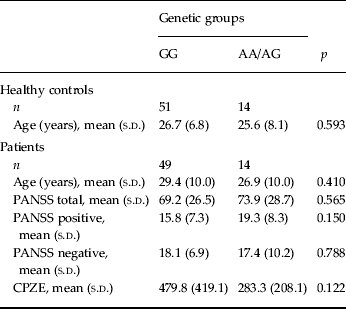
Healthy controls were screened for major medical, neurological and psychiatric history. None of the controls had a current psychiatric disorder, or a history of psychiatric disorder, and none had first-degree relatives with a psychiatric disorder according to DSM-IV. Exclusion criteria for all participants were neurological disease or damage, or medical disorders potentially influencing neurocognitive function. Ancestry was assigned to patients and controls on the basis of self-reported ancestry. All participants were of German origin. None of the subjects were consanguineous. All participants gave written informed consent to the study, which was approved by the Ethics Committee of Friedrich-Schiller University. Sociodemographic and psychopathological data are given in Table 1.
Demographic and clinical data

PANSS, Positive and Negative Syndrome Scale (Kay et al. Reference Kay, Fiszbein and Opler1987); CPZE, chlorpromazine equivalents; s.d., standard deviation.
Participants were grouped according to their NCAN risk status, that is homozygous and heterozygous risk genotype (AA + AG) versus the homozygous non-risk genotype (GG) of the single nucleotide polymorphism (SNP) rs1064395. There were no significant differences with regard to age and gender between the resulting genotype groups (p values > 0.190).
p values resulting from a two-sample t test.
Magnetic resonance imaging (MRI)
MRI acquisition
We acquired high-resolution anatomical T1-weighted MRI scans in a 1.5-T Siemens Magnetom Vision whole-body system (Erlangen, Germany) using a three-dimensional spoiled gradient echo sequence: 1-mm-thick sagittal slices with repetition time (TR) = 15 ms, echo time (TE) = 5 ms, flip angle = 30°, field of view (FOV) = 256 mm × 256 mm, matrix = 256 × 256, number of sagittal slices = 192. All scans were inspected for motion artefacts and a neuroradiologist confirmed the absence of gross pathological findings.
MR scan processing and calculation of cortical shape measures
We used the FreeSurfer software package (version 4.0.5; http://surfer.nmr.mgh.harvard.edu; Dale et al. Reference Dale, Fischl and Sereno1999; Fischl et al. Reference Fischl, Sereno and Dale1999) for image processing and for thickness and folding analyses. Image processing comprised the removal of non-brain tissue, transformation to Talairach-like space and segmentation of grey/white matter tissue. The white/grey matter boundary was tessellated and topological defects were corrected automatically. After intensity normalization, transition of the grey/white matter and pial boundary was identified by detecting the greatest shift in intensity through surface deformation. The entire cortex of each participant was then inspected visually and any inaccuracies in segmentation were edited manually.
Computation of cortical thickness
Cortical thickness was computed by finding the shortest distance between a given point (node of vertices) on the estimated pial surface and the grey/white matter boundary and vice versa and averaging these two values (Fischl & Dale, Reference Fischl and Dale2000). As the cortical maps generated were not restricted to the voxel resolution of the original data, they were capable of detecting submillimetre differences between diagnostic groups. This automated approach of cortical thickness measurement has been validated against manual measurements in schizophrenia (Kuperberg et al. Reference Kuperberg, Broome, McGuire, David, Eddy, Ozawa, Goff, West, Williams, van der Kouwe, Salat, Dale and Fischl2003).
Computation of cortical folding
Absolute mean curvature represents a very reliable local measure for cortical folding alterations, allowing a fine-grained comparison of cortical folding covering the entire cortex (Gaser et al. Reference Gaser, Luders, Thompson, Lee, Dutton, Geaga, Hayashi, Bellugi, Galaburda, Korenberg, Mills, Toga and Reiss2006; Luders et al. Reference Luders, Thompson, Narr, Toga, Jancke and Gaser2006). Absolute mean curvature of the pial surface was calculated as described by Schultz et al. (Reference Schultz, Koch, Wagner, Roebel, Nenadic, Gaser, Schachtzabel, Reichenbach, Sauer and Schlösser2010a ) for approximately 150 000 nodes in each hemisphere of the brain.
Genotyping and determination of subgroups according to the risk status
For the patients, rs1064395 genotypes were extracted from a genome-wide data set that had been genotyped and quality controlled in the study by Rietschel et al. (Reference Rietschel, Mattheisen, Degenhardt, Mühleisen, Kirsch, Esslinger, Herms, Demontis, Steffens, Strohmaier, Haenisch, Breuer, Czerski, Giegling, Strengman, Schmael, Mors, Mortensen, Hougaard, Ørntoft, Kapelski, Priebe, Basmanav, Forstner, Hoffman, Meier, Nikitopoulos, Moebus, Alexander, Mössner, Wichmann, Schreiber, Rivandeneira, Hofman, Uitterlinden, Wienker, Schumacher, Hauser, Maier, Cantor, Erk, Schulze, Craddock, Owen, O'Donovan, Børglum, Rujescu, Walter, Meyer-Lindenberg, Nöthen, Ophoff and Cichon2011). For the controls, lymphocyte DNA was isolated from venous blood samples using standard methods. To target SNP rs1064395 a primer pair was designed. Amplicons were generated using standard polymerase chain reaction (PCR) conditions. These were then sequenced using the Sanger method and a 3130XL Genetic Analyzer (Applied Biosystems, USA). Electropherograms were analysed by two independent investigators using SeqMan II (DNAStar, USA).
Depending on the NCAN risk status, patients and controls were divided into subgroups resulting in two genotype groups for each diagnostic group, that is 2 × (AA + AG) and 2 × GG, for statistical analyses. We compared risk allele (A) carriers with non-risk allele carriers in patients and controls separately, that is controls: AA + AG versus GG; patients: AA + AG versus GG. There were no significant differences with regard to age and gender between the resulting genotype groups (p values > 0.190).
Statistical analyses
Statistical cortical maps
Cortical thickness and cortical folding measurements at each vertex of the subjects' surface were mapped onto a common spherical coordinate system using a spherical transformation. Maps were smoothed using a Gaussian kernel of 10 mm. A general linear model (GLM) controlling for the effect of age was used to estimate differences in cortical thickness and cortical folding at each node. The GLM is based on an ANCOVA approach. Right and left hemispheres were tested separately.
Monte Carlo simulation and clustering
For correction of multiple comparisons, a Monte Carlo simulation (10 000 iterations) and a cluster analysis were performed to identify contiguous clusters of significant cortical thickness and cortical folding differences between the two genotype groups for each analysis (p < 0.05). The simulation and clustering approach is based on the AlphaSim algorithm (Ward, Reference Ward2000).
Results
Effect of NCAN risk status on the two cortical shape measures
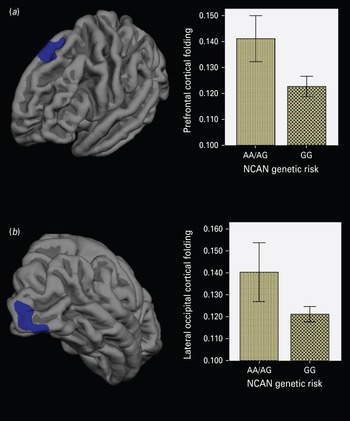
Schizophrenia patients carrying the homozygous and heterozygous risk genotypes (AA, AG) exhibited significantly higher cortical folding covering parts of the right visual cortex (V1 and V2 areas) than patients with the GG genotype (CWP = 0.032; Table 2, Fig. 1 b). A statistical trend (CWP = 0.073) was found for the left dorsolateral prefrontal cortical folding in the schizophrenia risk carriers (Table 2; Fig. 1 a). Extraction of the cortical folding values from these clusters demonstrated comparable highly significant nominal p values: p = 1 × 10⁻⁴ for the lateral occipital cluster and p = 6.10 × 10⁻⁵ for the prefrontal cluster.
Effect of the neocan (NCAN) risk status on cortical folding in patients with schizophrenia. Statistical maps show the identified anatomical clusters (coloured in blue) encompassing regions in (a) the left prefrontal and (b) the right lateral occipital cortex. Bar diagrams illustrate the folding differences between risk allele carriers (AA+AG) compared to non-risk allele carriers (GG) of the single nucleotide polymorphism (SNP) rs1064395. Mean cortical folding values extracted from the anatomical clusters between risk and non-risk carriers. Error bars indicate 95% confidence interval.

Results of the cluster analysis for cortical folding in patients with schizophrenia

CWP, Cluster-wise probability.
CWP (corrected for multiple testing) resulting from the cluster analysis in each cortical hemisphere; nominal (uncorrected) p values resulting from Student's t tests comparing the average cortical folding values at the identified anatomical clusters (as illustrated in Fig. 1).
No effect of NCAN risk status on cortical folding was observed in the controls. For cortical thickness, no effect of the risk variant was found, either in the patients or in the controls.
Genotype × diagnosis interaction
To test for differing effects of the rs1064395 genotype on diagnosis, we additionally performed a genotype × diagnosis interaction analysis as in prior imaging genetics studies (Prata et al. 2009), using the same statistical parameters as defined for the initial analyses (Monte Carlo simulation, clustering). We found a significant genotype × diagnosis interaction for cortical folding in the right superior parietal cortex, that is the influence of the NCAN variant on cortical folding was significantly stronger in patients (in the direction of a higher cortical folding in risk carriers) than in controls.
Comparison of cortical thickness and folding between patients and controls
We analysed the main effect of diagnosis on cortical thickness and folding post hoc using the same statistical conditions as defined for the primary analyses. Patients showed significant cortical thinning in several cortical areas including the left superior, middle and inferior temporal cortex, left inferior parietal, right inferior frontal, orbitofrontal, right superior, middle and inferior temporal cortex, in line with previous findings (Kuperberg et al. Reference Kuperberg, Broome, McGuire, David, Eddy, Ozawa, Goff, West, Williams, van der Kouwe, Salat, Dale and Fischl2003; Narr et al. Reference Narr, Bilder, Toga, Woods, Rex, Szeszko, Robinson, Sevy, Gunduz-Bruce, Wang, DeLuca and Thompson2005a ,Reference Narr, Toga, Szeszko, Thompson, Woods, Robinson, Sevy, Wang, Schrock and Bilder b ; Nesvåg et al. Reference Nesvåg, Lawyer, Varnäs, Fjell, Walhovd, Frigessi, Jönsson and Agartz2008; Schultz et al. Reference Schultz, Koch, Wagner, Roebel, Nenadic, Schachtzabel, Reichenbach, Sauer and Schlösser2010b ,Reference Schultz, Koch, Wagner, Roebel, Schachtzabel, Gaser, Nenadic, Reichenbach, Sauer and Schlösser c ). We found no significant cortical folding differences between patients and controls.
In a subsequent analysis, we compared cortical thickness and folding only in risk allele carriers using the same statistical parameters as defined for the initial analysis (entire cortex analysis, Monte Carlo Simulation and automated clustering). In patients, we found a significant cortical thinning with the AA/AG genotype compared to controls with the same genotype covering smaller parts of the left inferior and middle temporal region and the right inferior temporal, fusiform and lateral occipital cortex. No significant effects were detected for cortical folding.
Discussion
The investigated NCAN variant is one of the few genetic risk factors for major psychoses (BD, schizophrenia) that has received genome-wide support and robust evidence for replication in follow-up studies. To the best of our knowledge, the present study is the first to characterize the impact of this variant on the cortex structure in humans.
Effect of NCAN variation on occipital and frontal cortical folding
Our main finding was that cortical folding in association with NCAN risk status was significantly altered in parts of the primary and secondary visual areas (V1, V2) of the right occipital lobe in patients with schizophrenia, but not in the matched controls. Both V1 and V2 are related to early visual processing and deficits for these areas have been reported for schizophrenia (Butler & Javitt, Reference Butler and Javitt2005). Disturbed cortical integration of visual and other sensory inputs is thought to be involved in cognitive disruption in schizophrenia, as suggested by current bottom-up models (Javitt, Reference Javitt2009). Although the visual cortex in schizophrenia seems to be relatively free from reductions in grey matter volume (Honea et al. Reference Honea, Crow, Passingham and Mackay2005), several independent studies of schizophrenia have found alterations of occipital cortical folding (White et al. Reference White, Andreasen, Nopoulos and Magnotta2003; Narr et al. Reference Narr, Bilder, Kim, Thompson, Szeszko, Robinson, Luders and Toga2004; Schultz et al. Reference Schultz, Koch, Wagner, Roebel, Nenadic, Gaser, Schachtzabel, Reichenbach, Sauer and Schlösser2010a , Reference Schultz, Wagner, Koch, Gaser, Roebel, Schachtzabel, Nenadic, Reichenbach, Sauer and Schlösser2013). Hence, the observed association between the NCAN risk variant and disturbed occipital cortex folding suggests a role for NCAN in visual processing. Future studies are warranted to validate and further explore this potential function of NCAN.
Second, we found a strong statistical trend in the left hemisphere for altered dorsolateral prefrontal cortical folding in patients with NCAN risk. Prefrontal dysfunction is thought to be a major constituent of altered cognitive control in schizophrenia (Minzenberg et al. Reference Minzenberg, Laird, Thelen, Carter and Glahn2009), with crucial functions in higher-level gating and top-down processing (Miller, Reference Miller2000). Thus, the joint finding of fronto-occipital cortical folding alterations provides indirect support for an integrative model of both higher-order and early sensory processing deficits in the cortex of schizophrenia patients (Silbersweig & Stern, Reference Silbersweig and Stern1996; Adcock et al. Reference Adcock, Dale, Fisher, Aldebot, Genevsky, Simpson, Nagarajan and Vinogradov2009; Hugdhal, Reference Hugdahl2009; Hahn et al. Reference Hahn, Robinson, Kaiser, Harvey, Beck, Leonard, Kappenman, Luck and Gold2010; Neuhaus et al. Reference Neuhaus, Karl, Hahn, Trempler, Opgen-Rhein, Urbanek, Hahn, Ta and Dettling2011; Waters et al. Reference Waters, Allen, Aleman, Fernyhough, Woodward, Badcock, Barkus, Johns, Varese, Menon, Vercammen and Larøi2012). Moreover, our findings might reflect a potential pathomechanism for an additive disruption of top-down and bottom-up cortical processing associated with schizophrenia.
Third, we found a significantly stronger effect of the genotype on right superior parietal cortical folding in patients compared to controls in the direction of higher cortical folding in risk carriers. Hence, this finding supports the observed effects of the NCAN risk genotype on cortical folding in patients. The superior parietal cortex is known as a crucial structure for the reorganization of information during working memory processing (Koenigs et al. 2009). Disturbed working memory is one of the major pathophysiological features in schizophrenia (Forbes et al. 2009). Both prefrontal and superior parietal dysfunction constitute important elements in the context of disturbed cognitive control and associated altered working memory deficits in schizophrenia (Minzenberg et al. Reference Minzenberg, Laird, Thelen, Carter and Glahn2009). Thus, our finding of a significant genotype × diagnosis interaction strengthens the view that NCAN might be involved in altered higher-order cognitive functioning in schizophrenia.
In view of our previous result that NCAN variation is also a common risk factor for BD (Cichon et al. Reference Cichon, Mühleisen, Degenhardt, Mattheisen, Miró, Strohmaier, Steffens, Meesters, Herms, Weingarten, Priebe, Haenisch, Alexander, Vollmer, Breuer, Schmäl, Tessmann, Moebus, Wichmann, Schreiber, Müller-Myhsok, Lucae, Jamain, Leboyer, Bellivier, Etain, Henry, Kahn, Heath, Hamshere, O'Donovan, Owen, Craddock, Schwarz, Vedder, Kammerer-Ciernioch, Reif, Sasse, Bauer, Hautzinger, Wright, Mitchell, Schofield, Montgomery, Medland, Gordon, Martin, Gustafsson, Andreassen, Djurovic, Sigurdsson, Steinberg, Stefansson, Stefansson, Kapur-Pojskic, Oruc, Rivas, Mayoral, Chuchalin, Babadjanova, Tiganov, Pantelejeva, Abramova, Grigoroiu-Serbanescu, Diaconu, Czerski, Hauser, Zimmer, Lathrop, Schulze, Wienker, Schumacher, Maier, Propping, Rietschel and Nöthen2011), it is of note that top-down cognitive dysfunction (Hill et al. Reference Hill, Harris, Herbener, Pavuluri and Sweeney2008; Reichenberg et al. Reference Reichenberg, Harvey, Bowie, Mojtabai, Rabinowitz, Heaton and Bromet2009) and visual processing deficits (Green et al. Reference Green, Nuechterlein and Mintz1994; Yeap et al. Reference Yeap, Kelly, Reilly, Thakore and Foxe2009) are thought to be neurobiological features of both major psychoses. This observation might lead to the conclusion that specific common cognitive features in schizophrenia and BD are based on overlapping genetic risk variants such as NCAN. In view of the recent aetiological discussions about the psychosis spectrum, we are of the opinion that only a convergent integration of genetic, cognitive and neuroimaging features can shed further light on this important issue.
Cortical folding as an intermediate phenotype associated with NCAN variation in schizophrenia
An important aspect of our study is that the NCAN risk variant demonstrated an association with cortical folding but not with cortical thickness. This observation provides further support for accumulating evidence that specific neuroimaging features can be phenotypically and genetically independent (Panizzon et al. Reference Panizzon, Fennema-Notestine, Eyler, Jernigan, Prom-Wormley, Neale, Neale, Jacobson, Lyons, Grant, Franz, Xian, Tsuang, Fischl, Seidman, Dale and Kremen2009; Winkler et al. Reference Winkler, Kochunov, Blangero, Almasy, Zilles, Fox, Duggirala and Glahn2010). Our data suggest that NCAN might be specifically related to cortical folding rather than cortical thickness. This provides the first genetic evidence for a specific underpinning of localized cortical folding aberrations in schizophrenia.
As suggested by the spatiotemporal gene expression patterns in mice and humans (Cichon et al. Reference Cichon, Mühleisen, Degenhardt, Mattheisen, Miró, Strohmaier, Steffens, Meesters, Herms, Weingarten, Priebe, Haenisch, Alexander, Vollmer, Breuer, Schmäl, Tessmann, Moebus, Wichmann, Schreiber, Müller-Myhsok, Lucae, Jamain, Leboyer, Bellivier, Etain, Henry, Kahn, Heath, Hamshere, O'Donovan, Owen, Craddock, Schwarz, Vedder, Kammerer-Ciernioch, Reif, Sasse, Bauer, Hautzinger, Wright, Mitchell, Schofield, Montgomery, Medland, Gordon, Martin, Gustafsson, Andreassen, Djurovic, Sigurdsson, Steinberg, Stefansson, Stefansson, Kapur-Pojskic, Oruc, Rivas, Mayoral, Chuchalin, Babadjanova, Tiganov, Pantelejeva, Abramova, Grigoroiu-Serbanescu, Diaconu, Czerski, Hauser, Zimmer, Lathrop, Schulze, Wienker, Schumacher, Maier, Propping, Rietschel and Nöthen2011), along with the functions of NCAN known to date (Frischknecht & Seidenbecher, Reference Frischknecht and Seidenbecher2008; Karetko & Skangiel-Kramska, Reference Karetko and Skangiel-Kramska2009; Miró et al. Reference Miró, Meier, Dreisow, Frank, Strohmaier, Breuer, Schmäl, Albayram, Pardo-Olmedilla, Mühleisen, Degenhardt, Mattheisen, Reinhard, Bilkei-Gorzo, Cichon, Seidenbecher, Rietschel, Nöthen and Zimmer2012), the common genetic variant in NCAN most probably exerts its disease-relevant effect on cortex structure when major folding processes (gyrification) take place (White et al. Reference White, Andreasen, Nopoulos and Magnotta2003). After the cortical folding pattern has been established, it is largely maintained during life (Armstrong et al. Reference Armstrong, Schleicher, Omran, Curtis and Zilles1991). In line with this, mechanical models of brain development in primates indicate that folding is driven by the formation of cortico-cortical connections (Hilgetag & Barbas, Reference Hilgetag and Barbas2006), and further animal experiments have demonstrated that early disruption of white matter connections are related to focal hypergyria (Goldman-Rakic, Reference Goldman-Rakic1980). This view is also supported by a recent study by Dauvermann et al. (Reference Dauvermann, Mukherjee, Moorhead, Stanfield, Fusar-Poli, Lawrie and Whalley2012), who analysed prefrontal gyrification together with functional connectivity. Overall, our results, in conjunction with prior knowledge, indicate that increased prefrontal gyrification might be related to increased short-range and reduced long-range connectivity. Thus, our finding that genetic variation in NCAN is specifically associated with altered cortical folding, a neurodevelopmental cortical marker, fits well with previous molecular and neuroimaging studies.
Based on current knowledge, the question of how NCAN (encoding neurocan) contributes precisely to these neurodevelopmental processes at the molecular level cannot be answered definitively. In humans, NCAN is expressed in many cortical and subcortical regions (see BrainSpan: Atlas of the Developing Human Brain; www.brainspan.org). The expression in the cortex peaks during development starts to fall after birth, and decreases continually until the end of life (Human Brain Transcriptome (transcriptome data and associated metadata for the developing and adult human brain, www.hbatlas.org); Johnson et al. Reference Johnson, Kawasawa, Mason, Krsnik, Coppola, Bogdanović, Geschwind, Mane, State and Sestan2009; Kang et al. Reference Kang, Kawasawa, Cheng, Zhu, Xu, Li, Sousa, Pletikos, Meyer, Sedmak, Guennel, Shin, Johnson, Krsnik, Mayer, Fertuzinhos, Umlauf, Lisgo, Vortmeyer, Weinberger, Mane, Hyde, Huttner, Reimers, Kleinman and Sestan2011). Therefore, high NCAN expression levels coincide with the maturation of folding and connectivity patterns. This, and its molecular properties as an ECM molecule, enable neurocan to participate in the modulation of cell adhesion and migration processes during corticogenesis. As cortical folding, in addition to the mechanical properties of axonal fibres (‘tension-based hypothesis’), is thought to be caused by synergistic effects of cell proliferation and differentiation (‘grey matter hypothesis’) (Zilles et al. Reference Zilles, Palomero-Gallagher and Amunts2013), it seems likely that NCAN proteins are involved in cortical folding. The common genetic variant (SNP rs1064395) that we have analysed in the present study is a risk factor for schizophrenia and also for BD, but has not yet been characterized at the molecular genetic level. Our imaging genetics study provides the first evidence for a potential effect of the risk variant (A allele) on cortex structure. How the variant or another variant in linkage disequilibrium contributes exactly to an aberrant folding in the occipital and frontal regions remains to be elucidated in further follow-up studies.
Limitations
Cortical folding is regarded as an important anatomical feature in schizophrenia (Mangin et al. Reference Mangin, Jouvent and Cachia2010). In the present study we demonstrated the influence of NCAN on frontal and occipital cortical folding using an entire cortex approach. However, it cannot be excluded that other regions might be affected using region-of-interest (ROI) approaches. Thus, further studies with independent samples are needed to explore the role of NCAN in disease architecture.
Regarding the comparison of cortical folding between patients and controls, it might be of relevance that the numbers of risk allele carriers in both diagnostic groups were equal. This might explain why we could not detect any folding differences between the diagnostic groups as we demonstrated that the NCAN SNP influences cortical folding in patients.
One further limitation is that, because of the lack of longitudinal data, we cannot provide information about differences with regard to psychosis outcome, which might be influenced by the risk variant in association with the influence on cortical folding. Thus, longitudinal studies on this issue are warranted.
Conclusions
This is the first study to describe a potential neuroanatomical pathomechanism driven by a NCAN risk variant in schizophrenia patients. In particular, we used a systematic imaging genetics approach across both hemispheres and identified that the risk allele or alleles in linkage disequilibrium with it influence the folding of the occipital and prefrontal lobe in patients but not in controls. This finding indicates a potential role for NCAN in higher-order cognitive functioning and early visual processing. Both major cognitive processes are known to be disturbed in schizophrenia. Our study also provides evidence for a specific genetic underpinning of localized cortical folding aberrations in schizophrenia. This work is a good starting point for future studies, which should further investigate the suggested functional aspects along with the possible role of NCAN variation in brains of patients with BD. In general, we conclude that it might be beneficial to assess cortical folding as an additional intermediate phenotype in future studies of the cortex structure.
Acknowledgements
This study was supported by the German Federal Ministry of Education and Research (BMBF) grant 01GW0740 and the Interdisciplinary Centre for Clinical Research (IZKF) of the University of Jena.
Declaration of Interest
None.