INTRODUCTION
Mungbean (Vigna radiata (L.) Wilczek) is an important pulse crop; 5·5 million ha are grown annually (Weinberger Reference Weinberger2003) and the production rate is increasing by 2·5% per annum (Tomooka et al. Reference Tomooka, Vaughan, Kaga, Singh and Jauhar2005). Over half of the world's mungbean production is in India, China and Pakistan; however, Thailand is among the top exporters of mungbean grain and products. In 2007, 163 000 ha in Thailand were planted with mungbean, producing 122 000 tonnes of seed (Office of Agricultural Economics 2008). Mungbean can be grown up to three times per year, which makes it fit well with various cropping systems. Mungbean seeds have a high nutritive value and are utilized in making bean sprouts, starch noodles, different kinds of deep-fried patties and desserts. Seeds that do not meet human food standards can be used as livestock feed, to utilize its high-quality protein. The average yield of mungbean is low due to its indeterminate growth habit, photoperiod sensitivity, late and non-synchronous maturity, susceptibility to lodging, pod shattering and losses due to pests and diseases (Shanmugasundaram Reference Shanmugasundaram and Shanmugasundaram2003). One way to raise yield/unit area is to manipulate leaflet size and number. Mungbean yield is reported to be correlated positively with leaf area index (LAI), days to flowering, plant height, pod length, number of branches/plant, pods/plant and seeds/pod (Khan et al. Reference Khan, Nawab, Khan and Baloch2001; Makeen et al. Reference Makeen, Abrahim, Jan and Singh2007). Sung & Chen (Reference Sung and Chen1989) reported that soybean canopies comprised of narrow leaflets had increased light penetration. Wells et al. (Reference Wells, Burton and Kilen1993) reported that soybean with more leaflets per leaf produced a greater leaf area, which can intercept more sunlight and thus possibly give greater yields.
The multiple-leaflet trait in mungbean is reported to be controlled by a single recessive gene (Sripisut & Srinives Reference Sripisut and Srinives1986). This trait has been transferred to various mungbean lines, some of which bear up to seven leaflets. Soehendi et al. (Reference Soehendi, Chanprame, Toojinda, Ngampongsai and Srinives2007) reported that leaflet number was controlled by two loci of the gene, n 1 and n 2, while leaflet size (large and small) was controlled by a single locus, s. Kowsurat et al. (Reference Kowsurat, Srinives, Kasemsap and Lamseejan1999) reported greater seed yield, plant height and number of pods/plant in trifoliate mungbean cultivars than in ones with seven leaflets. Thus, leaflet size and number may be correlated with agronomic and physiological traits, and eventually seed yield, in mungbean.
Few studies have focused on how leaf architecture influences photosynthesis in mungbean. No study has used isogenic lines (ILs) to determine the effect of leaflet size and number. The present work was designed to develop ILs with different numbers and sizes of leaflets and to investigate their benefits on yield and yield components in comparison with the normal trifoliate mungbean cultivars.
MATERIALS AND METHODS
Plant materials
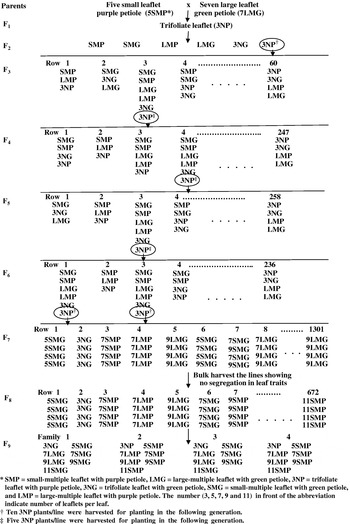
The population was derived from a cross between a female parent with five small leaflets per leaf (5S) and purple petioles and a male parent with seven large leaflets per leaf (7L) and green petioles. The 5S parent is a mutant line obtained from gamma-ray irradiation of F2 seeds from a cross between the cultivars Chai Nat 36 and TC 1966 (Srinives et al. Reference Srinives, Hual-Alai, Saengchot, Ngampongsai, Oono, Vaughan, Tomooka, Kaga and Miyazaki2000). The 7L parent is an IL (BC9) progeny of Kamphaeng Saen 1, the most popular cultivar in Thailand carrying the large-multiple leaflet gene from variety V 5926 (Kowsurat et al. Reference Kowsurat, Srinives, Kasemsap and Lamseejan1999). All F1 plants showed trifoliate leaves (Soehendi et al. Reference Soehendi, Chanprame, Toojinda, Ngampongsai and Srinives2007). The F2 progenies segregated for leaflet size and number in six main phenotype classes, viz. small multiple leaflets with green petioles (SMG), small multiple leaflets with purple petioles (SMP), trifoliate leaflet with green petioles (3NG), trifoliate leaflet with purple petioles (3NP), large multiple leaflets with green petioles (LMG) and large multiple leaflets with purple petioles (LMP). Only plants showing large trifoliate leaflets (3NP) with purple petioles (expected genotype N 1_N 2_S_P_) were harvested and sown plant-to-row to obtain F3 plants. The same process was repeated from F3 to F6 generations, during which the lines were observed for petiole colour and leaflet traits. To ensure continuation of the heterozygous genotype N 1_N 2_S_P_, any rows that did not contain all six phenotype classes (3NG, 3NP, SMG, SMP, LMG and LMP) were discarded and then only the 3NP plants were selected to provide seeds for rows planted in the following generation. Since mungbean is a strictly self-pollinated crop, heterozygosity of the progenies is half of their parents' in each generation. Among lines derived from the same F6 family, the F7 rows that showed no segregation within rows for leaflet size and number, viz. those phenotypes with normal trifoliate leaves (3N), with seven or nine large multiple leaflets (7LM and 9LM) or with five, seven, nine or 11 small multiple leaflets (5SM, 7SM, 9SM and 11SM), were individually harvested. Thus, there were seven leaflet types altogether in each F7-derived family. Leaflet lines in each family were almost identical in genetic background (theoretically 97% homozygous), but had different sizes and numbers of leaflets. Seeds from the F7-derived lines were sown and the lines with no further segregation were individually harvested for each leaflet trait. The steps of line development are shown in Fig. 1. Four families, two each with green and purple petioles, were finally tested in the field at Kasetsart University, Thailand (14°01′N, 99°58′E) in the late rainy season (August–November) 2008. The soil in the field is clay loam, pH 7·0–8·0 and high in organic matter over 30 g OM/kg soil. The land was ploughed, harrowed and ridged to make beds 1 m wide. The compound fertilizer was applied to provide 28 kg each of N, P2O5 and K2O/ha). In the trial, 28 ILs, seven from each of the four families) and both parents were sown in a randomized complete block design with three replications. The seeds were sown in experimental plots, each consisting of four rows of 5 m long, with 500 and 125 mm spacing between rows and hills within the same row, respectively. Each hill was planted with 2–3 seeds and thinned to one plant per hill at 2 weeks after germination. Weeds were controlled by hand hoeing once before flowering. Insect pests were controlled by spraying with triazophos twice, once at 7 days after germination and again at flowering.
Diagram showing development of ILs from the cross between parental mungbean lines, five small leaflets with purple petiole (5SMP) and seven large leaflets with green petiole (7LMG).

Data collection
Agronomic data
The median number of days to flowering was defined as the day when 0·5 of all plants in a plot were flowering. Plant height (in m) was recorded at this time. At first pod maturing stage (42–45 days after planting, DAP), the number of leaflets/plant and the number of compound leaves/plant was recorded on six random plants from the middle two rows in each plot. When 0·8 of the pods on these six plants had turned brown or black (65 DAP), the numbers of pods/plant, pod clusters/plant, branches/plant, and seeds/pod were counted and plant height, pod length (in mm) and pod width (in mm) were measured. Pods from each plant were hand-harvested, oven-dried at 65°C for 72 h and hand-threshed; mean seed weight (weight of 100 seeds) (mg) and seed yield/plant (g) were determined.
Physiological data
Light interception was measured on the date when all plots showed the first pod maturity using the LI-191 Line Quantum Sensor (LI-COR, Lincoln, Nebraska, USA). Two measurements above the canopy and four below were made in the middle of the plot, between the second and third rows, between 11.00 and 13.00 h. The growth habit and canopy pattern of plants in each plot were uniform, so the light interception measured was representative. The average photosynthetic photon fluxes (PPFs) were used for calculation of light interception as described by Board et al. (Reference Board, Zhang and Harville1996) as follows:

where I is the PPF beneath the canopy and I o is the PPF above the canopy.
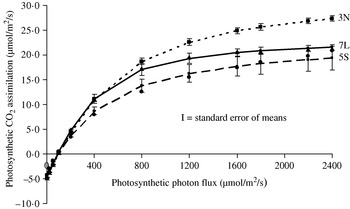
Photosynthetic CO2 assimilation rate (Pn): To determine the light saturation point (P max), a light response curve was constructed from a set of PPF values measured on the parental lines (7L and 5S) and the normal (3N) IL from 0 to 2400 μmol/m2/s. The photosynthetic rate at P max was observed at 2400 μmol/m2/s. Then, leaf photosynthetic rate at P max of 3N, 7L, 9L, 5S, 7S, 9S and 11S lines were determined when the first pod matured. Two plants from each plot were chosen randomly and leaf photosynthetic rate at P max was measured on a young, fully expanded, central leaflet using a LI-6400 Portable Photosynthesis System (LI-COR). A measurement was recorded when the leaf chamber temperature was 27–33°C, relative humidity 40–50% and CO2 concentration 358–363 g/kg. The data were presented as photosynthetic CO2 assimilation rate (Pn), which has the same unit as PPF.
Leaf area was measured from six plants per leaflet type per replication at the first pod maturing stage using an LAI-3100 Area Meter (LI-COR). The value is presented in mm2×1000 per plant.
LAI was estimated from fisheye photographs, taken using a Nikon fisheye lens converter (FC-E8) creating a combined focal length of 8 mm covering 183° angle by a digital camera (Nikon Coolpix 995). The images were taken looking upwards from beneath the plant canopy in the early morning at the maturity of the first pod. The effective LAI was calculated by integrating over the zenith angles of 0–75° using the Gap Light Analyzer (GLA) program Version 2.0. The GLA assumes that when the sun position is obstructed by the canopy, the direct radiation is zero, and when unobstructed, the direct radiation is equal to the above-canopy value (Frazer et al. Reference Frazer, Canham and Lertzman1999).
Statistical analysis
The agronomic and physiological data were subjected to analysis of variance to compare between means of the ILs and the parental lines, as well as between the individual ILs with different leaflet size and number. Upon detection of treatment difference, mean separation was performed using standard error of the difference (s.e.d.) between ILs at the specified error degrees of freedom (d.f.). Relationship between seed yield and yield components (number of pods/plant, seeds/pod and mean seed weight), and between seed yield and significant physiological traits were determined from the average of each trait across the IL families. Path coefficients showing direct and indirect relationship between seed yield and these traits were analysed following Roy (Reference Roy2000).
RESULTS
Effect of leaflet size and number on agronomic traits
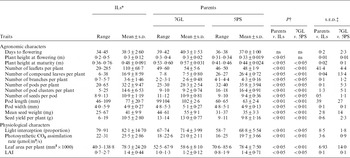
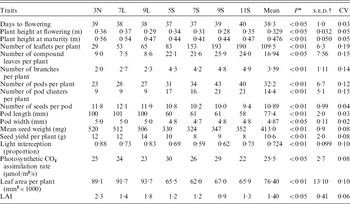
The ILs characterized by different sizes and numbers of leaflets were also diverse in all agronomic traits (Table 1). High variation in leaflets/plant, leaves/plant, pods/plant and pod length revealed that it is relatively easy to select superior ILs from the population. ILs carrying the same leaflet type were not different among families. The petiole colour was not responsible for variation in any traits (data not shown). Most traits of ILs were different from the parents, although they fell between their parents, except that the number of leaflets/plant was higher than both parents. This is because the progenies had more leaflets (5–11) per leaf and thus had higher leaflet numbers (20–285; mean 110) compared with their parents (mean 54 and 48 leaflets for 7GL and 5PS parents, respectively). The other traits showing large differences between the two parents as well as between the parents and the ILs were pod clusters/plant, pod length and seed yield. When the data were averaged across four families, 3N (denoting the average of four families entered in the field test, two each from 3NP and 3NG) was not different from 7L and 9L in most traits, except the number of leaflets/plant (Table 2). 3N and LM (7L and 9L) gave higher yield (12–14 g v. 8–10 g) and mean seed weight (506–520 mg v. 324–352 mg) than SM (5S, 7S, 9S and 11S), implying that seed weight is a major component of seed yield. 3N and LM also produced longer pods (100–101 mm v. 58–61 mm) and more seeds/pod (11·8–12·1 v. 9·4–10·8), but had fewer branches/plant (2·0–2·7 v. 4·2–4·9) and pods/plant (23–28 v. 31–43) than SM. There were no differences within the SM group in seed weight, pod size and number of branches/plant (Table 2).
Range and mean±S.D. of some agronomic and physiological traits of ILs and their parents carrying different leaflet size and number

* ILs=isogenic lines.
† The contrast differences between mean ILs v. parents (7GL and 5PS) and between two parents were identified as ns=non-significant.
‡ s.e.d.=standard error of the difference between ILs. v. parents and between two parents.
Mean comparisons of some agronomic and physiological characters of mungbean ILs carrying different leaflet size and number averaged across four families

* The differences between mean ILs were significant at the 0·05 and 0·01 levels of probability, respectively.
† s.e.d.=standard error of the difference between ILs.
Effect of leaflet size and number on physiological traits
Light interception was different between the ILs and their parents, as well as among the ILs with different leaflet sizes. On average, the progenies had higher light interception than their parents. The light interception of 3N lines was the highest (0·88), while those of 7L and 9L lines (0·73–0·83) were higher than those of SM (0·59–0·73) (Table 2).
The 3N, 5S and 7L plants began photosynthesis when the PPF reached 100 μmol/m2/s. The initial slope of the light response function increased until 2400 μmol/m2/s, which was the light saturation point (P max). The plants exhibited different photosynthetic rates from the PPF of 400 μmol/m2/s to the plateau at 2400 μmol/m2/s (Fig. 2). On average, the photosynthetic CO2 assimilation rate in 5S and 3N were the lowest and highest, respectively. 3N and 7L had similar but higher photosynthetic rates than 5S from PPF 400 to 1200 μmol/m2/s and from PPF 1600 to 2400 μmol/m2/s, 3N showed significantly higher photosynthetic rate than both 5S and 7L. At P max, the ILs expressed higher photosynthetic rate than their parents (Table 1). 3N and LM were similar in photosynthetic rate, while the SM lines were rather diverse (Table 2).
Light response curve of trifoliate leaflet (3N), five-small multiple leaflet (5SM) and seven-large multiple leaflet (7LM) mungbean lines.

Leaf area/plant differed between the parents as well as between the lines carrying various leaflet types. The ILs had a wider range of leaf area/plant (40·3–138·8 mm2×1000) than did the parents (52·5–67·9 and 70·6–85·6 mm2×1000) (Table 1). Among the progenies, 3N was not different from LM, but they were all higher than SM. The SM lines were not significantly different in leaf area/plant (Table 2), indicating that the difference in leaf area depended on leaflet size rather than leaflet number.
The ILs showed differences in LAI (Table 1), although the LAI seemed to vary across leaflet size and number. The 3N lines gave the highest LAI. Among the LM lines, 9L showed higher LAI than 7L, while among the SM lines, 11S was the highest (Table 2).
Relationship between yield and yield components
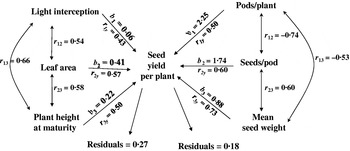
The relationship between seed yield and major agronomic and physiological traits was partitioned into direct and indirect effects through path coefficient analysis (Fig. 3). This revealed that yield depended on seed weight, the number of seeds/pod and the number of pods/plant with the correlation coefficients (r) of 0·73, 0·60 and 0·50, respectively. The relationship gave the combined R 2 for the three agronomic traits as 0·82 (residual=0·18). Seed weight was correlated positively with seeds/pod but negatively with pods/plant. This relationship caused indirect effects among the yield components upon seed yield. The number of pods/plant was also positively correlated with the numbers of pod clusters, branches and leaves/plant (data not shown). LM produced more yield/plant than SM due to its larger seed size and higher numbers of seeds/pod, although SM produced more pods/plant than LM.
Path coefficients between seed yield and related agronomic and physiological characters of mungbean across ILs of different leaflet size and number. All correlation coefficients (r) in the figure are significant at P<0·01.

For the physiological traits, leaf area/plant and light interception showed differences between leaflet types (Table 2), and correlated well with plant height at maturity (data not shown). Leaf area/plant, plant height at maturity and light interception were positively correlated with seed yield (r=0·57, 0·50 and 0·43, respectively). The combined effect of the three physiological traits accounted for 0·73 of the total variation in seed yield/plant (Fig. 3).
DISCUSSION
Since the genetic background of these F6-derived lines was 0·97 homozygous among lines within the same family, it allowed full expression of the leaflet types. Although the field trial was conducted only once, the coefficients of variability (CV) of the traits were low and thus allowed detection of the differences between leaflet types in all agronomic traits. This made the results of trait comparisons statistically valid. Seed yield, mean seed weight and the number of seeds/plant of the large leaflet group were higher than those of the small leaflet one (Table 2), revealing that the difference was effected by leaflet size rather than leaflet number. Mean seed weight is the most important yield component and directly proportional to seed yield/plant in the present study (r=0·73, P<0·01). The larger seed weight of the 3N and LM lines over that of SM lines implied that the genes controlling seed size might be linked with those controlling leaflet sizes. The large leaflet group was inferior in terms of clusters and pods/plant, which are considered major yield components. Thus, mungbean breeders could attempt to break the linkage and incorporate the pod prolificacy into the large leaflet genotypes. Kowsurat et al. (Reference Kowsurat, Srinives, Kasemsap and Lamseejan1999) found no variation in 100-seed weight and seeds/pod between trifoliate and multiple leaflet mungbean lines, whereas seed yield, plant height and pods/plant were greater in 3N than 7L. Soehendi et al. (Reference Soehendi, Chanprame, Toojinda, Ngampongsai and Srinives2007) reported that the pod lengths of trifoliate and 7L are similar, and significantly longer than those of 5S and 7S lines.
The mungbean genotypes that produced more branches tended to produce more pod clusters, pods and grain yield. However, plants bearing more pods usually have fewer seeds/pod because both traits are yield components and often balance each other. The present result reflects the results of Khan et al. (Reference Khan, Nawab, Khan and Baloch2001) and Makeen et al. (Reference Makeen, Abrahim, Jan and Singh2007), who reported a positive association between seed weight and pod length, as well as branches, pods and pod clusters/plant in mungbean. Similarly, although SM set more pods/plant, they also had smaller and fewer seeds/pod. SM might be used as a source to increase pod number and improve seed yield. The present study also showed that light interception was positively correlated with plant height, leaf area/plant and LAI as has been shown in cowpea (Idinoba et al. Reference Idinoba, Idinoba and Gbadegesin2002) and soybean (Wells et al. Reference Wells, Burton and Kilen1993).
The plants with large leaflets tended to intercept more light than the ones with small leaflets (Table 2). As an adaptation mechanism to maximize light interception, plants have developed different canopy architectures. Thus plant height, which relates to leaf canopy and growth rate, also affects light interception. The LM plants had a greater leaf area/plant and were taller than the SM plants (Table 2). This finding is similar to the report of Soehendi et al. (Reference Soehendi, Chanprame, Toojinda, Ngampongsai and Srinives2007) that the leaf area/plant of the trifoliate leaves and 7L lines was higher than that of 5S and 7S. Since the leaf area/plant was positively associated with light interception (r=0·54, P<0·01), the LM plants, which achieved a closed canopy sooner, would have higher light interception. Kowsurat et al. (Reference Kowsurat, Srinives, Kasemsap and Lamseejan1999) reported that trifoliate leaves have the same light interception as 7L. Also, light interception and plant height had important relationships with growth rate in faba bean (Odabas et al. Reference Odabas, Uzun and Gülümser2008).
Although photosynthesis/unit leaf area in crop plants is an important physiological attribute controlling whole plant photosynthesis, the present experiment could not establish a clear relationship between leaflet types and light interception. Kowsurat et al. (Reference Kowsurat, Srinives, Kasemsap and Lamseejan1999) reported that light saturation and photosynthetic rate were not different between normal and 7L lines.
SM have a large number of leaflets distributed evenly in the canopy, however, each leaflet has a much smaller area than 3N and LM (Table 2) and consequently they may absorb less sunlight. Idinoba et al. (Reference Idinoba, Idinoba and Gbadegesin2002) showed that leaf orientation and distribution in cowpea had a considerable influence on intercepted photosynthetically active radiation (PAR). Jahan & Hamid (Reference Jahan and Hamid2006) reported that leaf area was an important component, having a large bearing on the physiological processes controlling yield and dry matter production in mungbean and common bean (Gomez & Frankow-Lindberg Reference Gomez and Frankow-Lindberg2005).
LAI was reportedly positively correlated with seed yield, and the present study showed that it was associated with leaflet size rather than leaflet number (Table 2). Kowsurat et al. (Reference Kowsurat, Srinives, Kasemsap and Lamseejan1999) reported that LAI of the trifoliate lines was higher than that of the multifoliate lines (7L).
The path-coefficient analysis was constructed from ILs carrying a wide array of leaflet size and number and thus represented various possible relationships between yield and major agronomic and physiological traits in mungbean (Fig. 3). Among the agronomic traits, mean seed weight, the number of seeds/pod and the number of pods/plant were major yield components and so should be given high priority in a selection strategy for improving yield in mungbean. Idress et al. (Reference Idress, Sadiq, Hanif, Abbas and Haider2006) and Kumar et al. (Reference Kumar, Singh, Singh, Tonk and Lal2002) found a direct effect of pods/plant and seeds/pod on yield in mungbean, while Kutty et al. (Reference Kutty, Mili and Jaikumaran2003) reported a similar result in cowpea. Among the physiological traits, leaf area/plant and light interception were highly correlated with seed yield. Both traits were correlated with plant height and thus leaf area/plant, light interception and plant height at maturity were considered desirable traits in this mungbean population (Fig. 3). Similarly, Haile et al. (Reference Haile, Higley, Specht and Spomer1998) found that the greater the light interception, the higher the canopy apparent photosynthesis and the greater the yield in soybean.
It can be concluded from the present study that mean seed weight and seeds/pod are the most important agronomic traits related to leaflet size and seed yield in mungbean. Leaf area is the most important physiological traits positively correlated to seed yield, and the large-leaflet ILs have higher leaf area and yield than the small leaflet ILs. Thus, leaflet size is more important than leaflet number in relation to agronomic and physiological traits as well as seed yield in mungbean.
This research was supported by the Thailand Research Fund, Thailand's National Science and Technology Development Agency and the Graduate School of Kasetsart University.