

We live in an increasingly polarized society. Reference Westfall, Van Boven, Chambers and Judd1,Reference Abramowitz2 Many factors are feeding this tendency, although the media, in particular the partisan media, are often deemed responsible. Reference Wojcieszak, Bimber, Feldman and Stroud3,Reference Stroud4 Partisan media are understood as media that favor a political cause, party, or opinion, Reference Ward5 contrary to balanced news. Balanced news involves representing each point of view fairly. Fairly is loosely defined, Reference Abril6 but in practice, it involves devoting the same amount of space in a news article to each side of the issue, usually two. Reference Schudson7 One type of partisan media is nontraditional online news. Reference Sesno8,Reference Sunstein9,Reference Tremayne, Zheng, Kook Lee and Jeong10,Reference Brundidge, Garrett, Rojas and Gil de Zúñiga11 Nontraditional online news consists of ideologically charged or partisan information found online that does not follow conventional journalistic standards (e.g., the Huffington Post). Some researchers have viewed online partisan news as undesirable since it may lead to fragmented publics Reference Sunstein9 and polarization. Reference Sunstein9,Reference Wojcieszak12,Reference Iyengar and Hahn13 Their concern is that attitude polarization — engaging in even more extreme attitudes than one’s previously extreme attitudes — may endanger democracy by eclipsing the substance of policy arguments and increasing resistance to change among publics. Reference Kim, Wang, Gotlieb, Gabay and Edgerly14
However, online news users typically encounter more than one news article within an online experience, mostly two or more articles — what could be called a package, for instance, a webpage with different links to news articles. Reference Abril6,Reference McIntyre, Barnes and Ruel15,Reference Leeper16,Reference Gil de Zúñiga, Weeks and Ardèvol-Abreu17 For instance, most online news comes from social media, and although most of the exposure is like-minded, users still have exposure to difference through family members, high school or college friends, and/or coworkers whom we may have in our networks. Cross-sectional data show that half of Facebook users get news while Facebooking; 78% of these individuals mostly see news when on Facebook for other reasons, and the range of topics and opinions is quite broad. 18 Furthermore, big data from Facebook show that 24% of the (hard) news articles shared by friends of liberal account holders — and thus received by liberal individuals — were crosscutting (i.e., conservative). Similarly, for friends of conservative account holders, this percentage was 35% (i.e., liberal; see Bakshy, Messing, and Adamic). Evidence indicates that individuals exposed to a package of heterogeneous news (i.e., containing like-minded and contrary news articles) do not necessarily dismiss these contrary news articles, even if they stumble upon it. Reference Leeper16,Reference Brundidge20,Reference Garrett21 If contrary news is considered, what are the consequences of exposure to both like-minded and contrary news — that is, a heterogeneous bundle of news — on attitude polarization?
While research has looked at the effects of exposure to biased information on polarization (or related media effects) in controlled experiments, Reference Iyengar and Hahn13,Reference Taber and Lodge22,Reference Taber and Cann23,Reference Lord, Ross and Lepper24,Reference Coe, Tewksbury and Bond25,Reference Feldman26,Reference Feldman27 unresolved issues remain. First, few studies have tested the effects of exposure to a bundle of news (i.e., more than one news article), let alone exposure to a heterogeneous bundle, which mimics the online news experience more closely. Leeper is an exception in that he had a heterogeneous bundle, but his experiment did not include a balanced news condition. Reference Leeper16 Specifically, Leeper had separate pro and con environments in addition to an environment including pro and con articles. However, he lacked a balanced news condition with the same information. His control was a nonpolitical environment to control for exposure, so his manipulations are not exactly the same as what this study purports to test.
Second, it is less clear whether the effects on polarization also happen when there is a control group exposed to balanced news (following the North American and Anglo journalism tradition of objectivity, which includes balance; see Hallin and Mancini Reference Hallin and Mancini28 and Ward Reference Ward5 ) that contains the exact same information — that is, testing the effect of internal balance or balance at the story level. Internal balance is the degree of balance among issue positions within one news article, while external balance is the degree of balance among news articles, so it is balance at the macro, story, or bundle level. Reference Abril6 To be clear, studies on polarization have not typically checked whether there was an effect of exposure to a heterogeneous bundle of partisan news compared with a bundle of balanced news.
Third, some of these studies used short arguments or statements as stimulus Reference Taber and Lodge22,Reference Taber and Cann23,Reference Lord, Ross and Lepper24 but not news. When studies used news, they were referred to as cable news Reference Iyengar and Hahn13,Reference Coe, Tewksbury and Bond25,Reference Feldman26,Reference Feldman27 or generic news stories, Reference Feldman26,Reference Feldman27 but mostly not online news, which is on the rise. Reference Mitchell and Page29 Finally, it is possible that the effect of exposure on polarization is indirect, especially through hostile media perceptions, as some studies suggest. Reference Iyengar and Hahn13,Reference Vallone, Ross and Lepper30 Likely, focusing on partisan news that is overtly contrary to ones’ position and thus inducing hostile media perceptions Reference Iyengar and Hahn13 may make acceptance to like-minded news more likely, which, in turn, could result in heightened attitude polarization. Reference Vallone, Ross and Lepper30
This study seeks to test the effects of a heterogeneous partisan news bundle on attitude polarization controlling for external balance (i.e., balance of information at the bundle level, not at the news story level), using experimental data. In addition, study analyses distinguish whether the effects on attitude polarization are direct or indirect via hostile media perceptions, thus contributing to understanding how attitude polarization may arise from media exposure. The issue considered is assisted suicide, which remains a polarizing issue. Reference Gunther and Christen31,Reference Strate, Kiska and Zalman32,Reference Svenson33 In addition, assisted suicide affects most democratic societies and is still unresolved.
Online news and hostile media perceptions
The online news environment offers individuals the possibility of far greater selection of information than legacy media. Most individuals self-select information or news that aligns with their own issue positions (i.e., selective exposure; for a review, see Cappella, Kim, and Albarracín Reference Cappella, Kim and Albarracín34 ). However, the online news environment also offers opportunities to stumble upon news that one would not select. Many online navigational techniques and affordances attest to this crosscutting exposure (for a review, see Garrett Reference Garrett21 and Gil de Zúñiga et al. Reference Gil de Zúñiga, Weeks and Ardèvol-Abreu17 ), although it is not universal. Research also suggests that individuals do not always dismiss this “accidental” news. Brundidge Reference Brundidge20 calls this phenomenon the inadvertency thesis; Garrett Reference Garrett21 terms it opinion challenge.
Examining the effects of this crosscutting exposure on attitude polarization requires an understanding of processing biases. Among the indirect processing biases originating from news exposure and that studies have found to spur polarization is the hostile media phenomenon. Reference Vallone, Ross and Lepper30
The hostile media phenomenon is the tendency for partisans or strong attitude holders to see balanced news as biased against their own side of an issue. Reference Vallone, Ross and Lepper30 Exposure to balanced news causes partisans to focus on contrary information in the news, which leads to considering the news article as contrary to one’s position — carrying consequences such as attitude polarization. But the hostile media phenomenon also takes place with exposure to partisan news — the so-called relative hostile media perception. Reference Gunther and Christen31,Reference Gunther, Christen, Liebhart and Chia35 The relative hostile media perception is “the perception of relatively disagreeable media coverage by people on different sides of an issue” (p. 190). Reference Gunther and Christen31
Further, what are the effects on hostile media perceptions if, instead of one news story, individuals are exposed to a heterogeneous bundle of news — a more likely scenario in the online news media environment? Reference Abril6,Reference McIntyre, Barnes and Ruel15,Reference Leeper16,Reference Bakshy, Messing and Adamic19 If the hostile media perceptions can arise from balanced and partisan news, what are the effects of exposure to a heterogeneous bundle of partisan news, and, more importantly, do hostile media effects translate into attitude polarization for individuals — whether they have strong issue positions or not?
Findings by Fico and colleagues show that the more partisan news stories become, the more bias is reported by readers. Reference Fico, Richardson and Edwards36 Their study did contain a bundle of news, and each article had a different internal balance and/or story valence, but each article referred to a different topic, making control at the story level (external balance) difficult. In that case, participants were exposed to arguments regarding different stories (participants each read one pro, one con, and one neutral story from the three topics treated). Although their study closely mimicked the printed news media experience, the lack of control at the macro level triggers questions about the actual effects of partisan news bundles (since there was no bundle that was only partisan).
Gunther and Christen’s Reference Gunther and Christen37 study followed a similar design, with participants reading one article for each topic, so not controlling for the macro level either. Levels of influence, though, are key forces in media effects. Reference Abril and Rojas38 As a result of not controlling for levels of influence, is it argument strength or exposure to partisan news that drives the effects? Moreover, these studies consisted of administering print news. It is more likely to stumble upon a heterogeneous bundle of partisan news in online media than it is in print media, giving less credence to these scenarios with print media. Other studies testing the effects of written partisan news or slanted information consisted mainly of just one story per condition (e.g., Feldman Reference Feldman27 ).
The findings point toward partisan news eliciting a relatively stronger hostile media effect than balanced news, but it remains to be tested against a controlled condition of balanced news (one that is equivalent at the bundle level) to be sure the effects are due to fairness. It is likely that news bundles that are partisan, even if presenting both partisan sides in two separate articles, elicit more hostile media perceptions than articles that are completely balanced on their own. The first hypothesis purports to test precisely this.
- H1a:
Exposure to a heterogeneous partisan news bundle will lead to more hostile media perceptions than exposure to a balanced news bundle.
Because the hostile media effect occurs among partisans, but typically not among moderates, Reference Vallone, Ross and Lepper30 strong attitude holders are therefore expected to experience more hostile perceptions than moderates. The following hypothesis is proposed:
- H1b:
Strong supporters will experience more hostile media perceptions than moderates.
Attitude polarization
Early research showed that strong attitude holders are susceptible to disregarding information that runs contrary to their attitude and confirming information that is aligned with it, with the result that their strong attitudes may become stronger Reference Lord, Ross and Lepper24 — that is, polarized. When strong attitude holders are exposed to partisan news, this very effect should be expected. With partisan news, the selective exposure that triggers polarization Reference Sunstein9,Reference Johnson and Kaye39,Reference Conover, Ratkiewicz, Francisco, Gonc, Flammini and Menczer40 would exacerbate existing divisions between partisans from different sides. Reference Jacobson41
However, evidence of the inadvertency thesis Reference Brundidge20 and the regard for contrary news Reference Gil de Zúñiga, Weeks and Ardèvol-Abreu17,Reference Garrett21 implies that the undesirable effects of partisan news may become subdued when crosscutting information is taken into account. Reference Feldman26 This hypothesis runs parallel to the argument some scholars advance that partisan news plays a crucial role in democracy by encouraging a political discourse that is more vibrant, critical, and engaged. Reference Abril6,Reference Jamieson, Hardy and Romer42
Since evidence of the effects of exposure to a bundle of heterogeneous partisan news on attitude polarization has not been tested with a true control group (a bundle of balanced news with the same information), this remains an open question. Therefore, the following research question is advanced to look for a direct effect.
- RQ1:
Will exposure to a heterogeneous partisan news bundle lead to more attitude polarization than exposure to a balanced news bundle?
There is evidence that polarization is higher among partisans compared with nonpartisans. Reference Feldman26 This is because partisans are more reactive to contrary news than nonpartisans. So, if there is a polarization effect because of media exposure, strong attitude holders will experience more polarization than moderates. A hypothesis is posed:
- H2:
Strong supporters will experience more attitude polarization than moderates.
Finally, to assess the possibility that polarization may be a mediated effect, a model of media influence Reference Rojas, Barnidge and Abril43 leading to attitude polarization was formulated. The idea is that exposure to partisan news that is overtly contrary to one’s position ignites hostile media perceptions, which may make reliance on like-minded news more likely. This reliance, in turn, could result in heightened attitude polarization. Reference Vallone, Ross and Lepper30 That is, contrary news weighs heavier than like-minded news. But an argument could also be made that individuals are most attracted to like-minded information, thus directly leading to polarization among strong supporters of assisted suicide. This latter consideration would imply no mediation via hostile media perceptions. Because the mediation model has been hinted at Reference Vallone, Ross and Lepper30 but not directly tested, and because an argument could be made that mediation may not take place, the relationship is proposed as a research question.
- RQ2:
Will hostile media perceptions mediate the effect of a heterogeneous partisan news bundle on attitude polarization?
Methods
Study design
The present study consists of a between-subjects experiment with two conditions (partisan and balanced news bundles) embedded in a web survey with pre- and post-test questions. Question order was randomized to avoid order effects, but with the pre- and post-test questions always remaining pre- and post-test questions, respectively. Assignment to the conditions was random. Study participants were contacted using class Listservs via an email that contained the URL for the study. The stimuli consisted of news article bundles (heterogeneous partisan news versus balanced news bundles; two articles in each bundle). The researcher obtained informed consent online. Instructions recommended that participants complete the study in one sitting intended to require approximately 30 minutes. The study was pilot-tested before actual fieldwork.
Sample
The sample consisted of collegiate participants (
 $N=409$
; age:
 $M=22.48$
years,
 $SD=6.99$
; gender: 66% female). This choice was deemed appropriate because collegiate participants’ online presence is much higher than any other age group. For instance, 93% of 18- to 29-year-olds were online in the United States compared with 74% among all adults.
Reference Lenhart, Purcell, Smith and Zickuhr44
Thus, exposing participants to online news seemed more typical and common for this age group. Other research in this area has also employed collegiate samples (see Lord, Ross, and Lepper
Reference Lord, Ross and Lepper24
; Taber and Cann
Reference Taber and Cann23
; and Taber and Lodge
Reference Taber and Lodge22
).
The pilot study indicated that assisted suicide was a topic that collegiate participants cared about, and pre-test study results showed that on a scale from 0 (not at all) to 6 (very much), participants felt the issue of assisted suicide (assisting someone to die and having the right to be disconnected) was rather important to them (
 $M=4.37$
,
 $SD=1.13$
;
 $r=0.34$
), and perceived themselves to have quite a bit of knowledge about it (
 $M=3.42$
,
 $SD=1.30$
;
 $r=0.55$
).
The collegiate sample was diverse. Participants were recruited from a wide variety of majors, including communication, journalism, nursing, psychology, economics, business, consumer science, family studies, English, history, education, math, and social work, to name the most represented from a large midwestern university.
In keeping with tradition, the sample was split into moderates and strong supporters/detractors of assisted suicide using the following formula: each (pre-test) attitude item was multiplied by the strength of that attitude, and then the square root was taken to rescale.
Reference Tamborini, Weber, Eden, Bowman and Grizzard45,Reference Morisi46,Reference La Raja and Wiltse47,Reference Layman, Carsey, Green and Herrera48
A new variable assessing (pre-test) attitudes about assisted suicide by their strength was created (
 $M=4.05$
,
 $SD=1.34$
;
 $r=0.40$
) on a scale from 0 (strongly against) to 6 (strongly in favor). The distribution exhibited negative skewness (
 $M=-0.72$
,
 $SD=0.12$
;
 $p<0.001$
) but not kurtosis (
 $M=0.52$
,
 $SD=0.24$
, n.s.). This implies that there were more supporters than detractors in the sample. The distribution was split into three groups using the original scale thresholds. Strong supporters were those with pre-test attitude scores higher than or equal to five (
 $n=109$
). Detractors were those with pre-test attitude scores lower than or equal to 1 (
 $n=12$
). The rest were all considered moderates (
 $n=288$
). Because there were very few detractors, to have any power in our tests, they were excluded from subsequent analyses, resulting in a sample of 397 participants.
The issue of assisted suicide
Assisted suicide was chosen as the topic for this study for a variety of reasons. First, among nine controversial topics, assisted suicide was the issue closest to normality during pilot-testing. Second, assisted suicide was confirmed to be of interest to study participants at pre-test. Third, assisted suicide is a controversial issue in the United States. Reference Svenson33,Reference Ziegler and Jackson49,Reference Byock, Corbeil and Goodrich50,Reference Holody51,Reference Pollock and Yulis52,Reference Weir53 The news media have played a crucial role in stirring and shaping public opinion about the issue of assisted suicide (see “assisted suicide” in the New York Times topics: http://www.nytimes.com/pages/topics). Fourth, assisted suicide has been used in other studies dealing with processing biases, Reference Gunther and Christen31,Reference Christen and Gunther54 precisely as a controversial topic. Finally, assisted suicide is an issue that most democratic countries have debated fiercely in recent years and that remains unresolved.
Experimental stimulus: News bundles
The partisan articles were chosen from a set of articles generated by a LexisNexis search using the key words “assisted suicide” or “euthanasia.” To create the partisan condition, one article in favor of and one article against assisted suicide were chosen from the set. The pro-assisted suicide article appealed to notions of free choice and the right to stop suffering. The article against assisted suicide maintained that it was a religious sin and that no one should play God. Both articles were regular newspaper articles (i.e., not editorials).
To create the balanced condition, all paragraphs from the two partisan articles were mixed together and then split into two new (balanced) articles. The paragraphs were moved around to create a logical argument, and then transitions were added or changed to make the argument flow. Thus, in essence, both bundles of articles (the partisan condition with two partisan articles, and the balanced condition with two balanced articles) were equivalent but packaged differently. In fact, in terms of external balance, the two news conditions had the same external balance. However, the articles differed from condition to condition in terms of internal balance.
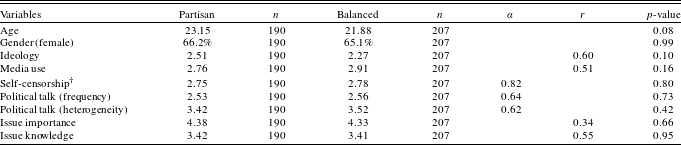
Differences across groups before experimental treatment.

Notes: All variables except age and gender were asked before the experimental manipulation. Tests are two-tail
 $t$
-tests except for gender (nonparametric).
 $r$
is reported for variables with two items, Cronbach’s
 $\unicode[STIX]{x1D6FC}$
, for variables with three or more items.
 $^{\dagger }$
Reference Hayes, Glynn and Shanahan66
 $N=397$
.
The articles were presented as (plain text) online news articles, each on a different screen, one after the other, and without reference to publication venue or authorship (participants were informed that venue and authorship were left out for study purposes). The order of appearance of each of the two articles in every condition was random to control for order effects. The titles of the partisan articles were as follows: “The Government [then the Barack Obama administration] Plans to Regulate Assisted Suicide this Term: It’s Time to Accept Assisted Suicide” (498 words) and “Conservatives [then the Republican opposition] Say That Assisted Suicide Is ‘Slaying’ People Using Public Funds” (537 words). For the balanced articles, the titles were as follows: “The Debate over Assisted Suicide Has Reignited Again” (468 words) and “Notes on Assisted Suicide” (563 words). Table 1 shows that random assignment to the two conditions was evenly split and produced two equivalent groups.
Measurement
Unless otherwise indicated, all measures in this article are on a scale from 0 (strongly disagree) to 6 (strongly agree).
Attitude polarization was measured using attitude change: pre- and post-test attitudes related to assisted suicide — the so-called actual polarization. Reference Wojcieszak55 Comparing pre- and post-test measures is the gold standard in studies examining attitude change in the context of media effects and polarization. Reference Taber and Cann23,Reference Feldman26
The pre-test questions were related to assisted suicide as a right and the right to be disconnected from life-sustaining equipment when unable to do so oneself (
 $M=4.34$
,
 $SD=1.26$
,
 $r=0.36$
). The precise wording was, “A patient suffering from a terminal or severe chronic disease should have the right to an assisted suicide (having a third person assist oneself in terminating one’s life)” and “Patients in assisted living, who have expressed their desire not to be connected to machines to keep them alive, should have the right to be disconnected.”
The post-test questions were related to assisted suicide as a right, how assisted suicide is a homicide (reversed), and the denial of assisted suicide as torture (
 $M=3.64$
,
 $SD=1.45$
, Cronbach’s
 $\unicode[STIX]{x1D6FC}=0.80$
). The precise wording was, “Assisted suicide is every citizen’s right,” “Assisting somebody to kill himself/herself is a homicide,” and “When a person is suffering and there is no cure, denying someone the right to die in dignity is torture.” Although the two measures (pre- and post-test) are not identical, they convey the same meaning (
 $r=0.73$
,
 $p<0.001$
). Researchers have used non-exact pre- and post-test comparisons to avoid participants’ ability to peruse previous answers in their short-term memory.
Reference DeBonis, Blair, Payne, Wigan and Kim56
To capture attitude polarization — the phenomenon of attitudes becoming more extreme among already extreme attitude holders — the following formula was used based on Wojcieszak (2011): among strong supporters (i.e., pre-test attitudes
 ${\geqslant}$
5), if the post-test attitude was strictly larger, then polarization took a value of 1 (attitude polarization
 $=$
3.2% among strong supporters). Otherwise, polarization took a value of zero. Among moderates (i.e., pre-test attitudes
 ${>}$
2 but
 ${<}$
5), if the post-test attitude was higher and greater than 5, then polarization took a value of 1 (attitude polarization
 $=$
1.0% among moderates). Otherwise, polarization took a value of zero.
Hostile media perceptions was measured on a Likert scale with four items that specifically tackled hostility, conflict, support, and consistency (
 $M=2.75$
,
 $SD=1.00$
, Cronbach’s
 $\unicode[STIX]{x1D6FC}=0.82$
). The precise wording was: The news stories you just read were… “Hostile to my stand on the issue of assisted suicide,” “Conflicting with my values concerning the issue of assisted suicide,” “Supportive of my point of view on the issue of assisted suicide” (reversed), and “Consistent with my view on the issue of assisted suicide” (reversed). Accordingly, the measure for hostile media perceptions is richer than the typical measures used in similar research, in which only unfavorability
Reference Gunther and Chia57
or bias and unfavorability
Reference Schmitt, Gunther and Liebhart58
are considered.
Analysis consisted of two-way ANOVAs with type of participant (moderates versus strong supporters) and news bundle (heterogeneous partisan versus balanced news bundles) as factors. To test for indirect effects, a path analysis model was built based on Gunther and colleagues Reference Gunther, Christen, Liebhart and Chia35,Reference Gunther and Storey59 and tested using bootstrap analytical techniques. Reference Hayes60 The path model was run to account for group effects, that is, keeping strong attitude holders and moderates separate within the model. The following variables were tested to see whether they were covariates to the relationships posed here: age, ideology, media use, self-censorship, political talk (frequency), political talk (heterogeneity), issue importance, and issue knowledge. None of these variables met the assumptions to become a covariate, Reference Keppel and Wickens61 and so they were not used. An analysis of this claim can be found in Appendix A online.
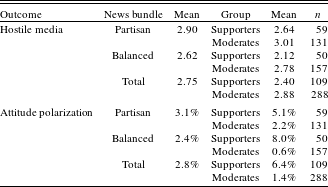
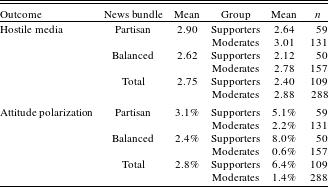
Means for the outcome variables across internal balance and supporter group (strong supporters versus moderates).
 $N=397$
.
Results
A manipulation check indicated that participants effectively identified whether the news bundles had articles with partisan news versus balanced news. This was tested with the semantic-differential item “Now, let’s recap. Would you say the news stories you just read are: unbalanced-balanced?” Responses were on a scale from 0 (unbalanced) to 6 (balanced). A
 $t$
-test indicated that participants exposed to the partisan news bundle condition (
 $M=2.61$
,
 $SD=1.39$
) perceived the news stories to be significantly more unbalanced than participants in the balanced news bundle condition (
 $M=3.19$
,
 $SD=1.30$
;
 $p<0.001$
). The balance differentiation of the news bundle manipulation (partisan and balanced news bundles) was thus effective.
Table 2 provides the descriptive statistics for all dependent variables across news bundle condition. Participants exposed to the partisan news bundle condition experienced significantly more hostile media perceptions (
 $M=2.90$
,
 $SD=0.98$
) than participants who were exposed to the balanced news bundle condition (
 $M=2.62$
,
 $SD=1.00$
),
 $F(1,393)=12.20$
,
 $p<0.001$
, (partial)
 $\unicode[STIX]{x1D702}^{2}=0.03$
. This supported H1a. Strong supporters did not experience more hostile media perceptions (
 $M=2.40$
,
 $SD=1.15$
) than moderates (
 $M=2.88$
,
 $SD=0.90$
), n.s., thus not finding support for H1b. See Appendix B online for the full ANOVA model.
In terms of polarization, participants who were exposed to partisan news stories did not experience more attitude polarization (3.1%) than participants exposed to balanced news stories (2.4%), n.s. Hence, the first research question could not be answered. Yet strong supporters experienced significantly more attitude polarization (6.4%) than moderates (1.4%),
 $F(1,393)=7.71$
,
 $p<0.01$
, (partial)
 $\unicode[STIX]{x1D702}^{2}=0.02$
. This result provided support for H2. See Appendix C online for the full ANOVA model.
Using the bootstrapping technique to formally test the mediation question (RQ2), results indicated that there was no mediation in the model. Specifically, the hypothesized effects found in the model, that is, from partisan news to attitude polarization through hostile media influence, was zero by a 95% bootstrap confidence interval based on 5,000 bootstrap samples (
 $-0.052$
to 0.008, with a point estimate of
 $-0.022$
for strong attitude holders;
 $-0.007$
to 0.007, with a point estimate of 0.000 for moderates). The model had a good fit. The likelihood ratio test was nonsignificant (
 $\unicode[STIX]{x1D712}^{2}=1.46$
, n.s.). Likewise, CFI
 $=$
1.00, and TLI
 $=$
1.15 indicated a good fit. The RMSEA
 $=$
0.00 also indicated a very good fit. Thus, mediation was not supported. See Appendix D online for the path analysis model.
Discussion
This study sought to examine the effects of exposure to a heterogeneous partisan news bundle on attitude polarization, both directly and indirectly through hostile media perceptions. Study results from experimental data point to partisan news leading to hostile media perceptions but not to attitude polarization. Specifically, exposure to a bundle of heterogeneous partisan news led to more hostile media perceptions compared to exposure to a bundle of balanced news. The findings regarding hostile media perception are analogous to recent studies, especially the ones conducted within online environments. Reference Garrett, Weeks and Neo62 However, the effects on polarization directly or indirectly (measured through bootstrapping) resulted in null effects. Strong attitude holders did experience more polarization than moderates, but that was irrespective of bundle exposure.
Earlier results on the effects of slanted information on polarization Reference Taber and Lodge22,Reference Taber and Cann23,Reference Lord, Ross and Lepper24 hinted that it really did not matter whether the information given was partisan or balanced; polarization was to be expected among strong attitude holders. Reference Taber and Cann23 In a way, our results are parallel in that there were no differences in attitude polarization between the partisan and the balanced news condition. Perhaps how the news is packaged is secondary to exposure itself. Future research will have to examine single versus multiple articles and dosage of partisanship in order to dig deeper into this question. Also, recent findings point to the strength of individuals’ previous attitudes as the driver of polarization, though media effects are present as well. Reference Leeper16 Only a study with enough conditions to disentangle these effects may ultimately assess the effects on polarization from partisan news.
Wojcieszak and Rojas Reference Wojcieszak and Rojas63 found no evidence of polarization in the online environment, but their data were cross-sectional. Still, their results may, after all, point in the direction of crosscutting exposure as the inoculation agent against polarization for online news consumers. Along the same lines, Feldman found that participants in her experimental study were persuaded by the valence of the article they were exposed to. Reference Feldman26 So, she found persuasion but not polarization.
Although the results here are encouraging, a few limitations must be noted. Because the sample was convenient, generalization at the population level is not possible, not even at the collegiate population level. Future studies will have to tackle this issue using a representative sample. Likewise, it is possible that the null effect on attitude polarization is a result of the issue of assisted suicide. Additional controversial issues will have to be included in future research to ensure the effects are not constrained to certain topics — even though similar results have been obtained with different issues. Reference Feldman26,Reference Wojcieszak and Rojas63 Also, it remains to be tested whether news bundles with external balance would have the same effect as exposure using conditions that contain different external balance (with one or several news articles and controlling for previous attitudes) since the measures in this study are limited to news bundles with the same external balance. Similarly, since political talk is crucial to news dissemination and attitude formation, Reference Mutz64 this should be included in future analyses.
Finally, it is possible that the artificial scale distinction between moderate and strong supporters of assisted suicide may have been insufficient to produce significant effects on attitude polarization — in particular, given the low statistical power of these subgroups because of their small size. The split used has been previously validated when sampling from non-extremist groups. Reference Taber and Cann23,Reference Feldman26,Reference Wojcieszak55 Studies that select participants directly from moderate and strong membership venues (e.g., members of a right to die group) would probably be better equipped to detect these effects.
This study contributes to understanding the effects of online partisan news bundles. The news articles used came precisely from online news outlets and were bundled in the way that, plausibly, online audiences view news. Results add to the growing call for more theoretical insight into the structure and consequences of partisan news. Gunther and Chia Reference Gunther, Christen, Liebhart and Chia35 have called for an integrated theory that simultaneously considers an array of related effects like the ones tested in this study. In addition to hostile media perceptions, this study also suggests that attitude polarization (directly and indirectly) ought to be considered in the ensemble of effects, even though the effects on polarization were null here. Participants exposed to a heterogeneous bundle of partisan news experienced polarization no differently than participants exposed to a bundle of balanced news.
Two understandings emerge from this study. First, we need to encourage mechanisms that offer crosscutting exposure to news in the online environment. News that is free or affordable and public social media such as Twitter are key to exposing individuals to multiple sides of an issue. Reference Abril65 Second, while a partisan news bundle does not seem to affect polarization, exposure to the news itself does increase polarization among strong supporters, which is a result also found by Leeper. Reference Leeper16 Additional mechanisms to buffer the effects for partisans are thus warranted.