INTRODUCTION
In the late 1940s, the American archaeologist Wendell Bennett (Bennett et al. Reference Bennett, Bleir and Sommer1948) published a paper titled “North West Argentine Archaeology,” consisting of a mainly bibliographic analysis of ceramic styles and “cultural” associations. The first goal of this research was to establish the basis for a periodization. The classification of styles and the conformation of archaeological contexts led Bennett et al. to define four periods for farmer and potter cultures: Early, Middle, Late, and Inca. A few years later, in 1952, Alberto Rex González started his own excavations in northwestern Argentina continuing in the same line purposed by Bennett and colleagues. González considered it essential to establish relative and absolute chronologies, since up to that time, interpretations were mainly based on ethnohistorical records. These did not take into account the temporal depth in the development of local societies and intermixing cultural materials, without an attempt to explain their differences. At first, González (Reference González1955) used a relative chronology built from some overlapped tombs and typological correlations. This chronology was based mainly on pottery classification taken from tombs of the Hualfín Valley (Department of Belén, Catamarca, Argentina) (Figure 1) from the Muñiz Barreto collection (Museum of La Plata), considering technical and stylistic features and in some cases settlement patterns (González Reference González1955).
Map of Hualfín Valley, showing late archaeological sites with 14C dates (empty circles) and Inca installations (filled circles).

A few years later, González, who was a pioneer in the application of the 14C dating method in Argentina, compared his sequence with the absolute chronology data (González Reference González1959, Reference González1960a, Reference González1960b, Reference González1964). In the First National Congress of Argentinean Archaeology, in collaboration with George Cowgill, he showed a compilation of the results of more than 20 years of work, having already obtained many 14C dates and the possibility to process the data using computers (González and Cowgill Reference González and Cowgill1975). These results produced the master sequence for northwestern Argentina based on archaeological materials from Hualfín Valley. The last three phases in the sequence were called Belén I, Belén II, and Belén III, and correspond to the Late and Inca periods. For these phases, González obtained nine 14C dates measured in different laboratories, as listed in Table 1 (Olsson Reference Olsson1960; Stuiver et al. Reference Stuiver, Deevey and Gralenski1960; Olson and Broecker Reference Olson and Broecker1961; Hakansson Reference Hakansson1971; Valastro et al. Reference Valastro, Davis and Varela1972). González warned that some of these results contradicted the proposed phases, so he decided to maintain the original sequence. Time proved him right about their precautions, since subsequent studies confirmed the need for correction of experimental and sampling errors. Beyond the cautions, he established precise chronological limits for their phases, as follows: Belén I (AD 1100–1300), Belén II (AD 1300–1480), and Belén III (AD 1480–1535).
Radiocarbon dates for Belén phases (González and Cowgill Reference González and Cowgill1975). *14C conventional date obtained by correction of the reference contemporary standard used by Uppsala lab (Carbonari et al. Reference Carbonari, Baldini, Huarte and Sempé2011).

In recent years, diverse research has been developed for late archaeological settlements and new 14C ages were obtained. Some of these dates were from the same sites González dated, and others in known but previously undated settlements or in recently found locations (Figure 1) (Wynveldt Reference Wynveldt2009; Balesta et al. Reference Balesta, Zagorodny and Wynveldt2011; Wynveldt and Iucci Reference Wynveldt and Iucci2013). With the aim of contributing to the problem of the chronology of Belén occupations in Hualfín Valley, this article critically analyzes the “old” 14C measurements, and looks at probable causes that led to inconsistencies between these dates and González’s Belén chronology. We also present the analysis of new 14C data, evaluating the contexts where samples were extracted, the different types of samples, the calibration curve, the lab where each date was obtained, and their methods of measuring and characteristics of the sites. Finally, using calibrated ranges, the sum of probabilities, and Bayesian models, we define the span represented by the dates and suggest groups of events that would correspond to different times in the history of late occupations in the valley.
PREVIOUS RADIOCARBON DATING AND BELÉN PHASES
The Belén culture, defined by González (Reference González1955), was subdivided into three phases according mainly to a series of architectural and ceramics features. Belén I was defined by the presence of Belén pottery and communal large pit houses, arranged in groups of three or four. This type of architecture, which lacked stone walls, was detected in a site called Corral de Ramas, which its gave name to this phase (González Reference González1955). Belén II showed changes in housing construction; dwellings were built in stone walls, configured in more or less independent and scattered units, as Gonzalez exemplified by means of the defensive site Cerrito Colorado (González Reference González1955).
Later changes, but unclear if still in phase II or already in phase III, were more pronounced, with significant transformations in cultural and social organization of Belén communities. These would be seen, for example, in the complex defensive sites of El Molino and Pueblo Viejo de El Eje, associated by González with phases II and III (González and Cowgill Reference González and Cowgill1975), or in the ability to undertake important collective tasks, as the cultivation terraces built in Asampay, which González ascribed to the Inca period. El Shincal was proposed as the type site for this phase; regarding the pottery, the presence of Inca influence on vessels was an indicator of the Belén III phase (González Reference González1955; González and Cowgill Reference González and Cowgill1975).
In summary, Belén phases were characterized by having a progressive evolution of architectural patterns, from communal pit houses to fortified and aggregated sites with Inca influences. After González’ proposal, this culture was characterized as a chiefdom or señorío, in a geopolitical model with its center in Hualfín Valley (Sempé Reference Sempé1999). According to Sempé, the Belén settlement pattern was organized in a site hierarchy of aggregated villages, dispersed or open villages, and villages with houses between terraces for farming. This pattern would reflect the complexity of social organization. Sempé’s proposition had a different perspective from González’s ideas, since she included not only settlement patterns but also political aspects. Moreover, in the 1990s, chronological problems still remained because almost no new 14C dates were obtained to establish the chronology of these. In spite of these restrictions and differences regarding the complex process outlined by González, Sempé kept Belén’s phases intact (Sempé Reference Sempé1999).
With reference to González’s 14C dates (detailed in Table 1), we can observe that dates were obtained before 1970/1971; therefore, some important methodological problems could affect these results, mainly the absence of intercomparison between labs, the type of the samples, and their storage.
Interlaboratory comparisons became effective just since 1980 (Otlet et al. Reference Otlet, Walker, Hewson and Burleigh1980) and only some years later started to be significantly extended, including a relevant number of participants (Scott et al. Reference Scott, Aitchison, Harkness, Cook and Baxter1990). Regarding the samples, archaeologists did not take into account the since documented “old wood” effect; consequently, samples sometimes may have been old wood, where the age of the wood does not correspond with the event to date. Another possible error source in 14C dating is contamination of the samples, but there is no record for these samples before or during the extraction or its storage, which in some cases was for many years. Finally, the Uppsala dates used a different standard than HOxl (Olsson 1961). These dates were later corrected by Carbonari et al. (Reference Carbonari, Baldini, Huarte and Sempé2011) according the international consensus currently employed, adding 135±35 yr to the previously reported ages (see Table 1).
Considering these observations, we proceeded to analyze the “old” 14C dates. The most discrepant dates compared to González’s scheme are the three oldest, obtained in the University of Texas lab (USA), which correspond to El Molino (Puerta de Corral Quemado) and Pueblo Viejo de El Eje, architecturally two of the most complex sites, and thus considered the latest in the Belén culture chronology.
Although there are no details on the characteristics of the samples in the published descriptions for these dates (Valastro et al. Reference Valastro, Davis and Varela1972), there was an internal coherence in the ages. However, as González assumed at the time, they are very old for phases II and III, given the characteristics of the dated sites (González and Cowgill Reference González and Cowgill1975). Instead, the age obtained in Lund (lab code Lu) for Pueblo Viejo de El Eje (520±50 BP), according to González is in line with his previous estimations and with historical information of Incas arrival, being a good mark for the beginning of Belén III (Hakansson Reference Hakansson1971: 355).
14C dates for Corral de Ramas were also problematic. Two samples were extracted from the same algarrobo (Prosopis nigra) log, found in a post hole belonging to a pit house (Olsson Reference Olsson1960) and two very different ages were obtained in different labs (U-153: 795±80, corrected age: 930±115 BP, and Y-559: 590±50 BP). The fact that the samples have been taken from a log in a post hole may involve a probable “old wood” effect. However, as stated by Carbonari et al. (Reference Carbonari, Baldini, Huarte and Sempé2011), the causes for the difference between the ages are not clear.
Regarding date Y-560 (240±80 BP) from Casa 3 in the Cerrito Colorado site, which should correspond to phase II, there are no details about how the sample was conformed. A comment about this date considered that the age for U-154 (715±115 BP) is more acceptable for Belén II (Stuiver et al. Reference Stuiver, Deevey and Gralenski1960). L-476C (400±100 BP), obtained for Casa 8 in Cerrito Colorado, is also not concordant with a pre-Inca occupation.
NEWER RADIOCARBON DATA
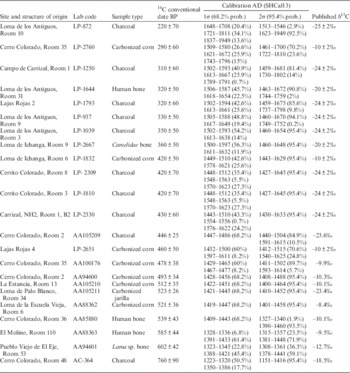
New research on the different archaeological late settlements located in Figure 1 allowed obtaining new archaeological and chronological information. Table 2 presents 22 14C dates obtained since 1996 until today for late sites in the Hualfín Valley. Moreover, AC-364 is included, a measurement made in 1984 in the INGEIS laboratory (Alberó and Angiolani Reference Alberó and Angialoni1985). Although this date is coherent with the oldest of the new set, we decided to exclude it from the analysis of the new dates because the laboratory that dated it did not participate in international comparisons.
Radiocarbon dates obtained since 1986, from samples of new excavations at late sites in Hualfín Valley and from samples extracted by González in the 1950s and 1960s.

In the new dating measurements, charcoal, carbonized corn, camelid remains, and human bones were selected. Both maize and faunal remains were associated with the occupation floor of the excavated structures, and charcoal is usually associated with fireplaces, branches, or more or less concentrated remains, also found on floor rooms (Valencia et al. Reference Valencia, Fernández and Barberis2010; Valencia and Balesta Reference Valencia and Balesta2013). In all these cases, we assume that the dated samples are reliable in relation to the proximity of death of the dated organism and the event of occupation. On the other hand, three of the new dates correspond to human burials found within rooms (LP-1644: 320±50 BP; AA-85880: 539±43 BP and AA-88363: 585±44 BP) and would be product of events that occurred after the effective occupation of the structure (García Mancuso and Iucci Reference García Mancuso and Iucci2008; Wynveldt Reference Wynveldt2009; Balesta and García Mancuso Reference Balesta and García Mancuso2010).
Three dates having unexpected modern ages were excluded from the table; two of them correspond to rooms 11 (LP-976) and 29 (LP-1123) from Loma de los Antiguos de Asampay, and the other (LP-1822) to room 48 from Cerro Colorado de La Ciénaga de Abajo. In the first two cases, the samples corresponded to dispersed and undetermined charcoal, while the latter was based on a sample of charcoal taken from the same context as AC-364.
Analyzing the whole set of ages obtained since 1996 it can be noted that, with the exception of LP-2651 and AA-105209, the rest are grouped according to the laboratory where they were made. The oldest correspond to the Arizona (AA) set, and the latest to the set of La Plata (LP). An important point related with these differences has to do with dating techniques; Arizona ages were made by accelerator mass spectrometry (AMS), with age uncertainties of ±25 and 44 yr, while the ages of La Plata were made by radiometric dating, with age uncertainties of ±50, 60 and 70 yr. These margins significantly extend the calibrated ranges for La Plata dates. Further, calibrated ranges for ages between a little over 400 and 300 BP are more affected by the irregularities of the calibration curve, where there are abrupt falls and spikes, which when added to large errors, produce a major scattering in the probabilities.
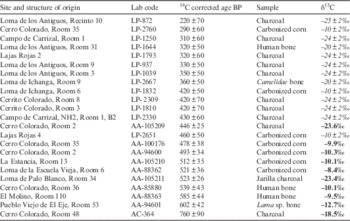
In addition to these differences, dates obtained with AMS were corrected based on measuring the δ13C value of each sample, while the ages obtained by the radiometric method employed standard values (Table 3). The δ13C values for the plants remains do not vary significantly; however, the calculated value for skeletal remains in AA-94601, AA-88363, and AA-85880, differs significantly from the estimated value of –20±2‰ used for corrections of LP-2667 and LP-1644. These discrepancies were analyzed by Greco (Reference Greco2012) for 124 14C ages from northwestern Argentina, proving that the average calculated for δ13C in human and faunal bones greatly deviate from the standard, with values of –12.49‰ and –15.6‰, respectively, which would generate older ages.
δ13C values for dating obtained since 1986 (in italics, standard values; in bold, measured values).

INTERPRETATION OF NEW DATING MEASUREMENTS
The sum of the probabilities of the dates, obtained using OxCal v 4.2.4 (Bronk Ramsey and Lee Reference Bronk Ramsey and Lee2013), allows us to note that calibrated ranges are located most probably between the 15th and 16th centuries (Figure 2), that is, times when there were important sociopolitical changes in northwestern Argentina, such as the Inca and Spanish conquests. Moreover, the sum of modeled data narrows the results almost to the 15th century, with a greater probability density in the first decades. Today, there is agreement on the fact that the Late or Regional Developments period extends from AD 1000 until the arrival of the Incas (Núñez Regueiro Reference Núñez Regueiro1974). Regarding the latter, although classic versions have argued that the conquest of this region and Chile was undertaken by Topa Inca Yupanqui in AD 1470–1480, a lot of new archaeological information in general—and chronologically in particular—indicates that it may have occurred decades earlier (Williams and D’Altroy Reference Williams and D’Altroy1998; Schiappacasse Reference Schiappacasse1999; Ogburn Reference Ogburn2012). Greco (Reference Greco2012) analyzed a set of 33 dating associated to Inca contexts from northwestern Argentina, using Bayesian models to define the temporal limits of the conquest. Results indicate that at least their influences had begun towards the first half of the 15th century. Considering this, we establish the Inca conquest boundary in the interval between AD 1400 to 1450; therefore, the dates that present probabilities within that time are considered Pre-Inca–Inca. The Inca period ends with the arrival of Diego de Almagro in 1536, when the Hispanic–Indigenous period begins, characterized by Spaniard attempts to subdue the natives, who resisted until the mid-17th century (1640–1670), when the region was incorporated to the Spanish crown, and beginning of the Colonial period.
Above: summed probabilities for 14C dates since 1996 until present for late sites in Hualfín Valley. Below: the same data modeled by OxCal v 4.2.4 (Bronk Ramsey and Lee Reference Bronk Ramsey and Lee2013). In different colors the proposed periods from late to modern times: P-I (Pre-Inca–Inca); Hip–Ind. (Hispanic indigenous); H-C (Hispanic indigenous–Colonial); Col. (Colonial).

Regarding the dated contexts, excavations have very little accumulation of materials, usually covered by collapsed roofs over a single occupation floor (Valencia and Balesta Reference Valencia and Balesta2013). It is very likely that frequent cleanings of these floors removed the remains of previous events; thus, the dated events were closely to definitive abandonment of the structures. Similarly, dated human burials correspond surely to events produced after the abandonment of the rooms. This would explain the absence of dates that represent times closer to the beginning of Late period (AD 1000–1300). In this sense, we assume that every village should have a deeper history in time.
Given these conditions, we must define the criteria for the interpretation of calibrated ranges. In recent years, the Bayesian statistics applied to chronology has produced significant results as a tool for interpreting sets of 14C dates (Bayliss Reference Bayliss2015). In our case, its application is limited to modeling probabilities of the total set of dating, because of the lack of archaeological markers that may be used for determining phases or chronological limits.
Added to the inability to measure precisely the time of the Inca conquest is the lack of Inca elements (or features that indicate an Inca influence) associated with dated events that allow us to estimate a before and after. The same applies to Spanish conquest: although we accept AD 1536 as the beginning of Hispanic–Indigenous period, we have not observed Hispanic elements that allow us to use this limit as a temporary marker in the Hualfín Valley.
Figure 3 shows the distributions of dates obtained since 1996, plotted with OxCal v 4.2.4 (Bronk Ramsey and Lee Reference Bronk Ramsey and Lee2013). The analysis of the probabilities for calibrated ranges first allows us to recognize a group of eight dates located between the late 14th century and the first half of the 15th century, that is, the Pre-Inca–Inca period. These dates are of great interest considering that, although they are very recent in relation to the beginning of Late period as it was traditionally defined (from AD 1000/1100), they are the oldest obtained for the analyzed sites.
Calibrated 14C graphics elaborated with OxCal v 4.2.4 (Bronk Ramsey and Lee Reference Bronk Ramsey and Lee2013) and SHCal13 (Hogg et al. Reference Hogg, Hua, Blackwell, Niu, Buck, Guilderson, Heaton, Palmer, Reimer, Reimer, Turney and Zimmerman2013), including 14C dates for late sites in Hualfín Valley, obtained since 1996 until present.

The following six dates show some probability of representing events in the second half of the 15th century and the first decades of the 16th century, in the Inca period, although there is also less probability to later periods. Inca presence in the valley is clear if we take into account installations like Hualfín Inca, Quillay, El Shincal (Raffino Reference Raffino2004; Lynch Reference Lynch2012; Spina and Giovannetti Reference Spina and Giovannetti2014), as well as surface remains or tombs in which local materials are mixed with Inca provincial or objects showing Inca features (Wynveldt Reference Wynveldt2009; Moralejo et al. Reference Moralejo, Lynch, Couso and Raffino2010). However, until now, very little material evidence of Inca influence has been found in the analyzed sites.
A third group of seven dates has calibrated ranges with more probabilities for the 16th century and some probability for the 17th century, represented by occupations that span the last years of the Inca Empire to early years of Spanish presence in northwestern Argentina, the Hispanic–Indigenous period. With respect to these dates, no European elements or objects or representations depicting Hispanic influence on local groups have been observed. LP-2667 (Loma de Ichanga, Room 9) and LP-2760 (Cerro Colorado, Room 35) would be placed in this group, although these cases have characteristics that must be specially analyzed. LP-2667 was obtained from a camelid bone in Room 9 of Loma de Ichanga, placed a few meters from Room 6, where LP-1832 was obtained, which is more likely to be from the second half of 15th century. Both dates are statistically indistinguishable at 95%. Considering the aforementioned observations in relation to the use of measured or standardized values of δ13C by laboratories to correct 14C ages, we think that both dated events would be closer to the second half of 15th century. The case of date LP-2760 from Room 35 of Cerro Colorado is more complex to interpret because it was obtained in the same context as the corncobs of AA100176, and both are statistically different. Since the rest of the dates obtained for the site are consistent with AA100176, we decided to reject LP-2760 as no new dates on different materials from the same room were obtained. Finally, the date from Room 10 of Loma de los Antiguos de Asampay (LP-872) has a greater chance to originate in the 18th century (Colonial period), although it also shows a significant percentage to be assigned to the 17th century.
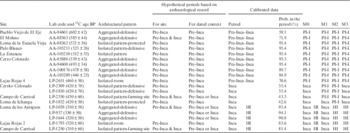
In summary, calibrated data show ranges with probabilities covering four moments in the regional sociocultural development—Late Pre-Inca, Inca, Hispanic–Indigenous, and Colonial—although there is little or no evidence in the architecture or archaeological contexts to distinguish them. This uncertainty led us to seek alternatives to define more precisely ranges and generate hypothesis about dating events and the occupation of the sites (Table 4). With this purpose, we proceeded to generate different Bayesian models using OxCal v 4.2.4 to test in the future with more archaeological and chronological information. The most modern date (LP-872) and the mentioned LP-2667 (Loma de Ichanga, Room 9) and LP-2760 (Cerro Colorado, Room 35) were excluded.
Radiocarbon dates considering site, architecture, hypothetical period, period for calibrated data with its greatest probability, and Bayesian models with the period (phase) assigned to each site: PI (pre-Inca), I (Inca), HI (Hispanic–Indigenous).

First, one model (M0) was obtained considering a hypothetical single phase without preconfigured boundaries (Figure 4), and is acceptable (>60%) for both concordance indexes (Aoverall=85.1 and Amodel=86.6). The lower limits of the distributions in this model are similar to those from calibrated ranges, adjusting dates to the early 15th century. However, as noted in the modeled sum of probabilities, the upper limits are reduced significantly, reaching most likely the mid-16th century, that is, early the Hispanic–Indigenous period. This result led us to consider different alternatives for phases with preset boundaries.
14C dates for Hualfín Valley late sites from 1996 until present, modeled using OxCal v 4.2.4, considering a single phase without preset boundaries.

Generated models for a single phase, both for Pre-Inca–Inca (AD 1400–1450) and a “pure” Inca phase (AD 1450–1536), were rejected. Also, a two-phase model including a Pre-Inca phase with all sites and excluding dates of Loma de los Antiguos, the most modern date for Campo de Carrizal and Lajas Rojas 2, was rejected (Amodel=53.3 and Aoverall=53.5). A new similar test (M1) was acceptable when incorporating in the Inca phase the date of Loma de Ichanga Room 6 (LP-1832) (Amodel=75.5 and Aoverall=75.5) (Figure 5). This model is consistent with the established idea that the sites of Asampay—the pukara Loma de los Antiguos and the farming site Campo de Carrizal—should have been occupied during pre-Inca, but also Inca times (González Reference González1955; Sempé Reference Sempé1999; Wynveldt Reference Wynveldt2009), although materials associated with the Tawantinsuyu are absent. The context of dwelling 6 of Loma de Ichanga was interpreted as an event of ritual abandonment with an intentional fire, perhaps linked to the Inca conquest (Balesta and Wynveldt 2010).
Model 1 considering a pre-Inca–Inca and an Inca phase with preset boundaries (AD 1400–1450–1536), generated with OxCal v 4.2.4. 14C dates correspond to Hualfín Valley late sites from 1996 until present.

Another acceptable model (M2, Amodel=64.6 and Aoverall=64.3) was based on the hypothesis that many of the sites dated to pre-Inca–Inca times may have been abandoned from Inca conquest, and the cases of Loma de los Antiguos, Campo de Carrizal, and Lajas Rojas 2 could be Hispanic–Indigenous occupations. A new model was proposed (M3) including very late dates, from Loma de Ichanga, Cerrito Colorado, and Campo de Carrizal, in the Inca phase, and it was also acceptable (Amodel=128.4; Aoverall=128.4).
While M1, M2, and M3 are statistically valid and archaeologically plausible, considering the available materiality and the characteristics of excavated contexts, we propose that M1 is the most acceptable today, since no European influences were found yet and Inca presence and influence in the valley is a fact. In this sense, we can argue that the 13 oldest 14C ages, which include a variety of sites—defensive and nondefensive villages with isolated or aggregated patterns, isolated dwellings in the countryside, and scattered dwellings among farming fields—may correspond to the last moments of the autonomous development of local groups and the start of Inca influence, while the rest of the dates could be associated with times of Inca presence in the valley, which had varying degrees of impact on different locations.
CONCLUSIONS
The pioneer work made by A Rex González in Hualfín Valley constituted a fundamental contribution to the knowledge of chronology of ancient social groups of northwestern Argentina. His relative sequence of three Belén phases, based on a supposed process of increasing complexity of this “culture,” was the first attempt to explain the development of the late groups in Hualfín Valley. While Gonzalez could not corroborate this sequence with 14C dates, he assumed that this problem would be solved with the progress in implementing the 14C method. However, neither the process was reflected in the dating nor was confirmed with the new research done in many of the same sites in Hualfín Valley. In this sense, we saw the coexistence between late sites with very different patterns, and maybe, functions: isolated rooms, villages with a scattered or conglomerate pattern, settled on protected hills or defended by walls, and scattered rooms between farming terraces. Moreover, the only residential sites where objects linked to the Inca conquest were found (it is worth clarifying that only on surface collections) are those with older dates (El Molino and Loma de la Escuela Vieja, in Puerta de Corral Quemado), while sites with more recent occupations only have materials traditionally associated with local Late period, even in the sites with dates most likely for Hispanic times.
With respect to pre-Inca times, we emphasized the absence of dating representing initial moments of Belén culture, Gonzalez´s phase I. In Wynveldt and Flores (Reference Wynveldt and Flores2014), we compared late 14C dating of the valley with dates from southern puna of Catamarca, a neighboring region with different resources and with strong cultural ties to Hualfín Valley, evidenced by the presence of Belén pottery. While different authors have postulated the puna sociopolitical dependence on a political Belén core in the valley (Raffino and Cigliano Reference Raffino and Cigliano1973; Sempé Reference Sempé1999: Olivera et al. 2003–Reference Olivera, Vigliani, Elías, Grana and Tchilinguirian2005), dating of the region associated with Belén pottery is much older than dates analyzed here. The absence of early dating from the valley, together with the earliest evidence in the puna, poses a quite interesting scenario about relationships between these regions and the origin of Belén.
Beyond these problems, according to the Bayesian models we analyzed here and the characteristics of dated archaeological contexts, we hold that the oldest dates from the new series for Hualfín Valley, with probabilities for the first half of 15th century, represent the last moments of a local development of unknown origins, and may correspond to events closer to the abandonment of structures, sections of the sites, or perhaps whole villages, for reasons related to Inca conquest. Moreover, following one of the tested Bayesian models, the rest of the dates could be linked to contexts of abandonment that represent movements of local groups during Inca domination in the region. Finally, for 14C dates most likely in 16th century onwards, it may be suggested that some of these occupations are associated with years after Inca presence, at times when local groups resisted Spanish conquest, in spite of the fact that archaeological evidences for this events have not been discovered yet.
ACKNOWLEDGMENTS
Radiocarbon dates made since 1996 were financed by the following institutions from Argentina: Universidad Nacional de La Plata, Agencia Nacional de Promoción Científica y Tecnológica, and Consejo Nacional de Investigaciones Científicas y Técnicas.