


Introduction
Dropout is a serious and common problem in research trials and in every-day practice of psychological treatment (Keijsers et al. Reference Keijsers, Kampman and Hoogduin2001; Bados et al. Reference Bados, Balaguer and Saldana2007; White et al. Reference White, Allen, Barlow, Gorman, Shear and Woods2010). Dropout causes methodological, clinical, financial and moral problems for researchers, mental health professionals, patients, their families, and ultimately society. In clinical studies, dropout is often described as a subject withdrawing or failing to complete a clinical study and not returning before the programme is accomplished (Bados et al. Reference Bados, Balaguer and Saldana2007). In psychological practice, a patient deciding to quit therapy before the end of the protocol or leaving before the therapist considered this decision as appropriate is also considered a dropout (Veeninga & Hafkenscheid, Reference Veeninga and Hafkenscheid2004).
Dropout in research trials can create several methodological challenges. Most importantly, dropout reduces the sample size and statistical power and may alter the group composition. As such, dropout can affect the internal, external, and construct validity of the study outcomes (Keijsers et al. Reference Keijsers, Kampman and Hoogduin2001; Nantz et al. Reference Nantz, Liu-Seifert and Skljarevski2009; White et al. Reference White, Allen, Barlow, Gorman, Shear and Woods2010). Another problem occurring in research is the administration and analysis of dropout data. Although it should be standard procedure to record the proportions and reasons of dropout, only few studies actually gather this information (Nantz et al. Reference Nantz, Liu-Seifert and Skljarevski2009; White et al. Reference White, Allen, Barlow, Gorman, Shear and Woods2010). Even if dropout rates are gathered, the data is often not adequately assessed because all dropouts are combined and analysed together regardless of the reason and moment of dropout. Since there are differences in dropout behaviour such as not starting the programme or terminating the treatment halfway, different dropout groups should be examined separately (White et al. Reference White, Allen, Barlow, Gorman, Shear and Woods2010). Finally, a prevalent issue is the lack of one commonly accepted definition for dropout (Pekarik & Wierzbicki, Reference Pekarik and Wierzbicki1986; Reis & Brown, Reference Reis and Brown1999; Mahon, Reference Mahon2000). As a result, studies tend to apply different, often arbitrary, definitions of dropout and many studies use dropout terms interchangeably instead of choosing one definition and using it consistently (Wierzbicki & Pekarik, Reference Wierzbicki and Pekarik1993). This, in turn, makes it difficult to compare the results of different studies.
Besides the negative consequences in research, dropout has also serious implications in psychological practice. Dropping out from psychological treatment not only affects patients themselves but also their families, the practitioners, and, in the long term, society. Patients who quit psychological treatment early are unlikely to recover on their own (Pekarik, Reference Pekarik1983) and they will not derive the same potential benefit as completers do (Davis et al. Reference Davis, Hooke and Page2006). Dropout also affects other parties and the patient's environment. The therapist can become demoralized when participants leave the treatment (Pekarik, Reference Pekarik1985; Mahon, Reference Mahon2000; Visser, Reference Visser2001) and in group therapy the cohesion of a group may be disrupted when participants leave the group. When participants leave the treatment without explanation, family and colleagues can experience additional stress because the participant's problem remains untreated (Grilo et al. Reference Grilo, Money, Barlow, Goddard, Gorman, Hofman, Papp, Shear and Woods1998; Mahon, Reference Mahon2000). Finally, economic consequences can play a role as well when dropouts do not receive the full benefit of treatment. Little or no improvement is associated with a large burden of disease because of absence through illness, extensive loss of productivity and medical consumption which can result in considerable economic costs for society in the long term (Harvison et al. Reference Harvison, Woodruff-Borden and Jeffery2004; Smit et al. Reference Smit, Cuijpers, Oostenbrink, Batelaan, De Graaf and Beekman2006; Batelaan et al. Reference Batelaan, De Graaf, Van Balkom, Vollebergh and Beekman2007).
Unfortunately, risk factors for dropout in public mental health interventions for panic symptoms have not yet been well researched. Moreover, existing studies on risk factors for dropout have frequently included too many predictors in too small or too heterogeneous patient samples. Consequently, the results of these studies can often not be replicated in subsequent studies (Keijsers et al. Reference Keijsers, Kampman and Hoogduin2001). Therefore, the current study focuses on the systematic examination of a more limited set of literature-based predictors in a relatively large sample of more than 200 participants in a public mental health intervention for panic symptoms.
Predictors for dropout
Previous studies have shown several predictive factors playing a role in dropout behaviour in mental health treatment in general and treatment of panic disorder in particular. Although mixed results have been found, it is possible to outline three main categories of potential predictors related to dropout: (1) socio-demographic variables, (2) personal factors, and (3) illness characteristics.
Socio-demographic variables
Previous studies of cognitive-behavioural therapy in panic disorder have shown that younger age (Wade et al. Reference Wade, Treat and Stuart1998; White et al. Reference White, Allen, Barlow, Gorman, Shear and Woods2010), fewer years of education (Keijsers et al. Reference Keijsers, Kampman and Hoogduin2001; Wade et al. Reference Wade, Treat and Stuart1998), and lower income (Grilo et al. Reference Grilo, Money, Barlow, Goddard, Gorman, Hofman, Papp, Shear and Woods1998) can result in higher treatment dropout. These findings correspond to predictors commonly identified in large survey studies or systematic reviews in general mental health or psychotherapy settings (Baekeland & Lundwall, Reference Baekeland and Lundwall1975; Sue et al. Reference Sue, McKinney and Allen1976; Wierzbicki & Pekarik, Reference Wierzbicki and Pekarik1993; Edlund et al. Reference Edlund, Wang, Berglund, Katz, Lin and Kessler2002; Nantz et al. Reference Nantz, Liu-Seifert and Skljarevski2009), which have also suggested the potential role of gender and ethnic background.
Personal variables
Variables such as attitude have also been linked to dropout behaviour in panic disorder treatment. Keijsers and colleagues (Reference Keijsers, Kampman and Hoogduin2001) found a small, but significant, relationship between treatment motivation and treatment completion in manualized cognitive-behavioural therapy where highly motivated participants were more eager to finish the treatment. Grilo and colleagues (Reference Grilo, Money, Barlow, Goddard, Gorman, Hofman, Papp, Shear and Woods1998) found that negative expectations about treatment efficacy was the strongest independent predictor of attrition. Finally, many studies of patient attrition from general psychotherapy have focused on the predictive role of clinical or non-clinical personality styles or disorders (Baekeland & Lundwall, Reference Baekeland and Lundwall1975). Wingerson and colleagues (Reference Wingerson, Sullivan, Dager and Flick1993) found that early dropouts from panic disorder treatment scored higher on non-clinical personality traits related to novelty seeking, while Grilo et al. (Reference Grilo, Money, Barlow, Goddard, Gorman, Hofman, Papp, Shear and Woods1998) and Keijsers et al. (Reference Keijsers, Kampman and Hoogduin2001) found no association with clinical personality styles and personality psychopathology, respectively.
Illness characteristics
Symptom severity and other disease-related characteristics are often cited factors within the dropout context. Within panic disorder, however, mixed results have been reported. In a study by Otto and colleagues (Reference Otto, Tuby, Gould, McLean and Pollack2001) participants with significantly more severe symptoms of obsessive compulsive disorder tended to terminate pharmacotherapy treatment more often. Wade and colleagues (Reference Wade, Treat and Stuart1998) showed that completers of a cognitive-behavioural therapy for panic disorder were significantly less likely to have one or more psychiatric comorbidities and reported higher pretreatment positive affect and less depression. Other cognitive-behavioural therapy studies in panic disorder, however, did not find any independent association with diagnostic severity, symptom severity, or psychiatric comorbidity (Wingerson et al. Reference Wingerson, Sullivan, Dager and Flick1993; Grilo et al. Reference Grilo, Money, Barlow, Goddard, Gorman, Hofman, Papp, Shear and Woods1998; Keijsers et al. Reference Keijsers, Kampman and Hoogduin2001; White et al. Reference White, Allen, Barlow, Gorman, Shear and Woods2010). Based on the findings above, the present exploratory study investigates whether demographic, personal, and illness variables are related to dropout in a public mental health intervention programme for sub-threshold and mild panic disorder called ‘Don't Panic’.
Methods
Sample
Data were obtained from the randomized controlled trial on the effectiveness of a public mental health intervention for panic symptoms (Meulenbeek et al. Reference Meulenbeek, Willemse, Smit, Van Balkom, Spinhoven and Cuijpers2010). The sample comprised 217 adult participants experiencing sub-threshold or mild panic disorder with and without agoraphobia. Inclusion criteria were defined as having symptoms of panic disorder falling below the cut-off score of 13 on the Panic Disorder Severity Scale – Self Report (PDSS-SR; Shear et al. Reference Shear, Rucci, Williams, Frank, Grochocinski, Vander Bilt, Houck and Wang2001; Van der Meer & Burgerhout, Reference Van der Meer and Burgerhout2004). A cut-off score of 8 discriminates between the presence or absence of current DSM-IV panic disorder, while a cut-off score of 13 discriminates between mild and severe panic disorder. Exclusion criteria were the occurrence of more severe panic disorder (PDSS-SR ≥ 13), current psychological treatment for panic disorder and related complaints, presence of other severe mental or social problems, or suicidal intentions.
The intervention
The intervention course for panic symptoms was developed in 2000 by GGNet, a Dutch community mental health centre. The course is based on cognitive-behavioural principles and makes use of interventions that have proven to be effective in the treatment of full-blown panic disorder. The programme consists of eight weekly sessions of 2 h each in groups of 6–12 participants. The ‘Don't Panic’ course utilizes a course manual, to be used by the psychologist and prevention worker offering the intervention, and an accompanying workbook for the participants. The course includes (a) a psycho-educational element, (b) life-style changes, (c) stress management, (d) relaxation training, (e) cognitive restructuring, (f) interoceptive exposure, (g) in vivo exposure, and (h) techniques aimed at relapse prevention. The intervention was extensively pilot-tested before entering the clinical trial stage.
Procedure
The recruitment, intake procedure, offering the intervention, and monitoring outcomes was conducted by 17 community centres in order to mimic the Dutch healthcare system as naturalistically as possible. Participants were recruited from the general population by media announcements and via banners placed on the internet. The community centres participated in screening the people who showed interest with standard procedures, e.g. providing more information first, a telephone screening to ascertain the presence of panic symptoms, and an interview with an experienced psychologist to check the inclusion criteria. Additionally, an interview with a trained staff member from the Trimbos Institute (Dutch Institute of Mental Health and Addiction) was held to assess the diagnosis, presence of agoraphobia, and severe depressive disorder by using the MINI-Plus questionnaire (Sheehan et al. Reference Sheehan, Lecrubier, Sheehan, Amorim, Janavs, Weiller, Herqueta, Baker and Dunbar1998; Van Vliet et al. Reference Van Vliet, Leroy and Van Megen2000). Explanations of the study procedures were given to participants who supplied written informed consent. The trial protocol was approved by an independent medical ethics committee (METIGG).
Results of the study showed that participants in the experimental condition improved significantly more on panic disorder symptomatology compared to clients in the waiting-list condition (Meulenbeek et al. Reference Meulenbeek, Willemse, Smit, Van Balkom, Spinhoven and Cuijpers2010). Furthermore, the original study showed that the intervention was more effective for completers than non-completers.
Instruments
Validated and frequently applied measurement instruments for psychological problems, quality of life and economic costs were used. Self-report questionnaires were mostly used for all measurements and were completed at home, except for the MINI-Plus. The data from the MINI-Plus were assessed during an interview with an assistant from the Trimbos Institute.
Sociodemographic variables
The following variables were assessed: age in years, gender, country of birth (The Netherlands or other), marital status (married/living together, single, widower/widow), years of education, and paid work (yes/no).
Personal variables
In order to measure the participants' attitude and behaviour, the following variables were examined. Panic appraisal was assessed by the Dutch version of the Panic Appraisal Inventory (PAI; Telch, Reference Telch1987; De Beurs et al. Reference De Beurs, Smit and Comijs2005). The PAI measures cognitive aspects of panic disorder, such as perceived likelihood of panic occurrence (PAI anticipation), perceived negative consequences of panic occurrence (PAI consequences), and perceived self-efficacy in coping with panic (PAI coping). Each of the three PAI subscales consists of 15 items. The scale scores range from 0 to 100, with a higher score indicating a more negative cognitive state. Perceived control was assessed by the Dutch version of the 5-item Mastery Scale (Pearlin & Schooler, Reference Pearlin and Schooler1978; Smits & Bosscher, Reference Smits, Bosscher, Deek, Beekman, Kriegsman and Westendorp-de Serière1998). The scale was used to assess locus of control. A higher rating means greater internal locus of control, indicating more feelings of mastery. The total score ranges from 5 to 25. Treatment credibility/attitude was assessed by the Treatment Credibility Questionnaire (TCQ; Meyer et al. Reference Meyer, Pilkonis, Krupnick, Egan, Simmens and Sotsky2002) which was only used at baseline. The scale measures treatment expectancy and rationale credibility. This variable was used to assess the participant's attitude towards treatment.
Illness variables
For the DSM-IV panic disorder diagnosis and agoraphobia status the Dutch version of MINI-Plus was used (Sheehan et al. Reference Sheehan, Lecrubier, Sheehan, Amorim, Janavs, Weiller, Herqueta, Baker and Dunbar1998; Van Vliet et al. Reference Van Vliet, Leroy and Van Megen2000). Furthermore, the presence of the following psychiatric disorders was evaluated: social phobia, generalized anxiety disorder, and major depression. In order to simplify statistical analysis, these co-morbid disorders were combined into one variable called ‘co-morbidity’. Severity of panic symptoms was assessed by the Dutch adaptation of the PDSS-SR (Shear et al. Reference Shear, Rucci, Williams, Frank, Grochocinski, Vander Bilt, Houck and Wang2001; Van der Meer & Burgerhout, Reference Van der Meer and Burgerhout2004). The instrument consists of seven items that assess the severity of seven dimensions of panic disorder and associated symptoms. The PDSS-SR generates a total score ranging from 0 to 28, with a higher score indicating more severe panic symptoms. Depressive symptoms: The Dutch version of the Beck Depression Inventory, 2nd edition (BDI-II; Beck et al. Reference Beck, Steer and Brown1996; Van der Does, Reference Van der Does2002) was used to assess depressive symptoms. The BDI-II is a 21-item self-report questionnaire for assessing the severity of depressive symptoms during the past week. The total score ranges from 0 to 63. A high score reflects a higher depression level. Anxiety symptoms: The subscale for anxiety of the Dutch version of the Hospital Anxiety and Depression Scale (HADS; Zigmond & Snaith, Reference Zigmond and Snaith1983; Spinhoven et al. Reference Spinhoven, Ormel, Sloekers, Kempen, Speckens and Van Hemert1997) was used to indicate the possible presence of anxiety states. The subscale for anxiety consists of seven items with a score range of 0–21. A higher score indicates a higher state of anxiety. Symptoms of agoraphobia were assessed by the Dutch adaptation of the Mobility Inventory (MI; Chambless et al. Reference Chambless, Caputo, Jasin, Gracely and Williams1985; De Beurs, Reference De Beurs1993). The MI assesses agoraphobic avoidance. The total score ranges from 1 to 5, with a higher score indicating more avoidance. Furthermore, the Alcohol Use Disorders Identification Test (AUDIT; Saunders et al. Reference Saunders, Aasland, Barbor, De la Fuente and Grant1993) was used to assess alcohol use, which was used only at baseline. Quality of life was measured by the Dutch version of the EuroQol Questionnaire (EQ-5D; EuroQol Group, 1990). The scale contains five dimensions (mobility, self-care, usual activities, pain/discomfort, anxiety/depression). Each item is rated by the respondent as causing ‘no problems’, ‘some problems’, or ‘extreme problems’. The EQ-5D generates a total of 243 unique health states, each of which is associated with a utility score ranging from 0 (poor health) to 1 (perfect health). Finally, economic costs were examined using parts of the Trimbos and Institute of Medical Technology Assessment Questionnaire on Costs Associated with Psychiatric Illness (TIC-P; Hakkaart-van Roijen et al. Reference Hakkaart-Van Roijen, Van Straten and Donker2002), including costs directly related to healthcare, indirect healthcare-related costs, costs of medication, and direct costs outside healthcare. Baseline costs were calculated in accordance with the pertinent Dutch guideline (Oostenbrink et al. Reference Oostenbrink, Koopmanschap and Rutten2002) and reflect integral cost prices. The sum of all costs is called ‘total costs’. These are expressed as monthly per capita costs in euros (€).
Analysis
In order to maximize power, the data of the experimental and control groups were combined for the analyses (i.e. after both groups underwent the intervention and the post-intervention and follow-up measurements). The experimental and the control group did not differ significantly with regard to socio-demographic and clinical characteristics at baseline. After the intervention the dropout rates (25% vs. 26%) and the effectiveness with respect to the severity of panic symptoms were about the same in the two groups (effect size on the PDSS-SR after the intervention: 1.1 vs. 1.3, t = 1.44, p = 0.15). The sample was split into four subgroups: pretreatment dropouts (attending no group sessions), regular dropouts (attending 1–5 group sessions), total dropout group (attending 0–5 sessions), and completers as the reference group (attending 6–8 sessions). The cut-off of six sessions for completers, was based on the content of the course. Participating fewer than six times meant missing essential parts of the course and increasing the risk of experiencing less benefit of the treatment. The predictors for dropout were analysed for the total dropout group first. The characteristics for pretreatment dropout and regular dropout were also examined separately in order to analyse dropout data more completely.
Descriptive analyses were performed to characterize the total sample and the different subgroups. Differences between dropouts and completers, as well as between the pretreatment dropout vs. completers and regular dropout group vs. completers, were examined first. Independent t tests were applied to compare the means of the groups on continuous variables and Pearson's χ 2 tests were used for categorical variables.
To identify independent predictors of dropout, multivariable logistic regression analyses were applied by including all predictor variables marginally suggestive of an unadjusted association (p < 0.20) with dropout in the univariate analyses. Variables with a two-sided p value < 0.05 were considered to be independent predictors of dropout. All analyses were performed using SPSS v. 18.0 (SPSS Inc., USA).
Results
The total sample consisted of 217 patients diagnosed with sub-threshold or mild panic disorder with or without agoraphobia. A total of 51 participants (23.5%) were classified as dropouts. The dropout group consisted of 34 regular dropouts attending 1–5 (mean = 3.3, s.d. = 1.51) group sessions and 17 pretreatment dropouts who did not attend any group session at all. Twenty-six (51%) of the 51 dropouts reported why they discontinued the public mental health intervention programme. Sixteen participants (31.4%) reported changing conditions, e.g. moving home, starting a new job or divorce, starting another therapy, or suffering from physical problems. Seven participants (13.7%) reported other issues, e.g. travel distance or problems with other participants in the group. Three (5.9%) participants thought there was no need to continue with the course because they were doing well or were improving. The remaining 25 (49.0%) dropouts did not report why they left the intervention programme early.
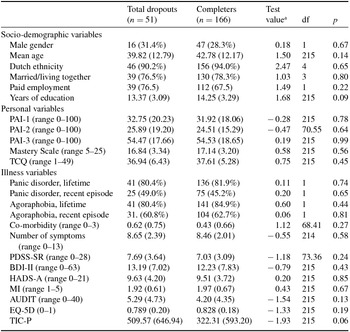
The univariate statistics for socio-demographic, personal, and illness-related variables of the total dropout group and completers are presented in Table 1. There were no differences between total dropouts and completers reaching a level of significance of p < 0.05. Five variables were marginally associated at p < 0.20 and thus included in the multivariable model: age, education, alcohol use, quality of life, and indirect mental healthcare-related costs.
Univariate differences in socio-demographic, personal, and illness variables between the total dropout group and the completers

Values given are mean (s.d.) or n (%).
PAI-1, Panic Appraisal Inventory, subscale anticipation; PAI-2, Panic Appraisal Inventory, subscale consequences; PAI-3, Panic Appraisal Inventory, subscale coping; TCQ, Treatment Credibility Questionnaire; co-morbidity, number of co-morbid disorders (including social phobia, general anxiety disorder and major depression); number of symptoms, number of symptoms during a panic attack; PDSS-SR, Panic Disorder Severity Scale – Self Report; BDI-II, Beck Depression Inventory – 2nd edition; HADS-A, Hospital Anxiety and Depression Scale, subscale Anxiety; MI, Mobility Inventory; AUDIT, Alcohol Use Disorders Identification Test; EQ-5D, EuroQol Questionnaire; TIC-P, costs associated with psychiatric illness.
a Either t test for independent samples or Pearson's χ2 test was applied.
The univariate analyses for pretreatment dropouts revealed one significant difference with relatively more male participants among the dropouts compared with completers (52.9% vs. 28.3%, χ 1 2 = 4.40, p = 0.04). Marginal differences between pretreatment dropouts and completers were seen for self-efficacy in coping with panic (PAI coping: 61.46 ± 12.07 vs. 54.53 ± 18.65, t 181 = -1.5, p = 0.14), mastery (16.05 ± 3.32 vs. 17.14 ± 3.20, t 181 = 1.34, p = 0.18), treatment credibility (TCQ: 35.81 ± 5.05 vs. 37.61 ± 5.28, t 181 = 1.35, p = 0.18), and co-morbid disorders (mean = 1.44 ± 0.81 vs. 0.43 ± 0.66, t 176 = −1.80, p = 0.07).
There were no significant differences between the regular dropouts and completers, but three variables with p values < 0.20 were kept for inclusion a multivariable model: age (39.44 ± 13.55 vs. 42.78 ± 12.17 years, t 198 = 1.43, p = 0.15), education (13.35 ± 2.96 vs. 14.25 ± 3.29 years, t 198 = 1.47, p = 0.14) and healthcare-related costs (€509.02 ± 657.77 vs. €322.31 ± 593.20, t 198 = −1.64, p = 0.10).
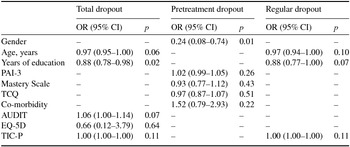
Table 2 shows the results for the multivariable logistic regression analyses for all dropout groups. Years of education was the only significant independent predictor of total dropout (OR = 0.88, p = 0.02), indicating that lower-educated participants were more likely to drop out from the intervention. Less than 10% of the total variance in dropout could be explained by the five possible predictors (Nagelkerke's R 2 = 0.09). Gender (OR = 0.24, p = 0.01) was the only independent predictor of pretreatment dropout, with males having higher odds of attending no course sessions. Nagelkerke's estimated R 2 was 0.13 taking all five predictors into account. Finally, no significant independent predictors were found for regular dropout, although years of education (OR = 0.88, p = 0.07) reached marginal significance. Nagelkerke's R 2 was only 0.06 taking all three predictors into account.
Multivariable logistic regression analyses of factors associated with total, pretreatment, and regular dropout relative to completers

OR, Odds ratio; CI, confidence interval; PAI-3, Panic Appraisal Inventory, subscale coping; TCQ, Treatment Credibility Questionnaire; co-morbidity, number of co-morbid disorders (including social phobia, general anxiety disorder and major depression); AUDIT, Alcohol Use Disorders Identification Test; EQ-5D, EuroQol Questionnaire; TIC-P, costs associated with psychiatric illness.
Discussion
The aim of the present study was to identify predictors of dropout in a sample of patients with sub-threshold and mild panic disorder treated with a public mental health intervention programme based on cognitive-behavioural principles. By splitting the dropout group further into pretreatment dropouts and regular dropouts, it was possible to carefully examine differences among the dropout groups concerning three groups of possible predictors: socio-demographic, personal, and illness variables. Following univariate analysis, several possible baseline differences between dropout groups and completers were included in multivariable models, including gender, age, education, perceived self-efficacy in coping with panic, feelings of mastery, treatment credibility, co-morbidity, drinking behaviour, quality of life, and mental healthcare-related costs. By multivariable analyses, however, only fewer years of education was a significant independent predictor of total dropout, while male gender was predictive of more pretreatment dropout. Moreover, the total variance in dropout explained by the possible predictors was low for all three models. This suggests that it is difficult to precisely identify dropout risks or to sketch a profile of the typical ‘dropout’ using baseline patient and illness characteristics. Taking the participants' reasons for termination of treatment into account, it can be concluded that other factors or practical circumstances might play a more crucial role in dropout behaviour.
The finding that lower-educated participants were more likely to drop out from the intervention programme corresponds with the general notion that higher levels of education or related indicators of socioeconomic status are predictive of mental health treatment completion across different treatments and conditions (Baekeland & Lundwall, Reference Baekeland and Lundwall1975; Sue et al. Reference Sue, McKinney and Allen1976; Wierzbicki & Pekarik, Reference Wierzbicki and Pekarik1993; Edlund et al. Reference Edlund, Wang, Berglund, Katz, Lin and Kessler2002) and this finding seems to extend to cognitive-behavioural therapy for panic disorder. In a study of manualized cognitive behavioural therapy for panic disorder (Keijsers et al. Reference Keijsers, Kampman and Hoogduin2001), lower levels of education and motivation were the only significant predictors of dropout. Wade and colleagues (Reference Wade, Treat and Stuart1998) and Grilo and colleagues (Reference Grilo, Money, Barlow, Goddard, Gorman, Hofman, Papp, Shear and Woods1998) also found a univariate association between dropout and lower education in panic disorder treatment, although this association did not remain significant in the latter study after controlling for related predictors, including household income, in multivariable analysis. Although a more recent trial for panic disorder (White et al. Reference White, Allen, Barlow, Gorman, Shear and Woods2010) found that education and income did not contribute significantly to the prediction of treatment completion, socioeconomic status does seem to be an issue of interest in designing and performing cognitive-behavioural therapies in panic disorder.
The finding that male gender was predictive of more pretreatment dropout is not in line with previous reviews that have suggested that females, in particular, are more likely to drop out from psychotherapy in general (Baekeland & Lundwall, Reference Baekeland and Lundwall1975; Wierzbicki & Pekarik, Reference Wierzbicki and Pekarik1993). Specific studies in panic disorder (Grilo et al. Reference Grilo, Money, Barlow, Goddard, Gorman, Hofman, Papp, Shear and Woods1998; Keijsers et al. Reference Keijsers, Kampman and Hoogduin2001; White et al. Reference White, Allen, Barlow, Gorman, Shear and Woods2010) did not find a significant association between gender and total dropout, although self-initiated dropout was significantly higher in male patients than female patients in the study by White and colleagues (Reference White, Allen, Barlow, Gorman, Shear and Woods2010). Since the reasons for the relatively high pretreatment dropout in males are currently unclear, this finding warrants further exploration and attention in future studies.
The current study did not find any other significant differences between total dropouts and completers concerning any of the other personal or illness-related variables. This is in contrast to Keijsers and colleagues (Reference Keijsers, Kampman and Hoogduin2001) and Baekeland & Lundwall (Reference Baekeland and Lundwall1975), who found that attitude and motivation were related to panic disorder treatment dropout. Although previous panic disorder studies did not examine the predictive role of alcohol use, the review by Baekeland & Lundwall (Reference Baekeland and Lundwall1975) suggested a possible relationship between alcoholism and dropout from psychotherapy treatment. The current study could not confirm this association with certainty, but the multivariable results did show a marginal tendency towards more alcohol use in the total group of dropouts. Additionally, no association was found between ethnicity and dropout, although the number of participant with non-Dutch ethnicity was small. Finally, no significant associations were found with any of the illness-related variables, including psychiatric co-morbidity. This corresponds fully with previous studies in panic disorder that also failed to find any association between dropout and symptom severity or co-morbidities (Grilo et al. Reference Grilo, Money, Barlow, Goddard, Gorman, Hofman, Papp, Shear and Woods1998; Keijsers et al. Reference Keijsers, Kampman and Hoogduin2001; White et al. Reference White, Allen, Barlow, Gorman, Shear and Woods2010).
The dropout rate of 23.5% in the present study was considerably lower than the average rate of 47% found across various treatment settings and therapy modes (Wierzbicki & Pekarik, Reference Wierzbicki and Pekarik1993) and the 30–60% range reported in the general psychotherapy literature (Baekeland & Lundwall, Reference Baekeland and Lundwall1975; Garfield, Reference Garfield, Garfield and Bergin1986), but very comparable to the 19–25% dropout rates reported in other panic disorder studies (Grilo et al. Reference Grilo, Money, Barlow, Goddard, Gorman, Hofman, Papp, Shear and Woods1998; Keijsers et al. Reference Keijsers, Kampman and Hoogduin2001; White et al. Reference White, Allen, Barlow, Gorman, Shear and Woods2010). Factors that might account for the relatively low dropout rate in the study are the short duration of the intervention programme and voluntary participation. Additionally, the course is easily accessible and initial symptom severity is less severe, since the participants do not suffer from full-blown panic disorder.
The reasons for dropout reported by the patients themselves in the current study were roughly in line with those reported in previous studies (Keijsers et al. Reference Keijsers, Kampman and Hoogduin2001; White et al. Reference White, Allen, Barlow, Gorman, Shear and Woods2010). Reported reasons were feeling better, suffering from physical issues, practical reasons such as long-distance travel, or a change in living conditions, e.g. moving home or getting divorced.
Recommendations for the public mental health intervention programme
The public mental health intervention programme ‘Don't Panic’ has previously been proven to be effective and was evaluated positively by both participants and course leaders (Meulenbeek et al. Reference Meulenbeek, Willemse, Smit, Van Balkom, Spinhoven and Cuijpers2010). Despite the feasibility and acceptability of the intervention programme, however, the current study did find one predictor for pretreatment dropout and one predictor for dropout in general, which should be taken into account to further improve the process of the intervention programme. In order to better fit the intervention programme to the needs of lower-educated participants, an adjusted version might be considered. Possible options that might help to involve and motivate the less-educated are reducing pressure through less homework, additional assistance and motivation by the course leader, and adjusting the workbook of the course in order to make the treatment a positive experience. Since the percentage of men not starting the intervention programme is higher compared to women, they warrant more attention in advance. Appropriate and timely information about the treatment duration, for example, may contribute to the patient's continuation of treatment (Garfield, Reference Garfield, Garfield and Bergin1994; Reis & Brown, Reference Reis and Brown1999), and may provide participants with more realistic ideas and expectations about the duration and content of the intervention programme.
As other factors like practical problems seem to play a more important role than the examined predictors, several other practical recommendations for the ‘Don't Panic’ course can be made. Practical problems such as timing, transportation, and caring for children could be better discussed and clarified with the doctor or therapist before the course starts in order to facilitate participation as the participant needs to be able to attend the treatment sessions and to do the homework exercises afterwards. Moreover, prospective participants should make an appeal to their social environment for support during the public mental health intervention period and doctors or therapists should encourage them to do this.
Study limitations
The nature of the current study was explorative and lacked, in some cases, strong theoretical support from the literature for possible predictors for dropout. Moreover, not all theoretically or potentially relevant factors, such as intrinsic motivation for treatment and personality, were specifically assessed in the current trial. Moreover, this was a secondary analysis from an RCT study that was not powered for the current question. Despite the relatively large sample size of the study, the number of dropouts was fairly low. A general rule of thumb suggests that at least 10 events per predictor variable are needed when performing a logistic regression analysis. This would suggest sufficient power for the multivariable analyses of regular and total dropout. However, the number of pretreatment dropouts was small. Therefore, conclusions about this particular group have to be interpreted with some caution. To verify the current findings, further research with larger sample sizes is recommended. Additionally, it should be borne in mind that the current study is community-based and included self-referred people with sub-threshold and mild panic disorder only and that the findings are not necessarily generalizable to treatment-seeking patients who may meet moderate to severe panic disorder. Finally, the cut-off of six sessions for completers was based on solely the content of the intervention. If a participant missed more than two sessions, they were considered to have missed too many exercises and educational elements about panic (Meulenbeek et al. Reference Meulenbeek, Willemse, Smit, Van Balkom, Spinhoven and Cuijpers2010). This cut-off, however, is still somewhat arbitrary and future research should establish a suitable and commonly accepted definition of completers for psychological treatments to overcome methodological problems and allow for better comparison of dropout prediction studies.
Conclusions
Although two predictors for dropout were found in the current study, it remains difficult to identify a profile of ‘the typical dropout’ in panic treatment. Gender and education were related to (pretreatment) dropout, but the explanatory power of these predictors remained small. Taking the participants' reasons for termination of treatment into account, more practical circumstances such as transportation and lack of time appear to be more relevant. Managing these practical problems may be the most effective way to reduce dropout.
Summary of the main points
-
• Dropout is a common and serious problem in psychological research and practice.
-
• The aim of the present study was to identify predictors of dropout.
-
• Two predictors for dropout were found in the current study (gender and education).
-
• It remains difficult to identify a profile of ‘the typical dropout’.
-
• Managing practical problems may be the most effective way to reduce dropout.
Ethical standards
The trial protocol was approved by an independent medical ethics committee (METIGG). The authors assert that all procedures contributing to this work comply with the ethical standards of the relevant national and institutional committees on human experimentation and with the Helsinki Declaration of 1975, as revised in 2008.
Acknowledgements
This study was supported by the Netherlands Health Research Council, The Hague (ZonMw) grant number 50–50110–98–035. The authors thank Ms Jessica Herzmanatus, M.Sc. (GGNet) and Ms Rianne van der Zanden, M.Sc. (Trimbos Institute) for their help with the development of the ‘Don't Panic’ course and the trainers and trainees for their valuable assistance in making this study possible. [Trial registration: Current Controlled Trials ISRCTN33407455.]
Declaration of Interest
None.
-
(1) To know what is meant by dropout.
-
(2) To understand why dropout is a problem.
-
(3) To identify predictors of dropout.
-
(4) To recognize opportunities to prevent dropout.



Comments
No Comments have been published for this article.