Introduction
The relationship between family policy and child poverty has attracted growing academic and political interest owing to the potentially negative impact of low income on individual wellbeing and behaviour. Poverty not only affects children at the time it is experienced, but may also have serious long-term effects on the future life chances of individuals, for example through the formation of cognitive resources. From a moral-philosophical perspective, child poverty is a particularly problematic social phenomenon since young children cannot be held responsible for their economic and social situation to the same extent as adults. It has even been argued that allowing child poverty to exist, and thereby denying some children the opportunities and life chances that are taken for granted by others, is a breach of the United Nations Convention on the Rights of the Child. The wide variation in child poverty in rich countries, ranging from a few per cent in Nordic countries to over 20 per cent in the US, shows that there is scope for political action (UNICEF, 2005).
Partly for these reasons, attention has been increasingly focused on the institutions of the welfare state in search of socio-political solutions to the problem of child poverty. Here, institutional analyses of particular types of welfare state legislation have pointed to the crucial role of family policy transfers and services for the alleviation of child poverty (Kangas and Palme, Reference Kangas and Palme2000). Previous analyses have, however, most often focused on macro relationships between institutions and outcomes, and neglected the links between welfare state legislation and micro-level characteristics of the individuals experiencing poverty.
The purpose of this article is to examine the macro-to-micro relationship between family policy institutions and child poverty in a comparative perspective. Our empirical analyses combine new institutional information on family policy legislation and micro-income data for 21 welfare democracies from the Luxembourg Income Study (LIS) from around 2000.Footnote 1 Through the use of multilevel modelling, individual- and country-level data are pooled for simultaneous analysis of their respective relationships to child poverty. Since separate family policy programmes may have different underlying motives, it is important to analyse family policy institutionally and multi-dimensionally. For these reasons, we employ Korpi's (Reference Korpi2000) distinction between dual-earner policies and traditional family policies. Dual-earner policies include generous earnings-related parental leave benefits, which favour female paid work and to some extent male care work. The term ‘dual-earner’ does not imply that single parents are excluded from such benefits. On the contrary, single mothers in particular tend to benefit from support for female labour force participation. Traditional family policies that more or less actively sustain families with a high gendered division of labour are often paid as low flat-rate benefits that are not based on the previous employment of women. This distinction enables us to separate policies broadly described as ‘woman-friendly’ into distinct policy dimensions that differ in generosity and in terms of their consequences for women's choices between paid and unpaid work, between employment and homemaking.
With comparative information on family policy legislation, we may avoid some of the problems that come with the use of expenditure data in analyses of specific welfare state programmes, and instead focus on the very content of such social rights (Kangas, Reference Kangas1991). Although the expenditure-based approach has contributed important knowledge on welfare state variation, social expenditures may give a less accurate picture of the institutional structures of social rights when variations in expenditure depend on factors not directly related to the quality of social protection, such as the number of children in different age groups in a country. It is also difficult to separate different types of family benefits at a programme level using expenditures. Even if such a distinction was possible, two benefits with similar expenditure may still have the opposite consequences for gender divisions of work and for poverty outcomes. Including information on family tax benefits and family policy services furthermore enables us to capture the effects of alternative or complementary redistributive strategies. The analyses are restricted to households with pre-school children since this group has the highest poverty risks due to their greater need of intensive parental care and related market income shortfalls.
The analyses cover countries in Eastern and Central Europe alongside the Western welfare democracies that have previously been the subject of comprehensive study in the comparative social policy literature. The countries included are Australia, Austria, Belgium, Canada, the Czech Republic, Denmark, Estonia, Finland, France, Germany, Hungary, Ireland, Italy, the Netherlands, Norway, Poland, Slovenia, Sweden, Switzerland, the United Kingdom and the United States.
The article is organised as follows: next, the consequences of child poverty and previous research on the relationship between child poverty and family policy are discussed. Subsequent sections are devoted to the institutional structures of family policy in the 21 countries and a presentation of the hypotheses. The data and methodology used in the study are described thereafter, followed by a presentation of the empirical results. The paper concludes with a discussion.
Child poverty – causes and consequences
The birth of a child heightens a household's immediate poverty risk in two main ways. First, the addition of another household member increases the financial burden on the household. Second, the need to provide parental care impairs parents’ earning capacity, in particular during the child's pre-school years. Parents – usually the mother – must reduce their time in paid work, with loss of market income as a consequence.
Although financial means are far from being the only source of individual wellbeing, they are central in determining present and future life chances (Sen, Reference Sen1992). Lack of economic resources restricts potential choices and the capabilities of individuals. As mentioned above, child poverty can be regarded as a more serious problem than adult poverty: children have little control over the circumstances of their birth, while adults to a greater extent can be argued to be responsible for the material conditions they experience. Moreover, early childhood poverty may have long-term effects on children's life chances over the life-course (Bäckman and Nilsson, Reference Bäckman and Nilsson2007). The risk of poverty and social exclusion in adulthood to some extent originates in early childhood, when essential cognitive resources are acquired (Esping-Andersen, Reference Esping-Andersen2002; Haveman and Wolfe, Reference Haveman and Wolfe1995). Material living conditions during pre-school years are strong determinants of school completion, in particular among children growing up in low-income families (Duncan et al., Reference Duncan, Brooks-Gunn, Yeung and Smith1998). Such factors in combination affect adult health and longevity (cf. Bynner, Reference Bynner2000; Stenberg, Reference Stenberg2000).
The role of the welfare state in structuring living conditions of young individuals has received increasing attention, and the provision of family policy benefits has been highlighted as vital to the direct mitigation of such latent risks of low income. Large cross-national disparities in poverty and income inequalities are well documented (see Bradbury and Jäntti, Reference Bradbury, Jäntti, Vleminckx and Smeeding2001; Eurostat, 2008; Rainwater et al., Reference Rainwater, Smeeding, Coder, Vleminckx and Smeeding2001; Rainwater and Smeeding, Reference Rainwater and Smeeding1995; Ritakallio, Reference Ritakallio2002; Smeeding, Reference Smeeding2002). Although these disparities have often been attributed to the redistributive capacity of total tax-transfer systems, it is often unclear exactly how particular policies relate to the prevalence of child poverty in different countries. Analyses of the macro-level links between family policies and poverty risks of families with children presuppose a relatively close relationship between institutional structure and outcome (Forssén, Reference Forssén1998; Kangas and Palme, Reference Kangas and Palme2000; Solera, Reference Solera1998). Some analyses also link family policy benefits to micro-level poverty outcomes (Immervoll et al., Reference Immervoll, Sutherland, de Vos, Vleminckx and Smeeding2001; Kunz et al., Reference Kunz, Villeneuve, Garfinkel, Vleminckx and Smeeding2001). Most previous studies have, however, either included relatively few countries or adopted a less systematic institutional perspective.Footnote 2 Broadly, comparative studies with an institutional focus mainly investigate macro relationships (see Kangas and Palme, Reference Kangas and Palme2000; Ferrarini, Reference Ferrarini2003; Bäckman, Reference Bäckman2009) and thereby have less-developed macro-to-micro perspectives on policy-outcome links.
Nevertheless, macro-comparative analyses indicate that different family policy institutions are likely to have different effects on child poverty risks. Dual-earner policies, in which earnings-related benefits and extensive childcare services predominate, have been related to lower poverty levels than flat-rate family policy benefits supportive of more traditional divisions of labour within the household. This is not only attributable to the direct income effect on household budgets, but is most likely also due to the favourable impact of dual-earner policies on household market income. Such benefits strengthen female labour force attachment by linking benefits to previous earnings as well as by integrating fathers in unpaid care work (Ferrarini, Reference Ferrarini2006). Welfare states with highly developed dual-earner support have the highest levels of female labour force participation and the lowest gender gaps in employment, whereas countries dominated by traditional family support typically show low levels of female paid work and the highest gender gaps in paid work (Korpi, Reference Korpi2000). Generous dual-earner support is likely to have consequences for poverty risks since it increases the number of women with low and medium levels of education in the labour force (Korpi et al., Reference Korpi, Ferrarini and Englund2009). Even if cross-national differences in female labour force participation have declined over time, large variations remain in women's work hours, in particular among women with young children (Daly, Reference Daly, Scharpf and Schmidt2000; Montanari, Reference Montanari2000).
The poverty-alleviating effects of dual-earner policies are not only restricted to two-earner households. In a comparative study using LIS data, Hobson and Takahashi (Reference Hobson, Takahashi and Lewis1997) show that single-mother households in countries with dual-earner models of family policy have the lowest poverty risks, primarily due to greater reliance on market income. A likely explanation for this finding is that, in the event of a divorce, the probability that the mother has already secured a foothold in the labour market is greatest in contexts with highly developed dual-earner support. Dual-earner policies thus seem to reduce poverty risks by raising the earnings potential of all households, whereas countries with other types of family policies reduce poverty less effectively. The above discussion points to the need for a closer examination of the macro-to-micro relationship between different dimensions of family policy institutions and poverty among families with young children.
Family policy legislation in a comparative perspective
Despite the general trend of expanding family policy in recent decades, large cross-national variations can be found in advanced welfare democracies today. In certain respects, welfare states even appear to have strengthened separate dimensions of family policy. Some welfare states, many of which are Continental European, primarily expanded traditional family policies supportive of highly gendered divisions of labour, for example through flat-rate childcare leave benefits or tax deductions for an economically dependent spouse. In recent decades, other welfare states, in particular Nordic countries, have instead primarily strengthened the dual-earner dimension of family policy, for example by the extension or introduction of earnings-related parental leave benefits (Ferrarini, Reference Ferrarini2006). Taken together, these developments have reinforced the broader models of family policy.
The divergent motives and impacts of different types of family policy institutions make a multidimensional approach particularly suitable for the analysis of policy and outcome links in this particular social policy area (Sainsbury, Reference Sainsbury1996). For this reason, we use the two-dimensional approach, originally developed by Korpi (Reference Korpi2000), to analyse gender dimensions of welfare states. This approach focuses on the degree to which a country supports a family with two earners or a more traditional family with a higher gender division of paid and unpaid work.
To measure the generosity of these two policy dimensions, we use data from the Parental Leave Benefit Database (PAL), which is being constructed at the Swedish Institute for Social Research, Stockholm University. This database comprises systematic, comparative and institutional information on a broad range of family policy benefits paid in cash or via the tax system in 24 welfare democracies.Footnote 3 Since the generosity of different social benefits is complicated to compare across countries, a procedure gradually adopted in this research tradition is to follow a ‘typical case’ approach, where benefit levels are calculated for standardised households that typically earn some type of average wage in a country (see Korpi, Reference Korpi1989; Esping-Andersen, Reference Esping-Andersen1990; Scruggs and Allan, Reference Scruggs and Allan2006). As compared to existing family policy data, benefits in PAL are estimated net of taxes and social security contributions in accordance with national income tax legislation governing each benefit. This procedure makes benefits paid in national currencies comparable within and across countries, not least where taxable and non-taxable benefits are analysed. This procedure also makes it possible to estimate the extent of family tax benefits.Footnote 4
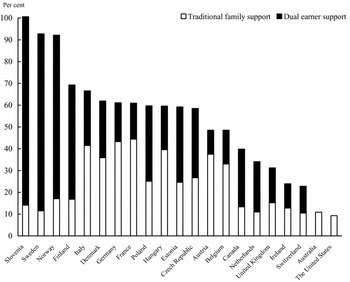
The generosity of the two family policy dimensions for each country in 2000 is shown in Figure 1, in which the vertical axis indicates the yearly generosity of family policy transfers after taxes as a percentage of an average production worker's net wage (APWW). The typical case family is a family with two adults and two pre-school children (aged 0 and 5), where the father earns an average production worker's wage and the mother is at home with the youngest child after childbirth.Footnote 5
Generosity of family policy transfers along two dimensions in 21 countries 2000. Net yearly net benefits in per cent of an average production worker's wage. Source: PAL.

The first dimension, dual-earner support, is made up of parental insurance transfers with earnings-related gradients. These benefits are paid to the mother, the father or both parents during the first year after childbirth. Such benefits provide strong incentives for female paid work since qualification for earnings-related components requires a previous job record. When calculating dual-earner support, both parents are assumed to have worked earning an APWW before having their second child in order to capture the generosity of earnings-related benefits.Footnote 6 The second dimension, traditional family support, is composed of yearly flat-rate or lump-sum benefits including: childcare leave benefits paid in low flat-rate amounts after the termination of earnings-related benefits; child allowances paid in cash or as tax benefits; lump-sum maternity grants paid in connection to childbirth; and tax deductions for workers with a dependent spouse. It is primarily the combination of low benefit generosity and weak links to previous work record of traditional family support that sustain male breadwinner families where women are part-time or full-time homemakers. In the calculation of traditional family support, the mother is assumed to be a homemaker to reflect the extent to which a male breadwinner household is sustained.Footnote 7
As may be expected, the longstanding welfare states to a large extent cluster along the family policy models described by Korpi (Reference Korpi2000) on the basis of the two constitutive dimensions. The Nordic countries (with the exception of Denmark) have relatively high dual-earner support, and high total generosity of family policy transfers. These countries have developed dual-earner models of family policy, where transfers and services support not only female work but also to some extent male care work. Countries characterised by generous support for traditional gender divisions of labour – primarily Continental European states – have medium generosity of total family policy benefits, with the main emphasis on support to traditional family structures and relatively low dual-earner support. The countries with the lowest generosities on both dimensions, primarily English-speaking ones, have developed market-oriented models of family policy, which to a greater extent rely on means-tested benefits.
Four of the five transitional welfare democracies are characterised by medium levels of total family support, namely Hungary, the Czech Republic, Estonia and Poland. The latter three countries combine relatively high levels of both types of family support and thus may be said to have mixed models of family policy. Family policy in Hungary, with its low level of dual-earner support and fairly high level of traditional family support, can be categorised as traditional, along with most other Continental European countries.Footnote 8 In these four countries, large departures from the various institutional starting points took place in the 1990s (Fodor, Reference Fodor2002). The fifth transitional country, Slovenia, with its high level of dual-earner support and low level of traditional family support, seems to adhere to a dual-earner model of family policy, along with the Nordic countries. Although the democratic histories are relatively recent in transitional countries, it should be noted that they had relatively well-developed – and in several respects more comprehensive – family policy systems before the fall of the communist regimes.
Transfer generosity is, of course, not the only aspect of family policy with an impact on child poverty, but the scope of public services, such as childcare for the youngest children, is also likely to affect the ability of parents to reconcile paid and unpaid work, not least for lone parents with young children whose paid work is largely structured by access to public childcare. Such services are most often part of dual-earner policies. Even if transfers and services seem to work as functional equivalents for individuals when it comes to solving work–family conflicts in some countries (Rostgaard, Reference Rostgaard2002), broader comparative analyses indicate that generous dual-earner transfers and extensive family policy services go hand in hand in longstanding welfare states. Dual-earner benefits as measured in Figure 1 may thus function as indicators of broader family policy strategies. In 2000, Denmark constitutes an exceptional case where dual-earner transfers are lower than in the other countries with dual-earner models, whereas childcare services for the youngest children are more comprehensive than in any of the countries considered here (Ferrarini, Reference Ferrarini2006). Furthermore, in transitional countries, the positive relationship between dual-earner support and public childcare is somewhat weaker, which appears, at least partially, to reflect conflicting motives in family policies of these countries (Ferrarini and Sjöberg, Reference Ferrarini and Sjöberg2009). Besides the transfer dimensions described here, the extent of public childcare for the youngest children will also be included in the upcoming analyses, discussed further in the data and methodology section below.
Hypotheses
In line with the discussion above, more generous family policy transfers can generally be expected to decrease child poverty. When distinguishing the different family policy dimensions of family policy transfers, dual-earner support can be hypothesised to have a stronger effect on child poverty than traditional family support, since dual-earner transfers are earnings-related and to a greater extent compensate for shortfalls in earnings due to childbirth, and also increase household income through incentives for higher female labour force participation. This line of thought also suggests that when labour market participation is controlled for in a multivariate analysis, we should anticipate a greater reduction in the effect of dual-earner support than in that of traditional family support. Even if traditional family support aims to raise incomes of households near the poverty line, this effect is also likely to be counteracted by a substitution effect as women reduce their labour force participation.
Another implication is that dual-earner support should protect single-mother households from poverty to a greater extent than support to traditional family structures. This is not only because dual-earner transfers provide higher benefits but also, as argued above, because they are often combined with better availability of childcare services, a precondition for labour force participation among single parents. Thus we can expect that the effect of dual-earner support will be reduced when the extent of public childcare service provision is controlled for at country level.
Data and methodological considerationsFootnote 9
A relative poverty threshold is used where people with less than half the median disposable income in a country are defined as poor. This is partly to facilitate international comparisons, but it is also theoretically motivated since the average standard of living in a particular country is likely to be the most relevant comparison point for most of its citizens. This practice can be criticised from several standpoints, and the choice might have implications for the results obtained (see, for instance, Danziger and Jäntti, Reference Danziger, Jäntti, Atkinson and Bourguignon2000; Ruggeri Laderchi et al., Reference Ruggeri Laderchi, Saith and Stewart2003). Clearly, relative income poverty measures are merely proxies for a more profound theoretical poverty concept and should be regarded as indicators of poverty risks rather than of poverty per se (for further discussion see Atkinson et al., Reference Atkinson, Cantillon, Marlier and Nolan2002: 78ff).
The practice of analysing both the pre-tax/transfer and the post-tax/transfer poverty rate has proved useful for estimating the redistributive effects of welfare states (for example, Bradley et al., Reference Bradley, Huber, Moller, Nielsen and Stephens2003; Fritzell and Ritakallio, Reference Fritzell and Ritakallio2004; Moller et al., Reference Moller, Bradley, Huber, Nielsen and Stephens2003). However, in the analysis of poverty risks of families with children, this practice has been shown to underestimate the redistributive capacity of tax-transfer systems since family policy benefits, such as parental leave, are partly amalgamated in the market income category or with other types of transfers in several national income datasets.Footnote 10 Due to such potential problems and since the purpose of this study is to explain variations in child poverty risks that are related to both a direct effect of transfers and an indirect effect of policies supporting paid work, analysing only the post-tax/transfer poverty rate seems a reasonable restriction.
The poverty rate of households with dependent children under six years is the proportion of this population with a disposable income below half of the median income in the country. Thus, the dependent variable is dichotomous, where unity indicates a disposable household income below the poverty line. In the construction of disposable income, we follow the practice of using the square root of the number of persons in the household to weight for family size.Footnote 11 As for the choice of poverty measure, the choice of equivalence scale may have implications for the results also (see Danziger and Jäntti, Reference Danziger, Jäntti, Atkinson and Bourguignon2000). The robustness of results is also tested by the use of alternative equivalence scales and alternative poverty lines, and the latter is also an indirect test of poverty intensity.
In analyses of childcare services, it is imperative to separate public efforts from market-produced outcomes or informal arrangements, in particular when we want to analyse impacts of welfare state arrangements on, for example, female work or poverty outcomes. In dual-earner models of family policy, public services facilitate female labour force participation after parental leave, while a market-oriented family policy model, by having low parental leave duration, pushes mothers into paid work and market-based childcare services that to lesser degrees are publicly subsidised. In the former case, female labour force participation can be considered to be more of an outcome of public childcare arrangements, whereas in the latter instance (private) childcare use is the outcome of female labour force participation itself. From the point of view of supporting female labour force participation, daycare services should be affordable and cover full days and whole working weeks for pre-school children. Unfortunately, however, to an extent not completely realised in much comparative research, available data on such services are often not fully comparable. One problem is the mixing of information to include both private market-based daycare services and those provided by, or highly subsidised by, public funds, which is of relevance for affordability and for variation in the quality of services. Recourse to the OECD (2009) database on childcare coverage is problematic as it merges institutions and outcomes into a category termed Formal Childcare, comprising publicly subsidised and privately purchased childcare. Another problem is that existing data sometimes use inconsistent age categories of children when defining public childcare coverage. By combining information from a number of comparative and national sources, a comparable indicator of public childcare coverage for under threes has been constructed.Footnote 12
As was discussed above, the number of earners, the age of parents and whether the household is female headed are closely linked to poverty risks. Therefore, in addition to poverty, at the household level we include the following variables in the multivariate analyses. The first is age of family head, classified into three age groups (−29, 30–39, 40+). Labour market attachment in the household is indicated by a three-level categorical factor measuring the number of earners in the household. Finally, female-headed household is a dummy variable indicating whether or not the household is headed by a woman, in practice a single mother (1 = female headed).Footnote 13 All household-level data are from LIS Wave V (around 2000). Since Wave V data were not yet available for the Czech Republic, data from 1996 are used. Institutional data are from around 2000.
To analyse these data, conventional multivariate regression techniques may not be employed since they cover households nested in countries and therefore are likely to be dependent. Moreover, in conventional regression models using data on more than one level, the standard errors of variables at higher levels will be underestimated since the degrees of freedom are calculated as if they were at the first level. To deal with these problems, we use a random intercept model in which the intercept is allowed to vary between second-level units, in this case countries.Footnote 14 With this model, it is also possible to calculate the variance partition coefficient (VPC), an estimate of how large a proportion of the (unexplained) variance is attributable to the second level (country). In a multilevel regression, correlated error terms are not treated as a problem that needs to be addressed; instead they are treated as information that adds something to our understanding of the phenomenon in focus. Important to note, however, is that in a model with a binary outcome – for example, ‘poor’ or ‘not poor’ – this interpretation of the VPC is only appropriate for the empty model; that is, a model without covariates.Footnote 15 A significant VPC also indicates that the multilevel approach is justified.
By employing random intercept models, we also gain precision in our analyses as compared to using aggregate (country-level) data only. Instead of modelling the average risk among all households with dependent children in a country, as would be the case if we were analysing aggregate data, we model the risk at the household level. For instance, if in the aggregate case we find that the proportion of female-headed households is positively correlated with the poverty rate, we must assume that it is precisely the female-headed households that turn poor. By analysing this relationship at the household level, we do not have to make that assumption. This gain in precision alongside the fact that we can combine the macro and the micro equations in one model without violating basic assumptions serves well as a rationale for choosing this type of model rather than any other available alternative. We estimate the models in the GLLAMM software (Rabe-Hesketh et al., Reference Rabe-Hesketh, Skrondal and Pickles2004) that runs in STATA. To ensure that the institutional arrangements in each country are given equal weight in the analyses, we have weighted the individual-level observations by the inverse of country sample sizes. The effects from independent variables are reported as odds ratios. For categorical variables the odds ratio indicates the relative deviation from a reference category, the value of which is set to ‘1’. For instance, an odds ratio of 1.5 indicates odds 50 per cent higher, and 0.5 indicates odds 50 per cent lower, as compared to the reference category. For continuous independent variables, the odds ratio minus one indicates the percentage change in odds at one unit increase in the independent variable. Thus, the further from unity the stronger the effect.
Empirical results
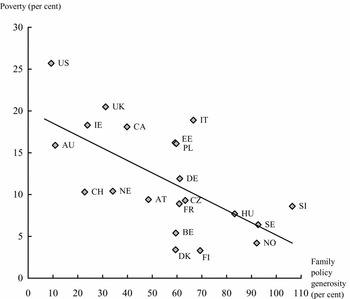
Before moving on to multivariate regressions, the underlying bivariate relationship between family policy legislation and poverty will be examined. Figure 2 shows the macro correlation between the total generosity of family policy benefits (shown in Figure 1 above) and child poverty. The coefficient of correlation between the factors is negative (−0.66, statistically significant at the 1 per cent level). This correlation increases slightly in strength (−0.69) when analyses are restricted to the longstanding welfare democracies. Separate analyses of dual-earner support and traditional family support indicate that the former type of family policy is the most important factor in the explanation of poverty risks. Dual-earner support shows a negative correlation with child poverty both within and without the transitional countries (the coefficient of correlation is −0.55 and −0.61 respectively, statistically significant at the 1 per cent level). Support to traditional family structures is negatively related to child poverty, but not statistically significant. Such macro analyses do not, of course, take into account that the variation of individual-level factors such as household composition, age of parents or number of earners may structure poverty risks. In the following analyses, multilevel modelling is therefore used to simultaneously combine individual- and country-level data for specification of their links to the incidence of child poverty at the individual level.
Generosity of family policy transfers and child poverty in 21 countries 2000. Net yearly family policy benefits in per cent of an average production worker's wage. Poverty risks among children in families with the youngest child aged 0–5. Poverty line: 50 per cent of equivalised median disposable income. Source: LIS, PAL.

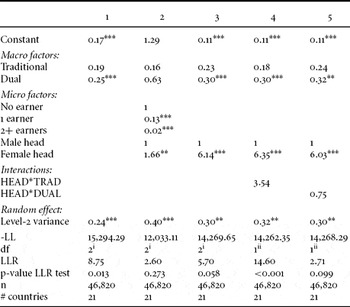
Tables 1 and 2 show the results using the random intercept regression models. The VPC for the empty model for all countries and for the reduced sample is 0.10, which means that 10 per cent of the total poverty variation among families with dependent children in data is at the country level.Footnote 16 Consequently, the remaining 90 per cent is found at the household level. The value of the VPC is significant and indicates that we should keep the random intercept model. We do not report estimates of age of household heads in the tables but, as expected, these indicate that the youngest families run the highest poverty risks.
Results from random intercept logistic regressions. Odds ratios of micro- and macro-level determinants for child poverty across 21 welfare democracies around 2000. VPC of empty model equals 0.10

Notes: *p<0.05; **p<0.01; ***p<0.001.
iReference model excludes the macro factors.
iiReference model is Model 3.
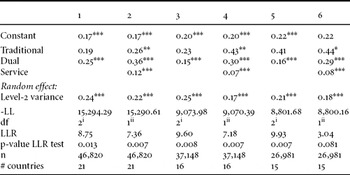
Results from random intercept logistic regressions. Odds ratios of macro-level determinants for child poverty across 21 (Model 1–2), 16 (Model 3–4) and 15 (Model 5–6) welfare states around 2000. All models are controlled for age of household head

Notes: *p<0.05; **p<0.01; ***p<0.001.
iReference model includes age of head only.
iiReference model is a model without Service.
In the first model of Table 1, the separate family policy indicators Traditional and Dual are included simultaneously for the 21 countries. These indicators are centred at their means. Thus, the effect of traditional is calculated for the case when dual is at its mean and vice versa.Footnote 17 Contrary to our expectations, there is a tendency for traditional family support to have a stronger negative relationship with child poverty than dual-earner support, even if the difference in the estimates is small. The odds ratios indicate that on average an increase of ten percentage points in either dual or traditional family support is linked to a fall in the odds of being poor of approximately 8 per cent ([0.25–1]/10 = −0.075; [0.19–1]/10 = −0.081). However, it should be noted that only dual-earner support is statistically significant. We investigate this further below.
Model 2 directs our attention to the hypothesis that dual-earner support reduces poverty, both directly through benefits and indirectly by providing incentives for both parents to work. The hypothesis receives support in the sense that when we control for labour market attachment of households by including the number-of-earners factor in the model, the effect of traditional family support remains practically unaffected, whereas the effect of dual-earner support is strongly reduced. This result indicates that the lion's share of the poverty-reducing effect of traditional support is due to transfers per se, whereas the direct income effect of transfers is of less importance as far as dual-earner support is concerned.Footnote 18
The effect of female-headed households is analysed in Model 3 in Table 1. Firstly, we see that the odds of being poor among female-headed households are on average more than six times as high as those for male-headed households.Footnote 19 If the parameter estimates of the two institutional variables are compared with the estimated effects in Models 1 and 2, we can also conclude that the effects of the two types of benefits are independent of household composition in this sense in the different countries. However, the hypothesis elaborated above predicted that dual-earner support would be more beneficial to single mothers than traditional family support. To test this hypothesis we need to examine the interaction effect between sex of family head and the two types of family support. This test is performed in Models 4 and 5. An examination of the LLR test at the bottom of the columns reveals that the interaction term between traditional support and sex of family head significantly improves the fit of the model (Model 4). The interaction between sex of family head and dual-earner support also improves the fit, but the improvement is significant only at the 10 per cent level (Model 5). Note also that the effect of the interaction term goes in different directions in the two models.
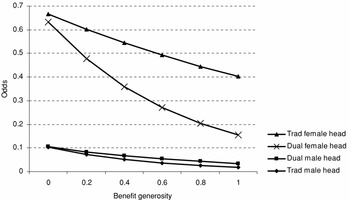
Since interaction effects are often difficult to interpret from parameter estimates, we have illustrated the interaction effects graphically in Figure 3. The first thing to notice in the graph is that the slopes for female-headed households are much steeper than for male-headed households, and that the overall odds for male-headed households lie far below that of female-headed households. This means that, on average, female-headed households benefit far more than the latter from generous family policies, irrespective of the system, although they never reach down to the low levels of male-headed households. We also notice that the hypothesis claiming that dual-earner support would be more beneficial to female-headed households than traditional family support is sustained. The slope of the line representing the effect of dual-earner support on the poverty risk of female-headed households is markedly steeper than the corresponding line for traditional family support. It was argued above that Denmark, due to its unique combination of high female labour force participation, relatively high levels of both types of support and low child poverty, could be an influential case or an outlier in our analyses, and it turns out that when Denmark is excluded from the analysis, the pattern that emerges in Figure 3 is even more pronounced (not reported).
Graphical representation of predicted interaction effects (odds) between sex of household head and generosity of traditional and dual-earner family policy expressed in per cent of an average production worker's net wage.

In Table 2 we focus on the effect of the two types of family support and how they are affected by the inclusion and exclusion of countries and the inclusion of an indicator of childcare service coverage. Model 1 is identical to the first model in Table 1 and is included to simplify the reading of the table. We start by comparing Model 1 and Model 3. Recall from the discussion of the results in Table 1 that the hypothesis claiming that dual-earner support has a stronger poverty-alleviating effect than traditional family support was not sustained. However, when we analyse only the old welfare states the hypothesis receives some support: the odds ratio for ‘dual’ falls from 0.25 to 0.15, while the effect of ‘traditional’ remains unchanged. As discussed above, a plausible explanation for this may be that the dual-earner dimension does not capture the scope of family policy services supportive of labour force participation to the same extent in transitional countries as in more mature welfare democracies. When we include the service factor we would, according to this hypothesis, expect the effect of the dual factor to be more reduced than that of the traditional factor. As is evident from Model 2, this does not happen when we include all countries in the analysis. Both factors are reduced at about the same magnitude as compared to those in Model 1. Likewise, when the corresponding models are estimated for the old welfare states (Models 3 and 4), the reduction of the two odds ratios are of the same magnitude, although the reduction is greater in these models. It is only in Models 5 and 6, when Denmark is also excluded from the analysis, that the expected pattern emerges. The effect of traditional family support does not change, while the effect of dual-earner support is substantively reduced. Thus, generous dual-earner support and comprehensive childcare largely appear to do the job jointly in the old welfare states (except Denmark), whereas this is not the case to the same extent in the new democracies.
The analyses presented here have also been run using an alternative equivalence scale for the calculation of disposable income and the poverty threshold: the so-called OECD scale, where the first adult is assigned the weight 1, other adults 0.7, and children 0.5. Those analyses generate slightly different results: most important, the effect of dual-earner support grows stronger while the effect of traditional family support is reduced. This provides even stronger support for our hypotheses, and indicates that the analyses in Tables 1 and 2 are conservative with respect to our hypotheses. We have also tested the effect of excluding the potentially influential case of United States (with low family policy generosity and high poverty) from the analyses. This generates the same effect as changing the equivalence scale and lends somewhat stronger support to the hypotheses. We have already discussed the effect of excluding Denmark in some of the models. However, in the other regression models, the inclusion or exclusion of Denmark does not affect the results. Furthermore, since poverty levels may be affected by other policies we have also run the models presented here with control for the generosity of means-tested social assistance and unemployment benefits without in any way modifying our conclusions.Footnote 20
Overall, our hypotheses are accepted, although the first and most straightforward of these – that dual-earner support is more effective as poverty protection – is valid primarily when analyses are restricted to the longstanding welfare democracies. The same goes for the hypothesis that the effect of dual-earner support should weaken when childcare service availability for the youngest child is controlled for, but only when Denmark is excluded. We have also shown (Model 2, Table 1) that the poverty-reducing effect of dual-earner support to a substantial degree is the result of its positive impact on labour force participation. Finally, the hypothesis that dual-earner support is more beneficial for female-headed households than traditional family support is demonstrated in the interaction analyses presented in Figure 3.
Discussion
The main purpose of this study was to analyse the macro-to-micro relationship between different family policy institutions and child poverty in a comparative perspective. Using a multilevel regression approach, the results indicate that greater generosity of all types of family policy transfers at the macro level can be linked to lower poverty risks of households with young children at the micro level. Interesting differences can be found, depending on the type of family support analysed. Overall, the effect of dual-earner support seems to operate by enabling both parents to work and raise market income. Support to more traditional family structures, on the other hand, has a more direct effect on household income and poverty risks; that is, in this case it is the transfer per se that matters. The analyses are also in line with the hypothesis that dual-earner support should alleviate poverty more effectively among single-mother households than support for more traditional gendered divisions of labour.
The links between policy and outcome are generally strengthened when transitional countries are excluded and analyses are confined to the longstanding welfare democracies. Among other things, this is likely to reflect the fact that policies in many countries of Eastern and Central Europe have increasingly moved in a mixed or contradictory direction, where dual-earner and traditional family support are equally important. When analysing the influence of public childcare coverage, generous dual-earner support and comprehensive services seem to do the job jointly in the old welfare states (when we exclude Denmark), whereas this is not the case in the transitional countries. However, further analyses of these new welfare democracies will be needed in order to disentangle policy and outcome links.
In this article we have claimed that the institutional packaging of family policy is crucial with respect to the poverty risks of families with dependent children. More specifically, we show that family policies aimed at supporting dual-earner families are an effective poverty-reducing measure. However, the Danish case calls for some additional comments. The fact that Denmark, which at the time combined comprehensive childcare services for the youngest children and high female labour force participation, has very low child poverty rates suggests that it is not dual-earner transfers but rather childcare services that also are supportive of female labour force participation that matter. On the other hand, it must be stressed that when we exclude Denmark and control for childcare service provision, although the effect is strongly reduced, dual-earner transfers still have a substantively stronger poverty-reducing effect than traditional family transfers. Thus, we believe that, despite the Danish case, we have a strong case for our claim that dual-earner transfers are more effective than traditional family support.
This claim does not, of course, mean that we deny the importance of other factors. Although our results indicate that the provision of financial resources through family policy legislation is an effective way of alleviating child poverty and equalising life chances, the ways in which poverty risks among families with children are reduced are complex. We have taken some steps in that direction here, but the link between the transfer-service part of the family policy matrix still needs to be further analysed. Future research should also endeavour to connect transfers and services to other aspects of labour market regulation that facilitate work−family reconciliation, such as legislation promoting gender-neutral wage setting, the right to part-time work for parents with young children, labour market flexibility and so on. The extension of leave rights to fathers in many European countries during recent years also opens up the possibilities for interesting analyses of how such entitlements structure household earnings and children's wellbeing.
Thus, analyses of relationships between welfare state institutions and poverty risks of their youngest citizens are likely to be a central focus of comparative welfare state research for decades to come. The results of this study point to the fruitfulness of multidimensional, institutionally informed macro-to-micro analyses of links between family policy legislation and child poverty outcomes. We have pointed to the importance of recognising that different types of family policy schemes may work through different types of mechanisms, and that this has implications for the poverty-alleviating effects of the schemes. We have found tentative evidence indicating that dual-earner policies have dynamic effects that go beyond the direct effects of transfers. Comparative analysis of such dynamic effects is one of the most important future tasks in the analysis of the policy mechanisms behind poverty.