

Introduction
Traumatic brain injury (TBI) is a major cause of death and disability worldwide (Hyder, Wunderlich, Puvanachandra, Gururaj, & Kobusingye, Reference Hyder, Wunderlich, Puvanachandra, Gururaj and Kobusingye2007). The experience of TBI can be devastating for patients, families and the wider community (Holloway et al., Reference Holloway, Orr and Clark-Wilson2019; Jones et al., Reference Jones, Theadom, Prah, Starkey, Barker-Collo, Ameratunga and Feigin2020). The injured person may face months of physical rehabilitation (Hellweg & Johannes, Reference Hellweg and Johannes2008); they may have new accommodation and employment needs (Huebner et al., Reference Huebner, Johnson, Bennett and Schneck2003); and they may confront the fundamental challenge of the reconstruction of their personhood (Gracey et al., Reference Gracey, Palmer, Rous, Psaila, Shaw, O’Dell and Mohamed2008; Levack et al., Reference Levack, Kayes and Fadyl2010). Support can be needed throughout the TBI recovery process from the acute medical care, through to long-term community rehabilitation and support services. The nature and availability of supports depends on many factors, such as how resources are used to meet community health needs (Epping-Jordan et al., Reference Epping-Jordan, Pruitt, Bengoa and Wagner2004). Ideally, this includes the input of the consumers of the health service.
There is growing recognition that the service user is a vital source of information for improving health services (Australian Government Department of Health, 2010; Brenner, Reference Brenner2003; Facey et al., Reference Facey, Boivin, Gracia, Hansen, Lo Scalzo, Mossman and Single2010; Milte, Ratcliffe, Bradley, Shulver, & Crotty, Reference Milte, Ratcliffe, Bradley, Shulver and Crotty2019; Wilkin & Hughes, Reference Wilkin and Hughes1987; World Health Organization, 2002). The term service user (or participant) is used in this study; but it should be noted that some sources use alternate terms, such as health consumers. Service user input is also highly valued by many health-related research and training agencies that encourage or explicitly require its consideration (Hall et al., Reference Hall, Bryant, Sanson-Fisher, Fradgley, Proietto and Roos2018). In Australia, the active participation of mental health service users in service development, planning, delivery and evaluation is a core standard of community service provision (Australian Government Department of Health, 2010). This participation is fundamental to recovery-oriented mental health practice. The use of such health provision models that include integrated service user participation and feedback should be central to improving service provision for people who have experienced a TBI and their families.
Several surveys have been conducted to illuminate the service user perspective in relation to TBI supports. These studies have shown that multiple factors contribute to TBI outcomes and service user experiences, such as the injured person’s sex and age, and the injury severity (Ponsford, Reference Ponsford2013). For example, a recent study showed that injury severity predicted an increase in the number of unmet service needs and postconcussion symptoms, and a decrease in quality of life and community integration. Identifying as female as opposed to male, was also found to predict increased service obstacles and symptoms, but also better community integration (Hennessy & Sullivan, under review). The findings suggest that changes in the available TBI supports and services are needed, and tailored services should be considered, but it did not show why the changes should be made from a service user perspective. Given the observation that TBI service reforms can be difficult to achieve, for example because of service provider-reported barriers to inter-service collaboration (Lefebvre, Pelchat, Swaine, Gélinas, & Levert, Reference Lefebvre, Pelchat, Swaine, Gélinas and Levert2005; Mueller et al., Reference Mueller, Wang, Brooks, Morant, Sullivan and Raymont2017), this additional information could be vital to support change.
Qualitative and mixed research methods can be used to answer questions such as how supports and services affect those who use them, and if they need improvement, how and why this should occur. These methods have been applied to understand the TBI service user perspective worldwide, including in the United States of America (e.g., Rotondi, Sinkule, Balzer, Harris, & Moldovan, Reference Rotondi, Sinkule, Balzer, Harris and Moldovan2007), the United Kingdom (e.g., Mueller et al., Reference Mueller, Wang, Brooks, Morant, Sullivan and Raymont2017), New Zealand (e.g., Fadyl et al., Reference Fadyl, Theadom, Channon and McPherson2019), and Australia (e.g., Conneeley, Reference Conneeley2012; Fleming, Sampson, Cornwell, Turner, & Griffin, Reference Fleming, Sampson, Cornwell, Turner and Griffin2012). These studies are typically small, involving less than 25 participants (Conneeley, Reference Conneeley2012; Piccenna, Lannin, Gruen, Pattuwage, & Bragge, Reference Piccenna, Lannin, Gruen, Pattuwage and Bragge2016). They typically find that more TBI support is needed than is available (e.g., Mueller et al., Reference Mueller, Wang, Brooks, Morant, Sullivan and Raymont2017), and there are themes that consistently emerge, such as dissatisfaction with discharge processes (Piccenna et al., Reference Piccenna, Lannin, Gruen, Pattuwage and Bragge2016). Qualitative studies can also reveal important nuances and alternate interpretations for the findings from quantitative studies. For example, an increase in activity frequency may be an accepted quantitative index for TBI recovery, but when the respondents can qualify their experience of this increased activity it does not necessarily correlate with increased satisfaction (Johnston et al., Reference Johnston, Goverover and Dijkers2005). Similarly, a quantitative measure such as marital status can be used to describe relationship breakdown after TBI, but it can also neglect important identity and relationship satisfaction issues even when marital status is unchanged (Gracey et al., Reference Gracey, Palmer, Rous, Psaila, Shaw, O’Dell and Mohamed2008; Proctor & Best, Reference Proctor and Best2019).
Despite the past research into the TBI service user experience of post-injury support, more qualitative studies are needed. The existing body of research into TBI service users’ experiences is still relatively small, the focus is mixed, and the follow-up period is often quite short (e.g., < one-year post-injury). For example, in a recent narrative review of qualitative research into the inpatient-to-community transition experiences of people with TBI, fewer than 10 eligible studies were identified (Piccenna et al., Reference Piccenna, Lannin, Gruen, Pattuwage and Bragge2016). The variation in the prior studies is also noteworthy. This includes the use of different: a) samples such as the injured person and their family or carer (Lefebvre et al., Reference Lefebvre, Cloutier and Josée Levert2008; Leith et al., Reference Leith, Phillips and Sample2004); b) study environments, such as post-acute inpatient settings (Fleming et al., Reference Fleming, Sampson, Cornwell, Turner and Griffin2012) versus outpatient clinics (Mueller et al., Reference Mueller, Wang, Brooks, Morant, Sullivan and Raymont2017); and c) follow-up timeframes (e.g., 1 month, Abrahamson et al., Reference Abrahamson, Jensen, Springett and Sakel2017) versus 10 years post-injury (Lefebvre et al., Reference Lefebvre, Cloutier and Josée Levert2008). When varied in this way, such factors can influence the interpretation (e.g., Fadyl et al., Reference Fadyl, Theadom, Channon and McPherson2019; Rotondi et al., Reference Rotondi, Sinkule, Balzer, Harris and Moldovan2007). For example in a prior longitudinal, multi-group study by Rotondi et al. (Reference Rotondi, Sinkule, Balzer, Harris and Moldovan2007), the nominated TBI service and support needs of prior patients and their primary support persons differed, and these were also dependent on the evaluation timing (e.g., acute care or when transitioning to home). Only a handful of studies have exclusively involved TBI service users living in the community (e.g., Sample & Darragh, Reference Sample and Darragh1998), and none of these were conducted in Australia.
Given that qualitative research into the TBI service user experience can reveal insights for service improvements, and the growing importance of both person-centred care and user-informed service delivery, this study explored the community service needs and supports for TBI, as nominated by people 6–18 months post-injury. A ‘wish basket’ was used to give the participants an open-ended invitation to express their needs, in their own words, and with as few restraints as possible.
Methodology
The study was performed from a constructivist perspective using a hermeneutic phenomenological methodology (Kidd, Reference Kidd2019; Laverty, Reference Laverty2003). Given the limited research examining unmet needs following TBI in rural and regional Australia, we aimed to describe and interpret the lived experience of TBI survivorship for these individuals using textual analysis of an open-ended survey question, called the wish basket. The use of a constructivist framework supported the ontological assumption that multiple experiences of reality following a TBI occur and that these are individually and specifically constructed (Denzin & Lincoln, Reference Denzin and Lincoln2018). In addition, an ontological perspective supports the idea of an ongoing, interactive evolution of knowledge in an area (Polkinghorne, Reference Polkinghorne1983). Epistemologically, this framework also supported the interactive reflective engagement of researcher and participant to co-construct experience and knowledge.
Setting
The Townsville Hospital and Health Service (THHS) provides neurosurgical, inpatient rehabilitation and outpatient services for traumatic brain injury patients. The THHS provides the only tertiary hospital in the region, and services a geographically dispersed catchment area of approximately 148,000 square kilometres, with an estimated population of 240,000 people. All participants had presented to a health facility in the region following a traumatic brain injury.
Method and participants
Ethical approval was obtained from The Townsville Hospital Human Research Ethics Committee (HREC/11/QTHS/53) and the Queensland University of Technology Human Research Ethics Committee (QUT HREC: 1900000999).
The study population was 662 people who had sought treatment for mild to severe TBI within the Townsville Health Service District, Queensland, Australia from October 2011 to May 2012. Cases were retrospectively identified from hospital admission records using the S06 code for intracranial injury from the World Health Organization International Classification of Diseases, version 10, Australian modification (ICD-10-AM). This code excludes skull fracture if there is no intracranial injury. Next, duplicate- or deceased-person’s records were removed. All remaining individuals were invited to participate in the study by post.
Eligible individuals were sent a postal survey about their TBI recovery, with reply paid envelopes included. The usable response rate (RR) for quantitative measures was 17% (n = 91). This RR was about 10% lower than for other postal surveys of TBI outcomes, which are typically in the order of 30% (Brown et al., Reference Brown, Moessner, Mandrekar, Diehl, Leibson and Malec2011; Schneiderman et al., Reference Schneiderman, Braver and Kang2008). Just over half of this group (58%) completed the wish-basket (n = 53). It should be noted that requirements for research participation and evaluation of the outcome of this process are different for quantitative versus phenomenological methodologies (Laverty, Reference Laverty2003). These 53 individuals met key hermeneutic phenomenological research participation requirements (Kidd, Reference Kidd2019; Van Manen, Reference Van Manen2016), in that they had lived experience of the focus of the study (TBI in regional areas), were willing to describe their experiences (through response to the wish basket), and who demonstrated diversity across the spectrum of injury severity and location to provide unique perspectives on their experiences.
Data collection
The study participants completed a survey comprised of standardised measures (Hennessy & Sullivan, under review), such as the Service Obstacle Scales (Kreutzer, Reference Kreutzer2000) and the Community Integration Questionnaire (Dijkers, Reference Dijkers2000). The findings from these quantitative measures are reported separately (Hennessy & Sullivan, under review). At the end of the survey, a section labelled ‘the wish-basket’ was presented, with the purpose of broadening participant feedback beyond the response constraints of the quantitative measures. This was separated from the other measures, with a full A4 page devoted to it. The page was given this label to encourage people to express their wishes. The invitation to express wishes encourages the identification of personal recovery needs that may not be captured by the clinical focus of the preceding measures (Burgess et al., Reference Burgess, Pirkis, Coombs and Rosen2011).The following guiding statements were also used: What is the most important need that you have now? Is there an important need that you have now, that we have not asked about?
Data analysis
Using a hermeneutic perspective, the research team (MH, KS, MC) reflected on their own experiences with TBI, and the manner in which their position and experience related to the research project (Kidd, Reference Kidd2019; Laverty, Reference Laverty2003; Muganga, Reference Muganga2015; Van Manen, Reference Van Manen2016). The research team were all psychologists with post-graduate training as scientist-practitioners. Two members (KS, MH) had significant research and clinical knowledge experience in the assessment of TBI, and long-term outcomes for survivors. In addition, members (MH, MC) also had significant experience in mental health, in particular dual-diagnosis issues following TBI. Finally, two members (MH, MC) had long-term experience of living and working in rural and regional areas of Australia. Researcher assumptions included that: TBI can potentially result in genuine long-term disruption of individual health and wellbeing across personal, social, physical and vocational life spheres; that this disruption is not related in a linear fashion to the severity of injury; and that following at TBI, individuals may be exposed to limited health service provision after injury in rural and regional areas.
To identify meaning from the data, iterative use of hermeneutic circles were used to allow patterns of meaning to emerge from the participant data, discussion of how interpretations arose, and how these interpretations were integrated with pre-understanding (Kidd, Reference Kidd2019; Koch, Reference Koch1995; Van Manen, Reference Van Manen2016). The participant data was subjected to open coding, where initial reading and re-reading of responses occurred, and impressions of patterns and meaning began to form. Each researcher conducted this task independently, followed by reflective integration with pre-understanding and study background. As ethical constraints prevented co-construction of data meaning and interpretation with participants (Koch, Reference Koch1995), this process was undertaken iteratively with the three members of the research team. Main themes were described and interpreted through consideration of the context of the lived experience of the participants, and the research team and their clinical and research contexts.
Throughout this process several procedures were employed to enhance the trustworthiness of the findings including: accurate identification and description of the study purpose (Lincoln & Guba, Reference Lincoln and Guba1985); the use of flexible, iterative processes to co-construction of the interpretation and meaning of the lived experiences shared by participants (Koch, Reference Koch1995); reflection on the process of research enquiry in relation to the study purpose (Hall & Stevens, Reference Hall and Stevens1991), maintaining faithful descriptions of the participant’s lived experience (Beck, Reference Beck1993), and persistent engagement with the data over time (Creswell, Reference Creswell1998).
Results
Of the 53 people who completed the wish basket, 39 participants (74%) identified ongoing needs. Fourteen of the 53 participants did not express wishes relevant to unmet needs. These responses included: not wishing for anything (e.g., ‘Everything is as good as gold’ Participant 44, mild TBI); expressing a general wish (e.g., such as for time ‘…there is not enough hours in a day’, Participant 43, moderate TBI), expressing gratitude for assistance received (e.g., ‘The attention and dedication from staff at both hospitals…[was]…without fault’, Participant 45, severe TBI), or; wishing for more resourcing for TBI care (e.g., ‘wish list [is] to assist …. Hospital with funds, resources, and staff’, Participant 6, moderate TBI). These responses were not considered further in this study.
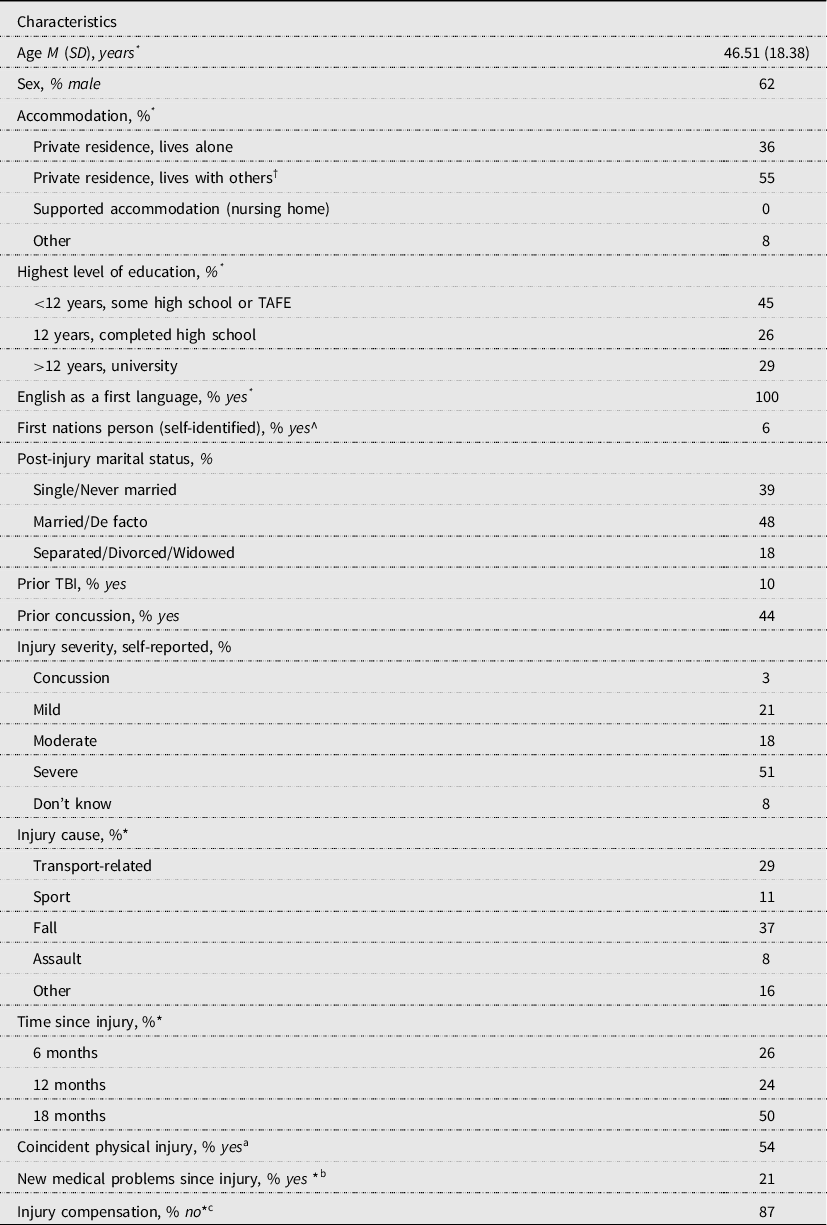
The thematic analysis of the remaining responses expressing unmet needs yielded five major themes. The following section discusses each theme and includes direct quotes from the participants. The demographic characteristics for these 39 participants are shown in Table 1. As Table 1 shows, the participants were typically middle-aged men (62%), with a history of moderate or severe TBI in the prior 12–18 months.
Participant Characteristics

TAFE = Technical and further education.
N = 39.
* n = 38.
^ n = 35.
† Private residence, lives with others = Living with parents, friends, or partner.
a ‘unsure’ (n = 1).
b ‘unsure’ (n = 2).
c vs ‘accepted liability’ (n = 2), ’settled’ (n = 1), or ‘other’ (n = 2).
Still symptomatic
Several participants nominated needs related to the management of ongoing symptoms. These comments raised issues around adjusting to, or struggling with, new physical and cognitive limits. For example, one participant wrote: ‘I need to recover as much as my body will let me. That is what I focus on everyday’ (Participant 16, severe TBI). Wishing for symptom reduction was important for the participants. Cognitive needs were also nominated in the open-ended responses. For example, these wishes were expressed as needing help to improve abilities such as memory or concentration. One person expressed the significance of this need by discussing it terms of the challenges faced with daily activities:
Finding something to eat, simple things, remembering what I have just said, etc. I just seem to have trouble performing the most mundane of tasks (some of) but have no problem with other things that seem to others to be complex i.e. writing this, driving, looking after myself (the best I can). I just forget to eat/cook mainly. That’s the main kickback. (Participant 1, severe TBI)
Yet another wrote: ‘I can’t smell food cooking and forget the stove is on, and [I] put timer on but can’t hear it’, (Participant 23, severe TBI).
Abandoned by health providers
Several participants described a sense of abandonment by health providers or services. Some participants indicated that after hospital discharge, they did not have adequate support, or information, or contact with health services. This was associated with feelings of fear and uncertainty about the future. People expressed feeling un- or under-prepared about what to expect post-discharge, and a sense of surprise and disappointment that there was no or insufficient health service follow-up. For example, one individual wrote:
I received no follow-up from any medical practitioner since being released from hospital. When I was released, I was told to pack my belongings and leave as the bed was needed. I live in [a] remote northwest…[area]…and was shown the door and left to fend for myself in the city. I was disoriented and didn’t know where I was, and without family and friends. (Participant 22, uncertain severity TBI)
Another person expressed a sense of having fallen ‘through the cracks’, and another wondered: ‘Is the support I am receiving going to continue or not?’ (Participant 26, moderate TBI).
Barred from independence
For some individuals, their major wish was to have perceived barriers removed that prevent them from doing everyday tasks and being independent. People expressed frustrations due to a lack of access to transport, employment, finances, and health care, and a sense that these barriers were imposed on them by others. For example, one person wrote: ‘I cannot yet drive… so am denied visits to shops and medical…’ (Participant 11, severe TBI). Another person wrote that they wished to be ‘permitted to have a break and get back on my feet’ (Participant 5, severe TBI), and another hoped to ‘..have full medical clearance to do anything that I wish to do e.g. driving…and return to work, etc.’ (Participant 27, severe TBI).
Loss of social wellbeing
Several individuals made comments about their own personal emotional needs and expressed a sense that it was vital for these to be met, especially by significant others. For example, one person wrote: ‘I live alone and what I want most is someone to talk to and hug everyday’, (Participant 25, mild TBI). Other people expressed the importance of ‘care’ and ‘assistance’ from family and loved ones. The risk of disconnection from this support was also evident in people’s comments about it as the ‘most important need’ (Participant 34, severe TBI), and in comments such as this one: ‘how much is my loving wife going to be able to give me support?’ (Participant 26, moderate TBI).
Misunderstood by society
Several people raised issues around stigma and negative societal reactions they experienced. In many cases, this was expressed as resulting in a feeling of a loss of dignity or respect. For example, one person wrote about a social service agency that they ‘don’t seem to understand what it means to have a TBI’ and this person wished for ‘no discrimination’ (Participant 5, severe TBI) and another wrote ‘just want other people to respect disability and not downgrade someone’ (Participant 17, severe TBI). When talking about the problems faced by the community of people who have had a brain injury, yet another person wrote: ‘…we have no social and emotional network of understanding and compassion’, and they wondered: ‘How are TBI survivors expected to survive the daily challenges while facing … ignorance of their head injuries?’ (Participant 37, moderate TBI).
Discussion
The service user perspective provides valuable insights into how models of care can be improved for people with TBI. This study found several areas of unmet need among people living with TBI in the community. Importantly, this study also identified several service user suggestions for improving the community support for people 6–18 months after hospital admission for TBI.
While some participants did not express wishes suggestive of unmet needs – a finding has been reported previously (Ylvisaker & Feeney, Reference Ylvisaker and Feeney2000) – several unmet needs were expressed by our study participants. These ranged from individual or personal needs to needs related to the social environment and health system operations (system-wide level needs). Five clear themes emerged. Three of these themes were considered ‘personal’ because they were framed as concerns about individual health and well-being. For example, people expressed wishes about: a) being symptom-free, and for more assistance to manage ongoing their own physical and cognitive difficulties; b) wanting emotional supports, and the potential risk of social disconnection (personal abandonment), and; c) being independent and able to self-manage instrumental and daily activities, including the removal of barriers. These themes resemble those identified in other studies; for example, the two themes that Mueller et al. (Reference Mueller, Wang, Brooks, Morant, Sullivan and Raymont2017) labelled: a desire for ‘human connectedness’, and ‘a lack of understanding among family and friends’ (p. 1865); and the theme that Conneeley (Reference Conneeley2012) labelled: ‘getting back to normal (sic)’. The findings are consistent with quantitative study results too. For example, Hennessy and Sullivan (under review) identified similar unmet personal needs, such as managing symptoms and functional tasks (financial, cognitive) and; improving psychological (stress and anger management) and social interactions (sports, recreation, relationships). The current study sheds further light on such needs, and why they matter to people. In order to meet such a wide range of personal needs, a co-ordinated user-focussed health service response would be needed, or a combination of formal services and informal supports could be considered.
Social and system-level changes are required to better meet the needs of people who have had a TBI. For example, people felt that social services were ill-prepared to provide appropriate support for people living with TBI, or that these services lacked understanding of the injury, and therefore could not meet their specific needs. This concern resembles the theme described by Mueller et al. (Reference Mueller, Wang, Brooks, Morant, Sullivan and Raymont2017) that, when dealing with people who have had a TBI, ‘financial and social support services lack expertise’ (p. 1865). This suggests a role for community or peer education about brain injury and how to support interactions that promote, rather than undermine, dignity (Stiekema, Winkens, Ponds, De Vugt, & Van Heugten, Reference Stiekema, Winkens, Ponds, De Vugt and Van Heugten2020). The idea that the general public and even health professionals may hold negative stereotypes about people who have had brain injury is not new (Fresson et al., Reference Fresson, Dardenne, Geurten and Meulemans2017; Linden & Crothers, Reference Linden and Crothers2006; McLellan et al., Reference McLellan, Bishop and McKinlay2010; Nochi, Reference Nochi1998; Slettebø, Caspari, Lohne, Aasgaard, & Nåden, Reference Slettebø, Caspari, Lohne, Aasgaard and Nåden2009). Several authors have also identified how such views can negatively impact the injured person’s experience when accessing services (Redpath et al., Reference Redpath, Williams, Hanna, Linden, Yates and Harris2010). The present study potentially shows how societal beliefs affect individuals, which includes them experiencing a loss of dignity, and feeling at-risk for discrimination. More efforts are needed to address these stereotypes so that people who have had a brain injury do not confront additional hurdles when seeking to access social and cognitive support services and going about their daily lives.
The need for health system reform is also strongly suggested by the participants’ comments. This includes improving discharge information, such as what symptoms individuals who have had a TBI can expect as they recover, and how and when to expect follow-up (continuity of care). This finding is consistent with prior research (e.g., Lefebvre et al., Reference Lefebvre, Pelchat, Swaine, Gélinas and Levert2005; Minney, Roberts, Mathias, Raftos, & Kochar, Reference Minney, Roberts, Mathias, Raftos and Kochar2019; Rotondi et al., Reference Rotondi, Sinkule, Balzer, Harris and Moldovan2007; Stiekema et al., Reference Stiekema, Winkens, Ponds, De Vugt and Van Heugten2020), including studies that have reported that TBI patients and carers wanted community services ‘to look further ahead’ with their planning (Abrahamson et al., Reference Abrahamson, Jensen, Springett and Sakel2017, p.1683) and provide ‘more information and education through the continuum of care’ (Mueller et al., Reference Mueller, Wang, Brooks, Morant, Sullivan and Raymont2017, p.1865). If no follow-up is planned, this intention should be explained to people, including why a follow-up by acute health providers is not required. This would enable proactive individuals to make their own arrangements, should they desire community assistance, or post-acute medical review (Fadyl et al., Reference Fadyl, Theadom, Channon and McPherson2019; Stiekema et al., Reference Stiekema, Winkens, Ponds, De Vugt and Van Heugten2020). Such people could also be offered a ‘post-discharge support session’ as has been suggested by Mueller et al. (Reference Mueller, Wang, Brooks, Morant, Sullivan and Raymont2017, p.1866) and others (Stiekema et al., Reference Stiekema, Winkens, Ponds, De Vugt and Van Heugten2020), as a potential solution to the perceived gap in current processes.
The participants’ comments also indicated that health services could do more to mitigate a sense of service discontinuity. While there were several positive comments about the quality of the health care received, it was clear that people hoped for change, particularly around care transitions and community supports, and they did not want to feel abandoned. In addition to providing better information about what to expect during recovery, the participants reported that the discharge experience was rushed or did not adequately support to their transition to community living. Given that similar findings have been reported previously (e.g., Mueller et al., Reference Mueller, Wang, Brooks, Morant, Sullivan and Raymont2017; Stiekema et al., Reference Stiekema, Winkens, Ponds, De Vugt and Van Heugten2020), this impression could be one that is widespread. A recent systematic review of the findings from 24 randomised controlled trials showed that there is significant value in providing individualised discharge plans for people, including to prevent hospital readmission (Shepperd et al., Reference Shepperd, Lannin, Clemson, McCluskey, Cameron and Barras2013). Evidently, people who have required treatment for brain injury feel that there are several ways in which hospital discharge and other transitional care processes could be improved.
This study has several limitations. First, while the findings suggest that there are gaps in services and their delivery for people with TBI, these gaps may be perceived rather than actual. The study design does not permit verification of people’s claims and if they are inaccurate, this could indicate that service changes are not needed. Related, because of their TBI, some participants may have struggled to communicate or recall or reflect on their experiences and needs (Paterson & Scott-Findlay, Reference Paterson and Scott-Findlay2002), and this may have led to bias. For example, the postal survey would likely exclude people who have significant, ongoing TBI-related cognitive and executive impairments, and this methodology could have reduced the RR or biased the findings towards the views of those with other injury-related challenges. The survey did not follow individuals up beyond 18 months post-injury, and the results are for a sample who were responding at different timepoints post-injury. Together, this means that the findings may not reflect views of the TBI population, and some perspectives may have been missed. Despite this limitation, the survey still captures some important perceptions of people with TBI that are relevant to service improvement.
Other study limitations include that some findings likely reflect the organisational arrangements of the health services encountered by the participants at the time that the survey was performed. Globally, the nature and availability of support services for people with TBI is highly variable and evolving. For example, public outpatient services were not routinely available to all TBI patients in this study, whereas this may be the case elsewhere in Australia, or it could become available in Queensland (Queensland Health, 2016). Similarly, this data was collected before Queensland’s rollout of a new funding scheme for people living with disability (the National Disability Insurance Scheme; Queensland Health, n.d.), which may have changed the nature and availability of the support available to people post-TBI. A third limitation is that the comments made by the participants might have been influenced by the ‘wish basket’ positioning at the end of a questionnaire where some people might have viewed it as optional, or the method might not have generated sufficiently ‘rich’ data for the analysis (Liamputtong, Reference Liamputtong2013). It is possible that other themes would have emerged or more wishes been expressed had the question appeared earlier in the survey or if a different method was used (e.g., interviews). These factors should also be borne in mind when interpreting the results.
In conclusion, this study has shown that 6–18 months after a mild to severe TBI people discharged from hospital to the community have unmet personal, social, and system-level needs. The views of people who have received such care should be integrated into future health system planning within a recovery-oriented framework that includes service user participation as a fundamental tenet of service delivery. At a minimum, the findings should spur further investigation of the proposed changes, including revised discharge processes to address feelings of abandonment, increased multidisciplinary support to meet ongoing personal needs (emotional, instrumental, and physical), and; public and service provider education to combat negative TBI stereotypes and promote dignity in interactions.
Acknowledgements
The authors acknowledge the contribution of the following individuals: Ms Danni Gifford who assisted with the initial survey data collection; Ms Michelle Costa who was responsible for the completion of the survey and completed the initial qualitative coding; and Ms Therese Hennessy-Batje for her feedback on the qualitative methodology. The authors also acknowledge the following partner organisations: the Townsville Health Service District, Queensland Health; the School of Psychology, James Cook University Singapore, and the Queensland University of Technology. Parts of this study were previously presented at the 2014 Australasian Society for the Study of Brain Injury (ASSBI) meeting.
Financial support
This research received no specific grant from any funding agency, commercial, or not-for-profit sectors.
Conflicts of interest
Maria Jeannette Hennessy has no conflicts of interest to disclose. Karen A. Sullivan has no conflicts of interest to disclose.
Ethical standards
The authors assert that all procedures contributing to this work comply with the ethical standards of the relevant national and institutional committees on human experimentation and with the Helsinki Declaration of 1975, as revised in 2008.