I. INTRODUCTION
Traditional antenna system design and optimization methods begin by assuming a fixed value for the feed system characteristic impedance or radio frequency source internal impedance Z 0, but doing so automatically excludes all matching networks and antennas whose performance is better with a different value of Z 0. Variable Z 0 addresses this limitation by making Z 0 a true variable quantity whose value is determined by the design or optimization methodology. Variable Z 0 produces better networks and antennas by introducing another degree of freedom into the design or optimization space, thereby making it easier to meet any set of performance objectives. As examples of Variable Z 0's effectiveness, this paper describes a multi-stub matching network (MSMN) designed using biogeography-based optimization (BBO) and an ultra wideband (UWB) meander monopole antenna (MMA) optimized using central force optimization (CFO).
Matching networks are important in all communication systems because they maximize power delivered to the load, improve signal-to-noise ratio (SNR), and reduce the amplitude and phase errors in power distribution networks by minimizing the reflection coefficient [Reference Pozar1]. An extremely low voltage standing wave ratio (VSWR) often is a requirement in broadcast applications, sometimes ≤1.05:1, where even slight amplitude and phase errors result in loss of signal fidelity. To that end, the MSMN is a commonly employed matching device usually designed using the Smith chart or an analytical solution to determine the stubs’ lengths and positions [Reference Pozar1]. Unfortunately, as the number of stubs increases, so does the complexity of this process, and at some point it becomes unwieldy. An alternative approach is to use optimization techniques that minimize the reflection coefficient in a specific frequency range [Reference Ulker2, Reference Deniz and Ulker3].
BBO is a newly proposed global optimization evolutionary algorithm (EA) [Reference Simon4] based on the science of biogeography (study of the natural geographic distribution of plants and animals). BBO has been demonstrated to be an effective optimization technique compared to other methodologies [Reference Simon4–Reference Simon, Rarick, Ergezer and Du6]. It has been successfully applied across a range of engineering problems, for example: optimal power flow [Reference Roy, Ghoshal and Thakur7, Reference Bhattacharya and Chattopadhyay8]; optimal Yagi–Uda antenna design [Reference Singh, Singla and Kamal9]; optimization of linear and circular antenna arrays [Reference Sharaqa and Dib10–Reference Singh and Kamal13]; and calculation of the resonant frequencies of rectangular and circular microstrip patch antennas [Reference Lohokare, Pattnaik, Devi, Panigrahi, Bakwad and Joshi14, Reference Lohokare, Pattnaik, Devi, Bakwad and Joshi15]. BBO's robustness and effectiveness against complex problems have been further improved by hybridizing BBO with other optimization techniques, thereby taking advantage of the best features of both algorithms [Reference Gong, Cai and Ling16, Reference Kundra and Sood17].
The first optimization problem considered in this paper is the design of an optimized MSMN comprising stubs placed at specific distances from the load [Reference Regoli18, Reference Moreno, Vazquez and Baneira-Gomez19], the design variables being the stubs’ locations and the lengths. BBO with fixed and Variable Z 0 is used to determine these values by minimizing the reflection coefficient in a specific frequency range. A multi-stub configuration is optimized, which is a significant extension of previously published work that considered only single- and double-stub configurations [Reference Ulker2, Reference Deniz and Ulker3].
With respect to the MSMN design, the objectives are twofold: demonstrating BBO's effectiveness as a design tool; and comparing BBO results using fixed and Variable Z 0 with results available in the literature. It should be emphasized that Variable Z 0 concept has not been applied to MSMN design previously. BBO with Variable Z 0 achieves almost exactly the desired VSWR response, whereas BBO (or other methods) with fixed Z 0 does not perform nearly as well. A similar approach is taken with respect to the MMA. The MMA is optimized for impedance bandwidth (IBW) using CFO using both fixed and Variable Z 0 [Reference Formato20]. The MMA example again demonstrates that Variable Z 0 provides much better results than the fixed Z0 case.
This paper is organized as follows: Section 2 presents the MSMN problem. In the same section, the BBO technique is briefly described (detailed information is available in the above-cited references with basic BBO Matlab code available in [21]), and two examples are presented. Section 3 describes the MMA design problem. Section 4 is the conclusion.
II. MULTI-STUB MATCHING NETWORK
In this section, Variable Z 0 is applied to a BBO-optimized MSMN. The obtained results are compared to optimization results for the MSMN using BBO along with the standard approach of fixing Z 0. The Variable Z 0 MSMN exhibits much better performance.
A) Optimization methodology
BBO is a metaphor drawn from the science of biogeography, which studies nature's geographical distribution of plants and animals. Mathematical biogeography models are based on the metaphor of extinction and migration of species between neighboring islands. An “island” is any habitat (area) that is geographically isolated from other habitats. Islands that are more suitable for habitation have a high “habitat suitability index” (HSI), which is treated as a dependent variable because it correlates with many factors such as rainfall, temperature, diversity of vegetation and topography, and so on. Another important BBO variable is the “suitability index variable” (SIV), which generally characterizes an island's habitability and is treated as an independent variable. The BBO algorithm consists of three steps: (1) creating a set of solutions to the problem, where they are randomly selected, and then applying (2) migration and (3) mutation steps to reach the optimal solution.
BBO is applied to global search and optimization by starting with a random population of candidate solutions represented by an array of integers as follows:
 $$Habitat=\left[{SIV_1\comma \; \; SIV_2\comma \; SIV_3\comma \; {\rm \ldots }\comma \; SIV_N } \right].$$
Each integer represents an independent suitability index variable (SIV), while the value of the BBO fitness function is the dependent variable habitat suitability index (HSI). HSI and SIV therefore are related by:
 $$\eqalign{fitness\left({Habitat} \right)&=HSI \cr & =f\left({SIV_1\comma \; \; SIV_2\comma \; SIV_3\comma \; {\rm \ldots }\comma \; SIV_N } \right).}$$
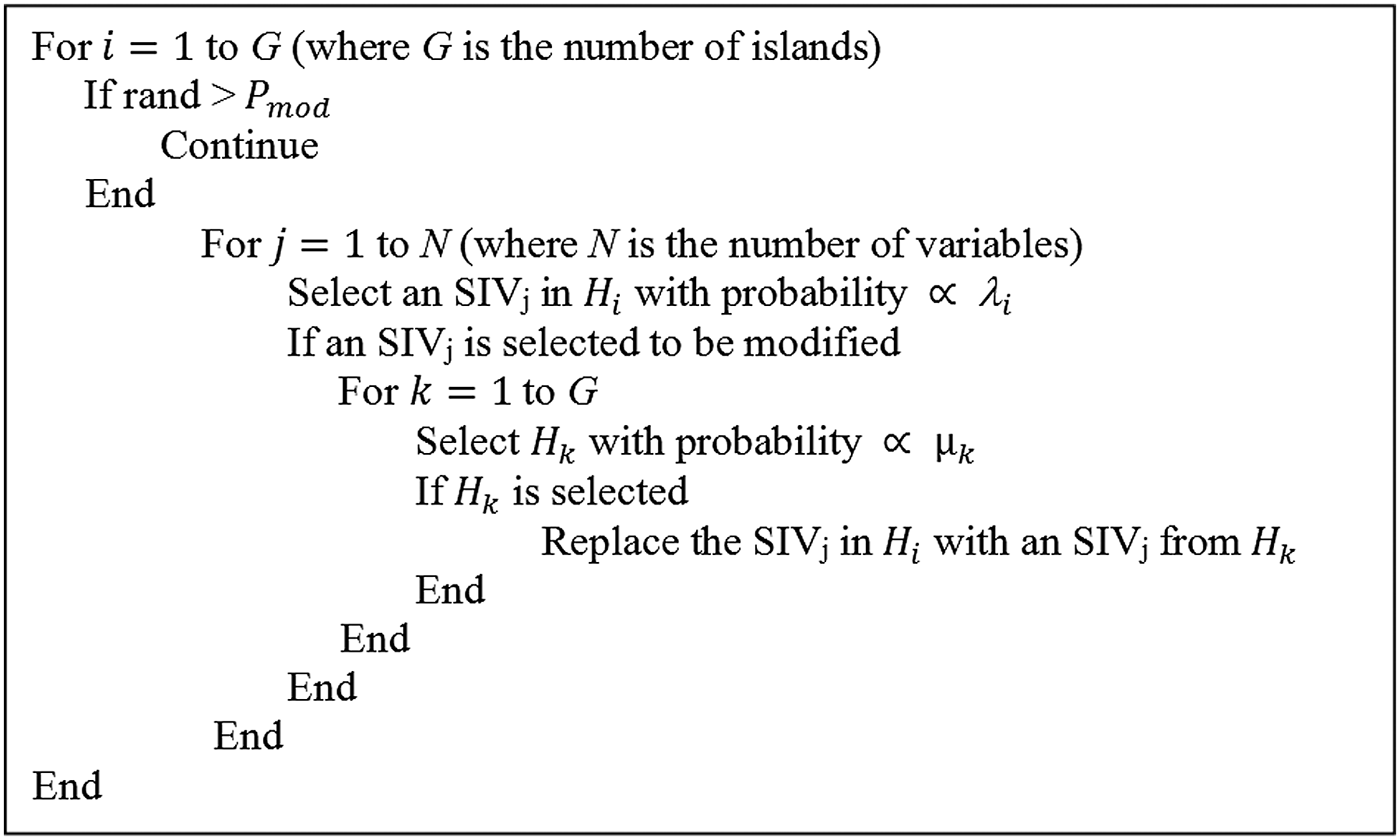
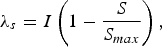
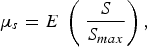
In the second step, the migration step, equations (3) and (4) are used to evaluate the immigration rate (λ) and the emigration rate (μ) of each solution, respectively, which are shown in Fig. 1, and which are used to probabilistically share information between habitats with probability P mod (P mod known as the “habitat modification probability”).
 $$\lambda _s=I\left({1 - \displaystyle{S \over {S_{max} }}} \right)\comma \;$$
 $$\mu _s=E\; \left({\; \displaystyle{S \over {S_{max} }}} \right)\comma \;$$
where S is the number of species in the habitat; S max the maximum possible number of species; and I and E, respectively, the maximum possible immigration and emigration rates. It is assumed that all solutions have identical rate curves with E = I = 1, which normalizes λ and μ to the interval [0, 1] (no net change in number of species in an island, only movement between islands). The pseudocode in Fig. 2 summarizes BBO's migration process.
Species model of a single BBO habitat.

Pseudocode for BBO Migration Operator.
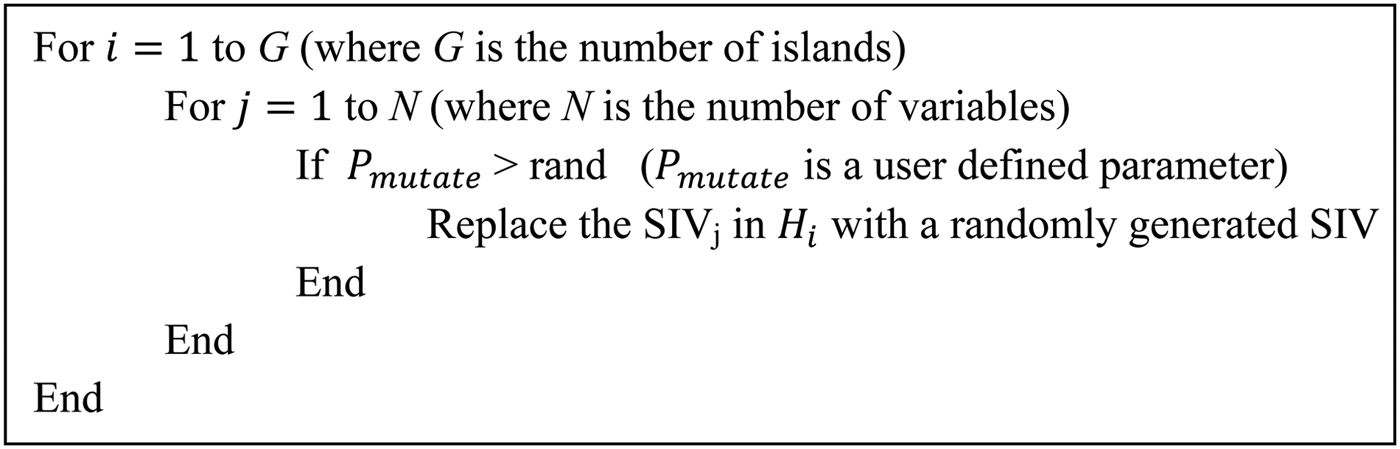
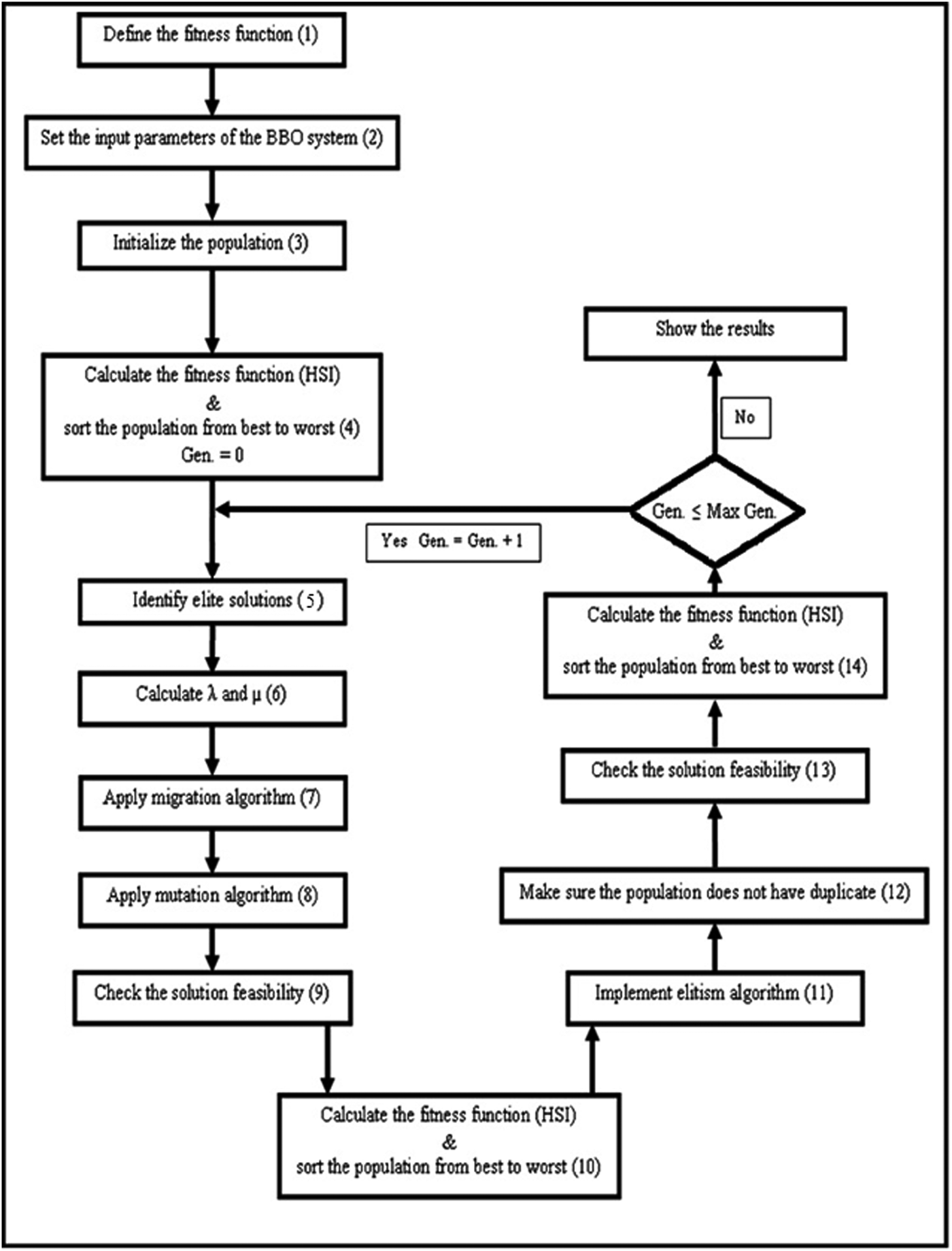
Finally, the mutation step tends to increase the diversity among the population and gives the solutions the chance to improve themselves by achieving better fitness. Performing mutation on a solution is done by replacing it with a new solution that is randomly generated. Figure 3 shows the pseudocode for the mutation process, whereas Fig. 4 shows a flow chart of the main steps of the BBO.
Pseudocode for BBO Mutation Operator.
Flowchart of the main steps of the BBO algorithm.
B) Formulation of the MSMN problem
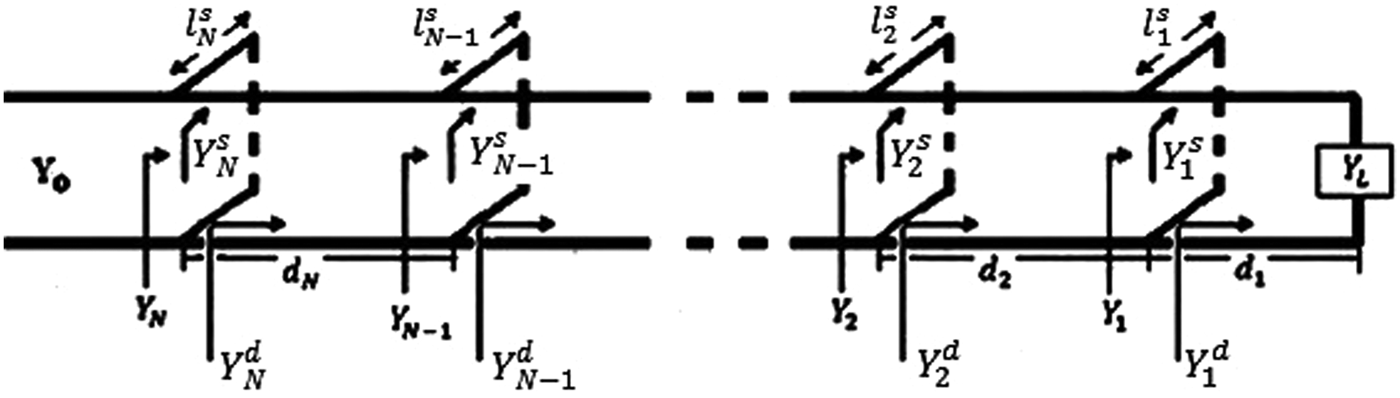
Figure 5 is a schematic representation showing an N-parallel (shunt) MSMN that matches an arbitrary load impedance Z L to a transmission line with characteristic impedance Z 0 (impedances and admittances being related as Z L = 1/(Y L) and Z 0 = 1/(Y 0)). In addition to their positions and lengths, the stubs can be either open-circuited or short-circuited at their ends. In a perfectly matched system, the total input impedance Z N (shown in Fig. 5) is equal to Z 0 resulting in no reflected power. Thus, the design objective is to determine the stub locations, lengths, and terminations that best achieve this matching condition.
General N parallel stubs connection.
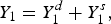
The first step is developing an expression for the total input admittance connected to the transmission line, which may be done recursively as follows [Reference Regoli18]:
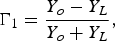
For the first stub (n = 1),
 $$Y_1=Y_1^d+Y_1^s\comma \;$$
 $$Y_1^d=Y_O \; \displaystyle{{1 - \; \Gamma _1 \; {\rm exp}\lpar \!\!-\! 2\; \gamma \; d_1 \rpar } \over {1+\; \Gamma _1 \; {\rm exp}\lpar \!\!-\! 2\; \gamma \; d_1 \rpar }}\comma \;$$
 $$\Gamma _1=\displaystyle{{Y_o - Y_L } \over {Y_o+Y_L }}\comma \;$$
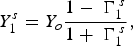 $$Y_1^s=Y_o \displaystyle{{1 - \; \Gamma _1^{\; s} } \over {1+\; \Gamma _1^{\; s} }}\comma \;$$
where Γis is the reflection coefficient at the ith stub (see below).
For the nth (n = 2, …, N − 1) stub,
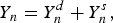 $$Y_n=Y_n^d+Y_n^s\comma \;$$
 $$Y_n^d=Y_O \; \displaystyle{{1 - \; \Gamma _n \; {\rm exp}\lpar \!\!-\! 2\; \gamma \; d_n \rpar } \over {1+\; \Gamma _n \; {\rm exp}\lpar \!\!-\! 2\; \gamma \; d_n \rpar }}\comma \;$$
 $$\Gamma _n=\displaystyle{{Y_o - Y_{n - 1} } \over {Y_o+Y_{n - 1} }}\comma \;$$
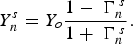 $$Y_n^s=Y_o \displaystyle{{1 - \; \Gamma _n^{\; s} } \over {1+\; \Gamma _n^{\; s} }}.$$
Furthermore, for the last stub (n = N),
 $$Y_N=Y_N^d+Y_N^s\comma \;$$
 $$Y_N^d=Y_O \; \displaystyle{{1 - \; \Gamma _N \; {\rm exp}\lpar \!\!-\! 2\; \gamma \; d_N \rpar } \over {1+\; \Gamma _N \; {\rm exp}\lpar \!\!-\! 2\; \gamma \; d_N \rpar }}\comma \;$$
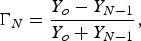 $$\Gamma _N=\displaystyle{{Y_o - Y_{N - 1} } \over {Y_o+Y_{N - 1} }}\comma \;$$
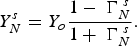 $$Y_N^s=Y_o \displaystyle{{1 - \; \Gamma _N^{\; s} } \over {1+\; \Gamma _N^{\; s} }}.$$
In the above equations, Γns depends on the type of the stub as follows:
 $$\eqalign{&\Gamma _n^{\; s}=- \exp \left({ \!- 2\gamma l_n^s } \right)\comma \; \quad n=1\comma \; 2\comma \; \; \ldots\comma \; \; N\comma \; \cr & \quad \hbox{if the stub is terminated in a short circuit}\comma}$$
 $$\eqalign{& \Gamma _n^{\; s}={\rm exp}\lpar \!\!-\! 2\gamma l_n^s \rpar \comma \; \quad \; n=1\comma \; 2\comma \; \; \ldots\comma \; \; N\comma \; \cr & \quad \hbox{if the stub is terminated in an open circuit}.}$$
The transmission line's propagation and phase constants, respectively, are
 $$\gamma=\alpha+j\beta\comma \;$$
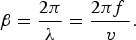 $$\beta=\displaystyle{{2\pi } \over \lambda }=\displaystyle{{2\pi f\; } \over v}.$$
Summarizing the notation, Y L is the load admittance, Y o the transmission lines’ characteristic admittance, Y n the admittance just to the left of the nth stub, Y nd the admittance just to the right of the nth stub, and Y ns the stub input admittance. Γn is the reflection coefficient between the characteristic admittance (Y o) and the admittance Y n−1, and Γns is the stub reflection coefficient. d n is the distance between nth and (n − 1)th stubs, and l ns is the stub length. γ is the propagation constant, α being the attenuation constant, β the phase constant, λ the wavelength, ν the phase velocity, and f the frequency, all in consistent units. As shown above, the last calculated input admittance is Y N which is obtained by recursively computing the admittances starting from Y 1 to Y N−1.
The final result is the overall input reflection coefficient between the total input admittance and the characteristic admittance of the feeding line, which is given by
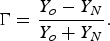 $$\Gamma=\displaystyle{{Y_o - Y_N } \over {Y_o+Y_N }}.$$
The optimal match between the load impedance Z L fed by a transmission line with characteristic impedance Z 0 is achieved by minimizing Γ in equation (21). This will be accomplished using BBO as described in the next section. Note that the optimization problem is simplified somewhat by assuming that all components are lossless, and that all stubs are either short-circuited or open-circuited, so that the optimization (decision space) parameters are only the distances between the stubs and their lengths (d n, l ns) which are assumed here to be in the range (1 mm, 100 mm).
C) Examples
The matching networks that consist of a single stub or double stubs are designed to operate at a single frequency, not over a band of frequencies [Reference Pozar1]. But many modern communication applications require a wide bandwidth to improve transmission quality and data rate. Consequently, in the MSMN examples presented here, three, five and seven short-circuited stub configurations are optimized to obtain as nearly as possible a desired standing wave ratio (SWR) in a specific frequency range. The same problem addressed in [Reference Regoli18] is considered here, so that results can be compared directly. Following [Reference Regoli18], SWR and the fitness function to be minimized by BBO are defined as:
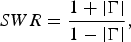 $$SWR=\displaystyle{{1+\left\vert \Gamma \right\vert } \over {1 - \left\vert \Gamma \right\vert }}\comma \;$$
 $$fitness=\mathop \sum \nolimits\lpar \Gamma \lpar f\rpar - \Gamma _d \lpar f\rpar \rpar ^2\comma \;$$
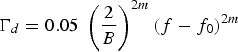 $$\Gamma _d=0.05\; \left({\displaystyle{2 \over B}} \right)^{2m} \lpar f - f_0 \rpar ^{2m}$$
subject to f = [1.1 GHz, 1.3 GHz] with 0.05 GHz increment.
The reflection coefficient Γ appears in equation (21). Γd is the desired reflection coefficient; B the bandwidth (here 0.2 GHz); f 0 is the band's center frequency; and exponent m is a parameter that has been set to unity following [Reference Regoli18]. The load impedance Z L = 150 − j60 Ω is the same value used in [Reference Regoli18] (note that Z L is assumed to be constant because the frequency range is relatively small). Two cases are considered: (a) optimization with fixed characteristic impedance Z 0 = 50 Ω; and (b) optimization with Variable Z 0 as described in [Reference Formato20]. In Variable Z 0 methodology, instead of fixing a value forZ 0, the feed system characteristic impedance (or the source internal impedance if there is no feed system) is considered as a variable quantity whose value is determined by the optimization methodology, which in this case is BBO (although any design or optimization methodology may be used because Variable Z 0 is not in any way methodology-specific).
Tables 1 and 2, respectively, summarize the BBO-optimized MSMN results for the fixed and Variable Z 0 cases. The corresponding SWR plots appear in Figs 6 and 7. The best design values provide SWR close to the desired SWR curve, which minimizes the fitness function. Figure 6 also includes the results presented in [Reference Regoli18] that were computed using Nelder–Mead (NM) optimization method. The BBO curve is closer to the desired SWR than the NM curve, thus demonstrating BBO's effectiveness in solving the MSMN problem.
Standing wave ratio versus frequency for fixed Z 0.
Standing wave ratio versus frequency for variable Z 0.
BBO-optimized MSMN with fixed Z 0.
BBO-optimized MSMN with Variable Z 0.
Turning to Fig. 7, it is apparent that Variable Z 0 markedly outperforms fixed Z 0 for all stub configurations. Using Variable Z 0 achieves almost exactly the desired response. In addition, only three stubs are required to get very close to the desired response, whereas using seven stubs with fixed Z 0 gives in an inferior SWR. Of course, the tradeoff in using Variable Z 0 is that the feed system impedance is not the “standard” value of 50Ω. But, as a practical matter for the MSMN, any impedance that is appropriate from a fabrication perspective is acceptable, and typical values range from 20 to 150 Ω. In this example, Variable Z 0's optimized impedance values ranged from 128 to 143 Ω as shown in Table 2. Variable Z 0 is an attractive new concept that holds out the possibility of considerably better performance played against a non-standard feed system impedance. Whether or not that tradeoff is desirable is case specific, but it always merits consideration because the end result very well may be much better.
As another example, four and six stub MSMN configurations are BBO-optimized using fixed and Variable Z 0. In this case, the load is chosen to be Z L = 100 − j80 Ω (a value used as an example in [Reference Pozar1]). The optimized stub parameters appear in Tables 3 and 4 for the fixed and Variable Z 0 cases, respectively, with the corresponding SWR plotted in Figs 8 and 9. As before, the SWR improvement using Variable Z 0 is dramatic. Much better SWR performance is obtained with Variable Z 0 for both the four and six stub cases, and the optimized impedances are quite reasonable at 122 and 131.44 Ω, respectively.
BBO-optimized 4 and 6 stub MSMN using fixed Z 0.
BBO-optimized 4 and 6 stub MSMN using Variable Z 0.
II. UWB MEANDER MONOPOLE
In this section, Variable Z 0 is applied to a CFO-optimized MMA. These results are compared to optimization results for the MMA using CFO and the standard approach of fixing Z 0. The Variable Z 0 MMA exhibits much better performance.
A) Optimization methodology
CFO is a deterministic optimization algorithm that has been applied to a variety of antenna problems as well as recognized benchmark functions [Reference Formato22–Reference Formato28]. As an example of applying Variable Z 0 to a simple antenna optimization problem, CFO/Variable Z 0 was applied to the design of a MMA on a PEC (perfectly electrically conducting) ground plane. Other examples employing Yagis and loaded bowties appear in [Reference Formato20, Reference Formato29, Reference Formato30, Reference Formato31], which also discuss Variable Z 0 in greater detail.
One of the major advantages of a deterministic algorithm is that it always returns the same result with the same setup parameters. This attribute makes optimizing an antenna much easier, because changes in antenna performance cannot be the result of the optimizer's inherent randomness (for example, a Genetic Algorithm or Particle Swarm Optimization, both of which are stochastic). Determinism is especially important in defining the “fitness function” against which the antenna is optimized (see [Reference Formato32] for a discussion of this question).
B) MMA fitness function
The general objective of the MMA optimization is maximum IBW with good gain without regard to the detailed radiation pattern. The MMA fitness function therefore was chosen to be the weighted gain-VSWR quotient defined as
 $$F=\sum\limits_{i=1}^N {\displaystyle{{w_g \lpar f_i \rpar \cdot G_{\max } \lpar f_i \rpar } \over {w_{VSWR} \lpar f_i \rpar \cdot VSWR//Z_0 \lpar f_i \rpar }}}\comma \;$$
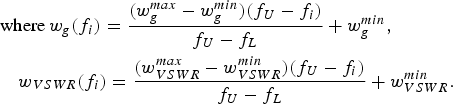 $$\eqalign{&{\rm where}\, w_g \lpar f_i \rpar =\displaystyle{{\lpar w_g^{max} - w_g^{min} \rpar \lpar f_U - f_i \rpar } \over {f_U - f_L }}+w_g^{min}\comma \; \cr & \quad w_{VSWR} \lpar f_i \rpar =\displaystyle{{\lpar w_{VSWR}^{max} - w_{VSWR}^{min} \rpar \lpar f_U - f_i \rpar } \over {f_U - f_L }}+w_{VSWR}^{min}.}$$
The MMA fitness was evaluated at N equally spaced frequencies between lower and upper frequency limits f L and f U. The antenna's performance was evaluated using the Numerical Electromagnetics Code Ver. 4.2 [Reference Burke33–Reference Burke and Poggio35]. Total power gain (same as directivity in this case) was computed in NEC's standard spherical polar coordinates at 10° increments in the polar angle θ for two values of the azimuth angle ϕ, broadside (ϕ = 0°) and endfire (ϕ = 90°) to the MMA (see Fig. 10 for geometry). G max is the maximum gain over these angles. VSWR//Z 0 is the voltage SWR relative to the feed system characteristic impedance Z 0.
Standing wave ratio versus frequency for fixed Z 0.
Standing wave ratio versus frequency for variable Z 0.
(a) Var Z 0 MMA Geometry (axis 0.05 m). (b) Fixed Z 0 MMA Geometry (axis 0.05 m).
The MMA gain-VSWR quotient contains frequency-dependent weighting coefficients w g for gain and w VSWR for VSWR. Each of these coefficients decreases linearly with increasing frequency. Of course, the antenna designer is free to choose any form for the fitness function, and changing its form changes the design or, in the case of optimization, the decision space's topology, so that the antenna(s) meeting the performance objectives or doing so optimally will be different in the different landscapes. In the MMA example, the fitness function was chosen empirically for its simplicity, as were the linearly tapered weights.
C) Deterministic algorithms and Variable Z 0
Variable Z 0 is particularly useful when used in conjunction with deterministic design or optimization algorithms. The concept underlying Variable Z 0 is extraordinarily simple, and it is rather surprising that it has been overlooked through decades of network and antenna design and optimization. All the usual approaches start with an assumed value for Z 0 (even if multiple procedures are employed using different parametric values). But, fixing Z 0 inevitably makes it more difficult to meet the specific network or antenna performance goals because that very assumption automatically excludes every better design obtained with some other value of Z 0.
An antenna's performance is determined by its current distribution, which, in turn, determines its input impedance. The objective therefore is discovering an antenna structure whose current distribution meets minimum user-specified performance goals (design) or best meets them (optimization). The current distribution that meets this objective is entirely independent of the feed system characteristic impedance. By constraining a design or optimization methodology to produce only current distributions that are matched to Z 0 to the degree possible eliminates all other distributions that do a better job of meeting the performance goals. By contrast, allowing Z 0 to “float” as a true variable quantity places no constraint on allowable current distributions. Once an acceptable distribution or the optimal distribution is discovered, the value of Z 0 is determined automatically by the distribution.
Variable Z 0 technology can be applied to any antenna or network design problem against any fitness function or set of performance goals (although Variable Z 0 may be especially useful for improving antenna IBW). Variable Z 0 moreover is a “product by process” approach that can be used in conjunction with any design or optimization methodology, deterministic ones like CFO; stochastic algorithms such as Particle Swarm, Ant Colony, Group Search Optimization, Differential Evolution, or Genetic Algorithm; analytic approaches such as extended Wu–King impedance loading [Reference Formato26]; even “seat of the pants” design or optimization based on experience, intuition, or a “best guess.” The specific design or optimization methodology is entirely irrelevant to the novelty and utility of treating Z 0 as a design variable instead of a fixed parameter.
D) MMA geometry
Variable Z 0's effectiveness is demonstrated by CFO-optimizing the MMA with and without Variable Z 0. The Variable Z 0 run allowed variable 25 ≤ Z 0 ≤ 500 Ω, while for the fixed Z 0 run Z 0 = 50 Ω. The antenna was optimized between 2 and 12 GHz with a height constraint of a λ/4 at 2 GHz and maximum width λ/2. Perspective views of the optimized MMA geometries visualized using 4NEC2 [36] appear in Fig. 10. The corresponding NEC input files defining these geometries appear in Fig. 11. The two antennas are quite different, yet the only difference in the optimization setup is allowing Z 0 to vary in one case, while it was fixed in the other. All CFO parameters were otherwise the same.
(a) Var Z 0 MM NEC File. (b) Fixed Z 0 MMA NEC File.
The value of Z 0 determined to be optimum by CFO is Z 0 = 263.91 Ω. Of course, feeding this MMA from a Z 0 = 50 Ω feed, which is the most common feed system characteristic impedance, requires a ~5:1 broadband transformer or matching network. Low-loss UWB matching systems are readily available, so that implementing this MMA should be straightforward. But, if it happens that the optimized value of Z 0 is unacceptably high or low, then Variable Z 0 still can be used simply by restricting Z 0's range to acceptable values.
The effect of Variable Z 0 methodology is evident in the NEC4.2-computed MMA data. The two parameters of interest, VSWR and maximum gain, are plotted in Figs 12 and 13, respectively. Variable Z 0 performance is plotted in red, while the fixed Z 0 curve is black. The Variable Z 0 MMA is obviously superior to its fixed Z 0 counterpart, especially with respect to VSWR, which is much lower and flatter across the entire UWB spectrum (3.1–10.6 GHz). Similarly, the maximum gain is generally higher at most frequencies, and the minima generally are no lower than the fixed Z 0 antenna's.
Meander monopole VSWR
Meander monopole Max Gain
IV. CONCLUSIONS
In this paper, proprietary Variable Z 0 technology [Reference Formato31] was employed with the new evolutionary optimization technique BBO to design a MSMN against an optimized reflection coefficient and with CFO to design an optimized MMA. Optimized MSMN stub lengths and positions were determined for a microwave circuit by minimizing the reflection coefficient, and results were compared to published data. The networks were optimized against a desired standing wave ratio profile over a range of frequencies. BBO was used in two cases: fixed Z 0 and Variable Z 0. A substantial improvement in MSMN performance was obtained using Variable Z 0 methodology, which appears to have a wide range of applicability for network and antenna design and optimization. BBO has been shown to be an effective optimization methodology, especially when combined with Variable Z 0, and future work will apply this technique to various other types of antennas. Of particular interest could be segmented wire wideband monopole antennas [Reference Altshuler37].
Variable Z 0 has been shown to be a simple and effective methodology for creating networks and antennas designed or optimized against any set of performance objectives. Its use is straightforward, and it is universally applicable regardless of the design or optimization methodology being used. Variable Z 0 is a proprietary [Reference Formato31] technology, and Variable Z 0, Var Z 0, VZ 0, and “Variable Z 0Inside” are trademarks and service marks of Variable Z0, Ltd., P.O. Box 1714, Harwich, MA 02645, USA.
ACKNOWLEDGEMENT
Part of this work was supported by the Deanship of Research at Jordan University of Science and Technology (JUST).
 Nihad I. Dib obtained his B.Sc. and M.Sc. degrees in Electrical Engineering from Kuwait University in 1985 and 1987, respectively. He obtained his Ph.D. degree in EE (major in Electromagnetics) in 1992 from University of Michigan, Ann Arbor. Then, he worked as an assistant research scientist in the Radiation Laboratory at the same school. In September 1995, he joined the EE Department at Jordan University of Science and Technology (JUST) as an assistant professor, and became a full professor in August 2006. His research interests are in computational electromagnetics, antennas, and modeling of planar microwave circuits.
 Ashraf Hamdan Sharaqa received his B.Sc. degree in Electrical Engineering from Birzeit University (BZU), Birzeit, Palestine in 2009. In 2010, he joined the Master program in the Electrical Engineering Department at Jordan University of Science and Technology (JUST) majoring in Wireless Communications and he worked as teacher and research assistant at the same school. He received the M.Sc. degree in 2012. In October 2012, he joined the Communication and Security Projects Division at WorleyParsons Arabia Ltd., Saudi Arabia, as a radio engineer. His research interests include the analysis and design of antennas and microwave circuits, optimization algorithms and their application in electromagnetics, and wireless communications.
 Richard A. Formato is a Consulting Engineer and Registered Patent Attorney. He received his JD from Suffolk University Law School, Ph.D. and M.S. degrees from the University of Connecticut, and M.S.E.E. and B.S. (Physics) degrees from Worcester Polytechnic Institute. In the early 1990s, he began applying genetic algorithms to antenna design and developed YGO3 freeware (Yagi Genetic Optimizer). His interest in optimization algorithms led to the development of Central Force Optimization and Dynamic Threshold Optimization. Variable Z 0 antenna technology was invented in a true “aha” moment when he realized that an antenna's feed system impedance should be treated as a true optimization variable, not as a fixed parameter.