

The conditions for workplace discourse have been influenced by a series of changes taking place in recent decades. Globalization and technological advances have led to new challenges for workers and managers. Throughout the world, we find transnational companies and organizations that use English, or another global language, as their corporate language and employ multilingual people who can move between jobs, between branches, and between countries. The workforce mobility and diversity that characterize a globalized economy require organizations and workplaces to address language and culture in recruitment and communication policies and practices. Technological advances have facilitated a globalization of working life and also changed linguistic practices at work. In today's economy it is not only managers and elite staff who need to be linguistically flexible. Factory floor workers come in contact with different languages during their workday. They have to be prepared to interact with group leaders and fellow workers with a different linguistic background than they have themselves.
In the globalized economy, technological advances have led to new types of work-related networks and also to new types of workplaces. Computer-mediated genres such as email, chat, and fax have facilitated written correspondence in global organizations, and the use of video technique and telephone have facilitated meetings and negotiations at a distance (e.g., Bargiela-Chiappini & Harris, Reference Bargiela-Chiappini and Harris1997; Gunnarsson, Reference Gunnarsson2009a, Reference Gunnarsson, Wei and Cook2009b; Harris & Bargiela-Chiappini, Reference Harris and Bargiela-Chiappini2003; Louhiala-Salminen & Kankaanranta, Reference Louhiala-Salminen, Kankaanranta, Gillaerts and Gotti2005; Pan, Scollon, & Scollon, Reference Pan, Scollon and Scollon2002). For the multilingual workplace, this means that we find call centers outsourced to countries far away from the company's head office, and we find partners working in small offices, or even in their homes, and attached to the main organization by means of computer. Telephone calls, videoconferencing, emails, and text messaging are thus part of the daily work-related activities in the new economy. In today's globalized economy, when the Internet is used not only to reach out to customers and producers but also to attract job seekers and shareholders, ideologies in relation to language choice and language use become socially salient in a new and more visible way (Gunnarsson, Reference Gunnarsson2009a, Reference Gunnarsson, Wei and Cook2009b, Reference Gunnarsson, Kelly-Holmes and Mautner2010; Kelly-Holmes & Mautner, Reference Kelly-Holmes and Mautner2010).
Beside these technologically advanced workplaces, we do indeed still find small workplaces like shops and restaurants for which face-to-face interaction is central, and in many regions of the world we also find cleaners, gardeners, and home helpers who work in other people's homes. And throughout the world, we find hospitals, care centers, and agencies where the interaction at work means talking to patients and clients. In these institutions, immigrant staff members in different positions need to master the local majority language, which raises issues of language competence and skills to the surface (Gunnarsson, Reference Gunnarsson2009a; Roberts Reference Roberts and Auer2007a, Reference Roberts, Kotthoff and Spenser-Oatey2007b).
Few places in the world are untouched by migration or the effects of the diaspora (D. Li, Reference Li2000). In most wealthy and secure societies, we find bilingual and multilingual workplaces with immigrants in low-paid jobs. As Roberts (Reference Roberts and Auer2007a) wrote, the settings where migrant workers have typically found jobs are shop floors and service industries, including the health service. This means that their status and work identity has been constructed not by their educational and background qualifications but by gaps in the labor market: A teacher may be a postal worker; a farmer may be a factory worker; a doctor may be a care assistant.
Many low-paid, so-called entry-level jobs are insecure. They are also isolated into ethnic work units, which means that there is little chance for language training and cultural adjustment (Andersson, Reference Andersson2010; Campbell & Roberts, Reference Campbell and Roberts2007; Goldstein, Reference Goldstein1997). There is also a divide between those who master the local majority language and those who do not (Andersson, Reference Andersson2010; Nelson, Reference Nelson2010). We thus find that “the dominant language of the nation state produces and enforces a linguistic capital that serves to maintain and reproduce linguistic and ethnic inequalities” (Roberts, Reference Roberts2010, p. 216).
Language and communication play a more central role today than earlier. An increased focus on services, symbolic goods, and information means that language skills and language talents become relevant for top positions but also for low-paid jobs. What has been called the new work order (cf. Gee, Hull, & Lankshear, Reference Gee, Hull and Lankshear1996) has thus led to a “new word order” (Farrell, Reference Farrell2001, p. 57; Iedema & Scheeres, Reference Iedema and Scheeres2003), and communication has become an in-demand competence in the competence-driven economy of the 21st century. From the perspective of diversity, many studies show that the new economy has led to a linguistically divided labor market where much talk at work also means much power, and little talk means little power (McCall, Reference McCall, Bayley and Schecter2003). Differences exist not only between “élite managers of the global economy and the actual providers of service at the chalk face,” but also between those who have access to a global language, such as English, French, or Spanish, and those who have not (Heller, Reference Heller and Auer2007, p. 541).
Multilingualism at work thus varies due to position and linguistic and cultural background. At one end of a scale, we find well-educated professional people who have learned several languages, among these one or two global languages, and who can move between jobs and countries without problems. Day and Wagner (Reference Day, Wagner and Auer2007) used the term “bilingual professionals” to describe bilingual individuals “who are either dislocated from their country of origin due to their engagement in the labor market, or residents in their home country using a second language in professional environments” (p. 391). At the other end of the scale, we find low-paid migrants, who work in “so-called entry-level jobs,” which are “insecure, isolated, in poor and noisy conditions, and organized into ethnic work units” (Roberts, Reference Roberts2010, p. 217), and who have to use a language that they do not fully master at work.
In order to understand multilingualism at work, it is relevant to make a distinction between organizational language policy and workplace practice. Although bilingual and multilingual individuals have been and still are found in companies and organizations all over the world, many large organizations uphold an idea of linguistic unity. For practical and ideological reasons, large organizations often choose one official, corporate language. This language is used as a lingua franca in meetings and written communication, and it also functions as a symbolic expression of organizational unity. In many cases, the official/corporate language penetrates the whole organization, which means that all employees are assumed to master this language. In other cases, the official language is an elite language used at top level meetings and for external, international contacts, while other languages are used in the daily interaction at work (e.g., Hill & van Zyl, Reference Hill and van Zyl2002). The organizational language policy is, for instance, revealed in the language of major documents, such as annual reports, contracts, company presentations and messages to top level staff. Other texts that reveal the language policy of a company are job advertisements, statements in press releases, surveys directed to managers and staff, and internal written texts that permeate the typical workplace (Day & Wagner, Reference Day, Wagner and Auer2007; Gunnarsson, Reference Gunnarsson2009a, Reference Gunnarsson, Kelly-Holmes and Mautner2010; D. Li, Reference Li and Auer2007).
From the perspective of policymakers and educators, we find a difference between those who see standardization (and monolingualism) as desirable and those who see diversity (and multilingualism) as the goal. Heller (Reference Heller and Auer2007) connected these ideologies to different views on what language is. Some see language as a skill that can be measured, evaluated, and separated from content, thus leaving room for translators and interpreters to reduce the role of linguistic diversity in the workplace. Others see language as a talent that is harder to control and separate from the content, which means that multilingualism is allowed to penetrate the organization and be practiced on the work floor (cf. Thomas, Reference Thomas2008).
Much work on multilingualism at work is coming out of studies of immigration (cf. Heller, Reference Heller and Auer2007; Hewitt, Reference Hewitt, Martin-Jones, Blackledge and Cheese2012; Roberts, Reference Roberts and Auer2007a). Using an ethnographic approach, studies have focused on individual workers and analyzed their experiences of workplace multilingualism by means of interviews, observations, recorded narratives, or survey data. Some researchers have described how the immigrant successfully learns how to cope with work-related interaction (e.g., Andersson, Reference Andersson2010; Kleifgen, Reference Kleifgen2001: D. Li, Reference Li2000; Nelson, Reference Nelson2010), while others have given a more critical, sociological perspective on multilingualism at work, thus discussing their findings in relation to diversity issues, hierarchies, power, and prejudices (e.g., Campbell & Roberts, Reference Roberts, Kotthoff and Spenser-Oatey2007; Goldstein, Reference Goldstein1997; Matheux-Pelletier, Reference Matheux-Pelletier2007; Roberts, Reference Roberts2010, Reference Roberts, Candlin and Sarangi2011; Shih, Reference Shih2002).
One set of studies on workplace multilingualism has dealt with language policy issues (Gunnarsson, Reference Gunnarsson2009a, Reference Gunnarsson, Kelly-Holmes and Mautner2010; D. Li, Reference Li and Auer2007). Advertisements, newspaper interviews with leaders, and surveys have been used to gather data on second language (L2) users’ required language skills and performances, thus giving a basis for language testing and course development (e.g., Cowie, Reference Cowie, Kelly-Holmes and Mautner2010; Green & Evans, Reference Green and Evans2000; Herat & McLoughlin, Reference Herat, McLoughlin, Kelly-Holmes and Mautner2010; Kassim & Ali, Reference Kassim and Ali2010; S. F. Li & Mead, Reference Li and Mead2000; Lorente, Reference Lorente, Kelly-Holmes and Mautner2010; Park, Reference Park2011).
Many researchers have recorded, collected, and analyzed various types of work-related authentic activities—small talk, business meetings, email exchanges, faxes, telephone calls, and videoconferencing (e.g., Firth, Reference Firth1995a; Gimenez, Reference Gimenez2002; Holmes, Marra, & Vine, Reference Holmes, Marra and Vine2011; Holmes & Riddiford, Reference Holmes and Riddiford2010; Markaki & Mondada, Reference Markaki and Mondada2012; Mondada, Reference Mondada, Gardner and Wagner2004; Pan et al., Reference Pan, Scollon and Scollon2002; Poncini, Reference Poncini2003; Pullin, Reference Pullin2010; Rasmussen & Wagner, Reference Rasmussen, Wagner, Luke and Pavlidou2002). A number of studies have dealt with written and spoken interaction in transnational companies and organizations for which English is the chosen lingua franca (e.g., Charles & Louhiala-Salminen, Reference Charles, Louhiala-Salminen, Kangas and Kangasharju2007; Kangasharju, Reference Kangasharju, Kangas and Kangasharju2007; Kankaanranta, Reference Kankaanranta and Gunnarsson2005, Reference Kankaanranta, Kangas and Kangasharju2007; Lønsmann, Reference Lønsmann2011; Nair-Venugopal, Reference Nair-Venugopal2001; Nickerson, Reference Nickerson2000; Nikko, Reference Nikko, Kangas and Kangasharju2007; Palmer-Silveira, Ruiz-Garrido, & Fortanet-Gómez, Reference Palmer-Silveira, Ruiz-Garrido and Fortanet-Gómez2006; Poppi, Reference Poppi2011; Tanaka, Reference Tanaka2011). Other studies based on collected data focus on the cross-cultural dimension of interaction, thus reporting on cultural differences between individuals from different regions (Angouri & Harwood, Reference Angouri and Harwood2008; Bilbow, Reference Bilbow1997, Reference Bilbow2002; Briguglio, Reference Briguglio2005; Charles & Marschan-Piekkari, Reference Charles and Marschan-Piekkari2002; Grieve, Reference Grieve2010; Spencer-Oatey & Xing, Reference Spencer-Oatey, Xing, House and Rehbein2004).
In this survey article, I will discuss studies on multilingualism in the workplace carried out in different regions. I begin with a model of the complex and dynamic interplay between workplace discourse and its various contextual frames, followed by a discussion of studies on workplace interaction in different English circles, namely in the inner English circle and in the English outer and expanding circles in Asia. Next, I turn to multilingualism in transnational companies in Asia, South America, and Africa; multilingual workplaces in Europe; and English lingua franca workplaces in Europe. I then deal with workplaces with workforce diversity and then return to the model and discuss workplace multilingualism in relation to broader contextual frameworks. Finally, I sketch some topics and directions for future applied studies. One aim of this overview is to give a cross-cultural picture of workplace studies on different languages; another is to discuss both positive and problem-based accounts of multilingualism at work. For obvious reasons, it has been impossible to cover all literature on this vast area, and the reader will therefore find a certain bias towards workplace studies that include English as a second language at work or as a lingua franca.
WORKPLACE DISCOURSE AND ITS CONTEXTUAL FRAMES
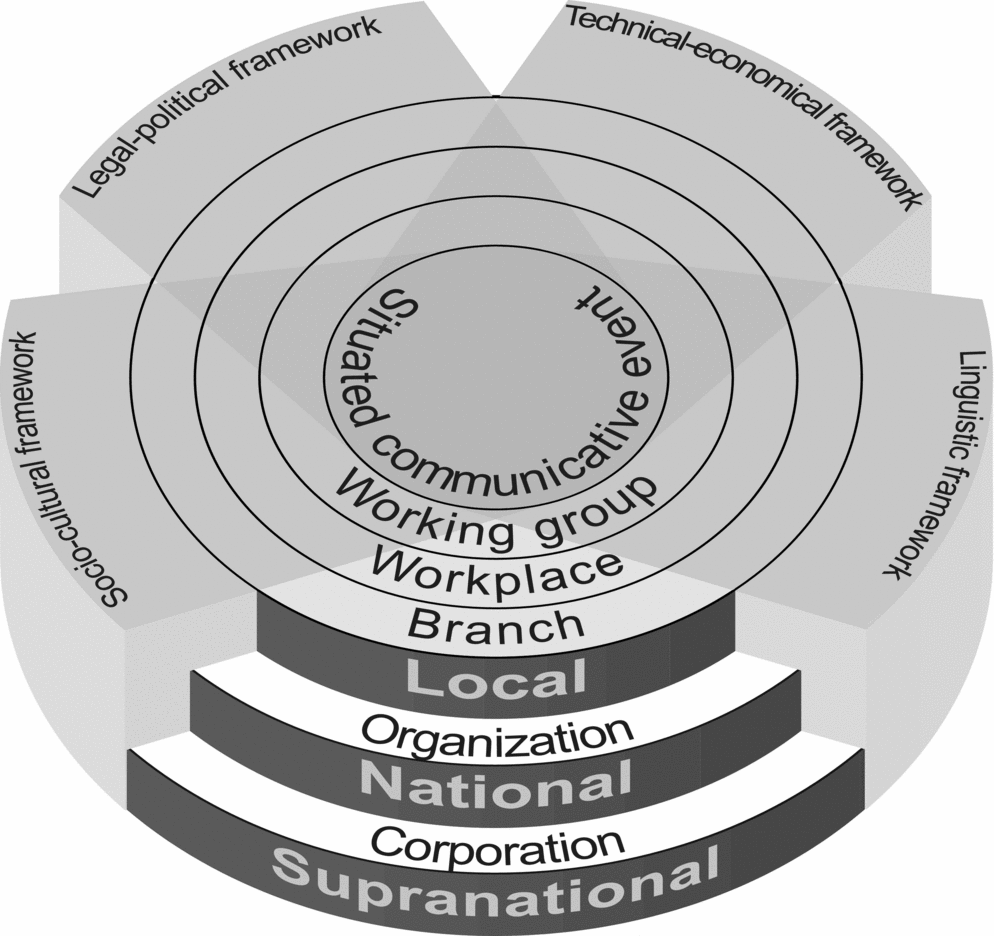
In Gunnarsson (Reference Gunnarsson2009a, p. 20–27), I presented a model that aims to grasp the complex and dynamic interplay between workplace discourse and its various contextual frames.
Model of workplace discourse and its contextual frames.

Text and talk at work can be described as related to different situated communicative events. An in-depth analysis, however, must also include the macro level, that is, the environmental framework in which the communicative events, or chain of events, occur. Text and talk in a small, close-knit working group form part of the traditions that evolve within an environmental structure; thus, the small working group is included in a larger unit such as a workplace, which in its turn belongs to a local branch of a large organization. In many cases, we further find additional organizational levels: The organization belongs to a corporation, to which there also might be attached working partners.
What also characterizes professional discourse is its dependence on various societal framework systems: (a) a technical-economical framework, (b) a legal-political framework, (c) a sociocultural framework, and (d) a linguistic framework. First, we know that technology and technological advances are important for the dynamism within organizations, as are the economy and economically driven changes. Second, it is also self-evident that professional discourse is constrained by politics, laws, and regulations at local, national, and supranational levels. Third, professional discourse is also constrained by a sociocultural framework system; ethical codes adopted in a particular professional environment thus reflect, to a large extent, ideologies and ethics in this framework. Fourth, professional discourse is dependent on the linguistic framework. The local language community, the national language community, and the supranational or global language community establish and follow language laws and policies that directly or indirectly influence text and talk in the professions and/or in local industries, institutions, and businesses. Language choice and language practice in professional environments follow, to a large extent, the practice in the relevant discourse communities. Policies and practice on language dominance issues (local language versus global language; majority language versus minority language), functional language stratification (diglossia), and social language stratification (elite and nonelite languages) formed within the various levels of the linguistic framework influence communicative events for professional purposes in terms of language choice and practice. The language knowledge and language use of the participants in a professional encounter, whether professionals or nonprofessionals, reflect language politics and laws.
While acknowledging the important role that all four frameworks play in shaping discursive practices in working environments, this survey uses the linguistic framework to structure the discussion of multilingualism in the workplace.
MULTILINGUALISM AT WORK IN DIFFERENT ENGLISH CIRCLES
Many studies on workplace discourse have explored environments situated in English-speaking regions. I will begin with some studies on multilingual workplaces in countries in which English is the official majority language, that is, countries in the so-called English inner circle (cf. Kachru, Reference Kachru, Quirk and Widdowson1985). I will then turn to studies of working environments in the English outer and expanding circles in Asia.
Workplaces in the English Inner Circle
Most studies on multilingualism at work in the English inner circle have focused on immigrants for whom English is a second language. Hewitt (Reference Hewitt2008), who studied Polish, Chinese, and Kurdish entrepreneurs in London, found that other languages than English were used for most work-task and social purposes, while the use of English only was found at strategically important nodes, such as interaction with customers, suppliers, and banks. In a series of studies, Roberts explored problems facing immigrants at work in United Kingdom (Roberts, Reference Roberts2010, Reference Roberts, Candlin and Sarangi2011). After analyzing job interviews for low-paid jobs, these studies found that the demands of the selection interviews or assessment outstripped the language and interactional demands of the job and assessed language and communication skills that were not relevant to the job in question. Also, studies of promotion interviews showed the rhetorical and textual constraints on candidates’ performances. As immigrants did not manage to find the required “hybrid discourses of the selection interviews,” they “tended to be judged as either too emotional or too impersonal” (Roberts, Reference Roberts2010, p. 219).
From the perspective of workplace multilingualism in the southern hemisphere, Clyne's exploration of language practices in Australian environments should be mentioned. As Clyne (Reference Clyne1994) stated, for many migrant workers, contact is most frequent with those who share a first language (L1) other than that of the majority, that is, English. This general fact (e.g., Day, Reference Day and Crischel1992; Duff, Wong, & Early, Reference Duff, Wong and Early2000; Roberts, Reference Roberts2010) is later evidenced in Kovacs (Reference Kovacs2004), which concerned Finnish immigrants in Australia. Australian Finns working in the construction industry had the opportunity to use Finnish in their working hours, which meant that they did not lose their mother tongue as would have been expected. Other studies on multilingual workplaces in Australia and New Zealand are Grossi (Reference Grossi2011), Cooke, Brown, and Zhu (Reference Cooke, Brown and Zhu2007), and Holmes and Riddiford (Reference Holmes and Riddiford2010). In Holmes et al. (Reference Holmes, Marra and Vine2011), the researchers focused on leadership in contrasting “ethnicized” contexts in Maori and Pakeha/European workplaces (p. 25).
Turning next to the United States, a problem-oriented focus is found in Shih (Reference Shih2002). Shih, who studied African American and immigrant Latino low-skilled workers in the United States, found that employers’ negative attitudes towards these groups of people were connected to “their perception that the manageability and pliability of workers vary by race, nativity and gender” (p. 99). Also, Marlow and Giles (Reference Marlow and Giles2010) focused on problems, in this case related to language criticism. On the basis of a survey given to people in the U.S. state of Hawai'i, the researchers found that a majority of the people included in this survey had experienced language criticism, for instance, during employment. The evolving role of Spanish in Northwest Alabama is examined in Johnson (Reference Johnson2010). She attributed the growth of the Hispanic populations in this region to job prospects in the manufacturing, agricultural, and construction sectors. As she argued, Hispanic workers are seen as a labor force that will enable these sectors to stay competitive in today's international markets. In the counties studied, the English-speaking community is being exposed daily to the Spanish language and culture. The linguistic picture is further complicated by the fact that many of the immigrants are actually speakers of Mayan dialects but using Spanish as their lingua franca.
Other studies of workplaces in the United States have described how immigrants manage to learn strategies that make them able to cope with the daily communication at work. Bausser (Reference Bausser2000) tutored a French native, who was employed at a US branch of an international company, and made him improve his writing and English. Mednick Myles (Reference Mednick Myles2005) analyzed the communication experiences of engineering students, for whom English was as a second language, during their professional internships. Challenges revolved around conversational aspects, in particular how to use and understand colloquial and idiomatic language. Through interactive coparticipation and collaboration with English L1 speakers, the interns were able to improve their communicative skills. Omar (Reference Omar2010) examined the cultural experience of Arab American entrepreneurs who had settled in South Texas, and Collier (Reference Collier2010) studied four bilingual, immigrant women entrepreneurs. For these women both L1 and L2 use were crucial to their business success; L1 conversations consisted of largely private speech and directives, while L2 use consisted of the mastery of basic conversational openings and closings, as well as various rapport-building methods such as small talk and socially expanded talk. A real success story from a multilingual circuit-board manufacturing plant in California's Silicon Valley was presented in Kleifgen (Reference Kleifgen2001). Kleifgen's analysis of the interaction between a Vietnamese supervisor and a machine operator showed how the interactants creatively use a stripped-down version of Vietnamese and American English in a task-solving event in the workplace (cf. Roberts Reference Roberts2010).
Canada is unique in that some parts belong to the English inner circle, while other parts are French speaking. The bilingual context is reflected in LeBlanc (Reference LeBlanc2010), who presented the results of a study conducted in a bilingual (English-French) workplace in New Brunswick. LeBlanc focused on how speakers of the minority language, French, perceived their own language and that of others and looked at claims that language representations are intimately linked to language practice and also to linguistic insecurity.
Goldstein (Reference Goldstein1997) examined a bilingual workplace context (involving first-generation immigrants from Portugal) in Toronto. Goldstein's study explored the complexities of and the reasons for workers’ resistance to learning English, even when they accepted the economic advantages for themselves of doing so. Another study describing the complexity for immigrants in Canada is Matheux-Pelletier (Reference Matheux-Pelletier2007). This study focused on the language choice decision of female, working-class immigrants in an on-the-job training center specialized in industrial sewing in Montreal. Based on observations and interview data collected on site and with government officials, Matheux-Pelletier explored how Arabic and Bengali speakers use language to maintain or cross cultural boundaries. Fluency in French is considered essential for successful integration in Montreal. As the means for acquiring the language are clearly insufficient, mainstream society justifies the divided job market, arguing that getting a low-paying job is the best newcomers can achieve considering their limited language skills. Among immigrants, language boundaries are largely maintained, as workers overwhelmingly interact with members of their own linguistic group in a language other than French or English.
My last focus in this section is on multilingual workplaces in South Africa. Hill and van Zyl (Reference Hill and van Zyl2002) investigated the linguistic context of the engineering profession in the Witwatersrand, covering companies within the electrical, chemical, mining, and aeronautical fields. Focus groups, interviews, survey questionnaires, and observations were used to explore the practices of 58 engineering personnel, mainly young black engineers. The research found that English played an extremely important role in engineering practice in South Africa. English was used across a range of interactions and also for documentation, which meant that English appeared to be considered as the official language of engineering. Based on the site observations and interviews, however, Hill and van Zyl found that a more complex picture of workplace interaction emerged. Afrikaans and indigenous African languages were perceived by more than 40 % of those surveyed to be important languages in the workplace to “get the work done” (p. 23). Most young black engineers were multilingual, which was found to be a positive force for cooperation with workers who did not know English. Multilingualism was thus found to be a significant professional resource for the young engineers.
Workplaces in the English Outer and Expanding Circles in Asia
I now turn to studies that focus on workplace multilingualism in countries in Asia, which belong to the English outer or expanding circles. As this part of my overview shows, the issues dealt with in these areas mainly concern language demands and language testing and training.
Language demands are dealt with in several studies on Hong Kong, Malaysia, Sri Lanka, and the Philippines. S. F. Li and Mead (Reference Li and Mead2000) reported on a study carried out in Hong Kong, the aim of which was to develop teaching and learning material for English courses for merchandisers in an international marketplace. Green and Evans (Reference Green and Evans2000) discussed data from a survey of the use of Chinese (Cantonese and Standard Written Chinese) and English in the professional workplace in Hong Kong. Results of this survey involving 1,475 respondents drawn from five key occupational sectors indicated that reading and writing in English are demanded frequently, but that English appears to play a less important role in spoken workplace communication. In informal situations but also in more formal ones, Cantonese is as likely to be used as English.
Also Kassim and Ali (Reference Kassim and Ali2010) reported on a survey, in this case of engineers in 10 multinational chemical companies in Malaysia. This survey showed that teleconferencing, networking for contacts and advice, and presenting new ideas and alternative strategies are important communicative events for engineers, and that fluency in English is important for those who wish to have a global career.
Call centers are a currently expanding domain where English is demanded (e.g., Friginal, Reference Friginal2007; Rahman, Reference Rahman2009). Hamp-Lyons and Lockwood (Reference Hamp-Lyons and Lockwood2009), who made a needs analysis of call centers in the Philippines, found that outsourced call centers complain of very poor recruitment because of poor English language ability.
Herat and McLoughlin (Reference Herat, McLoughlin, Kelly-Holmes and Mautner2010) analyzed 330 advertisements for jobs in the commercial sector in Sri Lanka. The authors found that English was being privileged and used ideologically to evaluate the suitability of the applicant for the job. Overtly, the employers seemed to downplay the importance of English, claiming the need for good communication skills rather than fluency in English. Covertly, however, employers held an elitist view with regard to English. In the studied sector, a perceived link seemed to exist between an applicant's competence in English and his or her other capabilities, which among other things led to a strengthening of the role of English on the job market.
Language training is dealt with in two recent interesting studies, which I have chosen to report on in some detail. Lorente (Reference Lorente, Kelly-Holmes and Mautner2010) examined how maid agencies in Singapore turn English into an instrument to commodify migrant women for jobs as domestic workers. As of 2004, there were an estimated 140,000 “foreign maids” in Singapore, the majority of who were Filipinos and Indonesians (p. 45). The agencies were found to stylize the discursive practices of migrant women—their registers and repertoires, speech forms, styles, and genres—in a way that could be said to reify their subordinate and servile positions in the Singaporean society. Lorente concluded that this stylization of the domestic workers’ English language skills, in accordance with the perceived demands of employers and the social position of the women, “produce[s] and reinforce[s] the marginalized, restricted, and highly regulated boundaries of foreign domestic work in Singapore” (p. 55).
Cowie (Reference Cowie, Kelly-Holmes and Mautner2010) studied the accent training industry in India. Accent training has sprung up in tandem with call centers in major Indian cities. New employees are routinely required to undergo several weeks of accent training and customer care training. Cowie analyzed how accent training is imagined and realized as a commercial activity by international call centers on the one hand, and local business partners and their employees on the other. In order to create a force of native-sounding agents, outsourcers look to the ideal of a global so-called neutral accent, an Indian prestige accent. Local trainers promote this abstraction. Cowie concluded that although the employees may share that interest in a local prestige accent, back in the call center they may be rewarded for their ability to accommodate to a native-speaker accent.
In the English expanding circle in Asia, language testing and language course development are dealt with in several studies. Cowling (Reference Cowling2007) studied a large Japanese industrial firm with the purpose to develop English language intensive courses. Choi (Reference Choi2003), who examined large private exporting industries in South Korea, found that 73% of the population seeking employment were screened for their English language skills, prior to being hired; moreover, over 90% of the companies continued to test them during employment.
Park (Reference Park2011) found a critical perspective on English language testing in South Korea. Since the 1990s, different modes of English language testing have emerged as popular means for evaluating job applicants for Korean corporations, which were constantly upgrading the criteria for good English. Park claimed that the evaluation of linguistic competence is always a matter of social and ideological interpretation, and that the fulfillment of the promise of English is constantly deferred.
Multilingualism in Transnational Companies in Asia, South America, and Africa
Workplace interaction has also been studied with a focus on multilingual interaction in global businesses in Asia, South America, and Africa. An early study of English lingua franca communication in international settings is found in Pan et al. (Reference Pan, Scollon and Scollon2002). Palmer-Silveira et al. (Reference Palmer-Silveira, Ruiz-Garrido and Fortanet-Gómez2006) explored English in intercultural and international business communication. Bilbow (Reference Bilbow1997, Reference Bilbow2002) recorded meetings in a large transnational airline corporation in Hong Kong, where the participants came from different cultural and language groups. Bilbow argued that there are significant differences between Western and Chinese interactional behavior in business meetings. Nair-Venugopal (Reference Nair-Venugopal2001) recorded presentations by and interactions between trainer and trainees in two Malaysian companies in order to explore how different varieties of Malaysian English (ME) were used. The findings show that ME and other ways of speaking in these Malaysian corporate business contexts contrast with the norms of standard English usage. Miller (Reference Miller and Spencer-Oatey2000) recorded interaction involving American and Japanese coworkers at two advertising agencies in Tokyo. Gimenez (Reference Gimenez2002) examined communication via faxes and emails between an Argentinean subsidiary and its European head office. Pullin (Reference Pullin2010) explored small talk in English lingua franca business communication in an international setting. Virkkula-Raeisaenen (Reference Virkkula-Raeisaenen2010) explored interaction between a group of Finnish and Chinese business professionals at a multilingual meeting in a small company in Finland. Poppi (Reference Poppi2011) analyzed emails written by Chinese and Japanese employees of a freight-forwarding company that had adopted English as a corporate language. Tanaka (Reference Tanaka2011) focused on naturally occurring business interaction between Japanese entrepreneurs and Indian business practitioners.
From these studies of workplace discourse involving English lingua franca, I turn to some studies on other languages: Japanese, Arabic, Turkish, and Portuguese. O'Connell (Reference O'Connell2006) reported on a survey of Australian expatriates working in business organizations in Japan. The results of this survey, which included responses from 12 Australian expatriates and their Japanese coworkers, showed that the higher their level of Japanese proficiency, the more conscious the Australians were of the need to converge to a Japanese style of communication in order to achieve smooth workplace communication and the more willing they were to do so. L2 proficiency was thus seen to be an integral part of cultural intelligence. Baoueb (Reference Baoueb2009) presented a study on code-switching between Arabic and French in Tunisian business companies. The case study, based on recorded data of conversations, observations, interviews, and a questionnaire, investigated the variety of languages chosen in two Tunisian businesses, focusing mainly on the social constraints of Arabic, French, and English. Moreover, it revealed the complex linguistic situation in terms of the different motivations for code-switching between in-group members and also with foreign colleagues and clients. Akar (Reference Akar2002), who collected data comprising memoranda and fax messages in Turkish and English produced by Turkish business practitioners in four companies, analyzed macro contextual factors that influence the forms and functions of written texts in the two languages. Pereira (Reference Pereira, Gouveia, Silvestre and Azuga2004) reported on a study of Portuguese and Brazilian businessmen, where not language per se but cultural differences, that is, different relations to collectivism versus individualism, became salient.
Many studies described how transnational companies work smoothly in spite of the varied backgrounds of their staff. Other studies, however, reported on problems due to misunderstandings and cultural mismatches. Spencer-Oatey and Xing (Reference Spencer-Oatey, Xing, House and Rehbein2004) focused on misunderstandings and displeasures in Chinese-British business interactions, and Grieve (Reference Grieve2010) reported on cultural differences in conversational structure and the expression of apology in German and Australian workplace telephone discourse. Charles and Marschan-Piekkari (Reference Charles and Marschan-Piekkari2002), who studied a Finland-based transnational corporation, found that interviews carried out with staff globally revealed problems not only for nonnative speakers but also for native speakers of English. Briguglio (Reference Briguglio2005), who reported on a study of international business communication in English, found that emails and faxes were difficult due to the amount of abbreviations and lack of cues that are not present in other forms of communication. Angouri & Harwood (Reference Angouri and Harwood2008) studied written communication in three transnational companies, with headquarters in Greece, Denmark, and Japan, that work together in a consortium. Although the participants broadly worked with the same genres of written documents, the form of these documents varied according to the local context, audience, and purpose. Writers therefore faced difficulty when they made the transition from writing for one community of practice to writing for another.
D. Li (Reference Li and Auer2007), in a discussion of problems with mergers at a general level, made the following claims: “At the institutional level, where the workforce is made up of staff coming from multilingual and multicultural backgrounds, communication—both linguistic and intercultural—problems are to be expected. Problems of this kind are especially acute when business conglomerates originate from very different ‘languacultures’ (Agar, Reference Agar1994, p. 58) and merge into still bigger transnational enterprises” (pp. 430–431).
MULTILINGUAL WORKPLACES IN EUROPE
The expanding of the European Union with its open labor market has provided opportunities both for well-trained professionals and unskilled workers to move to new countries to seek employment. At the same time, political changes and turmoil have led to migration and to the creation of new and more complex multilingual workplaces throughout Europe. As a background to relevant studies, I give some figures related to the balance among different languages. In Europe, there is a broad range of official languages. Only in the United Kingdom, Ireland (together with Irish), and Malta (with Maltese) is English the official language. French is the official language of France, Belgium (with German and Dutch), Luxembourg (with Luxembourgish and German), and Switzerland (with French, Italian, and Romance), and German is the official language of Germany and Austria and one of the languages of Belgium and Switzerland. In the rest of Europe many other languages are spoken by the majority of people, for instance, Dutch in the Netherlands, Swedish in Sweden, Danish in Denmark, and Finnish and Swedish in Finland (Extra & Gorter, Reference Extra, Gorter, Extra and Gorter2008). As the Eurobarometer of 2006 showed, 56% of Europeans can hold a conversation in at least one other language than their mother tongue; 28% in at least two other languages, and 11% in at least three (Extra & Gorter, Reference Extra, Gorter, Extra and Gorter2008).
Many studies (e.g., Breckle, Reference Breckle2005; Poncini, Reference Poncini2003; Rasmussen & Wagner, Reference Rasmussen, Wagner, Luke and Pavlidou2002) of communication in multilingual regions in Europe have shown that businesspeople are able to strategically use a language that suits their needs and their partners. A significant example of this strategic language practice is reported on by Poncini (Reference Poncini2003), who focused on meetings within an Italian company between company representatives and the company's international distributors. The close analysis of these meetings revealed the activity-related factors that trigger switches between languages. The study also illustrated a European perspective on multilingualism: English as a lingua franca may be predominately used, but a host of other languages play a subsidiary role. Other close analyses of multilingual interaction are found in Mondada (Reference Mondada, Gardner and Wagner2004) and Markaki and Mondada (Reference Markaki and Mondada2012). Mondada demonstrated the step-by-step creation of a bilingual interactional order in international work meetings, and Markaki and Mondada showed how managers from several European branches in a corporate meeting made “national categories” relevant (p. 49). A positive account of the linguistic diversity of Swiss-based global companies in the pharmaceutical industry and agribusiness is also given in Lüdi (Reference Lüdi2010).
In multilingual countries like Belgium, Luxembourg, and Switzerland, we also find multilingual staff in service-oriented enterprises—banks, assurance companies, travel agencies, railway box offices, and supermarkets—who are able to flexibly shift to a language that works for their customers (Bothorel-Witz & Choremi, Reference Bothorel-Witz and Choremi2009; Franziskus, Reference Franziskus2012; Kingsley, Reference Kingsley2009; Lüdi, Barth, Höchle, & Yanaprasart, Reference Lüdi, Barth, Höchle and Yanaprasart2009; Mettewie & Van Mensel, Reference Mettewie and Van Mensel2009).
A particular type of multilingualism exists in the Nordic countries. The Danish, Swedish, and Norwegian languages, known as the Scandinavian languages, are similar and, at least to some extent, mutually intelligible. We thus find Swedish caregivers using their mother tongue in elderly people's homes in Denmark (Ridell, Reference Ridell2008), and Swedes, Danes, and Norwegians interacting at meetings and conferences using their respective mother tongues (Börestam, Reference Börestam1991). The national linguistic framework of Finland, however, is different. Finland is a bilingual country; that is, both Finnish (a non-Germanic language) and Swedish are official languages, which means that some people in Finland, a minority, have Swedish as their mother tongue and also that all Finns are taught some Swedish at school. For Finnish-speaking Finns, however, Swedish is not an easy language, and Danish and Norwegian are even harder to understand. In meetings and conferences involving Finns, the Scandinavians therefore often turn to English as a lingua franca (e.g., Börestam, Reference Börestam1991).
As the studies discussed above reveal, a broad spectrum of languages is represented in the daily work-related interaction in multilingual regions in continental and northern Europe. The linguistic diversity and the important role of local languages are stressed in several studies, as are the individual professionals’ flexible and strategic switches between languages.
ENGLISH LINGUA FRANCA WORKPLACES IN EUROPE
Although many languages are represented in the different countries in Europe, the English language has a strong position in the business domain. Most transnational enterprises have chosen English as their corporate language, as Nickerson (Reference Nickerson2000) showed over a decade ago. Several recent studies focus on attitudes related to the use of English in European companies. Hilgendorf (Reference Hilgendorf, Kelly-Holmes and Mautner2010), who conducted interviews with business managers in Germany, claimed that Germany provides an example of the expanding role of English within the business domain. She found that in addition to using English in communication with non-Germans, Germans can also use English in communication with German colleagues. The use of English or German depends on the business context. Also, Ehrenreich (Reference Ehrenreich2010), who explored the role of English and other languages in a family-owned German transnational corporation, found that English was perceived as indispensable in the company at the same time as German maintained an important role. Deneire (Reference Deneire2008) focused on attitudes about the adoption of English as the main corporate language in French companies. An increasingly large number of French companies have chosen English as a corporate language, which has provoked various reactions ranging from enthusiastic embrace to strong rejection based on anxiety and cultural protectionism. The author, who made a stratified survey in order to understand these reactions, found that a real English divide existed between educated and less educated groups, and between upper management and shop floor workers: “While most employees are willing to adopt English to facilitate international trade, they reject the top-down imposition of English that often leads to exclusion and various forms of de-skilling” (p. 181).
For people in the Scandinavian countries, English has been the first choice as an international language for a long time. Firth (Reference Firth and Firth1995b) reported on an unproblematic use of English as a lingua franca in telephone negotiation between Danish cheese sellers and wholesale importers in the Middle East, and Wagner (Reference Wagner and Firth1995) on successful telephone interaction between Danes and Britons. An example of a more recent report of successful ELF (English as a lingua franca) interaction is Virkkula-Raeisaenen (Reference Virkkula-Raeisaenen2010), who described how multinational companies work smoothly in spite of the varied backgrounds of their staff.
Other studies, however, discussed problems relating to the adoption of English as corporate language. With a focus on a company with headquarters in Denmark, Tange (Reference Tange2008) studied the reactions towards the adoption of English as a corporate language. A discrepancy existed between language workers’ global commitment to language management and respondents’ local practices; the effect of the corporate language initiative was closely related to language attitudes in the different parts of the organization. Also, Lønsmann (Reference Lønsmann2011) explored a Danish workplace, in her case a pharmaceutical company, which had gone international and adopted English as its corporate language. Her study revealed that this international company was an extremely diverse environment with regard to language competence and language use. While many Danish employees were proficient English users, a minority had little or no English competence. The international staff (i.e., of non-Danish origin), though, were typically proficient English users, but had varying levels of Danish competence. Using focus group interviews, Lønsmann explored what values the employees attached to different languages. She found that beliefs about how language should function in a Danish company contributed to the construction of boundaries between groups such as “Danes” and “foreigners,” and the attribution of value to these groups. A shared belief among the staff was that Danish is the natural language in Denmark. A consequence of this ideology was that foreigners were classified in relation to their knowledge of Danish.
Two Scandinavian mergers, the Finnish-Swedish company Stora Enso, which is a packaging, paper, and wood products industry, and the Finnish-Swedish-Danish bank Nordea, have recently attracted the interest of Finnish researchers in English as a lingua franca. I will elaborate in some detail on their results. In these companies, English has come to be used not only at an international, external level but also for internal purposes. Kankaanranta (Reference Kankaanranta and Gunnarsson2005) described the new type of communicative practice as follows:
In practice, this language choice means that corporate-level documentation and all reporting is done in English, and communication between different units is mostly in English. This type of communication can be characterized as internal communication as it is taking place “in-house” in contrast to communication between buyers and sellers in which foreign languages have been traditionally needed in international business. For an individual writer of an email message, the choice is a pragmatic one: anytime there are recipients whose mother tongue is not that of the writer's, the message is in English. This means that a Swede (or a Finn) will receive an English message from another Swede (or a Finn) if the list of recipients includes non-Swedish speakers. (p. 42)
In her analysis of emails written in English by Swedish and Finnish employees of Stora Enso, Kankaanranta (Reference Kankaanranta, Kangas and Kangasharju2007) examined what the messages shared, how they differed from native speakers’ messages, and how the messages written by Finnish writers differed from those written by Swedish writers. Email messages written by both Finns and Swedes differed from native English speakers’ messages in the frequent use of salutations and complimentary closes together with first names. By using these phrases, which we recognize from ordinary letters, the employees created and maintained personal relationships within the company, at least according to Scandinavian conventions. Regarding differences between the Swedish and Finnish writers, the analysis revealed how Finns seem to favor direct requests in their writing, while Swedes use more indirect alternatives.
Similar cultural differences were also found in studies of spoken interaction (Charles & Louhiala-Salminen, Reference Charles, Louhiala-Salminen, Kangas and Kangasharju2007). Kangasharju (Reference Kangasharju, Kangas and Kangasharju2007) compared results from interviews, which she had made with managers and staff, with data from videorecorded internal meetings. The meetings were either national meetings held in Finland or Sweden, or cross-border meetings where Finns and Swedes met, using English as a lingua franca. A difference stressed in the interviews concerned the amount of time allowed for discussion and the chair's efficiency; that is, his or her orientation towards decision making. Swedish meetings were said to involve long discussions loosely steered by the chair, while Finnish meetings were said to be shorter and focused on the decisions to be taken. The analysis of the meetings both confirmed and questioned what had been said in the interviews. At the national meetings, there was a clear difference between Swedes and Finns. At the cross-border meetings, however, the cultural differences seemed to be of minor importance. As the language at these meetings was an L2 for both Swedes and Finns, new practices had developed, for instance, a new way to ensure that everyone had understood what was decided.
Nikko (Reference Nikko, Kangas and Kangasharju2007) analyzed Finnish-Swedish interaction in the Scandinavian mergers. Although the main language of the internal meetings recorded was English, code switches were common in all meetings, which meant that besides English also Finnish and Swedish were used. As all participants were either Finns or Swedes, code-switching seemed to be a natural tool to use to overcome language shortages. On the whole, the creation of meaning in the meeting interaction appeared to be highly successful, a fact that Nikko attributed to “the participants’ strong commitment to common goals,” “the informal and relaxed nature of the communication,” and “the vast amount of shared background information and shared experiences of the participants” (p. 478).
Interaction Between English Lingua Franca Users and Native English Speakers
Following these studies on workplace settings where all participants turn to English as a lingua franca, I will mention some analyses of problems related to interaction that also involve native English speakers. Jämtelid (Reference Jämtelid2002) reported on interviews with people involved in text production at different levels of the Swedish Electrolux group. Electrolux had chosen English as its official corporate language. However, there was a widespread belief among managers and staff at the time that native speakers of English found their corporate English poor. The director of corporate communications described the difficulty facing English lingua franca speakers in contexts where some participants are English native speakers and stressed the necessity for Scandinavians and others to speak up even if their English was bad: “Then of course the corporate language is quite clearly ‘bad English.’ Otherwise, you easily end up with only Americans, Brits and well-educated Swedes talking at meetings, while Germans and Italians remain silent. What happens, rather, is that we deliberately avoid difficult words, and that people shouldn't feel ashamed at all if they use bad grammar in an internal memo in English” (p. 44; my translation).
When Franklin (Reference Franklin, Kotthoff and Spenser-Oatey2007) interviewed German and British managers who worked together in a newly established German-British company, he found that the German managers mentioned the native English speakers’ lack of lingua franca skills as a perceived difficulty:
The German managers reported that their British colleagues were unable or unwilling to take account of the fact that they (the German managers) did not have a native-speaker competence in English and did not adjust their use of their mother tongue to the lower level of competence in English of their German colleagues. For example, one German manager noted of his British colleagues: “The English aren't always sympathetic to Germans when they speak English. To begin with, the English speak slowly, but then fall back into speaking the same speed and slang as if the listener is a native.” (p. 273)
Workplaces With Workforce Diversity: The Case of Sweden
All over the world, there are workplaces where some employees, mostly minorities, migrants, or unskilled guest workers, have to use their second, third, or fourth language at work. From the perspective of language users, there is indeed a difference between regions where the majority language is a global language and those where the majority speak a less widely spread language. We know that individuals who migrate to English-speaking countries have often learned English at school in their countries of origin. In parts of the world, where less widely spread languages are spoken, immigrants meet both a new country and a new language. For them, learning the majority language becomes a part of their adjustment to a new country and culture (Gunnarsson, Reference Gunnarsson2005).
With this as a background, I will discuss some results of a research project that I directed at Uppsala University in Sweden. Using a similar design based in interactional sociolinguistics, we studied the communicative situation of immigrants at two Swedish workplaces: a large hospital and a major Swedish company, which focuses on power and automation technologies (Gunnarsson, Reference Gunnarsson2009a; Andersson, Reference Andersson2010; Nelson, Reference Nelson2010). The first phase of the project work involved interviews with a fairly large number of immigrants, 18 at each workplace. The immigrants came from different parts of the world and had migrated to Sweden as adults. They had permanent jobs, though in different positions: At the hospital, the study included doctors, nurses, midwives, and cleaners; and at the company, office staff, that is, engineers, and factory floor workers. They were all L2 users at work; that is, both Swedish and English were foreign languages for them. The second phase involved case studies, five at each workplace. The employees were shadowed during a week, and data related to their workplace communication were collected.
In this section, I will focus on a few results related to the language situation at the two working environments. At the hospital, communication with lay people—patients and relatives—forms an important part of the daily work of the medically trained staff, which means that the majority language of the local community, Swedish, is the dominant language in their work. In addition, the doctors interviewed reported that English is used in their research and in writing articles for publication. Some of the nurses also said that every now and then they use their mother tongue at work, for example, when they act as interpreters between patients and doctors. The communicative situation for the cleaners at the hospital is very different from that of the medically skilled staff. When interviewed, the cleaners said that Swedish is used when they speak to their managers, to hospital staff they meet when cleaning their areas, and to other cleaners when they do not have a common mother tongue. Many of the cleaners have very poor skills in Swedish, and since they mainly interact with others from the same countries, they do not get much practice in Swedish, so their proficiency hardly improves, according to the managers who were interviewed.
In the company, communication is mainly directed to professionals, that is, to colleagues linked to the same workplace or within the same organization or to other professionals. As the workplace studied belongs to a large, transnational company for which English is the corporate language, the language practices are of a diglossic nature. English is used as a lingua franca for external purposes, for instance, in written correspondence with colleagues in other countries and in meetings with external professionals, while the local majority language, Swedish, is used for internal purposes and in the daily spoken interaction with colleagues.
From the point of view of language, a clear divide exists between engineers and factory floor workers. When the engineers were asked about the languages they used at work, one third said that they mainly use Swedish, one third that they mainly use English, and one third that they use English and Swedish to an equal extent. All claimed that they write English more often than they speak it. Two thirds of the engineers also said that they have used their mother tongues at work, for example, when they have been involved in guiding and taking care of groups and representatives from foreign countries. All factory floor workers interviewed, however, said that Swedish is the main language they use at work. Although they said that they come into contact with English texts, they did not claim to read them, and only one third of the factory workers said that they have used their mother tongues at the workplace.
The communicative situations for the employees interviewed are thus different at the hospital and at the company, and also within each environment. As I mentioned above, all informants have permanent jobs, and they also seem to be able to perform their assigned tasks. Their position at work and the tasks they are given correspond to their linguistic competence and communicative skills. Lack of language skills therefore hinders promotion in both environments: at the hospital good Swedish is necessary for a career, and at the company both English and Swedish are required. In the company, good writing skills are also important for promotion. We thus find that language knowledge creates a divide between those who master the corporate language and those who do not, and also between those who master the majority language and those who do not.
DISCUSSION
Here, I widen the perspective and discuss workplace discourse with a focus on the contextual frameworks. Returning to the model from Gunnarsson (Reference Gunnarsson2009a), we find that professional discourse has been revealed to depend on various societal frameworks.
As first concerns the technological-economical framework, many studies discussed in earlier sections reflect recent technological advances, for example, the use of Internet, faxes, emails, and distant telephone negotiations (e.g., Harris & Bargiela-Chiappini, Reference Harris and Bargiela-Chiappini2003; Louhiala-Salminen & Kankaanranta, Reference Kankaanranta and Gunnarsson2005), and the establishment of call centers (e.g., Cowie, Reference Cowie, Kelly-Holmes and Mautner2010; Friginal Reference Friginal2007; Hamp-Lyons & Lockwood, Reference Hamp-Lyons and Lockwood2009; Rahman, Reference Rahman2009). Other studies reflect economically driven changes, as well as globalization of production and of the job market (e.g., Kelly-Holmes & Mautner, Reference Kelly-Holmes and Mautner2010). Transnational companies and organizations employ managers and workers from different countries, and mobile employees who are willing to move between jobs, branches, and countries are attractive on the job market (Day & Wagner, Reference Day, Wagner and Auer2007; Gunnarsson, Reference Gunnarsson2009a, Reference Gunnarsson, Wei and Cook2009b). Many workplaces belong to transnational companies and newly merged companies that conduct meetings and letter exchanges across national cultural and language borders (e.g., Charles & Louhiala-Salminen, Reference Charles, Louhiala-Salminen, Kangas and Kangasharju2007; Kankaanranta, Reference Kankaanranta and Gunnarsson2005, Reference Kankaanranta, Kangas and Kangasharju2007; Nickerson, Reference Nickerson2000; Poppi, Reference Poppi2011). The fact that workforces move from one country to another is, at least to some extent, dependent on economy. Skilled and unskilled workers move to wealthier regions in order to seek employment, which also means that immigrants are found both in high- and low-status jobs (e.g., Gunnarsson, Reference Gunnarsson2009a, Hewitt, Reference Hewitt, Martin-Jones, Blackledge and Cheese2012; D. Li, Reference Li2000; Roberts, Reference Roberts, Kotthoff and Spenser-Oatey2007b).
Second, the legal-political framework is important. Professional discourse is constrained by politics and legislation at local, national, and supranational levels, for instance, concerning education, welfare, and the press. Commercial activities and business transactions in the 21st century take place within the framework of a global economy or market (D. Li, Reference Li and Auer2007). From the perspective of globalization of working life, we can say that “the entire world is increasingly integrated into a single economic system based around market exchange: labor, capital, technology, consumer products, and services move with fewer and fewer restraints across national boundaries” (Peoples & Bailey, Reference Peoples and Bailey2003, p. 160). From another perspective, we can argue that the conditions for working life vary in different regions of the world depending on societal conditions. So is the open labor market currently existing in the European Union a result of legislation at the supranational level. Of great importance for workforce mobility is, of course, the education system in different countries, in particular in relation to the teaching of languages. Although English is taught as an L1 or first foreign language in large parts of the world, there are many regions where language education does not involve English. The studies of immigrants in Swedish workplaces, for instance, showed that the lack of language skills in English created a divide between skilled and unskilled staff in the transnational company (Gunnarsson, Reference Gunnarsson2009a; Nelson, Reference Nelson2010). Also, the many accounts of language testing and language training of workers and professionals reflect a lack of basic language education (e.g., Green & Evans, Reference Green and Evans2000; Hamp-Lyons & Lockwood, Reference Hamp-Lyons and Lockwood2009; Herat & McLoughlin, Reference Herat, McLoughlin, Kelly-Holmes and Mautner2010; Kassim & Ali, Reference Kassim and Ali2010).
Third, professional discourse is constrained by a sociocultural framework system; ethical codes adopted in a particular professional environment thus reflect, to a large extent, ideologies and ethics in this framework. Diversity issues, hierarchies, power, and prejudices are discussed in several studies (e.g., Campbell & Roberts, Reference Roberts, Kotthoff and Spenser-Oatey2007; Goldstein, Reference Goldstein1997; Matheux-Pelletier, Reference Matheux-Pelletier2007; Roberts, Reference Roberts2010, Reference Roberts, Candlin and Sarangi2011; Shih, Reference Shih2002). Cultural patterns, attitudes, and social values are also essential aspects of workplace interaction, and communication in the professions is often sustained in a complex sociocultural framework system, where national and local frameworks are intertwined and interdependent. Problems related to cultural mismatches in cross-cultural interaction are dealt with in some studies (e.g., Bilbow, Reference Bilbow1997, Reference Bilbow2002; Pereira, Reference Pereira, Gouveia, Silvestre and Azuga2004; Spencer-Oatey & Xing, Reference Spencer-Oatey, Xing, House and Rehbein2004; D. Li, Reference Li and Auer2007), while other studies focus on problems related to the adoption of English as corporate language (e.g., Deneire, Reference Deneire2008; Lønsmann, Reference Lønsmann2011).
Fourth, professional discourse is dependent on the linguistic framework. Language choice and language practice in professional environments follow, to a large extent, the practice in the relevant discourse communities. Policies and practice on language dominance issues (local language vs. global language; majority language vs. minority language), functional language stratification (diglossia), and social language stratification (elite and nonelite languages) formed within the various levels of the linguistic framework influence communicative events for professional purposes in terms of language choice and practice. The linguistic framework is reflected, in one way or the other, in all studies discussed in this survey article. Language ideologies in relation to multilingualism are discussed in several studies (e.g., Franziskus, Reference Franziskus2012; Heller, Reference Heller and Auer2007; Mettewie & Van Mensel, Reference Mettewie and Van Mensel2009), and the result of language policy issues in other ones (e.g., Kingsley, Reference Kingsley2009). Several studies focus on organizations where the language practices have a diglossic nature, which means that a global language is used in some contexts, and local languages in others (e.g., Deneire, Reference Deneire2008; Ehrenreich, Reference Ehrenreich2010; Hilgendorf, Reference Hilgendorf, Kelly-Holmes and Mautner2010; Hill & van Zyl, Reference Hill and van Zyl2002; Nelson, Reference Nelson2010). Many studies report on successful multilingual interaction (e.g., Lüdi, Reference Lüdi2010; Markaki & Mondada, Reference Markaki and Mondada2012; Mondada, Reference Mondada, Gardner and Wagner2004; Nikko, Reference Nikko, Kangas and Kangasharju2007; Poncini, Reference Poncini2003), while other studies focus on problems and misunderstandings (Grieve, Reference Grieve2010; Spencer-Oatey & Xing, Reference Spencer-Oatey, Xing, House and Rehbein2004).
To conclude, the balance among different languages at work varies from one country to the other and one environment to the other, as do ideas on equality, power, and social inclusion. From a culture-language perspective, we can agree with Otsuji and Pennycook (Reference Otsuji and Pennycook2011), who argued that a “vision of social inclusion that includes bi- and multilingual capacities may comprise an appreciation of a diversity of languages other than English, and the skills and capabilities of multilingual language users” (p. 413). On the other hand, we know that many working environments are linguistically and socially divided, with multilingual professionals in central, powerful positions, and L2 speakers in low-paid, peripheral jobs, far away from the real power. The adoption of a multilingual workplace practice has financial consequences, a fact that contributes to tensions in many regions. The very positive image of multilingualism presented in Grin, Sfreddo, and Vaillancourt (Reference Grin, Sfreddo and Vaillancourt2010), which used Switzerland as an example of a country where multilingualism is counted as an economic asset, is counterbalanced by Phaahla's (Reference Phaahla2010) pessimistic account of multilingualism in South Africa, where, according to the author, people are still “grappling with issues such as the financial costs of using more than one official language in commerce and industry” (p. 52). Future research on multilingualism in the workplace needs to continue to explore how the gap between vision and practice can be overcome, thus increasing our understanding of how linguistic and cultural issues affect workplace discourse and how problems can be solved.
TOPICS FOR FUTURE RESEARCH
I focus on four problem areas that I find of particular relevance for applied linguists to investigate. The first problem area concerns how the global job market has affected workplace multilingualism in different regions. Globalization and technological advances have meant new possibilities for managers and workers to move to new countries to seek employment. For employers, the enlarged basis for recruitment of staff means new possibilities to find the best person for the job, at the same time as a diversified staff also leads to new challenges. Government policies on language education have varied, and still vary, from one country to another, as do the regional attitudes towards linguistic diversity. Also, at an organizational level, there are variations as to language policy. A topic for future applied studies is to investigate the language policy practices—if any—of companies and organizations operating in different regions, particularly if they tolerate linguistic diversity or if language policy practically means that their staff should use the local majority language at work. Language policy issues are indeed related to staff recruitment. They are also reflected in resources given to training, for instance, in the way the organizations stimulate their employees to learn new languages and offer them language courses.
The second problem area concerns the consequences of distance communication for internal democracy. New technology and globalization of the business world have changed the communicative structure of many enterprises, which means that large organizations today are held together as uniform entities by means of the Internet and distance communication. Although this structure is widely spread, few studies have analyzed its effect on workplace culture and internal democracy. Relevant research questions concern the consequences of physical distance for bottom-up influence, that is, how, and by what type of discourse, internal democracy is established—or hindered—in large, multinational organizations: Does the individual employee manage to get his or her voice through to the top management level? What role does language difference play for patterns of influence?
A third problem area concerns the individual employee's group affiliation. Large organizations in today's economy are often described as having fewer levels than before; hierarchies are reduced and the structural connection between organization and workplace is blurred. In many organizations, the working group is held together by means of distance communication, which means that phone calls and the Internet are replacing the daily face-to-face interaction with workmates. A topic for future research is to analyze if similar socializing patterns, as those which have been found in small group interaction, are also established in working groups held together by means of distance communication. Do humor, storytelling, and teasing play a role also in distance communication and in organizations which use English—or another language—as a lingua franca?
The fourth problem area concerns how diversity issues are handled in organizations. Workplace interaction is embedded in a sociocultural context, which means that the construction of an open climate and a constructive working group can be hindered by religious and ethnic prejudices and stereotyping. Relevant research questions would concern what societal values are expressed in official documents and more informal discourse within small and large organizations. Economic and political shifts have led to an increased migration, and new immigrant groups are found in most countries. Important topics to study in the future concern how immigrants from different regions are received and treated at work. Who is marginalized and who is made central through workplace discourse? How are migrants with various linguistic and cultural backgrounds treated in different workplace environments?