In the past two decades there has been increasing awareness of sensory problems relating to visual perception which are not caused by optometric or ophthalmological deficits. Visual stress (VS), also known as Meares-Irlen/visual stress syndrome, is a visual processing deficit believed to affect at least 5% of the general population (Allen & Hollis, Reference Allen and Hollis2008; Kriss & Evans, Reference Kriss and Evans2005). Symptoms of VS include distortions of print (text appears to move or vibrate), deteriorations in reading speed and accuracy within a short period, and sensitivity to fluorescent lighting (Irlen, Reference Irlen1994; Robinson, Reference Robinson1994). The use of colored filters has frequently been reported to alleviate such symptoms (Allen, Evans, & Wilkins, Reference Allen, Evans and Wilkins2012; Loew & Watson, Reference Loew, Watson, Gonzalez-Pienda, Rodriguez, Alvarez, Cerezo, Fernandez, Cueli and Suarez2012; Wilkins & Evans, Reference Wilkins and Evans2010), though this remains controversial (Ritchie, Della Sala, & McIntosh, Reference Ritchie, Della Sala and McIntosh2011).
Estimations of VS prevalence range from 5% applying rigorous criteria, such an as a substantial and immediate increase in reading speed (≥ 25%) on the Wilkins Rate of Reading Test (Wilkins, Jeanes, Pumfrey, & Laskier, Reference Wilkins, Jeanes, Pumfrey and Laskier1996) after colored transparencies are placed over the reading page (Kriss & Evans, Reference Kriss and Evans2005), to as high as 20–24% when reported symptoms form the basis of diagnosis (Allen & Hollis, Reference Allen and Hollis2008; Robinson, Hopkins, & Davies, Reference Robinson, Hopkins and Davies1995). It is difficult to establish a consensus on the prevalence of VS simply because the severity of the condition constitutes a continuum (Evans & Joseph, Reference Evans and Joseph2002), though estimates in the vicinity of 12% in the general population and 30% in the dyslexic population appear to be reasonable (Kriss & Evans, Reference Kriss and Evans2005; Kruk, Sumbler, & Willows, Reference Kruk, Sumbler and Willows2008). Identification of VS morbidity is also complicated by the fact that similar or identical symptoms have been identified in a number of independent disorders including: developmental dyslexia (Northway, Manahilov, & Simpson, Reference Northway, Manahilov and Simpson2010; Rodriguez-Pérez, González-Castro, Álvarez, Álvarez, & Fernández-Cueli, Reference Rodriguez-Pérez, González-Castro, Álvarez, Álvarez and Fernández-Cueli2012; Wright & Conlon, Reference Wright and Conlon2009), attention deficit/hyperactivity disorder (ADHD) (Loew & Watson, Reference Loew and Watson2013; Taurines et al., Reference Taurines, Schmitt, Renner, Conner, Warnke and Romanos2010), chronic fatigue syndrome (Loew, Marsh, & Watson, Reference Loew, Marsh and Watson2014; Robinson, McGregor, Roberts, Dunstan, & Butt, Reference Robinson, McGregor, Roberts, Dunstan and Butt2001), as well as migraine and photosensitive epilepsy (Wilkins, Huang, & Cao, Reference Wilkins, Huang and Cao2007).
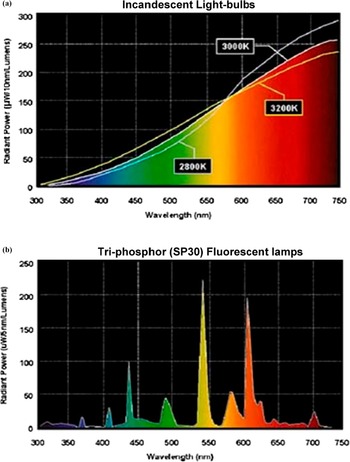
Symptoms of VS are known to be exacerbated by fluorescent lighting (Loew, Fernández, & Watson, Reference Loew, Fernández and Watson2013), and while a number of studies have investigated the possible effects of fluorescent lighting upon visual comfort and visual acuity tasks (Boyce, Reference Boyce and Veitch1994; Navvab, Reference Navvab2001; Winterbottom & Wilkins, Reference Winterbottom and Wilkins2009), most have focused almost exclusively upon comparisons of different types of fluorescent lamps (Küller & Laike, Reference Küller and Laike1998; Veitch & McColl, Reference Veitch and McColl1995, Reference Veitch and McColl2001). The spectral power distribution (SPD) emitted by thermal light sources such as incandescent light bulbs (Figure 1a) is vastly different to the SPD of fluorescent lamps. In particular, SPD graphs of incandescent lighting form a continuous curve, as is the case for sunlight, whereas SPD graphs of fluorescent lighting do not remotely resemble a continuous curve (Figure 1b).
Differences in spectral continuity and the proportions of short wavelength light relative to long wavelength light between the SPDs of typical incandescent lamps (a), and typical tri-phosphor fluorescent lamps (b). *[Source: www.gelighting.com/na/business]

A further distinction between the above two forms of illumination is that the proportion of longer wavelength light (orange - red) relative to shorter wavelength light (violet - blue) is greatly reduced in the spectrum emitted by fluorescent lamps. It is thus surprising that studies comparing ease of reading under each of these forms of interior-lighting appear to be scant.
Several studies have shown that differing spectral distributions can affect both visual performance and brightness perception (Berman, Fein, Jewett, & Ashford, Reference Berman, Fein, Jewett and Ashford1993; Berman et al., Reference Berman, Fein, Jewett, Benson, Law and Myers1996; Navvab, Reference Navvab2001, Reference Navvab2002). Such studies demonstrated that visual acuity is largely determined by pupil size which, in turn, is a determinant of the proportion of the illumination emitted in the shorter wavelength bands. The research showed that the violet, blue and green regions of the visible spectrum induce the greatest retinal cell response in the rod photoreceptors (which have peak sensitivity at 505nm in the bluish-green region), and further demonstrated that the human perception of illumination brightness is a positive correlate of rod receptor response. In addition, Navvab (Reference Navvab2001, Reference Navvab2002) found that the proportion of shorter wavelength light emitted by indoor lighting is the dominant factor affecting visual comfort and performance, not the degree of overall room illumination. By showing that yellow filters (favoring yellow/orange - red light) enhance visual convergence, accommodation and acuity (essential components of efficient reading), Ray, Fowler, and Stein (Reference Ray, Fowler and Stein2005) demonstrated that optimal artificial lighting for reading requires an adequate proportion of longer wavelength light. Similarly, Loew and Watson (Reference Loew, Watson, Gonzalez-Pienda, Rodriguez, Alvarez, Cerezo, Fernandez, Cueli and Suarez2012) reported that lighting fitted with pale-yellow/brown filters significantly reduced discomfort in VS subjects.
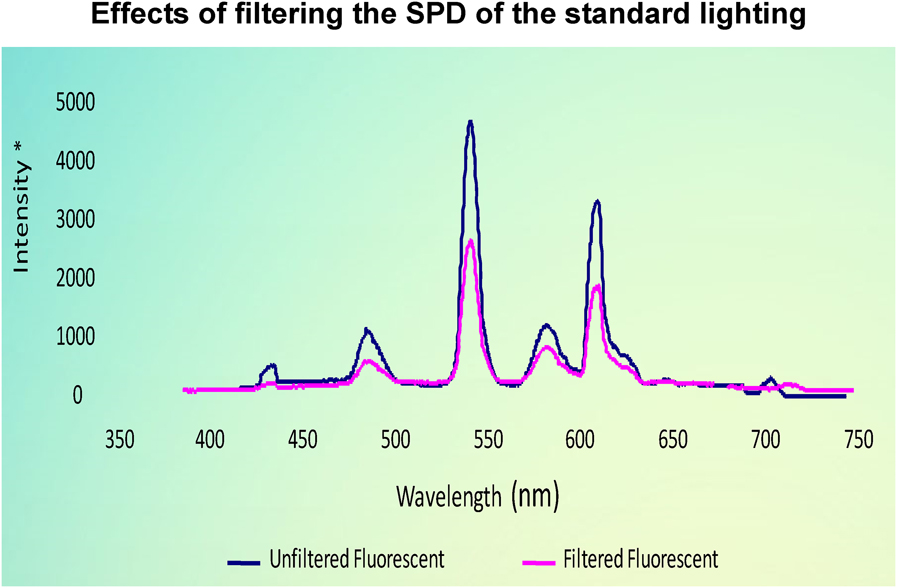
Converging lines of evidence indicate that visual acuity and brightness perception are influenced by the SPD of a given light source, and that symptoms of reading discomfort in the VS population are exacerbated by fluorescent lighting and can be alleviated with spectral filters. In this context, the primary purpose of the current study was to determine whether symptoms of reading discomfort under fluorescent lighting (often reported by poor readers) might also occur in proficient readers. To achieve this aim, a group of expert readers were recruited to assess levels (if any) of six VS symptoms of reading discomfort under standard office lighting. Reading speed and accuracy were also assessed. A further objective of the study was to test the potential effects of installing translucent spectral filters over the same fluorescent lamps to provide a color-balance more akin to that of incandescent lighting, without altering or replacing the lamps or the luminaries themselves. Thus, reading discomfort was further assessed under lighting which was filtered to provide a spectral bias towards the yellow, orange and red spectral bands. The filter also moderated the abrupt spikes in energy at specific wavelengths characteristic of fluorescent lighting (Figure 2).
Spectrometric analysis of the effects of the spectral filter upon the SPD of the standard (unfiltered) fluorescent lighting showed reductions in high intensity emissions. *Intensity measured in arbitrary units.

Methods
Participants
The study cohort comprised 24 Spanish-speaking academics recruited from the University of Oviedo, Spain, including 15 (62.5%) females and 9 (37.5%) males between the ages of 21 and 60 years (M = 30.63, SD = 9.54). There was no statistically significant difference between the mean age of the female subjects (M = 28.13, SD = 6.07 years) and the mean age of the male subjects (M = 34.78, SD = 12.89 years), t(22) = –1.72, p > .05). Reading glasses were required by 11 (45.8%) participants, however, spectacles with tinted lenses were not worn by any participants. To ensure that the incidences of the VS symptoms measured were exclusively related to proficient readers, only applicants working at academic levels requiring extensive reading at an expert level were included. All participants reported as not having any form of reading deficit, or any ophthalmological or optometric condition which had not been corrected. Participants were individually questioned regarding prior diagnoses of: 1) Reading problems (non-optical); 2) Irlen Syndrome/Meares-Irlen Syndrome/Visual Stress; 3) ADHD; 4) Chronic Fatigue Syndrome; 5) Other medical or health conditions (including headaches). None of the participants reported any disorders which might affect reading, visual attention or cognition. All subjects were fully briefed on the research protocol before signing an informed consent form. The study was conducted in accordance with the Code of Ethics of the World Medical Association (2008) Declaration of Helsinki for research involving human subjects.
Instruments and procedure
The proportion of shorter wavelength ‘scotopic’ light relative to longer wavelength ‘photopic’ light is known as the S/P ratio. To reduce the high scotopic content in the S/P of fluorescent lighting, a spectral filter [LEE-filter 205: 1/2 C.T.O. (Color-Temp. Orange)] was selected from a technical catalogue of lighting filter samples (Supplier: LEE Filters, Andover, UK). The intended purpose of the filter (Absorption: 0.15; Mired shift: +109; Chromaticity: x = 0.374, y = 0.364; Transmission Y%: 70.8) was to moderate the high proportion of shorter wavelength scotopic light emitted by fluorescent lighting (relative to natural or incandescent lighting) by reducing the intensities of violet, blue and green light reaching the reading page.
All external light sources were excluded from the testing room, which was illuminated by two sets of ceiling lights situated two meters apart, each fitted with four 36 Watt fluorescent tubes [Sylvania, model: Standard F36W/154 T8 Daylight; illuminance (desk): 515 Lux; modulation (frequency): 100 Hz] controlled by conventional magnetic-ballasts. The tubes in one array were enclosed in LEE 205 pale-yellow/brown tubular filters which were not discernible to the participants. The testing room walls were light-beige in color, thus any reflected light reaching the reading page was largely neutral in relation to spectral bias. With the filter installed the illuminance level at the reading surface was 355 lux and consistent with the technical specifications provided by the manufacturer which included a low absorption factor (15%). Thus, desk-illuminance in the filter condition remained above illuminance guidelines for classroom reading areas [European Standard EN 12464–1: (300 Lux); Australian Standard AS 1680.2.3: (240 Lux)].
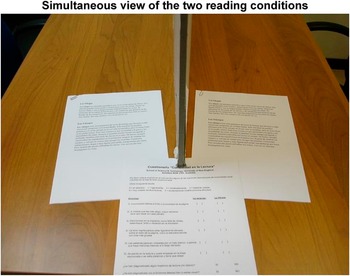
The reading surface was situated midway between and perpendicular to the two sets of lighting in order to avoid any direct glare. This also prevented potential shadowing of the text by the participants as they read. Glare from the lights was further mitigated by contemporary open-louvre lighting diffusers. During a participant’s assessment of reading discomfort both sets of lighting were switched on, however, a screen (height: 1.35 meters) divided the desk into two halves, effectively isolating the two lighting conditions. The two samples of text were placed on either side of the dividing screen and were viewed from the end of the screen. This allowed a participant to simultaneously compare two identical reading passages with each one situated in one of the two visual conditions (Figure 3). The amount of light passing over or around the dividing screen and reaching the sample of text on the opposite side was negligible (< 20 lux). The samples of text utilized were printed in standard font (Times New Roman; 12-point) on standard ultra-white printing paper (CIE Whiteness: 169; Opacity: 90%; Brightness: 25.5%) and were read from each participant’s accustomed reading distance.
Identical reading passages viewed under two lighting conditions (Left: unfiltered; Right: filtered), and the survey of six measures of reading and visual discomfort (Centre).

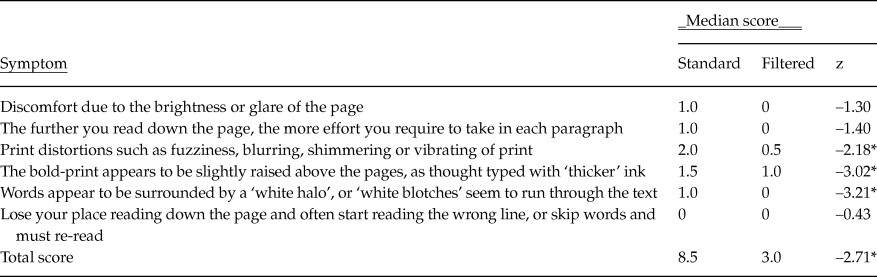
Participants completed a questionnaire designed to compare levels of visual and reading discomfort under standard lighting (Condition 1) to levels under filtered lighting (Condition 2). The questionnaire was purposely concise, as reading efficiency in individuals with VS is known to deteriorate in a relatively short period of time (Irlen, Reference Irlen1994; Robinson, Reference Robinson1994). The six primary symptoms of reading discomfort indicating the presence of VS to be assessed by participants (Table 1) were based upon symptoms mutually described by Kruk et al. (Reference Kruk, Sumbler and Willows2008), Whiting, Robinson, and Parrott (Reference Whiting, Robinson and Parrott1994), the Irlen Reading Perceptual Scale (Irlen, Reference Irlen1994), and the Visual Discomfort Scale (Conlon, Lovegrove, Chekaluk, & Pattison, Reference Conlon, Lovegrove, Chekaluk and Pattison1999). Participants indicated the degree to which they experienced any of the six symptoms while reading a simple passage of text under each condition, using a six-point scale that ranged from 0 = not at all, to 5 = highly noticeable (causes difficulty). It has previously been demonstrated (via a two-parameter Rasch rating-scale model producing a uni-dimensional logistic test scale) that visual discomfort can be accurately measured on a single dimension using a discomfort scale of this design (Conlon et al., Reference Conlon, Lovegrove, Chekaluk and Pattison1999). In addition, the six-symptom questionnaire utilized in the present study has also been shown to clearly distinguish subjects diagnosed with VS from a group of control subjects (Loew & Watson, Reference Loew, Watson, Gonzalez-Pienda, Rodriguez, Alvarez, Cerezo, Fernandez, Cueli and Suarez2012).
The questionnaire measured current symptom ratings (rather than recent or previous symptom ratings) as current symptoms have been found to be a significantly more reliable predictor of changes in reading speed attributable to spectral filtering (Hollis & Allen, Reference Hollis and Allen2006). Prior to assessing levels of visual discomfort under each lighting condition, reading speed and accuracy of the participants were measured using two well-established reading tests: 1) the Wilkins Rate of Reading Test (WRRT: Wilkins et al., Reference Wilkins, Jeanes, Pumfrey and Laskier1996); and 2) a pre-test/post-test reading-comparison task sourced from PROLEC-R (Cuetos, Rodríguez, Ruano, & Arribas, Reference Cuetos, Rodríguez, Ruano and Arribas2007). Both measures confirmed that all participants were able to read at a proficient rate (words/minute) under standard lighting (WRRT: M = 186.98, SD = 30.72; PROLEC-R: M = 212.68, SD = 28.68).
The WRRT is a measure of reading speed and accuracy using a 150-word passage of text composed of only 15 simple words recurring in a random and “non-sensible” order. The passage is read aloud by the subject as quickly as possible for one minute. The number of words read per minute is noted, as well as any errors and self-corrections. The WRRT is not designed to assess comprehension but rather, it is purely intended for detecting variations in reading speed when a subject reads with and without colored overlays or spectral lenses. Four versions of the test (in which the same 15 words are re-arranged) are available so that equivalent passages can be read under different visual conditions. The order in which the WRRT text-versions were presented to participants was alternated from one subject to the next. In this study, the WRRT was translated from English to Spanish by experienced linguists at the Faculty of Psychology, University of Oviedo, Spain. There were six reading variables measured: 1) reading speed (words per minute); 2) self-corrections; 3) misreadings 4) omissions; 5) additions; 6) total errors.
The PROLEC-R is a battery of reading tasks developed by leading literacy specialists in Spain. It contains a substantial array of short reading passages to cater for a range of reading ages. Unlike the WRRT however, PROLEC-R passages are in “sensible-text” format, as they are designed to test both reading accuracy and comprehension. PROLEC-R tasks are widely recognized due to their prior use in several peer-reviewed studies published in international journals, and are also the most commonly employed reading assessments in Spain. As the primary purpose of the reading tasks in this study was to gauge changes in reading speed, we applied the above described WRRT methodology to the implementation of the PROLEC-R task carried out by the participants. This approach was feasible because different passages of text developed to be precisely equivalent in reading difficulty were available in the PROLEC-R package. Thus, it was possible to utilize these specific passages in conjunction with the WRRT methodology in order to identify any changes in a subject’s rate of reading. To this end, the different versions of equivalent PROLEC-R reading tasks were read aloud as quickly as possible by participants under each of the two visual conditions for a period of one minute, with the order in which the conditions were presented being alternated with each consecutive participant. The order of the conditions under which each of the above two tests were carried out was also counter-balanced by alternating the sequence of the conditions [from (1, 2, 2, 1) to (2, 1, 1, 2)]. The PROLEC-R task is in Spanish, therefore translation was not required. There were six reading variables measured: 1) reading speed (words per minute); 2) self-corrections; 3) misreadings 4) omissions; 5) additions; 6) total errors.
The PROLEC-R was developed with a sample of 920 children distributed equally by age (6 to 12 years) and sex. There were no adult reading tasks suitable for the objectives of this study available in Spanish. Similarly, the WRRT was developed with a large sample of children aged 8 to 11 years, and no versions of the WRRT specifically developed to identify post-intervention changes in the reading speed of adults with VS were available.
Statistical analysis
Differences in participants’ reading speed, accuracy, and responses to the visual discomfort questionnaire under each lighting condition were analyzed using the Wilcoxon Signed Rank Test. Cohen’s d was calculated to determine effect size and, following Cohen (Reference Cohen1988), were interpreted as 0.1 for a small effect, 0.3 for a medium effect, and 0.5 for a large effect.
Results
The data showed significant differences in levels of reading discomfort reported by the group under each of the conditions, and indicated that the filter condition was of clear benefit to 19 (79.2%) of the study’s 24 subjects. Compared to the standard condition, for five of the six symptoms there was a reduction in discomfort under the filtered condition (Table 1). This reduction was statistically significant for three of the symptoms. The reduction in discomfort was statistically significant for the symptom of ‘print distortions’, z = –2.18, p = .029, with a medium effect size (r = .31). The median discomfort score on the symptom decreased from the standard condition (Md = 2.0) to the filtered condition (Md = 0.5). The reduction in discomfort was also statistically significant for the symptom of ‘bold print appearing raised’, z = –3.02, p = .003, with a medium effect size (r = .44). The median discomfort score on the symptom decreased from the standard condition (Md = 1.5) to the filtered condition (Md = 1.0). The reduction in discomfort was statistically significant for the symptom of ‘white halo, or white blotches’, z = –3.21, p = .001, with a medium effect size (r = .46). The median discomfort score on the symptom decreased from the standard condition (Md = 1.0) to the filtered condition (Md = 0). Finally, the reduction in discomfort was statistically significant for the total score of the questionnaire, z = –2.71, p = .007, with a medium effect size (r = .39). The median total discomfort score decreased from the standard condition (Md = 8.5) to the filtered condition (Md = 3.0).
Wilcoxon Signed Rank Test results for a Comparison of Reading Discomfort Scores under the Standard and Filter Conditions (n = 24)

* p < .05.
Examination of the discomfort scores under standard lighting on a case by case basis showed that 4 (16.7%) of the 24 subjects recorded total discomfort scores ranging from 14 to 24 (maximum score possible: 30), which suggests that they were experiencing significant levels of VS symptoms. This finding is consistent with prior reports of VS prevalence indicating that between 12% and 24 % of the general population are at least moderately affected by VS (Jeanes et al., Reference Jeanes, Busby, Martin, Lewis, Stevenson, Pointon and Wilkins1997; Kriss & Evans, Reference Kriss and Evans2005). Furthermore, under the filter condition the same four individuals also recorded substantial decreases in their total discomfort scores (M = –12.75, SD = 0.50) compared to the respective change in the total scores of the group as a whole (M = –4.21, SD = 4.71). The symptom most significantly reduced (p = .001) under the filter condition was: ‘The words appear to be surrounded by a white halo, or white blotches seem to run through the text’. It was particularly noteworthy that descriptions of VS symptoms such as this were clearly recognized by several subjects in a group of proficient readers, as this implies that VS is not a phenomenon restricted to specific populations with reading or visual-attention deficits.
The effects of the filter upon reading efficiency in the WRRT were mixed. Under the filter condition, there was a minor increase (1.02%) in the mean reading speed of the total group, which was not statistically significant. There were also no significant differences in the measures of: mistakes, omissions, or additions between the conditions. However, there were significantly fewer self-corrections (z = –2.35, p = .019) and significantly fewer total errors (z = –2.89, p = .004) under the filter condition. A case by case analysis of the participants’ scores in the WRRT showed that 3 (12.5%) of the 24 subjects recorded considerable increases (>10%) in words read per minute under the filter condition, with gains in reading speed of: +27.3%; +24.5%; and +14.0%. In the subsequent questionnaire, which surveyed levels of reading discomfort, the same three individuals also recorded notable reductions in total scores of discomfort (maximum possible: 30) under the filter condition, with their scores decreasing from: 24 to 11; 14 to 1; and 4 to 0, respectively. It was also noteworthy that one subject showed a >10% decrease in reading speed under Condition 2.
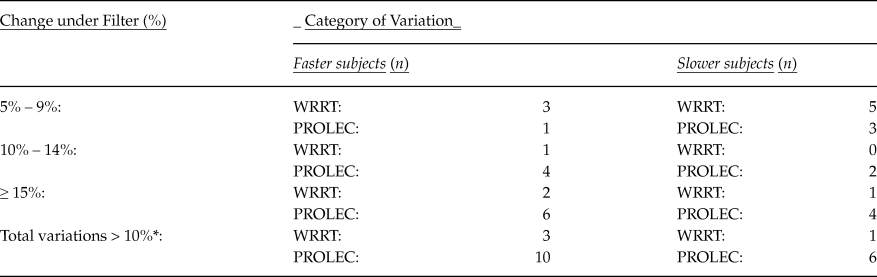
Similarly, the PROLEC-R task detected an insignificant increase (1.02%) in reading speed under the filter condition (identical to that detected by the WRRT). In relation to reading accuracy under each of the two conditions, the PROLEC-R task identified no significant differences in any of the variables measured. However, a case by case analysis of the participants’ scores indicated that 10 (41.7%) of the subjects had recorded reading speed increases of >10% under the filter condition. The same reading task also showed that 6 (25%) of subjects read >10% slower under the filter. Though the results were mixed, the data shown in Table 2 might suggest that the PROLEC-R task (or perhaps, sensible-text in general) may have a greater degree of sensitivity (than the WRRT) with respect to detecting substantial changes in reading speed ability due to variations in conditions affecting reading discomfort, however, the data also suggests that the WRRT is perhaps more sensitive to smaller changes.
Comparison of the Sensitivities of the WRRT and the PROLEC-R Tests Concerning Detection of Changes in Reading Speed Ability of Subjects (n = 24) when under the Filter Condition

* Variations > 10% are deemed noteworthy.
Discussion
The primary intention of this study was to examine the potential role of VS in a non-clinical sample of high performing adults who are expert readers. The results derived under the standard lighting indicated that the impact of VS may be significant, as 4 (16.7%) of the 24 proficient readers recorded moderate to high levels of reading discomfort. Furthermore, the symptom levels reported by these four participants were significantly lower under the filter condition. Contrary to what one might expect, however, the reading speeds (under standard lighting) of three of the participants with higher levels of reading discomfort were actually faster than the mean reading speed of the entire group.
With respect to the effects of the overhead spectral filter, the group’s mean ratings for each of the six reading discomfort symptoms surveyed were clearly lower under the filtered lighting than those reported under the standard illumination, with statistically significant decreases in the awareness of three of the six symptoms. As all participants were proficient readers, these additional findings also suggest that VS can affect all sectors of the population and are consistent with previous reports that the severity of VS morbidity is a continuum (Evans & Joseph, Reference Evans and Joseph2002). Analysis of the WRRT data on a case by case basis indicated that three individuals (12.5%) in the participant group recorded substantial increases (>10%) in reading speed under the filter condition. Despite the possible contribution of practice effect these increases were exceptionally large (27.3%, 24.5%, and 14.0%) and, when considered with these subjects’ significantly reduced levels of discomfort under the filter condition, are suggestive of the presence of VS in these three cases. Moreover, this result fits well with the previous findings of Kriss and Evans (Reference Kriss and Evans2005) who also reported that 12.5% of their control participants (n = 32) read >10% faster (as measured by WRRT) with spectral filters, and thus concluded that 12–14 % of the population are likely to be at least moderately affected by VS.
Interestingly, the PROLEC-R task detected 10 subjects showing gains >10% in reading speed and 6 subjects whose speed decreased by >10% under the filter condition (16 subjects in all). These findings contrast sharply with the results of the WRRT, which identified just 3 subjects who had recorded reading speed gains of >10% and only 1 subject whose speed decreased by >10% under the filter condition (a total of 4 subjects in all). It would thus seem that (in this instance) the PROLEC-R task may have shown greater sensitivity to variations in reading speed attributable to altered levels of visual discomfort (as compared to the WRRT). However, this apparent difference might have simply occurred due to the sensible-text format of PROLEC-R, and not because of the psychometric properties of the test itself. Indeed, we hypothesis that the use of non-sensible text in the WRRT does not allow for the effects of a primordial symptom of VS: ‘reduced span of word recognition’. Improving an individual’s visual span of recognized words (i.e. by means of colored filters) is likely to be of greater benefit to efficient reading fluency if a subject is reading sensible (connected) text, while a wider span of recognition may be less advantageous (and perhaps add to confusion-based errors) when a subject is reading randomly repeated words in a non-sensible text format. Pertinently however, in this particular study neither test detected significant differences in the mean reading speed of the group between the visual conditions, though an obvious reason for the failure to find a difference in reading speed on the two measures could be that the tests were designed to be used with children. When used with a group of adult proficient readers, any improvement that may have occurred under the filter condition would not necessarily have been detected by the measures (i.e. a ‘ceiling effect’ occurred, whereby the adult readers were too proficient under both conditions for any differences to show on the tests). If this were indeed the case, the results then suggest that current reading measures used to test the effects of colored filters on reading discomfort (e.g. WRRT) may not be suitable for use with VS individuals who can read at a capable level.
Furthermore, as the participants enlisted in this study were (in effect) ‘ideal control subjects’, our results have implications for all other studies of VS involving a control group. The findings of the present study suggest that a significant number of control subjects would be likely to also experience symptoms of VS when reading under fluorescent lighting which, the author assumes, would be the standard form of room-illumination in most controlled studies involving subjects with VS. In this context, it is also noteworthy that some studies have used similar ‘pale-yellow/brown’ filters to those employed in this study, though in these cases the filters actually constituted the control measures. Thus, our findings may partially explain the wide range of results reported by previous studies using such putative control measures to investigate the efficacy of colored filters in treating VS and/or dyslexia.
Limitations of the study include the comparison of only one spectral filter to standard lighting. Thus, if a participant with VS required blue filtering (for example) to best alleviate his or her symptoms, then it is possible that the pale-yellow/brown filter utilized in this study may have produced an unfavorable effect for that individual. It might also be argued that the screening of participants may have been enhanced by the inclusion of questions specifically targeting the VS-related disorders migraine and photo-sensitive epilepsy, and that further optometric data could have been obtained from participants prior to inclusion in the study, though previous research has indicated that subtle binocular anomalies or irregularities in accommodation are not key factors in the manifestation of significant levels of VS symptoms (Evans, Reference Evans2001; Evans et al., Reference Evans, Wilkins, Brown, Busby, Wingfield, Jeanes and Bald1996; Scott et al., Reference Scott, McWhinnie, Taylor, Stevenson, Irons, Lewis and Wilkins2002).
Careful consideration of our research findings also reveals two potentially confounding factors which require addressing: 1) the placebo effect; and 2) the somewhat reduced level of illumination under the filtered condition. Importantly however, these concerns were largely allayed by the fact that during the assessments of reading discomfort levels under the two conditions, each of the study’s 24 participants found it necessary to inquire as to which of the conditions actually represented the filter condition. This not only suggests that differences in the illumination levels of the standard and filter conditions were not obvious to participants, but also implies that during the preceding assessments of reading speed the same participants would have been unlikely to have discriminated between the two lighting conditions.
With respect to the measured variance in illuminance between the two conditions, it must be emphasized that the key objective of this aspect of the study was to ascertain if potential benefits to reading might be attainable by filtering existing lighting in schools and offices, without the need for costly modifications to the luminaries themselves. Though the modest variance in the illuminance of the two lighting conditions may raise questions as to whether the reduced reading discomfort reported by subjects was due to differences in the brightness levels, rather than the spectral distributions, the fact remains that the data showed a benefit. The lighting filter utilized in this study created subtle alterations in the visible spectrum emitted by the fluorescent lamps, firstly by reducing several abrupt spikes in emissions at specific wavelengths, and secondly by increasing the proportions of yellow, orange and red light, in relation to violet, blue and green light. Thus, these changes effectively brought the color balance of the SPD emitted by the fluorescent lamps somewhat closer to that of traditional incandescent or indeed of natural lighting. We acknowledge that the small sample size in this study limits the generalizability of the results and thus our conclusions, however, this was an exploratory study and its primary goal was to highlight the potential impact of VS in a non-clinical sample of high performing adults.
It was proposed at the outset of this study that sensitivity to fluorescent lighting may actually be caused by the unnatural proportions (as compared with natural sunlight) of the spectral colors emitted by standard fluorescent lamps. The variations in discomfort reported here appear to substantiate such an argument, as the filter utilized in the present study did not alter the 100 Hz flicker of the lamps, yet the reading discomfort scores showed statistically significant differences between the two conditions. It is notable however, that although the spectral-filter did not affect the modulation frequency of the lighting, it is likely to have had some affect upon the depth of the modulation of the triphosphor lamps used in our study. Based upon previous research by Wilkins and Wilkinson (Reference Wilkins and Wilkinson1991), and Wilkins and Clarke (Reference Wilkins and Clarke1990), we estimate the modulation depth of the lamps to have been in the order of 30–40%. The former study tested a brownish/red filter (FL41, Cambridge Optical) with highly similar transmission specifications to the LEE 205 filter utilized in the present study, and found that the filter increased the modulation depth in triphosphor lamps (from 32% to 39%). It is thus unlikely that the LEE 205 filter in this study caused dramatic reductions in modulation depth.
Although there were no significant differences in reading speed, both tests undertaken by the group of proficient readers were developed targeting children and this may have led to a ‘ceiling effect’, whereby there was little room for gains or variations in reading efficiency for the group as a whole. It is thus pertinent that reading tests designed to detect changes in the reading efficiency of VS individuals (particularly adults), who despite VS can read effectively, appear to be lacking. Future studies might also consider testing participants for pattern glare, which is characterized by symptoms of visual perceptual distortions on viewing striped patterns (Evans & Stevenson, Reference Evans and Stevenson2008). Susceptibility to pattern glare has been shown to be a reliable predictor of VS, as well as migraine and photo-sensitive epilepsy which, in turn, have been linked to symptoms of VS (Wilkins & Evans, Reference Wilkins and Evans2010). Sensitivity to such patterns is dependent upon the spatial frequency between stripes as well as the level of contrast. As lines of printed text and the strokes of letters within words have spatial frequencies that fall within the range that causes discomfort (Wilkins & Evans, Reference Wilkins and Evans2010), and text is typically viewed under high-contrast conditions (black print on ultra-white paper, under bright fluorescent lighting), the Pattern Glare Test (Evans, Reference Evans2001) may be a means of coalescing future research findings.
We believe that any effects of light filtering upon pattern glare in the present study were primarily related to reduced contrast sensitivity and also (with respect to individuals with VS) sensitivities to shorter wavelengths of light (e.g. violet, blue, green). Pattern glare is believed to be caused by hyperexcitability of the visual cortex (Wilkins et al., Reference Wilkins, Huang and Cao2007), and is largely a function of: 1) Spatial frequency; 2) Contrast; 3) Light and brightness sensitivities. Visual illusions occur when an individual’s threshold to pattern glare sensitivity is breached, and this threshold is significantly lower in VS individuals.
Finally, the research presented herein may also have implications for individuals working in situations where rapid and accurate reading is crucial. In this respect, medical professionals working in high-stress (and highly illuminated) hospital settings directly come to mind. In these circumstances, the misreading of a patient’s medical chart (e.g. not noticing a decimal point in the amount of medication prescribed) can be a matter of life or death for the patient. Indeed, the alarmingly high number of avoidable medical errors regularly occurring in hospitals is a serious issue which is recurrently discussed in the media by politicians and medical professionals. In this context, when one considers that all hospital areas have similar illumination levels to that optimal for their operating theatres and that medical staff work long hours in a high-pressure environment where shift-work and fatigue are routine, and then considers that symptoms of VS were prevalent in this study’s group of highly educated expert readers, one might conclude that VS could well be a latent dynamic in hospital settings and thus one of a number of potential factors contributing to rates of avoidable medical errors.
Although the precise underlying mechanisms are debatable, our results indicated that significant reductions in the severity of VS symptoms can be achieved by utilizing simple and inexpensive methods of filtering overhead illumination in schools and offices. Future studies on a larger scale are needed to substantiate these findings, as similar intervention strategies would greatly supplement current treatments with colored lenses and overlays, particularly for the many individuals with VS who are unaware that they have this common condition. Importantly, our primary findings indicating the presence of VS in expert readers were not encumbered by confounding factors concerning differences in illumination levels, as they were based purely upon the data derived under the standard lighting alone. We thus conclude that the results obtained under standard fluorescent lighting (typical of that in schools and offices) indicate that visual stress and related symptoms of reading discomfort can affect readers at all levels of proficiency.
We thank Trinidad García, Natalia Suarez and Estrella Fernández for their valued assistance in the preparation and conduction of the reading tests carried out in this study.