Governments facing internal security threats sometimes enact policies that undercut civil liberties (Davenport, Reference Davenport1995). Citizens’ commitment to civil liberties may also conflict with other important values or concerns such as national security, equality, and law and order (Peffleyet al., Reference Peffley, Knigge and Hurwitz2001; Sniderman et al., Reference Sniderman, Fletcher, Russell and Tetlock1996). After the September 11 attack, for instance, many Americans were willing to trade off civil liberties for greater personal safety (Davis and Silver, Reference Davis and Silver2004). When the perceived threat from terrorism increases, individuals are much more likely to support wiretaps without a warrant, video cameras in public places, and other government measures that strengthen state power (Hetherington and Weiler, Reference Hetherington and Weiler2009, Chapter 6). Other micro-level studies have also shown that violent or terror attacks make individuals more likely to participate in future elections (Balcells and Torrats-Espinosa, Reference Balcells and Torrats-Espinosa2018); more likely to vote for right-leaning parties (Berrebi and Klor, Reference Berrebi and Klor2008); more supportive of policies advocated by political leaders (Gadarian, Reference Gadarian2010); and more anxious about outgroups (Panagopoulos, Reference Panagopoulos2006).
Most of these studies speak about the effect of violence on the electorate in democracies. Yet violent or terror attacks occur in non-democracies as well, and we have limited understanding of their effects (Hou, Reference Hou2017). In the case of authoritarian regimes where the government may not be as responsive to citizen demands, how might acts of violence influence public opinion and policy outcomes?
To answer this question, we implemented an online survey experiment on a national sample of Chinese citizens, in which respondents were randomly selected to view reports on real violent acts in China. We focus on internal violence by controlling for the nationalities of perpetrators, and we further specify internal violence by differentiating types of targets, that is, whether targets of violence are citizens or elites. In light of findings in the civil war literature that civilians possess strong intergroup biases (Lyall et al., Reference Lyall, Blair and Imai2013), we ask whether in peaceful times individuals’ reaction to violence is also shaped by identity and intergroup biases. We find that exposure to violent acts makes individuals more supportive of a strong state: respondents randomly exposed to violence are more likely to approve police use of lethal force. Subgroup analysis reveals that this effect is particularly strong among the less wealthy Chinese. We also find suggestive evidence that individuals exhibit intergroup biases when reacting to violence.
This article contributes to the literature on violence and public opinion in non-democracies. It extends existing studies of the effect of violence on political attitudes to an authoritarian context. Scholars have traditionally focused on measuring voter sensitivity to violent attacks in democratic contexts. We believe it is also important to study the effect of violence on attitudes in authoritarian contexts, especially in the light of an emerging literature that challenges the assumption that authoritarian leaders ignore public opinion (e.g., Distelhorst and Hou, Reference Distelhorst and Hou2017; Lorentzen, Reference Lorentzen2013; Shirk, Reference Shirk, Pekkanen, Ravenhill and Foot2014) and the unfortunate trend of growing terror attacks in authoritarian countries.
BACKGROUND
Among the 55 official “ethnic minority” groups recognized by the Chinese state, Uyghurs are increasingly associated with ethnic violence in the public perception. There are around 11 million Uyghurs, distinguishable from the ethnic majority Han Chinese in terms of language and religion. Nonetheless, most Han Chinese see Uyghurs as Chinese citizens and part of the Chinese state (Bovingdon, Reference Bovingdon and Joseph2014). In recent years, violent incidents have occurred in China with increasing frequency, especially in the northwestern Xinjiang Uyghur Autonomous Region, where the majority of the Uyghur Muslim population reside (Potter and Wang, Reference Potter and Wang2018).Footnote 1 The 2014 Kunming attack, where eight black-clad assailants killed 29 people with knives and machetes at a railway station in the southwestern city of Kunming, was the first time Uyghurs were accused of a major organized attack outside Xinjiang.
The Chinese government has responded to the growing violent attacks with heightened control. Through the “Strike Hard” campaign, the government closely observes religious activities and festivals, monitors Muslims returning from their studies in Islamic schools overseas, arrests and executes suspected terrorists, reinvigorates a system of informants, and recruits minority cadres to the Party and government (Chung, Reference Chung2006). After the 2014 Kunming knife attack, China's security chief, Meng Jianzhu, vowed “all-out efforts” to severely punish terrorists. The state immediately implemented a new policy of preemptive shooting which stipulated that “special police officers, when encountering perpetrators of violence, do not have to follow the procedures of ‘identifying themselves and firing warning shots,’ instead, they can execute criminals on the spot.” Armed troops were seen on the streets of many Chinese cities shortly after the attack. Hundreds of suspects were arrested and more than a dozen suspects were executed in 2014.Footnote 2 These new security measures, although rendering civil liberties at risk, have been welcomed by many Han Chinese.Footnote 3 Unsurprisingly, these measures are disproportionally applied in areas with a large number of Uyghurs. It is argued that the extent and reach of the security apparatus in Xinjiang is “utterly alien to an average Han Chinese” outside the area (Potter, Reference Potter2013). In our study, we measure individuals’ support for one of these new security measures—the preemptive shooting policy, which significantly enhances police authority to use lethal force on civilian suspects.
RESEARCH DESIGN
We conducted an online survey experiment in China in August 2015 to understand how individuals react to violence perpetrated by co-nationals of different ethnicities. Through a popular Chinese crowdsourcing website similar to Amazon.com's Mechanical Turk, we recruited 1,357 respondents throughout the country.Footnote 4 Respondents recruited from this platform are similar to respondents recruited by major organizations and companies who run online panels in China (see Table A1). While our sample is not a probability sample representative of the Chinese population, surveying the online Chinese population is informative and valuable for our research objectives. First, given institutional and technological constraints (Huang, Reference Huang2015), a nationally representative survey in China would involve face-to-face interviews, a method which can be problematic because we are interested in politically sensitive questions such as support for government policies. Second, Chinese netizens are at the forefront of open public discourse, and they are younger, wealthier, better educated, and more likely to be living in urban areas (Truex, Reference Truex2017). Scholars have argued that these young and educated internet users constitute the present and future middle class, whose political attitudes are likely to matter more in the policy-making process (Easterly, Reference Easterly2001).
Of all respondents, 93.5% are Han Chinese, 2.5% are Muslim Chinese, and 4% come from other ethnic groups. We focus on the attitudes of the Han Chinese respondents because the number of respondents from other ethnic groups is too small for any inference to be precise.
Each respondent was randomly assigned into one of the treatment groups or the control group. The Violence-Uyghur treatment is based on a real-life violent incident in China: the Kunming incident on March 1, 2014. This treatment used a vignette that focused on the main factual features of the incident:
[Group Violence-Uyghur] At 9pm on March 1st, 2014, violent knife attacks occurred at the Kunming rail station. According to the statistics collected by 5pm on March 2nd, 29 people were stabbed to death. 143 more individuals were injured, among whom 73 were heavily injured and 70 lightly injured.
In the treatment groups Violence-Han1 and Violence-Han2, respondents read a description of a real recent violent attack committed by Han Chinese. The event described in Violence-Han1 was similar to the Violence-Uyghur event in the total number of fatalities.
The incident described in Violence-Han2 resulted in a smaller number of casualty but it was an attack targeting public officials. We use two different primes of violent events perpetrated by Han Chinese because we are interested in understanding whether the nature of the targets (i.e., citizens versus elites) has an impact on our dependent variable.Footnote 5 We included the perpetrators’ names in the prompts to ensure respondents understood that these events were perpetrated by Han Chinese:
[Group Violence-Han1] At 8pm on June 5th 2009, a perpetrator Zhang Yunliang set a bus on fire in Chengdu, Sichuan Province. The fire caused 28 deaths and many injuries.
[Group Violence-Han2] At 4pm on July 30th 2010, a bomb went off in a building in the tax bureau of Changsha, Hunan province. The perpetrator Liu Zhuiheng dropped the bomb under a conference room table in the tax bureau, causing 4 deaths and 19 injuries.Footnote 6
These are all real-life events. We used the descriptions from actual and official news coverage of these incidents, which consistently emphasized the same set of objective facts. To make these three violence vignettes more comparable, we removed all subjective commentaries and condemnations from their original coverage. Note that in the Violence-Uyghur condition, the ethnicity of the attackers was not explicitly mentioned. We excluded their names for two reasons: first, among the three violent events, the Yunnan knife attack was the most recent and received the most extensive media coverage, and we assumed respondents were aware of the identities of the perpetrators; second, there were eight perpetrators in total, and including all of their names would have made this prompt significantly longer compared to the other two prompts.
Finally, we included a treatment group Ethnicity, in which respondents were not exposed to any description of violent events but only primed to think about their own ethnic identity. Here, we are interested in understanding whether priming ethnicity alone would induce any attitude change towards state use of force. Respondents in this group read a prompt adopted from a standard identity priming treatment (Sniderman et al., Reference Sniderman, Hagendoorn and Prior2004):
[Group Ethnicity] People belong to different types of groups. One of the most important and essential of these groups is the ethnicity that you belong to. Each ethnicity is different. For example, you belong to the (dropdown) ethnicity.
To ensure that respondents read and registered the experimental stimuli, the experimental screen was programmed with an enforced minimum of 10 seconds before a button appeared for the respondent to click and move on. Respondents randomized into the control group only saw a screen displaying “Please wait while the webpage loads.” Immediately after being exposed to a treatment condition or the control screen, respondents proceeded to the following question, which is our main dependent variable—support for police use of lethal force under the new preemptive shooting policy:
Recently, social conflict is on the rise. Would you support the following policy if it were to be proposed:
“Special police officers, when encountering a perpetrator of violence, do not have to follow the procedures of ‘identifying themselves and firing warning shots,’ instead, they can execute the other party on the spot.”
The response options are as follows: (1) strongly disagree, (2) somewhat disagree, (3) neutral, (4) somewhat agree, and (5) strongly agree. It is possible that respondents in the control group, although not exposed to the prompt, might have still associated the preemptive shooting policy description with the Yunnan knife attack, but such effect, if it exists at all, would only result in an underestimation of the true treatment effect. Finally, each respondent proceeded to a series of demographic questions.
Randomization checks show that respondents’ income, education level, marital status, and location do not predict respondents’ assignment to groups. Four Wald tests show that we cannot reject the null that in these models the covariates are simultaneously equal to zero, that is, they are unassociated with the treatment assignments (see Table A2).Footnote 7
RESULTS
In general, there is substantial public support for police use of lethal force under the preemptive shooting policy. Among those in the control group, 9.44% strongly agree and 28.76% somewhat agree with the policy. Respondents of other ethnic groups are dropped for all analyses and all remaining respondents are Han Chinese.
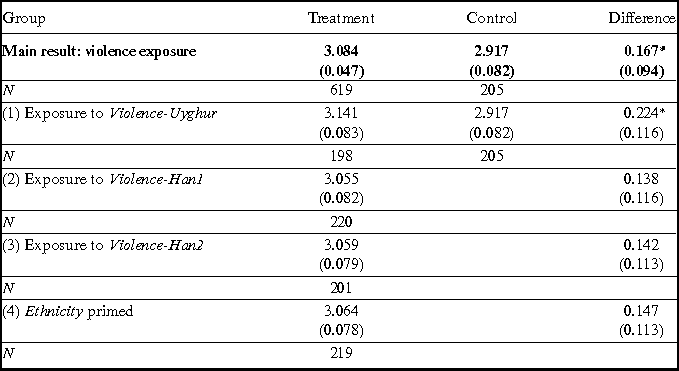
We pool the three violent events together, and find that the support for police use of lethal force increases by a significant 0.167 of a scale when respondents were exposed to the description of a violent attack. On a scale of 1–5 where the maximum change one can have is 4, a 0.167 increase represents a 4.2% change, which is substantively large (p = 0.0386, one sided; p = 0.0771, two sided). When respondents were exposed to the description of the Kunming knife attack, their support for police use of force increased by 0.224 of a scale. Meanwhile, when respondents were exposed to the other two violent events perpetrated by co-ethnics, they also become more supportive of state use of lethal force, but the effects are smaller. When respondents were not exposed to violence but simply primed of their own ethnicity, they also become slightly more supportive of the new policy. These results are presented in Table 1.
The Effects of Violence or Ethnicity Prime on Support for Use of Lethal Force
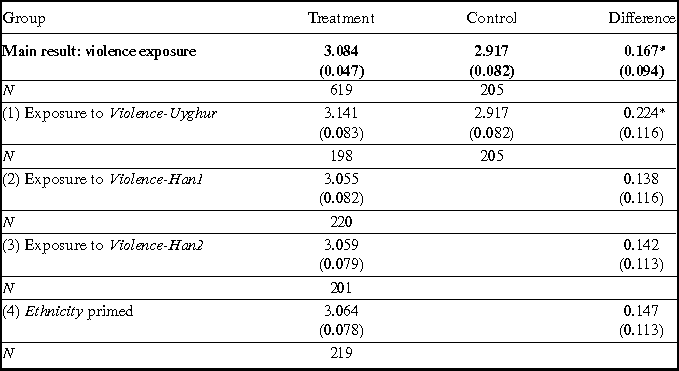
Note. Difference-in-means tests. All respondents are Han Chinese. Ethnic minority respondents are excluded. Respondents who did not answer the dependent variable question, gave inconsistent answer regarding their ethnicities, or took more than 60 minutes to finish are excluded. Dependent variable: Support for police use of lethal force. Scale: 1 (least supportive) to 5 (most supportive). Standard errors in parentheses.
**p < 0.05, *p < 0.1, two sided.
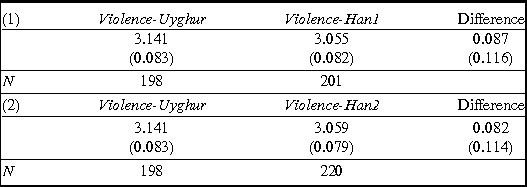
To answer the question of whether respondents react to violent events perpetrated by non-coethnics differently from those perpetrated by co-ethnics, we compare group means between Groups Violence-Uyghur and Violence-Han1 and between Violence-Uyghur and Violence-Han2.
Two difference-in-means tests (Table 2) show that these group means are not statistically distinguishable from each other, although in both comparisons individuals exposed to violence with non-coethnic attackers exhibit higher support on average. Note that the absence of perpetrators’ ethnic identity in the Violence-Uyghur condition makes this prompt different from the other two prompts where the ethnicities of the perpetrators were explicit, and the absence could have led to an underestimate of an ethnic-outgroup effect. Another possibility is that these treatments are under-powered, and thus we could not precisely estimate whether individuals exhibit intergroup biases when reacting to violence.
The Effects of Violence on Support for use of Lethal Force: Comparing Violence Treatment Groups
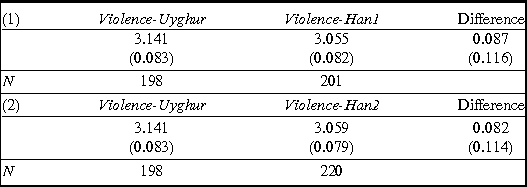
Note. **p < 0.05, *p < 0.1. Neither of these differences are statistically distinguishable from zero.
Finally, we consider whether different demographic subgroups respond to violence in different ways. Previous research suggests that citizens’ trust in government and expectation of government performance can depend on their social-economic status and political background (Truex, Reference Truex2017). Therefore, we divide our sample by income, education level, gender, and Chinese Communist Party (CCP) membership, and estimate the conditional average treatment effect (CATE) for each subgroup.Footnote 8
We again pool the three violent events together and examine how violence affects attitudes towards police use of lethal force. Our analysis indicates that respondents who are in the lower income bracket become much more supportive when exposed to violence. Their support for police use of lethal force increases by a statistically significant and substantially large 0.449 of a scale. The effect remains strong after multiple testing correction (two sided p = 0.0011, group = 4, Bonferroni p-value cut point = 0.05/4 = 0.0125). On the other hand, there is no distinguishable heterogeneous treatment effects by gender, education, or CCP membership (Table A5). These findings suggest that the increased support for police use of force we identified earlier is mainly driven by the less wealthy. The effect among low-income respondents is partially driven by their lower support for police use of lethal force in the control condition, but why they are more likely to increase their support in the face of violence is a question that requires further research. Because our experiment was not originally designed to detect any particular source of effect heterogeneity, larger samples and a more targeted research design will be necessary to better identify variation in effect sizes across groups in future research (Coppock et al., Reference Coppock, Leeper and Mullinix2018).
Taking these findings as a whole, we show that violence exposure makes Chinese citizens more supportive of government use of lethal force, and this effect is particularly strong among the less wealthy Han Chinese. We also find suggestive evidence that individuals’ perception of threat and the resulting support for state use of lethal force may be influenced by intergroup biases.
DISCUSSION
In this paper, we find that citizens in China are sensitive to violent attacks perpetrated by both co-ethnics and non-coethnics, and they tend to react by strengthening their support for state use of lethal force. Public support for a hardline policy is worrisome, because such policies might reinforce fears, foment opposition to the government, and inspire more violence (Bueno de Mesquita, Reference Bueno de Mesquita2005; Krueger, Reference Krueger2017). In China, a stronger security apparatus might further fuel existing grievances and entrench the divide “between a freer and more prosperous east and a security state in the west” (Potter, Reference Potter2013).
One direction for future research is to precisely estimate intergroup bias among individuals when reacting to violence. Another promising avenue is to study the effects of violent attacks on attitudes among the ethnic minorities in China, because their perceptions of the state and group security may diverge significantly from those of the ethnic majority. Extensions to this research may further pursue the mechanisms that underlie the changes in attitudes following exposure to violence. Besides self-reported public opinion data, future research may also consider using other types of data (e.g., government records in Hersh, Reference Hersh2013) to understand how attitudes and behaviors are shaped by different types of violence.
SUPPLEMENTARY MATERIAL
To view supplementary material for this article, please visit https://doi.org/10.1017/XPS.2018.26