Introduction
Coffee, along with tea, sugar, and chocolate, are, to use anthropologist Sidney Mintz's memorable phrasing, ‘drug foods’ (Mintz 1986). They provide little nutritional value, but plenty of energy through caffeine. Along with nicotine, cocaine, and morphine, caffeine is part of the alkaloid family, a group of compounds that produce pharmacological effects in humans and possesses a characteristic bitter note meant by nature to be aversive. Alkaloids are the very definition of ‘an acquired taste’. This bitter and bracing beverage aligned with the nature of Italy's colonial ambitions, coming to symbolise Fascist modernity coffee was energy and speed, aggression and technology – seizing East African coffee forests for the new Roman empire would enhance Italian autarky, or economic self-sufficiency. Coffee's role in Italian autarky has been described by cultural theorist Jeffrey Schnapp as the romance of caffeine and aluminum, two parallel domestic industries producing steaming cups of coffee and gleaming Moka machines, all humming with a Futurist buzz (Schnapp Reference Schnapp2001). This article expands the borders of Italian coffee history from the national to the transnational, demonstrating that this story is Italian – and Brazilian and Ethiopian as well.Footnote 1
This article traces the history of coffee culture across metropole, work site, and colony during the Fascist ventennio (1922–45). In other words, the novel framework of coffee can illuminate the connections between Fascist-period histories that previously have been explored independently. Three arenas reveal the different dimensions of what I term ‘the coffee triangle’, the exchange of beans and bodies between Italy, Brazil, and Ethiopia. By framing this history primarily in terms of the transnational movements of Italian colonos and colonialisti, and secondarily in terms of the coffee beans that travelled in their wake, this article contributes a new geography of triangular trade.Footnote 2 The coffee triangle should not be read as a corollary to the transatlantic slave triangle: it does not substitute the movement of East African coffee beans for the violent seizure of West African people. Rather, it constitutes a critique of the Atlantic world trade routes that privilege northern Europe while neglecting the continued centrality of southern European trade and cultural capital. The history of the coffee triangle actively engages with the previous literature of triangular trade by contributing to a new narrative of labour and agriculture in the modern world.
Specifically, I examine the transnational economics of coffee bean trade routes, the plantation organisation of São Paolo, Harar, Galla, and Sidamo, and the colonial imagery of Roman coffee advertising to argue that caffès emerged as key sites for promoting the Fascist imperial projects in East Africa – an architectural and artistic legacy that remains in place today. Ultimately, this trajectory broadens the way that we understand how food and farming became politicised during the Fascist period. By untangling the interwar trade of beans and bodies between Italy, Brazil, and Ethiopia, this article brings to light an untold story of caffeinated imperial aggression and resistance.
Italian colonos on Brazilian coffee plantations
Where did the fuel for the caffeinated revolution come from? Here, the coffee triangle provides a powerful means to demonstrate how Italy, Brazil, and Ethiopia forged uneven trade relationships through the exchange of beans and bodies. The story begins with the boom and bust cycles of Brazilian agriculture. The Brazilian colonial economy moved through a series of cycles that relied on the overwhelming dominance of one or two products: brazilwood (1500s), sugar (1600s), diamonds and gold (1700s), rubber and coffee (1800s), with each product lasting roughly a century. Coffee is not indigenous to the Americas. In the eighteenth century, the Portuguese planted strains of Ethiopian coffee in northern Brazil, and in the 1840s, the emergence of coffee cultivation provided an engine for economic growth that would transform Brazil for the next century. From the birth of the republic in 1889, the Brazilian coffee oligarchy dominated national politics. Along with Rio de Janeiro, the coffee states of São Paolo and Minas Gerais shared political power and the presidency: between 1894 and 1930, nine of the twelve presidents came from these states. With Minas best known for its dairy products, and São Paolo and Rio for their coffee, historians have coyly referred to this political coalition as café cum leite politics, that is, as the ‘coffee-and-cream alliance’ (Topik and Marichal Reference Topik and Marichal2006). With the arrival of Italian colonos, Brazilian coffee production exploded, going from 5.5 million bags in 1890 to 16.3 million in 1901. Put telegraphically, the steamships travelled a closed loop: Italy exported labour to Brazil and Brazil exported coffee back to Italy. At the turn of the century, Italians drank Brazilian coffee almost exclusively. Italian migration transformed the city of São Paolo, and consolidated the rise of the south-east and the decline of the north-east (Eakin Reference Eakin1997). Brazilian export taxes on coffee provided the vast bulk of revenue for building roads, ports, and post offices. The 1906 valorisation scheme further ameliorated the rosy economic picture for coffee, and introduced the idea of autarky: the production and consumption of domestic products for economic impunity on the world stage.
Between 1884 and 1914, 2.7 million Europeans immigrated to south and south-eastern Brazil, replacing enslaved people as the main labour force on the coffee plantations (fazendas). The boom was driven largely by Italian labour. Brazil was the most popular destination for Italians during these years, surpassing the United States and Argentina. Approximately 1.5 million Italians immigrated to Brazil between 1880 and 1930, their trans-Atlantic steamship tickets subsidised by the Brazilian government until 1902. With this financial incentive, the Brazilian government aimed to attract entire families of northern Italian farmers from the Veneto, the impoverished mountains and floodplains of the Italian north-east, to the coffee state of São Paolo. Once there, the Veneto farming families would aid the Brazilian nation in its agricultural colonisation. By quantitative standards, the financial incentive worked effectively: Italians comprised the majority of immigrants arriving in Brazil during this time. As noted by Aliano of the 1924 Conference International, 70 per cent of all immigrants to Brazil hailed from Italy (Aliano Reference Aliano2005).
Brazil abolished slavery in 1888, concurrent with the first wave of Italian migration. Fazendeiros (coffee barons) largely failed to adjust their approach to labourers, now free women and men, in this short amount of time. Instead, they tried to maintain the intense work pace of coffee slavery with immigrant workers. Life on the fazendas was physically exhausting. Consider the workload for family of Italian colonos: both parents and any children who could work looked after an average of 5–8,000 coffee trees year-round. Harvest and transport added additional layers to this work, as the coffee cherries needed to be picked, dried, hulled, sorted, weighed, sacked, and finally hauled to the nearest train depot for transport to the Santos coffee exchange for sale. Plantation labour contracts relied on the colono system, akin to indentured servitude. Northern Italian families received the use of the land in exchange for their work. They also received a small amount of pay, with income dependent on family size. Because contracts assigned pay based on the total number of coffee plants tended, bigger families meant higher earning power. The Veneto experience on the Brazilian latifondia mirrored that of southern Italian experiences in the large agricultural estates of the Mezzogiorno: in Brazil, a small, white elite used black or indigenous slaves, and later northern Italians, to produce export coffee for the very European markets from which those Italian immigrants hailed. Discipline still meant physical violence.
Despondency pervaded these rural outposts. Coffee farms were located far from urban centres, and the pharmacies and general stores provided on site by fazendieros (coffee barons) often charged usurious rates for necessities like medicine, food, clothes, kitchen utensils and agricultural tools. The despair that marked fazenda life was so common that it even occasioned a popular song, ‘Italia bella mostrati gentile’. The lyrics tell a tale of vagabond misery wherein the singer begs a bargain: if Italy will offer work, then her sons will not abandon her for Brazil. The refrain repeats, evoking the endless stream of departures from the Genovese ports to the coffee harvest in São Paolo, before concluding with a modification, a threat that one day even Brazilians will have to leave their homes for coffee work on the fazendas abroad.
Women suffered multiple layers of misery on the coffee farms, as shown by the advice column of La Cronaca Italiana, São Paolo's Italian-language newspaper for the homesick. From the 1880s to the 1930s, an anonymous columnist responded to desperate letters with home remedies and advice for how to cope with harsh fazenda life. Responses suggest that many Italian colone perceived their coffee farming labour in the context of the slavery system that preceded it. On 13 May 1898, the tenth anniversary of the Lei Áurea, the so-called ‘Golden Law’ abolishing slavery in Brazil, Sig. N.O. Bragança wrote to the ‘Piccola Posta’ section to commend abolition and to decry Italian labour on the fazendas as a new form of slavery. Mothers bore a triple load. Many tried to keep their families fed by raising chickens and growing their own corn and beans between the landlord's coffee rows in addition to their domestic work and coffee farming. Relatedly, many Italian colone feared that coffee farming would consume their European beauty: it built their muscles, slackened their breasts, and darkened their skin. Sig.ra G.T. was one of many women to share this last concern. To her, the columnist advised: ‘To whiten your hands, the easiest way is to wash them morning and night with a tisane of strained barley’. Other responses to women's dashed dreams about immigration to Brazil framed Italian labour more generally. Answering Sig.na R.A., the columnist advised her to remain strong for her children: ‘Sometimes what seems like a dream becomes reality’.
Italian state officials made note of the miserable conditions, and echoed the increasingly common comparisons between slave labor and indentured servitude on the coffee plantations. As a Ministry of Foreign Affairs inspector lamented, ‘The economic conditions of the coffee plantation workers are not adequate given the seriousness of the labour and the sacrifices that life on the coffee plantation imposes’. (De Michelis Reference De Michelis1923, Vol. II, 297). One Italian government agent sent to investigate the São Paolo fazenda conditions concluded that the average plantation resembled ‘a colony of condemned criminals in forced confinement’ (cited in Aliano Reference Aliano2005).
The year 1902 marked the decisive turning point in Italian-Brazilian migration policy. Scathing consular reports on rural labour conditions led to the Prinetti Decree, wherein the Italian government prohibited subsidised passage of Italians to São Paolo. The Prinetti Decree sharply reduced Italian immigration to Brazil, bringing arrivals down from 59,869 to 12,970 within the first year after the law took effect. Despite this dramatic plunge, Italians still immigrated to Brazil in large numbers, in part due to chain migrations linking Veneto families. Between the enforcement of the Prinetti Decree (1903) and Italy's entry into the First World War (1915), 225,033 Italians immigrated to Brazil, with a second migration wave following in the early years of Fascism, with an average 15,000 Italians disembarking annually. In 1924, Italian and Brazilian officials came together in Rome for the Italian Conference on Emigration and Immigration. In this much-publicised diplomatic event, government representatives from both nations revisited the charged debate over rural labour conditions for Italian immigrants in São Paolo, a political firestorm that had burned since the Prinetti Decree. Here, the 1920 Brazilian census permitted informed assessments to address earlier anecdotal accounts from Italian officials. Compared with the census, the agent reports were found to have ignored the first-hand voices and concerns of Italian immigrants, as well as actual conditions on the fazendas. Instead, they tell us much more about state relations between Rome and São Paolo in the early 1920s, and their evolving approach to immigration and emigration. In sum, coffee catalysed what Marshall Eakin has termed Brazil's ‘flawed industrial revolution’ (Eakin Reference Eakin1997). The coffee economy spurred modernisation, but it also reinforced the traditional features of colonial heritage. These records reveal a colonial approach that later expanded to control plants as well as people: the debt patronage system and monocultural farming temporarily consolidated elite domination. At stake in this situation lay the solidification of economic and political ties between South American and European elites.
In interwar Italy, coffee agriculture was all but defined by its practice on Brazilian plantations, which favoured large monocrop fields tended by day wage labour. A briefing from Italian Minister of Exchanges T. Mancini in São Paolo to his counterparts in Rome and Addis Ababa described coffee as a colonial product to be improved through European cultivation. The memo drew heavily on the example of Italo-Brazilian coffee impresario Geremia Lunardelli (Fig. 1). Born the son of Trevisano farmers, Lunardelli emigrated to Brazil in 1886, arriving in Santos while still a toddler. As a child, he worked as a harvester and truck driver on the São Paolo coffee plantations. Lunardelli was a teenager when the coffee crisis hit Brazil. In 1906–07, a bumper crop caused a collapse in coffee prices, bankrupting plantations. In the aftermath, Lunardelli purchased land at exceptionally low cost, quickly acquiring ten fazendas set across the Brazilian states of São Paolo, Paraná, Mato Grosso do Sud, as well as Goiás in Paraguay. Three thousand Italian families tended to Lunardelli's four million coffee plants, which produced 100,000 sacks of coffee per year. The labour and living conditions emphasised hygiene and modernity. Journalistic coverage made much of the free electricity that lit the new brick case coloniche, a decorous replacement for the mud and straw huts used on other plantations. Lunardelli also provided free medicine, and access to an on-site doctor for all workers after two years of labour. Workers could raise their own cows, pigs, horses, chickens, and borrow stalls from Lunardelli to house them. They could also plant cereals amongst the lanes of coffee in the plantations.
Photograph of Geremia Lunardelli, 1944, printed by Jean Manzon. Revista O Cruzeiro 28 October 1944. Fundação Biblioteca Nacional, Biblioteca Nacional Digital Brasil.

But one rule remained: all coffee was to be grown and harvested in the same way. Mancini advocated following the example of monoculturisation set by this and other Italian-owned and -operated fazendas. Lunardelli, Mancini noted, manipulated the physical components of his coffee crops and livestock in two ways: by breeding over generations towards particular traits and through intervention to the current crop generation. In both cases, standardisation stood as the goal, and evidenced the success indicated by Lunardelli's sobriquet, ‘Re do Caffè’.
On his and other successful Brazilian fazendas, monoculturisation meant that all coffee trees were to be the same in genotype, as well as in height, fullness, and harvesting load. This kind of growing works, but only temporarily. It produces lots of beans, but with less flavour and aroma. Writ broadly, the urge to monoculturalisation speaks to visual organisation and productivity but also to economic power and control. Armando Maugini served as the director of the Italian Colonial Agriculture Institute in Florence from 1924 to 1964. He was also the chief technical advisor to the Ministry of Colonies during the occupation of Ethiopia. Because of this work, he became the centre of an influential network of agronomers abroad, connecting scholars from São Paolo to Addis. Maugini also wrote prolifically, authoring over 20 books on the agronomy of tropical climates and founding an agricultural journal, L'agricoltura coloniale. Though the periodical supposedly focused on the East African Servizi Agrari dell'Eritrea e della Somalia Italiana, contributing agronomists relied on Brazilian exemplars to build a framework for Eritrean and Somali crops. First, agricultural scaffolding linked the New World to the Old through tropical plants. Then, it repurposed colono coffee farming knowledge for Fascist dreams of empire.
Dictator Benito Mussolini seized power in 1922, and state documents soon began to cast emigration in more nationalistic language. Propaganda suggested that immigrants abandoned by Liberal Italy would be awakened by the drums of war. In Brazil as well as Argentina and the United States, they, like their Ancient Roman ancestors, formed ‘an empire without borders’. With his 1923 statement to Italian immigrants abroad, Mussolini declared that Italy's relationship to the Americas was ‘like a gigantic extended arm’. In his metaphor, ‘the patria extends out to its distant sons, to attract them to itself, enabling them to participate ever more in its pain, its joy, its work, its greatness, its glory’. The Fascist vision of Italian empire promised to soon raise the status of Italian labourers abroad, transforming them from lowly colonos to respectable colonialisti. Transposed to Ethiopia, Brazilian methods were supposed to make small Italian settlements economically viable (Saraiva Reference Saraiva2018). Fascist imperial projects aiming to rationalise coffee farms would soon return to Brazilian fazenda agriculture, framing it as the ideal model for imperial agriculture. The wait was not long: in 1935, the Fascist regime annexed Ethiopia, and proclaimed the establishment of Italian East Africa (modern-day Ethiopia, Eritrea, and Somalia). Within a single generation, Italians could switch from being coffee plantation workers to being overseers. Soon, this reversal would shape East African plantation life as well.
Italian coffee imports: not Ethiopia, but Brazil
Given that the Italian Fascist regime invaded East Africa, the birthplace of coffea arabica, one might expect coffee consumption in Italy to rise, with an influx of coffee beans from the Ethiopian interior. But in fact, the opposite happened. Advertising evoked coffee harvesting in Harar, Ethiopia, but importation records show that the vast majority of beans continued to come from Brazil. Moreover, overall coffee consumption actually decreased. The decrease was the ironic result of the Ethiopian invasion of October 1935. Emperor Haile Selassie spoke out against Italy's unilateral imperial aggression at the League of Nations, who responded with a raft of trade sanctions from November 1935 to June 1936. Although coffee was not listed among the forbidden exports, fewer ships arrived in Italian ports, resulting in less foreign importation overall (League of Nations, 1936). The Fascist regime responded with vehement propaganda against foreign foods, with particular vitriol for British cuisine due to that nation's central role in the sanction authorship. Though never as popular in Italy as coffee, afternoon tea quickly became potum non grata. Ethiopian-produced hibiscus tea, called Karade, provided an autarkic alternative to teas from the British plantations in India and was ubiquitous in the period's advertising. In the 1935 edition of Dalla Cucina al Salotto, domestic doyenne Lidia Morelli went so far as to add an introductory letter to claim regret that her publishers had not had time to edit her description of té alle cinque to comply with linguistic autarky. In sum, the sanctions not only shaped the sources for Italian caffeine consumption, they also changed the total amounts. Curtailed imports drove coffee consumption down by almost 50 per cent, to 0.8kg per person per year, just under half a cup of coffee a day.
With the League of Nations curtailing imports, why was that half cup of coffee made from Brazilian beans? As cited by Jeffrey Schnapp, a coffee advertisement for Cirio – a major food brand – from the year of the invasion and sanctions explains why: ‘Brazil is a great friend to Italy/ it hasn't observed the sanctions and purchases Italian products/ 2 million Italians live in Brazil’ (Schnapp Reference Schnapp2001). In fact, many of those Italians had relatives who continued to work the Brazilian coffee plantations until the late 1930s. Cirio's slogan ‘Fresh and smells like a rose’ evoked the brand's advanced distribution networks: a good smell not only meant a superior bean, but also their patented pneumatic closure and swift shipping speeds. In a sense, the Ethiopian invasion primed the Italian market for more Brazilian beans than ever before. In 1937, Cirio financed a series of advertisements in connection with Domus, the popular architecture magazine. Palm trees, beach umbrellas, and bathing suits introduced Italian housewives to a new summertime treat: caffè brasiliano ghiacciato, or iced coffee (Fig. 2). Brazilianness figured prominently in Cirio's iconography of coffee. Green, yellow, and blue colour the ‘Ordem e Progresso’ flag in a January 1937 Domus advertisement. Cognate complements ‘Delizioso squisito aromatico saporoso’ speak to both Italophone and Lusophone consumers. Visually, they create the steam rising from this coffee cup. In the February continuation of the series, soft ochre and pale pinks soften the Rio sunset over the Pão de Azucar ‘sugarloaf’ mountains behind a beautiful coffee drinker. As Emanuela Scarpellini has pointed out, ‘coffee figured prominently in the mythology of empire and autarky: of empire because Ethiopia, the nation Italy had invaded was a major producer of Arabica coffee beans; of autarky because Brazil refused to follow sanctions imposed by the world community and continued to furnish Italy with its coffee beans’ (Scarpellini Reference Scarpellini and Mazhar2016). At stake in the Italian invasion of Ethiopia and Brazil's subsequent flouting of the League of Nations sanctions lay the groundwork for cross-associations between Brazilian and Ethiopian plantations in the minds of Italian coffee drinkers. In Fascist Italy, a majority of Italians were aware of East African coffee but almost no one was drinking it. Cultural blurring began.
Advertisement in Cirio-sponsored home economics book. From Il libro di Casa: Domus, Milan, 1938, Museo dell Figurina, Modena, Italy.

Rationalist farming and Ethiopian resistance
Brazil's refusal to participate in the League of Nations trade sanctions explains why so much coffee was coming from Brazil. But even so, why was so little coffee coming from Ethiopia? Italian agricultural imperialism faltered due to Ethiopian resistance – both botanical and political. Italian investigation of Ethiopian agriculture began with the Italian Società Geografica's scientific field station at Let Marefia, inaugurated with a 90-hectare land grant from Negus Menelik in 1877. Although agronomers used the site primarily as a base for expeditions to the south, Let Mariefia also provided the first Italian research headquarters for policy makers interested in the ‘colonizzazione agricola’. As early as 1890, agronomers posited that the Ethiopian and Eritrean highlands might one day produce enough food to support Italian ‘demographic colonisation’ throughout the Horn of Africa (Atkinson Reference Atkinson, Ben-Ghiat and Fuller2005). Grain, then coffee, drove Fascist agricultural experiments in Ethiopia. After 1935, the regime aimed for ‘panificazione’. First, Ethiopian agriculture would provide a model for agricultural autarky for the colonies. Then, it would provide the grain to feed Italians at home.
The Italian Società Geografica and the Istituto Coloniale Italiano both conducted agricultural research in Ethiopia. But under Fascism, the most active and prolific research took place in Florence, at the Regio Istituto Agronomico per l'Africa Italiana. Tropicalists like Armando Maugini and Ferdinando Bigi shaped and directed the East African research programme. Maugini drew on his previous experience in Libya as the agricultural authority for the regime's colonial settlement plans for Cyrenaica to develop the rural programmes for the enhancement of Ethiopian plants and animals. In cooperation with the Fascist government in Italian East Africa, operations soon extended to Addis Ababa, with the establishment of the Agrarian Bureau in 1936, and the Experimental Agricultural and Zootechnic Centre for Italian East Africa in 1938. As the colonisation of Libya made clear, the fastest way to obtain land for Italian concessions was to confiscate the estates belonging to the emperor, the rebels, and the church. But in Ethiopia, dispossessing the former elite did not mean that their lands were ready for Italian farmers. Unlike Libya, Ethiopian agriculture ran on a sharecropping system, wherein Ethiopian workers with lifetime contracts farmed the fields of absentee owners. Although Italian experts soon recognised that a large proportion of Ethiopian agriculture worked through sharecropping systems, many took a naïve view of diplomatic relations. They contended that when Ethiopian land entered Italian hands, most Ethiopian sharecroppers would simply continue farming, with no objections as to whether they paid a lease to the former Ethiopian elite or the new Italian settlers. Instead, local opposition was the norm. Granted, there was land in abundance. But as Maugini acknowledged, ‘it was not vacant but densely populated and intensely cultivated’ (Tilley Reference Tilley2011).
Facing intense resistance from Ethiopian sharecroppers, colonial agronomers were anxious to prove that agricultural know-how justified Italians’ privileged position in Ethiopia. When panificazione failed, they were quick to identify coffee as one of the few safe sources of revenues of the new colony. Unlike wheat, the critical commodity required to feed the colonial army and the builders of the colonial infrastructure, coffee encouraged imperial dreams. If Italian agronomers could increase coffee production in Harar, Arussi, and Galla-Sidamo, then colonial rule in Ethiopia would not just survive but thrive. To this end, the regime established Italian settlements in Ethiopia, including the ONC (Opera Nazionale Combattenti) plan to settle veterans and their families at Holeta and Ada. Additionally, they attempted to transplant entire Italian farming villages to Harege (Ente Puglia) and Gondor (Ente Romagna d'Etiopia).
Coffee concession contracts granted by the colonial government to Europeans reveal these abortive attempts at demographic colonisation to be failures, in part due to their approach to local populations. Settlement schemes displaced the Ethiopian coffee harvesters, who were expected to work in the new concession areas. Architectural sketches for the sites further explain the spirit of relations envisioned by colonial planners. Case coloniche for the ONC settlement, for instance, provided a large, central area for Italian farmers and a closet-like room for Ethiopian domestic workers. The pattern of labour relations was repeated at the level of the village. Colonial town layouts contrasted with the urban plans used for Italy's internal colonisation of the Pontine Marshes, which dispersed case coloniche in parallel lines to encourage the smooth flow of foot traffic. In rural Ethiopia, the layout of squares within squares provided security. The ONC settlement was oriented around a central Italian piazza, complete with a communal bakery.Footnote 3 A square of eight case coloniche meant to house 40 veterans-turned-farmers formed the next, larger plaza, followed by an additional eight adjoining holdings grouped together into a larger square. Under siege, the settlement converted into a compound, the inner and outer boxes snapping shut, one after the other. Further out still, huts for the Ethiopian workforce formed the vulnerable perimeter, a buffer zone to protect the Italian piazza at the settlement's heart.
In addition to potential attacks, colonial planners and agronomers frequently fretted over the relatively greater height of coffee trees planted by Ethiopians with respect to the shorter trees recently planted by Italians. Constant measuring and comparison tracked the trees, with the stated goal of determining the day that Italian would outpace Ethiopian tree height. But height has no relationship with productivity. Shade cover, soil health, tree age, and harvesting frequency determine coffee cherry quantity and quality. These facts were known to agronomers and colonialists alike. And yet, it is this very fact that agronomers insisted on: increasing Italian tree height denoted a certain kind of eugenic success in the colonies. Productivity evoked fertility: yearly budgets for colonial settlements calculated prize money for families with numerous children alongside prize money for those families’ numerous plants. In the specific case of Puglia d'Etiopia, financial officers lumped the two into a single budget item, just over 8,000 lire in 1938 for productivity prizes, with no distinction made between new coffee trees planted and new colonialists birthed. Pronatalism, the bearing of numerous children, had a botanical corollary in the hyper-productive health of European coffee plantations. Sandra Ponzanesi has noted the constant conflation of territorial and sexual conquest in Italian imperial logic: here, we see dovetailed issues in play (Ponzanesi Reference Ponzanesi, Andall and Duncan2005). Agronomers wanted both Italian-and Ethiopian-planted coffee trees to be rational, their growing method ‘proved’ by height. But Italians’ implicitly superior rationality was expected to produce taller trees within this rationalist framework.
Didactic materials drawn from the Italian Colonial Agriculture Institute's agricultural courses for future colonialists reveal an internal tension between two mutually exclusive goals for Fascist empire in Ethiopia: high coffee yields and Italian plantation oversight. Therein lay the problem: Ethiopian-run plantations produced more and better coffee. This fact negated a key justification for Italian empire. How could the regime claim to be conducting a civilising mission in Africa if their coffee plantations lagged behind local production? Reading government documentation against the grain suggests that colonial agronomers introduced rationalist farming to enhance output – gridded rows, planned planting dates, extensive signage. These moves are not all that surprising. What is surprising is the fact that they continued to celebrate rationalist techniques despite extensive evidence that they did not work. And yet, using rationalist farming was so important to agronomers that they even introduced it to successful Ethiopian-run plantations, resulting in coffee of poorer quality and lesser quantity. The performance of control mattered more than enhancing the product yield. What was deemed rational was not in fact logical.
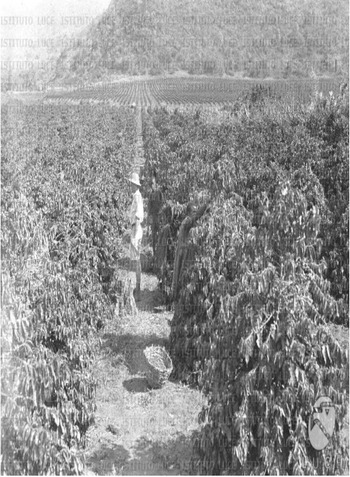
Rationalising coffee meant human planting, not spontaneous semination. It meant orientation in angled rows, not circular clumps (Fig. 3). Rigid adherence to calendars, with annual planting cycles fixed in the 12-month Italian calendar, not the 13-month Ethiopian one. To teach these techniques, Italian agronomers called for construction projects: an experimental coffee station at Malcó, with satellite pedagogical plantations, complete with agricultural guides printed in the local languages. Plans for multi-lingual signs would make Ethiopian plants legible to Italians and supposedly vice versa. But the vast majority of indigenous coffee harvesters did not read, and the few who did typically learned Italian first (Peveri Reference Peveri2012). In other words, these signs did not aim for local legibility:instead, this intervention – never actually carried out, but widely proposed at agricultural conferences – was designed to display a knowledge of African languages for parallel European powers.
Photograph of an Italian-run coffee plantation in occupied Ethiopia. Archivio Luce, Rome, Italy. Reparto Africa Orientale, Serie G.S. ‘Piantagioni di caffè’, 1935–7. Description reads ‘Indigeni al lavoro in una piantagione di caffè sotto la sorveglianza di un italiano in tenuta coloniale’ (‘Natives at work in a coffee plantation under the supervision of an Italian on a colonial estate’). Photo code: AO00009966.

Biopolitical control of the Africa Orientale Italiana (AOI) has traditionally been understood as state-sanctioned violence enacted on human bodies. By contrast, this analysis has taken an ecocritical approach to imperialism, investigating how the Fascist regime attempted to control not only human biology, but the ecosystem itself. Ultimately, these projects failed on three accounts: the botanical, the chemical, and the political.
First, Italian interventions in Ethiopian coffee agriculture drove national production down. Florentine agronomists working for Ministry of Colonial Agriculture attempted to rationalise Ethiopian coffee farming by using the monocultural model of Brazilian fazendas to standardise tree type to produce higher yields. Italian colonialists cut down forest belts between fields that would have acted as natural barriers, helping to check the spread of fungal spores, and switched to intense monocropping which temporarily boosted coffee bean production, but ultimately doomed the crop.
Second, in terms of the bean's growth: in comparison with Brazilian robusta beans, Ethiopian arabica beans were harder to farm and had lower yields. Robusta's higher caffeine content was also toxic to bugs, providing a chemical defence for the coffee seed that arabica did not have. Biological diversity protected coffee trees not at the level of the farm, but at the scale of the forest. Rationalisation of the coffee plantations relied on excessive use of water and fertilizer, and quickly depleted soil quality. Diminishing biological diversity opened the door to the disease H. vastatrix, a parasitic fungus that causes leaf rust (McCook Reference McCook2006). The lone survivors of la roya (the blight) were the isolated cloud forests of Ethiopia, the pockets of political resistance turned botanical, with their diversity of coffee trees that the Italians could not touch. As Mesfin Tekle relates, in Amharic ‘[the fungus] doesn't have a name, because it doesn't have an impact’ (Koehler Reference Koehler2017). Finally, large amounts of coffee were being both produced and consumed in the East African empire during this time, but not necessarily by Italians. As noted by Ayele Bekerie, the Italian occupation of East Africa was brief and precarious (Bekerie 1989). Despite the enthusiastic heralding in regime propaganda of the thousands of Italian colonialists crossing the Mediterranean to settle in Ethiopia, settlement data for coffee's centre of origin suggests the venture was a dismal failure. By January 1940, the Gallo Sidamo region housed only two settlements comprised of 55 case coloniche of 50 hectares each. In sum, the total area for coffee plantations run by Italian farmers totalled a mere 2,300 hectares. Even with the additional 25 capitalist coffee concessions, this still totalled only 32,000 hectares of Italian cultivation. The Ethiopian Patriots’ Resistance Movement typically operated through rural campaigns, meaning that Italian rule in Ethiopia was largely confined to towns. The majority of Ethiopian coffee farmers settled in the southern interior, the geographic hub of the nation's political opposition. Galla Sidamo, although considered the most promising coffee zone, had been the last part of the Ethiopian territory to be pacified, a fact noted even by colonial officers as justification for the region's poor yields. But even with this caveat, coffee production belied the promises of proletarian empire made by regime propaganda. Italian peasant settlements lagged far behind the capitalist concessions in regional coffee production and indigenous coffee growers. In the end, the majority of ancestral coffee forests and farms remained Ethiopian-owned and operated throughout the Fascist period.
Italian caffè culture and East African influence
In bars as well as wholesale shops, advertising and interior design reminded Italian consumers that coffee was a colonial product, and this imagery provided both general and specific forms of support for invasion by emphasising the goods to be gained and diminishing the humanity of the people harmed. Desserts created during the Fascist period often employed the trope of Africa in their product name, such as Africanette sponge fingers and Assab liquorice, named for the Eritrean commercial port where the Rubattino steamship company first established an Italian commercial presence in East Africa.
The 1920s and 1930s were a period of pervasive and explicit racism, in aspects ranging from segregation to the 1938 Race Laws, which restricted civil rights of Jews in Italy and Libyan, Ethiopian, Eritrean, and Somali subjects in the colonies. Unsurprisingly, Fascist empire and its corporate allies produced racist imagery. As this next section will demonstrate, these tropes have proved to be depressingly enduring. Advertising imagery on caffè posters and wall panels conflated colonial persons with colonial products by using dark coloured skin as a visual pun for dark coloured foods (Pinkus Reference Pinkus1995). People turn into coffee beans, the very definition of objectification (Fig. 4). Colonial importers paid artists and design studios to produce pugno nell'occhio or ‘punch-in-the-eye’ style food advertisements. In the 1920s, this artistic style was considered a marketing breakthrough: advertisers believed that searing neon icons cast against dark backgrounds had the power to burn Campari soda, Liebig meat extract, and Perugina chocolate into consumers’ minds, forging brand identity in a period when this was a very new idea. In the 1930s, coffee importers recycled the punch-in-the-eye ads to create their company trademarks as part of brand expansion into caffès.
‘Qui comando io!’ (‘Here I command!’) Coffeee advertisement by Studio Tytan, Trieste, Italy, 1925–30. Water, graphite, paper, 31.1 x 21.9 cm. Wolfsonian Museum, Miami, USA, (XX1990.3681).

The pugno nell'occhio style explains why these images are so visually memorable, but why are there so many of them? The proliferation of these images comes from the economics of bar ownership, specifically, from ‘comodato d'uso’. This contractual form links coffee bean suppliers to caffè owners through monthly supplies. Italian bars make most of their money by selling coffee – not liquor, not pastries, but coffee. To keep the coffee bean purchases coming, importers are invested in keeping all parts of the caffè in business: so along with the beans, they front the cost of the espresso machine and its monthly maintainance as well all the crockery associated with the bar. This explains why the colonial imagery of these former groups proliferates from advertising to lottery tickets to candy wrappers. This Nougat ad by Severo Sepo visually embodies this idea ‘one thing leads to another’, and then these images endlessly duplicate (Fig. 5).
‘L'una tira l'altra: Nougatine Unica’, (‘One thing leads to another: Unica Nougatine’). Advertisement painted by Severo Sepo for Venchi Chocolates, Turin, Italy, c1935, 30.5 x 61cm. Archivio della Communicazione, Parma, Italy.

The seminatrice in caffè decoration and design
The final section of this article focuses on one specific advertising trope, the seminatrice (coffee sower) to examine how the food industry supported increased military enlistment in the Abyssianian campaign. As noted by Sandra Ponzanesi and Cristina Lombardi-Diop, the regime distributed postcards, photographs, and pocket calendars of what were known as ‘Venere Nera’ or ‘Black Venus’ images free of charge to young men at barbershops and bars to increase military enlistment (Ponzanesi Reference Ponzanesi2012). The front of these cards showed East African women in erotic poses against expansive landscapes, the backs provided contact information for army enlistment offices. It exemplifies the stereotypical conflation of territorial and sexual conquest. Caffès then adopted and slightly modified this practice, creating a food-focused variant: the coffee sower (Fig. 6). They handed out paper ephemera, like the scented pocket calendar shown here, that simultaneously advertised their specific caffè and Ethiopian coffee as a product. Supporting colonialism was in importers’ financial interests: introducing Ethiopian beans into the market would have created competition with Brazilian beans, driving prices down. Perhaps that is why erotic coffee sowers appeared everywhere during this period.
Scented pocket calendar interior page, ‘Harrar: Raccolta del Caffè’ (‘Harrar: Coffee Harvest’), in ‘Il Trionfo della Civiltà’ (‘The Triumph of Civilisation’), printed by Stab. G. Rocca, 1938. Milan. Museo della Figurina, Modena, Italy.

Here a critical contrast emerges: whereas paper ephemera mapped sowers onto a specific geographic space (Harar, Ethiopia) in interior design, this trope evoked a more generalised coloniality, as in the Roman caffè Tazza d'oro (Fig. 7). Here, the sowers on the walls are life-size, standing just over four feet tall. A mirrored background collapses the geographic distance between the harvester located in a generalised colonial space of production, and the caffè patron in Rome. An outdoor sign with Spanish text shows the seminatrice again, and advertises ‘El mejor del mundo’, further confusing questions of language and nationality. Although the interior design has been refurbished, the imagery of the harvester has been part of Tazza d'oro's branding from its opening in 1946. Put another way, this colonial image was actually created after the Fascist period ended. The seminatrice's postwar dating speaks to the persistence of these images even into the present day. In the case of the caffè's motto, the imperial sentiment not only persisted but actually intensified. The original slogan voiced coffee beans: ‘I come from around the world, I go around the world’. Today's motto is, ‘In every cup of coffee is a journey, in every sip a new conquest’. During the 1930s, these mottos and images were a larger Fascist imaginary that conflated Brazilian beans (the product sold in Italy) with Ethiopian sowing and harvesting (the images advertised in Italian caffès). These tropes constructed East African women as agriculturally productive and easily conquered.
Tazza d'oro entrance, Rome, Italy. Photographed by author, 8 February 2018.

Seminatrice imagery directly contrasts with the actual military history of Ethiopia, as exemplified by the chronicle of Empress and cannoneer division leader Taytu Betul (Fig. 8), who was in fact fully clothed and martially formidable. Perhaps caffè decoration attempted to provide a form of wish fulfilment in the metropole that belied diplomatic and military histories abroad. To further complicate the narrative, different caffès told different stories: Francophone patrons could have read Le Petit Journal's account of Betul's martial prowess, as well as her preferred role as the diplomatic ‘heavyweight’ of the royal couple. By contrast, Spanish speakers might have read belittling accounts of her diplomatic career when they purchased a box of Manuel Oríí Roca Benicarló Chocolates.Footnote 4 In an example of dictatorships crossing borders, these narrative cards told an Italian version of the Ethiopian invasion. For example, the card deck, ‘La Guerra entre Italia y Abisinia’, (‘The War between Italy and Abyssina’), provided propagandistic photos of Fascist Italian projects in East Africa. Collectable cards in this deck characterised Betul's rule as ‘un periodo de indisciplina’ (‘an undisciplined period’) leading to insurrections in the northern Tigray region (Fig. 9). The deck was distributed along with chocolates to coffee houses all over Fascist Spain. The larger point is that caffès – along with other public venues like tea parlours and chocolate shops, were politicised places in the public sphere – here, attitudes towards colonial people and products were constructed within larger systems of commercial concerns.
‘S.M. Taïtou, Impératrice d'Abyssinie’, from Le petit journal: supplément illustré, 29 March 1896, No. 12147. Parti Social Français. Clermont-Ferrand (Bibliothèque Nationale).

Collectable picture card, ‘Un mercado en los alrededores de la capital’ (‘Market in the Outskirts of the Capital’), in ‘La Guerra entre Italia y Abisinia’ (‘The War between Italy and Abyssina’) series. Printed by Manuel Oríí Roca Benicarló Chocolates Company, 1939, Barcelona, Spain. Card 20 of 23-card set. Wolfsonian Museum, XC2014.12.12.40.15, Miami, United States.

From the Tazza d'Oro seminatrice to the Starbucks mermaid: the transnational history of Italian coffee
Today, the interwar coffee triangle continues to inform the agricultural models for Ethiopian and Brazilian coffee farming, as well as the aesthetics of transnational caffè culture. In terms of the former, the Agro-Forestry System attempts to mimic the original Ethiopian coffee harvesting style. Garden coffee now goes by the trade terms ‘shade-grown’ and ‘bird-friendly’, as white-cheeked turaco and large silvery-cheeked hornbills symbiotically co-exist with the coffee trees, sheltering in them while also eating and dispersing the seeds. Indigenous sun drying methods bring out tropical aromas and wild berry flavours; they add to the body density, and a creaminess in the mouth. Artisanal coffee farms now mimic the Ethiopian model – including the Italian-run plantations in Brazil.
In 2018, the average Italian consumed 5.9 kilograms, or 13 pounds, of coffee. Little wonder then, that the nation's espresso is currently under consideration for UNESCO status as an Intangible Cultural Heritage of Humanity (Povoledo Reference Povoledo2019). Starbucks founder Howard Schultz has long peddled northern Italy as the American chain's spiritual birthplace. In 2018, Starbucks opened their first Italian flagship, a reserve roastery, an Art Deco amplification of Milanese coffee culture. Steam and gleam light the macchia verde marble counters, bronze casks refract deeper sepia tones. A Carrara marble mermaid – the figurehead to the Starbucks mast – sails over the portico. Call it cream-punk: glamorous industrialisation rules this roastery. In effect, the Milanese Starbucks with its growling Scolari roaster is a granddaughter to the Caffè Asmarino Odeon, with its roaring Gaggia machine. In modern Italy as in interwar Eritrea, the colonisation of coffee culture is largely illusory, catering not to locals but to foreigners. Commercial empire shapes caffè architecture, and the rituals that caffeine-seeking patrons enact within these spaces.
More broadly, the legacy of the coffee triangle asks us to consider what coffee was doing for people culturally at this particular historical moment: contemporary caffè culture was created in a period heavily marked by Fascist and imperial logic. Cups break but those images tend to be recycled. In a bizarre modern corollary, colonial products like coffee and sugar remain vehicles for Italian far-right politics today. In 2015, a strange trend swept through northern Italian bars, wherein right-leaning baristas ordered Fascist-themed novelty sugar packets from Mussolini's birthplace in Predappio (Fig. 10). Dubbed ‘caffè nero’ by the press for the black Fascist voting card colour, the practice remained a journalistic novelty, fortunately never rising to the status of a true cultural phenomenon. Nonetheless, these sugar packets demonstrate how Fascist foodways can re-emerge, zombie-like, long after they are assumed to be culturally dead.
Sugar packet ‘Discorso del Duce al Teatro Lirico Milano 1944’ (‘Mussoini's Speech at the Lyric Theatre of Milan 1944’), printed in Predappio, Italy. Photograph from article by Matteo Bianchi, ‘Caffè nero a Ferrara. E lo zucchero? Con il Duce’ (‘Black Coffee in Ferrara. And sugar? With the Duce’), subtitle, ‘Caffè “nero”: la polemica ha indotto i titolari a ritirare le bustine. C’è chi è entrato nel locale col saluto romano’ (‘“Black” coffee: controversy led owners to recall the packets. There are some who enter the locale with the Roman salute’). La Nuova Ferrara 28 November 2015.

Benedetto Croce famously called Fascism a parenthesis in Italian history. This article argues that it works like a magnifying glass, blowing up tendencies in society that are always there but often harder to identify. This holds true for far-right politics in the United States as well. Many of the ideas discussed in this study of coffee history pre-date and post-date Fascism. The intention in engaging in this conversation is to demonstrate how dictatorial politics have shaped and continue to shape quotidian spaces and objects. To do so, this article has connected concrete examples from everyday life (coffee beans and machines) to broad historical phenomena (the economics of imperialism). By providing this very small piece for this very large project, the coffee triangle contributes to a more complete and accurate historical record. At stake in these questions is how the past creates the present.
Notes on contributor
Dr Diana Garvin is an Assistant Professor of Italian with a specialty in Mediterranean Studies. She works in the Department of Romance Languages at the University of Oregon. Garvin conducted her postdoctoral research at the American Academy in Rome as the 2017–18 Rome Prize winner for Modern Italian Studies. She received her PhD in Romance Studies from Cornell University, and her AB from Harvard University.