Introduction
Whether one views the League of Nations as a noble experiment in international peace-keeping or as a means of consolidating Anglo-French imperial hegemony in an era of ascendant nation-statism, there is little disagreement that the League failed to realize its self-stated goal of global collective security. By 1933 Japan and Germany had both withdrawn from the League. Italy's exit in 1937 signalled its pending dissolution and a concomitant shift in the global geo-political order, a shift which held especially ominous implications for countries failed by the League's collective security mechanisms. Despite the League's manifest weaknesses, however, it was nevertheless a powerful force in structuring conceptions of national sovereignty and global justice during the interwar period, in particular in Nationalist China. There, the League's handling of disputes over Manchuria (1931–1933) and Ethiopia (1935–1936) shaped widespread debates about the extant international order, the subordination of colonized countries within it, and the contours of a new international system that would enable China to escape from its protracted position of political-economic and military vulnerability.
As the Manchuria and Ethiopia crises unfolded, members and supporters of China's ruling Nationalist Party (Guomindang) reflected on the global hierarchies institutionalized by the League, the role of international law in maintaining these hierarchies, and the implications of collective security for nations classified by the League as ‘weak’ (ruoxiao minzu). The Nationalist Party's decision to work within the League structure after the party assumed state power in 1927 signalled its support for the international system that the League represented, and that it regarded China's incipient inclusion within a network of formally equal sovereign states under Anglo-French leadership more favourably than its potential absorption within an expanding Soviet-led anti-capitalist sphere. Yet this decision also meant that China was drawn even more deeply into the geo-political conflicts that precipitated World War II, and that the party was soon fractured by debates concerning the ideological and practical implications of League participation for colonized and semi-colonized countries. These debates took stock not only of Japan's unchecked ascendancy but also of global-scale shifts in inter-imperialist power relations, in particular the League's incapacity to constrain the expansionist ambitions of Germany or Italy, and how such shifts threatened to erase the real and perceived progress of many colonized and semi-colonized populations towards national sovereignty.
At the same time, Nationalist debates also engaged with the ways in which anti-colonial struggles had hitherto been fought largely against the League's dominant member states, and the fact that countries such as China and Ethiopia, which had requested the League's assistance against Japan and Italy respectively during the 1930s, occupied compromised positions within the organization. In the wake of World War I, the League had effected a shift in international relations by attempting, as Antony Anghie has written, to ‘promote self-government, and, in certain cases, to integrate previously colonized and dependent peoples into the international system as sovereign, independent nation-states’.Footnote 1 Similar to the Mandate territories formerly governed by Imperial Germany and the Ottoman Empire, but unlike the many colonies which were denied independent League representation altogether, countries such as China, Ethiopia (Abyssinia), Iran, and Thailand joined the League as self-governing members that exhibited key signs of nationhood but still ostensibly required civilizational tutoring by Euro-American powers and/or Japan.Footnote 2 China joined the League in 1920 as a sovereign member state, but also as one whose juridical autonomy and territorial integrity remained subject to violation by permanent members of the League Council, in particular Great Britain, France, and Japan. China, like Ethiopia which became a focus of Chinese concern on the eve of World War II, remained bound to international treaties signed under duress with the League's dominant powers that permitted colonial-territorial leaseholds with autonomous police and legal administrations as well as the local stationing of foreign military forces. League membership thereby crystallized the multivalent set of regional and global relationships in which China was entangled, and rendered visible China's structural position on the world stage. It also therefore remained a latent source of tension within the Nationalist Party, which faced the challenge of reconciling its own anti-imperialist stance with the compromises entailed by League membership.
The League's efforts to mediate Japan's claims to Manchuria in 1931 and to prevent Italy's invasion of Ethiopia in 1935 constituted two major flashpoints that brought these latent tensions to the surface, for they illuminated the precarious position of countries caught between the League and the expansionist ambitions of Japan, Italy, and Germany. As the Manchuria and Ethiopia crises unfolded, Nationalist Party adherents vocalized a spectrum of discomfort with China's League membership ranging from criticism of the organization's racial hierarchies to outright repudiation of its universalist claims. At one end of the spectrum, members of the Nationalist diplomatic corps expressed disappointment in the League but reaffirmed their commitment to its cosmopolitan principles. At the other, the fascist organization popularly known as the ‘Blue Shirts’, which formed under Nationalist auspices in response to the Manchuria crisis in 1931, charged that the League represented a false universalism and argued that countries such as China and Ethiopia should withdraw, for their own safety and integrity, into national isolation.Footnote 3 Blue Shirt criticism was matched in intensity by that of the prominent publisher Tang Liangli, who used the pages of his People's Tribune to challenge the League's civilizational yardsticks and to argue that China should script its own laws and forge its own international alliances. These contrasting views of the League reveal how Nationalist disunity on the eve of World War II was inflamed by disagreements over the nature and ideal structure of the global order. Chinese fascists perceived the looming world war as a pivotal historical conjuncture in which China could continue to submit to imperialist domination or begin to assert its own national will as had Germany, Italy, and Japan. Despite the intensity of this desire, however, they understood China's worldly predicament to be far closer to that of semi-colonized Ethiopia, and agitated for overcoming this predicament through lockstep national-racial unity, dictatorial rule, military armament, and violence against internal and external enemies.
Tensions of Nationalist China's League participation
In private correspondence dated October 1935 between Victor Chi-tsai Hoo, one of China's envoys to the League of Nations, and Samuel Sung Young, then working for the Chinese Legation in Rio de Janiero, Hoo wrote that ‘I am beginning to be sick of the League's incompetency, the Big Powers’ intrigues and our own helplessness, I often wonder whether it isn't a waste of time to be here [in Switzerland]’.Footnote 4 Young replied that he had been following with great interest ‘the activities of the League in connection with the Italian-Abyssinian affair and I have very much the same opinion as you’.Footnote 5 The Italian-Abyssinian conflict, Young continued, ‘may be said to be similar to our Manchurian situation of four years ago, in which the League took no action whatever, other than that of sending an investigating commission; now, because the interests are nearer home a different attitude is being taken’. Young noted that when he had spent time in Geneva in 1928, ‘I gained a very strong impression of the League's impotency, the intrigues of the Big Powers, and the hopelessness of our country ever expecting justice from that source’.Footnote 6 These two ranking diplomats, including one of the Nationalist government's own League envoys who later would work for the United Nations, observed distinct parallels between the disputes over Manchuria and Ethiopia.Footnote 7 Despite such concerns, China's diplomatic corps, and the Nationalist leadership more broadly, continued to support China's League participation.Footnote 8 Yet as Japan, Germany, and Italy challenged the League, tensions that had vexed China's League participation from the outset rose to the surface and prompted newly-emerged fascist activists within the party to denounce both the League and fellow Nationalists who supported it.
The League got off to an ignominious start in China and other parts of the colonized world, and it continued to trouble the Chinese political landscape for the duration of the League's existence. In 1919, Chinese representatives to the Paris Peace negotiations had been physically prevented from signing the Versailles Treaty by Chinese activists who had mobilized in opposition to the treaty's provisions to transfer China's Shandong peninsula to Japanese control.Footnote 9 The League had at first required that all potential members ratify the Versailles Treaty in order to join, but this clause was altered to allow signatories of other peace treaties to join as well. Chinese delegates signed the Treaty of St Germain in September 1919, which included the Covenant of the League of Nations, and China became a League member after the treaty's ratification in July 1920.Footnote 10 At the time, the Nationalist Party had not yet attained national power, but it lobbied from its south China power base against the League's willingness to transfer Shandong to Japan.Footnote 11 However, after the Nationalists under Chiang Kai-shek (Jiang Jieshi) seized centralized state power in 1927, altered national, regional, and global circumstances had fostered a prevailing Nationalist interest in working with rather than against what was widely perceived to be an organization for defending imperialist concerns.Footnote 12
Despite the compromises it entailed for their anti-imperialist platform, the new Nationalist government embraced the ways in which League membership seemed to signal China's equitable inclusion within a world system of sovereign nation-states.Footnote 13 The Nanjing-based regime courted the League's favour and resources for its own domestic and international advantage, whilst the League, aware of China's burgeoning communist movement and the expansionist ambitions of Japan, increasingly backed Nanjing's sovereign claims.Footnote 14 Appointees to China's Ministry of Foreign Affairs after 1927 reflected this general moderation of the Nationalists’ anti-imperialism, and the Nationalists’ professed ‘revolutionary diplomacy’ grew markedly less confrontational overall.Footnote 15 As Margherita Zanasi has shown, Nanjing's National Economic Council also accepted an incipient form of development assistance from the League to the extent that it supported the NEC's own economic agenda.Footnote 16 Nationalist leader Chiang Kai-shek supported China's League participation, even if for pragmatic reasons.Footnote 17 Chiang's erstwhile power rival, Wang Jingwei, also continued to publicly endorse the League until he performatively repudiated it in 1940 by assuming leadership of the Japanese-controlled Reorganized Nanjing government.Footnote 18 Although Nationalist China remained a League member until the organization dissolved at the end of World War II, China's standing within the League inevitably became a subject of intraparty debate.
Of primary concern was the fact that China's continued obligation to ‘unequal treaties’ signed with the League's dominant powers compromised China's standing within the organization and the world at large. As the League covenant required of all members, Nanjing inherited the expectation that it would ‘give effective guarantees of its sincere intentions to observe its international obligations’.Footnote 19 Insofar as China's ‘international obligations’ included unequal treaties which were precisely the medium through which China had been colonized since the first Opium War treaty was signed in 1842, and which the Nationalist Party was actively working to nullify, the institution that supposedly accorded China international recognition of its sovereign nationhood also undermined it in important ways. Even before the Manchuria and Ethiopia crises erupted, Nationalist supporters of the League felt compelled to publicly justify China's participation. For instance, a 1929 article on ‘The Question of Whether to Quit or Use the League of Nations’ printed in the supplement to the Nationalist Party paper Central Daily [Zhongyang Ribao fukan] addressed mounting popular pressure for China to leave the League over its lost election bid for a rotating seat on the League council.Footnote 20 The author Zhou Wei, who was part of China's delegation in Geneva, acknowledged that imperialist countries dominated the League, but insisted that participating in the organization accorded with the Nationalists’ general ethos of international engagement insofar as the League set the standard for ‘world evolution and the progress of international society’.Footnote 21 China did not have the resources or defence capacities to remain outside the League, as did the USSR and the United States, nor could it afford to alienate other members by exiting.Footnote 22 Zhou thereby acknowledged China's relative disempowerment within the League, but rationalized its continued participation as a sign of progress, good faith, and a sound defence strategy.
In September 1931, when the Japanese Kwantung (Kantō) Army moved to occupy Manchuria, tensions of China's League participation strained to breaking point and shadowed the crisis that erupted on the ground. In the Manchurian city of Mukden (Shenyang) on 18 September 1931, Japanese officers bombed a section of the Japanese-owned South Manchuria Railway with the intent to frame Chinese nationalist agitators and to provoke Tokyo into assuming direct control of northeastern China.Footnote 23 Then-chairman of the Nationalist Party, Chiang Kai-shek, opted to refer the dispute to the League rather than to mobilize his own underequipped troops.Footnote 24 China's League delegation, headed by V. K. Wellington Koo (Gu Weijun), then appealed to the League to investigate the matter and restore the status quo ante.Footnote 25 Because China had recently regained the aforementioned rotating seat on the League council, it was comparatively well positioned to challenge Japan's actions, even though Japan was itself a permanent council member.Footnote 26 The Lytton Commission dispatched by the League in January 1932 to investigate the situation ultimately decided that Japan's Kwantung Army had acted belligerently and that China had stronger historical claims to Manchuria than did Japan. After the League voted with near unanimity in February 1933 to accept the commission's findings, Japan resigned from the League.Footnote 27 Japan's resignation dramatically escalated political strife in East Asia by signalling to Great Britain, France, and the (influential League non-member) United States the limits of their capacity to curtail Japan's continental expansion. It also prompted Nationalists to reevaluate China's relationship to the League's universalist claims, forcing a rift between those who upheld the League's goals of mutual global governance and those who denounced the organization as a fig leaf for defending imperialist concerns.
This rift opened wider when, in February 1932, Japan's League delegates protested that China's claims to Manchuria were unfounded because of China's domestic disarray.Footnote 28 As Prasenjit Duara has observed, delegate Matsuoka Yōsuke attempted to invalidate China's capacity to approach the League as a legitimate national grievant in the first place, charging that China was ‘not an organized state’ and therefore did not warrant League membership.Footnote 29 Matsuoka argued that China's deterioration into ‘a state of complete anarchy’ meant that ‘the rights and interests of foreigners ensuing from various treaties and conventions have ceased to be protected’.Footnote 30 Japan's delegates thereby insisted that the League's recognition of China's membership eligibility actually threatened the rights and interests of other members. They pointed to the 1922 Washington Conference and to the British, French, and Japanese signatures on the resulting Nine-Power Treaty, which had upheld China's territorial integrity whilst also reiterating ‘open door policies’ dating to 1899 that had secured equal foreign access to Chinese markets.Footnote 31 China's internal disarray signalled that it would default on its ‘international obligations’ and thereby the terms of its League membership. That the League ultimately found Japan's claims unpersuasive could be seen as evidencing the League's commitment to shepherding weak nations towards empowered independence. However, it was also the case that Japan's actions in Manchuria threatened unequal treaties in which European council members, as well as the United States, had stakes—a fact which crystallized China's compromised position within the League and the complications of appealing to the organization for assistance in resisting Japan.
The Manchuria crisis thereby forced Nationalists to reckon with the implications of China's League participation: was it a gradualist avenue to equitable national participation in the international community, or did it further enfetter China to long-established structures of imperialist domination? China's own League delegates, including Victor Hoo, who were fully cognizant of Euro-American investment in the treaties and of their fear that Japan's actions would edge them out of the China market, themselves invoked the 1922 treaty to motivate signatories to defend China against Japan.Footnote 32 As Stephen G. Craft has observed, China's League envoys continued to advance this line of argument even after Japan had left the League.Footnote 33 Doing so may have demonstrated China's good faith regarding its obligations to the League and extant international law, but it also pledged China's support for treaties which were precisely the medium through which the country had been colonized.
Such decisions on the part of China's diplomatic corps drew fierce criticism from Nationalist party activists whose politics were moving further and further to the right as the 1930s wore on—men who were virulently anti-communist, advocated dictatorship to quell China's social instability, and imagined China as an organic community of ethno-racial kin ensnared within a world of predatorily competitive nations. This camp included members of the fascist Blue Shirt organization, which was founded under Nationalist auspices in the wake of the 1931 Mukden Incident. It also included Tang Liangli, a publisher and former Nationalist diplomat who later became a propaganda and foreign minister for Wang Jingwei's Japanese-controlled Reorganized Nationalist government during the 1940s.Footnote 34 Unlike the Nationalist diplomats who retained faith in the League's universalist principles, these men expressed anger at the compromises that League membership entailed and began to imagine alternative forms of international organization and alliance. They saw in the League's weakness an opening to a new global order in which historically colonized populations could begin to script their own laws, forge their own alliances, and defend their own interests.Footnote 35 The solutions they advocated did not aim to end inter-imperialist warfare or racialized conflict, but instead regarded these as natural and aimed to strengthen China's capacity to engage in such warfare.
Soon after Chiang Kai-shek referred the Manchuria dispute to the League, Tang and the Blue Shirts began to vocally criticize the League's structured hierarchies in the pages of their own publications. These publications included Tang's People's Tribune and the Blue Shirts’ The Future [Qiantu] and Sweat and Blood Weekly [Hanxue Zhoukan], which openly debated official government policies and hence constitute valuable resources for gauging the broad spectrum of Nationalist opinion.Footnote 36 Contributors accused Nationalist diplomats who opted to work with the League of tacitly accepting the permanency of China's global subordination and argued that the League illuminated the ways in which norms of international justice served populations already deemed ‘civilized’. Cemil Aydin has observed how the League constituted the first ‘international institution from which to demand justice based on normative principles’ which theoretically applied to humanity in general.Footnote 37 By institutionalizing the norms of justice, the League also heightened the implications of their denial. This denial prompted activists on China's far right to refute the premises of these normative principles and to articulate desires for a restructured world order in which historically colonized populations could set the terms of their own international engagement. They viewed Japanese, German, and Italian departures from the League with both fear and admiration: fear that Japan, Germany, and Italy would re-divide the colonial world between themselves, and admiration that these rising fascist powers had broken the League's fetters in exactly the manner that they wished China could.
Civilization at the crossroads
Several years before the Manchuria crisis erupted, Tang Liangli remarked that ‘the complete victory over China at Versailles. . .made her realise the necessity and expediency of not counting on the friendship or trusting the promises of any white nation’.Footnote 38 Even though the League condemned Japan's seizure of Manchuria in winter 1933, Tang maintained that the council's conflicts of colonial interest inevitably tainted its capacity for justice. The body of international law it employed to adjudicate disputes between members, Tang argued, was indivisible from that which bound the Chinese government to the unequal treaties. For Tang, the problem was not merely that the League covenant obliged China to preexisting treaties, but that the law of the League had itself been written to entrap colonized populations. He was ultimately unconcerned with whether or not appealing to the League had been strategically prudent. Rather, Tang turned his critical gaze to the League's racial hierarchies, its civilizational measurements, and their inflection in international law, arguing that justice was impossible to secure from any ‘white nation’ as such.Footnote 39
As the Manchuria crisis unfolded, Tang Liangli's Shanghai-based, English-language monthly The People's Tribune: An Organ of National-Revolutionary Thought and Opinion, to which all Nationalist Party leaders contributed either directly or in translation, printed trenchant criticism of China's League involvement. The fact that Tang published in English bespoke his mission to address directly his targets of critique and to alert China's foreign community to the range of opinions within Nationalist circles that by default affected all of them.Footnote 40 In the pages of The People's Tribune, Tang named China's worldly predicament as one of ‘a tributary State. . .an international dependency’ subjected to uni-directionally binding international laws which were formulated to maintain its subordination.Footnote 41 In a 1 February 1933 editorial responding to developments in Geneva, Tang observed that ‘in the present quasi-anarchical state of international relations. . .international law [is merely] a matter of expediency and military strength’.Footnote 42 Only by refusing to recognize the legitimacy of extant international law could China begin to reverse the socio-economic legacies of imperialism.Footnote 43 He criticized Nationalist diplomats—those who, like Victor Hoo and Wellington Koo (Gu Weijun), appealed to British and French interests in upholding the unequal treaties against Japan's expanding claims—for accepting ‘the Imperialist assumption of China's international inferiority, passing without challenge any foreign diplomatic pronouncement which in effect put China on the level of backward, undeveloped territories, inhabited by primitive semi-civilized tribes’.Footnote 44 By approaching the unequal treaties as negotiable in the first place, Nationalist diplomats sanctioned laws that were forcibly imposed, one-sidedly observed, and formulated to maintain China's subjugation.
Taking aim at the men then staffing Nanjing's Ministry of Foreign affairs, Tang charged them with failing to see that international law had different meanings in the West and in China, ‘where the main body of principles of law and equity is not applicable, but only a kind of appendix designed for countries outside the “pale of civilisation,” i.e., outside Christendom’.Footnote 45 Tang pointed to the 1922 Washington Conference, where Chinese delegates had pleaded with the major powers to reposition troops stationed beyond locations agreed upon by the 1901 Boxer Protocol. Rather than challenging the presence of foreign troops on Chinese soil and questioning China's obligations to all treaties signed at gunpoint, they ‘tacitly accepted the foreign assumption of China being an international dependency’.Footnote 46 Specific treaty provisions were incidental to the more pressing issue of the legitimacy of the laws that bound China to the treaties in the first place. In this way, Tang observed how the Manchuria crisis exposed the League's structured, racialized hierarchies—even as Tang distanced the Chinese from what he deemed ‘primitive, semicivilized tribes’—and how these hierarchies were shrouded in the language of civilization. China's foreign ministers, Tang suggested, lived by the fantasy that the League would someday deem China sufficiently civilized, even though recent events had indicated that this day would never arrive.
Other contributors to Tang's monthly noted how the League's civilizational measurements—which for instance delayed Ethiopia's membership until 1923—were overdetermined by the League's refusal to adopt the racial non-discrimination clause put forward by Japanese delegates in 1919.Footnote 47 Although Japanese delegates in Paris were themselves more interested in securing Shandong and Germany's Pacific island colonies than in seeing the clause adopted, the fact of its rejection cast a shadow over the League's subsequent proceedings and fostered an awkward situation in which Chinese critics of the League found themselves simultaneously wary of and sympathetic to Japan.Footnote 48 Commentators in The People's Tribune, for instance, noted the ways in which the League's racial hierarchies bound China and Japan closer together. Hao Wu-teh, identified by the monthly as a ‘distinguished student of sociology and international affairs’, observed that on the one hand, China's case before the League was compromised by longstanding alliances between Britain, France, and Japan—what he dubbed the ‘Super Council’.Footnote 49 On the other hand, the League's mediation of China's dispute with Japan was complicated by the fact that the League had ‘definitely repudiated the idea of racial equality, taking a stand for discrimination against Orientals and other “coloured peoples” such as exists in the United States and some British Dominions’.Footnote 50 The Lytton Commission's decision quite possibly spelled the ‘further extension of White influence in the Far East—which may or may not be to China's benefit’ as far as thwarting Japanese encroachments were concerned.Footnote 51 Hao thereby observed that collective security, which defended China's territorial claims in this case, amounted to acquiescing to racial discrimination as well as to the extension of Euro-American imperialism in Asia. If a demonstrated superpower such as Japan inevitably struck a glass ceiling within the League's confines, what could China ultimately expect to gain from participating?
In this way, the League's mediation of the Manchuria dispute illuminated China's compromised position within the League, and by extension within the world order that the Nationalists had officially opted to endorse. Articles in the People's Tribune presented the League as representing a false universalism that the Nationalists supported at the expense of their own integrity. Tang Liangli's own solution to this conundrum was to become an active propagandist for Japan's New Order in East Asia, with the idea that the expanding Japanese empire represented an effective counter to Euro-American racism and a means of escape from modern structures of imperialist domination.Footnote 52 More commonly, however, Nationalists who decried the League as representing a false universalism instead insisted that China should assert its national will against Japan, and that all historically colonized populations should withdraw from the League into national isolation. This position was vociferously argued by a group of radical young military officers popularly known as the Blue Shirts, which, as noted above, formed under Nationalist Party auspices in 1931 in response to events in Manchuria.Footnote 53 By the mid-1930s, the Blue Shirts had established numerous publishing houses and ran a variety of newspapers and magazines in which they demanded direct action to confront the Japanese threat without relying on any kind of foreign support.Footnote 54 In 1935, when Italy attacked Ethiopia and the latter turned to the League for assistance, the Blue Shirts saw the Manchuria crisis playing out once again, this time in a manner that signalled the imminence of a second world war. The Italian-Ethiopian conflict prompted the Blue Shirts to view the threat that Japan posed to China in the light of a broader shift in the global geo-political order—in which the League could not constrain the expansionist ambitions of Germany, Italy, or Japan—and to insist that countries such as China and Ethiopia should sever all international alliances and strengthen their own capacities for self-defence.
The Blue Shirts, Ethiopia, and the lessons of League participation
As Italy mobilized to invade Ethiopia in 1935, the Chinese press across the political spectrum highlighted connections between this conflict and Japan's encroachments on Chinese territory.Footnote 55 Scores of articles noted commonalities between China and Ethiopia's worldly positions, their common relationship to the League, and how both conflicts signalled an ominous shift in inter-imperialist power relations. Historians, in particular Margherita Zanasi, have compellingly illuminated the ways in which Nationalists admired the social and economic dimensions of Italian fascism.Footnote 56 Yet Nationalist identification with the victims of Italian imperialism has received little scholarly attention.Footnote 57 For some, including members of the Nationalist government's diplomatic corps, the Ethiopia crisis further eroded their confidence in the League's capacity for impartiality when mediating disputes concerning counties victimized by Euro-American imperialism.Footnote 58 For Blue Shirt activists, the Ethiopia crisis underscored the practical and theoretical impossibility of ‘weak nations’ securing justice from the League. Convinced that the international arena was regulated only by Darwinist laws of competition, the Blue Shirts not only objected to the fact that imperialist powers dominated the League, but also to the very idea of mutual global governance. Strong nations, they reasoned, naturally preyed upon the weak, and it was the responsibility of the weak to defend and strengthen themselves. Rather than appeal to the League, they argued, China and Ethiopia should assert their own autonomy and fight for a world order in which their own nation would never again be caught between imperialist rivals. The Ethiopia conflict moreover heightened Blue Shirt anxieties about the threat that Japan posed to China by signalling that the League could not even effectively check an expanding fascist power in its own backyard.
In December 1934, Italian soldiers provoked a skirmish with Ethiopian troops in the disputed border town of Walwal, for which Italy demanded an official apology and financial compensation.Footnote 59 As the conflict escalated in early 1935, Ethiopian delegates appealed to the League of Nations to arbitrate, whilst Britain and France attempted to curtail Rome's actions through the Hoare-Laval Pact, which ceded portions of Ethiopian territory in return for respecting Britain's regional interests.Footnote 60 When Italian troops proceeded to invade Ethiopia in October 1935, the League condemned Italy for unlawfully attacking a fellow member and imposed sanctions from November 1935 until July 1936. The sanctions prohibited member states from purchasing Italian commodities, extending loans and selling arms, but excluded war-related materials like coal, steel, and oil.Footnote 61 After Addis Ababa had fallen to Italian troops and Italian King Victor Emmanuel III had been crowned Emperor of Ethiopia in May 1936, deposed Ethiopian Emperor Haile Selassie III addressed the League of Nations assembly.Footnote 62 In addition to cataloguing Italian crimes, Selassie's June 1936 address charged the gathered delegates with sharing responsibility for them, emphasizing the conflicts of colonial interest that had prompted the League council to approach Rome gently and to prevent Ethiopia from obtaining the means to defend itself.Footnote 63 Despite Selassie's plea, the League lifted sanctions once Italy's occupation of Ethiopia appeared to be a fait accompli, signalling its preference for ingratiating Italy over defending Ethiopia's sovereignty.Footnote 64
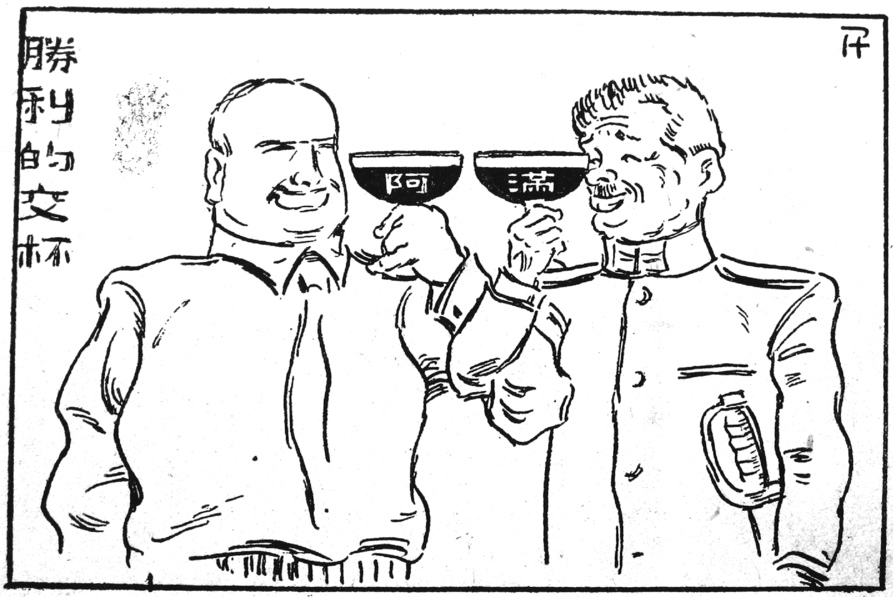
The League's handling of the Ethiopia crisis elicited angry responses from China's Blue Shirts, who, by 1935, rejected the League as an unnatural means of regulating an inherently conflict-ridden, Darwinist international order. A cartoon published in a 1937 issue of Hanxue Zhoukan [Sweat and Blood Weekly] shows Italian Prime Minister Benito Mussolini and Japanese Foreign Minister Hirota Koki toasting their respective acquisitions of Ethiopia and Manchuria, whilst the latter are linked by their common victimization (see Figure 1). In their estimation, the international arena was regulated only by natural laws of competition between inherently unequal, racially-culturally defined nations. An organization such as the League could only be the expression and instrument of the strongest, and it would readily sacrifice its weaker allies to preserve its dominant position. The Blue Shirts thereby retrospectively criticized Chiang Kai-shek's decision to refer the Manchuria dispute to League mediation, and that of Ethiopia's government to appeal to the League for assistance. They admired the challenge that Germany, Italy, and Japan presented to the League, desiring that China become as militarily formidable and assertive of its national will as these rising fascist powers, while expressing profound anxiety that China's present global position was far closer to that of Ethiopia, and hence that China was an easy target for Japan's expansionist ambitions.
‘Shengli de jiaobei’ [‘A Mutual Toast to Victory’]. Italian Prime Minister Benito Mussolini's cup is labelled ‘Abyssinia’ (A) whilst Japanese Foreign Minister Hirota Koki's cup holds ‘Manchuria’ (Man)
Source: Hanxue Zhoukan [Sweat and Blood Weekly], 8:1 (1937), p. 7.

According to one Sweat and Blood Weekly contributor, the volume of Chinese press attention devoted to Italy's invasion of Ethiopia was so great that excepting ‘primitive desert and forest peoples’, the attention of the entire world was riveted upon the conflict's progression.Footnote 65 Between 1935 and 1937, photographs, photo-collages, cartoons, and editorials pertaining to the conflict appeared in the Blue Shirts’ myriad publications. On the one hand, this commentary praised Italy's rapid rise from a weak to a strong nation capable of acquiring its own colonies and asserting its will against Britain, France, and the League. On the other hand, it also expressed alarm over Ethiopia's rapid subjugation. Italy's actions, the Blue Shirts suggested, were in accord with how nations normatively act within the international arena. An editorial in the Blue Shirt publication Qiantu [The Future] by a contributor pen named Wei on ‘The Crisis of the Italian-Abyssinian War’, for instance, reasoned that once a country's military and political strength outstrips its available supply of natural resources ‘this country must attack outwards to attain the natural riches necessary to maintain its political and military needs. The country that it attacks must have rich and fertile produce and have a low level of popular knowledge, it must be a backward country or tribe with an undeveloped government and military’.Footnote 66 Italy's actions followed Darwinist laws of competition: the strong inevitably preyed upon the weak and it was therefore incumbent upon the weak to develop measures to defend their own resources. In this respect, the Blue Shirts understood sovereignty to be synonymous with the capacity to develop and defend a nation's territory and resources. Anything which impeded this capacity, such as a League of Nations, by extension countered the laws of nature.
Nevertheless, Blue Shirt characterizations of Ethiopia's transformation into an object of colonial desire bespoke their anxieties about China's own global position. They examined how Ethiopia was coveted for its agricultural and mineral wealth, its potential as a market for European and Japanese commodities, and its geo-strategic importance. Most importantly, they identified with the ways in which Ethiopia was targeted because it was an independent country amidst a sea of formal colonies. Jiang Yiqing—a commentator for a provincial girls school publication in a region patrolled by Blue Shirt paramilitary squads—observed that because the rest of Africa had already been claimed by European powers ‘only the black east African kingdom of Abyssinia could be encroached upon with relative ease’.Footnote 67 By this logic, Ethiopian leaders had taken inadequate steps to defend themselves.Footnote 68 An anonymous writer for The Future opined that despite having been hemmed in by British and French colonies for decades, Ethiopians were still unprepared to deflect the Italian attack, and this lack of preparation forced them to appeal to the League.Footnote 69 By the same token, this assessment of Ethiopia's failure to defend itself can be read as an implicit critique of China's own military weakness and reliance on the League for defence against Japan.
The Blue Shirts also examined the ways in which the League's imperialist leadership compromised its capacity to impartially mediate territorial disputes. Mo Deng, a pseudonymous contributor to Sweat and Blood Weekly, stated matter-of-factly that ‘the League is a weapon of British foreign policy’ and that British ‘measures [to assist Ethiopia] have unquestionably been enacted for its own benefit’.Footnote 70 He noted that ‘invading another country and oppressing their people is not limited to Italy’ so why else would the League attempt to circumscribe Italy's actions?Footnote 71 Britain could not ignore Italian aggression against Ethiopia because of its economic and geo-strategic stakes in Northeastern Africa; it was clearly concerned with retaining control of the Suez Canal as a ‘lifeline to India, Singapore, Australia and the great market of the Far East—China. . .’.Footnote 72 In this way, Blue Shirts equated appealing to the League’s collective security framework with acquiescing to imperialist domination, because it implicitly sanctioned the rights of permanent council members to violate the territorial integrity of weak nations.
From their perspective, far from protecting either China or Ethiopia from the predations of stronger powers, the League rendered both more vulnerable by discouraging self-reliance. In the pages of Sweat and Blood Weekly, Jun Kuang observed that:
During the Mukden incident, we [Chinese] cried out in distress to the League of Nations, but with what result? The League of Nations advocates for the strong, it is not a tool to help the weak. This turn of international events hinges upon superior and inferior capacities for self-reliance. In facing a national crisis one must make plans of one's own accord and not be lured into traps by seeking foreign assistance.Footnote 73
Collective security essentially entrapped those lacking modern weaponry and military training.Footnote 74 Elsewhere, Jun lamented how the ‘extreme humiliation of the Abyssinian people has made a mockery of weak nations’.Footnote 75 Whilst Britain and France were left to worry about their failed experiment in global governance, countries such as China and Ethiopia faced the far more pressing problem of national survival.
The global-scale shift in inter-imperialist power relations heralded by the League's demise threatened to demote countries such as Ethiopia and China from semicolony to full colony. After Italian troops occupied Addis Ababa, a contributor to Sweat and Blood Weekly named Bai Ning observed how ‘the only independent kingdom on the African continent’ was poised to lose the independence it had narrowly retained throughout the modern era.Footnote 76 Although China had not yet suffered Ethiopia's fate, the ‘domestic crises that it harbours are no different from those of Abyssinia before the war’.Footnote 77 As Bai put it, China still had time to save itself by implementing self-reliant resistance policies, achieving material self-sufficiency, and exterminating all national traitors.Footnote 78 In a similar vein, the editors of The Future derived from Ethiopia's fate the importance of self-reliance and self-defence.Footnote 79 Any nation which found itself in Ethiopia's position should ‘redouble preparatory efforts in the areas of production, construction, training, organization, etc., with the intent to save itself’.Footnote 80 The aforementioned Jun Kuang similarly observed that the ‘sufferings of Abyssinia before the war and those of our country are quite similar, and there are affinities between Abyssinia's resistance against Italy and ours against Japan’.Footnote 81 The lessons of Manchuria and Ethiopia, then, were that collective security not only failed but also endangered non-dominant member states.
Disappointment with the League was common throughout the world on the eve of World War II, but fascist critiques were grounded in a broader attack on the principle of inter-national cooperation. Jun Kuang, for instance, argued that interactions between nations had nothing to do with justice but were rather a zero-sum game, and that it had therefore been ‘foolish’ of Haile Selassie to expect it from the League.Footnote 82 Echoing Tang Liangli's critique of international law, Jun suggested that justice amounted to whatever the stronger power declared it to be, and thereby blamed Ethiopia for placing naive hope in Britain and in the League.Footnote 83 He went so far as to mock Selassie's June 1936 speech to the League, responding to Selassie's famous charge that ‘God and history will remember your judgment’ that ‘the League of Nations has never had a God’. Far from fearing God's wrath, the only thing that the League feared, Jun insisted, was that Italy would tender its resignation.Footnote 84 Now that the League had revealed its true colours, Ethiopia's people had ‘no means against the dread of Italy's cannons, planes and poison gas’ and their leader no longer had the credibility to wage a successful resistance struggle.Footnote 85 Still others insisted that insofar as Japan was likely to be emboldened by Italy's victory in Africa just as Mussolini had been emboldened by Japan's victory in Manchuria, self-defence was more critical than ever.Footnote 86
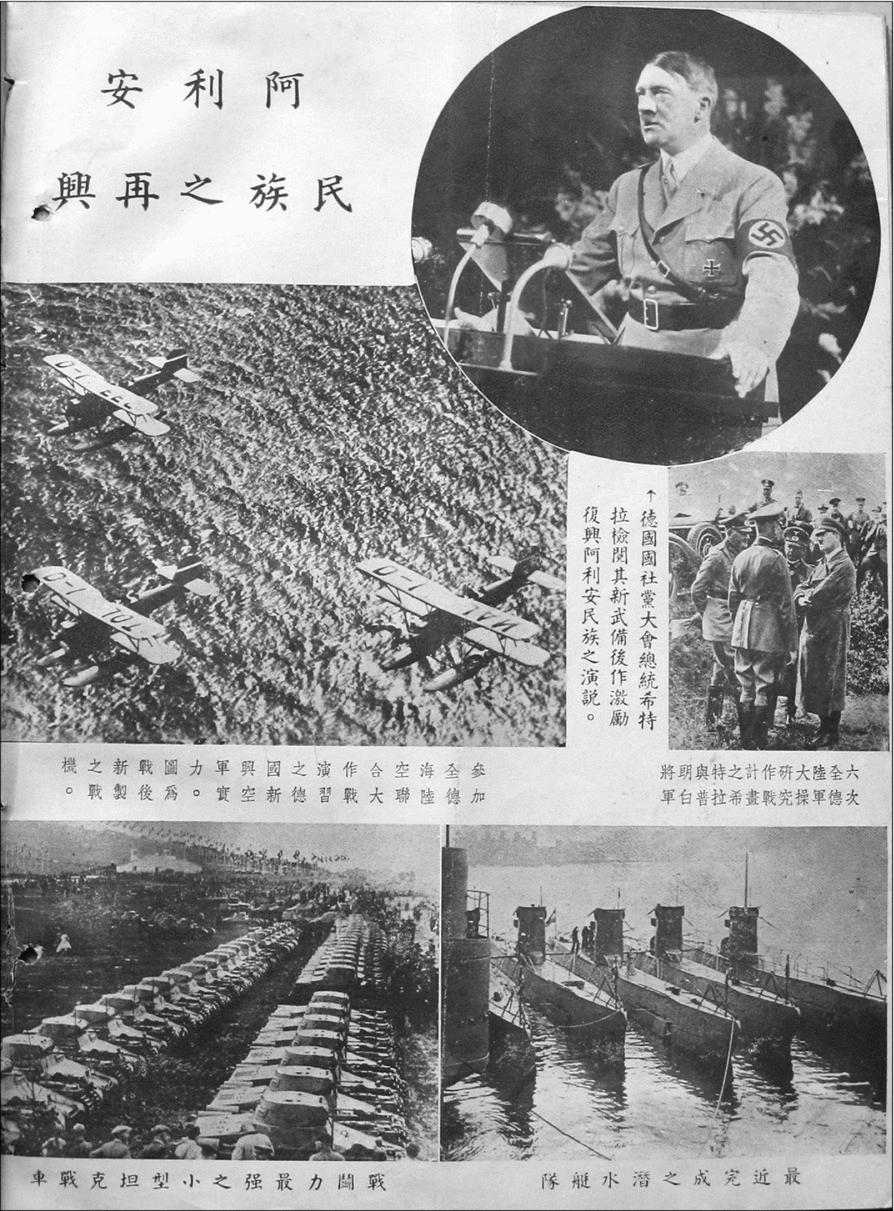
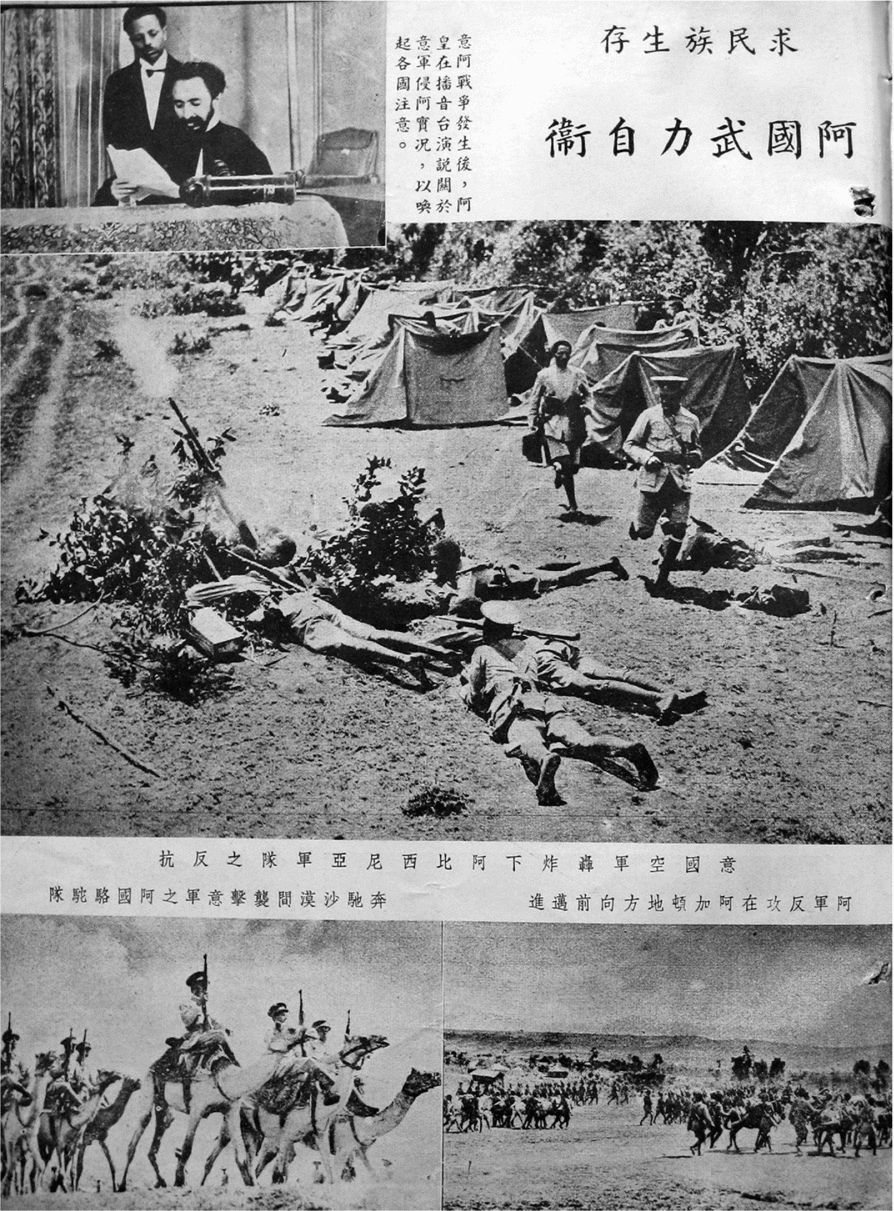
The Blue Shirts’ double identification with the agents and victims of European fascism is strikingly illustrated in a single 1935 issue of Hanxue Zhoukan [Sweat and Blood Weekly]. A pictorial (Figure 2) at the start of this issue, captioned ‘The Revival of the Aryan Race-Nation’, illustrates connections between racial self-assertion and military self-defence, which Germany undertook against League opposition. Here, it is clear that the Blue Shirts viewed national self-assertion against the League's strictures as admirable achievements of European fascist regimes. Yet the Blue Shirt concern for what such self-assertion actually meant for peoples historically victimized by European imperialism is visible on the back cover of this same Hanxue Zhoukan issue, which carried photographs of Ethiopians at war against Italy (Figure 3). The main caption reads: ‘For the Survival of the Race-Nation, Abyssinia Uses Armed Force to Defend Itself’. We see Ethiopian Emperor Haile Selassie in the upper left-hand corner delivering a radio address, juxtaposed to pictures of Ethiopian troops in battle. Like the Germans depicted above, Ethiopians struggle to defend themselves. But here we see Ethiopians fighting for their very survival (shengcun) rather than celebrating racial revival (zaixing) as per the Nazis. Whereas the Germans have fighter planes and submarines, Ethiopians wage war using available modes of military transport (camels) and their familiarity with local terrain. The capacity to exert autonomous national will was thus a desired yet elusive state.
‘A-li-an minzu zhi zaixing’ [‘The Revival of the Aryan Race’].
Source: Hanxue Zhoukan [Sweat and Blood Weekly], 5:21 (1935), inside front cover.
‘Jiu minzu shengcun, A-guo wuli ziwei’ [‘For the Survival of the Race-Nation, Abyssinia uses Armed Force to Defend Itself’].
Source: Hanxue Zhoukan [Sweat and Blood Weekly], 5:21 (1935), back cover.
In this way, Blue Shirt critiques of the League's constraints stemmed from anti-cosmopolitan political impulses similar to those of European and Japanese fascists, but were articulated from a quite different global position. When Blue Shirt periodicals printed images of Italian soldiers wearing masks to protect themselves from the poisonous gasses described by Selassie in his League assembly speech, or stories about the tanks and chemical weapons possessed by Japanese troops, it was with an acute consciousness of China's lack of them and a strong desire to acquire the means of waging an autonomous war.Footnote 87 They praised the assertiveness and strength of Italian and German fascisms—and even Japan's compunction to leave the League in 1933—but they were also aware that even if the Nationalist government threw down such a gauntlet it would not significantly affect the League's functioning. Based on long historical precedent, they could also anticipate that China, like Ethiopia, would suffer direct consequences for alienating the League's dominant members.
Towards a New World Order
From the moment of its inception in 1919, people across the world criticized the League of Nations from a range of political perspectives, from conservative American Republican isolationism to Soviet claims that it constituted a fig leaf for capitalist-imperialist hegemony. European and Japanese fascists soon joined the critical fray by asserting that the League constrained national sovereignty and violated national will. In China, the League was widely denounced in 1919 for overseeing the transfer of Shandong province to Japanese control. Despite such disappointments, the Chinese Nationalist Party, after it assumed state power in 1927, embraced the potential domestic and international advantages of working with the League. Yet by the mid-1930s, tensions inherent in Nationalist China's League participation became too stark to ignore. The League's handling of the Manchuria and Ethiopia crises brought these tensions to the fore, opening a new discursive space in which Nationalists critically evaluated China's relationship to the League and its role in perpetuating China's global subordination. While liberal-minded Nationalists negotiated these tensions by retaining hope that the League's shortcomings could be rectified in the future, newly-emerged fascist activists within the party called for abandoning the League altogether. The latter simultaneously envied and feared the ways in which Japan, Germany, and Italy thwarted the League's strictures, desiring that China could do the same, yet recognized that China's position vis-à-vis the League more closely resembled that of Ethiopia. That the Chinese government had to appeal to one set of imperialist powers to defend itself against another fuelled their nationalistic fervour in a direction that did not aim to end racial oppression or inter-imperialist warfare, but to render China capable of engaging it more formidably.
Tang Liangli, who joined the Japanese-controlled Reorganized Nationalist government in 1940, and members of the Blue Shirts, who retreated to China's southwest and fought against Japan during World War II, expressed desires for a reconfigured relationship between China and the world which they were ultimately unable to effectuate. Tang lobbied for China's equal partnership with Japan in constructing a New Order for East Asia, free from the legacies of Euro-American imperialism and equally free of communist influence.Footnote 88 The Blue Shirts lobbied for an autarkic, militarily-formidable, ethnically-and-culturally homogenous, anti-communist nation populated by rigorously disciplined and obedient citizens. The Reorganized Chinese Nationalist government under Wang Jingwei that Tang joined never became an equal partner in constructing Japan's Pacific empire, whilst the Nationalist government under Chiang Kai-shek never severed ties with the League, nor did it cease to court Euro-American support for its struggle against Japan. Yet Tang and the the Blue Shirts constituted powerful voices in the spectrum of Chinese anti-imperialist thought and action on the eve of World War II. Their deep hostility towards fellow Nationalists who favoured more gradualist avenues to national liberation and otherwise retained faith in the idea of a cooperative world community greatly contributed to the Nationalist Party's internal disarray. Moreover their violent antagonism towards Chinese Communists and leftists, who espoused the alternative universalisms of proletarian internationalism and other forms of transnational solidarity, fractured rather than fostered the unified national anti-imperialist front that they ostensibly desired.
If the League did not directly cause Tang Liangli to support Japan's expanding empire, or the Blue Shirts to agitate for autonomous national defence, it nevertheless framed their analyses of global inequalities and how they envisioned alternative structures of global order. In this respect, the League may have failed in its efforts at collective security, but it still constituted a powerful force in clarifying global hierarchies and in shaping how people thought the world should be ordered. China's fascist critics of the League not only envisioned a world in which the ‘Great Powers’ could no longer dictate the terms of worldly engagement to colonized populations, but also one in which claims to universality were jettisoned altogether. Like their European and Japanese counterparts, Chinese fascists repudiated the League and its cosmopolitan aspirations, privileging the nation instead as a natural category of identification and belonging, and wished that China could similarly assert its national will on the world stage.