Introduction
Dormancy of barley grains corresponds to an inability to germinate at temperatures higher than 20°C (Corbineau and Côme, Reference Corbineau and Côme1996; Benech-Arnold, Reference Benech-Arnold, Benech-Arnold and Sánchez2004). It is typically imposed by the seed-covering structures (lemma and palea, pericarp plus endosperm). Embryos germinate well from very early stages of development if they are isolated from the rest of the grain and incubated in water (Lenoir et al., Reference Lenoir, Corbineau and Côme1983; Benech-Arnold et al., Reference Benech-Arnold, Giallorenzi, Frank and Rodriguez1999). Limitation of oxygen supply to the embryo by oxygen fixation as a result of enzymatic oxidation of phenolic compounds in the lemma and palea (i.e. glumellae) has been suggested to be responsible for the dormancy of whole caryopses of cereals such as barley (Lenoir et al., Reference Lenoir, Corbineau and Côme1986; Benech-Arnold et al., Reference Benech-Arnold, Gualano, Leymarie, Côme and Corbineau2006) and oat (Corbineau et al., Reference Corbineau, Lecat and Côme1986). Germination of dormant barley grains (that do not germinate when incubated with glumellae in water) is strongly promoted when the lemma and palea are removed. If oxygen concentration during incubation is lowered to 5%, germination is again inhibited as with the whole grain, simulating then the presence of glumellae (Lenoir et al., Reference Lenoir, Corbineau and Côme1986; Benech-Arnold et al., Reference Benech-Arnold, Gualano, Leymarie, Côme and Corbineau2006).
Expression of barley grain dormancy is associated with maintenance of abscisic acid (ABA) at a high level, while embryo ABA content decreased sharply in non-dormant seeds or in dormant grains placed in conditions that allow germination (Benech-Arnold et al., Reference Benech-Arnold, Gualano, Leymarie, Côme and Corbineau2006; Millar et al., Reference Millar, Jacobsen, Ross, Helliwell, Poole, Scofield, Reid and Gubler2006; Gubler et al., Reference Gubler, Hughes, Waterhouse and Jacobsen2008). Whole grain favoured the expression of dormancy, and this expression seemed to be mediated by an initial (i.e. a few hours after the start of incubation) increase in ABA content and in embryo sensitivity to ABA (Benech-Arnold et al., Reference Benech-Arnold, Gualano, Leymarie, Côme and Corbineau2006). In contrast, de-hulled grains germinated readily at 30°C and this was accompanied by a smooth but constant decline in ABA content, and the initial ABA increase was not detected. Incubation under hypoxia (i.e. 5% oxygen), however, prevented germination of de-hulled grains, and embryo ABA content during incubation resembled that observed in intact grains (i.e. an initial ABA peak was again detected) (Benech-Arnold et al., Reference Benech-Arnold, Gualano, Leymarie, Côme and Corbineau2006). In addition, incubation of isolated embryos under hypoxia increased embryo sensitivity to ABA severalfold (Benech-Arnold et al., Reference Benech-Arnold, Gualano, Leymarie, Côme and Corbineau2006).
Endogenous ABA levels are regulated through the balance of biosynthesis and catabolism, with biosynthesis dominating when ABA content increases and catabolism dominating when ABA content decreases (Millar et al., Reference Millar, Jacobsen, Ross, Helliwell, Poole, Scofield, Reid and Gubler2006). Hypoxia could interfere with ABA catabolism through down-regulation of the activity of ABA 8′-hydroxylase, the enzyme responsible for ABA inactivation. In vitro assays have shown that this enzyme works at a wide range of temperatures and oxygen availabilities, although oxygen concentrations lower than 10% seriously reduce its activity (Krochko et al., Reference Krochko, Abrams, Loewen, Abrams and Cutler1998). In plants, ABA is synthesized indirectly from carotenoid precursors (Nambara and Marion-Poll, Reference Nambara and Marion-Poll2005). The first step is catalysed by the enzyme 9-cis-epoxycarotenoid dioxygenase (NCED), which cleaves 9-cis xanthophylls to xanthoxin, an ABA precursor (Schwartz et al., Reference Schwartz, Tan, Gage, Zeevaart and McCarty1997). NCEDs encoded by AtNCED6 and AtNCED9 in Arabidopsis are key regulatory enzymes in ABA biosynthesis in developing seeds (Lefebvre et al., Reference Lefebvre, North, Frey, Sotta, Seo, Okamoto, Nambara and Marion-Poll2006) and HvNCED1 and HvNCED2 are expressed in embryos of barley grains (Millar et al., Reference Millar, Jacobsen, Ross, Helliwell, Poole, Scofield, Reid and Gubler2006). NCED genes, together with that coding for ABA 8′-hydroxylase, are obvious candidates to assess when exploring the effect of the glumellae and hypoxia at the molecular level.
The ABA signalling network is much more complex than the ABA biosynthesis pathway. Indeed, although several components have been identified and shown to be conserved among species, knowledge of how this pathway works remains far from complete. ABI genes (ABI3/VP1 and ABI5) have been implicated by different means in ABA repression of seed germination (Finkelstein et al., Reference Finkelstein, Gampala and Rock2002). Also, the abscisic acid (ABA)-induced protein kinase PKABA1 is present in dormant seeds and is a component of the signal transduction pathway leading to ABA-suppressed gene expression in cereal grains (Johnson et al., Reference Johnson, Wagner, Verhey and Walker-Simmons2002). These genes, therefore, are among the candidates for gene expression analysis within the context of our previously obtained results (i.e. increased sensitivity to ABA as a result of embryo incubation under hypoxia) (Benech-Arnold et al., Reference Benech-Arnold, Gualano, Leymarie, Côme and Corbineau2006).
The aim of this work was to explore the molecular basis of the altered ABA metabolism and sensitivity that arise either from the presence of the glumellae or from artificially imposed hypoxia to the naked caryopses. We reasoned that, if the effect of the presence of the glumellae on ABA metabolism and sensitivity is mainly mediated through an hypoxia condition imposed on the embryo, then the expression pattern of genes related to ABA metabolism and signalling should be the same in intact grains (i.e. with glumellae) and in naked caryopses (i.e. without glumellae) incubated under hypoxia.
Materials and methods
Plant material
Hordeum vulgare L. (cv. Pewter) grains harvested in 2005 and received from the ‘Coopérative Agricole de la Beauce et du Perche’ (28 310 Toury, France) were used throughout this study. The initial dormancy level of freshly harvested seeds was preserved by placing the grains at − 20°C (Lenoir et al., Reference Lenoir, Corbineau and Côme1983; Corbineau and Côme, Reference Corbineau and Côme1996).
Germination assays
Whole (i.e. grains with the glumellae) and de-hulled (i.e. grains without the glumellae) dormant grains and embryos isolated from dormant grains, were incubated in 9-cm Petri dishes (50 seeds per dish, two replicates) on cotton wool imbibed with 20 ml deionized water. Incubation was performed in darkness at 30°C, a temperature at which dormancy is expressed (Lenoir et al., Reference Lenoir, Corbineau and Côme1986; Corbineau and Côme, Reference Corbineau and Côme1996). Germination was scored daily for 7 d, a duration that allows reaching the maximal germination percentage.
Germination under atmospheres with different controlled oxygen tensions was performed in darkness using the procedure of Côme and Tissaoui (Reference Côme and Tissaoui1968). Gas mixtures containing from 3 to 21% oxygen were obtained through capillary tubes connected to sources of compressed air and nitrogen. The gaseous atmospheres were passed continuously through germination chambers at a constant flow rate (4.0 l h− 1). The oxygen tensions were measured daily using a Servomex analyser (Servomex, type 570A, The Netherlands).
A grain (whole or de-hulled) was regarded as germinated when the radicle had pierced the seed covering structures (glumellae or seed coat). The results presented are the means of the germination percentages obtained after various durations in two replicates ± standard error of the mean (SEM).
RNA isolation and cDNA production
Whole and de-hulled dormant grains were incubated for different periods of time in two replicates of 30 seeds/Petri dish and embryos were isolated from the rest of the seed with a scalpel and immediately after excision placed in liquid nitrogen. Embryos from germinated seeds were not included in these samples and were stored separately to avoid assessment of post-germination events. The frozen embryos were ground into powder in liquid nitrogen with a mortar and pestle. Total RNA was extracted from the two biological replicates of 30 embryos with a Nucleo Spin RNA plant extraction kit, following the manufacturer's instructions (Macherey-Nagel, Düren, Germany). The RNA was converted into cDNA in the following way for each sample: 5 μg of RNA, 0.625 μl of deoxynucleoside triphosphates (dNTP) (Invitrogen, Carlsbad, California, USA) and 0.625 μl of oligoDT (Biodynamics, Buenos Aires, Argentina) were added and then transferred to a bath at 65°C and incubated for 5 min. The reaction was continued with 2.5 μl of M-MLV 5 × Buffer (Promega, Madison, Wisconsin, USA), 1.25 μl of dithiothreitol (DTT) (Invitrogen) and M-MLV reverse transcriptase (Promega). Finally, the samples were incubated for 1 h at 37°C. After the incubation, 50 μl of RNAse-free water was added.
Gene expression analysis
A BLAST search was performed against the Hordeum vulgare databases of Plant GDB (Plant Genome Database, http://www.plantgdb.org) and NCBI (National Center of Biotechnology Information, http://www.ncbi.nlm.nih.gov).
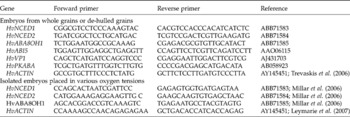
The primers used for real-time polymerase chain reactions (PCR) are characterized in Table 1. The primers were designed using Primer Express 2.0 software (Applied Biosystems, Foster City, California, USA). For the gene expression analysis in isolated embryos, the primers used were from Millar et al. (Reference Millar, Jacobsen, Ross, Helliwell, Poole, Scofield, Reid and Gubler2006) and Leymarie et al. (Reference Leymarie, Bruneaux, Gibot-Leclerc and Corbineau2007) for HvACTIN (AY145451).
Oligonucleotide sequences used for gene expression analysis with real-time PCR on embryos from whole grains or de-hulled grains and on isolated embryos placed in various oxygen tensions

Real-time PCR was performed with Applied Biosystems, model 7500 equipment in a 10 μl reaction with 5 μl of SYBR Green PCR Master Mix (Applied Biosystems), 0.08 μl of each set of primers (25 nmol), 3.84 μl of MilliQ water and 1 μl of cDNA as template. Gene expression was normalized against actin (Leymarie et al., Reference Leymarie, Robayo-Romero, Gendreau, Benech-Arnold and Corbineau2008). Standard curves for absolute quantitation were created for each primer set. Standard PCR conditions for real-time PCR were used: 10 min at 95°C, one cycle; 15 s at 95°C and 1 min 60°C, 40 cycles, followed by melting curve standard conditions. Each PCR reaction was performed in duplicate in the same plate and repeated twice. Data are presented as means of the two biological replicates plus SEM.
ABA quantification
In parallel with all the germination assays carried out, batches of whole seeds and de-hulled grains were incubated and sampled at different times after incubation. Thirty embryos were dissected from the rest of the seed structure and immediately frozen in liquid nitrogen. The embryos were then lyophilized, powdered, weighed and stored at − 30°C until assayed for free ABA content with a radioimmunoassay, as described by Steinbach et al. (Reference Steinbach, Benech-Arnold, Kristof, Sánchez and Marcucci-Poltri1995) using the monoclonal antibody AFR MAC 252 (Quarrie et al., Reference Quarrie, Whitford, Appleford, Wang, Cook, Henson and Loveys1988) and tritiated ABA (Amersham Biosciences, Little Chalfont, Bucks, UK). The results presented are the means of two measurements carried out in duplicate ± SEM.
Statistical analyses
To analyse transcript expression in isolated embryos, Newman–Keuls test was performed on data from HVABA8OH1 and a Kruskal–Wallis test was carried out for HVNCED1 and HVNCED2, with StatBox 6.40 software (Grimmer logiciels, Paris).
Results
Germination of whole and de-hulled grains in air and 5% O2
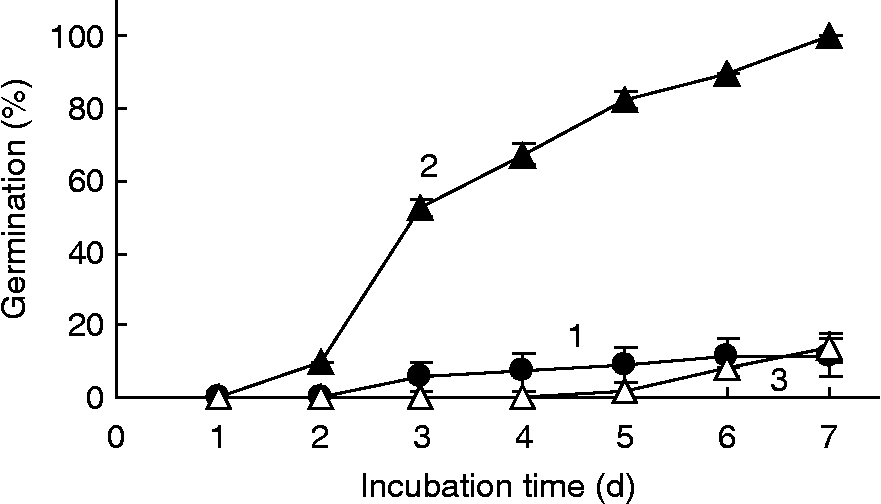
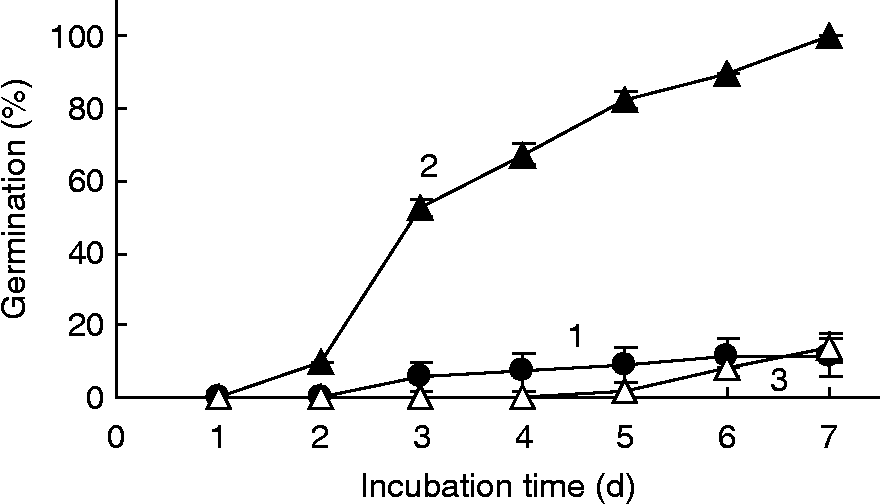
At 30°C, whole dormant grains reached only 10% germination within 7 d (Fig. 1, curve 1). When the glumellae were removed, all the grains became able to germinate in air (Fig. 1, curve 2), indicating that the covering structures were responsible for the inability to germinate of whole grains incubated at 30°C. Incubation under hypoxia (i.e. 5% O2) re-established the inhibition of germination in de-hulled grains (Fig. 1, curve 3).
Germination at 30°C of dormant whole (filled circles, 1) and de-hulled grains (filled triangles, 2) incubated under 21% O2 and de-hulled grains incubated in 5% O2 (empty triangles, 3). Means of two measurements ± SEM. Where no bars are shown, the value of SEM is less than the size of the symbols.
Embryo ABA content in whole and de-hulled grains, incubated in air and 5% O2
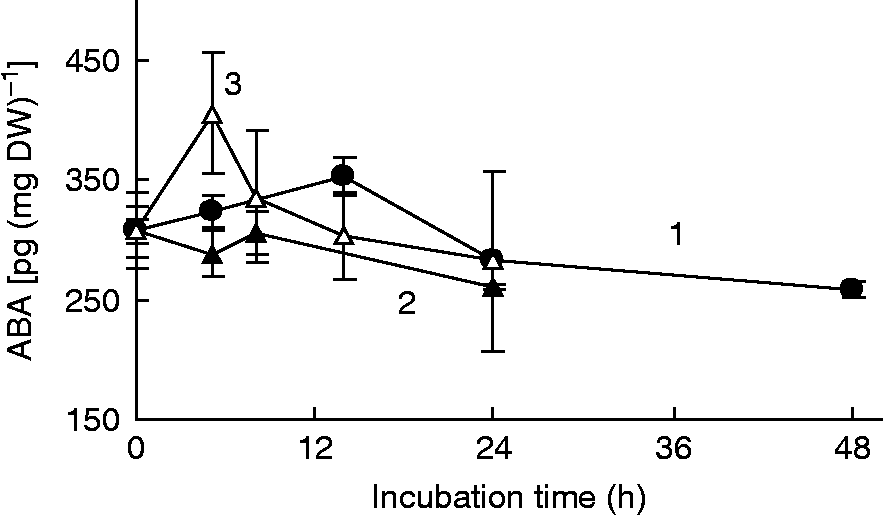
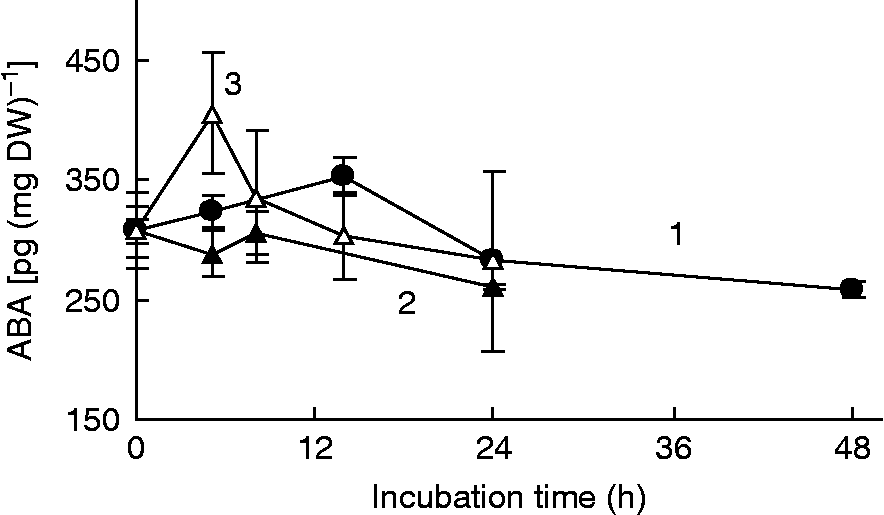
In dry grains, embryo ABA content was 307 pg (mg DW)− 1. In whole grains incubated at 30°C, it increased during the first 14 h and then decreased smoothly reaching about 250 pg (mg DW)− 1 after 48 h (Fig. 2, curve 1). No significant increase in embryo ABA content was detected in de-hulled grains incubated in air, and ABA content continuously decreased during imbibition (Fig. 2, curve 2). Incubation of de-hulled grains under hypoxia (5% O2) re-established the initial ABA peak in embryos observed in whole grains (Fig. 2, curve 3).
Changes in embryo abscisic acid (ABA) content during incubation at 30°C of dormant whole (filled circles, 1) and de-hulled grains (filled triangles, 2) incubated under 21% O2 and de-hulled grains incubated in 5% O2 (empty triangles, 3). Means of two measurements ± SEM. Where no bars are shown, the value of SEM is less than the size of the symbols.
Effects of glumellae on expression of genes involved in ABA metabolism and signalling
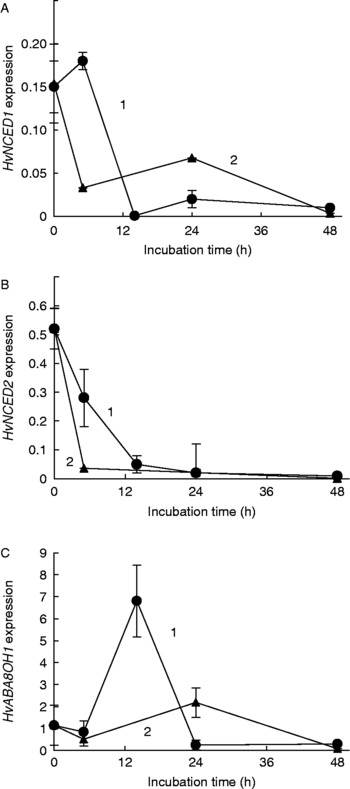
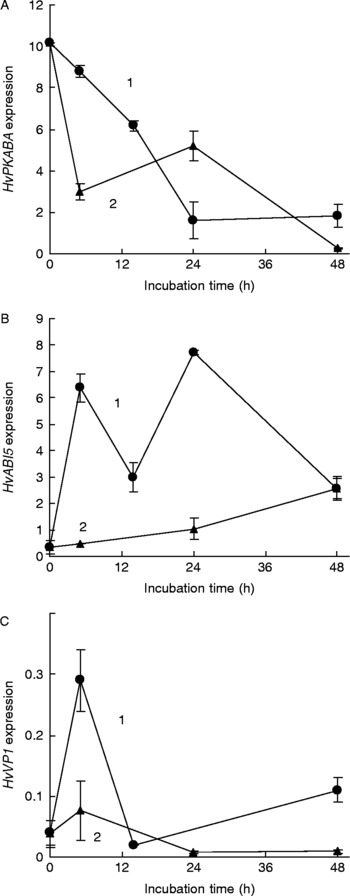
In order to determine whether the glumellae intervene in ABA metabolism and signalling, the expression pattern of genes related to ABA synthesis (HvNCED1 and HvNCED2) and catabolism (HvABA8OH1) and involved in ABA signalling (HvPKABA, HvABI5 and HvVP1) was studied in whole grains (i.e. with glumellae) and in de-hulled caryopses (i.e. without glumellae) incubated in air. HvNCED1 expression differed in embryos between whole and de-hulled grains. In whole grains incubated at 30°C, a temperature at which dormancy is expressed, mRNA abundance increased and peaked at 5 h after imbibition and declined (Fig. 3A). In contrast, de-hulled caryopses did not display the initial expression peak of HvNCED1 at 5 h, mRNA abundance decreased sharply during the first hours of imbibition, but remained higher during the first 24 h than in whole grains (Fig. 3A). The expression pattern of HvNCED2 was also altered by the removal of the glumellae but in a different way than observed for HvNCED1. In both whole and de-hulled grains, HvNCED2 transcripts decreased during the first hours of imbibition, but at a slower rate in the case of whole grains: after 5 h of imbibition HvNCED2 expression in the de-hulled grains was only 10% of the expression measured in whole grains. There was almost no expression after 5 h in de-hulled and after 14 h in whole grains (Fig. 3B).
Changes in expression of HvNCED1 (A), HvNCED2 (B) and HvABA8OH1 (C) genes in embryos during incubation at 30°C and in air of whole (filled circles, 1) and de-hulled grains (filled triangles, 2). Data are expressed as a ratio with actin gene expression and represent means of two measurements ± SEM. Where no bars are shown, the value of SEM is less than the size of the symbols.

HvABA8OH1 expression peaked at 14 h after imbibition in whole grains (Fig. 3C), consistently with the small decrease in ABA content at that stage (Fig. 2). In de-hulled grains its expression remained low during the experimental period when compared to that measured in whole grains (Fig. 3C), but an experimental measurement at 14 h was not recorded in de-hulled grains.
Expression of HvPKABA decreased during incubation at 30°C in both whole and de-hulled grains incubated in air, but it tended to be higher in whole grains than in de-hulled ones during the first hours of imbibition (Fig. 4A). Removal of the glumellae strongly reduced the expression of HvABI5 during the first 24 h of incubation on water and in air (Fig. 4B). HvVP1 (Fig. 4C) expression was considerably lower than that of HvABI5 (Fig. 4B) and HvPKABA (Fig. 4A) and its expression level was further reduced after removal of the glumellae (Fig. 4C) except at 14 h.
Changes in expression of HvPKABA (A), HvABI5 (B) and HvVP1 (C) genes in embryos during incubation at 30°C and in air of whole (filled circles, 1) and de-hulled grains (filled triangles, 2). Data are expressed as a ratio with actin gene expression and represent means of two measurements ± SEM. Where no bars are shown, the value of SEM is less than the size of the symbols.

Effect of hypoxia on expression of genes involved in ABA metabolism and signalling
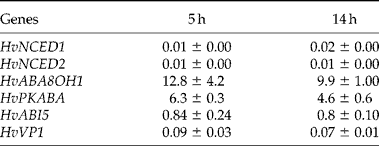
In order to determine whether the effects of the glumellae on ABA metabolism and signalling is mainly mediated by an hypoxia condition imposed on the embryo, the expression pattern of genes related to ABA metabolism (HvNCED1, HvNCED2 and HvABA8OH1) and signalling (HvPKABA, HvABI5 and HvVP1) were studied in de-hulled caryopses (i.e. without glumellae) incubated under hypoxia (5% oxygen). Measurements were only made after 5 and 14 h of imbibition and data are presented in Table 2.
Changes in expression of HvNCED1, HvNCED2, HvABA8OH1, HvPKABA, HvABI5 and HvVP1 genes in embryos of de-hulled grains incubated for 5 and 14 h at 30°C under 5% O2. Data are expressed as a ratio with actin gene expression and represent means of two measurements±SEM
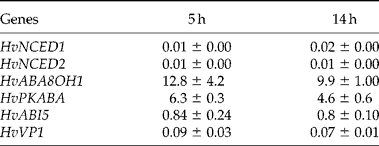
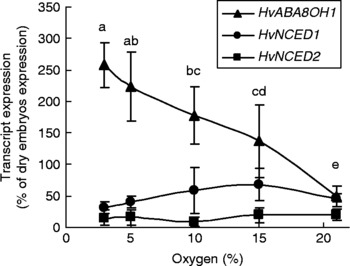
Unexpectedly, incubation of de-hulled grains under 5% oxygen did not re-establish the expression peak of HvNCED1 after 5 h of imbibition (Table 2) which was detected in whole grains (Fig. 3A). The expression pattern of HvNCED2 was similar in de-hulled grains incubated in air (Fig. 3B) and in 5% oxygen (Table 2): in both cases HvNCED2 transcript amount decreased dramatically during the first 5 h of imbibition. In contrast, incubation in 5% oxygen increased the expression of HvABA8OH1 severalfold from 5 h after imbibition onwards (Table 2) in comparison to expression observed in air (Fig. 3C, curve 2). In order to confirm this stimulatory effect of hypoxia on HvABA8OH1 expression, we studied the effects of various oxygen tensions (3–21% O2) on the expression of this gene using isolated embryos (Fig. 5). The results obtained confirmed an induction of HvABA8OH1 gene expression with a maximal effect at 3–5% O2. In contrast, the expression of the NCED genes remained at a low level, and was not significantly different between oxygen concentrations.
HvABA8OH1 (filled triangles), HvNCED1 (filled circles) and HvNCED2 (filled squares) transcript expression in isolated embryos placed in various oxygen tensions after an incubation in water for 14 h at 30°C as a percentage of expression in dry embryos for each gene. Means of three measurements ± SEM. Letters above the HvABA8OH1 curve indicate homogeneous groups after statistical analysis. For HvNCED1 and HvNCED2 the statistical analysis does not reveal significant variation according to oxygen tension.

Although its expression was much lower than in whole grains, HvPKABA showed higher expression in de-hulled grains incubated in 5% oxygen than in de-hulled grains incubated in air (Table 2 and Fig. 4A). Gene expression patterns of both HvABI5 and HvVP1 were similar in de-hulled grains incubated either in air (Fig. 4B and C) or in 5% oxygen (Table 2) during the 14 h of incubation at 30°C.
Discussion
The mechanisms suggested to be responsible for dormancy in the barley grain are: (1) regulation of oxygen availability to the embryo by the glumellae (Lenoir et al., Reference Lenoir, Corbineau and Côme1986); and (2) ABA content in the embryo and/or the ability of dormant embryos to de novo synthesize ABA upon imbibition (Benech-Arnold et al., Reference Benech-Arnold, Gualano, Leymarie, Côme and Corbineau2006). The data presented here confirm that sensitivity to high temperatures displayed by dormant barley grains results from an inhibitory effect imposed by the glumellae (Fig. 1). Both dormancy release during afterripening and reduced expression of dormancy at low temperatures (10–20°C) have been associated with the loss of the ability to synthesize ABA and a lower sensitivity of the embryo to ABA (Benech-Arnold et al., Reference Benech-Arnold, Gualano, Leymarie, Côme and Corbineau2006). In dry seed harvested in 2005, embryo ABA content was around 300 pg (mg DW)− 1 (Fig. 2) whereas it was approximately 400 pg (mg DW)− 1 in seeds harvested in 2002 (Benech-Arnold et al., Reference Benech-Arnold, Gualano, Leymarie, Côme and Corbineau2006). Removal of the glumellae resulted in an absence of an ABA content peak (Fig. 2), but this effect was not as marked as that observed in seeds harvested in 2002 (Benech-Arnold et al., Reference Benech-Arnold, Gualano, Leymarie, Côme and Corbineau2006). It has also been suggested that hull-imposed dormancy is mediated by high polyphenol oxidase activity existing in the barley glumellae which results in oxygen deprivation to the embryo (Lenoir et al., Reference Lenoir, Corbineau and Côme1986). Benech-Arnold et al. (Reference Benech-Arnold, Gualano, Leymarie, Côme and Corbineau2006) have also shown that hypoxia increases embryo sensitivity to ABA and interferes with ABA metabolism, increasing ABA synthesis and/or reducing the ability of the embryo to inactivate ABA. Moreover, reducing O2 from 21% to 10% increased the sensitivity of germination to ABA by almost 500-fold for seeds and 45- to 75-fold for embryos (Bradford et al., Reference Bradford, Benech-Arnold, Côme and Corbineau2008). Taken together, these results suggest that hull-imposed dormancy is through a deprivation of oxygen to the embryo, which causes changes in ABA metabolism that result in an initial ABA build-up and increases embryo sensitivity to this growth regulator.
Results presented in this paper clearly show that the presence of the glumellae alters the expression of genes involved in ABA synthesis (HvNCED1 and HvNCED2) with respect to the pattern observed with the de-hulled grains (Fig. 3A and B). Indeed, consistent with an initial build-up in ABA content upon imbibition (which took place in whole grains but not in de-hulled ones) expression of HvNCED1 peaked 5 h after imbibition, while it came down sharply in de-hulled grains. During the rest of the incubation period, expression of the gene was similar in both whole and de-hulled grains. The expression of HvNCED2 was also reduced by the presence of the glumellae. Gene expression declined less sharply in whole grains than in de-hulled ones (and consequently was higher at 5 h after imbibition, again in agreement with an initial built-up of ABA content). The timing of expression of HvABA8OH1 was also altered by the presence of the glumellae with respect to that observed in de-hulled grains. This was also in agreement with changes in embryo ABA content in whole grains: gene expression peaked at 14 h after imbibition and ABA content decreased from there onwards. Although from this figure it is not possible to say that this peak did not occur in embryos from de-hulled grains (i.e. the data-point for this sampling time in de-hulled grains is missing in Fig. 3C), results displayed in Fig. 5 (i.e. expression of various genes, including HvABA8OH1, measured 14 h after imbibition in embryos incubated at various oxygen concentrations) indicate that, at 14 h after imbibition, HvABA8OH1 expression in embryos incubated at 21% oxygen is 50% of that measured prior to imbibition, thus precluding the existence of an expression peak for this gene at that sampling time in de-hulled grains. Taken together, then, these results suggest that the initial increase in ABA content observed in embryos from whole grains is due to a hull-induced increased capacity of ABA synthesis, rather than to a hull-induced reduced ability to inactivate ABA. Nevertheless, alteration in ABA 8′-hydroxylase enzyme activity as a result of a poor oxygen concentration in the endogenous environment of the embryo cannot be ruled out (Krochko et al., Reference Krochko, Abrams, Loewen, Abrams and Cutler1998).
The presence of the glumellae also altered the expression pattern of genes involved in ABA signalling (HvPKABA, HvABI5 and HvVP1) with respect to that observed in de-hulled grains (Fig. 4A–C). For all three genes analysed, expression was higher in whole grains than in de-hulled ones, at least during the first 5 h after imbibition. This suggests that the ABA signal must be intensified in the enclosed embryo, thus adding to dormancy maintenance of the whole grain. Overall, these results suggest that at least part of the physiological responses to the presence of the glumellae in the barley grain observed in this and in a previous work (Benech-Arnold et al., Reference Benech-Arnold, Gualano, Leymarie, Côme and Corbineau2006) (i.e. altered ABA metabolism and signalling) could be regulated at the level of gene expression.
If the effect of the presence of the glumellae on ABA metabolism and sensitivity is truly mediated by a hypoxia condition imposed on the embryo, then the expression pattern of genes related to ABA metabolism and signalling should be the same in whole grains and in de-hulled caryopses incubated under hypoxia. However, hypoxia determined an expression pattern of candidate genes (HvNCED1, HvABI5, HvVP1 and HvABA8OH1) that was substantially different from that determined by the presence of the glumellae (Table 2 and Figs 3 and 4). First, the presence of the glumellae enhanced the expression of HvNCED1 (Fig. 3A) during incubation of dormant grains at 30°C, but this effect was not mimicked by hypoxia (Table 2). Second, as in the case of the glumellae, hypoxia enhanced the expression of HvABA8OH1 with respect to de-hulled grains incubated in air (Table 2 and Fig. 5), but with a different timing and to a greater extent than in whole grains. Indeed, expression of HvABA8OH1 peaked at 5 h after imbibition instead of at 14 h, and remained high until at least 14 h after imbibition (Fig. 3C and Table 2). Third, the presence of the glumellae enhanced the expression of HvPKABA, HvABI5 and HvVP1 (Fig. 4), but this effect was not mimicked by hypoxia for HvABI5 and HvVP1 (Table 2). The question that arises then, is how are the ABA accumulation patterns so similar in embryos from whole grains and in embryos from de-hulled grains incubated under hypoxia if the expression pattern of genes involved in ABA metabolism is so different? Although the gene expression profile might not necessarily reflect protein abundance, increased expression of HvABA8OH1 in embryos from de-hulled grains incubated under hypoxia might be indicating a feedback regulation, since oxygen is the substrate of ABA 8′-hydroxylase (Krochko et al., Reference Krochko, Abrams, Loewen, Abrams and Cutler1998). Indeed, ABA accumulation as a result of deficient ABA 8′-hydroxylase activity might induce the expression of this ABA-inactivating enzyme in a feedback manner (Argyris et al., Reference Argyris, Dahal, Hayashi, Still and Bradford2008). Results in Fig. 5 showing increased gene expression at low oxygen concentrations support this possibility. This type of feedback regulation in hypoxia appeared specific for this gene, as it was not seen for the NCED genes, even though oxygen is also a substrate for these enzymes. Taken together, these results allow us to conclude that, while in embryos from dormant whole grains initial ABA accumulation appears to be governed by an increased synthesis regulated at the transcriptional level, in embryos from de-hulled dormant grains incubated under hypoxia this initial ABA accumulation is not through an increase in NCED gene expression. This discrepancy could be explained by an altered enzyme activity (i.e higher and lower in the case of NCED and ABA8OH, respectively, than in embryos from grains incubated at 21% oxygen). On the other hand, the evident disagreement between expression patterns of ABA signalling genes (HvABI5 and HvVP1) in embryos from dormant whole grains and from de-hulled dormant ones incubated under hypoxia, indicates that if ABA signalling is truly enhanced in embryos enclosed in whole grains, it is possibly through a different pathway involving PKABA than in isolated embryos incubated in presence of ABA and under hypoxia. Measurements of kinase activity are required to confirm this hypothesis. Benech-Arnold et al. (Reference Benech-Arnold, Gualano, Leymarie, Côme and Corbineau2006) suggested that the apparent increase in sensitivity to ABA displayed by barley embryos incubated under hypoxia might arise from a hypoxia-imposed inability for ABA inactivation. Our present results support that proposition.
We originally proposed that hypoxia imposed artificially would restore germination inhibition and gene expression patterns that occur in intact dormant embryos, but the latter did not occur. This suggests that inhibition of germination by glumellae is not mediated only by interference with oxygen diffusion; there have to be other factors affected by the glumellae and involved in the control of gene expression. Also, hypoxia may be affecting other components downstream of ABI5 and VP1 involved in ABA signalling. One possibility is that other factors may be involved in the inhibition of germination by the glumellae. In particular, phenolic compounds might be involved in such a regulation. For example, in developing grains they are correlated with the prevention of preharvest sprouting in cereals (Weidner et al., Reference Weidner, Krupa, Amarowicz, Karamac and Abe2002). Flavonoids are efficient antioxidants (Rice-Evans et al., Reference Rice-Evans, Miller and Paganga1997); when present in the seed coat, they may fix molecular oxygen through reactions catalysed by polyphenol oxidases and peroxidases and also through non-enzymatic oxidation, therefore limiting oxygen availability for the embryo (Lenoir et al., Reference Lenoir, Corbineau and Côme1986). Also, polyphenolic compounds are known to have a inhibitory effect on germination when added to the incubation medium; phenolic acids (caffeic, p-coumaric, ferulic, etc.), which occur naturally in seed coats of many seeds (Debeaujon et al., Reference Debeaujon, Lepiniec, Pourcel, Routaboul, Bradford and Nonogaki2007), could be involved in the inhibition of germination in addition to ABA. Seed germination is reduced in the presence of exogenous phenolics in a dose-dependent manner (Buta and Lusby, Reference Buta and Lusby1986; Cutillo et al., Reference Cutillo, D'Abrosca, DellaGreca, Fiorentino and Barelli2003).
In summary, these results show that, although the presence of the glumellae might impose hypoxia on the embryo with possible implications in dormancy expression, interference with ABA metabolism and enhancement of embryo sensitivity to ABA does not appear to be through hypoxia. The way in which the presence of the glumellae stimulates the expression of genes involved in ABA synthesis and signalling, then, remains to be clarified.
Acknowledgements
The authors wish to thank Silvina Enciso for excellent technical assistance with ABA determinations and also Dr Carlos Ballare for allowing us to use some of the equipment in his lab. We would also like to thank Dr Sánchez and Dr María Verónica Rodríguez for useful discussions. This work was supported by the University Pierre et Marie Curie-Paris 6, Agencia Nacional de Promoción Científica y Técnica (BID 1728 no. 08-14402 and 01565) and a travelling fellowship from Development – The Company of Biologists. G.M.M. held a postgraduate scholarship from CONICET, the Research Council of Argentina. R.L.B.-A and J.M.F. gratefully acknowledge support from the University Pierre et Marie Curie as invited professors between 2003 and 2007.